
BuddhistCatholicContemplativeEvangelicalGeneral ChristianHinduJewishLatter-day SaintMuslimNew VisionsProgressive Christian
Beliefs
- Buddhist
- Catholic
- Contemplative
- Evangelical
- General Christian
- Hindu
- Jewish
- Latter-day Saint
- More Voices
- Muslim
- New Visions
- Pagan
- Progressive Christian
Topics
- Religion News
- Food and Religion
- Sports and Religion
- Religious Art
- Religious Music and Entertainment
- Religious Events
- History and Religion
- Style and Religion
- Politics and Religion
- Women in Religion
- Recreation Outdoors and Religion
- Business Finance and Religion
- Careers Workplace and Religion
- Education and Religion
- Family Parenting and Religion
- Health Fitness and Religion
- Home and Religion
- Relationships and Religion
- Technology and Religion
- Travel and Religion
Columnists
- Buddhist Columnists
- Business Finance and Religion Columnists
- Careers Workplace and Religion Columnists
- Catholic Columnists
- Contemplative Columnists
- Education and Religion Columnists
- Evangelists Columnists
- Family Parenting and Religion Columnists
- General Christian Columnists
- Health Fitness and Religion Columnists
- Hindu Columnists
- History and Religion Columnists
- Home and Religion Columnists
- Jewish Columnists
- More Voices Columnists
- Latter Day Columnists
- Muslim Columnists
- New Visions Columnists
- Nonreligious Columnists
- Pagan Columnists
- Politics and Religion Columnists
- Progressive Columnists
- Recreation Outdoors and Religion Columnists
- Relationships and Religion Columnists
- Religion News Columnists
- Religious Art Columnists
- Religious Events Columnists
- Religious Music and Entertainment Columnists
- Sports and Religion Columnists
- Style and Religion Columnists
- Technology and Religion Columnists
- Travel and Religion Columnists
- Women in Religion Columnists
Resource Library
- 2026 Calendar
- Library of World Religions
- The 100 Most Holy Places on Earth
- Patheos Answers
- Podcasts
- Videos
- Faith Leaders Database
- Anglican Episcopalian
- Bahai
- Baptist
- Buddhism
- Christianity
- Confucianism
- Eastern Orthodoxy
- Hinduism
- Holiness and Pentecostal
- ISKCON
- Islam
- Judaism
- Lutheran
- Methodist
- The Church of Jesus Christ of Latter-day Saints
- New Age
- Paganism
- Presbytarian and Reformed
- Protestantism
- Religion Behind the Scenes
- Roman Catholic
- Scientology
- Shia Islam
- Sikhism
- Sufism
- Sunni Islam
- Taoism
- Zen
- See all religions
Research Tools
 Ad-Free & Subscriber Log-In Subscription Support
Ad-Free & Subscriber Log-In Subscription Support
Follow Patheos 

- Trending:
- Forgiveness
- |
- Marriage
- |
- Consciousness
- |
- Death Penalty
- |
- Election
- |
- Halloween

-
About the Authors
- Home
- Evangelical
- Health, Fitness and Religion
- Heaven on Earth? Nahua-Christian Ritual in Colonial Mexico
Heaven on Earth? Nahua-Christian Ritual in Colonial Mexico
Last updated on: March 14, 2025 at 3:23 pm by Verónica A. Gutiérrez
Heaven on Earth? Nahua-Christian Ritual in Colonial Mexico 2025-03-14T15:23:06-04:00 Verónica A. Gutiérrez
Patheos Explore the world's faith through different perspectives on religion and spirituality! Patheos has the views of the prevalent religions and spiritualities of the world.
This Spring, I’m teaching a special topics course, “Christianizing Native Peoples,” which explores the Franciscan-indigenous relationship in central Mexico during the first half of the sixteenth century. Inspired by my research, I designed this course to explore the Christianization process via the themes of resistance and resilience.
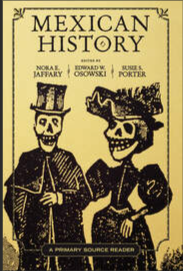
One of our readings this week was a selection from Historia de los indios de la Nueva España (1541), penned by the Franciscan fray Toribio de Benavente Motolinía, one of the famous “Twelve Apostles” who arrived to New Spain in 1524. The selection, “On the Festivals of Corpus Christi and San Juan that They Celebrated in Tlaxcala in the Year 1538,” [taken from Mexican History: A Primary Source Reader edited by Nora Jeffrey, Edward W. Osowski, and Susie S. Porter (Westview Press, 2010)] was brief. For this post I’d like share the text and the ideas generated in class discussion.
PARAGRAPH 1: “When the Holy Day of Corpus Christi arrived in the year 1538, the Tlaxcaltecas staged a very solemn festival that merits being memorialized because I believe that if the Pope and Emperor with their courts had attended, they would have been much pleased to see it. Although there were no precious jewels and no brocades, there were other decorations that were fine to see, especially flowers and roses that God created in the trees and in the fields—so much so that it was pleasing and worth note that a people that until now were taken for bestial, would know how to do such things.”
HISTORICAL ANALYSIS: As a Franciscan, the author fray Toribio de Benavente Motolinía was a millenarian, that is, he and his brother friars believed they were living in the eleventh hour. With the world on the verge of collapse, baptizing as many native people as possible as quickly as possible became their priority. The Dominicans, who began arriving to central Mexico in 1526, were not millenarian, so they took their time to instruct local peoples in Christianity before offering baptism. Indeed, the two orders were so different in their approach that the native peoples thought they were two different religions, and asked the friars why they couldn’t keep their own religion. The debate became so heated from 1536-1539 that Pope III intervened, issuing a papal bull on June 1, 1539 recognizing the validity of all Franciscan mass baptisms up to that point, but requiring subsequent baptisms to follow the full ritual ceremony.
The text thus becomes an argument for the rightness of the Franciscan position – look at these Nahuas whom we have baptized and how they have embraced their new faith, the true faith. The pope himself would have loved it, as would have Holy Roman Emperor Charles V. Students pointed out the reference to the “flowers and roses that God created in the trees and in the fields” demonstrates how God himself contributed to the celebration, indicating his divine approval, which of course supersedes that of the Pope and Emperor.
The reference in the final line to the “people that until now were taken for bestial” alludes to Pope Paul II’s earlier papal bull, dated May 29, 1537, in which he declared that native peoples were indeed human beings, with the liberties and responsibilities of all people. Unfortunately, this declaration did not end the debate about the humanity of native peoples in the Americas.
PARAGRAPH 2, PART 1: “The procession of the Most Holy Sacrament went along with many crosses and saints on portable platforms and saints on portable platforms. The arms of the crosses and the adornments of the saints’ platforms were made completely of gold and plumes, and so were the saints’ images themselves, and they were so finely worked that people in Spain would have held them in higher esteem that those of brocade. There were many saints’ banners. There were twelve Apostles, each dressed with their insignias. Many of the people who accompanied the procession carried lit candles in their hands. The whole route was covered in sedge, bulrushes, and flowers, and at one point, there were people who went about tossing roses and carnations the whole time. There were all kinds of dances that delighted the people in the procession. All along the route, one could stop at chapels with altars and beautifully adorned altarpieces from which came many singers who were singing and dancing in front of the Most Holy Sacrament.”
HISTORICAL ANALYSIS: Students noted how the ostensibly European tradition of carrying saints on portable platforms could, in fact, reflect Mesoamerican traditions as they learned about in my article, “A Procession Through the Milpas: Indigenous-Christian Ritual in Cholula, Puebla, Mexico” in Fides et Historia 51:1 (Winter/Spring 2019): 105-123. In this essay, I describe the modern-day Franciscan-led Procession of the Lanterns in Cholula during which Cholulteca process with saints on portable platforms alongside ancient Mesoamerican milpas (maize fields), where generations ago they had walked cradling images of their deities. The custom of lining the processional route with flowers continues to this day; often the flowers are laid in elaborate designs, sometimes as portraits of saints. Students in my courses are often surprised to see vestiges of the colonial legacy extant in modern-day Mexico. This is just one example.
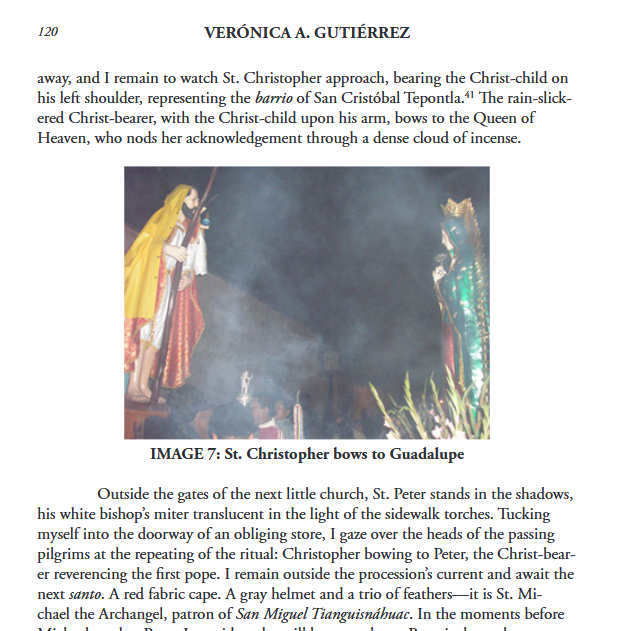
Page from my article, “A Procession Through the Milpas: Indigenous-Christian Ritual in Cholula, Puebla, Mexico” in Fides et Historia 51:1 (Winter/Spring 2019) showing an image of two saints on platforms walking along the milpa; St. Christopher is bowing to an image of Our Lady of Guadalupe.
One student pointed out that the dances were likely indigenous dances, which is an example of Catholicism’s custom of absorbing aspects of local culture when introducing Christianity to a new people. We also see local custom in the use of plumes to decorate saint platforms; feathers were traditionally used to decorate warrior shields and the garments of the elites, among other uses. Europeans were so impressed by this specialized art form that they Christianized it, hiring native artists to produce feather images of Christ and the saints, some of this have survived to this day. These examples reminded students of what they learned in Willam Christian Jr.’s chapter, titled simply “Catholicisms,” from a 2006 volume, Local Religion in Colonial Mexico, that “[l]ocal variation in Catholicism has its place in canon law.” I’ve explored this idea in previous posts: Will the Real San Diego Please Stand up? and On Holiday: Hawaiian History through a Colonial Mexican Lens.
As the students also learned, a decade or so later, plumes would become an issue as the Tlaxcalteca begin taking the feathers decorating the church property and dancing around the crucifix with them, a practice forbidden by the indigenous cabildo in a 1550 decree. [You can access this decree in Mesoamerican Voices: Native Language Writings from Colonial Mexico, Oaxaca, Yucatan, and Guatemala, edited by Matthew Restall, Lisa Sousa, and Kevin Terraciano, p. 186).
PARAGRAPH 2, PART 2: “There were ten large triumphal arches that were delicately constructed. There was even more to see and to notice all along the street, such as, they had divided the street along its length in the figure of three naves of a church. In the middle, there was a space twenty feet wide, and through this space passed the Most Holy Sacrament and ministers, and crosses, and all the pomp of the procession. All the people, who were not a small number in this city and province, walked along on the other two sides that were each fifteen feet wide. This space was created by some dividing arches that had openings of nine feet. To the amazement and admiration of three Spaniards and many others in attendance who counted them, there were a total of 1,068 of these arches. The arches were completely covered in roses and flowers of every color and style, and they estimated that each arch had a load and a half of roses—understood as the load of the Indians. They estimated a total of 2,000 loads of roses for all the chapels, for all the people to hold in their hands, and the triumphal arches, which included 66 little arches. About one fifth of them were carnations which originated in Castile, and had multiplied in such an astounding manner, that it is incredible. The groves here are much larger than those in Spain and the flower-growing season lasts year-round. There were 1,000 round shields which were woven from flowers and distributed among the arches. And the other arches did not have shields but, instead, there were great flower designs assembled like the domes of onion skins, rounded and so finely made that they shined. There was so much more than one could not count at all.”
HISTORICAL ANALYSIS: All of the flowers mentioned in this section – especially those from Castile – reminded me of the story of Guadalupe, since Castilian flowers miraculously appeared on a desert hillside as a sign to the “priestly-ruler” (bishop-elect) that the Mother of God had indeed appeared [see previous posts: Will the Real Juan Diego Please Stand up, Juan Diego and the Indigenous Engineers of Mexico-Tenochtitlan, and my review of Guadalupe and the Flower World Prophecy Part I and Part II.] Though students will not read about Guadalupe until Week 14, they know I’m writing a children’s book about it. Though this text dates to 1538, that is, 7 years after the traditional date of the Guadalupe apparitions, the friar makes no mention of it when he discusses the Castilian flowers.
Students noted that this section provided evidence of what they have been reading about in Franciscan histories, namely, that the Nahuas were skilled artists and artisans and quickly excelled at Europeans arts. For this week we also read letters to the emperor penned by Franciscans and Dominicans arguing about the best approach to Christianization. In those letters, the Franciscans describe teaching the Nahuas European arts, Latin, and singing, as well as instructing them in alphabetized Nahuatl; the language had been pictographic until the Franciscans arrived, learned it, and wrote and published grammars.
We had a long discussion about language and culture, and whether it was possible to separate the two. Students wondered whether alphabetizing Nahuatl detracted from local language and culture, or embellished it, considering that Nahuas took this new skill and wrote their own histories, preserving them in a way accessible to us. Students had the same question about the arts. If the Nahuas are painting and decorating churches and crafting European-style triumphal arches, what does that mean for their own artistic traditions? Should we celebrate the beauty of these indigenous-made arches made to honor the Christian God, truly present in the Eucharist? Or lament that native artisans are not producing traditional art?
PARAGRAPH 3: “There was another thing that was amazing to see. In each of the four corners or turns of the route, they had made a mountain—and each one a great tall rock. Down below they had created a meadow with patches of grass and flowers and everything else that is found in a wild field. The mountain and the rock [were] so natural that it was a though they had originated there. It was an amazing thing to see because there were many trees—wild, fruit, and flowering—and mushrooms, funguses, and mosses, which grow on mountain trees, in the rocks, and in old split trees. In some places it was like bushy thickets and in others it was thin. In the trees there were many birds, great and small. There were falcons, crows, and owls. In the rest of the woodlands there was he hunting of deer, hares, rabbits, jackals, and very many snakes. There were tamed and defanged because most of them were a type of viper, which were as long as a fathom [six feet] and as thick as a man’s arm at the wrist. The Indians take them in their hands as one would do with birds, because they have an herb that tranquilizes or numbs the ferocious and poisonous ones. This substance is also medicinal for many things; it is an herb called picietl. So that nothing would diminish the total naturalism, there were hunters very well-hidden in the mountains with bows and arrows. Those that normally play this role are from another language-group, and because they inhabit the mountains, they are great hunters. In order to see these hunters it was necessary to look very closely because they were so invisible behind all the branches and foliage of the trees; because they were so well-hidden, the hunted animals easily came right up to their feet. They made many hand signals before they fired so that they could carefully select which of the unsuspecting animals they would hit.”
HISTORICAL ANALYSIS: Students didn’t understand the mountains mentioned here, which I immediately recognized as symbolizing a tlachihualpetetl, a “mountain-made-by-hand” or pyramid, often situated over springs, which native peoples believed served as portals to the divine. This is an example of a Mesoamerican tradition that Nahuas incorporated into Christian festival whose deeper meaning might not be apparent to European observers. We spent a lot of time talking about whether to interpret this living mountain replete with animals and hunters as an example of resistance or resilience. Were local peoples trying to redirect the spiritual direction of the feast toward their Mesoamerican deities? Or were they making the procession their own by inserting an object sacred to them, but not to Europeans? Could it be both?
PARAGRAPH 4: This was the first day that the Tlaxcaltecas brought out their coat of arms, which the Emperor gave them when this pueblo [town] was designated as a city, which no other pueblo of Indians had been granted. You justifiably granted this because they were a great help to Don Hernando Cortés when he won these lands for Your Majesty. They had their coat of arms on flags, which also included the coat of arms of the Emperor, which they raised into the air on a very high pole. I was astonished, wondering where they could have found a pole that was so tall and slender. These banners were placed on the rooftops of the buildings of their municipal council because this is where they could be the highest. The procession left from the choir and organ chapel with my singers and to the music of flutes in concert with the chorus, trumpets, drums, and large and small bells. All of this was played together at the entrance and exit of the church which made it seem all the more like heaven on earth.
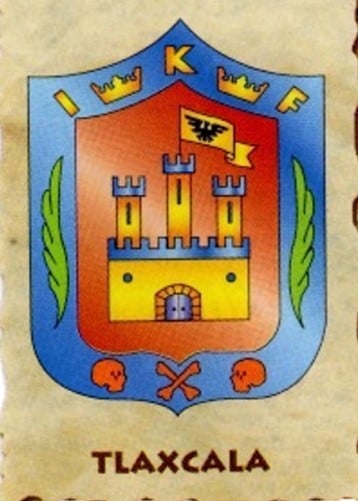
Modern rendition of Tlaxcala’s coat of arms
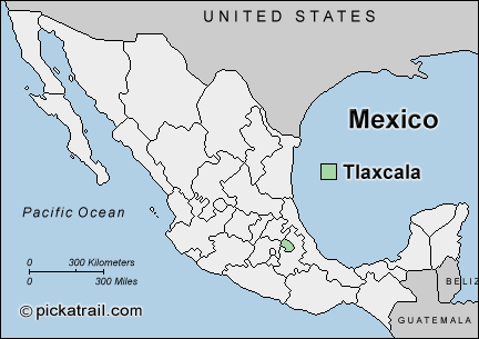
HISTORICAL ANALYSIS: Tlaxcallan (hispanized as Tlaxcala) contributed the largest contingent of warriors to Cortés during the Mexica-Castilian War (1519-1521) and received city (ciudad) status as recognition, the first altepetl (city-state) to receive such a designation. Significantly, Madrid, the capital of Castile since 1561, would remain a villa (a lower ranking distinction) for centuries.
Even so, students wondered why the Tlaxcalteca would display their coat of arms during a religious festival. Did they wish to assert their dominance as one of only a handful of indigenous altepeme (city-state; singular: altepetl) to receive such a distinction? To whom? Was this an attempt to remind the small number of Europeans that they would not have been victorious without them? Was this an attempt to remind any native people attending the Corpus Christi procession from another altepetl that they, Tlaxcala, were politically superior via their city status, as well as spiritually superior given the elaborateness of their religious festival?
The selection ends by describing the procession entering and exiting of the church “which made it seem all the more like heaven on earth.” As the students and I have discussed, Christian churches were constructed on the site of the destroyed indigenous teocalli (god-house) using the same stones. As I’ve discussed in a previous post, “the late historian James Lockhart points out in Nahuas After the Conquest: A Social and Cultural History of the Indians of Central Mexico, Sixteenth Through Eighteen Centuries (Stanford U. Press, 1992), local peoples would have enthusiastically constructed these churches because they served as an analogue to the pre-conquest temple and represented communal identity. In indigenous codices, the glyph of a burning temple signaled conquest, so that the (re)building of a sacred structure would, in a way, represent the rebirth of that same polity… In addition, as Jonathan Truitt points out in his introduction to Sustaining the Divine in Mexico Tenochtitlan: Nahuas and Catholicism, 1524-1700 (U. of Oklahoma Press, 2018): “[t]he arrival of foreigners did not change [Nahua] understanding of how they engaged with religion, it just changed the religion with which they interacted” (5)” [taken from Open-Air Worship: Outdoor Chapels for New World Nahuas].
So, there you have it: a glimpse into one of my class discussions, demonstrating how the materials describing Nahua-Christian rituals are so rich.
Health, Fitness and Religion
Previous Post
March 13, 2025
After Francis: What's Next in the Vatican?
Next Post
March 18, 2025 Mothers of the (Nicene) Church: Helena Augusta
Recent Comments
"Life Force is a guilty pleasure of mine! Not a great film, but a fun ..."
Fairies, Witches, Folk Horror, and the ..."
"I love horror but would have to acclimate back to Lovecraft and especially Machen. Have ..."
Fairies, Witches, Folk Horror, and the ..."
"Very good point about MacDonald.I am certainly a Machen fan!"
Fairies, Witches, Folk Horror, and the ..."
"The Scottish author George MacDonald integrated fairy world into his fiction in a way that ..."
Fairies, Witches, Folk Horror, and the ..."
Browse Our Archives
Select a Category abolitionism Abortion Abraham Joshua Heschel Abraham Kuyper Abraham Lincoln Academia Activism Adam Renberg Advent Adventist africa African American Religion Agnes Howard Albert Camus American History American Religious History American Revolution American West Anabaptists Ancient History Andrea Turpin Andrei Tarkovsky Anglicanism Annales Ansley Lillian Quiros anti-Catholicism Antisemitism Anxious Bench apologetics Apparitions Arash Azizi Archaeology archives art Artificial Intelligence Asia Asian Americans Augustine Authors Bad Bunny Baptism Baptists Barack Obama Battle of Hastings Benjamin Franklin Bernard-Henri Levy Beth Allison Barr Beth Moore Bethany Mannon Bible Bill Cunningham Billy Graham Black Music Bob Dylan Body Boenhoffer Books Breastfeeding Bruce Springsteen C.S. Lewis Calvinism Cancel Culture Capitalism Carmelites Catholicism Cedric Robinson Cesar Chavez Charismaticism charity Charles Dickens Charles Lindbergh Che Guevara Chicago Children Chinese Christianity Chris Gehrz Christ Christian death Christian Higher Education Christian life Christian Nation Christian Nationalism Christianity Today Christmas Church life Church Practice cinema Civil Religion Civil Rights Movement Civil War civility Classics Climate Change Cold War Colonial Mexico colonialism Comer Communism community complementarianism Conference on Faith and History Congregationalism Conspiracies Conspiracy Conversion Narratives Coronavirus Costa Rica Council of Nicaea Covid-19 Creation Critical Race Theory Crusades Culture culture wars Daniel K. Williams David Barton David Swartz Death Ways death with dignity DEI democracy Democratic Party Devotion Digital Age Diplomacy discipleship diversity Donald Trump Drama Dua Lipa Early Church early modern Early modern Catholicism Easter Eastern Christianity economic exploitation Education elections Elie Wiesel Elizabeth II Elizabeth Taylor emotions Empire Engineering England enslavement Entertainment Episcopal Church Erica Ramirez eschatology Eurocentrism Evangelicalism Evangelicals Exegesis Family Feminism Film Flannery O'Connor folk music Food Foreign Policy founding fathers Franciscans Franciscus Junius fundamentalism Funerals G.K. Chesterton Gender Genocide genre geography George W. Bush George Washington George Whitefield Global Christianity Global church Grief Guadalupe guest post Guest Post gun control gun violence Gustavo Gutierrez Hamid Dabashi Harold John Ockenga Harvest Hate Hawaiian Christianity Healing health care Heather Cox Richardson Hell Heresy Hermeneutics Higher Education Hinduism Hippocratic oath Historical Fiction Historical Methodology Historical Profession Historical Profession Historical Theology Historical Thinking historiography Holidays Holocaust horror movies Human rights Humanitarian Work humanities Hummingbirds Hungary hymns Imago Dei Immigration Injustice Interviews Iran Islam Islamophobia Israel Ivan's Childhood Jacob Randolph James Bratt Janine Giordano Drake Japanese history Japanese Literature Jean Paul Sartre Jesse Miranda Jesus Jesus Christ Jimmy Carter Joan Baez Joan Didion Joanne Freeman João B. Chaves Joao Chaves Joey Cochran John Calvin John Fea John Tillotson John Turner Johnny Cash Jonathan Edwards Jonathan Tran Joseph Smith Josh Howerton Journalism Jr. Judaism Jürgen Moltmann Just War Justice Justin Brierley Karl Barth Katelyn Beaty koi ponds Kris Kristofferson Kristin Kobes Du Mez Latin American Religious History Latino Americans Lectio Divina Leisure Lent Leonard Cohen liberal arts liberalism Liberation Theology Linda Ronstadt Lisa Clark Diller Literature Lou Reed Lynchings Lynneth Miller Renberg Mainline Protestantism Malcolm Foley Marilyn Monroe Maritime history Mark Noll Marriage Martin Luther Martin Luther King Martyrdom Marxism Mary Masih Alinejad mass shootings material culture medieval Christianity Medieval Ethiopia Melissa Borja memory Mennonites Mental Health Mental Illness Methodism Mexican Americans Mexicans Mike Madrid Miles Mullin Min Jin Lee Miscarriage Missionaries Mister Rogers Mitt Romney modernity Monasticism Mormonism Motherhood Mothers of the Church Moving Music Musicals Nadya Williams Nahua Christianity Native Americans Natsume Sōseki New Contributor New England New Year New York Nico Non-Violent Protest Orthodoxy pacifism Paleo Evangelicals Palestinians Parenting Patti Smith Paul Kingsnorth Pedro Calderón de la Barca Pentecostalism Philip Jenkins Phillis Wheatley physician-assisted suicide pilgrimage Pilgrims pluralism Plutocracy Poetry Politics Pope Francis Pope Leo XIV post-modernism prayer preaching Presbyterians prosperity gospel Protest Public history Publishing Puritans purity culture Quakers race Race Massacres Racial Capitalism racial reconciliation racialization Racism Raha Bahloulipour Re-Enchantment reading Reformation Refugees religion and the university religion and war Religious Freedom Religious Nones Religious Pluralism Religious Symbols religious violence Republican Party Revival Rita Coolidge Ritual Roger Williams Roman Catholic church Royalty Russell Moore same-sex marriage Sarah Irving-Stonebraker Scandinavia Science Science and Technology Scopes trial Scriptural Interpretation secularism Selena Quintanilla seminary Seventh-Day Adventists sexual morality Sexuality Sikhs Silence slaveholders theology Slavery Slavoj Zizek social justice Social Media Southern Baptist Convention Southern Religion Spain Spiritual Autobiography Spiritual but not religious Spiritual Discipline Sports Stanley Hauerwas Suffering Summer Camps Sunday Night Odds and Ends Supernatural Supreme Court Syriac Christianity Tal Howard Taylor Swift Teaching Technology Television Thanksgiving The Beatles The Mission theater TheoBros Theology Thomas Dixon Thomas Jefferson Thomas Kidd Thomas Merton Tim Gloege Tim Walz Tom Holland Tourism tradition Tragedy Translation Transnationalism Travel Trump Ukraine Uncategorized Unitarians United Methodist Church US History Vanessa Chan Velvet Underground Verónica A. Gutiérrez Veronica Gutierrez Vikings Violence Virgin Mary Virtue Virtue ethics Visions Voting War WCTU Wendell Berry Westminster Assembly White Evangelicalism Wildfires Winnie the Pooh Witches women Women in Ministry Women's and Gender Studies Work Worship writing Yasunari Kawabata Zena Hitz
Select a Month October 2026 September 2026 August 2026 July 2026 June 2026 May 2026 April 2026 March 2026 February 2026 January 2026 December 2025 November 2025 October 2025 September 2025 August 2025 July 2025 June 2025 May 2025 April 2025 March 2025 February 2025 January 2025 December 2024 November 2024 October 2024 September 2024 August 2024 July 2024 June 2024 May 2024 April 2024 March 2024 February 2024 January 2024 December 2023 November 2023 October 2023 September 2023 August 2023 July 2023 June 2023 May 2023 April 2023 March 2023 February 2023 January 2023 December 2022 November 2022 October 2022 September 2022 August 2022 July 2022 June 2022 May 2022 April 2022 March 2022 February 2022 January 2022 December 2021 November 2021 October 2021 September 2021 August 2021 July 2021 June 2021 May 2021 April 2021 March 2021 February 2021 January 2021 December 2020 November 2020 October 2020 September 2020 August 2020 July 2020 June 2020 May 2020 April 2020 March 2020 February 2020 January 2020 December 2019 November 2019 October 2019 September 2019 August 2019 July 2019 June 2019 May 2019 April 2019 March 2019 February 2019 January 2019 December 2018 November 2018 October 2018 September 2018 August 2018 July 2018 June 2018 May 2018 April 2018 March 2018 February 2018 January 2018 December 2017 November 2017 October 2017 September 2017 August 2017 July 2017 June 2017 May 2017 April 2017 March 2017 February 2017 January 2017 December 2016 November 2016 October 2016 September 2016 August 2016 July 2016 June 2016 May 2016 April 2016 March 2016 February 2016 January 2016 December 2015 November 2015 October 2015 September 2015 August 2015 July 2015 June 2015 May 2015 April 2015 March 2015 February 2015 January 2015 December 2014 November 2014 October 2014 September 2014 August 2014 July 2014 June 2014 May 2014 April 2014 March 2014 February 2014 January 2014 December 2013 November 2013 October 2013 September 2013 August 2013 July 2013 June 2013 May 2013 April 2013 March 2013 February 2013 January 2013 December 2012 November 2012 October 2012 September 2012 August 2012 July 2012 June 2012 May 2012
Follow Us!
TAKE THE
Religious Wisdom Quiz
What does "Jabez" mean in Hebrew?
Select your answer to see how you score.
The Lord Saves Victory Sorrow Strength
Related posts from Anxious Bench
Guadalupe's Pilgrim Image Visits Our Parish School
Singing Seafarers: Sailing a 16th-Century Spanish Galleon
Heralds of Heaven: Hummingbirds on a Hillside
¡Que Viva Cristo Rey! La Cristiada martyrs 100...
TRENDING AT PATHEOS Evangelical

Emotion in Early Christianity by Andrew Crislip
Andrew Crislip’s Emotion in Early Christianity examines an often overlooked dimension of...

16 Spiritual Touchstones for a More Grounded Life
After decades of spiritual study, here are 16 principles I try...

Catholic Evangelization: Sharing Your Faith Every Day
Welcome back to the Graceful Awakening mini-series called, “From Faith to Mission.” ...

The Pillar of the Boatmen: the Ancient Monument...
The Pillar of the Boatmen is a Romano-Gaulish sculpture that dates from...

In one sense walking into Westminster Abbey is like walking down the...

'Super Scam Me' Exposes AI Jon Bon Jovi...
Leslie Pickett believed she was in a relationship with Jon Bon Jovi....
view all Evangelical blogs
What Are Your Thoughts?leave a comment
Ad-Free & Subscriber Log-In Subscription Support
- About Us
- 2026 Calendar
- Videos
- Podcasts
- Library of World Religions
- Faith In Media Tracker
- Advertise With Us
- Write for Us
- Privacy Policy
- Terms of Service
- Do Not Sell My Data
- Contact Us
- Radiant Digital
- Manage Newsletter Subscriptions
- Unsubscribe From Notifications
- Sitemap
Copyright 2008-2026, Patheos. All rights reserved.
Subscription Support Ad-Free & Subscriber Log-In
Follow Patheos