
BuddhistCatholicContemplativeEvangelicalGeneral ChristianHinduJewishLatter-day SaintMuslimNew VisionsProgressive Christian
Beliefs
- Buddhist
- Catholic
- Contemplative
- Evangelical
- General Christian
- Hindu
- Jewish
- Latter-day Saint
- More Voices
- Muslim
- New Visions
- Pagan
- Progressive Christian
Topics
- Religion News
- Food and Religion
- Sports and Religion
- Religious Art
- Religious Music and Entertainment
- Religious Events
- History and Religion
- Style and Religion
- Politics and Religion
- Women in Religion
- Recreation Outdoors and Religion
- Business Finance and Religion
- Careers Workplace and Religion
- Education and Religion
- Family Parenting and Religion
- Health Fitness and Religion
- Home and Religion
- Relationships and Religion
- Technology and Religion
- Travel and Religion
Columnists
- Buddhist Columnists
- Business Finance and Religion Columnists
- Careers Workplace and Religion Columnists
- Catholic Columnists
- Contemplative Columnists
- Education and Religion Columnists
- Evangelists Columnists
- Family Parenting and Religion Columnists
- General Christian Columnists
- Health Fitness and Religion Columnists
- Hindu Columnists
- History and Religion Columnists
- Home and Religion Columnists
- Jewish Columnists
- More Voices Columnists
- Latter Day Columnists
- Muslim Columnists
- New Visions Columnists
- Nonreligious Columnists
- Pagan Columnists
- Politics and Religion Columnists
- Progressive Columnists
- Recreation Outdoors and Religion Columnists
- Relationships and Religion Columnists
- Religion News Columnists
- Religious Art Columnists
- Religious Events Columnists
- Religious Music and Entertainment Columnists
- Sports and Religion Columnists
- Style and Religion Columnists
- Technology and Religion Columnists
- Travel and Religion Columnists
- Women in Religion Columnists
Resource Library
- 2026 Calendar
- Library of World Religions
- The 100 Most Holy Places on Earth
- Patheos Answers
- Podcasts
- Videos
- Faith Leaders Database
- Anglican Episcopalian
- Bahai
- Baptist
- Buddhism
- Christianity
- Confucianism
- Eastern Orthodoxy
- Hinduism
- Holiness and Pentecostal
- ISKCON
- Islam
- Judaism
- Lutheran
- Methodist
- The Church of Jesus Christ of Latter-day Saints
- New Age
- Paganism
- Presbytarian and Reformed
- Protestantism
- Religion Behind the Scenes
- Roman Catholic
- Scientology
- Shia Islam
- Sikhism
- Sufism
- Sunni Islam
- Taoism
- Zen
- See all religions
Research Tools
 Ad-Free & Subscriber Log-In Subscription Support
Ad-Free & Subscriber Log-In Subscription Support
Follow Patheos 

- Trending:
- Forgiveness
- |
- Marriage
- |
- Consciousness
- |
- Death Penalty
- |
- Election
- |
- Halloween

-
About the Authors
- Home
- Evangelical
- The River Empires of #VastEarlyAmerica
The River Empires of #VastEarlyAmerica
Last updated on: October 3, 2024 at 12:37 am by Philip Jenkins
The River Empires of #VastEarlyAmerica 2024-09-28T13:15:20-04:00 Philip Jenkins
Patheos Explore the world's faith through different perspectives on religion and spirituality! Patheos has the views of the prevalent religions and spiritualities of the world.
My present research involves the relationship between religion and American empire. Recently, I have been viewing that through the context of the idea of “vastness” that dominates current work on early American history, namely the urge to go beyond traditional frontiers, whether national, racial, or chronological. As I’ll show today, a geographical perspective brings those various themes together nicely, and actually has quite a bit to say about the foundations of quite diverse US religious traditions.
American history has been shaped at least as much by its modes of transportation as by its political parties, and the successive worlds created by the sailing ship, the Conestoga wagon, the steamboat, the train, and the automobile differed from each other quite as much as the eras so often described by merely political labels. As Thoreau wrote of America’s great cities in the 1850s, “Boston, New York, Philadelphia, Charleston, New Orleans and the rest are the names of wharves projecting into the sea (surrounded by the shops and dwellings of the merchants), good places to take in and to discharge a cargo.” Forty years later another observer might well have described the cities of that era as chiefly rail depots. Those successive patterns shaped the geography of American religion and, as I will suggest, even its native theologies. I’ll concentrate here on Catholics and Mormons, but the same points apply much more widely.
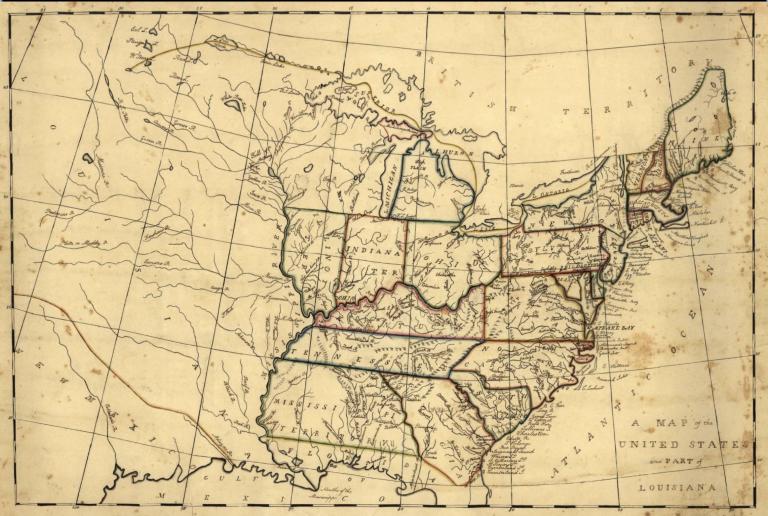
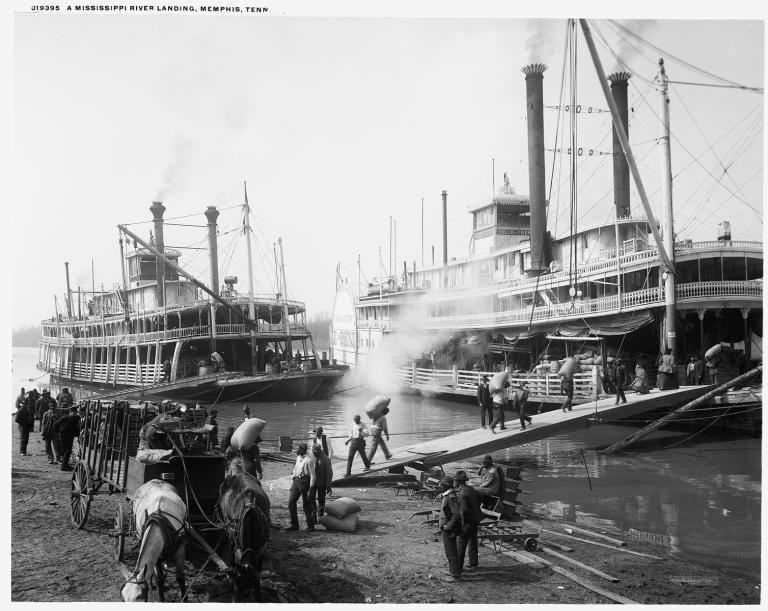
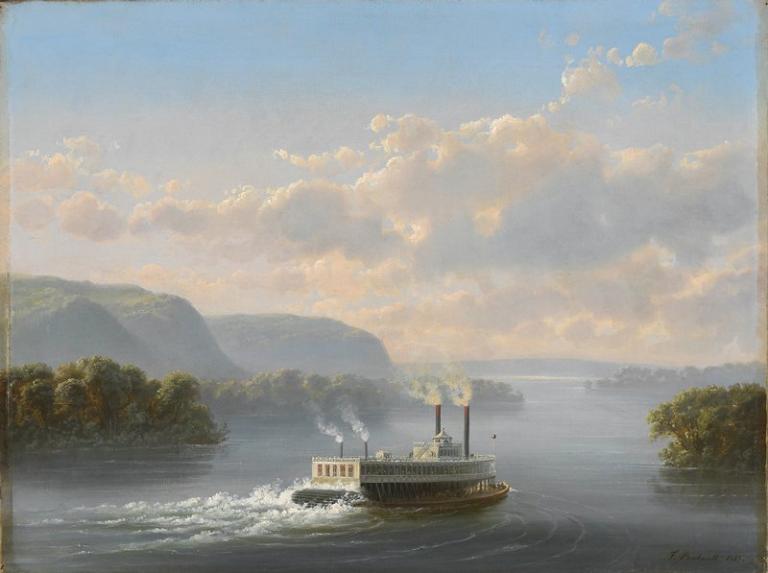
Let me focus here on the age of rivers, which were so critical to founding the American continental empire that became the Lower Forty Eight states. Before the Revolution, the British colonies clung tightly to the east coast, and one major factor in provoking independence was the British desire to restrain Americans from plunging into the heartland, where travel depended utterly on the great rivers. After independence was achieved, rivers were the critical thoroughfares of the growing continental empire. New technologies contributed, and above all steamboats. After several false starts, the continuous history of American steamboats begins with Robert Fulton’s efforts with the Clermont in 1807. By 1811, river steamboats were leaving Pittsburgh to sail down the Ohio River to the Mississippi and on to New Orleans.
You get a sense of just how important these routes were when you see the negotiations to end the War of 1812, and some of the key points at issue. At a point in 1814 where the British thought they were definitely winning, they drew up their own vision for the future of the continent, in which the US would have no naval forces on the Great Lakes, and the British would have navigation rights on the Mississippi. The continental future was built on water.

Here is Lyman Beecher, in Cincinnati in 1835, describing the astonishing impact that these routes had on everyday life and people’s horizons:
When I first entered the West, its vastness overpowered me with the impression of its uncontrollable greatness in which all human effort must be lost. But [then] I perceived the active intercourse between the great cities, like the rapid circulation of a giant’s blood; and heard merchants speak of just stepping up to Pittsburgh — only 600 miles — and back in a few days ; and others just from New Orleans, or St Louis, or the Far West; and others going thither; and when I heard my ministerial brethren negotiating exchanges in the near neighborhood — only 100 miles up or down the river — and going and returning on Saturday and Monday, and without trespassing on the Sabbath.
By 1850, a list of the largest US cities contains few surprises. The list is headed by New York/Brooklyn, followed by Boston, Philadelphia, and Baltimore. But racing up behind them, and jostling for the fifth position, were Cincinnati and New Orleans, both intimately tied to the river routes, and St. Louis was not far behind.

To observe the consequences, look at the history of the country’s Catholic dioceses. Baltimore was the first in 1789, and in 1808, four new dioceses followed. This actually makes a great trivia question: what were they? Well, Boston, Philadelphia and New York are easy enough, and then – um, Bardstown, Kentucky. Bardstown? The church was not imagining a Catholic megalopolis at that site, but rather thinking of the obvious future directions of settlement, above all along the Ohio, and its tributaries, the Tennessee, the Cumberland and the Wabash. The Bardstown diocese covered what would ultimately become ten US states.
Over the next forty years, Catholic dioceses and archdioceses grew rapidly, from those five to over thirty, and throughout, we can map the expansion mainly in terms of river routes, to the Mississippi and beyond. We also discern the ghost of the older French empire that had been held together by these water routes. Many of the first bishops were French by origin and nationality.
If we look at the foundations by 1840, a few are on or near the coast – Charleston, Richmond, and Mobile – but overwhelmingly, this is a river story. Key names include Cincinnati, St Louis, Vincennes, Nashville, Natchez, and Dubuque. Except for Cincinnati, all of these were older French foundations, as was Mobile. The see of Detroit (1833) shows the new interest in the Great Lakes following the building of the Erie Canal (although Detroit was also a French foundation). In 1841, the Bardstown diocese was moved to Louisville. The one year of 1843 brought new dioceses in Chicago, Little Rock, Milwaukee, Pittsburgh, as well as Hartford. Throughout, the map shows that continuing western core of dioceses at Bardstown/Louisville, Vincennes, and Cincinnati. That is a pure lake-and-river geography, and it is a near perfect map of the patterns of White settlement and the building of political empire.
As the hierarchy developed, the church created new metropolitan sees, with Archbishops. Here is another trivia question: Baltimore was the first such see in the US, obviously enough, but what was the second? It is unguessable: Oregon City, 1846, the precursor of Portland. By 1850, the US had four more metropolitan sees, namely New York, New Orleans, Cincinnati, and St. Louis. St. Louis was “the Rome of the West.” That is also a full generation before Boston, which did not gain metropolitan status until 1875.
I should say that this list does not include some distinct French and Spanish diocesan foundations: New Orleans in 1793, and the Diocese of California in 1840.
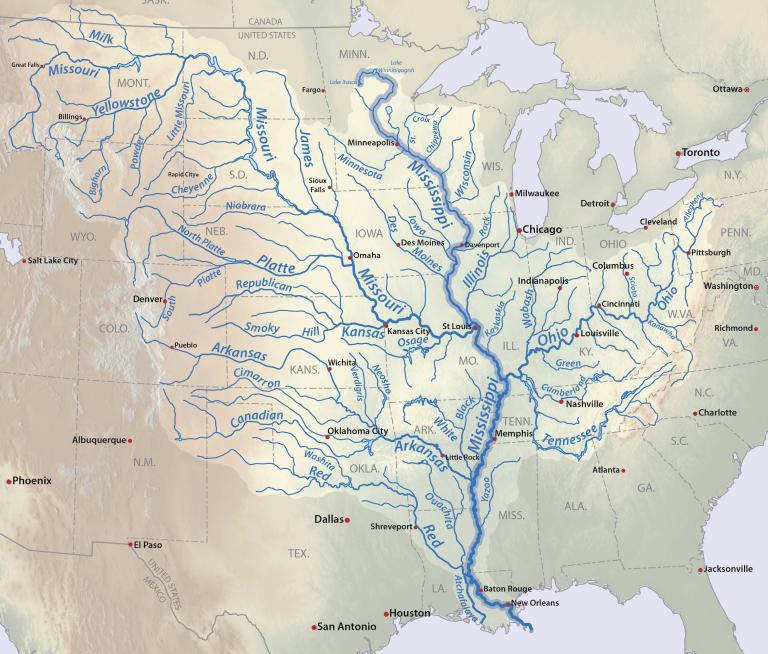
Source information can be found here

That is the Catholic story, but it is of far wider application. Look at any evangelical revival of the era and ask why it happened where it did, and why it had the impact it did. How did people travel there, and by what means did they move further into the continent, carrying those new ideas and inspirations? This again is a river story. The oldest US Jewish congregation west of the Alleghenies, is of course in Cincinnati (1824). Where else? New Orleans followed in 1828.
Of course, rivers themselves don’t inspire theologies… well, maybe they do.
As Americans ventured along the Ohio, the Tennessee, and the Mississippi, everywhere they saw the remains of the great Native cultures that had built all those mounds and earthworks, and who themselves had so closely followed the rivers throughout: such were the Hopewell cultures, and the later Mississippian. Follow the rivers and you eventually come to the great mound cities, with their temples. Put that map of ancient remains together, and it looks so much like American settlement in that era, and the later structure of the American Catholic hierarchy. The Cahokia mound complex stands only a few miles east of St. Louis.
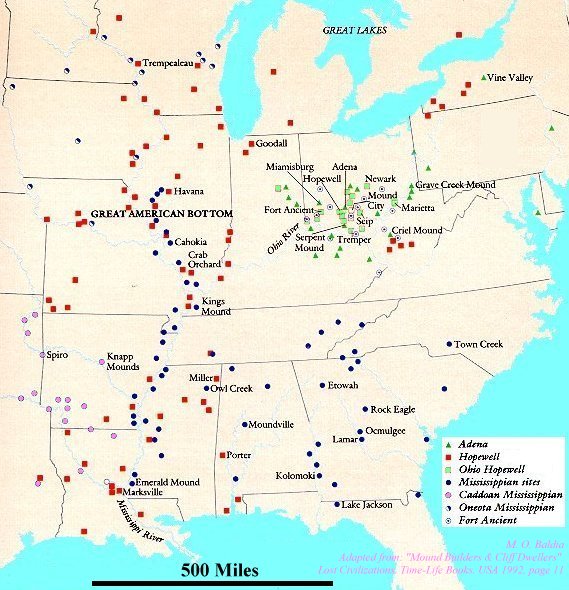
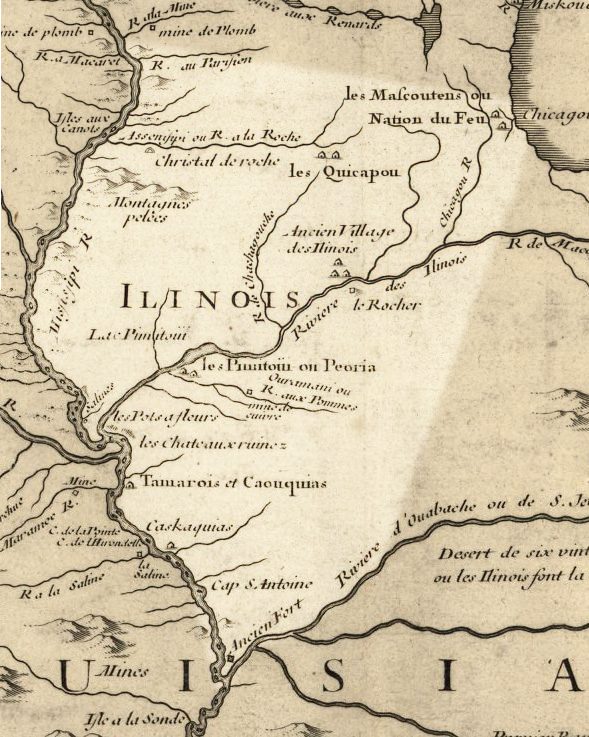
US expansion into the Ohio country produced countless reports of the discovery of quite vast remains from the ancient mound-builder cultures, including geometric earthworks, road systems and giant carved figures – many of which were recorded, but are now lost. One of the most astonishing such complexes, at Newark, Ohio, became a White settlement in 1802. The following year, when Ohio gained statehood, the first state capital was actually at Chillicothe, the setting for still more mound remains. The Serpent Mound was first mapped in 1815. Then Americans pushed west to the Mississippi, and by 1818, steamboats were sailing from St. Louis.
Was the new American empire being built over the remains of a glorious predecessor, another empire far more ancient than the French?
Quite a few travelers were struck by the contrast between the radical technological modernity represented by the steamboats and the archaic lost world of the mounds. Here is Charles Dickens en route to Cincinnati in 1842:
Through such a scene as this, the unwieldy machine takes its hoarse, sullen way: venting, at every revolution of the paddles, a loud high-pressure blast; enough, one would think, to waken up the host of Indians who lie buried in a great mound yonder: so old, that mighty oaks and other forest trees have struck their roots into its earth; and so high, that it is a hill, even among the hills that Nature planted round it. The very river, as though it shared one’s feelings of compassion for the extinct tribes who lived so pleasantly here, in their blessed ignorance of white existence, hundreds of years ago, steals out of its way to ripple near this mound: and there are few places where the Ohio sparkles more brightly than in the Big Grave Creek.
Accounts of ancient mounds circulated through newspapers, prints, and of course travelers’ tales. Nobody could doubt that America had been home to ancient settlements and even substantial cities, and most people believed that mere Indians could not have constructed them (as of course they had, and as Dickens knew). It just remained to discover which set of unknown immigrants had done the deed. Were the mound-builders the Lost Tribes of Israel? Phoenicians? What exactly? And what happened to them? Surely they must have been wiped out by savage Indians. Hmm, not just one ancient race, but two in competition, and one survived to become Indians.
The Lost Tribe theory found expression in the View of the Hebrews, published by Ethan Smith in 1823, a work that has massive and unavoidable parallels with the Book of Mormon that Joseph Smith first published in 1830. In the Mormon scheme, the sinful Lamanites destroyed the noble Nephites, and devolved into the Indians of our familiar experience. Although later Mormon attempts to prove the historicity of that work focus on Central America, Smith left no doubt that he was visualizing the world of the North American mounds. How could it be otherwise? Smith’s world, and so much of the world of early Mormonism, was utterly conditioned by rivers and river transport: just think of Nauvoo, Independence, and Carthage.
In 1834, Smith was traveling across western Illinois when, at Griggsville near the Illinois river, he passed the mound burial of one he identified as Zelph, a “white Lamanite” of the Ancient Book of Mormon era. (Griggsville is a hundred miles north of Cahokia, and a hundred miles south of the later Nauvoo). To borrow the famous line by the writer Saki, Romance at short notice was Joseph Smith’s specialty. The following day, Smith wrote that
The whole of our journey, in the midst of so large a company of social honest and sincere men, wandering over the plains of the Nephites, [my emphasis] recounting occasionally the history of the Book of Mormon, roving over the mounds of that once beloved people of the Lord, picking up their skulls and their bones, as a proof of its divine authenticity, and gazing upon a country the fertility, the splendor and the goodness so indescribable, all serves to pass away time unnoticed.
This was by no means the only attempt in that era to appropriate the mounds for that Mormon schema.
If you want to see a precise map of Nephite and Lamanite America, as imagined by Joseph Smith, then you can find one easily by looking at this helpful map of moundbuilder remains. These are the Plains of the Nephites, and their lost cities.
Follow the rivers and you map the religious life of early and early national America
Previous Post

October 1, 2024
The problem with JD Vance
Next Post

October 7, 2024 Still Scandalized: Another Noll Review
Recent Comments
"Very good point about MacDonald.I am certainly a Machen fan!"
Fairies, Witches, Folk Horror, and the ..."
"The Scottish author George MacDonald integrated fairy world into his fiction in a way that ..."
Fairies, Witches, Folk Horror, and the ..."
"I like the idea that we can have different streams. The coffee analogy is genius."
How Do You Take Your Evangelicalism?
"Geography lesson: Southern California is actually in North Texas. I've lived her for 40 years, ..."
How Do You Take Your Evangelicalism?
Browse Our Archives
Select a Category abolitionism Abortion Abraham Joshua Heschel Abraham Kuyper Abraham Lincoln Academia Activism Adam Renberg Advent Adventist africa African American Religion Agnes Howard Albert Camus American History American Religious History American Revolution American West Anabaptists Ancient History Andrea Turpin Andrei Tarkovsky Anglicanism Annales Ansley Lillian Quiros anti-Catholicism Antisemitism Anxious Bench apologetics Apparitions Arash Azizi Archaeology archives art Artificial Intelligence Asia Asian Americans Augustine Authors Bad Bunny Baptism Baptists Barack Obama Battle of Hastings Benjamin Franklin Bernard-Henri Levy Beth Allison Barr Beth Moore Bethany Mannon Bible Bill Cunningham Billy Graham Black Music Bob Dylan Body Boenhoffer Books Breastfeeding Bruce Springsteen C.S. Lewis Calvinism Cancel Culture Capitalism Carmelites Catholicism Cedric Robinson Cesar Chavez Charismaticism charity Charles Dickens Charles Lindbergh Che Guevara Chicago Children Chinese Christianity Chris Gehrz Christ Christian death Christian Higher Education Christian life Christian Nation Christian Nationalism Christianity Today Christmas Church life Church Practice cinema Civil Religion Civil Rights Movement Civil War civility Classics Climate Change Cold War Colonial Mexico colonialism Comer Communism community complementarianism Conference on Faith and History Congregationalism Conspiracies Conspiracy Conversion Narratives Coronavirus Costa Rica Council of Nicaea Covid-19 Creation Critical Race Theory Crusades Culture culture wars Daniel K. Williams David Barton David Swartz Death Ways death with dignity DEI democracy Democratic Party Devotion Digital Age Diplomacy discipleship diversity Donald Trump Drama Dua Lipa Early Church early modern Early modern Catholicism Easter Eastern Christianity economic exploitation Education elections Elie Wiesel Elizabeth II Elizabeth Taylor emotions Empire Engineering England enslavement Entertainment Episcopal Church Erica Ramirez eschatology Eurocentrism Evangelicalism Evangelicals Exegesis Family Feminism Film Flannery O'Connor folk music Food Foreign Policy founding fathers Franciscans Franciscus Junius fundamentalism Funerals G.K. Chesterton Gender Genocide genre geography George W. Bush George Washington George Whitefield Global Christianity Global church Grief Guadalupe Guest Post guest post gun control gun violence Gustavo Gutierrez Hamid Dabashi Harold John Ockenga Harvest Hate Hawaiian Christianity Healing health care Heather Cox Richardson Hell Heresy Hermeneutics Higher Education Hinduism Hippocratic oath Historical Fiction Historical Methodology Historical Profession Historical Profession Historical Theology Historical Thinking historiography Holidays Holocaust horror movies Human rights Humanitarian Work humanities Hummingbirds Hungary hymns Imago Dei Immigration Injustice Interviews Iran Islam Islamophobia Israel Ivan's Childhood Jacob Randolph James Bratt Janine Giordano Drake Japanese history Japanese Literature Jean Paul Sartre Jesse Miranda Jesus Jesus Christ Jimmy Carter Joan Baez Joan Didion Joanne Freeman João B. Chaves Joao Chaves Joey Cochran John Calvin John Fea John Tillotson John Turner Johnny Cash Jonathan Edwards Jonathan Tran Joseph Smith Josh Howerton Journalism Jr. Judaism Jürgen Moltmann Just War Justice Justin Brierley Karl Barth Katelyn Beaty koi ponds Kris Kristofferson Kristin Kobes Du Mez Latin American Religious History Latino Americans Lectio Divina Leisure Lent Leonard Cohen liberal arts liberalism Liberation Theology Linda Ronstadt Lisa Clark Diller Literature Lou Reed Lynchings Lynneth Miller Renberg Mainline Protestantism Malcolm Foley Marilyn Monroe Maritime history Mark Noll Marriage Martin Luther Martin Luther King Martyrdom Marxism Mary Masih Alinejad mass shootings material culture medieval Christianity Medieval Ethiopia Melissa Borja memory Mennonites Mental Health Mental Illness Methodism Mexican Americans Mexicans Mike Madrid Miles Mullin Min Jin Lee Miscarriage Missionaries Mister Rogers Mitt Romney modernity Monasticism Mormonism Motherhood Mothers of the Church Moving Music Musicals Nadya Williams Nahua Christianity Native Americans Natsume Sōseki New Contributor New England New Year New York Nico Non-Violent Protest Orthodoxy pacifism Paleo Evangelicals Palestinians Parenting Patti Smith Paul Kingsnorth Pedro Calderón de la Barca Pentecostalism Philip Jenkins Phillis Wheatley physician-assisted suicide pilgrimage Pilgrims pluralism Plutocracy Poetry Politics Pope Francis Pope Leo XIV post-modernism prayer preaching Presbyterians prosperity gospel Protest Public history Publishing Puritans purity culture Quakers race Race Massacres Racial Capitalism racial reconciliation racialization Racism Raha Bahloulipour Re-Enchantment reading Reformation Refugees religion and the university religion and war Religious Freedom Religious Nones Religious Pluralism Religious Symbols religious violence Republican Party Revival Rita Coolidge Ritual Roger Williams Roman Catholic church Royalty Russell Moore same-sex marriage Sarah Irving-Stonebraker Scandinavia Science Science and Technology Scopes trial Scriptural Interpretation secularism Selena Quintanilla seminary Seventh-Day Adventists sexual morality Sexuality Sikhs Silence slaveholders theology Slavery Slavoj Zizek social justice Social Media Southern Baptist Convention Southern Religion Spain Spiritual Autobiography Spiritual but not religious Spiritual Discipline Sports Stanley Hauerwas Suffering Summer Camps Sunday Night Odds and Ends Supernatural Supreme Court Syriac Christianity Tal Howard Taylor Swift Teaching Technology Television Thanksgiving The Beatles The Mission theater TheoBros Theology Thomas Dixon Thomas Jefferson Thomas Kidd Thomas Merton Tim Gloege Tim Walz Tom Holland Tourism tradition Tragedy Translation Transnationalism Travel Trump Ukraine Uncategorized Unitarians United Methodist Church US History Vanessa Chan Velvet Underground Verónica A. Gutiérrez Veronica Gutierrez Vikings Violence Virgin Mary Virtue Virtue ethics Visions Voting War WCTU Wendell Berry Westminster Assembly White Evangelicalism Wildfires Winnie the Pooh Witches women Women in Ministry Women's and Gender Studies Work Worship writing Yasunari Kawabata Zena Hitz
Select a Month October 2026 September 2026 August 2026 July 2026 June 2026 May 2026 April 2026 March 2026 February 2026 January 2026 December 2025 November 2025 October 2025 September 2025 August 2025 July 2025 June 2025 May 2025 April 2025 March 2025 February 2025 January 2025 December 2024 November 2024 October 2024 September 2024 August 2024 July 2024 June 2024 May 2024 April 2024 March 2024 February 2024 January 2024 December 2023 November 2023 October 2023 September 2023 August 2023 July 2023 June 2023 May 2023 April 2023 March 2023 February 2023 January 2023 December 2022 November 2022 October 2022 September 2022 August 2022 July 2022 June 2022 May 2022 April 2022 March 2022 February 2022 January 2022 December 2021 November 2021 October 2021 September 2021 August 2021 July 2021 June 2021 May 2021 April 2021 March 2021 February 2021 January 2021 December 2020 November 2020 October 2020 September 2020 August 2020 July 2020 June 2020 May 2020 April 2020 March 2020 February 2020 January 2020 December 2019 November 2019 October 2019 September 2019 August 2019 July 2019 June 2019 May 2019 April 2019 March 2019 February 2019 January 2019 December 2018 November 2018 October 2018 September 2018 August 2018 July 2018 June 2018 May 2018 April 2018 March 2018 February 2018 January 2018 December 2017 November 2017 October 2017 September 2017 August 2017 July 2017 June 2017 May 2017 April 2017 March 2017 February 2017 January 2017 December 2016 November 2016 October 2016 September 2016 August 2016 July 2016 June 2016 May 2016 April 2016 March 2016 February 2016 January 2016 December 2015 November 2015 October 2015 September 2015 August 2015 July 2015 June 2015 May 2015 April 2015 March 2015 February 2015 January 2015 December 2014 November 2014 October 2014 September 2014 August 2014 July 2014 June 2014 May 2014 April 2014 March 2014 February 2014 January 2014 December 2013 November 2013 October 2013 September 2013 August 2013 July 2013 June 2013 May 2013 April 2013 March 2013 February 2013 January 2013 December 2012 November 2012 October 2012 September 2012 August 2012 July 2012 June 2012 May 2012
Follow Us!
TAKE THE
Religious Wisdom Quiz
What does "Jireh" mean in Hebrew?
Select your answer to see how you score.
Redeemer Savior Protector Provider
Related posts from Anxious Bench

Fairies, Witches, Folk Horror, and the Secret Commonwealth

Hogg’s Justified Sinner: A Gothic Classic for Halloween

James Hogg, Weird Wives, and Feminist Witches

How an Explosive Book Rewrote the Study of...
TRENDING AT PATHEOS Evangelical

In "Irreplaceable," our book on vocation and technology, Trevor Sutton and I...

I was strolling through the top floor of the brand new Parthenon...

What Does Gêvâh Mean For Kimberley Guifoyle &...
This week, a lot of the news is focused on Kimberly Guilfoyle....

INNER CIRCLE: Profound Mystery (Of Christ In All...
Ephesians 5:31-32 “For this reason, a man will leave his father and...

Do Not Rejoice When Your Enemy Falls: The...
Turning an execution into a public spectacle is a disturbing expression of...

'The Chosen' S6 Trailer: The Passion Gets Very...
Not many watching 'The Chosen' worry about spoilers, but just because they...
view all Evangelical blogs
What Are Your Thoughts?leave a comment
Ad-Free & Subscriber Log-In Subscription Support
- About Us
- 2026 Calendar
- Videos
- Podcasts
- Library of World Religions
- Faith In Media Tracker
- Advertise With Us
- Write for Us
- Privacy Policy
- Terms of Service
- Do Not Sell My Data
- Contact Us
- Radiant Digital
- Manage Newsletter Subscriptions
- Unsubscribe From Notifications
- Sitemap
Copyright 2008-2026, Patheos. All rights reserved.
Subscription Support Ad-Free & Subscriber Log-In
Follow Patheos