
BuddhistCatholicContemplativeEvangelicalGeneral ChristianHinduJewishLatter-day SaintMuslimNew VisionsProgressive Christian
Beliefs
- Buddhist
- Catholic
- Contemplative
- Evangelical
- General Christian
- Hindu
- Jewish
- Latter-day Saint
- More Voices
- Muslim
- New Visions
- Pagan
- Progressive Christian
Topics
- Religion News
- Food and Religion
- Sports and Religion
- Religious Art
- Religious Music and Entertainment
- Religious Events
- History and Religion
- Style and Religion
- Politics and Religion
- Women in Religion
- Recreation Outdoors and Religion
- Business Finance and Religion
- Careers Workplace and Religion
- Education and Religion
- Family Parenting and Religion
- Health Fitness and Religion
- Home and Religion
- Relationships and Religion
- Technology and Religion
- Travel and Religion
Columnists
- Buddhist Columnists
- Business Finance and Religion Columnists
- Careers Workplace and Religion Columnists
- Catholic Columnists
- Contemplative Columnists
- Education and Religion Columnists
- Evangelists Columnists
- Family Parenting and Religion Columnists
- General Christian Columnists
- Health Fitness and Religion Columnists
- Hindu Columnists
- History and Religion Columnists
- Home and Religion Columnists
- Jewish Columnists
- More Voices Columnists
- Latter Day Columnists
- Muslim Columnists
- New Visions Columnists
- Nonreligious Columnists
- Pagan Columnists
- Politics and Religion Columnists
- Progressive Columnists
- Recreation Outdoors and Religion Columnists
- Relationships and Religion Columnists
- Religion News Columnists
- Religious Art Columnists
- Religious Events Columnists
- Religious Music and Entertainment Columnists
- Sports and Religion Columnists
- Style and Religion Columnists
- Technology and Religion Columnists
- Travel and Religion Columnists
- Women in Religion Columnists
Resource Library
- 2026 Calendar
- Library of World Religions
- The 100 Most Holy Places on Earth
- Patheos Answers
- Podcasts
- Videos
- Faith Leaders Database
- Anglican Episcopalian
- Bahai
- Baptist
- Buddhism
- Christianity
- Confucianism
- Eastern Orthodoxy
- Hinduism
- Holiness and Pentecostal
- ISKCON
- Islam
- Judaism
- Lutheran
- Methodist
- The Church of Jesus Christ of Latter-day Saints
- New Age
- Paganism
- Presbytarian and Reformed
- Protestantism
- Religion Behind the Scenes
- Roman Catholic
- Scientology
- Shia Islam
- Sikhism
- Sufism
- Sunni Islam
- Taoism
- Zen
- See all religions
Research Tools
 Ad-Free & Subscriber Log-In Subscription Support
Ad-Free & Subscriber Log-In Subscription Support
Follow Patheos 

- Trending:
- Forgiveness
- |
- Marriage
- |
- Consciousness
- |
- Death Penalty
- |
- Election
- |
- Halloween

-
About the Authors
- Home
- Evangelical
- History and Religion
- Still Scandalized: Another Noll Review
Still Scandalized: Another Noll Review
Last updated on: October 7, 2024 at 2:00 am by Ansley Quiros
Still Scandalized: Another Noll Review 2024-10-04T13:59:30-04:00 Ansley Quiros
Patheos Explore the world's faith through different perspectives on religion and spirituality! Patheos has the views of the prevalent religions and spiritualities of the world.
I have been writing and thinking a lot about evangelicalism, the myth of evangelical consensus, and Mark Noll lately. (Hi Mark! We’ve never met, but you seem very nice!)
Most recently, I reviewed, again, The Scandal of the Evangelical Mind for ByFaith, the magazine of the Presbyterian Church in America (PCA). An original draft is printed below. Let me know what you think!
….
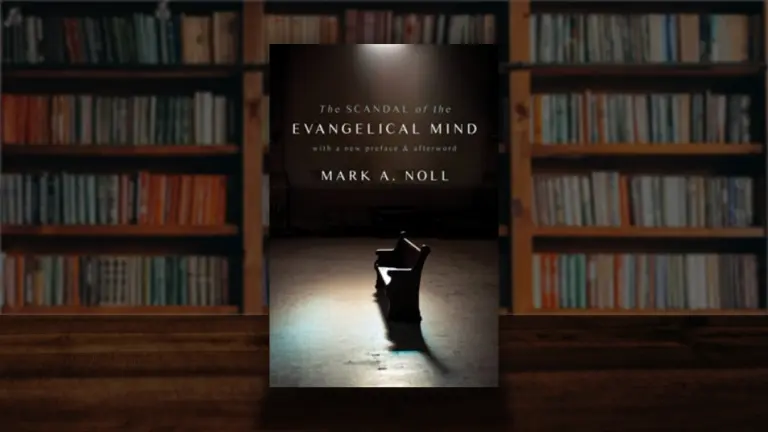
Admittedly, it’s a little odd to be reviewing a book that is thirty years old. But historian Mark Noll’s The Scandal of the Evangelical Mind, remains both pressing and prescient. He’s probably not happy about it.
Noll, an accomplished scholar and long-time professor at Wheaton, Notre Dame, and now Regent College, is an evangelical himself. The Scandal of the Evangelical Mind, then, was his “epistle from a wounded lover,” his “cri de couer.” In the preface, he describes the tension this caused him as a scholar and a committed Reformed Christian. “The thought has occurred to me regularly, that, at least in the United States, it is simply impossible to be, with integrity, both evangelical and intellectual.”
But Noll refused to give either up. And, of course, he’s right. Our faith can inform the deepest of questions and most cerebral of studies. “When we study something, we are of course learning about that thing,” Noll asserts, but even more we are “learning about the One that made that thing.” Evangelicals, he maintains, should push forward into science, the humanities, social sciences, political philosophy, with boldness and curiosity. This expansive faith, what twenty years ago might have been called a Christian worldview, should draw believers into wonder, into study in all sorts of academic disciplines, and ultimately into worship. Actually, Noll asserts, “to neglect…serious attention to the mind, nature, society, the arts–all spheres created by God and sustained for his own glory—may be, in fact, sinful.” (23) After all, as Jesus explained, we are to “love the Lord [our] God with all [our] heart and with all [our] soul and with all [our] mind.” (Matthew 22:37, emphasis mine).
This is certainly what I was taught at my Christ-centered college preparatory school. I studied European History and statistics and William Faulkner as well as Bible and apologetics. There was no contradiction. “All truth is God’s truth,” we were told repeatedly, encouraged to cultivate a “passion for learning.” It was this passion, this holy, fearless curiosity, that led me to graduate school and, ultimately, the professoriate. Still, my scholarly vocation and my belief in the gospel feel mutually sustaining.
So, why have modern American evangelicals historically been so averse to intellectual pursuits? Why, as Noll puts it, has there been a “failure to exercise the mind for Christ”? Why the huddling in fear?
Noll looks to the past. In elucidating how “the scandal came to pass,” he offers a sweeping history of Protestantism, finding a “rich heritage of fruitful intellectual labor,” from Luther to Calvin to Jonathan Edwards to John Winthrop, until the twentieth century. At this point, feeling besieged by theological modernism and cultural change, evangelicals opted to play defense. If the world was going to reject the supernatural fundamentals of the faith, they would simply “no longer pay attention to the world.” (123) They also adopted a simplistic, dogmatic literalism and dispensationalism, positing certainty and alienating dissenters. But their defense of supernatural truths of the faith (some of which, Noll admits, are important), meant that when they confronted the intellectual, theological, and cultural challenges of modernity “the cupboard was nearly bare.” (106) Even after the “intellectual disaster of Fundamentalism,” evangelicalism never recovered. Instead, Noll argues, evangelicalism held on to reductionist Biblicism and hysterical eschatology, with dire consequences for both politics and science. Which brings us to the present.
Noll wrote Scandal of the Evangelical Mind in 1994 with hope for intellectual renewal but also skepticism that evangelicalism could ever contribute to the life of the mind. “The recent past,” he admitted, “seems to point in no other direction.”(239) Again, Noll was right. And he is likely dismayed at how right. Modern American evangelicalism has doubled down on anti-intellectualism. And, unlike our historical forebears, this willful ignorance is not in service of any piety, but self-righteous anger and blind partisanship. Our “worst features” have remained our “methodological keystones,” leaving evangelicals woefully ill-equipped to face the pressing challenges of our day–economic inequality, technological change, globalization, climate change—susceptible to conspiratorial thinking, and lacking a winsome public witness.
There is some good news, though. And critiques of Scandal of the Evangelical Mind point the way, inviting big questions. First, the book has rightly been criticized for its exclusion of women as well as Black evangelicals. For instance, to the pressing question “Did American democracy have a place for one if one was Black?” Noll answers, “evangelicals gave little thought to the matter.” (74) Of course, Black evangelicals certainly did. Mary Beth Mathews’s Doctrine and Race and Daniel Bare’s Black Fundamentalists highlight examples of Black Christians who held evangelical theologies and devoted substantial intellectual effort to questions of racial justice. Why isn’t Dr. King, one of America’s great intellectual theologians, considered in the analysis? Isaac Sharp, in The Other Evangelicals, has shown how not only Black evangelicals, but feminist, liberal, and gay evangelicals were edged out, narrowing the story Noll tells. Another critique has to do with Noll’s geographical timeline. In his rendering, “evangelicals” in the Protestant Reformation, Scottish Enlightenment, American Revolution, and Early Republic made great intellectual contributions, only to be “hopelessly disfigured” by Fundamentalism. But, as historians–including Mark Noll!– well know, evangelicals made intellectual arguments for all kinds of nefarious enterprises, including slavery. Antebellum Southern evangelicals were evangelicals, too, invoking their Biblicism, their activism, to the cause of violence and plunder.
So what’s the good news here?
Matthew Sutton recently published an already field-defining essay, “Redefining the History and the Historiography on American Evangelicalism in the Era of the Religious Right.” In it, he traces the rise of a cadre of prominent religious historians, including Mark Noll, who developed an evangelical consensus school. These scholars, resisting what they saw a reactionary and anti-intellectual trends in the new Religious Right, created a more palatable “usable history,” first “retroactively” defining evangelicalism in broad and abstract terms, and then creating an unbroken lineage of both orthodoxy and orthopraxy throughout American history. This interpretation became very popular with historians and laypeople alike and remains so. But there is no “no multi-century evangelical throughline” at least not without a definition “so elastic you could stretch it to eternity,” and to invent one is to “decouple the movement from politics, race, class, gender and sexuality,” that is to say, historical and cultural realities. Modern evangelicalism, Sutton claims, is best understood less as the most recent iteration of a timeless theological lineage and more as a “religio-political coalition.” The term itself was adopted by a group of white Fundamentalists in the 1940s who were looking to rebrand and create an “effective political lobby,” one that would “represent the interests of socially and politically conservative Christians.” Sutton concludes, then, that modern American evangelicalism is best defined as “a white, patriarchal, nationalist, religious movement made up of Christians who seek power to transform American culture through conservative learning politics and free-market economics.”
Understanding evangelicalism this way helps make sense of the scandal of the evangelical mind and of the insistent anti-intellectualism that marks our current moment. It helps makes sense of the unreflective biblicism, the patriarchal heresies, the nationalist curriculum rewrites, the demonization of educators and professors and universities, of the slander and exclusion of evangelical scholars who transgress the cultural and political allegiances of evangelicalism—from Dr. Kristen Kobes du Mez to Dr. Jemar Tisby to Dr. Francis Collins to Dr. Tim Keller. Mark Noll seems to agree. See, while those who might theologically qualify as evangelical Christians can be found on both sides of the political aisle, doing science and writing history and theology, the lines of exclusion fall on purely political, reactionary grounds. In a new 2022 afterword to Scandal, Mark Noll admitted, “the word ‘evangelical’ is now next to worthless for serious investigation of questions about Christian faith and scholarship.”
It’s probably time to give up hope on the evangelical mind. Either its time has passed, or it’s been compromised in service to slavery and its afterlives, or it never really existed at all. But the good news is: we do not need to give up hope for the Christian mind. One that is not warped by partisan politics or degraded by seeking power. One that can hold wonder and mystery, that is humble and open, fixed on Jesus, and being renewed day by day.
When I walk into my classroom at a public, secular university, this is what I bring with me. There remains, for me, a truly sacred joy in collectively wondering about the past, in asking big questions about perspective and causality, in watching young people awaken to the world of ideas. In 1994, Mark Noll asked evangelicals not to “scorn the good gifts of a loving God.” That remains a good admonition–if we have ears to hear.
History and Religion
Previous Post

October 3, 2024
The River Empires of #VastEarlyAmerica
Next Post
October 8, 2024 Mothers, Children and the Body Politic: Pursuing Flourishing
Recent Comments
"I love horror but would have to acclimate back to Lovecraft and especially Machen. Have ..."
Fairies, Witches, Folk Horror, and the ..."
"Very good point about MacDonald.I am certainly a Machen fan!"
Fairies, Witches, Folk Horror, and the ..."
"The Scottish author George MacDonald integrated fairy world into his fiction in a way that ..."
Fairies, Witches, Folk Horror, and the ..."
"I like the idea that we can have different streams. The coffee analogy is genius."
How Do You Take Your Evangelicalism?
Browse Our Archives
Select a Category abolitionism Abortion Abraham Joshua Heschel Abraham Kuyper Abraham Lincoln Academia Activism Adam Renberg Advent Adventist africa African American Religion Agnes Howard Albert Camus American History American Religious History American Revolution American West Anabaptists Ancient History Andrea Turpin Andrei Tarkovsky Anglicanism Annales Ansley Lillian Quiros anti-Catholicism Antisemitism Anxious Bench apologetics Apparitions Arash Azizi Archaeology archives art Artificial Intelligence Asia Asian Americans Augustine Authors Bad Bunny Baptism Baptists Barack Obama Battle of Hastings Benjamin Franklin Bernard-Henri Levy Beth Allison Barr Beth Moore Bethany Mannon Bible Bill Cunningham Billy Graham Black Music Bob Dylan Body Boenhoffer Books Breastfeeding Bruce Springsteen C.S. Lewis Calvinism Cancel Culture Capitalism Carmelites Catholicism Cedric Robinson Cesar Chavez Charismaticism charity Charles Dickens Charles Lindbergh Che Guevara Chicago Children Chinese Christianity Chris Gehrz Christ Christian death Christian Higher Education Christian life Christian Nation Christian Nationalism Christianity Today Christmas Church life Church Practice cinema Civil Religion Civil Rights Movement Civil War civility Classics Climate Change Cold War Colonial Mexico colonialism Comer Communism community complementarianism Conference on Faith and History Congregationalism Conspiracies Conspiracy Conversion Narratives Coronavirus Costa Rica Council of Nicaea Covid-19 Creation Critical Race Theory Crusades Culture culture wars Daniel K. Williams David Barton David Swartz Death Ways death with dignity DEI democracy Democratic Party Devotion Digital Age Diplomacy discipleship diversity Donald Trump Drama Dua Lipa Early Church early modern Early modern Catholicism Easter Eastern Christianity economic exploitation Education elections Elie Wiesel Elizabeth II Elizabeth Taylor emotions Empire Engineering England enslavement Entertainment Episcopal Church Erica Ramirez eschatology Eurocentrism Evangelicalism Evangelicals Exegesis Family Feminism Film Flannery O'Connor folk music Food Foreign Policy founding fathers Franciscans Franciscus Junius fundamentalism Funerals G.K. Chesterton Gender Genocide genre geography George W. Bush George Washington George Whitefield Global Christianity Global church Grief Guadalupe Guest Post guest post gun control gun violence Gustavo Gutierrez Hamid Dabashi Harold John Ockenga Harvest Hate Hawaiian Christianity Healing health care Heather Cox Richardson Hell Heresy Hermeneutics Higher Education Hinduism Hippocratic oath Historical Fiction Historical Methodology Historical Profession Historical Profession Historical Theology Historical Thinking historiography Holidays Holocaust horror movies Human rights Humanitarian Work humanities Hummingbirds Hungary hymns Imago Dei Immigration Injustice Interviews Iran Islam Islamophobia Israel Ivan's Childhood Jacob Randolph James Bratt Janine Giordano Drake Japanese history Japanese Literature Jean Paul Sartre Jesse Miranda Jesus Jesus Christ Jimmy Carter Joan Baez Joan Didion Joanne Freeman João B. Chaves Joao Chaves Joey Cochran John Calvin John Fea John Tillotson John Turner Johnny Cash Jonathan Edwards Jonathan Tran Joseph Smith Josh Howerton Journalism Jr. Judaism Jürgen Moltmann Just War Justice Justin Brierley Karl Barth Katelyn Beaty koi ponds Kris Kristofferson Kristin Kobes Du Mez Latin American Religious History Latino Americans Lectio Divina Leisure Lent Leonard Cohen liberal arts liberalism Liberation Theology Linda Ronstadt Lisa Clark Diller Literature Lou Reed Lynchings Lynneth Miller Renberg Mainline Protestantism Malcolm Foley Marilyn Monroe Maritime history Mark Noll Marriage Martin Luther Martin Luther King Martyrdom Marxism Mary Masih Alinejad mass shootings material culture medieval Christianity Medieval Ethiopia Melissa Borja memory Mennonites Mental Health Mental Illness Methodism Mexican Americans Mexicans Mike Madrid Miles Mullin Min Jin Lee Miscarriage Missionaries Mister Rogers Mitt Romney modernity Monasticism Mormonism Motherhood Mothers of the Church Moving Music Musicals Nadya Williams Nahua Christianity Native Americans Natsume Sōseki New Contributor New England New Year New York Nico Non-Violent Protest Orthodoxy pacifism Paleo Evangelicals Palestinians Parenting Patti Smith Paul Kingsnorth Pedro Calderón de la Barca Pentecostalism Philip Jenkins Phillis Wheatley physician-assisted suicide pilgrimage Pilgrims pluralism Plutocracy Poetry Politics Pope Francis Pope Leo XIV post-modernism prayer preaching Presbyterians prosperity gospel Protest Public history Publishing Puritans purity culture Quakers race Race Massacres Racial Capitalism racial reconciliation racialization Racism Raha Bahloulipour Re-Enchantment reading Reformation Refugees religion and the university religion and war Religious Freedom Religious Nones Religious Pluralism Religious Symbols religious violence Republican Party Revival Rita Coolidge Ritual Roger Williams Roman Catholic church Royalty Russell Moore same-sex marriage Sarah Irving-Stonebraker Scandinavia Science Science and Technology Scopes trial Scriptural Interpretation secularism Selena Quintanilla seminary Seventh-Day Adventists sexual morality Sexuality Sikhs Silence slaveholders theology Slavery Slavoj Zizek social justice Social Media Southern Baptist Convention Southern Religion Spain Spiritual Autobiography Spiritual but not religious Spiritual Discipline Sports Stanley Hauerwas Suffering Summer Camps Sunday Night Odds and Ends Supernatural Supreme Court Syriac Christianity Tal Howard Taylor Swift Teaching Technology Television Thanksgiving The Beatles The Mission theater TheoBros Theology Thomas Dixon Thomas Jefferson Thomas Kidd Thomas Merton Tim Gloege Tim Walz Tom Holland Tourism tradition Tragedy Translation Transnationalism Travel Trump Ukraine Uncategorized Unitarians United Methodist Church US History Vanessa Chan Velvet Underground Verónica A. Gutiérrez Veronica Gutierrez Vikings Violence Virgin Mary Virtue Virtue ethics Visions Voting War WCTU Wendell Berry Westminster Assembly White Evangelicalism Wildfires Winnie the Pooh Witches women Women in Ministry Women's and Gender Studies Work Worship writing Yasunari Kawabata Zena Hitz
Select a Month October 2026 September 2026 August 2026 July 2026 June 2026 May 2026 April 2026 March 2026 February 2026 January 2026 December 2025 November 2025 October 2025 September 2025 August 2025 July 2025 June 2025 May 2025 April 2025 March 2025 February 2025 January 2025 December 2024 November 2024 October 2024 September 2024 August 2024 July 2024 June 2024 May 2024 April 2024 March 2024 February 2024 January 2024 December 2023 November 2023 October 2023 September 2023 August 2023 July 2023 June 2023 May 2023 April 2023 March 2023 February 2023 January 2023 December 2022 November 2022 October 2022 September 2022 August 2022 July 2022 June 2022 May 2022 April 2022 March 2022 February 2022 January 2022 December 2021 November 2021 October 2021 September 2021 August 2021 July 2021 June 2021 May 2021 April 2021 March 2021 February 2021 January 2021 December 2020 November 2020 October 2020 September 2020 August 2020 July 2020 June 2020 May 2020 April 2020 March 2020 February 2020 January 2020 December 2019 November 2019 October 2019 September 2019 August 2019 July 2019 June 2019 May 2019 April 2019 March 2019 February 2019 January 2019 December 2018 November 2018 October 2018 September 2018 August 2018 July 2018 June 2018 May 2018 April 2018 March 2018 February 2018 January 2018 December 2017 November 2017 October 2017 September 2017 August 2017 July 2017 June 2017 May 2017 April 2017 March 2017 February 2017 January 2017 December 2016 November 2016 October 2016 September 2016 August 2016 July 2016 June 2016 May 2016 April 2016 March 2016 February 2016 January 2016 December 2015 November 2015 October 2015 September 2015 August 2015 July 2015 June 2015 May 2015 April 2015 March 2015 February 2015 January 2015 December 2014 November 2014 October 2014 September 2014 August 2014 July 2014 June 2014 May 2014 April 2014 March 2014 February 2014 January 2014 December 2013 November 2013 October 2013 September 2013 August 2013 July 2013 June 2013 May 2013 April 2013 March 2013 February 2013 January 2013 December 2012 November 2012 October 2012 September 2012 August 2012 July 2012 June 2012 May 2012
Follow Us!
TAKE THE
Religious Wisdom Quiz
Who wrote many letters (epistles) in the New Testament?
Select your answer to see how you score.
Jude Paul Peter John
Related posts from Anxious Bench

What Coffee Reveals About America's Evangelical Varieties

A Casserole is Not a Counterpoint

Angelina Grimké's Forgotten Turn to Apocalyptic Faith
Angelina Grimké and the Turmoils of Perfection
TRENDING AT PATHEOS Evangelical

Nearly every morning, I make the drive to Detroit with my high-school-age...

The Real AI Story Is Adoption Without Trust
Artificial intelligence has crossed a political threshold. It is no longer a...

A new article, written by Jeff Lindsay and Gale L. Pooley,...

Swimfan: Forgotten Aughts Pleasures
This is a recovery effort. In 2002, My Big Fat Greek Wedding...

Top Three Anti-Catholic Lies About Catholicism
This is my initial transcript for the video, "THE 3 WORST...

Pope Leo Celebrates Mass for Nurses & Docs...
I don't have any idea how he did it, but Pope Leo...
view all Evangelical blogs
What Are Your Thoughts?leave a comment
Ad-Free & Subscriber Log-In Subscription Support
- About Us
- 2026 Calendar
- Videos
- Podcasts
- Library of World Religions
- Faith In Media Tracker
- Advertise With Us
- Write for Us
- Privacy Policy
- Terms of Service
- Do Not Sell My Data
- Contact Us
- Radiant Digital
- Manage Newsletter Subscriptions
- Unsubscribe From Notifications
- Sitemap
Copyright 2008-2026, Patheos. All rights reserved.
Subscription Support Ad-Free & Subscriber Log-In
Follow Patheos