
BuddhistCatholicContemplativeEvangelicalGeneral ChristianHinduJewishLatter-day SaintMuslimNew VisionsProgressive Christian
Beliefs
- Buddhist
- Catholic
- Contemplative
- Evangelical
- General Christian
- Hindu
- Jewish
- Latter-day Saint
- More Voices
- Muslim
- New Visions
- Pagan
- Progressive Christian
Topics
- Religion News
- Food and Religion
- Sports and Religion
- Religious Art
- Religious Music and Entertainment
- Religious Events
- History and Religion
- Style and Religion
- Politics and Religion
- Women in Religion
- Recreation Outdoors and Religion
- Business Finance and Religion
- Careers Workplace and Religion
- Education and Religion
- Family Parenting and Religion
- Health Fitness and Religion
- Home and Religion
- Relationships and Religion
- Technology and Religion
- Travel and Religion
Columnists
- Buddhist Columnists
- Business Finance and Religion Columnists
- Careers Workplace and Religion Columnists
- Catholic Columnists
- Contemplative Columnists
- Education and Religion Columnists
- Evangelists Columnists
- Family Parenting and Religion Columnists
- General Christian Columnists
- Health Fitness and Religion Columnists
- Hindu Columnists
- History and Religion Columnists
- Home and Religion Columnists
- Jewish Columnists
- More Voices Columnists
- Latter Day Columnists
- Muslim Columnists
- New Visions Columnists
- Nonreligious Columnists
- Pagan Columnists
- Politics and Religion Columnists
- Progressive Columnists
- Recreation Outdoors and Religion Columnists
- Relationships and Religion Columnists
- Religion News Columnists
- Religious Art Columnists
- Religious Events Columnists
- Religious Music and Entertainment Columnists
- Sports and Religion Columnists
- Style and Religion Columnists
- Technology and Religion Columnists
- Travel and Religion Columnists
- Women in Religion Columnists
Resource Library
- 2026 Calendar
- Library of World Religions
- The 100 Most Holy Places on Earth
- Patheos Answers
- Podcasts
- Videos
- Faith Leaders Database
- Anglican Episcopalian
- Bahai
- Baptist
- Buddhism
- Christianity
- Confucianism
- Eastern Orthodoxy
- Hinduism
- Holiness and Pentecostal
- ISKCON
- Islam
- Judaism
- Lutheran
- Methodist
- The Church of Jesus Christ of Latter-day Saints
- New Age
- Paganism
- Presbytarian and Reformed
- Protestantism
- Religion Behind the Scenes
- Roman Catholic
- Scientology
- Shia Islam
- Sikhism
- Sufism
- Sunni Islam
- Taoism
- Zen
- See all religions
Research Tools
 Ad-Free & Subscriber Log-In Subscription Support
Ad-Free & Subscriber Log-In Subscription Support
Follow Patheos 

- Trending:
- Forgiveness
- |
- Marriage
- |
- Consciousness
- |
- Death Penalty
- |
- Election
- |
- Halloween

-
About the Authors
- Home
- Evangelical
- Indigenous Intellectuals and their Writings, Reconsidered
Indigenous Intellectuals and their Writings, Reconsidered
Last updated on: October 15, 2024 at 9:59 am by Wyatt Reynolds
Indigenous Intellectuals and their Writings, Reconsidered 2024-10-15T09:59:03-04:00 Wyatt Reynolds
Patheos Explore the world's faith through different perspectives on religion and spirituality! Patheos has the views of the prevalent religions and spiritualities of the world.
Preface
I am currently in the third year of my PhD program in history, which means I am studying for my comprehensive exams. To non academics, this is a time when one reads more than is possible, attempting to retain as much as one can. At the end of the process, four professors will test me to ascertain if I am qualified to be called an expert in the four fields I am studying. For me, these fields are Colonial American History, 19th Century US History, Native American History, and Native American Literature. As I was frantically considering what to post here between reading the aforementioned mountain of books, I thought I might share with you a review essay I wrote as I was putting together my lists about a few books that while not representative of my studies, per se, are nonetheless interesting enough to discuss and focus on the Indigenous Intellectuals I study. Hopefully, dear reader, you will enjoy what follows.
“A form is simply something which allows something else to be transported from one site to another. Form then becomes one of the most important types of translation. To provide a piece of information is the action of putting something into a form.” ~Bruno Latour
“Sovereignty is when I speak my language” ~John Ridge, as written by Mary Katherine Nagle
Introduction
In this essay, I review The Life of William Apess, Pequot by Philip F. Gura; Assembled for Use: Indigenous Compilations and the Archives of Early American Literatures by Kelly Wisecup; Speaking for the People: Native Writing and the Question of Political Form by Mark Rifkin; and Samson Occom: Radical Hospitality in the Native Northeast by Ryan Carr. One volume considers larger collections of Native intellectual writings as archives and collaborative collections. Another looks at four distinct thinkers as an avenue for understanding relationality between individual representatives on Native nations, their communities, and the settler public. While the remaining two books are in-depth studies of particular intellectuals, their writings, and their contexts. Importantly, although often endorsed by historians, none of these books is written by a historian by training. Three of the authors reside in and hold terminal degrees in English while the third holds a doctorate in American Civilization and is spread between American Studies, English, and Religion. In a sense, this is unsurprising. Intellectual history has been on the outs within the guild for at least a decade. Most attention paid to what we might traditionally think of as intellectual history has come from scholars of literature and religion. As part of my review, I attempt to understand why this has been the case and what we may have lost in the process. Here I will consider each book briefly, in order of publication, on its own before turning to a synthetic analysis of the works and where they might guide future research and writing. Here I will make use of a panel I attended at a recent Ohmohundro Institute conference on “The Future of Vast Early America.”
The Life of William Apess, Pequot

Many, including Robert Warrior, assert that William Apess was the most important Native intellectual before the twentieth century. He was the most published Native author and spoke publicly with a fervor that shocked and awed white audiences. He has also been radically understudied. This short volume by Gura describes Apess as a theologian/pastor, intellectual, and social reformer. Despite this, until the 1990s, he remained almost entirely ignored by the academic community. His early life was quite tragic, including abuse and abandonment from parents and grandparents before being placed in the equivalent of foster care. After suffering abuse at the hands of both biological and foster families, Gura argues that “Christianity taught Apess to resist the self-loathing such treatment engendered.” The greatest strength of William Apess, Pequot is Gura’s incredibly deep knowledge of both the print and intellectual culture of New England as context for the paucity of sources directly related to the man himself. Particularly, Gura’s description of the debates between pro and anti-Native newspapers during the Mashpee controversy immerses one in granular details of the controversy. His understanding of Methodism in all its complexity at the time provides helpful perspective for understanding how Apess navigated the theological and practical waters of denominational life. More time might have been spent on Apess’s wife and the few sources we have from her as well as the small controversy over his death and its mirror in the death of David Walker. Additionally, although Gura does not focus on it, it is worth noting in the list of 48 books which Apess owned, a volume by Hannah Moore, a prominent British Abolitionist on spiritual and societal reform is included. This speaks both to Apess’s international perspective and his focus on social reform as a person of mixed-race ancestry. The book easily accomplishes Gura’s goal of presenting a “straightforward” account of Apess’s life in order to make him more accessible and recognizable as a crucial figure in the Early American republic.
Speaking for the People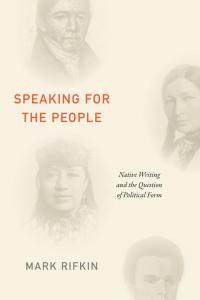
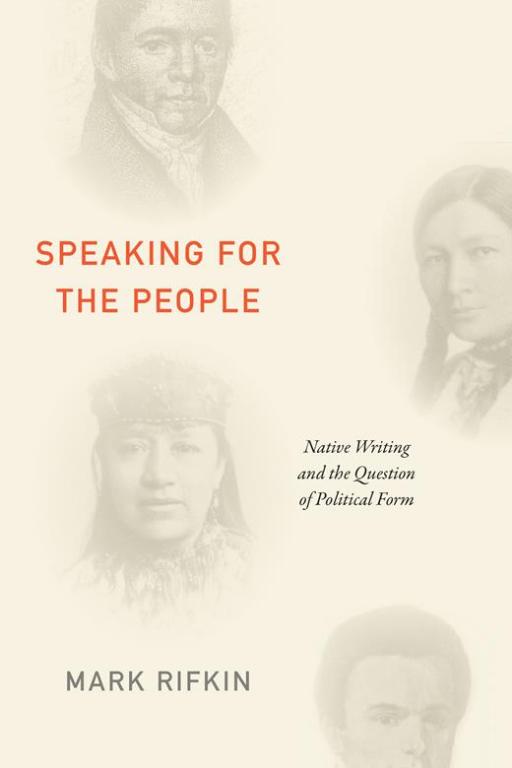
Mark Rifkin’s Speaking for the People, presents the most political account of Indigenous intellectuals among the volumes considered in this essay. Four such thinkers are considered. Alongside Apess, Rifkin introduces us to Elias Boudinot (Cherokee), William Apess (Pequot), Sarah Winnemucca (Paiute), and Gertrude Bonnin/Zitkala-Ša (Yankton Dakota). Using theoretical concepts propounded by Audra Simpson and Glen Coulthard, Rifkin analyzes these figures and their writings while particularly asking “Can refusal—the repudiation of settler frameworks operating on their own terms and toward their intended ends— dwell within what may look like the pursuit of recognition?” In a nineteenth century context, his answer is often yes. Throughout the volume we observe Rifkin’s four native intellectuals navigate the “dialectics of refusal and recognition.” Moving beyond recognition, Rifkin asks how his figures represent larger political groups both in the sense of acting as a proxy as well as creating a portrait of that group for a largely non-native audience. Here Rifkin argues against any sense of “authentic” Native-ness. For instance, many have looked at Elias Boudinot as being inauthentically Cherokee because he eventually signed the Treaty of New Echota, agreeing to Cherokee removal. By contrast, John Ross is often seen as more “authentically” Cherokee because he continued to resist removal. Rifkin argues we should actually see these differing strategies as distinct means of carrying on Cherokee-ness neither of which is more “real” than the other. To assume one is more authentically Cherokee or Indigenous is to limit Native cultures according to their legibility to white audiences. Although it would have been difficult, attention to the difference between Boudinot’s Cherokee language and English language writings could have bolstered the case Rifkin makes for Boudinot as continuing in Cherokee-ness. In many ways, Rifkin seems to see himself as responding to Lisa Brooks’s Common Pot, which he believes takes Native writers at face value without sufficient care or attention paid to the manner in which they are catering to the Settler imagination. While this may be a valid critique, it does at times seem shallow and to be comparing the incomparable as Brooks volume sits squarely in the eighteenth century compared to the nineteenth and even verging into the twentieth centuries where Speaking for the People occurs.
Assembled for Use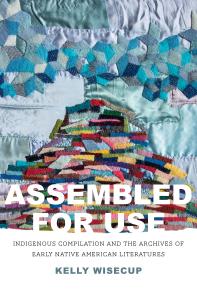
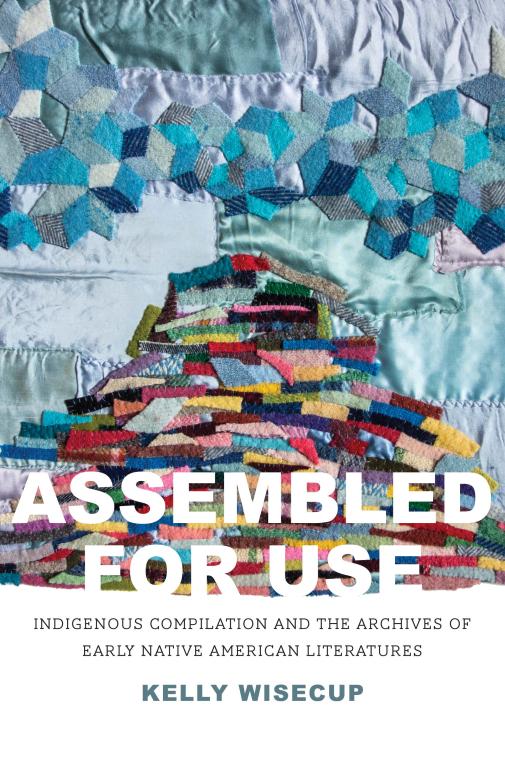
In Assembled for Use, Kelly Wisecup attempts to juxtapose Native texts from the eighteenth and nineteenth centuries with contemporary settler archives. This allows her to contrast how one might read and make use of these parallel sources for writing about the late colonial period all the way through the 1809s. The texts she asks her reader to attend to may at first appear uncanny. As she remarks early on, asking, “what… might [we] learn by reading texts long assumed both to lack readers and to elicit use rather than reading”? Hence, she looks at texts such as a collection of herbal remedies and recipes arranged by Samson Occom and the sue of quotations in John Ridge’s correspondence. These texts could even be considered utilitarian, but in Wisecup’s hands, the herbal recipes demonstrate how Occom healed and held together his community. Ridge’s quotations demonstrate… While Pokogon’s birchbark book reveals a materiality centered in an environmental critique of colonialism. Even these texts, which are more legible and seemingly prepared for the colonial archive “do important work on the page” and this “transforms narratives of non-reading and Indigenous objects of collection and study into one[s] of creative making, recontextualizing, and using within Native communities” Two categories of “reader” and “user” prove important for making sense of her project. The first represents a colonial observer audience and the second an indigenous audience which may or may not be literate, but is still able to make use of the given text. In short, by centering afterlives and unconventional archives, Wisecup seeks to destabilize colonial understandings of Indigenous texts. As she writes in her conclusion, The making, uses for, and circulations of Indigenous compilations expand our understandings of the hands that made early Native literatures, allowing us to recognize the relations among people already familiar in literary histories and those absent from such narratives but significant as requestors of healing, senders and readers of letters, singers of hymns, sewers of makaks, speakers of dialogues in an Indigenous language, and tellers of histories”
Samson Occom
Samson Occom was the first Native person to be ordained in the Christian church. History has tended to view him simply as a Native man who for all intents and purposes became white. According to this view, his various writings hold no particularly strong Indigenous perspective, nor do they attempt to resist colonialism or white supremacy. Ryan Carr challenges these perspectives in his meticulously researched recent biography. Here Occom becomes a multifaceted and radically complex figure who worked to create change under a veneer of supporting the status quo. In many ways, Samson Occom: Radical Hospitality in the Native Northeast should serve as a model for what engagement with and seriously considering early Native intellectuals look like. Not only is the introduction written by community members from Occom’s Native communities, but Carr in his research also discovered previously unknown texts owned, annotated, and written by his subject. Each of these pieces allows him to meticulously construct Occom’s theology, its political implications, and his tragic personal life.
In this way, Carr can also be seen as following the critique Wisecup has asked literary scholars to make in interrogating the archive. And indeed, Carr cites both Wisecup and Rifkin in sections considering archives and their legacies.
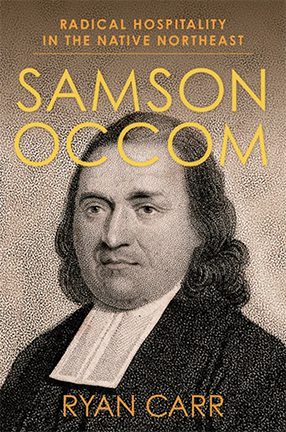 Carr presents three arguments in his argument about Occom: first, that Occom should be understood as a “traditionalist who sought to perpetuate rather than abandon Indigenous life ways…” Second, to protest the assumption that “Occom’s writings on religious topics were conventional, conformist, and/or derivative” of his Euro-American interlocutors. Finally, Carr argues that “Occom used evangelical discourse as a means of practicing his traditionalism in public.” I find Carr’s project remarkably compelling, and in several senses, it represents the cutting edge of Indigenous intellectual and religious history, practicing the methodological promiscuity urged on by Jean O’Brien and others. In addition to discovering previously unknown sources, including Occom’s personal, annotated copies of several works by Jonathan Edwards, Occom is displayed as the cosmopolitan figure he was. Carr puts a strong emphasis on his international ties and connections as well as the time he spent in British Isles. A representation of the ways in which he lives across boundaries is demonstrated in one of his school books where across seven pages and three languages, he wrote his identity: “Samson Occam Am Indian of Moyauhegonnuck Jure Hunc Librum Tenet.”
I am less convinced by Carr’s argument for Occom’s “traditionalism.” It seems clear that Carr understands himself to be defending Occom’s indigeneity against those who see his move to Brothertown as indicative of a shift toward adopting an overarching Euro-american mindset or worldview. Here Speaking for the People might have proved useful. I am quite skeptical that Occom was a “traditionalist” in any sense that word is used in religious history. Jaroslav Pelikan, the theologian and church historian, once remarked that “Tradition is the living faith of the dead. Traditionalism is the dead faith of the living, and I should note that traditionalism is what gives tradition a bad name.” Carr continually makes the point that Occom sought to use what he learned from Euro-Americans, particularly the transatlantic evangelical version of Christianity in order to reinvigorate his own communities’ lifeways. Occom often referred to this as “Our reformation.” In this sense, he was closer to Derrida’s original understanding of deconstruction as the taking apart and putting back together of a thing which one loves to ensure its continuance than he is to traditionalism. I worry that any claim towards “traditionalism” falls into the same conflict over authenticity that Rifkin demonstrates is both fruitless and an imposition from the white gaze in a Cherokee context. At his best, Carr clearly means something similar to Rifkin’s claim that there can be parallel, non-competing authenticities within Native communities. Despite this minor critique, Samson Occom: Radical Hospitality in the Native Northwest represents an important step for scholarship as Carr takes up the challenges brough to the field of Native Studies by books like Brooks’s Common Pot, Wisecup’s Assembled for Use, and Rifkin’s Speaking for the People.
Synthesis
The conversation between these books and their authors is complex to say the least. As mentioned, Carr cites Wisecup and Rifkin. Neither Wisecup nor Rifkin cite Gura; although Wisecup does reference Rifkin. Although, in a move that Gura would no doubt approve, Rifkin argues that Apess’s writing does not “so much prove Native sovereignty as presume it” Carr makes similar claims in defending Occom’s writings against those historians who see him as capitulating to the Euro-American imagination. It is also clear that Gura published at least six years before any of the other three. The explosion of literature in Native studies between 2015 and 2020 cannot be overestimated.
Another sense that draws these books together is their shared Latourian project of turning matters of fact (namely books as objects) into matters of concern (books/collections/pen strokes as things in a Heideggerian sense). While I think only Rifkin and perhaps Wisecup think of themselves as pursuing such a project, the care with which each of these authors observes what might in the past have been considered minutia demonstrates their perhaps unconscious presence in such work. Latour describes this phenomena as “What the etymology of the word thing—chose, causa, res, aitia—had conserved for us mysteriously as a sort of fabulous and mythical past has now become, for all to see, our most ordinary present. Things are gathered again.” In the post or metamodern world, we have begun again to find ways to understand the world around us as “enchanted” to borrow a commonly used theory word. However, it is important to note that since Native Americans were never allowed to be modern, in importance ways, their study never became fully removed from pre-modern understandings of reality and interconnectedness.
Provocation and the Future
As I think about the disconnects over religion, archives, and other problems between these books, part of the issue at hand appears to be a realization I had as I was thinking about the endorsements and acknowledgments from these books. I think this disconnect originates from the dual origins of NAIS. The two groups of scholars who came together to form the guild were largely anthropologists and theologians with a few Western historians. Thus, there is to this day an emphasis on one genealogy of Native history or the other, following ethnohistory and anthropology on the one hand and the dichotomous one primarily in religious studies and, sometimes messily, in English who follow the theologians. Vine Deloria, Jace Weaver, and Robert Warrior all received PhDs in Theology. These were the academic waters in which they learned to wade. Thus, they have a fundamentally different set of tools and means of looking at the academic world.
In thinking about all four of these works, I am broadly concerned with what moving the scholarly discourse around these figures into a broader complexity and knowledge looks like. In the most recent “state of the field” roundtable, The Society of American Intellectual history made this point: “Thus the individuals who would be the principal focus of intellectual historians would be those who think in public about matters of public concern.” While this article is over a decade old, it still raises problems for me here. Which public and whose concerns? In a sense, this question was raised parallel to intellectual history by Bruno Latour in his essay “Why Has Critique Run Out?” Latour answers his own question by demonstrating the limits of criticism as a skeptical taking apart, emphasizing instead the need for a positive project of criticism.
An example may prove useful. Beginning with Black Puritan, Black Republican in 2003, there has been a sub-genre of Black religious intellectuals studied in American Religious History. The Black church was one of the few avenues open for intellectual inquiry and output even in the North, prior to abolition. Scholars like Steven Harris and Jan Stievermann are expanding this category even now to demonstrate the depth of African-American political and theological thought during this period. There seems to be no major movement to separate these two facets of the African American intellectual tradition. It is confusing then why in the same period, when the two subjects seem inseparable except for the emerging White enlightenment thinker, we would divorce them for Native intellectuals as Rifkin and Wisecup tend to. As Doug Winiarski has noted, there appears to be an ongoing “Ontographic turn” among theorists. “Its leading lights include Bruno Latour in science studies” among others, such as Jane Bennet, Eduardo Viveiros de Castro, and Martin Holbraad. Winiarski describes this turn as taking seriously the world as inhabited and experienced by those who still believed in “dreams, trances, and visions. Where God spoke directly to ordinary people in an everyday voice…and where white children spoke in unknown Indian tongues…” Why should we not also take such phenomena seriously in Indigenous intellectual and religious history during this same period of vast early America? Native Americans, even the most educated were still far removed from Enlightenment understandings of religion and spiritual phenomena. It seems to me that taking this sort of perspective, like Wisecup look seriously at Native writings as created for both settler and Indigenous audiences only grants us a broader scope in which to see and understand those whom we study. As Robert Orsi has written, “The alternative to historiography without gods is one that allows another reality to break into history and theory, not to destroy them but to enlarge them.”
Works Cited
Bender, Thomas. 2012. “Forum: The Present and Future of American Intellectual History, Introduction.” Modern Intellectual History 149-156.
Carr, Ryan. 2023. Samson Occom: Radical Hospitality in the Native Northeast. New York: Columbia University Press.
Gura, Philip. 2015. The Life of William Apess, Pequot. Chapel Hill: University of North Carolina Press.
Latour, Bruno. 2004. “Why Has Critique Run out of Steam? From Matters of Fact to Matters of Concern.” Critical Inquiry 225-248.
Nagle, Mary Kathryn. 2020. Sovereignty: A Play. Evanston: Northwestern University Press.
Pelikan, Jaroslav. 1984. The Vindication of Tradition. New Haven: Yale University Press.
Rifkin, Mark. 2021. Speaking for the People: Native Writing and the Question of Political Form. Durham: Duke University Press.
Winiarski, Doug. 2023. “Early American Religious History in the Ontographic Grain.” Ohmohundro Institute. Williamsburg: N.A. 1-11.
Wisecup, Kelly. 2021. Assembled for Use: Indigenous Compilation and the Archives of Early American Literature. New Haven: Yale University Press.
Previous Post

October 14, 2024
America's Other Universities
Next Post

October 17, 2024 How a Mediterranean Spiritual Movement Went Global
Recent Comments
"I love horror but would have to acclimate back to Lovecraft and especially Machen. Have ..."
Fairies, Witches, Folk Horror, and the ..."
"Very good point about MacDonald.I am certainly a Machen fan!"
Fairies, Witches, Folk Horror, and the ..."
"The Scottish author George MacDonald integrated fairy world into his fiction in a way that ..."
Fairies, Witches, Folk Horror, and the ..."
"I like the idea that we can have different streams. The coffee analogy is genius."
How Do You Take Your Evangelicalism?
Browse Our Archives
Select a Category abolitionism Abortion Abraham Joshua Heschel Abraham Kuyper Abraham Lincoln Academia Activism Adam Renberg Advent Adventist africa African American Religion Agnes Howard Albert Camus American History American Religious History American Revolution American West Anabaptists Ancient History Andrea Turpin Andrei Tarkovsky Anglicanism Annales Ansley Lillian Quiros anti-Catholicism Antisemitism Anxious Bench apologetics Apparitions Arash Azizi Archaeology archives art Artificial Intelligence Asia Asian Americans Augustine Authors Bad Bunny Baptism Baptists Barack Obama Battle of Hastings Benjamin Franklin Bernard-Henri Levy Beth Allison Barr Beth Moore Bethany Mannon Bible Bill Cunningham Billy Graham Black Music Bob Dylan Body Boenhoffer Books Breastfeeding Bruce Springsteen C.S. Lewis Calvinism Cancel Culture Capitalism Carmelites Catholicism Cedric Robinson Cesar Chavez Charismaticism charity Charles Dickens Charles Lindbergh Che Guevara Chicago Children Chinese Christianity Chris Gehrz Christ Christian death Christian Higher Education Christian life Christian Nation Christian Nationalism Christianity Today Christmas Church life Church Practice cinema Civil Religion Civil Rights Movement Civil War civility Classics Climate Change Cold War Colonial Mexico colonialism Comer Communism community complementarianism Conference on Faith and History Congregationalism Conspiracies Conspiracy Conversion Narratives Coronavirus Costa Rica Council of Nicaea Covid-19 Creation Critical Race Theory Crusades Culture culture wars Daniel K. Williams David Barton David Swartz Death Ways death with dignity DEI democracy Democratic Party Devotion Digital Age Diplomacy discipleship diversity Donald Trump Drama Dua Lipa Early Church early modern Early modern Catholicism Easter Eastern Christianity economic exploitation Education elections Elie Wiesel Elizabeth II Elizabeth Taylor emotions Empire Engineering England enslavement Entertainment Episcopal Church Erica Ramirez eschatology Eurocentrism Evangelicalism Evangelicals Exegesis Family Feminism Film Flannery O'Connor folk music Food Foreign Policy founding fathers Franciscans Franciscus Junius fundamentalism Funerals G.K. Chesterton Gender Genocide genre geography George W. Bush George Washington George Whitefield Global Christianity Global church Grief Guadalupe Guest Post guest post gun control gun violence Gustavo Gutierrez Hamid Dabashi Harold John Ockenga Harvest Hate Hawaiian Christianity Healing health care Heather Cox Richardson Hell Heresy Hermeneutics Higher Education Hinduism Hippocratic oath Historical Fiction Historical Methodology Historical Profession Historical Profession Historical Theology Historical Thinking historiography Holidays Holocaust horror movies Human rights Humanitarian Work humanities Hummingbirds Hungary hymns Imago Dei Immigration Injustice Interviews Iran Islam Islamophobia Israel Ivan's Childhood Jacob Randolph James Bratt Janine Giordano Drake Japanese history Japanese Literature Jean Paul Sartre Jesse Miranda Jesus Jesus Christ Jimmy Carter Joan Baez Joan Didion Joanne Freeman João B. Chaves Joao Chaves Joey Cochran John Calvin John Fea John Tillotson John Turner Johnny Cash Jonathan Edwards Jonathan Tran Joseph Smith Josh Howerton Journalism Jr. Judaism Jürgen Moltmann Just War Justice Justin Brierley Karl Barth Katelyn Beaty koi ponds Kris Kristofferson Kristin Kobes Du Mez Latin American Religious History Latino Americans Lectio Divina Leisure Lent Leonard Cohen liberal arts liberalism Liberation Theology Linda Ronstadt Lisa Clark Diller Literature Lou Reed Lynchings Lynneth Miller Renberg Mainline Protestantism Malcolm Foley Marilyn Monroe Maritime history Mark Noll Marriage Martin Luther Martin Luther King Martyrdom Marxism Mary Masih Alinejad mass shootings material culture medieval Christianity Medieval Ethiopia Melissa Borja memory Mennonites Mental Health Mental Illness Methodism Mexican Americans Mexicans Mike Madrid Miles Mullin Min Jin Lee Miscarriage Missionaries Mister Rogers Mitt Romney modernity Monasticism Mormonism Motherhood Mothers of the Church Moving Music Musicals Nadya Williams Nahua Christianity Native Americans Natsume Sōseki New Contributor New England New Year New York Nico Non-Violent Protest Orthodoxy pacifism Paleo Evangelicals Palestinians Parenting Patti Smith Paul Kingsnorth Pedro Calderón de la Barca Pentecostalism Philip Jenkins Phillis Wheatley physician-assisted suicide pilgrimage Pilgrims pluralism Plutocracy Poetry Politics Pope Francis Pope Leo XIV post-modernism prayer preaching Presbyterians prosperity gospel Protest Public history Publishing Puritans purity culture Quakers race Race Massacres Racial Capitalism racial reconciliation racialization Racism Raha Bahloulipour Re-Enchantment reading Reformation Refugees religion and the university religion and war Religious Freedom Religious Nones Religious Pluralism Religious Symbols religious violence Republican Party Revival Rita Coolidge Ritual Roger Williams Roman Catholic church Royalty Russell Moore same-sex marriage Sarah Irving-Stonebraker Scandinavia Science Science and Technology Scopes trial Scriptural Interpretation secularism Selena Quintanilla seminary Seventh-Day Adventists sexual morality Sexuality Sikhs Silence slaveholders theology Slavery Slavoj Zizek social justice Social Media Southern Baptist Convention Southern Religion Spain Spiritual Autobiography Spiritual but not religious Spiritual Discipline Sports Stanley Hauerwas Suffering Summer Camps Sunday Night Odds and Ends Supernatural Supreme Court Syriac Christianity Tal Howard Taylor Swift Teaching Technology Television Thanksgiving The Beatles The Mission theater TheoBros Theology Thomas Dixon Thomas Jefferson Thomas Kidd Thomas Merton Tim Gloege Tim Walz Tom Holland Tourism tradition Tragedy Translation Transnationalism Travel Trump Ukraine Uncategorized Unitarians United Methodist Church US History Vanessa Chan Velvet Underground Verónica A. Gutiérrez Veronica Gutierrez Vikings Violence Virgin Mary Virtue Virtue ethics Visions Voting War WCTU Wendell Berry Westminster Assembly White Evangelicalism Wildfires Winnie the Pooh Witches women Women in Ministry Women's and Gender Studies Work Worship writing Yasunari Kawabata Zena Hitz
Select a Month October 2026 September 2026 August 2026 July 2026 June 2026 May 2026 April 2026 March 2026 February 2026 January 2026 December 2025 November 2025 October 2025 September 2025 August 2025 July 2025 June 2025 May 2025 April 2025 March 2025 February 2025 January 2025 December 2024 November 2024 October 2024 September 2024 August 2024 July 2024 June 2024 May 2024 April 2024 March 2024 February 2024 January 2024 December 2023 November 2023 October 2023 September 2023 August 2023 July 2023 June 2023 May 2023 April 2023 March 2023 February 2023 January 2023 December 2022 November 2022 October 2022 September 2022 August 2022 July 2022 June 2022 May 2022 April 2022 March 2022 February 2022 January 2022 December 2021 November 2021 October 2021 September 2021 August 2021 July 2021 June 2021 May 2021 April 2021 March 2021 February 2021 January 2021 December 2020 November 2020 October 2020 September 2020 August 2020 July 2020 June 2020 May 2020 April 2020 March 2020 February 2020 January 2020 December 2019 November 2019 October 2019 September 2019 August 2019 July 2019 June 2019 May 2019 April 2019 March 2019 February 2019 January 2019 December 2018 November 2018 October 2018 September 2018 August 2018 July 2018 June 2018 May 2018 April 2018 March 2018 February 2018 January 2018 December 2017 November 2017 October 2017 September 2017 August 2017 July 2017 June 2017 May 2017 April 2017 March 2017 February 2017 January 2017 December 2016 November 2016 October 2016 September 2016 August 2016 July 2016 June 2016 May 2016 April 2016 March 2016 February 2016 January 2016 December 2015 November 2015 October 2015 September 2015 August 2015 July 2015 June 2015 May 2015 April 2015 March 2015 February 2015 January 2015 December 2014 November 2014 October 2014 September 2014 August 2014 July 2014 June 2014 May 2014 April 2014 March 2014 February 2014 January 2014 December 2013 November 2013 October 2013 September 2013 August 2013 July 2013 June 2013 May 2013 April 2013 March 2013 February 2013 January 2013 December 2012 November 2012 October 2012 September 2012 August 2012 July 2012 June 2012 May 2012
Follow Us!
TAKE THE
Religious Wisdom Quiz
True or False: Ezekiel saw a vision of a valley of dry bones that came to life.
Select your answer to see how you score.
FALSE TRUE
Related posts from Anxious Bench
Christians Helped Invent Race. Some Now Call It...
Why Hymns and Poems Count as Real Theology

What Coffee Reveals About America's Evangelical Varieties

A Casserole is Not a Counterpoint
TRENDING AT PATHEOS Evangelical

The First Eucharistic Controversy: Christ’s Real Presence
For Catholics, the Eucharist is the source and summit of the Christian...

What a Stop Sign Can Teach Us About...
How to Make a Decision When You Can't Hear God Main point:...

Archdiocese Hosts Military Marriage Retreat in Germany
RASTATT, Germany — The transient military lifestyle, with its frequent deployments and...

Nearly every morning, I make the drive to Detroit with my high-school-age...

The Real AI Story Is Adoption Without Trust
Artificial intelligence has crossed a political threshold. It is no longer a...

A new article, written by Jeff Lindsay and Gale L. Pooley,...
view all Evangelical blogs
What Are Your Thoughts?leave a comment
Ad-Free & Subscriber Log-In Subscription Support
- About Us
- 2026 Calendar
- Videos
- Podcasts
- Library of World Religions
- Faith In Media Tracker
- Advertise With Us
- Write for Us
- Privacy Policy
- Terms of Service
- Do Not Sell My Data
- Contact Us
- Radiant Digital
- Manage Newsletter Subscriptions
- Unsubscribe From Notifications
- Sitemap
Copyright 2008-2026, Patheos. All rights reserved.
Subscription Support Ad-Free & Subscriber Log-In
Follow Patheos