
BuddhistCatholicContemplativeEvangelicalGeneral ChristianHinduJewishLatter-day SaintMuslimNew VisionsProgressive Christian
Beliefs
- Buddhist
- Catholic
- Contemplative
- Evangelical
- General Christian
- Hindu
- Jewish
- Latter-day Saint
- More Voices
- Muslim
- New Visions
- Pagan
- Progressive Christian
Topics
- Religion News
- Food and Religion
- Sports and Religion
- Religious Art
- Religious Music and Entertainment
- Religious Events
- History and Religion
- Style and Religion
- Politics and Religion
- Women in Religion
- Recreation Outdoors and Religion
- Business Finance and Religion
- Careers Workplace and Religion
- Education and Religion
- Family Parenting and Religion
- Health Fitness and Religion
- Home and Religion
- Relationships and Religion
- Technology and Religion
- Travel and Religion
Columnists
- Buddhist Columnists
- Business Finance and Religion Columnists
- Careers Workplace and Religion Columnists
- Catholic Columnists
- Contemplative Columnists
- Education and Religion Columnists
- Evangelists Columnists
- Family Parenting and Religion Columnists
- General Christian Columnists
- Health Fitness and Religion Columnists
- Hindu Columnists
- History and Religion Columnists
- Home and Religion Columnists
- Jewish Columnists
- More Voices Columnists
- Latter Day Columnists
- Muslim Columnists
- New Visions Columnists
- Nonreligious Columnists
- Pagan Columnists
- Politics and Religion Columnists
- Progressive Columnists
- Recreation Outdoors and Religion Columnists
- Relationships and Religion Columnists
- Religion News Columnists
- Religious Art Columnists
- Religious Events Columnists
- Religious Music and Entertainment Columnists
- Sports and Religion Columnists
- Style and Religion Columnists
- Technology and Religion Columnists
- Travel and Religion Columnists
- Women in Religion Columnists
Resource Library
- 2026 Calendar
- Library of World Religions
- The 100 Most Holy Places on Earth
- Patheos Answers
- Podcasts
- Videos
- Faith Leaders Database
- Anglican Episcopalian
- Bahai
- Baptist
- Buddhism
- Christianity
- Confucianism
- Eastern Orthodoxy
- Hinduism
- Holiness and Pentecostal
- ISKCON
- Islam
- Judaism
- Lutheran
- Methodist
- The Church of Jesus Christ of Latter-day Saints
- New Age
- Paganism
- Presbytarian and Reformed
- Protestantism
- Religion Behind the Scenes
- Roman Catholic
- Scientology
- Shia Islam
- Sikhism
- Sufism
- Sunni Islam
- Taoism
- Zen
- See all religions
Research Tools
 Ad-Free & Subscriber Log-In Subscription Support
Ad-Free & Subscriber Log-In Subscription Support
Follow Patheos 

- Trending:
- Forgiveness
- |
- Marriage
- |
- Consciousness
- |
- Death Penalty
- |
- Election
- |
- Halloween

-
About the Authors
- Home
- Evangelical
- Teaching the Faith and Fomenting Contempt in the Reformation
Teaching the Faith and Fomenting Contempt in the Reformation
Last updated on: September 20, 2024 at 12:31 pm by Jacob Randolph
Teaching the Faith and Fomenting Contempt in the Reformation 2024-09-20T12:31:16-04:00 Jacob Randolph
Patheos Explore the world's faith through different perspectives on religion and spirituality! Patheos has the views of the prevalent religions and spiritualities of the world.
I have been preoccupied over the last few months by the subject of tradition in the Reformation—how it is constructed, where it is appropriated, and where the self-conscious breaks occur. As part of that preoccupation, I’ve turned numerous times to the question of transmission. How is the faith being passed on to the next generation when new beliefs and new ways of being Christian appear in the 16th century? One way this transmission happened frequently was in the writing and disseminating of new catechisms, manuals instructing parishioners in the basics of the Christian faith.
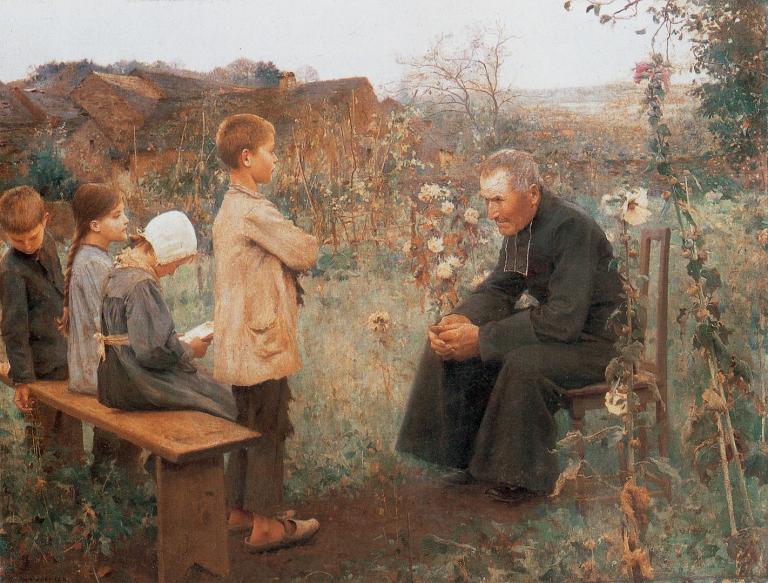
The Catechism Lesson, Jules-Alexis Meunier, 1890
By all accounts, it would be quite fitting to call the sixteenth century, if not the age of catechesis, at least the age of the catechism. In the decades after Luther’s break with Rome, it seems that every churchman with at least a meagre education and a modicum of influence issued a program for pastoral education of the laity. Most of these catechisms shared a basic form centered around the Creed, the Lord’s Prayer, and the Ten Commandments along with some confessional statements about the sacraments. Many of them were in question-and-answer format, and within catechesis the subgenre of children’s education was quite popular.
Most catechisms were quite similar in their structure. But sometimes, much to the delight of sixteenth century readers and myself, the writers of catechisms would go “off script” as it were, often to indulge in some controversial theology, creative adaptation, confessional bugaboos, and a little bit of name-calling. The presence of polemic in these teaching manuals suggests to me that the catechetical genre could be quite flexible in scope and purpose. Rather than just giving instructions in the long-revered basics of the Creed, the Prayer, the Ten Commandments—church leaders could use these manuals to construct new religious borders, to chastise one’s neighbors or family members, or to insult one’s religious enemies.
In the past, confessional Protestant histories have been quick to emphasize that 1) post-Tridentine Catholic catechesis was especially polemical in its approach and 2) the great catechists of Protestantism largely avoided polemic in their works. This is true, as far as it goes. Luther’s 1528 Small Catechism was indeed more reserved in tone than some of his other, more salty treatises, while Robert Bellarmine’s famous catechism of 1597 was certainly polemical at many points. But the picture is more complicated.
The desire to “play nice” was not shared by all those who engaged in early attempts at Protestant catechesis, especially in places where the question of religious adherence was a live and contentious one. Today, I’ll illustrate this fact with three documents that arose in varying cultural and confessional contexts: Balthasar Hubmaier’s 1526 Anabaptist catechism, William Roye’s A Brefe Dialogue Between a Christian Father and His Stubborn Son of 1527, and John Carswell’s 1567 Scottish catechism found in his Foirm na n-Urrnuidheadh, a Gaelic translation of John Knox’s liturgy.
Three Pioneers of Religious Education
I’ll spare you the long version of how all three of these came to be. Suffice it to say, all three of these are historically important, although none of them had lasting influence in the movements they represent. Yet they all share characteristics that may prove helpful in looking at the function of polemic as a rhetorical device. First, all three are pioneering works in their respective territories of Moravia, England, and Scotland, being the first vernacular catechisms in print in each location. Second, all three employ a question-and-answer format and a focus on the education of youths. And third, all three draw on, yet significantly alter, preexisting catechetical source material. To further frame this exploration, I’ll note these works’ stated purpose and the varying points in the teaching when harsh rhetoric surfaces to see if there are any clues as to why such rhetoric was deemed useful in Christian education.
(One more note—someone may ask the question of whether all catechisms are inherently polemical. To this I answer, yes, all are by virtue of their exclusionary nature. But this does not mean that all catechesis uses the rhetorical device of polemic. The use of polemic as a device means that a text uses language self-consciously to attack, delegitimize, or suppress a literarily constructed “other,” to recognize the proximity of that other only to deny them a voice and dismiss their claims as self-evidently wrong. Here I’m drawing on Peter Matheson, Almut Suerbaum, George Southcombe and others.)
So let’s look at the stated purposes of these works first. On the face of it, the three catechisms are written to aid in the education of youths and to remediate the knowledge of the laity who had been failed by the clergy of the land. The prefatory material of each work serves as a springboard into later anticlerical language in each catechism.
Balthasar Hubmaier’s 1526 catechism is dedicated to Martin Göschl, erstwhile prior of the Kanitz monastery who settled in Nikolsburg, Moravia in 1526, shortly before Hubmaier arrived in the summer of that year. In his dedication, Hubmaier notes that it was Göschl who requested the catechism so that youths could be given pure doctrine that had for so long been “congealed in the mire and mud puddles of human precepts.” He writes that the church was plagued by “incompetent shepherds and pastors…whom we would in truth not have trusted to herd our pigs and goats, but still we had to accept them as our souls’ shepherds.” For Hubmaier, such men were not priests of the Mass but of Maoz, the foreign idol of Daniel 11:38 who must be honored with gold, silver, and precious stones. Hubmaier states that his catechism was written to provide “food and drink” for youths, to rectify his previous errors in doctrine, and to provide clear teaching of what one must know before receiving baptism into the “holy, universal Christian church.”
In the dedication of Roye’s Brief Dialogue, Roye states that he wanted to produce a text to aid the common person’s capacity which had been stifled under “great superstition which so long hath reigned and had the upper hand.” He was moved to do so because he thought it “most grievous to see the price of the precious blood of Christ so despitefully to be trodden under foot by such unclean swine”—that is, by the leading clergy of the Roman church. As Roye would have it, he stumbled on “a treatise most excellent” that was fitting for his cause. This, we now know, was Wolfgang Capito’s 1527 Kinderbericht, written in both German and Latin.
In the case of Carswell, no preface to the catechism is given, although the prefatory material for the Form provides hints as to the catechism’s role. In his dedication to the earl of Argyll, Carswell noted that “this testimony of Christ has been suppressed, and drowned, and polluted” by “the oppression of the Pope and other false apostles who have deceived the whole world…through great ignorance.” Thus, Carswell felt compelled as by God to “help the Christian brethren who have need of teaching and of comfort, and who have no books.” Like Roye, Carswell presented his work primarily as translation but, like Roye, Carswell took significant liberties with the Genevan shorter catechism, essentially creating an altogether new catechism based loosely on Calvin’s earlier work.

First page of Carswell’s 1567 catechism, “The manner to examine children before the supper of the Lord”
The prefatory material of the three works utilizes various, sometimes contradictory language to refer to Roman interference with true teaching; it could be simultaneously priestly ignorance and conspiratorial obfuscation; both the novelty of the medieval doctors and the blind obedience to ancient customs. In every case though, language of darkness and suppression appear. While this is significant, it is not in and of itself unique. After all, Luther’s small catechism was also prefaced by noting its necessity due to lack of teaching and lack of urgency among ministers and the laity. But the remedial purpose, paired with the catechisms’ shared status as texts situated on the front line of a burgeoning reform movement, suggests that defense against superstition and false teaching was an essential element in educating in the faith. They were not written with a long view in mind—catechesis for a reformed and socially stable church—but rather were created ad hoc for a decisive moment in time, a period of nascent religious pluralism in Europe, when the need was urgent and the stakes were high. We gain further insight into catechetical polemic by looking at individual questions and answers that focus on creating distance between the catechumen and the threatening religious “other.”
Teaching in the Trenches
All three catechisms use the pedagogical format of a question-answer dialogue to point sharp words at their traditional education, or lack thereof, in the Roman rite. The objects of their ire are not surprising—the Eucharist, images, baptism, veneration of the saints—but the language is at times shockingly pointed. The questions on the sacraments are particularly telling. For Hubmaier, infant baptism is nothing but a “bath” administered by those who are “water-priests.” Hubmaier’s constructed dialogue partners, Leonhard and Hans, also take up the question of the Mass. Leonhard asks, “what is the mass?” And Hans answers: “It is the very idol and abomination spoken of by the Prophet Daniel…By his honor he is recognized as the kind of God he is to the papists, maozites, mass-priests, sophists, and all belly-Christians.” Roye’s catechism addresses the question of why the doctrine of transubstantiation was not true, as the son in the catechism says, “as they whom men call ghostly fathers, doctors, and preachers do affirm?” The father answers that “they being blind would fain lead other blind with them into the pit of error.” Carswell notes that “they are directly opposed to each other, the mode of administering the sacrament according to Christ…and the mode followed in the popish mass.”
On the question of images, Roye notes that “maintainers of such abominable seductions” are “Baal’s priests” who “have no god saving their belly only.” So too Carswell, typically the most reserved of the three catechists, writes that “the erring priests stole away [the commandment against idols] from the Christian people, that they might place these lying images before the people as deceiving shadows in their own place, and so escape the performance of their own duty to the people, and besides from love to the gain they might obtain from the ignorant people in honor of these accursed images.”
Indeed, any clerical traditions that reinforce the traditional church hierarchy become the targets of Hubmaier, Roye, and Carswell. Hubmaier, drawing again on the apocalyptic imagery of Daniel, notes that the only true vow is the baptismal pledge that takes place in water baptism, a vow that has been lost for a thousand years. “Meanwhile,” Hubmaier writes, “Satan has forced his way in with his monastic vows and priestly vows and established them in the holy place.” Roye writes that such vows, like voluntary poverty, are taken by “belly beasts whom men call monks, friars, canons, nuns” who “promise they never will have thing in proper and yet in the meanwhile they devour up the blood and sweat of the other poor people.” On the question of following church tradition, Carswell writes that the command of God “was dimmed, or concealed, or corrupted very much in the time past, through the covetousness and ignorance of the priests.”
So what?
It’s clear from the brief scan over these three texts that anticlericalism and antifraternalism stand behind many of their authors’ choices. Why might polemic have been used in catechesis? I am hesitant to make any definitive statements based on three catechisms, and I recognize that the reasons are likely manifold and highly contextual. The varied social situations of even these three catechisms resist any imposed uniformity. So in lieu of any pronouncements, I have three hypotheses that are open to further testing.
-
Influence of the 16th century pamphlet wars on Reformation writing
In the case of both Roye and Hubmaier, we cannot discount the situation of the mid-to-late 1520s. Mark Edwards, Miriam Chrisman, Amy Nelson-Burnett, Andrew Pettegree and others have opened our eyes to the power of the pamphlet and its attendant rhetoric. Controversial literature was the demand of the day, the earthy language of the early Reformation as it took shape in the minds and mouths of the city and town. The abundance of pamphlets helped shape the opinions of the laity—but one wonders if they did not also shape the overall style and form of writing in the early sixteenth century. Was the literary atmosphere so saturated with polemic as to dampen the effectiveness of other written forms?
2. The social setting
It may be that many catechisms that utilize polemic share a similar social situation, as these three do. All three catechisms form part of a program of early literary penetration into a cultural vernacular. For Hubmaier, Roye, and Carswell, catechesis, for whatever reason, seemed a fitting mode for pressing the front line of a nascent ecclesiastical regime change. In such a context, the boundaries of community identity are reinforced not only by illustrating adherence to right belief but by self-consciously creating metaphysical distance where spatial distance is not yet possible. This is done by giving new believers conceptual tools to actively shape opponents (in this case, Catholic clergy) into objects of contempt, presumably through rote memorization. This may also help explain why polemic as a rhetorical device does not appear in catechisms like that of Geneva. For Calvin, his catechisms of 1538 and 1541 appeared as the fruit of a constitutionally ratified, city-administered reform movement already in process. He explicitly expresses a desire to avoid whatever is not basic and universal in Christian education, noting that catechists who are intent on “disseminating controversial matters in religion” profane baptism and fatally injure the church.
3. Fluidity of literary genre
The above points suggest that catechesis could be used not only for cross-generational transmission of the faith within the worshipping community but also for persuasion of potential converts. Ian Hazlett suggests this is the case with Carswell’s catechism: “The Strasbourg and Genevan catechisms were intentionally not overtly contentious, but Carswell’s introduces controversial elements and tones presupposing debate…An understanding of this gear change is that while Genevan non-polemical catechisms had existing Reformation communities primarily in mind, Carswell’s version also aimed to convert Catholics.” Eamon Duffy also points to the use of catechesis in English contexts as a tool of conversion, to “bring the tepid to a boil…to arouse to faith.” Indeed, this is suggested in the prefatory material of the three texts surveyed above. Such a purpose betrays the stated function of our three catechisms, the education of youths—or perhaps it expands what is meant by “youths” to include those who are young in belief, or those childishly holding on to irrational beliefs.
So were such catechisms written to create distance between the religious pure and their enemies, or to draw vacillating enemies into the fold of the faithful? Were they written to aid believing parents in the education of their children, or to convince doctrinally unstable parents on the prevailing questions of the day? Were they forms of interrogation or thinly veiled charges of apostasy? It may well be that authors of such works were so enraptured in the gravity of their respective moments, so consumed with zeal for the new faith, and so anxious in anticipation of the future, that they themselves were not interested in parsing out the distinctions assumed by such questions.
While lack of education of the laity had been a trope of church leaders’ complaints for centuries, it wasn’t until the Protestant Reformation ignited the ancient coals of what Nicholas Terpstra has called the obsession with purity, contagion, and purgation that church leaders began to put their minds and pens to the education of the laity in a concentrated way. Whether or not one utilized polemic likely depended on a complex interaction of variables, some of which I have at least pointed to—the literary ether and social location—but most of which I did not trace here, not least of which is the author’s personal disposition. But in cases where polemic was deployed and where it was not, pastoral concerns were at the forefront. In this way, polemical catechisms were true to their intention, even if they betrayed a certain level of elasticity in their presentation.
Previous Post

September 19, 2024
Empires and Religions in #VastEarlyAmerica
Next Post

September 24, 2024 Asian American Religious Voters: Three Basic Things To Know
Recent Comments
"I love horror but would have to acclimate back to Lovecraft and especially Machen. Have ..."
Fairies, Witches, Folk Horror, and the ..."
"Very good point about MacDonald.I am certainly a Machen fan!"
Fairies, Witches, Folk Horror, and the ..."
"The Scottish author George MacDonald integrated fairy world into his fiction in a way that ..."
Fairies, Witches, Folk Horror, and the ..."
"I like the idea that we can have different streams. The coffee analogy is genius."
How Do You Take Your Evangelicalism?
Browse Our Archives
Select a Category abolitionism Abortion Abraham Joshua Heschel Abraham Kuyper Abraham Lincoln Academia Activism Adam Renberg Advent Adventist africa African American Religion Agnes Howard Albert Camus American History American Religious History American Revolution American West Anabaptists Ancient History Andrea Turpin Andrei Tarkovsky Anglicanism Annales Ansley Lillian Quiros anti-Catholicism Antisemitism Anxious Bench apologetics Apparitions Arash Azizi Archaeology archives art Artificial Intelligence Asia Asian Americans Augustine Authors Bad Bunny Baptism Baptists Barack Obama Battle of Hastings Benjamin Franklin Bernard-Henri Levy Beth Allison Barr Beth Moore Bethany Mannon Bible Bill Cunningham Billy Graham Black Music Bob Dylan Body Boenhoffer Books Breastfeeding Bruce Springsteen C.S. Lewis Calvinism Cancel Culture Capitalism Carmelites Catholicism Cedric Robinson Cesar Chavez Charismaticism charity Charles Dickens Charles Lindbergh Che Guevara Chicago Children Chinese Christianity Chris Gehrz Christ Christian death Christian Higher Education Christian life Christian Nation Christian Nationalism Christianity Today Christmas Church life Church Practice cinema Civil Religion Civil Rights Movement Civil War civility Classics Climate Change Cold War Colonial Mexico colonialism Comer Communism community complementarianism Conference on Faith and History Congregationalism Conspiracies Conspiracy Conversion Narratives Coronavirus Costa Rica Council of Nicaea Covid-19 Creation Critical Race Theory Crusades Culture culture wars Daniel K. Williams David Barton David Swartz Death Ways death with dignity DEI democracy Democratic Party Devotion Digital Age Diplomacy discipleship diversity Donald Trump Drama Dua Lipa Early Church early modern Early modern Catholicism Easter Eastern Christianity economic exploitation Education elections Elie Wiesel Elizabeth II Elizabeth Taylor emotions Empire Engineering England enslavement Entertainment Episcopal Church Erica Ramirez eschatology Eurocentrism Evangelicalism Evangelicals Exegesis Family Feminism Film Flannery O'Connor folk music Food Foreign Policy founding fathers Franciscans Franciscus Junius fundamentalism Funerals G.K. Chesterton Gender Genocide genre geography George W. Bush George Washington George Whitefield Global Christianity Global church Grief Guadalupe guest post Guest Post gun control gun violence Gustavo Gutierrez Hamid Dabashi Harold John Ockenga Harvest Hate Hawaiian Christianity Healing health care Heather Cox Richardson Hell Heresy Hermeneutics Higher Education Hinduism Hippocratic oath Historical Fiction Historical Methodology Historical Profession Historical Profession Historical Theology Historical Thinking historiography Holidays Holocaust horror movies Human rights Humanitarian Work humanities Hummingbirds Hungary hymns Imago Dei Immigration Injustice Interviews Iran Islam Islamophobia Israel Ivan's Childhood Jacob Randolph James Bratt Janine Giordano Drake Japanese history Japanese Literature Jean Paul Sartre Jesse Miranda Jesus Jesus Christ Jimmy Carter Joan Baez Joan Didion Joanne Freeman João B. Chaves Joao Chaves Joey Cochran John Calvin John Fea John Tillotson John Turner Johnny Cash Jonathan Edwards Jonathan Tran Joseph Smith Josh Howerton Journalism Jr. Judaism Jürgen Moltmann Just War Justice Justin Brierley Karl Barth Katelyn Beaty koi ponds Kris Kristofferson Kristin Kobes Du Mez Latin American Religious History Latino Americans Lectio Divina Leisure Lent Leonard Cohen liberal arts liberalism Liberation Theology Linda Ronstadt Lisa Clark Diller Literature Lou Reed Lynchings Lynneth Miller Renberg Mainline Protestantism Malcolm Foley Marilyn Monroe Maritime history Mark Noll Marriage Martin Luther Martin Luther King Martyrdom Marxism Mary Masih Alinejad mass shootings material culture medieval Christianity Medieval Ethiopia Melissa Borja memory Mennonites Mental Health Mental Illness Methodism Mexican Americans Mexicans Mike Madrid Miles Mullin Min Jin Lee Miscarriage Missionaries Mister Rogers Mitt Romney modernity Monasticism Mormonism Motherhood Mothers of the Church Moving Music Musicals Nadya Williams Nahua Christianity Native Americans Natsume Sōseki New Contributor New England New Year New York Nico Non-Violent Protest Orthodoxy pacifism Paleo Evangelicals Palestinians Parenting Patti Smith Paul Kingsnorth Pedro Calderón de la Barca Pentecostalism Philip Jenkins Phillis Wheatley physician-assisted suicide pilgrimage Pilgrims pluralism Plutocracy Poetry Politics Pope Francis Pope Leo XIV post-modernism prayer preaching Presbyterians prosperity gospel Protest Public history Publishing Puritans purity culture Quakers race Race Massacres Racial Capitalism racial reconciliation racialization Racism Raha Bahloulipour Re-Enchantment reading Reformation Refugees religion and the university religion and war Religious Freedom Religious Nones Religious Pluralism Religious Symbols religious violence Republican Party Revival Rita Coolidge Ritual Roger Williams Roman Catholic church Royalty Russell Moore same-sex marriage Sarah Irving-Stonebraker Scandinavia Science Science and Technology Scopes trial Scriptural Interpretation secularism Selena Quintanilla seminary Seventh-Day Adventists sexual morality Sexuality Sikhs Silence slaveholders theology Slavery Slavoj Zizek social justice Social Media Southern Baptist Convention Southern Religion Spain Spiritual Autobiography Spiritual but not religious Spiritual Discipline Sports Stanley Hauerwas Suffering Summer Camps Sunday Night Odds and Ends Supernatural Supreme Court Syriac Christianity Tal Howard Taylor Swift Teaching Technology Television Thanksgiving The Beatles The Mission theater TheoBros Theology Thomas Dixon Thomas Jefferson Thomas Kidd Thomas Merton Tim Gloege Tim Walz Tom Holland Tourism tradition Tragedy Translation Transnationalism Travel Trump Ukraine Uncategorized Unitarians United Methodist Church US History Vanessa Chan Velvet Underground Verónica A. Gutiérrez Veronica Gutierrez Vikings Violence Virgin Mary Virtue Virtue ethics Visions Voting War WCTU Wendell Berry Westminster Assembly White Evangelicalism Wildfires Winnie the Pooh Witches women Women in Ministry Women's and Gender Studies Work Worship writing Yasunari Kawabata Zena Hitz
Select a Month October 2026 September 2026 August 2026 July 2026 June 2026 May 2026 April 2026 March 2026 February 2026 January 2026 December 2025 November 2025 October 2025 September 2025 August 2025 July 2025 June 2025 May 2025 April 2025 March 2025 February 2025 January 2025 December 2024 November 2024 October 2024 September 2024 August 2024 July 2024 June 2024 May 2024 April 2024 March 2024 February 2024 January 2024 December 2023 November 2023 October 2023 September 2023 August 2023 July 2023 June 2023 May 2023 April 2023 March 2023 February 2023 January 2023 December 2022 November 2022 October 2022 September 2022 August 2022 July 2022 June 2022 May 2022 April 2022 March 2022 February 2022 January 2022 December 2021 November 2021 October 2021 September 2021 August 2021 July 2021 June 2021 May 2021 April 2021 March 2021 February 2021 January 2021 December 2020 November 2020 October 2020 September 2020 August 2020 July 2020 June 2020 May 2020 April 2020 March 2020 February 2020 January 2020 December 2019 November 2019 October 2019 September 2019 August 2019 July 2019 June 2019 May 2019 April 2019 March 2019 February 2019 January 2019 December 2018 November 2018 October 2018 September 2018 August 2018 July 2018 June 2018 May 2018 April 2018 March 2018 February 2018 January 2018 December 2017 November 2017 October 2017 September 2017 August 2017 July 2017 June 2017 May 2017 April 2017 March 2017 February 2017 January 2017 December 2016 November 2016 October 2016 September 2016 August 2016 July 2016 June 2016 May 2016 April 2016 March 2016 February 2016 January 2016 December 2015 November 2015 October 2015 September 2015 August 2015 July 2015 June 2015 May 2015 April 2015 March 2015 February 2015 January 2015 December 2014 November 2014 October 2014 September 2014 August 2014 July 2014 June 2014 May 2014 April 2014 March 2014 February 2014 January 2014 December 2013 November 2013 October 2013 September 2013 August 2013 July 2013 June 2013 May 2013 April 2013 March 2013 February 2013 January 2013 December 2012 November 2012 October 2012 September 2012 August 2012 July 2012 June 2012 May 2012
Follow Us!
TAKE THE
Religious Wisdom Quiz
How many Gospels are in the New Testament?
Select your answer to see how you score.
4 3 5 6
Related posts from Anxious Bench

A Casserole is Not a Counterpoint

Hogg’s Justified Sinner: A Gothic Classic for Halloween
John Calvin: Pastor. Theologian. Immigrant Nuisance?
Angelina Grimké and the Turmoils of Perfection
TRENDING AT PATHEOS Evangelical

A new article, written by Jeff Lindsay and Gale L. Pooley,...

Swimfan: Forgotten Aughts Pleasures
This is a recovery effort. In 2002, My Big Fat Greek Wedding...

Top Three Anti-Catholic Lies About Catholicism
This is my initial transcript for the video, "THE 3 WORST...

Pope Leo Celebrates Mass for Nurses & Docs...
I don't have any idea how he did it, but Pope Leo...

The Sermon on the Mount, Part I: Matthew...
The Sermon on the Mount, Part I (Matthew 4:12-5:12) St. Matthew moves...

What's up from Crossway: Reviewing some of their latest A few weeks...
view all Evangelical blogs
What Are Your Thoughts?leave a comment
Ad-Free & Subscriber Log-In Subscription Support
- About Us
- 2026 Calendar
- Videos
- Podcasts
- Library of World Religions
- Faith In Media Tracker
- Advertise With Us
- Write for Us
- Privacy Policy
- Terms of Service
- Do Not Sell My Data
- Contact Us
- Radiant Digital
- Manage Newsletter Subscriptions
- Unsubscribe From Notifications
- Sitemap
Copyright 2008-2026, Patheos. All rights reserved.
Subscription Support Ad-Free & Subscriber Log-In
Follow Patheos