
BuddhistCatholicContemplativeEvangelicalGeneral ChristianHinduJewishLatter-day SaintMuslimNew VisionsProgressive Christian
Beliefs
- Buddhist
- Catholic
- Contemplative
- Evangelical
- General Christian
- Hindu
- Jewish
- Latter-day Saint
- More Voices
- Muslim
- New Visions
- Pagan
- Progressive Christian
Topics
- Religion News
- Food and Religion
- Sports and Religion
- Religious Art
- Religious Music and Entertainment
- Religious Events
- History and Religion
- Style and Religion
- Politics and Religion
- Women in Religion
- Recreation Outdoors and Religion
- Business Finance and Religion
- Careers Workplace and Religion
- Education and Religion
- Family Parenting and Religion
- Health Fitness and Religion
- Home and Religion
- Relationships and Religion
- Technology and Religion
- Travel and Religion
Columnists
- Buddhist Columnists
- Business Finance and Religion Columnists
- Careers Workplace and Religion Columnists
- Catholic Columnists
- Contemplative Columnists
- Education and Religion Columnists
- Evangelists Columnists
- Family Parenting and Religion Columnists
- General Christian Columnists
- Health Fitness and Religion Columnists
- Hindu Columnists
- History and Religion Columnists
- Home and Religion Columnists
- Jewish Columnists
- More Voices Columnists
- Latter Day Columnists
- Muslim Columnists
- New Visions Columnists
- Nonreligious Columnists
- Pagan Columnists
- Politics and Religion Columnists
- Progressive Columnists
- Recreation Outdoors and Religion Columnists
- Relationships and Religion Columnists
- Religion News Columnists
- Religious Art Columnists
- Religious Events Columnists
- Religious Music and Entertainment Columnists
- Sports and Religion Columnists
- Style and Religion Columnists
- Technology and Religion Columnists
- Travel and Religion Columnists
- Women in Religion Columnists
Resource Library
- 2026 Calendar
- Library of World Religions
- The 100 Most Holy Places on Earth
- Patheos Answers
- Podcasts
- Videos
- Faith Leaders Database
- Anglican Episcopalian
- Bahai
- Baptist
- Buddhism
- Christianity
- Confucianism
- Eastern Orthodoxy
- Hinduism
- Holiness and Pentecostal
- ISKCON
- Islam
- Judaism
- Lutheran
- Methodist
- The Church of Jesus Christ of Latter-day Saints
- New Age
- Paganism
- Presbytarian and Reformed
- Protestantism
- Religion Behind the Scenes
- Roman Catholic
- Scientology
- Shia Islam
- Sikhism
- Sufism
- Sunni Islam
- Taoism
- Zen
- See all religions
Research Tools
 Ad-Free & Subscriber Log-In Subscription Support
Ad-Free & Subscriber Log-In Subscription Support
Follow Patheos 

- Trending:
- Forgiveness
- |
- Marriage
- |
- Consciousness
- |
- Death Penalty
- |
- Election
- |
- Halloween

-
About the Authors
- Home
- Evangelical
- Politics and Religion
- Freemasons, Catholics, and American Religious Politics
Freemasons, Catholics, and American Religious Politics
Last updated on: September 12, 2024 at 8:49 am by Philip Jenkins
Freemasons, Catholics, and American Religious Politics 2024-09-12T08:49:55-04:00 Philip Jenkins
Patheos Explore the world's faith through different perspectives on religion and spirituality! Patheos has the views of the prevalent religions and spiritualities of the world.
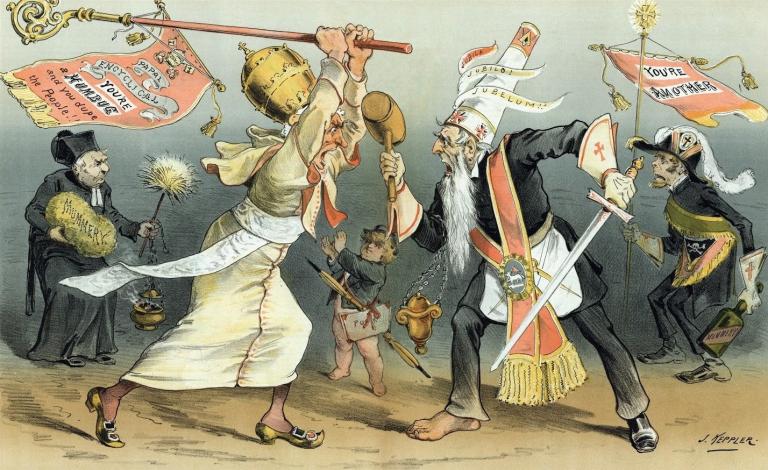
I posted last time about the importance of Freemasonry for understanding American history, American empire, and its religious dimensions. It is a lengthy story with large implications that stretch beyond Christianity. It also reminds us of a time in that history – only yesterday, in fact – when religion played a central role in politics.
Masons and Toleration
As a social and political movement, modern Freemasonry developed in the British Isles in the early eighteenth century. It was devoted to the idea of brotherhood, and admitted anyone who could subscribe to belief in one God, however that figure was imagined. Christians, Jews and Muslims all qualified under that criterion, as did any Hindus who could assert that the various gods of that faith were manifestations of a higher monotheism. Jews were welcome, and the fact that Jews were such enthusiastic Masons goes a long way to explaining their assimilation in both the US and the British Empire in the nineteenth and twentieth centuries.
And not just in North America. I remember the bafflement of that very fine historian Jonathan Steinberg, whose research showed that during the 1940s, the Italian military and large sections of the nation’s bureaucracy had engaged in a massive conspiracy to protect the country’s Jews from the Nazis. (I have posted about this at some length here). For the life of him, he could not work out why they had done so. Other than natural goodness, what possessed those Italian elites to act thus, and to act in such an organized and coordinated way? Then, at a late stage in his research, an informant pointed out what was obvious enough to Italians: all those generals, ministers and public servants, all those diplomats and spooks? “They were all Masons!” And with that clue, everything else fell into place. Yes indeed, there really had been a far-reaching Masonic conspiracy – a Deep State, if you like – and in this instance, it was working wholly for good.
Masons and Catholics
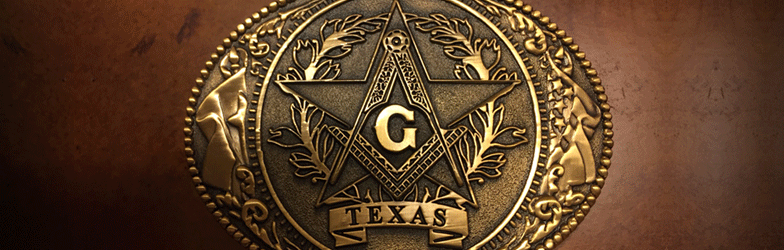
There was one gaping exception to that universal tolerance, namely Roman Catholic Christians. Indeed, much of European and American politics over the past two centuries has involved a running and often bitter confrontation between Masons and Catholics.
Initially, the hostility derived from Catholics themselves. Masons were happy to admit Catholics, but the Catholic Church in absolutist Europe was highly nervous about what they saw as a Protestant-derived deist cult that taught radical ideas of broad religious tolerance. Also arousing suspicion was the very strong ancient Roman and Roman Law dislike of secret societies of any and all kinds, on the basis that secret groups must have something wicked to conceal. That assumption was all the more likely when the group in question demanded that its members swear oaths of secrecy, framed in astonishingly bloody terms.
Various Popes sternly forbade Catholics from joining lodges. In the words of the pioneering 1738 document,
Now it has come to Our ears, and common gossip has made clear, that certain Societies, Companies, Assemblies, Meetings, Congregations or Conventicles called in the popular tongue Liberi Muratori or Francs Massons or by other names according to the various languages, are spreading far and wide and daily growing in strength; and men of any Religion or sect, satisfied with the appearance of natural probity, are joined together, according to their laws and the statutes laid down for them, by a strict and unbreakable bond which obliges them, both by an oath upon the Holy Bible and by a host [sic] of grievous punishment, to an inviolable silence about all that they do in secret together. But it is in the nature of crime to betray itself and to show itself by its attendant clamor. Thus these aforesaid Societies or Conventicles have caused in the minds of the faithful the greatest suspicion, and all prudent and upright men have passed the same judgment on them as being depraved and perverted. For if they were not doing evil they would not have so great a hatred of the light.
By 1917, a Catholic who joined a Masonic Lodge faced automatic excommunication.
Lest you think that I am putting all the blame on one side, Masons in various countries did become viscerally anti-Catholic and anti-clerical, and lodges became the foci of radical political movements aimed at undermining the established royal and Catholic ancien regime.
In the late nineteenth and early twentieth centuries, Freemasonry became the principal vehicle for militant secularism and anti-clericalism. Those struggles almost led to overt civil war in France in the Dreyfus years, and they actually did spark armed violence in Spain and Mexico in the 1930s. It is scarcely an exaggeration to say that if you ignore Freemasonry, you have no hope of understanding Mexican history over the past century or so. Meanwhile, Masonic support of Jewish emancipation provoked reactionary denunciations of the “Masonic-Jewish” conspiracy, which was later expanded to include Bolsheviks. Masons occupied a primary place in Nazi and ultra-Right demonology.
American Struggles
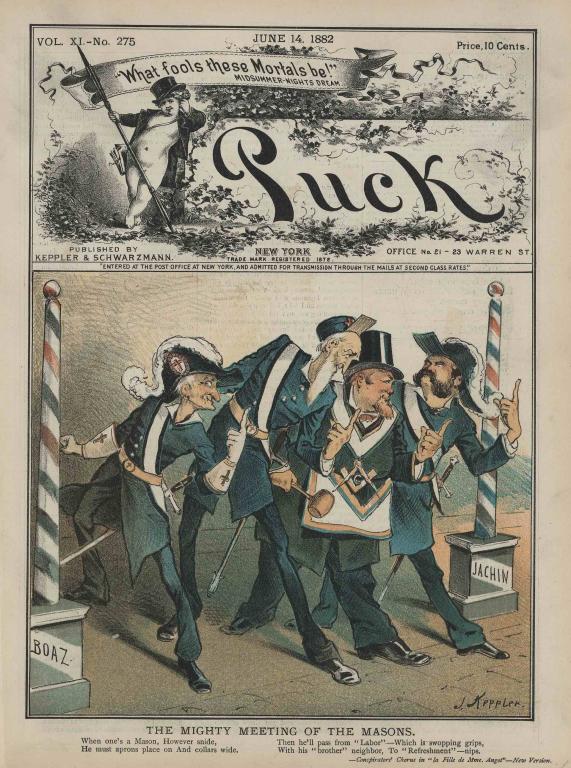
Matters were of course very different in the Anglo-American world, but Freemasons had a progressive bent. Through the nineteenth century, Freemasons and Catholics remained at odds over such issues as Catholic Emancipation, public education, and immigration. Masonic lodges tended to be anti-Catholic, and to be linked, explicitly or otherwise, to anti-Catholic mass movements.
This rivalry existed at all levels of society. Protestants enjoyed the great advantages of the Masonic order, in supplying mutual support in times of trouble, and also in creating invaluable networks in business, law and government. Feeling themselves excluded, the growing immigrant population (mainly Catholics) created their own pseudo-Masonic counterparts, most successfully the Knights of Columbus, which dates from 1882.
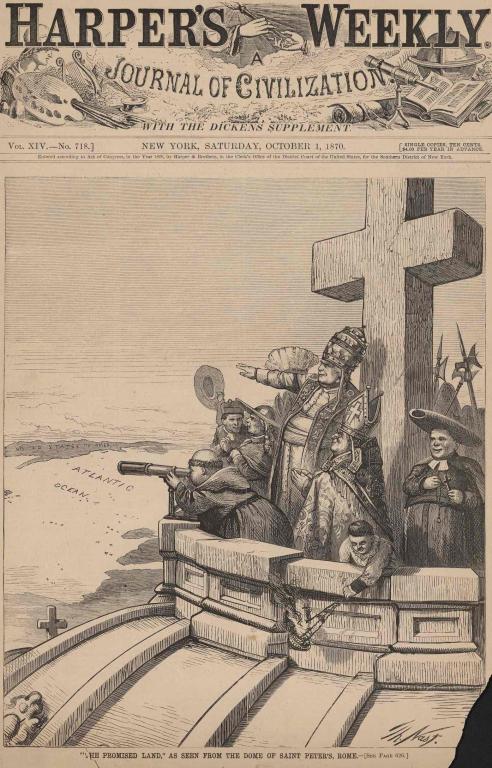
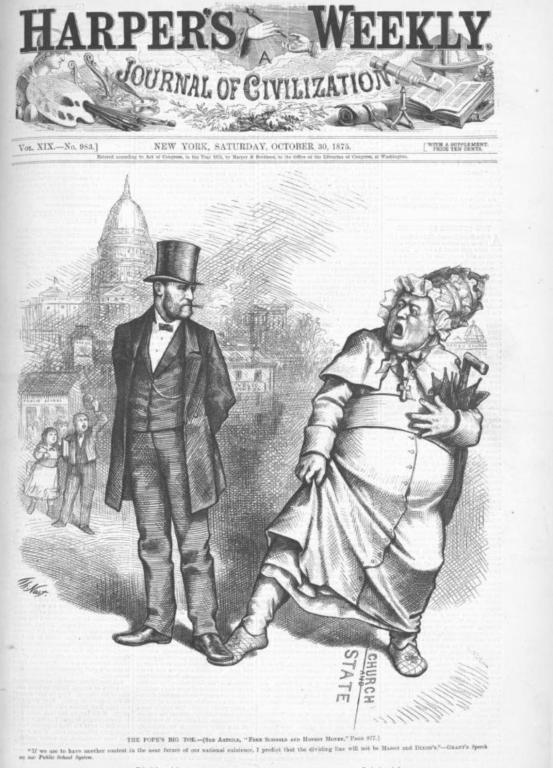
Outright violence was a real threat. In 1870 and 1871, more than sixty perished in Protestant-Catholic riots in New York City. Over the coming decade, some Protestants were thinking very seriously about the prospect of an actual civil war between the faiths. In 1875, President Grant spoke to a reunion of the Army of the Tennessee in Des Moines, Iowa, and although he never mentioned the word “Catholic,” nobody doubted who he was referring to:
If we are to have another contest in the near future of our national existence I predict that the dividing line will not be Mason & Dixon . . . but between patriotism and intelligence on the one side and superstition, ambition and ignorance on the other.
One potential detonator was the issue of public money being directed to Catholic institutions, notably schools. As Grant said, it was crucial to “encourage free schools and resolve that not one dollar of money appropriated to their support . . . shall be appropriated to the support of any sectarian school.” Republican Congressman James G Blaine actually proposed enshrining this principle in an amendment to the US Constitution. Although this failed, very narrowly, a majority of US states adopted Blaine Amendments in their own constitutions. When Blaine ran for President in 1884, one of his supporters famously labeled the Democrats as a toxic coalition of greedy liquor interests, the Roman Catholic church, and unreconstructed Confederates – that is, the party of “rum, Romanism, and Rebellion.”
Although not well remembered today, the great American popular movement of the late nineteenth century was the American Protective Association, which preached radical anti-Catholicism, and prepared to resist a feared Catholic coup d’état. Founded in 1887, the movement’s support ran into the hundreds of thousands at least, chiefly in the Midwest. Its founder was Henry F. Bowers, a Freemason, who structured the movement on Masonic lines, with regalia, oaths and initiations. The APA oath specified that,
I do most solemnly promise and swear that I will always, to the utmost of my ability, labor, plead and wage a continuous warfare against ignorance and fanaticism; that I will use my utmost power to strike the shackles and chains of blind obedience to the Roman Catholic church from the hampered and bound consciences of a priest-ridden and church-oppressed people; that I will never allow any one, a member of the Roman Catholic church, to become a member of this order, I knowing him to be such; that I will use my influence to promote the interest of all Protestants everywhere in the world that I may be; that I will not employ a Roman Catholic in any capacity if I can procure the services of a Protestant.
Masons and the Klan
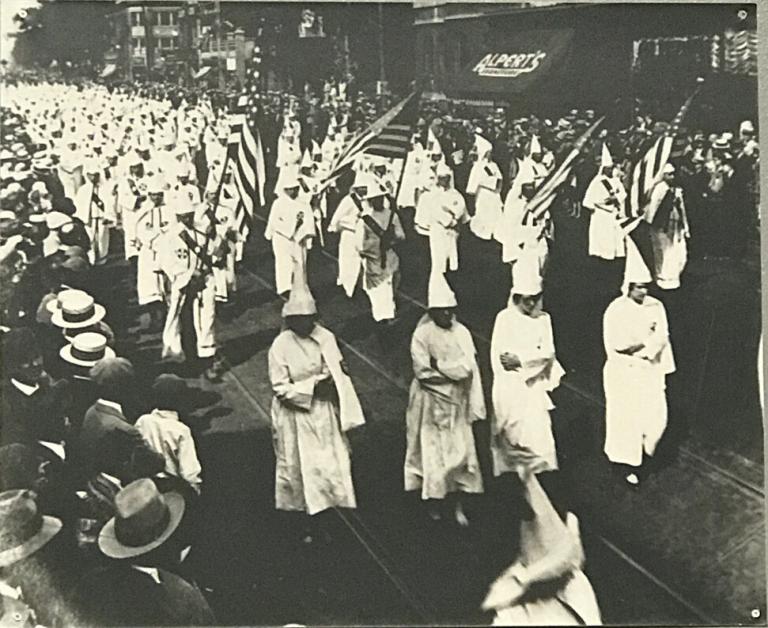
These precedents shaped the post-1915 Ku Klux Klan, which became a national US phenomenon between 1921 and 1926, drawing perhaps five million members at its height. And at this stage, the KKK was at least as heavily devoted to anti-Catholic and anti-immigration causes as to anti-Black racism. The Klan found its local leadership in Masonic lodges, and especially among local Protestant clergy: “The Old Rugged Cross” was a main Klan anthem. In order to appeal to Masons and other fraternal organizations, the Klan offered a rich mythology and heraldry, with all the mystique implied by its hierarchy of “Hydras, Great Titans, Furies, Giants, Exalted Cyclops, Terrors,” its distinctive secret language, and an elaborate system of progressive initiations, of signs and countersigns. (I published on this at some length in my 1997 book Hoods and Shirts).
That background explains the very rapid growth of the Klan after 1915. However bizarre the new movement might seem to moderns, it spoke to an audience fully prepared to accept this world of secret signs and lodges, and much of the rhetoric was very familiar.
This political alignment created some outcomes that look distinctly odd today. If you look at Klan or Masonic literature in the 1920s and 1930s, you find a list of political concerns that look surprisingly, well, Left-wing. Masons favored strictly secular approaches to the public schools, as a bulwark against Catholic incursions, and they wanted a high wall of separation between church and state. They campaigned to spread Blaine Amendments throughout the nation. They fought hard against foreign interventionism. Catholics, on the other side, were pushing for armed US intervention against the anti-clerical Masonic regime in Mexico, and later against the anti-clerical Left in Spain. The Klan really had no problems with driving Catholics out of public life and public education, by force if necessary.
Racial Struggles and Culture Wars
So fundamental were these religious issues to American life that it is striking that they faded away so thoroughly. The last gasp of old animosities was probably the debate over JFK’s Catholicism in the 1960 Presidential election. Of course, anti-Catholicism morphed and evolved into other forms, but that is a different story. Meanwhile, Masonic numbers began their long withdrawing roar, to a present level of well under a million, and that in a country that is far more populous than it was in the 1950s.
I would offer three explanations for this change, each of which in its way supplied alternatives to religious rivalry. One was the Cold War focus on Communism, when Protestants and Catholics alike united in common cause, in which many of the key players and super-patriots were themselves Catholic. The other of course was the rise of racial politics during the age of Civil Rights, with a new emphasis on shared Whiteness. Finally, the rise of identity politics and culture wars from the early 1960s fundamentally redrew older political maps. The new political world was symbolized by Jerry Falwell’s Moral Majority of the 1970s, which sought to unite conservatives of all religious groups in a common movement.
So familiar have such developments become that we tend to forget an older America when Protestant-Catholic rivalries were so central.
On a different topic that should be of great interest, do check out this splendid upcoming virtual conference on Evangelicalism and Missions: Studies in the History of the Spread of the Gospel
Catholic
Politics and Religion
History and Religion
Previous Post
September 11, 2024
Jesse Miranda: A Model of Civility
Next Post
September 13, 2024 La Conquistadora: Female Conqueror of the Americas
Recent Comments
"I love horror but would have to acclimate back to Lovecraft and especially Machen. Have ..."
Fairies, Witches, Folk Horror, and the ..."
"Very good point about MacDonald.I am certainly a Machen fan!"
Fairies, Witches, Folk Horror, and the ..."
"The Scottish author George MacDonald integrated fairy world into his fiction in a way that ..."
Fairies, Witches, Folk Horror, and the ..."
"I like the idea that we can have different streams. The coffee analogy is genius."
How Do You Take Your Evangelicalism?
Browse Our Archives
Select a Category abolitionism Abortion Abraham Joshua Heschel Abraham Kuyper Abraham Lincoln Academia Activism Adam Renberg Advent Adventist africa African American Religion Agnes Howard Albert Camus American History American Religious History American Revolution American West Anabaptists Ancient History Andrea Turpin Andrei Tarkovsky Anglicanism Annales Ansley Lillian Quiros anti-Catholicism Antisemitism Anxious Bench apologetics Apparitions Arash Azizi Archaeology archives art Artificial Intelligence Asia Asian Americans Augustine Authors Bad Bunny Baptism Baptists Barack Obama Battle of Hastings Benjamin Franklin Bernard-Henri Levy Beth Allison Barr Beth Moore Bethany Mannon Bible Bill Cunningham Billy Graham Black Music Bob Dylan Body Boenhoffer Books Breastfeeding Bruce Springsteen C.S. Lewis Calvinism Cancel Culture Capitalism Carmelites Catholicism Cedric Robinson Cesar Chavez Charismaticism charity Charles Dickens Charles Lindbergh Che Guevara Chicago Children Chinese Christianity Chris Gehrz Christ Christian death Christian Higher Education Christian life Christian Nation Christian Nationalism Christianity Today Christmas Church life Church Practice cinema Civil Religion Civil Rights Movement Civil War civility Classics Climate Change Cold War Colonial Mexico colonialism Comer Communism community complementarianism Conference on Faith and History Congregationalism Conspiracies Conspiracy Conversion Narratives Coronavirus Costa Rica Council of Nicaea Covid-19 Creation Critical Race Theory Crusades Culture culture wars Daniel K. Williams David Barton David Swartz Death Ways death with dignity DEI democracy Democratic Party Devotion Digital Age Diplomacy discipleship diversity Donald Trump Drama Dua Lipa Early Church early modern Early modern Catholicism Easter Eastern Christianity economic exploitation Education elections Elie Wiesel Elizabeth II Elizabeth Taylor emotions Empire Engineering England enslavement Entertainment Episcopal Church Erica Ramirez eschatology Eurocentrism Evangelicalism Evangelicals Exegesis Family Feminism Film Flannery O'Connor folk music Food Foreign Policy founding fathers Franciscans Franciscus Junius fundamentalism Funerals G.K. Chesterton Gender Genocide genre geography George W. Bush George Washington George Whitefield Global Christianity Global church Grief Guadalupe Guest Post guest post gun control gun violence Gustavo Gutierrez Hamid Dabashi Harold John Ockenga Harvest Hate Hawaiian Christianity Healing health care Heather Cox Richardson Hell Heresy Hermeneutics Higher Education Hinduism Hippocratic oath Historical Fiction Historical Methodology Historical Profession Historical Profession Historical Theology Historical Thinking historiography Holidays Holocaust horror movies Human rights Humanitarian Work humanities Hummingbirds Hungary hymns Imago Dei Immigration Injustice Interviews Iran Islam Islamophobia Israel Ivan's Childhood Jacob Randolph James Bratt Janine Giordano Drake Japanese history Japanese Literature Jean Paul Sartre Jesse Miranda Jesus Jesus Christ Jimmy Carter Joan Baez Joan Didion Joanne Freeman João B. Chaves Joao Chaves Joey Cochran John Calvin John Fea John Tillotson John Turner Johnny Cash Jonathan Edwards Jonathan Tran Joseph Smith Josh Howerton Journalism Jr. Judaism Jürgen Moltmann Just War Justice Justin Brierley Karl Barth Katelyn Beaty koi ponds Kris Kristofferson Kristin Kobes Du Mez Latin American Religious History Latino Americans Lectio Divina Leisure Lent Leonard Cohen liberal arts liberalism Liberation Theology Linda Ronstadt Lisa Clark Diller Literature Lou Reed Lynchings Lynneth Miller Renberg Mainline Protestantism Malcolm Foley Marilyn Monroe Maritime history Mark Noll Marriage Martin Luther Martin Luther King Martyrdom Marxism Mary Masih Alinejad mass shootings material culture medieval Christianity Medieval Ethiopia Melissa Borja memory Mennonites Mental Health Mental Illness Methodism Mexican Americans Mexicans Mike Madrid Miles Mullin Min Jin Lee Miscarriage Missionaries Mister Rogers Mitt Romney modernity Monasticism Mormonism Motherhood Mothers of the Church Moving Music Musicals Nadya Williams Nahua Christianity Native Americans Natsume Sōseki New Contributor New England New Year New York Nico Non-Violent Protest Orthodoxy pacifism Paleo Evangelicals Palestinians Parenting Patti Smith Paul Kingsnorth Pedro Calderón de la Barca Pentecostalism Philip Jenkins Phillis Wheatley physician-assisted suicide pilgrimage Pilgrims pluralism Plutocracy Poetry Politics Pope Francis Pope Leo XIV post-modernism prayer preaching Presbyterians prosperity gospel Protest Public history Publishing Puritans purity culture Quakers race Race Massacres Racial Capitalism racial reconciliation racialization Racism Raha Bahloulipour Re-Enchantment reading Reformation Refugees religion and the university religion and war Religious Freedom Religious Nones Religious Pluralism Religious Symbols religious violence Republican Party Revival Rita Coolidge Ritual Roger Williams Roman Catholic church Royalty Russell Moore same-sex marriage Sarah Irving-Stonebraker Scandinavia Science Science and Technology Scopes trial Scriptural Interpretation secularism Selena Quintanilla seminary Seventh-Day Adventists sexual morality Sexuality Sikhs Silence slaveholders theology Slavery Slavoj Zizek social justice Social Media Southern Baptist Convention Southern Religion Spain Spiritual Autobiography Spiritual but not religious Spiritual Discipline Sports Stanley Hauerwas Suffering Summer Camps Sunday Night Odds and Ends Supernatural Supreme Court Syriac Christianity Tal Howard Taylor Swift Teaching Technology Television Thanksgiving The Beatles The Mission theater TheoBros Theology Thomas Dixon Thomas Jefferson Thomas Kidd Thomas Merton Tim Gloege Tim Walz Tom Holland Tourism tradition Tragedy Translation Transnationalism Travel Trump Ukraine Uncategorized Unitarians United Methodist Church US History Vanessa Chan Velvet Underground Verónica A. Gutiérrez Veronica Gutierrez Vikings Violence Virgin Mary Virtue Virtue ethics Visions Voting War WCTU Wendell Berry Westminster Assembly White Evangelicalism Wildfires Winnie the Pooh Witches women Women in Ministry Women's and Gender Studies Work Worship writing Yasunari Kawabata Zena Hitz
Select a Month October 2026 September 2026 August 2026 July 2026 June 2026 May 2026 April 2026 March 2026 February 2026 January 2026 December 2025 November 2025 October 2025 September 2025 August 2025 July 2025 June 2025 May 2025 April 2025 March 2025 February 2025 January 2025 December 2024 November 2024 October 2024 September 2024 August 2024 July 2024 June 2024 May 2024 April 2024 March 2024 February 2024 January 2024 December 2023 November 2023 October 2023 September 2023 August 2023 July 2023 June 2023 May 2023 April 2023 March 2023 February 2023 January 2023 December 2022 November 2022 October 2022 September 2022 August 2022 July 2022 June 2022 May 2022 April 2022 March 2022 February 2022 January 2022 December 2021 November 2021 October 2021 September 2021 August 2021 July 2021 June 2021 May 2021 April 2021 March 2021 February 2021 January 2021 December 2020 November 2020 October 2020 September 2020 August 2020 July 2020 June 2020 May 2020 April 2020 March 2020 February 2020 January 2020 December 2019 November 2019 October 2019 September 2019 August 2019 July 2019 June 2019 May 2019 April 2019 March 2019 February 2019 January 2019 December 2018 November 2018 October 2018 September 2018 August 2018 July 2018 June 2018 May 2018 April 2018 March 2018 February 2018 January 2018 December 2017 November 2017 October 2017 September 2017 August 2017 July 2017 June 2017 May 2017 April 2017 March 2017 February 2017 January 2017 December 2016 November 2016 October 2016 September 2016 August 2016 July 2016 June 2016 May 2016 April 2016 March 2016 February 2016 January 2016 December 2015 November 2015 October 2015 September 2015 August 2015 July 2015 June 2015 May 2015 April 2015 March 2015 February 2015 January 2015 December 2014 November 2014 October 2014 September 2014 August 2014 July 2014 June 2014 May 2014 April 2014 March 2014 February 2014 January 2014 December 2013 November 2013 October 2013 September 2013 August 2013 July 2013 June 2013 May 2013 April 2013 March 2013 February 2013 January 2013 December 2012 November 2012 October 2012 September 2012 August 2012 July 2012 June 2012 May 2012
Follow Us!
TAKE THE
Religious Wisdom Quiz
Who prophesied swords would be beaten into plowshares?
Select your answer to see how you score.
Hosea Micah Joel Daniel
Related posts from Anxious Bench

Fairies, Witches, Folk Horror, and the Secret Commonwealth

Hogg’s Justified Sinner: A Gothic Classic for Halloween

James Hogg, Weird Wives, and Feminist Witches

How an Explosive Book Rewrote the Study of...
TRENDING AT PATHEOS Evangelical

Nearly every morning, I make the drive to Detroit with my high-school-age...

The Real AI Story Is Adoption Without Trust
Artificial intelligence has crossed a political threshold. It is no longer a...

A new article, written by Jeff Lindsay and Gale L. Pooley,...

Swimfan: Forgotten Aughts Pleasures
This is a recovery effort. In 2002, My Big Fat Greek Wedding...

Top Three Anti-Catholic Lies About Catholicism
This is my initial transcript for the video, "THE 3 WORST...

Pope Leo Celebrates Mass for Nurses & Docs...
I don't have any idea how he did it, but Pope Leo...
view all Evangelical blogs
What Are Your Thoughts?leave a comment
Ad-Free & Subscriber Log-In Subscription Support
- About Us
- 2026 Calendar
- Videos
- Podcasts
- Library of World Religions
- Faith In Media Tracker
- Advertise With Us
- Write for Us
- Privacy Policy
- Terms of Service
- Do Not Sell My Data
- Contact Us
- Radiant Digital
- Manage Newsletter Subscriptions
- Unsubscribe From Notifications
- Sitemap
Copyright 2008-2026, Patheos. All rights reserved.
Subscription Support Ad-Free & Subscriber Log-In
Follow Patheos