
BuddhistCatholicContemplativeEvangelicalGeneral ChristianHinduJewishLatter-day SaintMuslimNew VisionsProgressive Christian
Beliefs
- Buddhist
- Catholic
- Contemplative
- Evangelical
- General Christian
- Hindu
- Jewish
- Latter-day Saint
- More Voices
- Muslim
- New Visions
- Pagan
- Progressive Christian
Topics
- Religion News
- Food and Religion
- Sports and Religion
- Religious Art
- Religious Music and Entertainment
- Religious Events
- History and Religion
- Style and Religion
- Politics and Religion
- Women in Religion
- Recreation Outdoors and Religion
- Business Finance and Religion
- Careers Workplace and Religion
- Education and Religion
- Family Parenting and Religion
- Health Fitness and Religion
- Home and Religion
- Relationships and Religion
- Technology and Religion
- Travel and Religion
Columnists
- Buddhist Columnists
- Business Finance and Religion Columnists
- Careers Workplace and Religion Columnists
- Catholic Columnists
- Contemplative Columnists
- Education and Religion Columnists
- Evangelists Columnists
- Family Parenting and Religion Columnists
- General Christian Columnists
- Health Fitness and Religion Columnists
- Hindu Columnists
- History and Religion Columnists
- Home and Religion Columnists
- Jewish Columnists
- More Voices Columnists
- Latter Day Columnists
- Muslim Columnists
- New Visions Columnists
- Nonreligious Columnists
- Pagan Columnists
- Politics and Religion Columnists
- Progressive Columnists
- Recreation Outdoors and Religion Columnists
- Relationships and Religion Columnists
- Religion News Columnists
- Religious Art Columnists
- Religious Events Columnists
- Religious Music and Entertainment Columnists
- Sports and Religion Columnists
- Style and Religion Columnists
- Technology and Religion Columnists
- Travel and Religion Columnists
- Women in Religion Columnists
Resource Library
- 2026 Calendar
- Library of World Religions
- The 100 Most Holy Places on Earth
- Patheos Answers
- Podcasts
- Videos
- Faith Leaders Database
- Anglican Episcopalian
- Bahai
- Baptist
- Buddhism
- Christianity
- Confucianism
- Eastern Orthodoxy
- Hinduism
- Holiness and Pentecostal
- ISKCON
- Islam
- Judaism
- Lutheran
- Methodist
- The Church of Jesus Christ of Latter-day Saints
- New Age
- Paganism
- Presbytarian and Reformed
- Protestantism
- Religion Behind the Scenes
- Roman Catholic
- Scientology
- Shia Islam
- Sikhism
- Sufism
- Sunni Islam
- Taoism
- Zen
- See all religions
Research Tools
 Ad-Free & Subscriber Log-In Subscription Support
Ad-Free & Subscriber Log-In Subscription Support
Follow Patheos 

- Trending:
- Forgiveness
- |
- Marriage
- |
- Consciousness
- |
- Death Penalty
- |
- Election
- |
- Halloween

-
About the Authors
- Home
- Evangelical
- Pentecostals in Hong Kong: A Conversation with Alex Mayfield
Pentecostals in Hong Kong: A Conversation with Alex Mayfield
Last updated on: August 21, 2024 at 12:01 am by David Swartz
Pentecostals in Hong Kong: A Conversation with Alex Mayfield 2024-08-20T08:53:01-04:00 David Swartz
Patheos Explore the world's faith through different perspectives on religion and spirituality! Patheos has the views of the prevalent religions and spiritualities of the world.
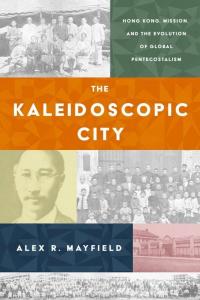
I’m pleased to welcome my colleague Alex Mayfield to the Anxious Bench. Alex is an assistant professor of history at Asbury University and is the author of the recently released The Kaleidoscopic City: Hong Kong, Mission, and the Evolution of Global Pentecostalism. What follows is a conversation we recently had about his book. –David
***
David: In 1926 a little girl with golden brown curls sat in a Chinese pagoda boat made of roses, which itself sat on a “missionary float” in the Rose Bowl parade. For hours as the float went through Pasadena, California, the girl held an open Bible in one hand and pointed heavenward with the other. That girl, born in Hong Kong a decade earlier, was the daughter of Aimee Semple McPherson, the most famous character readers will encounter in your book. Why were the McPhersons in Hong Kong in the first place, and how did their brief stay take on such mythical status in later decades?
Alex: Oh, Aimee! If there was a saint of American religiosity, it would have to be her. Her story in Hong Kong was part of the broad interest among faith missionaries at the time. As a young girl, she married Robert Semple, a successful evangelist, and they soon after felt the call to the “great white fields” of China. Semple, several years her senior, was a guiding light in her life and unlocked her ministerial calling. Sadly, he died from dysentery a few months after their arrival and Aimee gave birth to their daughter, Roberta, shortly thereafter. I think it would be hard to overemphasize the experience this had on Aimee. Robert was forever a saint in her memory (she would, after all, remain Aimee Semple McPherson); he was the loadstar of her evangelical call, and his passing was the major turning point in her life. Hong Kong broke her, it was the dark night of her soul, and it reappeared over and over in her sermons and published testimony. That experience gave her ministerial call gravitas, and—uncomfortable as it is—she emphasized this well-known story by employing orientalist tropes in the early days of her ministry. The Rose Bowl “flower boat” (a euphemism for floating brothels in China) was perhaps the most egregious and spectacular of these examples.
What do you mean by “worship as evangelism,” and why did this Pentecostal strategy work so well in Hong Kong’s soundscape?
That is one of the surprising things I found. For quite a long time, Protestant missionaries had been using Western-style music to attract crowds for street preaching (think of the Salvation Army and their brass band). Pentecostals did that sort of thing, but to their surprise, their own worship actually came to be a more successful crowd-drawer. Some missionaries even complained about their doors being broken down because so many people wanted to see what was going on. I think it had something to do with the “noise” of Pentecostal worship. The shouts, singing, shaking, and other physical movements mirrored the hot and noisy cacophony of many Chinese religious sites. Moreover, the hustle and bustle of noisy crowds often holds a good connotation in Chinese culture. So, while it was no doubt still strange for Chinese people to see a Pentecostal service; it was also probably far more entertaining and interesting for Chinese people than it would be for a Western onlooker.
 You make fine use of traditional print and archival sources. But you also add an innovative methodology. How are you using the spatial tools like GIS to better understand religion?
Historians can—rightfully—be suspicious of forms of analysis that rely heavily on computational methods, but I do think they have a place as a complimentary way to see the past. As I read through my primary sources for this project, I input information about where people were and who they were talking with into a relational database. This helped me track large-scale trends that might only be hinted at or outright hidden by primary sources. For example, you can see how Pentecostal missionaries moved to the fringes of the urban spaces of Hong Kong, a fact that they almost never remarked on but that makes sense considering their desire to reach the “unworked fields” of China. More importantly, you can also uncover the primacy of women, who tend to leave fewer historical records. With my data, I could illustrate exactly how certain women were vital to the Pentecostal network of Hong Kong even though I only left a few pieces of their writing behind for historians like me to work with.
You’re critical of scholars who emphasize Pentecostal exceptionalism—both insider hagiographers and many scholars who see Pentecostals as radical millenarians and ecstatic revivalists making a dramatic break from earlier missionary efforts. Why do you see more continuity than discontinuity with the broader evangelical missionary enterprise?
In so many ways, Pentecostals missionaries were…well… boring! When I began my research, I thought I’d find so many strange and interesting stories, but what I actually found were the same old evangelical things. Pentecostals built schools, ran orphanages, distributed tracts, and sold Bibles. They took time to learn Chinese and build administrative systems; they even asked leaders of the evangelical missionary establishment for advice. It is true that they had their share of extremes and a distinctive approach, but not much more than other groups. By the end of the project, it was clear that Pentecostals simply reflected the holistic paradigm of early evangelicalism that blended social engagement with experiential forms of piety.
My own research deals with how American evangelicals have been shaped by their experiences abroad. Did you observe this “global reflex” among American Pentecostals who proselytized Hong Kong and China?
Certainly. While no early Pentecostals were involved in what we would recognize as intercultural or interfaith dialogue, their experiences in China shaped them immensely. Many returned missionaries, especially women, would become the largest boosters of missions in their home networks and take on outsized roles in establishing funding support structures. Others would go on to use their missionary bona fides to wield influence at important events. Hong Kong missionaries, for example, were key players in the Arroyo Seco Camp Meeting that sent shock waves throughout the Pentecostal world. While trying to raise funds for work in China, Hong Kong missionaries inadvertently became embroiled in debates over Trinitarianism. More famously, Aimee Semple McPherson built her evangelistic enterprise on her identity as a “real missionary” who spent time in Hong Kong.
In a chapter on how Pentecostals bureaucratized their missionary work in the 1920s and 1930s, you write, “Structures divide, but they also define, and that definition was increasingly needed.” What needed defining?
By the late 1910s, it was becoming increasingly clear that the idea of Pentecostalism as a high-minded, nondenominational renewal movement was unsustainable. Sensationalist traveling preachers were grifting off the movement, heterodox ideas were spreading among Pentecostal churches, and missionaries who set out “on faith” believing that God would provide were facing dire straits as funding began to dry up. This does not even take account of the racial tensions that stirred up in the United States or the economic turmoil of the war and interwar years. Regardless, many Pentecostals in North America increasingly felt the need for stronger denominational structures to safeguard certain ideas and ensure missionary and evangelical efforts were well-funded and established. These denominations defined and set the agenda for what Pentecostalism would be for the next several decades. Perhaps unavoidably, the act of clearly defining Pentecostalism also changed it into something slightly different than what it was before.
What was “missionary tongues,” and how exceptional is this theology/practice in church history?
Oh, that is an interesting question. The idea of xenoglossy, miraculously speaking in a different language, is attested to throughout Christian history (and modern anthropology). In fact, Augustine writes that it was common for Christians to speak in new tongues upon their baptism and confirmation—the two rites were unified in the early Church. In that context, the phenomenon is usually treated as a testament to the unity of God’s work assembling the multiethnic early Church. Throughout Christian history, various saints and holy people were attested to have miraculously spoken in different languages. “Missionary tongues,” in contrast, is a relatively modern evangelical phenomenon because it weds this idea of xenoglossy with the turn-of-the-century evangelical desire to preach the gospel to the entire world. They believed they would speak in a new language for the sake of preaching the gospel to unreached groups. This miraculous ability would speed up the process of evangelization. Pentecostals also had several toes in the dispensationalist camp, so they tended to think speeding up world evangelization would quicken the return of Christ. There may be precedents in history to similar ideas, but I don’t know of any at the moment.
In my favorite chapter, “The Women’s City,” you write that “Female Pentecostal missionaries outnumbered their male counterparts by a large margin, challenged traditional women’s roles, and carved out new social worlds for women through education and orphanage work. Yet Pentecostal women also reified colonialist and patriarchal structures that they had imbibed as part of their Western worldview.” How so?
This is another area where Pentecostals shared a lot in common with evangelicals. By virtue of their Western status, women missionaries were often able to interact in ways that were coded as male in traditional societies. As part of the colonial establishment, they had protections and privileges that meant that could say and do even more than many local men could. Likewise, they were able to build entire female-run enterprises that offered women real advantages and opportunities that defied traditional gender stereotypes. At the same time, evangelical women tended to espouse late-Victorian and patriarchal gendered norms. They practiced modesty in dress and temperament and deferred to male forms of leadership. If you want to dive deeper into this paradox, I really recommend Jane Hunter’s The Gospel of Gentility. Ultimately, while many Pentecostal groups did affirm women’s ordination and make new avenues for female participation, the same paradox was at work.
As you researched this book, what finding or character most inspired you? What discouraged you?
One of the first people who really captivated me in this research was Anna M. Deane. A native Kentuckian, Deane moved to Hong Kong in her late fifties after years as an educator. She was made “matron” of a Pentecostal missionary home, but quickly moved out of that position and established a school for women and children. She eventually founded one of the first schools for the floating population of Hong Kong and became the quiet backbone of the movement in China. Sadly, she died with a ticket for her passage home in hand. In some ways, I think her death was prophetic of a wider shift in the movement. Deane represented this holistic strain of mission that focused on wider social needs. While that strain continued in Hong Kong and elsewhere, it all but died out in much of North America. Pentecostals gradually became associated with a stream of American anti-intellectualism. Deane reminds me of what might have been.
Which was your favorite archive to research at? What was your coolest find?
The Flower Pentecostal Heritage Center is by far the largest Pentecostal archive in the world, but my favorite has to be that of the International Pentecostal Holiness Church in Bethany, Oklahoma. The former archivist, Harold Hunter, had a passion for the denomination’s global history and they even have a little model of the two-story “gospel boat” that served as a floating school and church. My favorite find comes from the Hong Kong Records Office and is still a bit mysterious: a deed of sale for Fu Taü Chaü Island. It was sold to Paul Bettex and the Pentecostal Mission in 1911. With the help of a colleague, I believe the island refers to Fat Tong Chau, a tiny little island in the New Territories, but I haven’t confirmed that as of yet. The Pentecostal Mission broke apart soon after and nothing ever came of it, but I cannot for the life of me figure out what they were planning on doing with that island!
Pretend you’re a sociologist. What would a spatial analysis of religion look like in Hong Kong’s high rises now?
Fortunately, I do not have to. There is a new book by Tobias Brandner called Christians in the City of Hong Kong (Bloomsbury, 2023). It actually came out the same month as my book! The first chapter really focuses on this question and highlights the multiple approaches to visibility and contextualization pursued by historic and new churches. Brandner argues that the new “upper-floor” churches (meaning churches that rent or own space in a high-rise building) reveal a pragmatic approach to economic realities and hint at the impermanence of sacred space in global cities. I think he is right on. If Pentecostals were afraid of urban cores in the past, they are not afraid of them now.
What’s your next project?
Too many! I am still working with other colleagues to strengthen the China Historical Christian Database, it is the world’s largest database on Christian actors, institutions, and organizations in China from 1550-1950. We have some exciting papers in the works that utilize data science to show what this database can do and how it might reframe our understanding of Chinese Christian history. I also hope to expand some of the thoughts in The Kaleidoscopic City into a further book project that spans the globe, but it is still in the early days. Lastly, I am starting to work on an important project that will take me back to the very beginning of Protestant missions in China, but I have to (painfully) keep that under wraps for the moment. Sorry for the tease!
Previous Post
August 20, 2024
Lectio Divina and the Unchristian Assumptions of AI
Next Post
August 22, 2024 American Empire: Settlers, Colonists, and Invaders
Recent Comments
"I love horror but would have to acclimate back to Lovecraft and especially Machen. Have ..."
Fairies, Witches, Folk Horror, and the ..."
"Very good point about MacDonald.I am certainly a Machen fan!"
Fairies, Witches, Folk Horror, and the ..."
"The Scottish author George MacDonald integrated fairy world into his fiction in a way that ..."
Fairies, Witches, Folk Horror, and the ..."
"I like the idea that we can have different streams. The coffee analogy is genius."
How Do You Take Your Evangelicalism?
Browse Our Archives
Select a Category abolitionism Abortion Abraham Joshua Heschel Abraham Kuyper Abraham Lincoln Academia Activism Adam Renberg Advent Adventist africa African American Religion Agnes Howard Albert Camus American History American Religious History American Revolution American West Anabaptists Ancient History Andrea Turpin Andrei Tarkovsky Anglicanism Annales Ansley Lillian Quiros anti-Catholicism Antisemitism Anxious Bench apologetics Apparitions Arash Azizi Archaeology archives art Artificial Intelligence Asia Asian Americans Augustine Authors Bad Bunny Baptism Baptists Barack Obama Battle of Hastings Benjamin Franklin Bernard-Henri Levy Beth Allison Barr Beth Moore Bethany Mannon Bible Bill Cunningham Billy Graham Black Music Bob Dylan Body Boenhoffer Books Breastfeeding Bruce Springsteen C.S. Lewis Calvinism Cancel Culture Capitalism Carmelites Catholicism Cedric Robinson Cesar Chavez Charismaticism charity Charles Dickens Charles Lindbergh Che Guevara Chicago Children Chinese Christianity Chris Gehrz Christ Christian death Christian Higher Education Christian life Christian Nation Christian Nationalism Christianity Today Christmas Church life Church Practice cinema Civil Religion Civil Rights Movement Civil War civility Classics Climate Change Cold War Colonial Mexico colonialism Comer Communism community complementarianism Conference on Faith and History Congregationalism Conspiracies Conspiracy Conversion Narratives Coronavirus Costa Rica Council of Nicaea Covid-19 Creation Critical Race Theory Crusades Culture culture wars Daniel K. Williams David Barton David Swartz Death Ways death with dignity DEI democracy Democratic Party Devotion Digital Age Diplomacy discipleship diversity Donald Trump Drama Dua Lipa Early Church early modern Early modern Catholicism Easter Eastern Christianity economic exploitation Education elections Elie Wiesel Elizabeth II Elizabeth Taylor emotions Empire Engineering England enslavement Entertainment Episcopal Church Erica Ramirez eschatology Eurocentrism Evangelicalism Evangelicals Exegesis Family Feminism Film Flannery O'Connor folk music Food Foreign Policy founding fathers Franciscans Franciscus Junius fundamentalism Funerals G.K. Chesterton Gender Genocide genre geography George W. Bush George Washington George Whitefield Global Christianity Global church Grief Guadalupe Guest Post guest post gun control gun violence Gustavo Gutierrez Hamid Dabashi Harold John Ockenga Harvest Hate Hawaiian Christianity Healing health care Heather Cox Richardson Hell Heresy Hermeneutics Higher Education Hinduism Hippocratic oath Historical Fiction Historical Methodology Historical Profession Historical Profession Historical Theology Historical Thinking historiography Holidays Holocaust horror movies Human rights Humanitarian Work humanities Hummingbirds Hungary hymns Imago Dei Immigration Injustice Interviews Iran Islam Islamophobia Israel Ivan's Childhood Jacob Randolph James Bratt Janine Giordano Drake Japanese history Japanese Literature Jean Paul Sartre Jesse Miranda Jesus Jesus Christ Jimmy Carter Joan Baez Joan Didion Joanne Freeman João B. Chaves Joao Chaves Joey Cochran John Calvin John Fea John Tillotson John Turner Johnny Cash Jonathan Edwards Jonathan Tran Joseph Smith Josh Howerton Journalism Jr. Judaism Jürgen Moltmann Just War Justice Justin Brierley Karl Barth Katelyn Beaty koi ponds Kris Kristofferson Kristin Kobes Du Mez Latin American Religious History Latino Americans Lectio Divina Leisure Lent Leonard Cohen liberal arts liberalism Liberation Theology Linda Ronstadt Lisa Clark Diller Literature Lou Reed Lynchings Lynneth Miller Renberg Mainline Protestantism Malcolm Foley Marilyn Monroe Maritime history Mark Noll Marriage Martin Luther Martin Luther King Martyrdom Marxism Mary Masih Alinejad mass shootings material culture medieval Christianity Medieval Ethiopia Melissa Borja memory Mennonites Mental Health Mental Illness Methodism Mexican Americans Mexicans Mike Madrid Miles Mullin Min Jin Lee Miscarriage Missionaries Mister Rogers Mitt Romney modernity Monasticism Mormonism Motherhood Mothers of the Church Moving Music Musicals Nadya Williams Nahua Christianity Native Americans Natsume Sōseki New Contributor New England New Year New York Nico Non-Violent Protest Orthodoxy pacifism Paleo Evangelicals Palestinians Parenting Patti Smith Paul Kingsnorth Pedro Calderón de la Barca Pentecostalism Philip Jenkins Phillis Wheatley physician-assisted suicide pilgrimage Pilgrims pluralism Plutocracy Poetry Politics Pope Francis Pope Leo XIV post-modernism prayer preaching Presbyterians prosperity gospel Protest Public history Publishing Puritans purity culture Quakers race Race Massacres Racial Capitalism racial reconciliation racialization Racism Raha Bahloulipour Re-Enchantment reading Reformation Refugees religion and the university religion and war Religious Freedom Religious Nones Religious Pluralism Religious Symbols religious violence Republican Party Revival Rita Coolidge Ritual Roger Williams Roman Catholic church Royalty Russell Moore same-sex marriage Sarah Irving-Stonebraker Scandinavia Science Science and Technology Scopes trial Scriptural Interpretation secularism Selena Quintanilla seminary Seventh-Day Adventists sexual morality Sexuality Sikhs Silence slaveholders theology Slavery Slavoj Zizek social justice Social Media Southern Baptist Convention Southern Religion Spain Spiritual Autobiography Spiritual but not religious Spiritual Discipline Sports Stanley Hauerwas Suffering Summer Camps Sunday Night Odds and Ends Supernatural Supreme Court Syriac Christianity Tal Howard Taylor Swift Teaching Technology Television Thanksgiving The Beatles The Mission theater TheoBros Theology Thomas Dixon Thomas Jefferson Thomas Kidd Thomas Merton Tim Gloege Tim Walz Tom Holland Tourism tradition Tragedy Translation Transnationalism Travel Trump Ukraine Uncategorized Unitarians United Methodist Church US History Vanessa Chan Velvet Underground Verónica A. Gutiérrez Veronica Gutierrez Vikings Violence Virgin Mary Virtue Virtue ethics Visions Voting War WCTU Wendell Berry Westminster Assembly White Evangelicalism Wildfires Winnie the Pooh Witches women Women in Ministry Women's and Gender Studies Work Worship writing Yasunari Kawabata Zena Hitz
Select a Month October 2026 September 2026 August 2026 July 2026 June 2026 May 2026 April 2026 March 2026 February 2026 January 2026 December 2025 November 2025 October 2025 September 2025 August 2025 July 2025 June 2025 May 2025 April 2025 March 2025 February 2025 January 2025 December 2024 November 2024 October 2024 September 2024 August 2024 July 2024 June 2024 May 2024 April 2024 March 2024 February 2024 January 2024 December 2023 November 2023 October 2023 September 2023 August 2023 July 2023 June 2023 May 2023 April 2023 March 2023 February 2023 January 2023 December 2022 November 2022 October 2022 September 2022 August 2022 July 2022 June 2022 May 2022 April 2022 March 2022 February 2022 January 2022 December 2021 November 2021 October 2021 September 2021 August 2021 July 2021 June 2021 May 2021 April 2021 March 2021 February 2021 January 2021 December 2020 November 2020 October 2020 September 2020 August 2020 July 2020 June 2020 May 2020 April 2020 March 2020 February 2020 January 2020 December 2019 November 2019 October 2019 September 2019 August 2019 July 2019 June 2019 May 2019 April 2019 March 2019 February 2019 January 2019 December 2018 November 2018 October 2018 September 2018 August 2018 July 2018 June 2018 May 2018 April 2018 March 2018 February 2018 January 2018 December 2017 November 2017 October 2017 September 2017 August 2017 July 2017 June 2017 May 2017 April 2017 March 2017 February 2017 January 2017 December 2016 November 2016 October 2016 September 2016 August 2016 July 2016 June 2016 May 2016 April 2016 March 2016 February 2016 January 2016 December 2015 November 2015 October 2015 September 2015 August 2015 July 2015 June 2015 May 2015 April 2015 March 2015 February 2015 January 2015 December 2014 November 2014 October 2014 September 2014 August 2014 July 2014 June 2014 May 2014 April 2014 March 2014 February 2014 January 2014 December 2013 November 2013 October 2013 September 2013 August 2013 July 2013 June 2013 May 2013 April 2013 March 2013 February 2013 January 2013 December 2012 November 2012 October 2012 September 2012 August 2012 July 2012 June 2012 May 2012
Follow Us!
TAKE THE
Religious Wisdom Quiz
Who was the high priest when Jesus was crucified?
Select your answer to see how you score.
Gamaliel Nicodemus Annas Caiaphas
Related posts from Anxious Bench
George Rogers and the Pentecostal Case Against Movies
How Modern Citizenship Debates Echo the Reformation
When Pentecostals Took on “Hellywood”

The Sunday School Democrats: Carter and Talarico
TRENDING AT PATHEOS Evangelical

The First Eucharistic Controversy: Christ’s Real Presence
For Catholics, the Eucharist is the source and summit of the Christian...

What a Stop Sign Can Teach Us About...
How to Make a Decision When You Can't Hear God Main point:...

Archdiocese Hosts Military Marriage Retreat in Germany
RASTATT, Germany — The transient military lifestyle, with its frequent deployments and...

Nearly every morning, I make the drive to Detroit with my high-school-age...

The Real AI Story Is Adoption Without Trust
Artificial intelligence has crossed a political threshold. It is no longer a...

A new article, written by Jeff Lindsay and Gale L. Pooley,...
view all Evangelical blogs
What Are Your Thoughts?leave a comment
Ad-Free & Subscriber Log-In Subscription Support
- About Us
- 2026 Calendar
- Videos
- Podcasts
- Library of World Religions
- Faith In Media Tracker
- Advertise With Us
- Write for Us
- Privacy Policy
- Terms of Service
- Do Not Sell My Data
- Contact Us
- Radiant Digital
- Manage Newsletter Subscriptions
- Unsubscribe From Notifications
- Sitemap
Copyright 2008-2026, Patheos. All rights reserved.
Subscription Support Ad-Free & Subscriber Log-In
Follow Patheos