
BuddhistCatholicContemplativeEvangelicalGeneral ChristianHinduJewishLatter-day SaintMuslimNew VisionsProgressive Christian
Beliefs
- Buddhist
- Catholic
- Contemplative
- Evangelical
- General Christian
- Hindu
- Jewish
- Latter-day Saint
- More Voices
- Muslim
- New Visions
- Pagan
- Progressive Christian
Topics
- Religion News
- Food and Religion
- Sports and Religion
- Religious Art
- Religious Music and Entertainment
- Religious Events
- History and Religion
- Style and Religion
- Politics and Religion
- Women in Religion
- Recreation Outdoors and Religion
- Business Finance and Religion
- Careers Workplace and Religion
- Education and Religion
- Family Parenting and Religion
- Health Fitness and Religion
- Home and Religion
- Relationships and Religion
- Technology and Religion
- Travel and Religion
Columnists
- Buddhist Columnists
- Business Finance and Religion Columnists
- Careers Workplace and Religion Columnists
- Catholic Columnists
- Contemplative Columnists
- Education and Religion Columnists
- Evangelists Columnists
- Family Parenting and Religion Columnists
- General Christian Columnists
- Health Fitness and Religion Columnists
- Hindu Columnists
- History and Religion Columnists
- Home and Religion Columnists
- Jewish Columnists
- More Voices Columnists
- Latter Day Columnists
- Muslim Columnists
- New Visions Columnists
- Nonreligious Columnists
- Pagan Columnists
- Politics and Religion Columnists
- Progressive Columnists
- Recreation Outdoors and Religion Columnists
- Relationships and Religion Columnists
- Religion News Columnists
- Religious Art Columnists
- Religious Events Columnists
- Religious Music and Entertainment Columnists
- Sports and Religion Columnists
- Style and Religion Columnists
- Technology and Religion Columnists
- Travel and Religion Columnists
- Women in Religion Columnists
Resource Library
- 2026 Calendar
- Library of World Religions
- The 100 Most Holy Places on Earth
- Patheos Answers
- Podcasts
- Videos
- Faith Leaders Database
- Anglican Episcopalian
- Bahai
- Baptist
- Buddhism
- Christianity
- Confucianism
- Eastern Orthodoxy
- Hinduism
- Holiness and Pentecostal
- ISKCON
- Islam
- Judaism
- Lutheran
- Methodist
- The Church of Jesus Christ of Latter-day Saints
- New Age
- Paganism
- Presbytarian and Reformed
- Protestantism
- Religion Behind the Scenes
- Roman Catholic
- Scientology
- Shia Islam
- Sikhism
- Sufism
- Sunni Islam
- Taoism
- Zen
- See all religions
Research Tools
 Ad-Free & Subscriber Log-In Subscription Support
Follow Patheos 

- Trending:
- Advent
- |
- Forgiveness
- |
- Thanksgiving
- |
- Election
- |
- Seasonal Holidays
- |
- Marriage

-
About the Authors
- Home
- Evangelical
- History and Religion
- Evangelical Outrage Over Olympic Opening Ceremony
Evangelical Outrage Over Olympic Opening Ceremony
Last updated on: July 31, 2024 at 2:44 am by Joey Cochran
Evangelical Outrage Over Olympic Opening Ceremony 2024-07-31T02:44:20-04:00 Joey Cochran
Patheos Explore the world's faith through different perspectives on religion and spirituality! Patheos has the views of the prevalent religions and spiritualities of the world.
Outrage aptly describes the evangelical response to the Paris Olympic Opening Ceremonies this past week. I, like many, did not have the luxury to watch the opening ceremonies on live TV. Rather, I found out about the purportedly offensive and objectionable content second-hand through social media.
Evangelical Leaders Respond to Living Art
The first evangelical response I saw to the Paris Olympics Opening Ceremony was a strident condemnation that came from Ed Stetzer’s X account. The account accompanied the post with an image of drag-queens juxtaposed to an image of Da Vinci’s “The Last Supper.” The post claimed that the staged living art display on the Passerelle Bebilly bridge was an “open mockery of Christianity.” It let the visual juxtaposition influence people to believe this living art displayed a bad faith, malicious intent to mock Christians around the globe. The post closed with the remark, “Also—and sadly—you could not watch the opening ceremony with Children.”
Strangely, this did not stop the account from posting the supposed objectionable content on social media and sharing it with an audience of over 93K by late Saturday night. Like a middle-school boy experiencing second-hand pornography from a classmate at lunchtime, I discovered this content from this post. By Monday, the image was recycled for a thumbnail from an editorial attributed to Stetzer’s authorship at ChurchLeaders.com entitled, “Being Offended By Offensive Things Is Good, Actually.” So, while Mr. Stetzer purportedly believed that the material was offensive, objectionable, and unsafe for children—he nor his content creators found any reason to apply common sense casuistry nor had any qualms leveraging the image to garner attention.
As I continued to scroll through my feed to investigate this scandal, I next stumbled upon a boycott post from Lee Strobel’s X account, which garnered 281K views, 10K likes, and 1.9K reposts. Over the course of the next two days, everyone who was anyone on evangelical social posted their view of the so-called “The Last Supper” mockery.
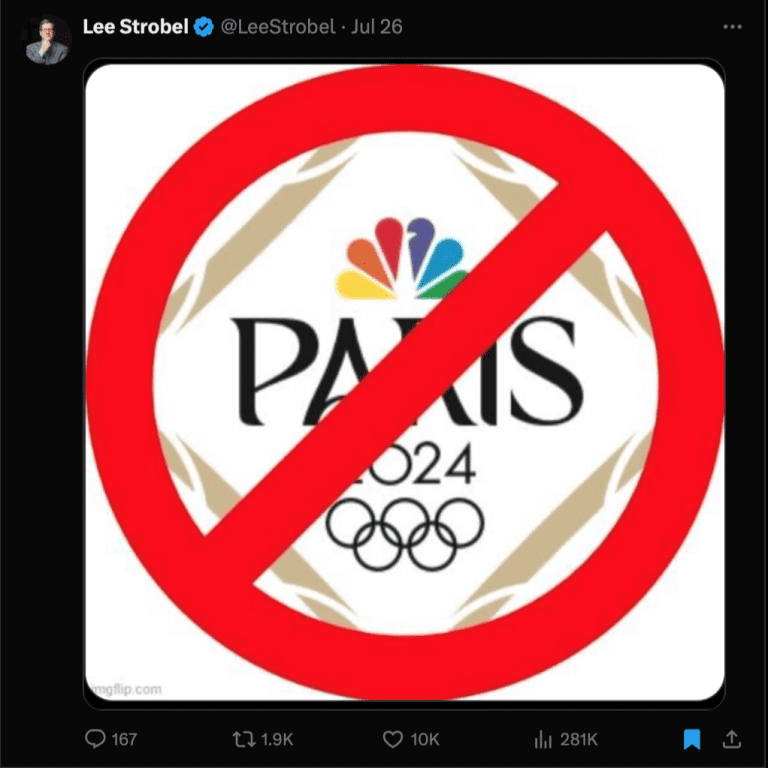
Tweet displaying Lee Strobel’s evangelical protest.
Almost immediately after the post from Mr. Stetzer’s account, an X account from Denny Burk, President of the Council on Biblical Manhood and Womanhood, crafted a similar piece of evangelical outrage—including the same juxtaposed image from the opening ceremony with Da Vinci’s “The Last Supper.” This account shared that “friends are texting me images from the event that are more than a little disturbing.” Let’s just let that sink in for a moment. Sober-minded Christians or, for the sake of it, just reasonable, decent human beings ought to wonder why conservative Christians are passing what they believe to be “disturbing” and “offensive” content around to one another in voyeuristic fashion. This behavior seems out of characteristic and inconsistent with a healthy Christian ethic. If we could do it all over again, it would have been interesting to monitor the hearts of evangelical outrage viewing the opening ceremonies and not just the parents watching their children compete in the Olympic Games.
Al Mohler, Franklin Graham, and Andy Stanley added their two-cents later on Saturday. The person managing Mohler’s X account, perhaps more sober-minded than others, indicated that the account would not “post the blasphemous image.” Rather, it shared a statement from Mr. Mohler that the opening ceremony was an example of “secular replacement” with a new dominant religious symbol at the center. Paris strove to be a new Babylon “with a drag queen at the center behind the altar.” The post from Mohler’s X account gained a viewership of 98K, 1.8K likes and 400+ reposts.
The Graham X account reproached the International Olympic Committee for allowing the opening ceremonies to “feature men in drag parodying the Last Supper?” This account appealed to technologist Elon Musk’s rebuke that “this was extremely disrespectful to Christians” as well as U. S. Speaker of the House, Mike Johnson, who said that “Last night’s mockery” was “insulting to Christian people around the world.” Echoing them, Mr. Graham indicated that this was “disrespectful to Christians” and more so disrespectful to God, who should not be mocked, according to Galatians 6:7. Mr. Graham appealed to an ecumenical consensus that Catholics, Orthodox, Anglicans, and Protestants should be offended by this content. The post from Graham’s X account had over 150K views, 12K likes, and 2.6K reposts. Notably, within the next twenty-four hours, Roman Catholic Bishops and Anglican Clergy around the globe took to social to display their Christian protest to the opening ceremonies as well.
Andy Stanley’s X account provided its own creative rebuke that circumvented passing around the alleged objectionable image. Stanley’s content creation team posted an image of the graves of WWII soldiers, who paid the ultimate sacrifice on the beaches of Normandy. This account claimed that those soldiers’ last prayers were to the God the opening ceremonies mocked. Mr. Stanley admonished the French to remember that they possess a 172.5 acre reminder of what Christian love looks like. Mr. Stanley claimed, “You don’t just owe Christians an apology. You owe the West an apology.”
Since these posts, old guard evangelical outrage has exerted a notable global influence on readings and interpretations of the living art at the Paris Olympic Opening Ceremonies, but theirs are not the only interpretations and readings to consider.
Pushback Against Evangelical Outrage
From mid-afternoon on Friday, July 26 to late on Saturday, July 27, other evangelical or evangelical adjacent voices offered a more measured and reflective tone that cut through old guard evangelical outrage against the International Olympic Committee, the city and people of Paris, and the artistic director of the Opening Ceremonies, Thomas Jolly.
Joash Thomas repurposed the now notorious picture juxtaposing the living art at the opening ceremony to Da Vinci’s “The Last Supper,” and he provided a redemptive discourse and posture towards the scenes. “If we resisted the urge to get offended by this, we might look a little bit closer and be reminded that everyone has a seat at Jesus’ table.” Jay Mallow posted, “If the Olympic Opening Ceremony has taught us anything it’s that WAY too many Evangelical Christians think American culture is ‘Western’ and universal. They also have never taken a foreign language film course.” Kristina Hart argued: “Christians are insufferable. No one did anything to you no one is abusing you, u are not a victim bc the opening ceremony showcased very typical French art. Read a book & grow up. Ppl find us annoying bc we are. No intellect to appreciate things outside our tiny world view.”
Dante Stewart compared evangelical outrage to evangelical ambivalence, claiming, “You know your faith is broken when you are more angry about drag queens reenacting the Last Supper than you are with Donald Trump using Christianity to become a wannabe dictator.” Carlos A. Rodriguez admonished, “Jesus did not call his followers to defend Christianity; he called them to defend the poor, the marginalized, the oppressed, and the hurting. Stop wasting time being offended. Get to feeding, and healing, and peace making.” Mason Mennenga cleverly turned the notion of mockery on its head by crafting this post:
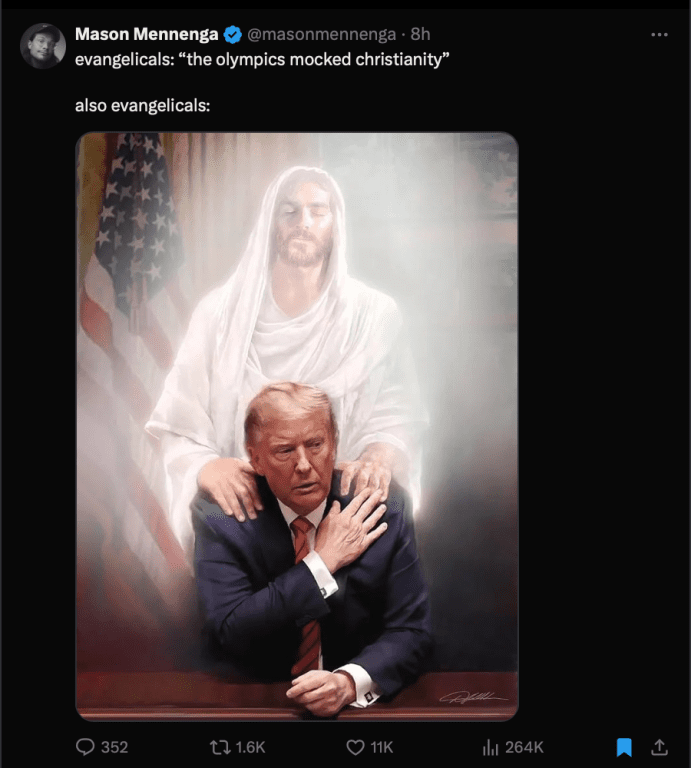
Screenshot of Mason Mennenga’s tweet about evangelical outrage.
Anabaptist and pacifist, Shane Claiborne, employed the moment to redirect people back to the genocide in Gaza. He used the now notorious juxtaposition in a satire to say: “If you’re upset about this, wait until you hear about Gaza.” Claiborne knows full well that people will wait indefinitely to hear old guard evangelical outrage about the genocide of Palestinians in Gaza.
Two other posts struck me from Joy Qualls and J. David Dark. Qualls subtweeted: “It is almost like we need the Humanities in our world today…” Dark posted a picture he had taken of Da Vinci’s fresco in Milan and averred, “I beheld the original in Milan just the other day, and y’all don’t know what you’re talking about.” Qualls and Dark made notable claims, which as events unfolded, proved to be prescient appeals that tacitly urged Christians to cultivate a patient, reflective posture rather than knee-jerk outrage.
The Modern/Post-Modern Rub of This Debacle
Of course, the discourse about the objectionable living art display at the opening ceremonies hung on an interpretation that it was an intentional mockery of Da Vinci’s “The Last Supper” fresco. Few have given due consideration on how this is a dilemma related to the distinction between modern and post-modern views of reading cultural texts and memes and where the seat of authority in readings reside.
From what we understand, the authorial intent of the Artistic Director, Thomas Jolly, was that the living art display reimagined a depiction of a Bacchanal Feast. The New York Times reported, “Mr. Jolly said on Sunday that he had not been inspired by ‘The Last Supper.’” Central to Jolly’s inspiration of the living art display was the depiction of French singer and actor, Phillipe Katerine, painted in blue, bearded, with a green wreath of ivy upon his crown.
Over the course of the weekend and early this week, numerous art historians and other classicist scholars corroborated Jolly’s authorial intent by providing expert interpretations to help journalistic news coverage repair misunderstandings and misinterpretations of the living art, many of which had been spread and perpetuated by ongoing evangelical outrage. These scholars offered comparative analyses from various Renaissance and post-Renaissance realism that depicted the Bacchanal Feasts. A consensus of scholars demonstrated clear similarities between Jolly’s visual art display to renditions of the Bacchanal Feasts, while pointing out incongruities with Da Vinci’s “The Last Supper.” Both Jolly’s and the Olympic’s official statements have emphasized that they wished to convey values of diversity, inclusion, and “the absurdity of violence between human beings.” This seems consistent with the history and evolution of the Cult of Dionysus.
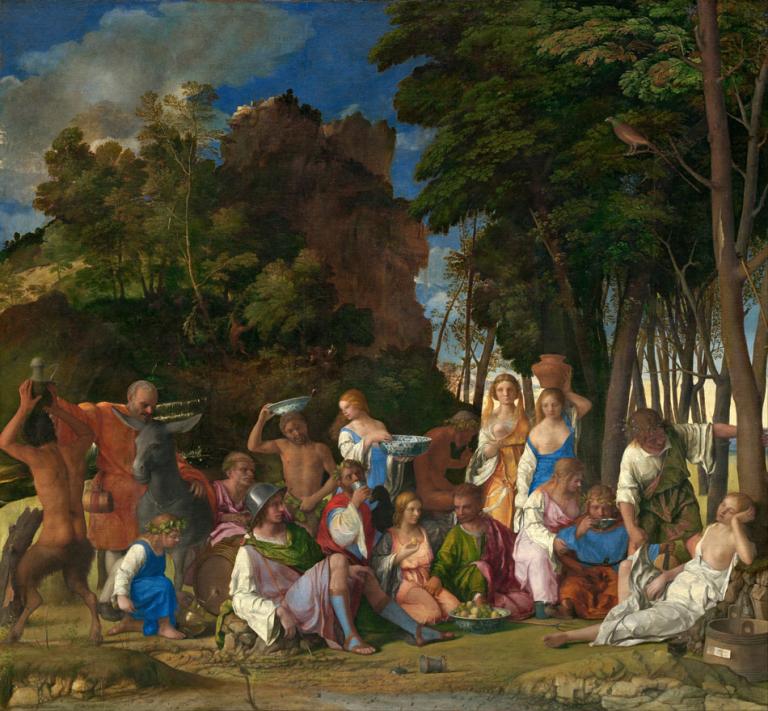
Bellini and Titian, “Feast of the Gods” (1514/29), National Gallery of Art, Washington, D. C., USA.
A Brief History of the Cult of Dionysus and the Bacchanal Feast
Dionysus or Bacchus was the demi-God son of Zeus and the Theban princess Semele. Even Dionysus’s birth was rooted in the absurdity of violence. Zeus swore by the river Styx to do anything for his paramour Semele, but Zeus’s jealous wife Hera bewitched Semele to ask Zeus to show her his full glory and splendor as “King of Heaven and Lord of the Thunderbolt,” a request Zeus knew would be her undoing. Bound by an oath to the river Styx, Zeus came to her and Semele burned up in his glory, but not before Zeus rescued the soon to be born Dionysus from Semele’s side.
As half man and God, Dionysus dwelled on earth with humans rather than Mount Olympus. He was God of the vine, ivy, and feasts. Because the fruit of the vine is given to dispose consumers with either mirth or violence, Dionysus’s persona evoked both consequences of the drink. A retinue of wand carrying maidens, the Maenads, who were too easily frenzied by wine, served him. He commonly kept Satyrs and Sirens as companions. His mirthful, noisy, and flamboyant entourage attracted attention and revulsion wherever they went.
Dionysus wished to establish his cult in Thebes, the home of his mother, so he brought along his fairie attendants and dancing retinue of Maenads before the Theban regent, his cousin, Pentheus. Pentheus resented this odd display and did not wish to recognize Dionysus’s deity. Edith Hamilton’s account of the affair is disquieting. “The wild dancing and the loud joyous singing and the generally queer behavior of these strangers seemed to him highly objectionable, and to be stopped at once” (Hamilton, Mythology, 68). The parallels of part-human part-creature attendants, dancing witches, and the overall flamboyant behavior depicted here should not be lost on those who viewed the opening ceremonies. In retribution for Pentheus’s sleight against Dionysus, Pentheus’s mother and sisters were bewitched on Mount Cithaeron. In a trance, they mistook Pentheus for a young lion. They and Dionysus’s Maenads tore Pentheus to pieces.
The persona of Bacchus evolved over time from freeing men’s minds through drunkenness to freeing them through inspiration. Classical poets and philosophers downplayed the brutal, violent associations of the early mythology as well as associations with drunkenness. His cult took on a pacifistic association that emphasized his associations with mirth, feasting, and celebrating all that is fully human, which involves accepting death and sorrow. The symbology of how the vine flourishes in Spring, while its branches withered and died in winter took on significance in the mythology of Dionysus. Likewise, every winter Dionysus brutally died, being violently torn apart by the Titans or others, according to Hera’s orders. Yet, each spring Dionysus rose again, and “it was his joyful resurrection they celebrated in his theater.” The absurdity of violence in the various mythologies concerning Dionysus conveyed a sober message for humans to be repulsed by such bizarre behaviors.
Edith Hamilton describes the Bacchanal Feast as such:
No other festival in Greece could compare with it. It took place in the spring when the vine begins to put forth its branches, and it lasted for five days. They were days of perfect peace and enjoyment. All the ordinary business of life stopped. No one could be put in prison; prisoners were even released so that they could share in the general rejoicing. But the place where people gathered to do honor to the god was not a wild wilderness made horrible by savage deeds and a bloody feast; it was not even a temple precinct with ordered sacrifices and priestly ceremonies. It was a theater; and the ceremony was the performance of a play. The greatest poetry in Greece, and among the greatest in the world, was written for Dionysus. The poets who wrote the plays, the actors and singers who took part in them, were all regarded as servants of the god. The performances were sacred; the spectators, too, along with the writers and the performers, were engaged in an act of worship. Dionysus himself was supposed to be present; his priest had the seat of honor. (Hamilton, Mythology, 72-73)

Titian, Bacanal de los Andrios (1523–26), Museo del Prado, Madrid, Spain.
Who Has Authoritative Interpretation Over Art?
This faithful account of the myths of Dionysus and the development of his cult, across the history of the Western tradition, ought to help us see why Jolly and the Olympic planners appropriated the Bacchanal Feast for their vision of the opening ceremony, and their good faith effort to offer a message of diversity, inclusion, and the absurdity of violence.
Furthermore, perhaps old guard evangelicals ought to interpret the Cult of Dionysus in the spirt of the medievalist C. S. Lewis. Lewis would’ve argued that this cult is just one more type in Western cultural history that points to the truer and better fulfillment, Jesus Christ, who is the “true Vine” and the first fruits of resurrection, he whose birth was heralded by a host of angels proclaiming “peace on earth.”
Frankly, viewers of the opening ceremonies have a choice to receive this visual living art with a sentimental appreciation that transcends worldview differences, or they may wish to receive it in a spirit of evangelical outrage, intolerance, and as bad-faith mockery. As a post-modernist, the Artistic Director, Jolly, recognized that spectators of his living art have a subjective authority upon how they wished to receive his artwork. He didn’t intend to mock or offend Christians. It appears he wasn’t even thinking about Christians when he displayed this art. However, in his press interviews he was not going to deny Christian spectators of their interpretations. There is indeed a comparative relation and tradition between “The Last Supper” and “The Bacchanal Feasts” or “Feast of the Gods” canon of sixteenth and seventeenth century art. The sacred value of artistic freedom in France includes offering beholders freedom and authority in their own interpretations of art. This is a very post-modern impulse.
However, we also need to discern the interpretive approach of old guard evangelical outrage. Have they invoked a pre-modern disposition, one that overrides the authority of the artist and appeals to their irrefutable authority as religious leaders and experts? It does seem that old guard evangelicals like Stetzer, Strobel, Burk, Graham, and even Cosper have strong-armed Jolly, Paris, and the Olympics into their authoritative pre-modern interpretation that the visual art is undoubtedly a bad faith mocking parody of Da Vinci’s “The Last Supper.” There is plenty of historical precedence for pre-modern religious authorities to exercise their rights, as expert theological and clerical actors, to co-opt the power of interpretation and authority over religious art from the artists themselves. I will conclude this essay with one such historical example.
On the other hand, has old guard evangelical outrage stemmed from evangelicals giving over to the spirt of the age and denying their pre-modern commitments that privilege authorial intent? Rather, have these old guard evangelicals followed the impulse towards a pragmatic, opportunistic, and post-modern predilection that privileges their subjective authority as readers of this cultural art? If this is the case, their decision to do so is not at all surprising and fits with the pragmatic and opportunistic impulses of evangelicals, who historically and habitually adapt to cultural contexts. Regardless, at bottom, the result is that old guard evangelical outrage has been motivated by a desire to garner attention for evangelicals and the global Christianity they wish to culturally lead and represent. Similar to the Marvel character Deadpool, in the recent Deadpool and Wolverine movie, these people just want to still matter.
Perhaps, that’s exactly what undergirds the ongoing mood of old guard evangelical outrage. It may even be residue of the spirit of fundamentalist, militant evangelicals that have haunted the evangelical story since the early twentieth century. The Paris Olympic Opening Ceremonies is one more reminder to old guard evangelicals that Western Culture is Post-Christian. The French played a seminal role in the ascendance and eclipse of Christianity in the Western tradition. They make an easy, if not traditionally acceptable target of evangelical outrage. Anglicized folk, with conservative Burkian impulses and responses to the French Revolution and the Enlightenment tradition, will undoubtedly be repulsed by this visual art display. Jolly envisioned a message that catered to the tastes of global secularization, democratization, and the pluralistic human impulses that transcend the authority of any one dominant worldview. It was this mood he envisioned for humanity and presented as a living canvas put on display at the opening ceremonies.
An Alternative View of the Opening Ceremonies
In my opinion, the mood of old guard evangelical outrage is not only pathetic and immature, but it is unbecoming of the Gospel and inconsistent with the model of Christ. I clearly have more sympathy for the evangelical adjacent Christian response to the opening ceremonies, and I especially found consonance with Joash Thomas’s conviction that we should view Jolly’s living art as an invitation to see that all are welcome at Jesus’s Table.
Perhaps more art history will help us reimagine Jolly’s living art with a more Christian perspective. In 1571, a fire destroyed Titian’s rendition of “The Last Supper” in Venice, Italy. Besides having painted his own version of “The Last Supper,” Titian (1488/90–1576) has also been credited for producing the best Renaissance portrayals of the Bacchanal Feasts. He painted “The Bacchanal of the Adriaans” from 1523–26, which may be viewed in the Museo del Prado in Madrid, Spain, and, in 1529, Titian completed Giovanni Bellini’s 1514 piece “The Feast of the Gods,” which may be found in the National Gallery of Art in Washington, D. C., USA (both pictured above).
After the misfortunate destruction of Titian’s painting of “The Last Supper,” Paolo Veronese (1528–88) was commissioned to paint one of the largest sixteenth century oil canvases of “The Last Supper” for the wall of the Dominican friary, the refrectory of the Basilica di Santi Giovanni e Paolo. This painting is now housed in the Galleria dell’Accademia in Venice, Italy, but it is entitled, “The Feast of the House of Levi.” You see, the Venetian inquisition heard about objectionable material that Veronese had portrayed in his painting of “The Last Supper.” The inquisition interrogated Veronese concerning a handful of scandalous elements, including the presence of sinners at the table, which included a dwarf jester pictured with a young child (center left) and drunken Prussian soldiers (bottom right). The Venetian religious authorities objected to this content and believed it to be a mockery of “The Last Supper.” They forced their interpretation and consensus that “The Last Supper” should depict only Christ and his disciples upon the painting’s author, Veronese. They permitted Veronese to display his painting only if he revised its title and message to convey the story of Luke 5, where Jesus sat at the table of Levi among sinners. If you recall, Luke 5:29–32 recounts:
Then Levi held a great banquet for Jesus at his house, and a large crowd of tax collectors and others were eating with them. But the Pharisees and the teachers of the law who belonged to their sect complained to his disciples, “Why do you eat and drink with tax collectors and sinners?”
Jesus answered them, “It is not the healthy who need a doctor, but the sick. I have not come to call the righteous, but sinners to repentance.”
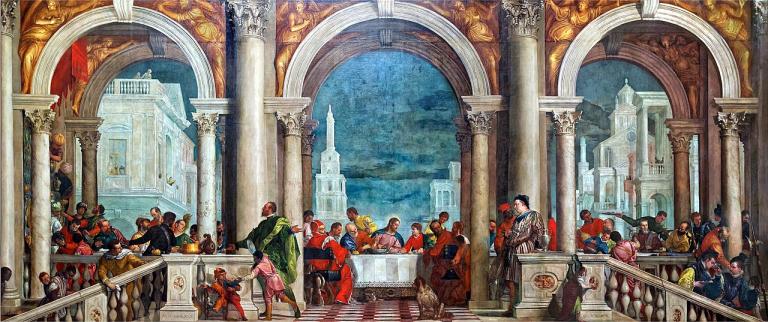
Paolo Veronese, Feast of the House of Levi (1573), Galleria dell’Accademia, Venice, Italy.
The plangent parallels between the spirit, authority, and mood of Roman Catholic inquisitors then and old guard evangelical outrage today are quite unsettling. Likewise, Veronese’s flexibility and accommodation to the Venetian authorities is also quite consonant with the response of Jolly, who has been rather apologetic and contrite concerning the perceived offenses that have been made.
The “Feast of the House of Levi” debacle occurred about a decade after the close of the Council of Trent and during the furor of a Roman Catholic counter-reformational offensive. At this time, Roman Catholic leaders feverishly mobilized and organized to desperately hold onto political, social, and cultural power in Europe. They acutely felt the fragmentation of their power, and their desperation indicates they did not wish to come to terms with their diminished power.
The Paris Olympic opening ceremony kerfuffle seems to be a parallel instance. Old guard evangelical outrage mimics the frenzied Roman Catholic counter-reformational spirit, while having corollaries with the militant energy of early twentieth century fundamentalists. Is this but another signal instance of diminishing power-brokers feebly fighting against cultural currents that are too powerful, in a furious effort to hold onto something that’s already been lost? Whatever the matter, evangelical outrage isn’t a good look on evangelicals, and it doesn’t help its global image one bit. But curating an appealing global image is not what it’s all about anyway. Christians should be first and foremost concerned about being good global neighbors.
History and Religion
Previous Post
July 30, 2024
Joseph H. Jackson and Christian Unity
Next Post
August 1, 2024 American Empire, Voodoo, and Black Religion
Recent Comments
"Every religion is "made up," even Adam and Eve were made up thousands of years ..."
Forging Druids and Inventing a Nation
"I have an identical twin, and Thomas was always the disciple I connected with most. ..."
In the Footsteps of Thomas: A ..."
"I've never thought of Constantine as a villain. Do Christians generally? Maybe the ones who ..."
"The TV sitcom BEWITCHED was an old favorite of mine"
How Scotland Gave Us Our Modern ..."
Browse Our Archives
Select a Category abolitionism Abortion Abraham Joshua Heschel Abraham Kuyper Abraham Lincoln Academia Activism Adam Renberg Advent Adventist africa African American Religion Agnes Howard Albert Camus American History American Religious History American Revolution American West Anabaptists Ancient History Andrea Turpin Andrei Tarkovsky Anglicanism Annales Ansley Lillian Quiros anti-Catholicism Antisemitism Anxious Bench apologetics Apparitions Arash Azizi Archaeology archives art Artificial Intelligence Asia Asian Americans Augustine Authors Bad Bunny Baptism Baptists Barack Obama Battle of Hastings Benjamin Franklin Bernard-Henri Levy Beth Allison Barr Beth Moore Bethany Mannon Bible Bill Cunningham Billy Graham Black Music Bob Dylan Body Boenhoffer Books Breastfeeding Bruce Springsteen C.S. Lewis Calvinism Cancel Culture Capitalism Carmelites Catholicism Cedric Robinson Cesar Chavez Charismaticism charity Charles Dickens Charles Lindbergh Che Guevara Chicago Children Chinese Christianity Chris Gehrz Christ Christian death Christian Higher Education Christian life Christian Nation Christian Nationalism Christianity Today Christmas Church life Church Practice cinema Civil Religion Civil Rights Movement Civil War civility Classics Climate Change Cold War Colonial Mexico colonialism Comer Communism community complementarianism Conference on Faith and History Congregationalism Conspiracies Conspiracy Conversion Narratives Coronavirus Costa Rica Council of Nicaea Covid-19 Creation Critical Race Theory Crusades Culture culture wars Daniel K. Williams David Barton David Swartz Death Ways death with dignity DEI democracy Democratic Party Devotion Digital Age Diplomacy discipleship diversity Donald Trump Drama Dua Lipa Early Church early modern Early modern Catholicism Easter Eastern Christianity economic exploitation Education elections Elie Wiesel Elizabeth II Elizabeth Taylor emotions Empire Engineering England enslavement Entertainment Episcopal Church Erica Ramirez eschatology Eurocentrism Evangelicalism Evangelicals Exegesis Family Feminism Film Flannery O'Connor folk music Food Foreign Policy founding fathers Franciscans Franciscus Junius fundamentalism Funerals G.K. Chesterton Gender Genocide genre geography George W. Bush George Washington George Whitefield Global Christianity Global church Grief Guadalupe guest post Guest Post gun control gun violence Gustavo Gutierrez Hamid Dabashi Harold John Ockenga Harvest Hate Hawaiian Christianity Healing health care Heather Cox Richardson Hell Heresy Hermeneutics Higher Education Hinduism Hippocratic oath Historical Fiction Historical Methodology Historical Profession Historical Profession Historical Theology Historical Thinking historiography Holidays Holocaust horror movies Human rights Humanitarian Work humanities Hummingbirds Hungary hymns Imago Dei Immigration Injustice Interviews Iran Islam Islamophobia Israel Ivan's Childhood Jacob Randolph James Bratt Janine Giordano Drake Japanese history Japanese Literature Jean Paul Sartre Jesse Miranda Jesus Jesus Christ Jimmy Carter Joan Baez Joan Didion Joanne Freeman João B. Chaves Joao Chaves Joey Cochran John Calvin John Fea John Tillotson John Turner Johnny Cash Jonathan Edwards Jonathan Tran Joseph Smith Josh Howerton Journalism Jr. Judaism Jürgen Moltmann Just War Justice Justin Brierley Karl Barth Katelyn Beaty koi ponds Kris Kristofferson Kristin Kobes Du Mez Latin American Religious History Latino Americans Lectio Divina Leisure Lent Leonard Cohen liberal arts liberalism Liberation Theology Linda Ronstadt Lisa Clark Diller Literature Lou Reed Lynchings Lynneth Miller Renberg Mainline Protestantism Malcolm Foley Marilyn Monroe Maritime history Mark Noll Marriage Martin Luther Martin Luther King Martyrdom Marxism Mary Masih Alinejad mass shootings material culture medieval Christianity Medieval Ethiopia Melissa Borja memory Mennonites Mental Health Mental Illness Methodism Mexican Americans Mexicans Mike Madrid Miles Mullin Min Jin Lee Miscarriage Missionaries Mister Rogers Mitt Romney modernity Monasticism Mormonism Motherhood Mothers of the Church Moving Music Musicals Nadya Williams Nahua Christianity Native Americans Natsume Sōseki New Contributor New England New Year New York Nico Non-Violent Protest Orthodoxy pacifism Paleo Evangelicals Palestinians Parenting Patti Smith Paul Kingsnorth Pedro Calderón de la Barca Pentecostalism Philip Jenkins Phillis Wheatley physician-assisted suicide pilgrimage Pilgrims Piracy pluralism Plutocracy Poetry Politics Pope Francis Pope Leo XIV post-modernism prayer preaching Presbyterians prosperity gospel Protest Public Executions Public history Publishing Puritans purity culture Quakers race Race Massacres Racial Capitalism racial reconciliation racialization Racism Raha Bahloulipour Re-Enchantment reading Reformation Refugees religion and the university religion and war Religious Freedom Religious Nones Religious Pluralism Religious Symbols religious violence Republican Party Revival Rita Coolidge Ritual Roger Williams Roman Catholic church Royalty Russell Moore same-sex marriage Sarah Irving-Stonebraker Scandinavia Science Science and Technology Scopes trial Scriptural Interpretation secularism Selena Quintanilla seminary Seventh-Day Adventists sexual morality Sexuality Sikhs Silence slaveholders theology Slavery Slavoj Zizek social justice Social Media Southern Baptist Convention Southern Religion Spain Spiritual Autobiography Spiritual but not religious Spiritual Discipline Sports Stanley Hauerwas Suffering Summer Camps Sunday Night Odds and Ends Supernatural Supreme Court Syriac Christianity Tal Howard Taylor Swift Teaching Technology Television Thanksgiving The Beatles The Mission theater TheoBros Theology Thomas Dixon Thomas Jefferson Thomas Kidd Thomas Merton Tim Gloege Tim Walz Tom Holland Tourism tradition Tragedy Translation Transnationalism Travel Trump Ukraine Uncategorized Unitarians United Methodist Church US History Vanessa Chan Velvet Underground Verónica A. Gutiérrez Veronica Gutierrez Vikings Violence Virgin Mary Virtue Virtue ethics Visions Voting War WCTU Wendell Berry Westminster Assembly White Evangelicalism Wildfires Winnie the Pooh Witches women Women in Ministry Women's and Gender Studies Work Worship writing Yasunari Kawabata Zena Hitz
Select a Month November 2026 October 2026 September 2026 August 2026 July 2026 June 2026 May 2026 April 2026 March 2026 February 2026 January 2026 December 2025 November 2025 October 2025 September 2025 August 2025 July 2025 June 2025 May 2025 April 2025 March 2025 February 2025 January 2025 December 2024 November 2024 October 2024 September 2024 August 2024 July 2024 June 2024 May 2024 April 2024 March 2024 February 2024 January 2024 December 2023 November 2023 October 2023 September 2023 August 2023 July 2023 June 2023 May 2023 April 2023 March 2023 February 2023 January 2023 December 2022 November 2022 October 2022 September 2022 August 2022 July 2022 June 2022 May 2022 April 2022 March 2022 February 2022 January 2022 December 2021 November 2021 October 2021 September 2021 August 2021 July 2021 June 2021 May 2021 April 2021 March 2021 February 2021 January 2021 December 2020 November 2020 October 2020 September 2020 August 2020 July 2020 June 2020 May 2020 April 2020 March 2020 February 2020 January 2020 December 2019 November 2019 October 2019 September 2019 August 2019 July 2019 June 2019 May 2019 April 2019 March 2019 February 2019 January 2019 December 2018 November 2018 October 2018 September 2018 August 2018 July 2018 June 2018 May 2018 April 2018 March 2018 February 2018 January 2018 December 2017 November 2017 October 2017 September 2017 August 2017 July 2017 June 2017 May 2017 April 2017 March 2017 February 2017 January 2017 December 2016 November 2016 October 2016 September 2016 August 2016 July 2016 June 2016 May 2016 April 2016 March 2016 February 2016 January 2016 December 2015 November 2015 October 2015 September 2015 August 2015 July 2015 June 2015 May 2015 April 2015 March 2015 February 2015 January 2015 December 2014 November 2014 October 2014 September 2014 August 2014 July 2014 June 2014 May 2014 April 2014 March 2014 February 2014 January 2014 December 2013 November 2013 October 2013 September 2013 August 2013 July 2013 June 2013 May 2013 April 2013 March 2013 February 2013 January 2013 December 2012 November 2012 October 2012 September 2012 August 2012 July 2012 June 2012 May 2012
Follow Us!
TAKE THE
Religious Wisdom Quiz
What animal did Samson kill with his bare hands?
Select your answer to see how you score.
Leopard Lion Wolf Bear
Related posts from Anxious Bench

Best Books of 2026 on American Christianity
Public Executions and the Pirate Curse of Nix's...
Paris & CT Burn 50 Years After Newsweek's...

What Coffee Reveals About America's Evangelical Varieties
TRENDING AT PATHEOS Evangelical

Debate on Purgatory & Biblical Evidences for It
This is from a combox on my video channel, Catholic Bible Highlights....

Set the table for the coming King
On Thursday we visited my sister-in-law for Thanksgiving, and throughout the entire...

If I Stop Becoming, Will I Disappear?
(At our most recent half day Zen retreat, Dr Chris Hoff, a...

A Modest Proposal for President Trump
Trump should just quit the loser Republicans who failed him so badly...
Praise and Thanks As Natural as Breathing
This week I had the privilege of sitting down with Deacon Tom...
Jesus is Coming with Glory and Power
https://www.youtube.com/watch?v=_lt60EDHOQ4&list=RD_lt60EDHOQ4&start_radio=1
view all Evangelical blogs
What Are Your Thoughts?leave a comment
Ad-Free & Subscriber Log-In Subscription Support
- About Us
- 2026 Calendar
- Videos
- Podcasts
- Library of World Religions
- Faith In Media Tracker
- Advertise With Us
- Write for Us
- Privacy Policy
- Terms of Service
- Do Not Sell My Data
- Contact Us
- Radiant Digital
- Manage Newsletter Subscriptions
- Unsubscribe From Notifications
- Sitemap
Copyright 2008-2026, Patheos, part of the Radiant Digital network of media brands. All rights reserved.
Subscription Support Ad-Free & Subscriber Log-In
Follow Patheos