
BuddhistCatholicContemplativeEvangelicalGeneral ChristianHinduJewishLatter-day SaintMuslimNew VisionsProgressive Christian
Beliefs
- Buddhist
- Catholic
- Contemplative
- Evangelical
- General Christian
- Hindu
- Jewish
- Latter-day Saint
- More Voices
- Muslim
- New Visions
- Pagan
- Progressive Christian
Topics
- Religion News
- Food and Religion
- Sports and Religion
- Religious Art
- Religious Music and Entertainment
- Religious Events
- History and Religion
- Style and Religion
- Politics and Religion
- Women in Religion
- Recreation Outdoors and Religion
- Business Finance and Religion
- Careers Workplace and Religion
- Education and Religion
- Family Parenting and Religion
- Health Fitness and Religion
- Home and Religion
- Relationships and Religion
- Technology and Religion
- Travel and Religion
Columnists
- Buddhist Columnists
- Business Finance and Religion Columnists
- Careers Workplace and Religion Columnists
- Catholic Columnists
- Contemplative Columnists
- Education and Religion Columnists
- Evangelists Columnists
- Family Parenting and Religion Columnists
- General Christian Columnists
- Health Fitness and Religion Columnists
- Hindu Columnists
- History and Religion Columnists
- Home and Religion Columnists
- Jewish Columnists
- More Voices Columnists
- Latter Day Columnists
- Muslim Columnists
- New Visions Columnists
- Nonreligious Columnists
- Pagan Columnists
- Politics and Religion Columnists
- Progressive Columnists
- Recreation Outdoors and Religion Columnists
- Relationships and Religion Columnists
- Religion News Columnists
- Religious Art Columnists
- Religious Events Columnists
- Religious Music and Entertainment Columnists
- Sports and Religion Columnists
- Style and Religion Columnists
- Technology and Religion Columnists
- Travel and Religion Columnists
- Women in Religion Columnists
Resource Library
- 2026 Calendar
- Library of World Religions
- The 100 Most Holy Places on Earth
- Patheos Answers
- Podcasts
- Videos
- Faith Leaders Database
- Anglican Episcopalian
- Bahai
- Baptist
- Buddhism
- Christianity
- Confucianism
- Eastern Orthodoxy
- Hinduism
- Holiness and Pentecostal
- ISKCON
- Islam
- Judaism
- Lutheran
- Methodist
- The Church of Jesus Christ of Latter-day Saints
- New Age
- Paganism
- Presbytarian and Reformed
- Protestantism
- Religion Behind the Scenes
- Roman Catholic
- Scientology
- Shia Islam
- Sikhism
- Sufism
- Sunni Islam
- Taoism
- Zen
- See all religions
Research Tools
 Ad-Free & Subscriber Log-In Subscription Support
Follow Patheos 

- Trending:
- Advent
- |
- Forgiveness
- |
- Thanksgiving
- |
- Election
- |
- Seasonal Holidays
- |
- Marriage

-
About the Authors
- Home
- Evangelical
- Sea Peoples, Goths, and Barbarians
Sea Peoples, Goths, and Barbarians
Last updated on: June 20, 2024 at 6:32 am by Philip Jenkins
Sea Peoples, Goths, and Barbarians 2024-06-20T06:32:56-04:00 Philip Jenkins
Patheos Explore the world's faith through different perspectives on religion and spirituality! Patheos has the views of the prevalent religions and spiritualities of the world.
If you study the historical background of the Old Testament, you will very soon come across the Sea Peoples. According to a widely told narrative, these were ferocious barbarian peoples who erupted into the civilized worlds of the Late Bronze Age Mediterranean around 1200 BC. They posed a deadly threat to Egypt and were likely responsible for destroying other great states of the day. Among their ranks were the Peleset, the Philistines, who settled in Palestine, and ultimately gave the land their name. They feature very extensively in the historical accounts of the early Hebrew states and kingdoms.
So much is widely accepted, but some recent scholarship is challenging that model: see especially a major article that appeared in the prestigious pages of the New Scientist, by Colin Barras, and titled “Who Were The Enigmatic Sea Peoples Blamed For The Bronze Age Collapse?” Now, we are told, “new evidence shows that many of our ideas about this turbulent time need completely rethinking.” Rethinking is always a useful exercise, but in this case, I think most of the proposed revisions are simply wrong, and I will demonstrate that by drawing on other analogies, both ancient and early medieval.
I make the obvious point that the whole category and terminology of “barbarians” is wildly subjective and unstable. Everybody is a “barbarian” to someone: just read what nineteenth century Chinese elites said about the obnoxious British and French arriving on their shores. How we apply the label is largely a matter of whose written records happened to survive for the uses of later historians. Having said that, bear with me as I will use the loaded B-word without elaboration in this short piece. On every occasion, just assume that quotes are implied.
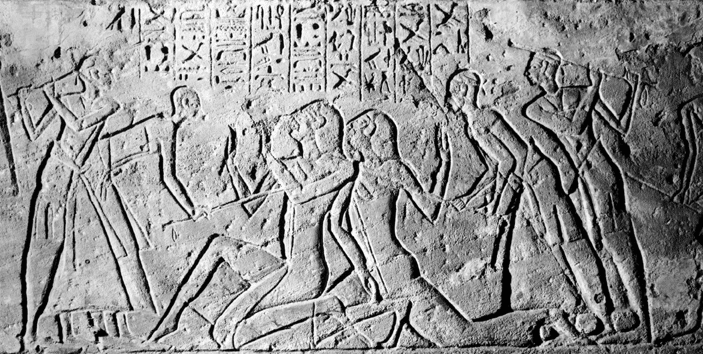
The Sea Peoples
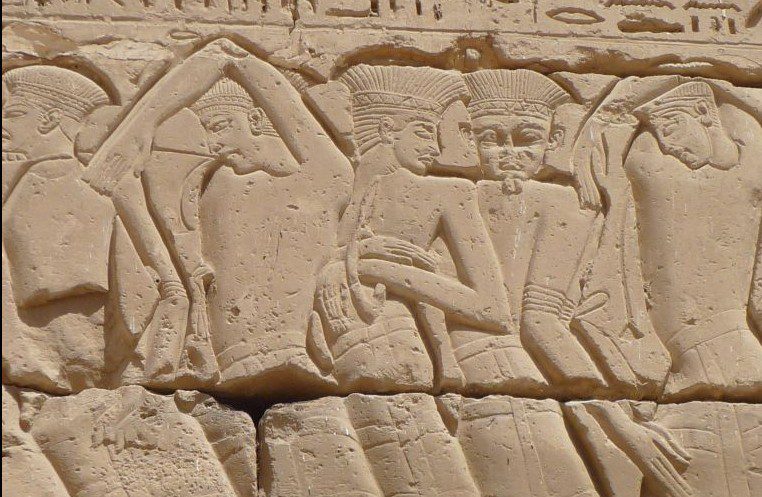
The Sea Peoples first appear in Egyptian inscriptions in which Pharaohs Rameses II and III tell of these fierce raiders who swept all before them, or at least until they met their own mighty armed forces. Rameses III was especially boastful. Some of those raiders, by the way, wore the kind of horned helmets we easily associate with barbarians and pirates.
The origins of these Ekwesh, these Peoples of the Countries of the Sea, are widely discussed. Among the recorded names that appear in ancient sources, we find such ethnic labels as Lukka, Shekelesh, and Sherden which might or might not correspond to such later terms as Sicilian and Sardinian, as well as Lycians and (probably) Greeks. I will over-simplify grossly here, but one standard theory suggests that various climatic stresses and disasters forced a mass movement of peoples from the Aegean and Anatolian worlds, and possibly from the Western Mediterranean. Rhodes is always an intriguing source for the raiders, as are Cyprus and Crete. These peoples formed a confederation which struck at Egypt and other temptingly wealthy lands.
What happened to them after that point is debated. If we accept the linkage with Sicilians and Sardinians, that might either mean that some of the raiders came from those western parts, or else that is where they ended up after some wanderings. We can be confident enough about the fate of the Philistines, and recent genetic investigations confirm that they had roots in Greece or southern Europe.
Much of our interpretation of this whole story was formulated in the nineteenth century by European historians who held views about ethnicity and migration that are now very much out of fashion. Even so, the broad outline remains, and this is what Barras is challenging, or rather, what is being criticized by the range of experts he is interviewing. As he says, the older picture of widespread cumulative calamities
sounds more like a Hollywood plot than an account of real history. [Some current scholars] argue that a more critical examination of the evidence suggests there was, in fact, no destructive wave of migrants sweeping across the Mediterranean and no centuries-long drought. In fact, some even doubt there was a Late Bronze Age collapse in the sense of a single region-wide disaster. “People turned this up to 11, and we have to take it back down to 3,” says Jesse Millek at Leiden University in the Netherlands.
These revisionists dislike the traditional picture in several ways. Just to take one instance, they note the appearance of new groups, but suggest that these might be operating on an invited and approved basis, rather than crashing into the old established order. The Sea Peoples who attacked Egypt might have been working for (or with?) the Hittites, rather than being freelance marauders.
Critics also note the very gradual nature of the incursions, and differ radically from the image of a sudden overnight appearance of countless thousands of burly warriors in their horned helmets. More generally, these critics challenge the idea of a near-overnight Bronze Age collapse that affected the whole region. Perhaps individual states failed separately and independently:
At first glance, that sounds implausible: so much chaos occurring simultaneously is surely no coincidence. But, in reality, the timeline of these events was probably more relaxed than that. “The destructions in Mycenaean Greece could have taken place over 15 or 20 years,” says Helène Whittaker at the University of Gothenburg, Sweden. Across the region more broadly, it might have occurred over 50 years, says Manning – hardly evidence of a single, acute crisis.
I will return to these comments about the “relaxed” chronology.
One oddity about Barras’s article is that it suggests that the Sea Peoples are commonly blamed for the Bronze Age collapse, which most surely attribute primarily to climate factors. Barbarians or climate? The article goes back and fore on these emphases.
In summary,
We still have plenty to learn about the dramatic events at the end of the Bronze Age. But as the evidence continues to accumulate, we may finally be able to acquit the Sea Peoples. It is possible they have been framed for “crimes” that may never have happened.
Vikings
As I read this critique, I felt a powerful sense of déjà vu as it so often recalled other periods of which I have some knowledge.
The chronological issue emerges strongly. If we look at the Viking raids that so devastated much of Europe in the early Middle Ages, they were far more gradual than our conventional accounts suggest. Anyone who knows anything about that story is familiar with the shock and astonishment that greeted the attack on the northern English island of Lindisfarne in 793, but this was in no sense the start of an overnight revolution. Raids were sporadic until then 840s, when the Vikings were sufficiently well established in many local bases to target virtually any destination they chose, including Paris and the Western Mediterranean. That crisis then endured for several decades more. In other words, the seemingly sudden and revolutionary shock of the Viking incursions actually developed over around half a century, very much what is suggested for the Sea Peoples, and the whole span of the crisis was over a century.
Did Europe in these long decades suffer a “single acute crisis” that came close to destroying its emerging Germanic/Latin civilization? Definitely. In historical terms, such an existential crisis can easily be spread over a half century or more.
The Viking situation also forces us to think what we mean when we hear of raiders or pirates. In the early days, the Vikings might hit with a couple of ships, on a very targeted operation against wealthy monasteries. When they found how easy matters were, and how weak the opposition, they moved up to ever larger ventures and groupings, until in 865 England was hit with a whole “Great Army.” Kings now took the lead, and they were looking for new realms to rule, not just plunder. I don’t know if that trajectory also occurred in the Sea People era, but we should always ask these questions about size, scale, organization, and intent. These things varied a lot at different stages over the long periods of crisis.
Incidentally, there is no doubt whatever that Europe’s ninth century crisis was intimately connected with climate disasters, which in the same years had a near-terminal effect on both the Byzantine Empire and the Caliphate. Particularly in the years around 810, both realms came very close to collapse.
Extraordinary climate crisis combined with horned helmeted barbarians – does that sound at all familiar from the Late Bronze Age Mediterranean? If the climate crisis had not been so appalling, maybe the early medieval states would have been stronger and better prepared to resist the Vikings, but they were not. In other words, the invaders were a symptom of catastrophe as much as its cause. That was true in the early ninth century AD. Might it have been true around 1200BC?
So does that ninth century AD story sound like a script for an overheated Hollywood epic? Maybe it does. Sorry about that, it’s just what happened. History is like that.
The Age of Alaric
But there is an even stronger analogy to the Late Bronze Age crisis.
Again, as everyone knows, in the year 410 the Goths sacked Rome, causing a tectonic cultural shock that echoes through many Christian writings, including the work of St Augustine. In fact, reading those accounts, we might well imagine that the Goths had appeared almost overnight, which they certainly had not, and their onslaught was anything but new. Facing intolerable pressure from the Huns, the Goths had moved into Roman lands several decades earlier, and accepted Roman service. Atrocious treatment at the hands of the Romans caused a fatal split, and in 378, Gothic forces defeated the Romans at Adrianople, in one of the worst military catastrophes the empire ever suffered. The Emperor Valens was killed on the battlefield.
Thereafter, successor emperors tried many strategies to accommodate to overcome these increasingly terrifying frenemies, with many attempts to set up contracts or deals. To see how Gothic positions and attitudes fluctuated over time, check out the lengthy Wikipedia entry about their King Alaric, who eventually sacked Rome, very much against his wishes and better judgment. By the way, the Goths at this stage were Arian Christians, who were appalled when their orthodox Catholic Roman enemies violated an Easter truce.

Over the following decades, a variety of other peoples surged into imperial territories, often beginning as mercenaries or contract forces, and then, on occasion, moving into rebellion. One critical change happened in 405-407 when the Roman commander Stilicho – himself a barbarian – removed most forces from the western borders to defend Rome against Alaric. Several Danubian peoples took advantage of the new opportunity to cross into Roman Gaul. The customary listing of the peoples involved includes Vandals, Alans, and Suevi, but seriously, who knows what other peoples might have been involved? The situation in fact quite closely recalls the debates over the exact ethnic makeup of the Sea Peoples.
The accumulation of interlinked catastrophes between 405 and 410 proved fatal for the old imperial order. During the fifth century, various Germanic groups created whole new kingdoms on what had been Roman territory. The Vandals took Carthage in 439 and over the next century ruled a mighty kingdom in North Africa. The Visigoths ruled Spain until 711, and the Burgundians gave their name to a sizable area of what we would call southern France. Large sections of the former Britain became Anglo-Saxon England. The Ostrogoths took Italy. The Western empire staggered on for several decades, but it was wound up an independent entity in 476 (Of course, New Rome continued to flourish in the east).
Remember that recent critique of the Bronze Age crisis, which was allegedly no crisis because it was spread over some decades? If we look at the Roman world between say 378 and 415 or so – over almost forty years – then Hell, yes, there emphatically was “evidence of a single, acute crisis,” and one with prolonged consequences. Would Barras and his experts still be speaking of all this in terms of a “relaxed” chronology? The Western Roman empire in those years found precious little time for the luxury of relaxation.
Some Lessons
The details of these tribes and kingdoms do not matter, but for present purposes, several points stand out.
First, a really disastrous series of empire-slaying crises can be a very long drawn out process, and the fact that the main sacks and battles are spread over lengthy periods does not diminish that fact.
Second, it would quite normal for empires to try to defuse such threats by actually hiring the invaders, or trying to come to some kinds of terms with them. That is a standard part of imperial practice, If you can’t beat them, hire them. Arguing that Group X was working for Kingdom Y at any given point says nothing about their origins, intentions, or ultimate attitude towards that kingdom. We can usefully recall G. K. Chesterton’s framing of the four stages of empire: “Victory over barbarians. Employment of barbarians. Alliance with barbarians. Conquest by barbarians.”
Third, we don’t have to decide between blaming the fall of a state or state system on either climate or barbarian invaders. The climate disasters created the conditions for the barbarians. Maybe the barbarians just populated the landscape as it was falling into ruin through climatic factors.
I add one thing. Barras speaks of the prolonged drought that so weakened the late Bronze Age world, and critiques claims about its seriousness and length. That is fine. But there might well have been another and quite separate climatic cataclysm that destroyed that old world, such as a super-volcano. Disproving (or questioning) the drought theory does not eliminate climate as a decisive factor.
What Drives Barbarian Invasions?
Finally, the forces driving such barbarians might be very mixed indeed. The Romans saw their barbarians as greedy interlopers seeking to build their own empires, and some of course were. But most of the new arrivals were actually refugees fleeing from still nastier barbarians expanding into their space, and that especially meant the Huns.
Did some comparable spark began the Sea People explosion? As I read the New Scientist article, the author suggests that pressure from some northern invaders could have driven southern Italian peoples to seek new lands further afield, whether that meant in Greece, or further afield across the eastern Mediterranean. Conceivably, these new pressures could have shattered the Mycenaean world, and created an almighty knock-on effect. I wonder if the Sea Peoples were themselves refugees and, dare I say, asylum seekers?
The barbarians you see crossing your frontiers and landing on your shores might actually mark the last stage in a series of connected shocks that had their origins a thousand miles away, and which initially affected peoples very different from those who appear in the historical record. Think billiard balls.
Going back to the Gothic age, their motivation through much of this era was not seeking to grab new lands, but rather to seize food supplies, and official rations. The Vandals targeted Africa precisely because that was then so rich in food supplies, and it served as Rome’s granary. Was something similar driving the Sea Peoples? How would we know?
I am all in favor of asking challenging questions about conventional historical models, even if that sometimes looks like nitpicking. But in any such endeavor, we really have to think very carefully about possible historical analogies. In the case of the Sea Peoples and the Late Bronze Age crisis, the critics really need to get out more. It’s time for them to see other centuries.
Tell me again why we should not turn that Late Bronze Age crisis up to eleven? It destroyed a whole world.
See now the excellent book by Eric H. Cline, After 1177 B.C.: The Survival of Civilizations (Princeton University Press, 2024)
Previous Post

June 19, 2024
Princesses and Policemen: Discourses of Human Trafficking
Next Post

June 21, 2024 Adams, MacArthur and Evangelical Denial of Mental Illness
Recent Comments
"Every religion is "made up," even Adam and Eve were made up thousands of years ..."
Forging Druids and Inventing a Nation
"I have an identical twin, and Thomas was always the disciple I connected with most. ..."
In the Footsteps of Thomas: A ..."
"I've never thought of Constantine as a villain. Do Christians generally? Maybe the ones who ..."
"The TV sitcom BEWITCHED was an old favorite of mine"
How Scotland Gave Us Our Modern ..."
Browse Our Archives
Select a Category abolitionism Abortion Abraham Joshua Heschel Abraham Kuyper Abraham Lincoln Academia Activism Adam Renberg Advent Adventist africa African American Religion Agnes Howard Albert Camus American History American Religious History American Revolution American West Anabaptists Ancient History Andrea Turpin Andrei Tarkovsky Anglicanism Annales Ansley Lillian Quiros anti-Catholicism Antisemitism Anxious Bench apologetics Apparitions Arash Azizi Archaeology archives art Artificial Intelligence Asia Asian Americans Augustine Authors Bad Bunny Baptism Baptists Barack Obama Battle of Hastings Benjamin Franklin Bernard-Henri Levy Beth Allison Barr Beth Moore Bethany Mannon Bible Bill Cunningham Billy Graham Black Music Bob Dylan Body Boenhoffer Books Breastfeeding Bruce Springsteen C.S. Lewis Calvinism Cancel Culture Capitalism Carmelites Catholicism Cedric Robinson Cesar Chavez Charismaticism charity Charles Dickens Charles Lindbergh Che Guevara Chicago Children Chinese Christianity Chris Gehrz Christ Christian death Christian Higher Education Christian life Christian Nation Christian Nationalism Christianity Today Christmas Church life Church Practice cinema Civil Religion Civil Rights Movement Civil War civility Classics Climate Change Cold War Colonial Mexico colonialism Comer Communism community complementarianism Conference on Faith and History Congregationalism Conspiracies Conspiracy Conversion Narratives Coronavirus Costa Rica Council of Nicaea Covid-19 Creation Critical Race Theory Crusades Culture culture wars Daniel K. Williams David Barton David Swartz Death Ways death with dignity DEI democracy Democratic Party Devotion Digital Age Diplomacy discipleship diversity Donald Trump Drama Dua Lipa Early Church early modern Early modern Catholicism Easter Eastern Christianity economic exploitation Education elections Elie Wiesel Elizabeth II Elizabeth Taylor emotions Empire Engineering England enslavement Entertainment Episcopal Church Erica Ramirez eschatology Eurocentrism Evangelicalism Evangelicals Exegesis Family Feminism Film Flannery O'Connor folk music Food Foreign Policy founding fathers Franciscans Franciscus Junius fundamentalism Funerals G.K. Chesterton Gender Genocide genre geography George W. Bush George Washington George Whitefield Global Christianity Global church Grief Guadalupe guest post Guest Post gun control gun violence Gustavo Gutierrez Hamid Dabashi Harold John Ockenga Harvest Hate Hawaiian Christianity Healing health care Heather Cox Richardson Hell Heresy Hermeneutics Higher Education Hinduism Hippocratic oath Historical Fiction Historical Methodology Historical Profession Historical Profession Historical Theology Historical Thinking historiography Holidays Holocaust horror movies Human rights Humanitarian Work humanities Hummingbirds Hungary hymns Imago Dei Immigration Injustice Interviews Iran Islam Islamophobia Israel Ivan's Childhood Jacob Randolph James Bratt Janine Giordano Drake Japanese history Japanese Literature Jean Paul Sartre Jesse Miranda Jesus Jesus Christ Jimmy Carter Joan Baez Joan Didion Joanne Freeman João B. Chaves Joao Chaves Joey Cochran John Calvin John Fea John Tillotson John Turner Johnny Cash Jonathan Edwards Jonathan Tran Joseph Smith Josh Howerton Journalism Jr. Judaism Jürgen Moltmann Just War Justice Justin Brierley Karl Barth Katelyn Beaty koi ponds Kris Kristofferson Kristin Kobes Du Mez Latin American Religious History Latino Americans Lectio Divina Leisure Lent Leonard Cohen liberal arts liberalism Liberation Theology Linda Ronstadt Lisa Clark Diller Literature Lou Reed Lynchings Lynneth Miller Renberg Mainline Protestantism Malcolm Foley Marilyn Monroe Maritime history Mark Noll Marriage Martin Luther Martin Luther King Martyrdom Marxism Mary Masih Alinejad mass shootings material culture medieval Christianity Medieval Ethiopia Melissa Borja memory Mennonites Mental Health Mental Illness Methodism Mexican Americans Mexicans Mike Madrid Miles Mullin Min Jin Lee Miscarriage Missionaries Mister Rogers Mitt Romney modernity Monasticism Mormonism Motherhood Mothers of the Church Moving Music Musicals Nadya Williams Nahua Christianity Native Americans Natsume Sōseki New Contributor New England New Year New York Nico Non-Violent Protest Orthodoxy pacifism Paleo Evangelicals Palestinians Parenting Patti Smith Paul Kingsnorth Pedro Calderón de la Barca Pentecostalism Philip Jenkins Phillis Wheatley physician-assisted suicide pilgrimage Pilgrims Piracy pluralism Plutocracy Poetry Politics Pope Francis Pope Leo XIV post-modernism prayer preaching Presbyterians prosperity gospel Protest Public Executions Public history Publishing Puritans purity culture Quakers race Race Massacres Racial Capitalism racial reconciliation racialization Racism Raha Bahloulipour Re-Enchantment reading Reformation Refugees religion and the university religion and war Religious Freedom Religious Nones Religious Pluralism Religious Symbols religious violence Republican Party Revival Rita Coolidge Ritual Roger Williams Roman Catholic church Royalty Russell Moore same-sex marriage Sarah Irving-Stonebraker Scandinavia Science Science and Technology Scopes trial Scriptural Interpretation secularism Selena Quintanilla seminary Seventh-Day Adventists sexual morality Sexuality Sikhs Silence slaveholders theology Slavery Slavoj Zizek social justice Social Media Southern Baptist Convention Southern Religion Spain Spiritual Autobiography Spiritual but not religious Spiritual Discipline Sports Stanley Hauerwas Suffering Summer Camps Sunday Night Odds and Ends Supernatural Supreme Court Syriac Christianity Tal Howard Taylor Swift Teaching Technology Television Thanksgiving The Beatles The Mission theater TheoBros Theology Thomas Dixon Thomas Jefferson Thomas Kidd Thomas Merton Tim Gloege Tim Walz Tom Holland Tourism tradition Tragedy Translation Transnationalism Travel Trump Ukraine Uncategorized Unitarians United Methodist Church US History Vanessa Chan Velvet Underground Verónica A. Gutiérrez Veronica Gutierrez Vikings Violence Virgin Mary Virtue Virtue ethics Visions Voting War WCTU Wendell Berry Westminster Assembly White Evangelicalism Wildfires Winnie the Pooh Witches women Women in Ministry Women's and Gender Studies Work Worship writing Yasunari Kawabata Zena Hitz
Select a Month November 2026 October 2026 September 2026 August 2026 July 2026 June 2026 May 2026 April 2026 March 2026 February 2026 January 2026 December 2025 November 2025 October 2025 September 2025 August 2025 July 2025 June 2025 May 2025 April 2025 March 2025 February 2025 January 2025 December 2024 November 2024 October 2024 September 2024 August 2024 July 2024 June 2024 May 2024 April 2024 March 2024 February 2024 January 2024 December 2023 November 2023 October 2023 September 2023 August 2023 July 2023 June 2023 May 2023 April 2023 March 2023 February 2023 January 2023 December 2022 November 2022 October 2022 September 2022 August 2022 July 2022 June 2022 May 2022 April 2022 March 2022 February 2022 January 2022 December 2021 November 2021 October 2021 September 2021 August 2021 July 2021 June 2021 May 2021 April 2021 March 2021 February 2021 January 2021 December 2020 November 2020 October 2020 September 2020 August 2020 July 2020 June 2020 May 2020 April 2020 March 2020 February 2020 January 2020 December 2019 November 2019 October 2019 September 2019 August 2019 July 2019 June 2019 May 2019 April 2019 March 2019 February 2019 January 2019 December 2018 November 2018 October 2018 September 2018 August 2018 July 2018 June 2018 May 2018 April 2018 March 2018 February 2018 January 2018 December 2017 November 2017 October 2017 September 2017 August 2017 July 2017 June 2017 May 2017 April 2017 March 2017 February 2017 January 2017 December 2016 November 2016 October 2016 September 2016 August 2016 July 2016 June 2016 May 2016 April 2016 March 2016 February 2016 January 2016 December 2015 November 2015 October 2015 September 2015 August 2015 July 2015 June 2015 May 2015 April 2015 March 2015 February 2015 January 2015 December 2014 November 2014 October 2014 September 2014 August 2014 July 2014 June 2014 May 2014 April 2014 March 2014 February 2014 January 2014 December 2013 November 2013 October 2013 September 2013 August 2013 July 2013 June 2013 May 2013 April 2013 March 2013 February 2013 January 2013 December 2012 November 2012 October 2012 September 2012 August 2012 July 2012 June 2012 May 2012
Follow Us!
TAKE THE
Religious Wisdom Quiz
What city was the Apostle Paul imprisoned in for two years?
Select your answer to see how you score.
Jerusalem Corinth Ephesus Rome
Related posts from Anxious Bench
Forging Druids and Inventing a Nation
Why Do Forgeries Explode in Some Eras and...
In the Footsteps of Thomas: A Christian Story...
Fairies, Witches, Folk Horror, and the Secret Commonwealth
TRENDING AT PATHEOS Evangelical

Smart people saying smart things (11.24.26)
Please take time to listen to Perry Bacon, Sarah Posner, Adam Serwer,...

The Contingency of Our Technology
Last week we were hit with a raft of massive technology outages....

In 1939, President Franklin D. Roosevelt moved Thanksgiving from November 30 to...

Reasons for Restraint: Ricardo Gonzalez, Florida and Dec...
The Morning of January 3 I begin with the dead. On the...

I published this column for Thanksgiving 2012 in the Deseret News....

For many years, Catholicism has been caught up in division over the...
view all Evangelical blogs
What Are Your Thoughts?leave a comment
Ad-Free & Subscriber Log-In Subscription Support
- About Us
- 2026 Calendar
- Videos
- Podcasts
- Library of World Religions
- Faith In Media Tracker
- Advertise With Us
- Write for Us
- Privacy Policy
- Terms of Service
- Do Not Sell My Data
- Contact Us
- Radiant Digital
- Manage Newsletter Subscriptions
- Unsubscribe From Notifications
- Sitemap
Copyright 2008-2026, Patheos, part of the Radiant Digital network of media brands. All rights reserved.
Subscription Support Ad-Free & Subscriber Log-In
Follow Patheos