
BuddhistCatholicContemplativeEvangelicalGeneral ChristianHinduJewishLatter-day SaintMuslimNew VisionsProgressive Christian
Beliefs
- Buddhist
- Catholic
- Contemplative
- Evangelical
- General Christian
- Hindu
- Jewish
- Latter-day Saint
- More Voices
- Muslim
- New Visions
- Pagan
- Progressive Christian
Topics
- Religion News
- Food and Religion
- Sports and Religion
- Religious Art
- Religious Music and Entertainment
- Religious Events
- History and Religion
- Style and Religion
- Politics and Religion
- Women in Religion
- Recreation Outdoors and Religion
- Business Finance and Religion
- Careers Workplace and Religion
- Education and Religion
- Family Parenting and Religion
- Health Fitness and Religion
- Home and Religion
- Relationships and Religion
- Technology and Religion
- Travel and Religion
Columnists
- Buddhist Columnists
- Business Finance and Religion Columnists
- Careers Workplace and Religion Columnists
- Catholic Columnists
- Contemplative Columnists
- Education and Religion Columnists
- Evangelists Columnists
- Family Parenting and Religion Columnists
- General Christian Columnists
- Health Fitness and Religion Columnists
- Hindu Columnists
- History and Religion Columnists
- Home and Religion Columnists
- Jewish Columnists
- More Voices Columnists
- Latter Day Columnists
- Muslim Columnists
- New Visions Columnists
- Nonreligious Columnists
- Pagan Columnists
- Politics and Religion Columnists
- Progressive Columnists
- Recreation Outdoors and Religion Columnists
- Relationships and Religion Columnists
- Religion News Columnists
- Religious Art Columnists
- Religious Events Columnists
- Religious Music and Entertainment Columnists
- Sports and Religion Columnists
- Style and Religion Columnists
- Technology and Religion Columnists
- Travel and Religion Columnists
- Women in Religion Columnists
Resource Library
- 2026 Calendar
- Library of World Religions
- The 100 Most Holy Places on Earth
- Patheos Answers
- Podcasts
- Videos
- Faith Leaders Database
- Anglican Episcopalian
- Bahai
- Baptist
- Buddhism
- Christianity
- Confucianism
- Eastern Orthodoxy
- Hinduism
- Holiness and Pentecostal
- ISKCON
- Islam
- Judaism
- Lutheran
- Methodist
- The Church of Jesus Christ of Latter-day Saints
- New Age
- Paganism
- Presbytarian and Reformed
- Protestantism
- Religion Behind the Scenes
- Roman Catholic
- Scientology
- Shia Islam
- Sikhism
- Sufism
- Sunni Islam
- Taoism
- Zen
- See all religions
Research Tools
 Ad-Free & Subscriber Log-In Subscription Support
Ad-Free & Subscriber Log-In Subscription Support
Follow Patheos 

- Trending:
- Forgiveness
- |
- Marriage
- |
- Consciousness
- |
- Death Penalty
- |
- Election
- |
- Halloween

-
About the Authors
- Home
- Evangelical
- Politics and Religion
- Exvangelicals and Evangelicals: Reviewing McCammon & Alberta
Exvangelicals and Evangelicals: Reviewing McCammon & Alberta
Last updated on: June 5, 2024 at 2:36 pm by Ansley Quiros
Exvangelicals and Evangelicals: Reviewing McCammon & Alberta 2024-06-05T14:36:52-04:00 Ansley Quiros
Patheos Explore the world's faith through different perspectives on religion and spirituality! Patheos has the views of the prevalent religions and spiritualities of the world.
Last month, I read two recently-released books grappling with trends within evangelicalism: Sarah McCammon’s The Exvangelicals and Tim Alberta’s The Kingdom, the Power, and the Glory.: American Evangelicals in An Age of Extremism. While certainly different in tone, aim, and scope, both authors identify (and personally corroborate) fractures within evangelicalism and disillusioning trends. Taken together, a striking portrait emerges not only of this historical moment in evangelicalism but its intimate effects.
(*Note: Both authors read their own audiobooks!)
A quick summary:
In the Exvangelicals, NPR reporter Sarah McCammon employs both her journalistic training and her own native understanding to offer the first definitive account of the movement of mostly young, “largely online” (14) who were raised in (white, conservative) evangelicalism, but no longer identify as evangelical. They include not just white millennials like McCammon (and Alberta) but nonwhites, women, LGBTQ and affirming folks. Some continue to identify as Christians or as believers in Jesus, attending (or not) other types of churches, and others do not. While exact numbers of those raise in evangelicalism who now do not claim the faith is hard to pinpoint, the figure helps comprise the rising percentage of Gen Z (34%) and millennials (29%) that identify as “Nones.”
The Exvangelicals constitutes McCammon’s attempt to describe this new demographic and, with her keen eye and personal knowledge, offer some suggestions as to its origins and consequences.
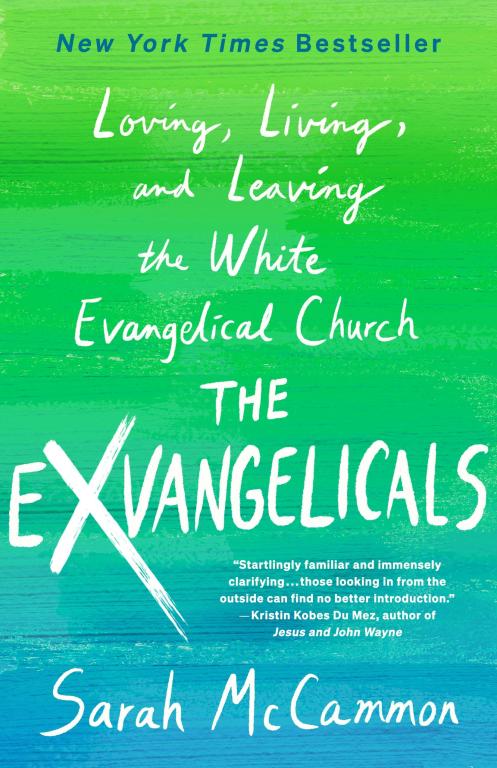
Most of the exvangelicals McCammon spoke to for the book are young, raised in the “shadow of the Moral Majority.” These people came of age receiving the message that alignment with conservative social and political beliefs amounted, more or less, to alignment with the gospel itself. As those political beliefs have a turn toward the violent and amoral, this unholy tangling was exposed.
As a result, despite the political and legal victories for evangelicalism–the triumph of that movement in overturning of Roe, the hard turn of local and state house, the cultural surge of white Christian nationalism— McCammon asserts that it is simultaneously a moment of “confusion and disillusionment.” (3) It may seem an irony/contradiction, but one that makes sense if you consider the way of Jesus: an unfollowing as the love of power crests (244).
To tell this story, McCammon interviews friends and connections, folks who have publicly identified as Exvangelicals. She speaks to Jeff Chu and Emily Petrini and Abraham Piper. These stories are organized thematically, taking up political character, race, homosexuality, purity culture, and a particularly heartrending chapter on corporeal punishment, among others. Interviewing these evangelical insiders from the cultural movement of the 1980s-2000s, McCammon’s portrait is layered and deeply personal. What comes through most is a sense of alienation —for better or worse—from the rigid certainty evangelicalism offered. And some bitterness.
While her tone is conversational, McCammon engages, albeit briefly, many scholars of evangelicalism. She cites the work of many friends of the Anxious Bench (and mine): Malcolm Foley, Jemar Tisby, Sam Perry, Isaac Sharp, Kristen Du Mez, as well as Randall Balmer, David Gushee, David Dark, and Diana Butler Bass. The result is a personal if important contribution about this particular moment in American religious history.
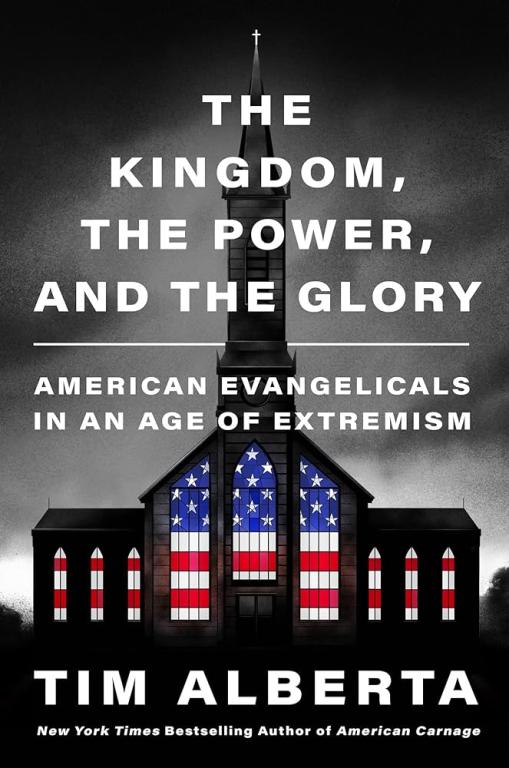
By contrast, Tim Alberta’s extensive 500-page book stands as an extensively researched ethnography of this moment in evangelicalism. Alberta draws out compelling, bizarre and sometimes frustrating characters, excavates deep histories on denominations and conspiracies, and offers unflinching analysis. The Kingdom, The Power, and the Glory explains, in terrifying detail, the hypocrisies and perils of conservative evangelicalism’s Faustian bargain.
Trump comes up a lot. But the central issue is deeper, one that Alberta imagines theologically. “Instead of fixing our eyes on the unseen,” he says, “we,” that is Christians, “have become fixated on the here and now. Instead of fleeing temptation to rule all the world, like Jesus did, we have made deals with the Devil.” The question is why. Or as Alberta’s wife understandably put it: “What the hell is wrong with us?”
In seeking an answer, Alberta visited “half-empty sanctuaries and standing room only auditoriums,” talked with “big city televangelists and small town preachers and everyday congregants,” considered evangelical institutions, like colleges, nonprofits, and publishers. Interviews with influential leaders like Doug Olson of Liberty University or Robert Jeffers of First Baptist Dallas, with David French and Russell Moore, as well as with regular pastors show Alberta’s journalistic reach and influence. He asked folks questions about COVID and January 6, about polarization, and Bill Clinton, finding, much to his own personal dismay, “the deterioration of American Christianity.” Abandoning the Sermon on the Mount, congregants mainline right-wing newsmedia, abandoning ecclesiastical covenant vows for churches than align with their extreme politics. As a result, pastors are burned-out, discouraged, and even afraid.
Alberta locates the genesis of the shift to the end of the Cold War, when the enemy shifted from godless communists without to, well, godless communists within. Abetted by the Clinton scandals, and the hysteria around America’s first Black President, evangelicalism has fully embraced a siege mentality, one that justifies any evil to ward off the imagined threat. The Kingdom, The Power and the Glory charts these developments in stunning detail, the result of which is historically persuasive and spiritually shattering.
Differences:
Both The Exvangelicals and The Kingdom, the Power, and the Glory are memoirs, but they read quite differently. McCammon’s account is broad, anecdotal, and often personal. She toggles between childhood recollections and recent PEW data. She interviews twitter friends and digs into the family archive. The result is not only a snapshot of this era in American life but also of her life. She parses through her own theological commitments and questions, describing fights with her mother in her teen years, coming to terms with her paternal grandfather’s identity as a gay man, her own divorce from her Christian college sweetheart. Alberta’s book on the other hand is framed personally, around his father’s funeral and his home church, Cornerstone, in Brighton, Michigan, but less personal throughout. Instead, Alberta’s interest is in detailed description and sharp, if still generous, analysis. His own ideas and opinions are present, but his own religious journey is less the focus.


The two are also writing from different religious spaces. McCammon herself leans Exvangelical, “still attached to the story of Jesus,” but no longer exclusively within that tradition. Alberta remains. Wrenching against what he sees as a deviation from the evangelicalism he grew up in, his determined reporting can be understood as an act of journalistic lament. He writes “we are called to be followers of Jesus; we are called to make disciples of all nations,” as he mourns that the label “evangelical has become an impediment to evangelizing.” Alberta loves the gospel of Jesus and the church, and his searing book is in fact evidence of that deep love.
Similarities
Despite the distinct aims and tones, there is much about which The Exvangelicals and The Kingdom, the Power, and the Glory agree. Both clearly see this as a crucial moment for evangelicalism in America—the identity if not the faith. Co-opted into a political project of fear and (quite literal) demonization of dissent, evangelicalism’s witness they claim has been hopelessly compromised. Taken together, the two works offer a serious journalistic contribution to a moment not to be ignored. Historians will find them, today and in the future, an invaluable primary source.
Aside from the urgency of this time, the books share other revealing similarities.
In particular, both zero in on the utter collapse of truth: the denial of clear evidence, the embrace of alternative facts, the blind adherence to conspiracies. Even the tenets of the faith are up for alternative interpretation. Both books bring up the oft cited stat on the importance of personal character for political leaders from Clinton to Trump, the invented theology of Cyrus or David as either evil or sinners, but placed in power by God to advance Israel’s interests. At moments, some evangelicals will momentarily acknowledge the hypocrisies or unevenness, the justification resorting, to Alberta’s argument, to worldly expediencies. As Robert Jeffers succinctly put it to Alberta: “I don’t want someone who’s going to turn the other cheek…I want to the meanest toughest SOB I can find to protect this nation.” He and other evangelicals are absolutely convinced that, despite the rise of white Christian nationalism, they are the persecuted minority, always an election away from outright religious persecution. That fear justifies extreme rhetoric, twisting falsehoods, and even to embrace immoral leaders.
On that note: interestingly, both books devote chapters to the disgraced and disgraceful Jerry Falwell, Jr., who perhaps serves as an embodiment of the cravenness and moral rot over generations. (Also, as an aside: Of my long-standing question about Eric Metaxas’ sincerity or swindle, Alberta sums: “Corruption and psychosis are not mutually exclusive.”)
Both books see this shift as having occurred over the past generation, finding a harsh and disorienting break from their parents. Boomers, who experienced conversions in the 1970s and 1980s, as McCammon and Alberta did, were baptized into faith at a particularly heady cultural moment for evangelicalism. Believing in Jesus, being saved, attending church were part and parcel with opposing abortion and embracing Republicanism, all marks of zeal for the convert both theologically and politically. McCammon and Alberta grieve their parents’ blindspots even as they admire their faith, a generational story of great enthusiasm for Christ eroded over time by the idolatry of self-righteousness.
The similarity most striking to me, and most heartbreaking, was that both books belie a strong sense of betrayal. McCammon and Alberta were raised in the church. They each recall knowing each pew, each person, practicing Bible recitations, and sincere conversions. They were both formed, spiritually and intellectually, in these church spaces. For instance, McCammon recalled Odyssey tapes, Brio magazine, Blue Ridge Christian School, serving as a GOP Senate page to influence politics for Christ. She recalled receiving a comprehensive “worldview education” (79). Alberta, too, was taught that “Christians are called to reflect the awesome power of a God who renews minds and transforms hearts—who dwells within us, seeking our complete devotion to him, commanding us to lead lives of truth and love that might shine His light in a darkened world,” leaving him reeling to encounter evangelicals for whom “Character didn’t matter. Truth didn’t matter. Honor and integrity didn’t matter. Those were means, and all that mattered was the ends: winning elections.”
This intellectual and emotional whiplash resonated deeply with me too. Like McCammon, I also went to a Christ-centered college prep school where I was taught (in addition to some heavy-handed apologetics) that all truth was God’s Truth, that we could read and wonder deeply, without fear. God was the author and source of all and all sincere learning, all moral searches for truth ended in Him. We were warned, then, about discarding truth and beauty for the dreaded “moral relativism,” or prevailing political dogmas, which, tragically, many conservative evangelicals now wholeheartedly embrace. It has been wild–and profoundly disappointing–to witness so many Christians intellectually warped by fear and lust for power.
While the intellectual betrayal confounds, for these children of faith, it’s the spiritual one that stings the most. Alberta’s book wrestles with the sincerity and limitations of his father’s faith, thankful that he “showed me how to live for Christ,” but written in response to his (and many others’) blind spots. As for McCammon, she laments: “I was taught to try to mimic Christ, to love generously, even at a great cost. Even when people don’t deserve it. Even when they hurt us, I was taught to pray, “Father, forgive”…and I was taught to speak the truth. I was taught this and much more by evangelicals” (11). Evangelicals who now don’t seem to believe it at all. The animating contention of both The Exvangelicals and The Kingdom, the Power, and the Glory is that the good news McCammon describes, this loving grace power, has been traded for temporary political winds. Just as Esau traded the blessing of Isaac for a bowl of stew, evangelicals have let their temporary hunger for influence and dominance, trump their beautiful witness.
But because I, too, came up in the evangelical Protestant tradition of biblical literacy, I remember how that particular story ends. God works grace for Jacob and Esau, and through them. We don’t know what God is up to in our days, in his church, but God is always up to something good. God isn’t concerned about his kingdom, his power, his glory. They are sure and already. Christians—even exvangelicals, even evangelicals—might take hope: they don’t need to fight or conquer; it is finished.
Politics and Religion
History and Religion
Previous Post
June 4, 2024
Swimsuits, Stones, and Shepherds: Patristic Takes on Modesty
Next Post
June 6, 2024 Clergy Sexual Abuse and American Catholic History
Recent Comments
"Life Force is a guilty pleasure of mine! Not a great film, but a fun ..."
Fairies, Witches, Folk Horror, and the ..."
"I love horror but would have to acclimate back to Lovecraft and especially Machen. Have ..."
Fairies, Witches, Folk Horror, and the ..."
"Very good point about MacDonald.I am certainly a Machen fan!"
Fairies, Witches, Folk Horror, and the ..."
"The Scottish author George MacDonald integrated fairy world into his fiction in a way that ..."
Fairies, Witches, Folk Horror, and the ..."
Browse Our Archives
Select a Category abolitionism Abortion Abraham Joshua Heschel Abraham Kuyper Abraham Lincoln Academia Activism Adam Renberg Advent Adventist africa African American Religion Agnes Howard Albert Camus American History American Religious History American Revolution American West Anabaptists Ancient History Andrea Turpin Andrei Tarkovsky Anglicanism Annales Ansley Lillian Quiros anti-Catholicism Antisemitism Anxious Bench apologetics Apparitions Arash Azizi Archaeology archives art Artificial Intelligence Asia Asian Americans Augustine Authors Bad Bunny Baptism Baptists Barack Obama Battle of Hastings Benjamin Franklin Bernard-Henri Levy Beth Allison Barr Beth Moore Bethany Mannon Bible Bill Cunningham Billy Graham Black Music Bob Dylan Body Boenhoffer Books Breastfeeding Bruce Springsteen C.S. Lewis Calvinism Cancel Culture Capitalism Carmelites Catholicism Cedric Robinson Cesar Chavez Charismaticism charity Charles Dickens Charles Lindbergh Che Guevara Chicago Children Chinese Christianity Chris Gehrz Christ Christian death Christian Higher Education Christian life Christian Nation Christian Nationalism Christianity Today Christmas Church life Church Practice cinema Civil Religion Civil Rights Movement Civil War civility Classics Climate Change Cold War Colonial Mexico colonialism Comer Communism community complementarianism Conference on Faith and History Congregationalism Conspiracies Conspiracy Conversion Narratives Coronavirus Costa Rica Council of Nicaea Covid-19 Creation Critical Race Theory Crusades Culture culture wars Daniel K. Williams David Barton David Swartz Death Ways death with dignity DEI democracy Democratic Party Devotion Digital Age Diplomacy discipleship diversity Donald Trump Drama Dua Lipa Early Church early modern Early modern Catholicism Easter Eastern Christianity economic exploitation Education elections Elie Wiesel Elizabeth II Elizabeth Taylor emotions Empire Engineering England enslavement Entertainment Episcopal Church Erica Ramirez eschatology Eurocentrism Evangelicalism Evangelicals Exegesis Family Feminism Film Flannery O'Connor folk music Food Foreign Policy founding fathers Franciscans Franciscus Junius fundamentalism Funerals G.K. Chesterton Gender Genocide genre geography George W. Bush George Washington George Whitefield Global Christianity Global church Grief Guadalupe guest post Guest Post gun control gun violence Gustavo Gutierrez Hamid Dabashi Harold John Ockenga Harvest Hate Hawaiian Christianity Healing health care Heather Cox Richardson Hell Heresy Hermeneutics Higher Education Hinduism Hippocratic oath Historical Fiction Historical Methodology Historical Profession Historical Profession Historical Theology Historical Thinking historiography Holidays Holocaust horror movies Human rights Humanitarian Work humanities Hummingbirds Hungary hymns Imago Dei Immigration Injustice Interviews Iran Islam Islamophobia Israel Ivan's Childhood Jacob Randolph James Bratt Janine Giordano Drake Japanese history Japanese Literature Jean Paul Sartre Jesse Miranda Jesus Jesus Christ Jimmy Carter Joan Baez Joan Didion Joanne Freeman João B. Chaves Joao Chaves Joey Cochran John Calvin John Fea John Tillotson John Turner Johnny Cash Jonathan Edwards Jonathan Tran Joseph Smith Josh Howerton Journalism Jr. Judaism Jürgen Moltmann Just War Justice Justin Brierley Karl Barth Katelyn Beaty koi ponds Kris Kristofferson Kristin Kobes Du Mez Latin American Religious History Latino Americans Lectio Divina Leisure Lent Leonard Cohen liberal arts liberalism Liberation Theology Linda Ronstadt Lisa Clark Diller Literature Lou Reed Lynchings Lynneth Miller Renberg Mainline Protestantism Malcolm Foley Marilyn Monroe Maritime history Mark Noll Marriage Martin Luther Martin Luther King Martyrdom Marxism Mary Masih Alinejad mass shootings material culture medieval Christianity Medieval Ethiopia Melissa Borja memory Mennonites Mental Health Mental Illness Methodism Mexican Americans Mexicans Mike Madrid Miles Mullin Min Jin Lee Miscarriage Missionaries Mister Rogers Mitt Romney modernity Monasticism Mormonism Motherhood Mothers of the Church Moving Music Musicals Nadya Williams Nahua Christianity Native Americans Natsume Sōseki New Contributor New England New Year New York Nico Non-Violent Protest Orthodoxy pacifism Paleo Evangelicals Palestinians Parenting Patti Smith Paul Kingsnorth Pedro Calderón de la Barca Pentecostalism Philip Jenkins Phillis Wheatley physician-assisted suicide pilgrimage Pilgrims pluralism Plutocracy Poetry Politics Pope Francis Pope Leo XIV post-modernism prayer preaching Presbyterians prosperity gospel Protest Public history Publishing Puritans purity culture Quakers race Race Massacres Racial Capitalism racial reconciliation racialization Racism Raha Bahloulipour Re-Enchantment reading Reformation Refugees religion and the university religion and war Religious Freedom Religious Nones Religious Pluralism Religious Symbols religious violence Republican Party Revival Rita Coolidge Ritual Roger Williams Roman Catholic church Royalty Russell Moore same-sex marriage Sarah Irving-Stonebraker Scandinavia Science Science and Technology Scopes trial Scriptural Interpretation secularism Selena Quintanilla seminary Seventh-Day Adventists sexual morality Sexuality Sikhs Silence slaveholders theology Slavery Slavoj Zizek social justice Social Media Southern Baptist Convention Southern Religion Spain Spiritual Autobiography Spiritual but not religious Spiritual Discipline Sports Stanley Hauerwas Suffering Summer Camps Sunday Night Odds and Ends Supernatural Supreme Court Syriac Christianity Tal Howard Taylor Swift Teaching Technology Television Thanksgiving The Beatles The Mission theater TheoBros Theology Thomas Dixon Thomas Jefferson Thomas Kidd Thomas Merton Tim Gloege Tim Walz Tom Holland Tourism tradition Tragedy Translation Transnationalism Travel Trump Ukraine Uncategorized Unitarians United Methodist Church US History Vanessa Chan Velvet Underground Verónica A. Gutiérrez Veronica Gutierrez Vikings Violence Virgin Mary Virtue Virtue ethics Visions Voting War WCTU Wendell Berry Westminster Assembly White Evangelicalism Wildfires Winnie the Pooh Witches women Women in Ministry Women's and Gender Studies Work Worship writing Yasunari Kawabata Zena Hitz
Select a Month October 2026 September 2026 August 2026 July 2026 June 2026 May 2026 April 2026 March 2026 February 2026 January 2026 December 2025 November 2025 October 2025 September 2025 August 2025 July 2025 June 2025 May 2025 April 2025 March 2025 February 2025 January 2025 December 2024 November 2024 October 2024 September 2024 August 2024 July 2024 June 2024 May 2024 April 2024 March 2024 February 2024 January 2024 December 2023 November 2023 October 2023 September 2023 August 2023 July 2023 June 2023 May 2023 April 2023 March 2023 February 2023 January 2023 December 2022 November 2022 October 2022 September 2022 August 2022 July 2022 June 2022 May 2022 April 2022 March 2022 February 2022 January 2022 December 2021 November 2021 October 2021 September 2021 August 2021 July 2021 June 2021 May 2021 April 2021 March 2021 February 2021 January 2021 December 2020 November 2020 October 2020 September 2020 August 2020 July 2020 June 2020 May 2020 April 2020 March 2020 February 2020 January 2020 December 2019 November 2019 October 2019 September 2019 August 2019 July 2019 June 2019 May 2019 April 2019 March 2019 February 2019 January 2019 December 2018 November 2018 October 2018 September 2018 August 2018 July 2018 June 2018 May 2018 April 2018 March 2018 February 2018 January 2018 December 2017 November 2017 October 2017 September 2017 August 2017 July 2017 June 2017 May 2017 April 2017 March 2017 February 2017 January 2017 December 2016 November 2016 October 2016 September 2016 August 2016 July 2016 June 2016 May 2016 April 2016 March 2016 February 2016 January 2016 December 2015 November 2015 October 2015 September 2015 August 2015 July 2015 June 2015 May 2015 April 2015 March 2015 February 2015 January 2015 December 2014 November 2014 October 2014 September 2014 August 2014 July 2014 June 2014 May 2014 April 2014 March 2014 February 2014 January 2014 December 2013 November 2013 October 2013 September 2013 August 2013 July 2013 June 2013 May 2013 April 2013 March 2013 February 2013 January 2013 December 2012 November 2012 October 2012 September 2012 August 2012 July 2012 June 2012 May 2012
Follow Us!
TAKE THE
Religious Wisdom Quiz
Who was Aquila's wife?
Select your answer to see how you score.
Mary Priscilla Ruth Lydia
Related posts from Anxious Bench

What Coffee Reveals About America's Evangelical Varieties

A Casserole is Not a Counterpoint
John Calvin: Pastor. Theologian. Immigrant Nuisance?

Angelina Grimké's Forgotten Turn to Apocalyptic Faith
TRENDING AT PATHEOS Evangelical

Emotion in Early Christianity by Andrew Crislip
Andrew Crislip’s Emotion in Early Christianity examines an often overlooked dimension of...

16 Spiritual Touchstones for a More Grounded Life
After decades of spiritual study, here are 16 principles I try...

Catholic Evangelization: Sharing Your Faith Every Day
Welcome back to the Graceful Awakening mini-series called, “From Faith to Mission.” ...

The Pillar of the Boatmen: the Ancient Monument...
The Pillar of the Boatmen is a Romano-Gaulish sculpture that dates from...

In one sense walking into Westminster Abbey is like walking down the...

'Super Scam Me' Exposes AI Jon Bon Jovi...
Leslie Pickett believed she was in a relationship with Jon Bon Jovi....
view all Evangelical blogs
What Are Your Thoughts?leave a comment
Ad-Free & Subscriber Log-In Subscription Support
- About Us
- 2026 Calendar
- Videos
- Podcasts
- Library of World Religions
- Faith In Media Tracker
- Advertise With Us
- Write for Us
- Privacy Policy
- Terms of Service
- Do Not Sell My Data
- Contact Us
- Radiant Digital
- Manage Newsletter Subscriptions
- Unsubscribe From Notifications
- Sitemap
Copyright 2008-2026, Patheos. All rights reserved.
Subscription Support Ad-Free & Subscriber Log-In
Follow Patheos