
BuddhistCatholicContemplativeEvangelicalGeneral ChristianHinduJewishLatter-day SaintMuslimNew VisionsProgressive Christian
Beliefs
- Buddhist
- Catholic
- Contemplative
- Evangelical
- General Christian
- Hindu
- Jewish
- Latter-day Saint
- More Voices
- Muslim
- New Visions
- Pagan
- Progressive Christian
Topics
- Religion News
- Food and Religion
- Sports and Religion
- Religious Art
- Religious Music and Entertainment
- Religious Events
- History and Religion
- Style and Religion
- Politics and Religion
- Women in Religion
- Recreation Outdoors and Religion
- Business Finance and Religion
- Careers Workplace and Religion
- Education and Religion
- Family Parenting and Religion
- Health Fitness and Religion
- Home and Religion
- Relationships and Religion
- Technology and Religion
- Travel and Religion
Columnists
- Buddhist Columnists
- Business Finance and Religion Columnists
- Careers Workplace and Religion Columnists
- Catholic Columnists
- Contemplative Columnists
- Education and Religion Columnists
- Evangelists Columnists
- Family Parenting and Religion Columnists
- General Christian Columnists
- Health Fitness and Religion Columnists
- Hindu Columnists
- History and Religion Columnists
- Home and Religion Columnists
- Jewish Columnists
- More Voices Columnists
- Latter Day Columnists
- Muslim Columnists
- New Visions Columnists
- Nonreligious Columnists
- Pagan Columnists
- Politics and Religion Columnists
- Progressive Columnists
- Recreation Outdoors and Religion Columnists
- Relationships and Religion Columnists
- Religion News Columnists
- Religious Art Columnists
- Religious Events Columnists
- Religious Music and Entertainment Columnists
- Sports and Religion Columnists
- Style and Religion Columnists
- Technology and Religion Columnists
- Travel and Religion Columnists
- Women in Religion Columnists
Resource Library
- 2026 Calendar
- Library of World Religions
- The 100 Most Holy Places on Earth
- Patheos Answers
- Podcasts
- Videos
- Faith Leaders Database
- Anglican Episcopalian
- Bahai
- Baptist
- Buddhism
- Christianity
- Confucianism
- Eastern Orthodoxy
- Hinduism
- Holiness and Pentecostal
- ISKCON
- Islam
- Judaism
- Lutheran
- Methodist
- The Church of Jesus Christ of Latter-day Saints
- New Age
- Paganism
- Presbytarian and Reformed
- Protestantism
- Religion Behind the Scenes
- Roman Catholic
- Scientology
- Shia Islam
- Sikhism
- Sufism
- Sunni Islam
- Taoism
- Zen
- See all religions
Research Tools
 Ad-Free & Subscriber Log-In Subscription Support
Follow Patheos 

- Trending:
- Advent
- |
- Forgiveness
- |
- Thanksgiving
- |
- Election
- |
- Seasonal Holidays
- |
- Marriage

-
About the Authors
- Home
- Evangelical
- Politics and Religion
- Why Is the Abortion Rate Increasing?
Why Is the Abortion Rate Increasing?
Last updated on: April 23, 2024 at 2:00 am by Daniel K. Williams
Why Is the Abortion Rate Increasing? 2024-04-22T16:08:28-04:00 Daniel K. Williams
Patheos Explore the world's faith through different perspectives on religion and spirituality! Patheos has the views of the prevalent religions and spiritualities of the world.
The Supreme Court’s reversal of Roe v. Wade in June 2022 was supposed to reduce the number of abortions in the United States.
In the summer of 2022, jubilant pro-life advocates eagerly forecast an increase in the number of childbirths and encouraged churches to be prepared to help care for all the extra children in their communities who would be born to women in crisis situations who would otherwise have had abortions. And advocates of abortion rights issued dire predictions of a country in which women denied legal abortions would be forced to give birth to children they did not want and could not adequately care for.
Yet a curious thing happened: According to two separate studies, the number of abortions in the United States increased in the year after Dobbs. And according to the CDC, the number of childbirths in the United States marginally decreased in 2022. (It then experienced a very slight increase in 2023).
Pro-lifers in Mississippi forecast that an additional 5,000 babies per year would be born in the state as a result of abortion becoming completely illegal the summer of 2022. But instead, the number of childbirths in Mississippi declined in 2022 and dropped again in 2023.
So, there was no post-Dobbs baby boom, and there was no net reduction in abortion in the United States – even though more than a dozen states banned nearly all abortions.
This was largely what I predicted in a series of posts that I wrote for Anxious Bench in the spring of 2022 and in my book The Politics of the Cross, published in early 2021. A few weeks before the Supreme Court issued its ruling in Dobbs, I wrote on the Anxious Bench, “For pro-life advocates, the initial excitement over the demise of Roe v. Wade is likely to give way to disappointment when they discover that the end of Roe does not mean the end of legal pregnancy terminations in the United States. Far fewer unborn lives will be saved than many pro-lifers imagine.”
But why would more women have abortions in the United States if abortion became less available?
Actually, abortion did not become less available. In most of the country, abortion is easier to obtain today than ever before – and that’s why pro-lifers’ strategy to reduce abortion rates by legally restricting abortion has backfired so badly.
What Influences Abortion Rates?
For the past half century, there have been two major measurable influences on abortion rates: funding for abortion and availability of abortion services. Both affect the supply of abortion – and when the supply of abortion goes up, the number of abortions performed each year increases.
There may well be other influences on abortion rates that are not so easily measured, such as the stigma attached to abortion, the value that a community places on human life, or the degree to which women facing crisis pregnancies feel supported by those around them and can access the economic resources they need to support their families. On an individual level, we know that pregnant women are more likely to choose life for their unborn child when they feel supported, which is why crisis pregnancy centers, churches, an expanded social safety net, and family leave policies can convince individual women to carry a pregnancy to term. We also know that when people delay pregnancy until marriage, they are far less likely to have an abortion; 87 percent of the women who have abortions are unmarried. So, encouraging and facilitating marriage (and supporting and strengthening existing marriages) will reduce abortion rates. We also know that abortion is negatively correlated with income and education – which is why reducing poverty rates and expanding educational opportunities for lower-income people will probably reduce abortion rates.
But all of these things are very difficult to measure on the national level, because most of these things have not appreciably changed in the aggregate – or, if they have changed, they have changed for the worse. On a local and individual level, some churches may have seen people in their congregations respond positively to encouragements to save sex until marriage and to value children within marriage – but on a national level, marriage rates have continued to decline. In particular states, there have been programs to increase college access – but nationally, college enrollment and graduation numbers have decreased.
I firmly believe that these methods of reducing abortion are effective, but because they’re not happening on a national scale, our analysis of what has affected abortion rates in the United States in the last few decades will have to focus primarily on the two factors that have arguably had the greatest effect: abortion availability and abortion funding.
Roe v. Wade (1973) greatly increased the availability of legal abortion in the United States. In January 1973, immediately before Roe, legal elective abortion was fully available in only four states (New York, Washington, Alaska, and Hawaii), and partly available in a fifth (California). Twelve other states allowed abortion for specific health-related reasons, while the other thirty-three states restricted abortion largely to circumstances in which a pregnancy endangered a woman’s life. So, for most women who didn’t live on the West Coast or in Alaska or Hawaii, legal elective abortion was available only by going to New York, the one state that had no residency requirement for abortion services. Any woman, therefore, who was able to travel to New York City and pay the few hundred dollars required for a hospital abortion could terminate her pregnancy.
In those circumstances, there were 587,000 legal abortions in the United States in 1972. But after Roe v. Wade allowed abortion clinics to be built in every state, the number of abortions in the United States increased to 745,000 in 1973, 899,000 in 1974, and more than a million in 1975.
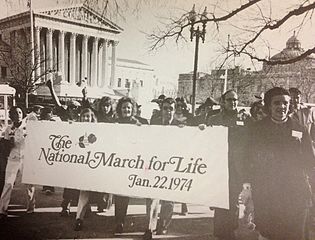
First annual March for Life, Washington, DC, January 1974 (Wikipedia)
What we can learn from this is that if even one state (which in this case was New York) offers legal abortion to anyone from out of state who can pay for one, more than half the women who want an abortion will probably find a way to get there and purchase a pregnancy termination. That’s what happened in 1972. But if abortion availability is expanded to allow convenient abortion services in every state, the abortion rate will rise substantially, just as it did in the United States between 1973 and 1975.
In addition, funding makes a difference. In the mid-1970s, shortly after Roe v. Wade, abortion was covered under the federal Medicaid program, and approximately 300,000 abortions per year were financed by Medicaid. The Hyde Amendment, which went into effect in August 1977, prohibited federal funding for most abortions, but because twenty-two states at the time continued funding abortions under their own state Medicaid programs, approximately two-thirds of the women who would otherwise have had government-funded abortions under the federal Medicaid program were able to get Medicaid reimbursement for their abortions under their state plans. The Hyde Amendment may well have saved at least a few unborn lives immediately after it was enacted, but if it did, its impact was difficult to detect through statistical studies. The number of abortions continued to increase each year until the annual number peaked at more than 1.5 million abortions in 1981.
Furthermore, studies conducted shortly after the Hyde Amendment went into effect showed that even in states that did not fund abortion, most of the low-income women who would have had Medicaid-funded abortions if they had been available managed to find the money needed for the procedure – perhaps by foregoing other needed expenses or borrowing the money from a friend. “Those deeply opposed to abortion on religious or moral grounds who hoped that stopping federal and state funds for abortions would bring about dramatic decreases in these procedures must be disappointed,” a study published in Family Planning Perspectives in 1980. “Most poor women in need of abortions managed to obtain them.”
The late 1970s and early 1980s therefore saw the highest legal abortion rates that the United States has ever experienced. The supply of abortion was high – and apparently, so was the demand. By 1980, there was nearly one abortion in the United States for every two live births.
The Decreases in Abortion in the 1980s and Beyond
But after 1981, the number of abortions began dropping slightly. Over time, the Hyde Amendment arguably led to reductions in the abortion rate, because after the Supreme Court upheld the constitutionality of the amendment in Harris v. McRae (1980), several other states that had previously funded abortions rescinded that funding. An article published in 1993 in the Journal of Policy Analysis and Management by Deborah Haas-Wilson (a professor of economics at Smith College) found that while women in states that provided Medicaid funding for abortion had 371 abortions for every 1,000 live births, women in states that did not provide this funding had only 245 abortions for every 1,000 live births. So, although it took a few years for behavioral changes to set in, the Hyde Amendment eventually had real effects on American abortion rates: It reduced the number of abortions nationwide, while also creating a bifurcated system in which the seventeen states that continued to offer state funding for abortions after the mid-1980s would continue to experience high abortion rates, while the many other states that had cut off such funding would experience significantly lower abortion rates.

Data on abortion rates in the United States compiled by the Guttmacher Institute (graph published on Wikipedia)
During the 1980s, the decreases in the abortion rate may have been largely attributable to reductions in abortion funding and to new state restrictions on abortion (such as parental notification laws). As abortion rates declined, the number of children born each year increased.
But after the early 1990s, abortion rate declines were matched by declines in childbirth rates – suggesting that perhaps the total number of pregnancies declined in the United States. One might assume that this was due to higher rates of contraceptive use, but CDC data indicate that contraceptive use among women ages 15-44 actually declined by 4 percentage points between 1995 and 2010, even as abortion rates during that time were also decreasing. There is some data to indicate that the contraceptives that were used during this time period may have been more effective than those that had been used earlier. For instance, there was a 1,000 percent increase in reported IUD use rate among women of childbearing age who used contraception between 1995 and 2010. So, perhaps this was one of the reasons for the decline in surgical abortion rates during that time.
The decline in abortion rates at the beginning of the 21st century occurred mainly among middle-class women, not women living below the poverty line. In the 1990s, middle-class women had been almost as likely as lower-income women to have abortions. In 2000, only 27 percent of women who obtained abortions were poor. But by 2008, 42 percent were, and by 2014, 49 percent of women who obtained abortions were living below the poverty line. Based on these figures, we can say that the number of abortions obtained by women living above the poverty line declined from 949,000 in 2000 to only 703,000 eight years later – a decrease of 26 percent. But unfortunately, during that same period, the number of abortions obtained by women living in poverty increased from 349,000 in 2000 to 509,000 in 2008 – an increase of 46 percent.

The 2004 March for Life in Washington, DC, held at a time when the abortion rate was declining, especially among the middle class (Wikipedia)
After 2010, abortion rates began falling more rapidly than before, because in many conservative states, new restrictions made it difficult for abortion clinics to operate. Seventy clinics in about a dozen states closed between 2010 and 2015, mostly because of these new restrictive laws. But in addition, a significant decrease in teen pregnancy greatly reduced demand for abortion among teens.
By 2014, the typical woman who had an abortion was not a college student or a pregnant teenager; she was a low-income, unmarried woman in her mid-20s who was already a mother to at least one child. Many of these women chose abortion because they did not believe that they could adequately care for another child at that moment in their lives.
In this environment, abortion rights advocates pivoted from focusing mainly on abortion rights as a matter of women’s right to equality to portraying abortion access as a matter of social justice for the poor. In 2016, the Democratic Party platform for the first time included a direct call for the repeal of the Hyde Amendment. For decades, many Democrats had voted for the renewal of the Hyde Amendment, but now being a political progressive meant not only supporting abortion rights but also abortion funding. Democratic states that had not previously funded abortion through their state Medicaid programs began reconsidering their stance.
An Increase in Abortion Funding and Abortion Access
For twenty-seven years, from 1990-2017, the number of abortions performed in the United States fell each year, but in 2018, that trend was reversed. For the first time since 1990, the nation experienced an increase in the number of abortions.
One of the things that changed that year was abortion funding. In 2018, Illinois began funding abortions through Medicaid. Maine began doing so in 2019, and Rhode Island followed suit in 2023. California, which already funded abortions for low-income women through its state Medi-Cal program, passed a law in 2022 eliminating out-of-pocket costs for women using private insurance, regardless of their income level. Because of these changes, 33 percent of the people who had abortions in the United States in 2021-2022 paid zero dollars for their abortion.
In addition, abortion access became significantly easier because of the rapid rise in popularity of abortion pills. Abortion pills were used in only 39 percent of abortions in 2017, but as the preferred method for abortion shifted from surgical to chemical, the number of abortions began rising for the first time in decades. In 2020, 53 percent of all abortions in the United States were medication abortions – that is, conducted using abortion pills. In 2023, 63 percent were.
Abortions increased by 3 percent in 2018, 3 percent again in 2019, and 1 percent in 2020, according to Guttmacher data – which resulted in a total increase of 8 percent between 2017 and 2020. Guttmacher has not yet released data from its 2021 abortion survey, but CDC data from that year indicated a 5 percent increase in the number of abortions nationwide in 2021, even though that was the year that Texas passed its abortion ban. In 2023, the first full calendar year since Dobbs, the number of abortions was 10 percent higher than in 2020. It seems from preliminary data from Guttmacher that both the number of abortions and the abortion rate (the percentage of women of childbearing age having abortions each year) were higher in 2023 than at any point since 2012.
The restrictive abortion laws that a few states enacted after Dobbs reduced the number of abortions in those states, but those declines have been offset by a much greater increase in abortion availability elsewhere. That’s partly due to increases in abortion funding through state Medicaid programs and probably also due to the popularity of abortion pills. Instead of going to a clinic for a surgical abortion, women who want an abortion in their first eleven weeks of pregnancy can get a prescription for abortion pills through a video call with an abortion provider and can then pick up their prescription at a pharmacy in a state where abortion is legal – which means that for most women in the United States, abortion is now easier than it has ever been before.
Did the restrictive abortion laws that were passed after Dobbs save unborn lives? It’s clear that they have not reduced abortion rates. The best case that can be made for them is that they may have prevented the abortion rate from rising even higher than it would have otherwise, but that’s difficult to prove. One can also make an equally compelling argument that a national backlash against restrictive abortion laws increased the political pressure for additional abortion funding and looser restrictions on abortion pills. In any case, we can say that restrictive abortion laws alone have not reduced abortion rates and are not likely to do so in the immediate future.
Some pro-life activists have tried to impose national restrictions on abortion pills through the courts, a strategy that has not worked so far. If it eventually succeeds (which is doubtful), I imagine that the number of legal abortions in the United States will decrease substantially, but that the number of women ordering abortion pills from offshore providers will also increase. Abortion pills, the New York Times noted in November 2022, are “available to nearly anyone with an internet connection and a mailing address.” One study published in the Journal of American Medicine found that tens of thousands of American women ordered abortion pills from one offshore abortion pill provider in 2022 for what are known as “self-managed” abortions at home. Other women, though, especially in states such as Texas or Arizona, may have crossed the border to Mexico, where abortion pills are available without a prescription as an over-the-counter medication in some pharmacies.
Ironically, the pro-life movement’s most successful record of reducing abortion rates through a suppl-side approach came during President Obama’s administration, when abortion remained legal everywhere and when the White House was not supportive of the cause, but when pro-lifers effectively used state regulations to significantly reduce the availability of abortion in at least a dozen or more conservative states. But precisely because of that success during Obama’s presidency, there wasn’t any room for them to do much more on the supply end in these states by making abortion in these places illegal altogether. Most of the states that banned abortion in 2022 had very few clinics operating anyway. The conservative states that banned abortion closed the door on a surgical procedure that was already becoming infrequent in those states and that was on the verge of becoming obsolete, as women who wanted abortions in those areas began switching to medication abortions, which were easier to obtain.
The negative publicity surrounding Dobbs increased abortion rights advocates’ determination to open new clinics in states where abortion remained legal, expand funding for abortion, and make abortion pills easier to access. The result has been a public furor over antiabortion laws passed in red states that only marginally reduced abortion numbers and a blind eye in the pro-life movement toward the more significant expansion of abortion in the many states where the procedure still remains legal – and where pro-lifers have no chance at all of making it illegal at any point in the foreseeable future.
How Can We Reduce Abortion Rates?
So, how can we reduce abortion rates?
Legal restrictions on abortion have focused on reducing the supply of abortions – but ironically, the lowest supply of abortions may have occurred several years before Dobbs. Since then, the supply of abortions has only increased, as access to abortion pills has risen.
But if we can’t reduce the supply of abortions, perhaps we can reduce the demand. If the demand for abortions has become disproportionately concentrated among women in poverty who are already mothers, perhaps we can expand access to healthcare, family leave, and economic assistance programs that will enable women in such a situation to care for their children. We can improve career prospects for these women by expanding access to tuition-free college programs.
I have advocated for these programs at multiple points in the past and will continue to do so. But I also think that a lot of the real pro-life work will need to take place at the local and individual level, where people at a crisis pregnancy center can meet with a woman facing a crisis pregnancy and can offer baby clothes, food, and job placement assistance – but to an even greater extent, can offer life coaching and a supportive structure that will help her move forward with her own life while also choosing life for her unborn child. And churches can provide the supportive structures that will encourage stable marriages among their own congregants – a measure that can reduce the incidence of abortion, since the vast majority of people who have abortions are unmarried.
For a while, pro-life advocates were able to effectively limit abortion rates by reducing funding for the procedure and reducing the number of abortion clinics, but as the technology of abortion changed and the pro-choice backlash against restrictions on abortion funding increased, it became harder for pro-life activists to reduce abortion rates through law.
But maybe a supply-side solution was never the ideal approach for the pro-life movement anyway. If the goal is a culture of life, we have to focus not merely on reducing the supply but on reducing the demand for abortion, because a culture of life cannot be imposed from the top down on an unwilling populace. The pro-life movement has been most effective not when it bans abortion through law when it convinces people that choosing life for an unborn child in a difficult situation is the right choice – and that’s a process that can take place even if the supply of abortion is higher than it has been in years.
Politics and Religion
History and Religion
Previous Post

April 22, 2024
The Johnson-Reed Act and American Religious History
Next Post

April 24, 2024 United Methodist General Conference Redux: 2020 vs. 2024
Recent Comments
"Every religion is "made up," even Adam and Eve were made up thousands of years ..."
Forging Druids and Inventing a Nation
"I have an identical twin, and Thomas was always the disciple I connected with most. ..."
In the Footsteps of Thomas: A ..."
"I've never thought of Constantine as a villain. Do Christians generally? Maybe the ones who ..."
"The TV sitcom BEWITCHED was an old favorite of mine"
How Scotland Gave Us Our Modern ..."
Browse Our Archives
Select a Category abolitionism Abortion Abraham Joshua Heschel Abraham Kuyper Abraham Lincoln Academia Activism Adam Renberg Advent Adventist africa African American Religion Agnes Howard Albert Camus American History American Religious History American Revolution American West Anabaptists Ancient History Andrea Turpin Andrei Tarkovsky Anglicanism Annales Ansley Lillian Quiros anti-Catholicism Antisemitism Anxious Bench apologetics Apparitions Arash Azizi Archaeology archives art Artificial Intelligence Asia Asian Americans Augustine Authors Bad Bunny Baptism Baptists Barack Obama Battle of Hastings Benjamin Franklin Bernard-Henri Levy Beth Allison Barr Beth Moore Bethany Mannon Bible Bill Cunningham Billy Graham Black Music Bob Dylan Body Boenhoffer Books Breastfeeding Bruce Springsteen C.S. Lewis Calvinism Cancel Culture Capitalism Carmelites Catholicism Cedric Robinson Cesar Chavez Charismaticism charity Charles Dickens Charles Lindbergh Che Guevara Chicago Children Chinese Christianity Chris Gehrz Christ Christian death Christian Higher Education Christian life Christian Nation Christian Nationalism Christianity Today Christmas Church life Church Practice cinema Civil Religion Civil Rights Movement Civil War civility Classics Climate Change Cold War Colonial Mexico colonialism Comer Communism community complementarianism Conference on Faith and History Congregationalism Conspiracies Conspiracy Conversion Narratives Coronavirus Costa Rica Council of Nicaea Covid-19 Creation Critical Race Theory Crusades Culture culture wars Daniel K. Williams David Barton David Swartz Death Ways death with dignity DEI democracy Democratic Party Devotion Digital Age Diplomacy discipleship diversity Donald Trump Drama Dua Lipa Early Church early modern Early modern Catholicism Easter Eastern Christianity economic exploitation Education elections Elie Wiesel Elizabeth II Elizabeth Taylor emotions Empire Engineering England enslavement Entertainment Episcopal Church Erica Ramirez eschatology Eurocentrism Evangelicalism Evangelicals Exegesis Family Feminism Film Flannery O'Connor folk music Food Foreign Policy founding fathers Franciscans Franciscus Junius fundamentalism Funerals G.K. Chesterton Gender Genocide genre geography George W. Bush George Washington George Whitefield Global Christianity Global church Grief Guadalupe guest post Guest Post gun control gun violence Gustavo Gutierrez Hamid Dabashi Harold John Ockenga Harvest Hate Hawaiian Christianity Healing health care Heather Cox Richardson Hell Heresy Hermeneutics Higher Education Hinduism Hippocratic oath Historical Fiction Historical Methodology Historical Profession Historical Profession Historical Theology Historical Thinking historiography Holidays Holocaust horror movies Human rights Humanitarian Work humanities Hummingbirds Hungary hymns Imago Dei Immigration Injustice Interviews Iran Islam Islamophobia Israel Ivan's Childhood Jacob Randolph James Bratt Janine Giordano Drake Japanese history Japanese Literature Jean Paul Sartre Jesse Miranda Jesus Jesus Christ Jimmy Carter Joan Baez Joan Didion Joanne Freeman João B. Chaves Joao Chaves Joey Cochran John Calvin John Fea John Tillotson John Turner Johnny Cash Jonathan Edwards Jonathan Tran Joseph Smith Josh Howerton Journalism Jr. Judaism Jürgen Moltmann Just War Justice Justin Brierley Karl Barth Katelyn Beaty koi ponds Kris Kristofferson Kristin Kobes Du Mez Latin American Religious History Latino Americans Lectio Divina Leisure Lent Leonard Cohen liberal arts liberalism Liberation Theology Linda Ronstadt Lisa Clark Diller Literature Lou Reed Lynchings Lynneth Miller Renberg Mainline Protestantism Malcolm Foley Marilyn Monroe Maritime history Mark Noll Marriage Martin Luther Martin Luther King Martyrdom Marxism Mary Masih Alinejad mass shootings material culture medieval Christianity Medieval Ethiopia Melissa Borja memory Mennonites Mental Health Mental Illness Methodism Mexican Americans Mexicans Mike Madrid Miles Mullin Min Jin Lee Miscarriage Missionaries Mister Rogers Mitt Romney modernity Monasticism Mormonism Motherhood Mothers of the Church Moving Music Musicals Nadya Williams Nahua Christianity Native Americans Natsume Sōseki New Contributor New England New Year New York Nico Non-Violent Protest Orthodoxy pacifism Paleo Evangelicals Palestinians Parenting Patti Smith Paul Kingsnorth Pedro Calderón de la Barca Pentecostalism Philip Jenkins Phillis Wheatley physician-assisted suicide pilgrimage Pilgrims Piracy pluralism Plutocracy Poetry Politics Pope Francis Pope Leo XIV post-modernism prayer preaching Presbyterians prosperity gospel Protest Public Executions Public history Publishing Puritans purity culture Quakers race Race Massacres Racial Capitalism racial reconciliation racialization Racism Raha Bahloulipour Re-Enchantment reading Reformation Refugees religion and the university religion and war Religious Freedom Religious Nones Religious Pluralism Religious Symbols religious violence Republican Party Revival Rita Coolidge Ritual Roger Williams Roman Catholic church Royalty Russell Moore same-sex marriage Sarah Irving-Stonebraker Scandinavia Science Science and Technology Scopes trial Scriptural Interpretation secularism Selena Quintanilla seminary Seventh-Day Adventists sexual morality Sexuality Sikhs Silence slaveholders theology Slavery Slavoj Zizek social justice Social Media Southern Baptist Convention Southern Religion Spain Spiritual Autobiography Spiritual but not religious Spiritual Discipline Sports Stanley Hauerwas Suffering Summer Camps Sunday Night Odds and Ends Supernatural Supreme Court Syriac Christianity Tal Howard Taylor Swift Teaching Technology Television Thanksgiving The Beatles The Mission theater TheoBros Theology Thomas Dixon Thomas Jefferson Thomas Kidd Thomas Merton Tim Gloege Tim Walz Tom Holland Tourism tradition Tragedy Translation Transnationalism Travel Trump Ukraine Uncategorized Unitarians United Methodist Church US History Vanessa Chan Velvet Underground Verónica A. Gutiérrez Veronica Gutierrez Vikings Violence Virgin Mary Virtue Virtue ethics Visions Voting War WCTU Wendell Berry Westminster Assembly White Evangelicalism Wildfires Winnie the Pooh Witches women Women in Ministry Women's and Gender Studies Work Worship writing Yasunari Kawabata Zena Hitz
Select a Month November 2026 October 2026 September 2026 August 2026 July 2026 June 2026 May 2026 April 2026 March 2026 February 2026 January 2026 December 2025 November 2025 October 2025 September 2025 August 2025 July 2025 June 2025 May 2025 April 2025 March 2025 February 2025 January 2025 December 2024 November 2024 October 2024 September 2024 August 2024 July 2024 June 2024 May 2024 April 2024 March 2024 February 2024 January 2024 December 2023 November 2023 October 2023 September 2023 August 2023 July 2023 June 2023 May 2023 April 2023 March 2023 February 2023 January 2023 December 2022 November 2022 October 2022 September 2022 August 2022 July 2022 June 2022 May 2022 April 2022 March 2022 February 2022 January 2022 December 2021 November 2021 October 2021 September 2021 August 2021 July 2021 June 2021 May 2021 April 2021 March 2021 February 2021 January 2021 December 2020 November 2020 October 2020 September 2020 August 2020 July 2020 June 2020 May 2020 April 2020 March 2020 February 2020 January 2020 December 2019 November 2019 October 2019 September 2019 August 2019 July 2019 June 2019 May 2019 April 2019 March 2019 February 2019 January 2019 December 2018 November 2018 October 2018 September 2018 August 2018 July 2018 June 2018 May 2018 April 2018 March 2018 February 2018 January 2018 December 2017 November 2017 October 2017 September 2017 August 2017 July 2017 June 2017 May 2017 April 2017 March 2017 February 2017 January 2017 December 2016 November 2016 October 2016 September 2016 August 2016 July 2016 June 2016 May 2016 April 2016 March 2016 February 2016 January 2016 December 2015 November 2015 October 2015 September 2015 August 2015 July 2015 June 2015 May 2015 April 2015 March 2015 February 2015 January 2015 December 2014 November 2014 October 2014 September 2014 August 2014 July 2014 June 2014 May 2014 April 2014 March 2014 February 2014 January 2014 December 2013 November 2013 October 2013 September 2013 August 2013 July 2013 June 2013 May 2013 April 2013 March 2013 February 2013 January 2013 December 2012 November 2012 October 2012 September 2012 August 2012 July 2012 June 2012 May 2012
Follow Us!
TAKE THE
Religious Wisdom Quiz
What is a "cubit's" approximate length according to the Bible?
Select your answer to see how you score.
12 inches 24 inches 36 inches 18 inches
Related posts from Anxious Bench
John Calvin: Pastor. Theologian. Immigrant Nuisance?

How Modern Citizenship Debates Echo the Reformation

Emulating Odysseus? Ancient History and Modern Politics

The Sunday School Democrats: Carter and Talarico
TRENDING AT PATHEOS Evangelical

More Than a Meal: A Messianic Thanksgiving
A Messianic Thanksgiving What if Thanksgiving became more than a meal to...

The Darkening of the Sun, Moon, and Stars
The darkening of the sun and moon and the falling of stars...

Gratitude as the Parent of All Virtues
Giving thanks stems from gratitude. Cicero said that gratitude is the parent...

Make Thanksgiving Bring Family Closer
Written by Dr. David K. Ewen from Eternal Truth Bible College Start...

Ghosts, Spirits, and Wizards in Post-Puritan New England
As it is Thanksgiving, I have a seasonal post concerned with New...

Here are two Thanksgiving columns that I originally wrote for the...
view all Evangelical blogs
What Are Your Thoughts?leave a comment
Ad-Free & Subscriber Log-In Subscription Support
- About Us
- 2026 Calendar
- Videos
- Podcasts
- Library of World Religions
- Faith In Media Tracker
- Advertise With Us
- Write for Us
- Privacy Policy
- Terms of Service
- Do Not Sell My Data
- Contact Us
- Radiant Digital
- Manage Newsletter Subscriptions
- Unsubscribe From Notifications
- Sitemap
Copyright 2008-2026, Patheos, part of the Radiant Digital network of media brands. All rights reserved.
Subscription Support Ad-Free & Subscriber Log-In
Follow Patheos