
BuddhistCatholicContemplativeEvangelicalGeneral ChristianHinduJewishLatter-day SaintMuslimNew VisionsProgressive Christian
Beliefs
- Buddhist
- Catholic
- Contemplative
- Evangelical
- General Christian
- Hindu
- Jewish
- Latter-day Saint
- More Voices
- Muslim
- New Visions
- Pagan
- Progressive Christian
Topics
- Religion News
- Food and Religion
- Sports and Religion
- Religious Art
- Religious Music and Entertainment
- Religious Events
- History and Religion
- Style and Religion
- Politics and Religion
- Women in Religion
- Recreation Outdoors and Religion
- Business Finance and Religion
- Careers Workplace and Religion
- Education and Religion
- Family Parenting and Religion
- Health Fitness and Religion
- Home and Religion
- Relationships and Religion
- Technology and Religion
- Travel and Religion
Columnists
- Buddhist Columnists
- Business Finance and Religion Columnists
- Careers Workplace and Religion Columnists
- Catholic Columnists
- Contemplative Columnists
- Education and Religion Columnists
- Evangelists Columnists
- Family Parenting and Religion Columnists
- General Christian Columnists
- Health Fitness and Religion Columnists
- Hindu Columnists
- History and Religion Columnists
- Home and Religion Columnists
- Jewish Columnists
- More Voices Columnists
- Latter Day Columnists
- Muslim Columnists
- New Visions Columnists
- Nonreligious Columnists
- Pagan Columnists
- Politics and Religion Columnists
- Progressive Columnists
- Recreation Outdoors and Religion Columnists
- Relationships and Religion Columnists
- Religion News Columnists
- Religious Art Columnists
- Religious Events Columnists
- Religious Music and Entertainment Columnists
- Sports and Religion Columnists
- Style and Religion Columnists
- Technology and Religion Columnists
- Travel and Religion Columnists
- Women in Religion Columnists
Resource Library
- 2026 Calendar
- Library of World Religions
- The 100 Most Holy Places on Earth
- Patheos Answers
- Podcasts
- Videos
- Faith Leaders Database
- Anglican Episcopalian
- Bahai
- Baptist
- Buddhism
- Christianity
- Confucianism
- Eastern Orthodoxy
- Hinduism
- Holiness and Pentecostal
- ISKCON
- Islam
- Judaism
- Lutheran
- Methodist
- The Church of Jesus Christ of Latter-day Saints
- New Age
- Paganism
- Presbytarian and Reformed
- Protestantism
- Religion Behind the Scenes
- Roman Catholic
- Scientology
- Shia Islam
- Sikhism
- Sufism
- Sunni Islam
- Taoism
- Zen
- See all religions
Research Tools
 Ad-Free & Subscriber Log-In Subscription Support
Ad-Free & Subscriber Log-In Subscription Support
Follow Patheos 

- Trending:
- Forgiveness
- |
- Marriage
- |
- Consciousness
- |
- Death Penalty
- |
- Election
- |
- Halloween

-
About the Authors
- Home
- Evangelical
- Taylor Swift, Tortured Poets Department and Exegesis
Taylor Swift, Tortured Poets Department and Exegesis
Last updated on: April 21, 2024 at 8:08 am by Joey Cochran
Taylor Swift, Tortured Poets Department and Exegesis 2024-04-21T08:08:34-04:00 Joey Cochran
Patheos Explore the world's faith through different perspectives on religion and spirituality! Patheos has the views of the prevalent religions and spiritualities of the world.
I think Taylor Swift, J. J. Abrams, and pre-critical exegesis share something in common. They have mastered the method of employing “mystery” to foster enduring curiosity and interest in discovering the riches that their stories contain.

Taylor Swift album cover artwork for the Tortured Poets Department (double album)
When I chat with my family about a new Taylor Swift album, the pull of Swift’s music that keeps my family members listening is that they want to unlock the secrets of the stories that she tells. They want to know what they “really” mean, and what is its “deeper” significance.
As I listened through the new double-album, The Tortured Poets Department: The Anthology on Friday, I anticipated a lively conversation with my 9th grade daughter and that evening after her varsity track invitational, we chatted about the poetic genius of “loml”, the power song and future tour favorite “I Can Do It With a Broken Heart”, the hilarious line “You should see your faces” in “But Daddy I Love Him”, and the cathartic and therapeutic power that will resonate with many in “The Smallest Man Who Ever Lived.”
My family members by all means are not alone on this. When I talk to others about Swift’s artistry, they commonly echo these interests. Sometimes they’ll disclose the little tidbits or “easter eggs” they’ve discovered. A Washington Post analysis of the recent album does just this. It provides a guide to some of the “easter eggs” in the album.
Taylor Swift has unlocked a method that J. J. Abrams also employs in his storytelling. Many years ago Abrams gave a compelling TED TALK on “The Mystery Box,” where he shared about the powerful role that mystery plays for awakening and inspiring imagination and fostering enduring interest in a story.
How Does Pre-Critical Exegesis Fit Into All This?
Now bear with me on this, I believe that the era of biblical interpretation referred to as pre-critical exegesis has consonance with J. J. Abrams and Taylor Swift’s genius of storytelling. It’s as if these storytellers have learned from the master storyteller himself. You see, one benefit that pre-critical exegesis offered as a method of unlocking the story of the Bible is that it stirred readers to search for deeper personal truth, spiritual truths, and even apocalyptic truths. Just like how listener’s linger over Taylor Swift’s lyrics to discover the “easter eggs” or the hidden backstory to her compositions, the pre-critical method of interpretation, that involved discovering the four-fold sense of Scripture, enchanted biblical interpreters for centuries, drawing them into deep study of the text to uncover its riches and explore its mysteries.
Back in the idyllic age of the early 80s, David Steinmetz wrote a masterful essay entitled, “The Superiority of Pre-Critical Exegesis.” In this essay, he analyzed various medieval practitioners of biblical interpretation and he made this audacious claim:
Only by confessing the multiple sense of scripture is it possible for the church to make use of the Hebrew Bible at all or to recapture the various levels of significance in the unfolding story of creation and redemption. The notion that scripture has only one meaning is a fantastic idea and is certainly not advocated by the biblical writers themselves. (Steinmetz, 8)
I would follow up with Steinmetz’s audacious claim by offering my own. I believe that there has been quite a bit of historical fallout as a result of the modern critical dethroning of the pre-critical method of interpretation. What has that fallout meant for the readers of Scripture? My audacious claim is that an element of intrigue, interest, and curiosity was wrest from readers of Scripture with the rise of modern exegetical methods.
It’s somewhat ironic that once vernacular texts became available for mass consumption, intellectual leaders reformed how Scripture was read. While some Reformed-Scholastics held onto old school practices of interpreting Scripture, theology and history with thick and deep readings of texts, many turned to a rigid and plain interpretation.
Some of the explanations for the new school of biblical exegesis can be explained by the need for men to control the narrative and reading of the text. They did this by preserving their authority over the text, restricting who could properly exercise authority over it. Since there was now a restricted range of theologically and spiritually appropriate meanings in the text, you had to be properly trained and credentialed. You had to earn a degree from a recognized learning institution like Oxford, Cambridge, Harvard, and Yale—places only men could study. And then once you had your degree in hand you had to be licensed by an ecclesial assembly that examined and approved that you accurately interpreted the text, kept theological fidelity, and could be trusted to exercise spiritual authority over a congregation.
In other words, there became quite a bit of control over the Bible, by men in authority over the Bible, as soon as men like Martin Luther introduced the idea of “private judgment” and others made the Bible available in vernacular translations and printed it in mass for people’s reading. Now that anyone with literacy could read the text for themselves, it became essential to control how it was read and who had authority over its proper reading.
Despite this attempt to control people’s reading of the Bible, many defiantly re-appropriated the imaginative pre-critical reading of Scripture. To these defiant readers, Scripture was already imbued with final authority and inspiration, but it offered multiple senses in which it might be understood. These multiple possibilities offered some flexibility in how its power might be wielded for the purpose of resistance and liberation from oppressive readings. People of color, women, the poor, and marginalized in society imaginatively claimed these alternative senses and readings to inspire their liberation.
This threatened current power structures and centers of power in the modernizing world. Thus, notions developed from empire and enlightenment, which served as powerful sources to tame people’s reading of Scripture. For a time, these notions maintained the traditional order of society, through a modern critical reading, that reduced scriptural interpretation down to one precise meaning, which only an expert could know.
The Anti-Hutchinsonian Sentiment of the 1630s
Nonetheless, significant figures would arise, who would challenge the standing authorities and their views. They would re-appropriate pre-critical methods of reading Scripture and they would harness pre-critical modes of understanding them.
One such person in the 1630s in New England was Anne Hutchinson. She challenged the standing order and accrued a large following, but eventually she was ousted and forced into refuge. When the authorities in Boston took her to trial, the matter of how she read the Bible and what authority she claimed to have over interpreting the Bible was a vital part of the trial.
One of her brilliant strategies in the trial was to take on the challenge of accepting their terms to how the Bible ought to be interpreted. She discoursed with them concerning the Bible and its exact interpretation. She detailed how she had interpreted it and what exact claims she made concerning it. During the course of the trial, she observed how imperfectly her examiners recalled events and how imprecisely they remembered her arguments and her statements about the Bible. This undermined her examiners’ authority over Scripture and potentially caused many of those common people witnessing the trial to lose confidence in those authorities. When it came to having a modern mastery over understanding Scripture, Anne Hutchinson demonstrated her superiority over the men of Boston.
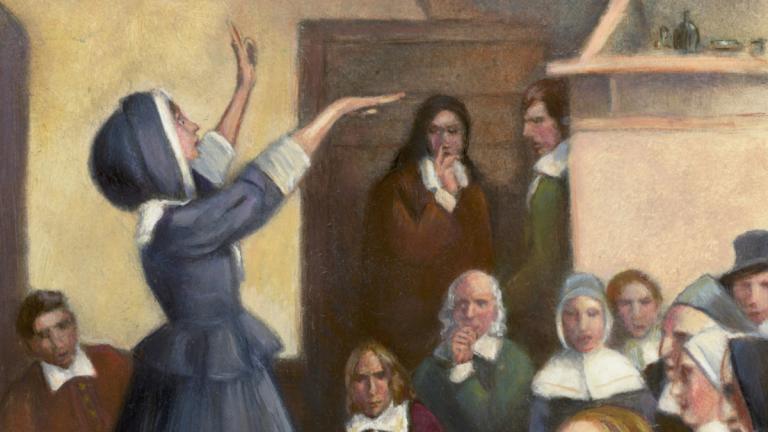
But that didn’t matter to her because she fundamentally had a different understanding of how Scripture worked. She believed in a pre-critical method, where the Holy Spirit animated the senses and immediately revealed truths about the Scripture to the reader. She claimed this as being a valid experience of Scripture during her trial. Since the authorities understood this as being a radical view of the Holy Spirit and Scripture, the case was closed and they declared her guilt.
Immediately after Hutchinson’s exile from Boston, the Bostonian clergy established Harvard University in Cambridge (1638). They appointed Thomas Shepard to head the school. Shepard was one of the many ministers who had examined and exiled Hutchinson. Now, aspiring ministers would not have to travel back across the Atlantic to receive credentialed training, that could be much more liberal training. Rather, they could train men there, where they raised them, and they would be safely nurtured in a local nursery of Puritan scriptural interpretation and theological training.
Swift as Incarnation of Hutchinson and the Anti-Swift Sentiment
That said, it seems that Taylor Swift and Anne Hutchinson have quite a bit in common. In many ways, Taylor Swift is another incarnation of Anne Hutchinson. Both have experienced no small resistance to their efforts.
Just as there was an anti-Hutchinsonian sentiment in Boston, there has been a swelling anti-Swift sentiment as well. On the album release day, I asked my history students at Wheaton College how they had received the new Taylor Swift album, I was surprised by how much disdain I heard from some of the students. It reminded me that, around the time of the Super Bowl, there was an equal amount of disdain from these students and the middle school students at my church concerning the Kansas City Chiefs and Swift’s intervention in the world of football. Many of these young people were anti-Chiefs because they were anti-Swift.
Is it because of her poetic genius? Is it because she is a successful businesswoman and a powerful billionaire? Is it because she encourages people to vote? I think these are all part of the whole Taylor Swift package that both inspires her draw and detraction. But there’s something more there too.
While I’m still pondering the motivation for anti-Swift sentiment among these young people, I can’t help but see how they have been raised in a certain kind of nursery of social and cultural thinking that has trained them to have a disdain for powerful and influential women that break the mold of conservative values.
Perhaps this sentiment might be captured from this peculiar thread by the @thebereanmillen.
My two cents on Swift. Unsaved in college, I loved Taylor Swift. I knew every word to Red and all the other albums too. Her music is intoxicating bc she’s done a very good job capturing worldly relationships and hookup culture.
Now, as a believer– I stay far away from it. Why?…
— Katie (@thebereanmillen) April 20, 2024
Undoubtedly, Taylor Swift has become controversial among those who follow the conservative persuasion, and it is because she has been a disruption to their power. Leah Payne noted this in her recent publication, God Gave Rock and Roll to You (OUP, 2024), which Payne brought to people’s attention yesterday with her own thread (the inspiration of this special column).
Lots of @taylorswift13 talk today – among her many accomplishments, #TaylorSwift was also disruptive to the dominant #CCM biz model of the aughts, which aimed to present conservative white evangelicals with alternatives to mainstream pop stars.https://t.co/tsev45a2gU pic.twitter.com/OGgyYFb7Wf
— Leah Payne (@drleahpayne) April 19, 2024
Payne said in her history of the Contemporary Christian Music (CCM) movement:
The reign of virginal CCM pop starlets was eventually threatened, however, by a teenage singer from West Reading, Pennsylvania, named Taylor Swift. Swift was a pretty, petite blonde teenager who wore modest clothing and wrote chaste country songs with plenty of adolescent longing and Christian imagery. Swift’s third single, “Our Song,” depicted two teenagers who refrained from kissing and made sure to pray every night. “I think the real end for a lot of pop CCM was Swift,” observed former Forefront A&R representative Mark Nicholas; “the same moms who brought their daughters to CCM concerts felt comfortable bringing them to a Taylor Swift show.”21
Whether it was the fault of the Swifties or not, women of any age singing about anything at all were rarer and rarer on sales charts and Christian radio in the early 2000s. Women had always been underrepresented in CCM, but as rock-oriented worship music rose in prominence, their numbers dwindled further. (Payne, 145)

God Gave Rock and Roll to You by Leah Payne (Oxford University Press, 2024)
Taylor Swift ended up being a disruption to the reign of CCM musicians because she existed in mainstream culture and drew a large Christian following to her. Why did this happen? Is it simply because she “was safe for the whole family,” while being across the aisle in the land of mainstream. I don’t think it’s that simple. Rather, it is far more complex than that. I think she was offering something to these moms and daughters that they all longed for. They wanted a Madonna, who had the sensibilities of respectable Christianity. Lady Gaga wouldn’t work but Taylor Swift would.
Furthermore, I think it’s possible that anti-Swift sentiment is also driven by how she has awakened the imaginations and curiosities of young women globally. She is an inspiration to young blossoming artists and poets. She has enchanted them with a desire to unlock all the mysteries that her poetry offers. Quite frankly, as a human artist, she awakens the imaginations of her audience in the same way Scripture did to its readers during the era of pre-critical exegesis. She has drawn her audience in to read her story carefully, and she has succeeded in enchanting a generation of listeners.
When David Steinmetz concluded his famous essay on the “The Superiority of Pre-Critical Exegesis”, he appropriated an illuminating anecdote from C. S. Lewis:
I am inclined to agree with C. S. Lewis, who commented on his own book Till We Have Faces: “An author doesn’t necessarily understand the meaning of his own story better than anyone else.”8 The act of creation confers no special privileges on authors when it comes to the distinctly different, if lesser, task of interpretation. (Steinmetz, 12)
Taylor Swift has become a symbol of liberal power that has not bowed to other structures of authority. Her audience searches her poetic genius for catharsis, inspiration, and strength to persevere through pain or setbacks. Perhaps, that’s why she released her album on the anniversary of the “shot heard around the world,” the first engagements of the American Revolution at Lexington and Concord. As Swift keeps building momentum globally, this album is her poetic shout heard around the world.
Previous Post

April 20, 2024
United Methodist General Conference 2024: What to Look For
Next Post

April 22, 2024 The Johnson-Reed Act and American Religious History
Recent Comments
"I love horror but would have to acclimate back to Lovecraft and especially Machen. Have ..."
Fairies, Witches, Folk Horror, and the ..."
"Very good point about MacDonald.I am certainly a Machen fan!"
Fairies, Witches, Folk Horror, and the ..."
"The Scottish author George MacDonald integrated fairy world into his fiction in a way that ..."
Fairies, Witches, Folk Horror, and the ..."
"I like the idea that we can have different streams. The coffee analogy is genius."
How Do You Take Your Evangelicalism?
Browse Our Archives
Select a Category abolitionism Abortion Abraham Joshua Heschel Abraham Kuyper Abraham Lincoln Academia Activism Adam Renberg Advent Adventist africa African American Religion Agnes Howard Albert Camus American History American Religious History American Revolution American West Anabaptists Ancient History Andrea Turpin Andrei Tarkovsky Anglicanism Annales Ansley Lillian Quiros anti-Catholicism Antisemitism Anxious Bench apologetics Apparitions Arash Azizi Archaeology archives art Artificial Intelligence Asia Asian Americans Augustine Authors Bad Bunny Baptism Baptists Barack Obama Battle of Hastings Benjamin Franklin Bernard-Henri Levy Beth Allison Barr Beth Moore Bethany Mannon Bible Bill Cunningham Billy Graham Black Music Bob Dylan Body Boenhoffer Books Breastfeeding Bruce Springsteen C.S. Lewis Calvinism Cancel Culture Capitalism Carmelites Catholicism Cedric Robinson Cesar Chavez Charismaticism charity Charles Dickens Charles Lindbergh Che Guevara Chicago Children Chinese Christianity Chris Gehrz Christ Christian death Christian Higher Education Christian life Christian Nation Christian Nationalism Christianity Today Christmas Church life Church Practice cinema Civil Religion Civil Rights Movement Civil War civility Classics Climate Change Cold War Colonial Mexico colonialism Comer Communism community complementarianism Conference on Faith and History Congregationalism Conspiracies Conspiracy Conversion Narratives Coronavirus Costa Rica Council of Nicaea Covid-19 Creation Critical Race Theory Crusades Culture culture wars Daniel K. Williams David Barton David Swartz Death Ways death with dignity DEI democracy Democratic Party Devotion Digital Age Diplomacy discipleship diversity Donald Trump Drama Dua Lipa Early Church early modern Early modern Catholicism Easter Eastern Christianity economic exploitation Education elections Elie Wiesel Elizabeth II Elizabeth Taylor emotions Empire Engineering England enslavement Entertainment Episcopal Church Erica Ramirez eschatology Eurocentrism Evangelicalism Evangelicals Exegesis Family Feminism Film Flannery O'Connor folk music Food Foreign Policy founding fathers Franciscans Franciscus Junius fundamentalism Funerals G.K. Chesterton Gender Genocide genre geography George W. Bush George Washington George Whitefield Global Christianity Global church Grief Guadalupe Guest Post guest post gun control gun violence Gustavo Gutierrez Hamid Dabashi Harold John Ockenga Harvest Hate Hawaiian Christianity Healing health care Heather Cox Richardson Hell Heresy Hermeneutics Higher Education Hinduism Hippocratic oath Historical Fiction Historical Methodology Historical Profession Historical Profession Historical Theology Historical Thinking historiography Holidays Holocaust horror movies Human rights Humanitarian Work humanities Hummingbirds Hungary hymns Imago Dei Immigration Injustice Interviews Iran Islam Islamophobia Israel Ivan's Childhood Jacob Randolph James Bratt Janine Giordano Drake Japanese history Japanese Literature Jean Paul Sartre Jesse Miranda Jesus Jesus Christ Jimmy Carter Joan Baez Joan Didion Joanne Freeman João B. Chaves Joao Chaves Joey Cochran John Calvin John Fea John Tillotson John Turner Johnny Cash Jonathan Edwards Jonathan Tran Joseph Smith Josh Howerton Journalism Jr. Judaism Jürgen Moltmann Just War Justice Justin Brierley Karl Barth Katelyn Beaty koi ponds Kris Kristofferson Kristin Kobes Du Mez Latin American Religious History Latino Americans Lectio Divina Leisure Lent Leonard Cohen liberal arts liberalism Liberation Theology Linda Ronstadt Lisa Clark Diller Literature Lou Reed Lynchings Lynneth Miller Renberg Mainline Protestantism Malcolm Foley Marilyn Monroe Maritime history Mark Noll Marriage Martin Luther Martin Luther King Martyrdom Marxism Mary Masih Alinejad mass shootings material culture medieval Christianity Medieval Ethiopia Melissa Borja memory Mennonites Mental Health Mental Illness Methodism Mexican Americans Mexicans Mike Madrid Miles Mullin Min Jin Lee Miscarriage Missionaries Mister Rogers Mitt Romney modernity Monasticism Mormonism Motherhood Mothers of the Church Moving Music Musicals Nadya Williams Nahua Christianity Native Americans Natsume Sōseki New Contributor New England New Year New York Nico Non-Violent Protest Orthodoxy pacifism Paleo Evangelicals Palestinians Parenting Patti Smith Paul Kingsnorth Pedro Calderón de la Barca Pentecostalism Philip Jenkins Phillis Wheatley physician-assisted suicide pilgrimage Pilgrims pluralism Plutocracy Poetry Politics Pope Francis Pope Leo XIV post-modernism prayer preaching Presbyterians prosperity gospel Protest Public history Publishing Puritans purity culture Quakers race Race Massacres Racial Capitalism racial reconciliation racialization Racism Raha Bahloulipour Re-Enchantment reading Reformation Refugees religion and the university religion and war Religious Freedom Religious Nones Religious Pluralism Religious Symbols religious violence Republican Party Revival Rita Coolidge Ritual Roger Williams Roman Catholic church Royalty Russell Moore same-sex marriage Sarah Irving-Stonebraker Scandinavia Science Science and Technology Scopes trial Scriptural Interpretation secularism Selena Quintanilla seminary Seventh-Day Adventists sexual morality Sexuality Sikhs Silence slaveholders theology Slavery Slavoj Zizek social justice Social Media Southern Baptist Convention Southern Religion Spain Spiritual Autobiography Spiritual but not religious Spiritual Discipline Sports Stanley Hauerwas Suffering Summer Camps Sunday Night Odds and Ends Supernatural Supreme Court Syriac Christianity Tal Howard Taylor Swift Teaching Technology Television Thanksgiving The Beatles The Mission theater TheoBros Theology Thomas Dixon Thomas Jefferson Thomas Kidd Thomas Merton Tim Gloege Tim Walz Tom Holland Tourism tradition Tragedy Translation Transnationalism Travel Trump Ukraine Uncategorized Unitarians United Methodist Church US History Vanessa Chan Velvet Underground Verónica A. Gutiérrez Veronica Gutierrez Vikings Violence Virgin Mary Virtue Virtue ethics Visions Voting War WCTU Wendell Berry Westminster Assembly White Evangelicalism Wildfires Winnie the Pooh Witches women Women in Ministry Women's and Gender Studies Work Worship writing Yasunari Kawabata Zena Hitz
Select a Month October 2026 September 2026 August 2026 July 2026 June 2026 May 2026 April 2026 March 2026 February 2026 January 2026 December 2025 November 2025 October 2025 September 2025 August 2025 July 2025 June 2025 May 2025 April 2025 March 2025 February 2025 January 2025 December 2024 November 2024 October 2024 September 2024 August 2024 July 2024 June 2024 May 2024 April 2024 March 2024 February 2024 January 2024 December 2023 November 2023 October 2023 September 2023 August 2023 July 2023 June 2023 May 2023 April 2023 March 2023 February 2023 January 2023 December 2022 November 2022 October 2022 September 2022 August 2022 July 2022 June 2022 May 2022 April 2022 March 2022 February 2022 January 2022 December 2021 November 2021 October 2021 September 2021 August 2021 July 2021 June 2021 May 2021 April 2021 March 2021 February 2021 January 2021 December 2020 November 2020 October 2020 September 2020 August 2020 July 2020 June 2020 May 2020 April 2020 March 2020 February 2020 January 2020 December 2019 November 2019 October 2019 September 2019 August 2019 July 2019 June 2019 May 2019 April 2019 March 2019 February 2019 January 2019 December 2018 November 2018 October 2018 September 2018 August 2018 July 2018 June 2018 May 2018 April 2018 March 2018 February 2018 January 2018 December 2017 November 2017 October 2017 September 2017 August 2017 July 2017 June 2017 May 2017 April 2017 March 2017 February 2017 January 2017 December 2016 November 2016 October 2016 September 2016 August 2016 July 2016 June 2016 May 2016 April 2016 March 2016 February 2016 January 2016 December 2015 November 2015 October 2015 September 2015 August 2015 July 2015 June 2015 May 2015 April 2015 March 2015 February 2015 January 2015 December 2014 November 2014 October 2014 September 2014 August 2014 July 2014 June 2014 May 2014 April 2014 March 2014 February 2014 January 2014 December 2013 November 2013 October 2013 September 2013 August 2013 July 2013 June 2013 May 2013 April 2013 March 2013 February 2013 January 2013 December 2012 November 2012 October 2012 September 2012 August 2012 July 2012 June 2012 May 2012
Follow Us!
TAKE THE
Religious Wisdom Quiz
Which prophet's wife died as a sign to Israel, and he was told not to mourn?
Select your answer to see how you score.
Obadiah Ezekiel Amos Daniel
Related posts from Anxious Bench

What Coffee Reveals About America's Evangelical Varieties
Origen, Eustathius, and the Witch of Endor

The Evangelical Brand Image Crisis
TRENDING AT PATHEOS Evangelical

How to Make a Decision When You Can't...
Main point: It’s much more valuable to stay close to God so...

Archdiocese Hosts Military Marriage Retreat in Germany
RASTATT, Germany — The transient military lifestyle, with its frequent deployments and...

Nearly every morning, I make the drive to Detroit with my high-school-age...

The Real AI Story Is Adoption Without Trust
Artificial intelligence has crossed a political threshold. It is no longer a...

A new article, written by Jeff Lindsay and Gale L. Pooley,...

Swimfan: Forgotten Aughts Pleasures
This is a recovery effort. In 2002, My Big Fat Greek Wedding...
view all Evangelical blogs
What Are Your Thoughts?leave a comment
Ad-Free & Subscriber Log-In Subscription Support
- About Us
- 2026 Calendar
- Videos
- Podcasts
- Library of World Religions
- Faith In Media Tracker
- Advertise With Us
- Write for Us
- Privacy Policy
- Terms of Service
- Do Not Sell My Data
- Contact Us
- Radiant Digital
- Manage Newsletter Subscriptions
- Unsubscribe From Notifications
- Sitemap
Copyright 2008-2026, Patheos. All rights reserved.
Subscription Support Ad-Free & Subscriber Log-In
Follow Patheos