
BuddhistCatholicContemplativeEvangelicalGeneral ChristianHinduJewishLatter-day SaintMuslimNew VisionsProgressive Christian
Beliefs
- Buddhist
- Catholic
- Contemplative
- Evangelical
- General Christian
- Hindu
- Jewish
- Latter-day Saint
- More Voices
- Muslim
- New Visions
- Pagan
- Progressive Christian
Topics
- Religion News
- Food and Religion
- Sports and Religion
- Religious Art
- Religious Music and Entertainment
- Religious Events
- History and Religion
- Style and Religion
- Politics and Religion
- Women in Religion
- Recreation Outdoors and Religion
- Business Finance and Religion
- Careers Workplace and Religion
- Education and Religion
- Family Parenting and Religion
- Health Fitness and Religion
- Home and Religion
- Relationships and Religion
- Technology and Religion
- Travel and Religion
Columnists
- Buddhist Columnists
- Business Finance and Religion Columnists
- Careers Workplace and Religion Columnists
- Catholic Columnists
- Contemplative Columnists
- Education and Religion Columnists
- Evangelists Columnists
- Family Parenting and Religion Columnists
- General Christian Columnists
- Health Fitness and Religion Columnists
- Hindu Columnists
- History and Religion Columnists
- Home and Religion Columnists
- Jewish Columnists
- More Voices Columnists
- Latter Day Columnists
- Muslim Columnists
- New Visions Columnists
- Nonreligious Columnists
- Pagan Columnists
- Politics and Religion Columnists
- Progressive Columnists
- Recreation Outdoors and Religion Columnists
- Relationships and Religion Columnists
- Religion News Columnists
- Religious Art Columnists
- Religious Events Columnists
- Religious Music and Entertainment Columnists
- Sports and Religion Columnists
- Style and Religion Columnists
- Technology and Religion Columnists
- Travel and Religion Columnists
- Women in Religion Columnists
Resource Library
- 2026 Calendar
- Library of World Religions
- The 100 Most Holy Places on Earth
- Patheos Answers
- Podcasts
- Videos
- Faith Leaders Database
- Anglican Episcopalian
- Bahai
- Baptist
- Buddhism
- Christianity
- Confucianism
- Eastern Orthodoxy
- Hinduism
- Holiness and Pentecostal
- ISKCON
- Islam
- Judaism
- Lutheran
- Methodist
- The Church of Jesus Christ of Latter-day Saints
- New Age
- Paganism
- Presbytarian and Reformed
- Protestantism
- Religion Behind the Scenes
- Roman Catholic
- Scientology
- Shia Islam
- Sikhism
- Sufism
- Sunni Islam
- Taoism
- Zen
- See all religions
Research Tools
 Ad-Free & Subscriber Log-In Subscription Support
Ad-Free & Subscriber Log-In Subscription Support
Follow Patheos 

- Trending:
- Forgiveness
- |
- Marriage
- |
- Consciousness
- |
- Death Penalty
- |
- Election
- |
- Halloween

-
About the Authors
- Home
- Evangelical
- Religious Art
- History and Alternatives: An Interview with Francis Spufford
History and Alternatives: An Interview with Francis Spufford
Last updated on: April 17, 2024 at 1:22 pm by Wyatt Reynolds
History and Alternatives: An Interview with Francis Spufford 2024-04-17T13:22:38-04:00 Wyatt Reynolds
Patheos Explore the world's faith through different perspectives on religion and spirituality! Patheos has the views of the prevalent religions and spiritualities of the world.

Monk’s Mound, the largest remaining earthen pyramid at Cahokia.
A few notes before jumping into this interview, which I am delighted to present to you. Francis Spufford is the author or editor of nearly a dozen books spanning an array of genres and fields including memoir, popular history, fiction, and alternative history. I have reviewed his most recent novel, Cahokia Jazz and found it both delightful and poignant. I hope you’ll read it. After my encounter with the book, I reached out in the hopes of chatting with him a bit about history, research, fiction, and how these can help us make sense of our own times. I hope you enjoy this nearly as much as I did. I have edited our conversation for clarity and style. Do beware. While there are no dragons here, spoilers aplenty await you.
WR: I don’t want to be a fanboy. I’m going to try not to be. But I really enjoyed this book and it sort of touched on so many different things that I enjoy. So I am really excited to chat with you.
FS: I’m very, very glad. And I’ll try not to enjoy any fanboying you show too much. But from my point of view, the book was a combination of things I didn’t know would ever find one reader who liked all of them at the same time. So it was great to find that you exist.
WR: I’m also glad that I exist. So here we are. So to start off, you dedicate Cahokia Jazz, in a sort of convoluted way to Ursula K. Le Guin, and you’ve talked about her as being raised in a household of anthropologists. I think similarly, you were raised in a household of historians. And I’m curious in what ways you think that has shaped the ways you think more broadly, but perhaps particularly in the way you went about writing this novel.
FS: I do think I tend to be a very historically minded novelist, and I was a historically minded nonfiction writer before that. But I can remember a review of a book I’d written that described me as a historian and my mother ringing me up in a state of total irony and just saying the word “historian, historian?” to me with mounting skepticism. Because it’s true that I have also been strongly aware of the distance between the way my mind works and the way that scholarly history, proper history works. And I’ve always known what proper history was. One of my earliest memories is my parents casting scorn on the phrase, “the olden days,” which I had learned at school aged five or something. And my parents said, there are no “olden days”. They’re all different. *Which “*olden days” is the question you should always ask. And I always been clear that the kind of analytical temperament and the temperament that goes, in particular with working in archives and combing happily through them for the little, single, golden nugget among the 200,000 data points, that’s not me. First, I had a kind of essayistic mind. And then I had a fiction writing mind, but I never quite had a historical mind in the sense of an enormous appetite for detail. And the dirty secret of historical fiction, as I’ve learned it, anyway, is that you need comparatively little detail. You need a kind of pictorial grasp, and you need some kind of set of associated ironies. You need to know what the issues are. But then in terms of trying to recreate a past—and this applies to the real past in 18th century New York, just as much as it applies to an imaginary past in 1922 Cahokia— you don’t need much. You need the right details and you need stuff that will cause the reader’s imagination to get in gear collaboratively and start doing half the work or two thirds of the work for you. Having said all that, I kind of just disagree with myself at regular intervals here. I really enjoy the process of research. A kind person after one of my previous books, wrote to me with an offer to become my research assistant, and take away all the historical stuff from me, and I thought, that’s the fun part! So no, I wouldn’t want to be without the direct exposure to past documents and past details and past discourses. My one historical skill seems to be a kind of pattern-recognition. Looking at and spotting what the patterns are, and therefore, perhaps, which detail will best express those patterns.
WR: That’s wonderful. A lot of times you’ll hear historians talk how one of the most important skills as a historian is knowing how to pick which facts to include in your narrative in a way that is both honest, but also keeps people engaged.
FS: I suppose that the judgment of typicality then comes in, in the fiction version as well. You’re not just looking for expressiveness, but specifically expressiveness of the pattern you’re creating.
WR: I love that. I’m curious, going back a bit, if you could talk a little about how you did go about doing the research for this novel, because one doesn’t just sort of bump into the Mobilian trade jargon, especially when you’ve been writing the sort of things that you’ve written in the past. And then along with that, if you could talk a little bit about pictures, because I think both in the book itself, and especially in the way you’ve talked about it on your Instagram, you’ve made remarkable use of these images of the past as a means of inviting us into the city of Cahokia.
FS: Yeah, they often they have to be pictures that you’re willing to take with a certain difference. So, it’s very easy to put up expressive pictures of early 20th century American cops, but then they have to come with a label going kind of, by the way, all these people are of the wrong ethnicity for what I have in mind. But keep the uniform, keep the telephones, keep the horses, keep the station houses, but change the people a bit. I wrote the book during the pandemic, so God bless the internet, which was standing in for a research library, and God bless all the research libraries, which digitize their holdings and then put them on the internet as well.
The way round I work is never kind of “I happen to know a lot about something, so let’s write about that.” It’s “I want to know about something.” And then my reading is directed towards the narrative I’m hoping I may be able to find in it. So I read. I read 19th century and 20th century American economic history, I read Civil War history. I read stuff about the Jackson era. And one of the things that’s startling from a European perspective is just how recent the Confederate States, the deep southern states anyway, were at the time of the Civil War. I mean, these are places that only just existed in 1830. And a decade before that had been unrecognizably different human and social landscapes. By 1860, you’ve got just in time, at the earliest possible moment, the first generation of young white men who are under the impression that that “Alabama” or “Arkansas” or “Mississippi” were real places for which one might even die. Or, with the same speed, there was the incredibly rapid assembly of the extractive cotton economy and the expansion of slavery. Among the most important books I read was Walter Johnson’s River of Dark Dreams which is just extraordinary, and it is also a wonderful piece of writing. There is a stolen anecdote out of it in the novel, because it was just too good. And I also hoped that—I’ve sent him a copy. So, I’m hoping he will take it as a kind of tip of the hat to the wonderful scholarship he’s done. If you remember—I’m not trying to assume that you remember the whole book with perfect clarity, because why should you. But if you remember Lydia Lee’s grandfather’s escape story from the plantation, that’s real, except that it’s not a steamboat crewed by a Cherokee transportation company that takes the real guy away. But yeah, I suppose, I read fairly recent historiography, and took from it the sense that slavery has to be allowed to define those, those Mississippian landscapes in real history, and then that before that, there had been this complicated multi-sided encounter (and linguistic encounter) between the Native American nations and the French and the Spanish, and American/British settlers moving in from the east. And understood, as something the story need to capture when I meddled with history, that there had been a long-ish period of overlap in the 18th century, during which what was thought of as at the time as tribal military capacity and the fur trade and early forms of extractive agriculture and patterns of settlement were all kind of interrelating and changing things. When it came to anthropological stuff, I had a tame and friendly anthropologist, who is my daughter’s godmother, who pointed me to good stuff about syncretism, and she sent me, although I can’t remember the name of the author, a book about Handsome Lake and his somewhat mystic religion, which was great. And again, one of the things that kept striking me about these books was the speed of the various tipping points there had been in American history. For example, a relatively stable pattern of power in the Northeast through most of the 1700s, with Iroquois military power being just a kind of immovable fact over a whole swathe of what is now the United States for more than four generations, something like that. And the speed with which it was gone kind of makes your head spin; the speed with which a set of peoples who have dominated getting on for a fifth of a continent are reduced to a few reservations in a forest.
I suppose this fed into my sense of alternative history as a good way to think about the real thing, as well as a kind of intellectual parlor game, given that it gives you a chance to revisit such moments of rapid tipping and rapidly tip them a different way. So, I ended up with quite a lot more conjectural history for 18th and 19th century Cahokia, than I could possibly have put in the book. But I had to work it out to decide what sort of details should survive the sieve and make it onto the page: like the two victory monuments on the plaza in the middle of the city. Also, just so that I had some minimal sense that the whole imaginary structure was standing on a reasonably solid foundation. Oh, and I was also reading Jesuit history. From another angle, I had to work out how Cahokia would survive the suppression of the Society of Jesus, and what they were doing during the 40 or 50 years that, the Jesuits weren’t around until the refoundation of the order. I was also thinking about Jesuit architecture and the kind of interface between Jesuits architecture and the Guarani down in Paraguay and the ways in which that was and wasn’t a kind of actual collaboration, rather than just an exercise in dominance, because it half was. Then aware that I was I was actually sidestepping some of the harder historiographical questions, because I just went, “it’s out of range of the Spanish Empire.” It’s to be treated as a pure missionary field. So, the Jesuits kind of have to go, “good grief, we found ourselves a Native American Constantine,” rather than saying “quick, slap in a viceroy.”
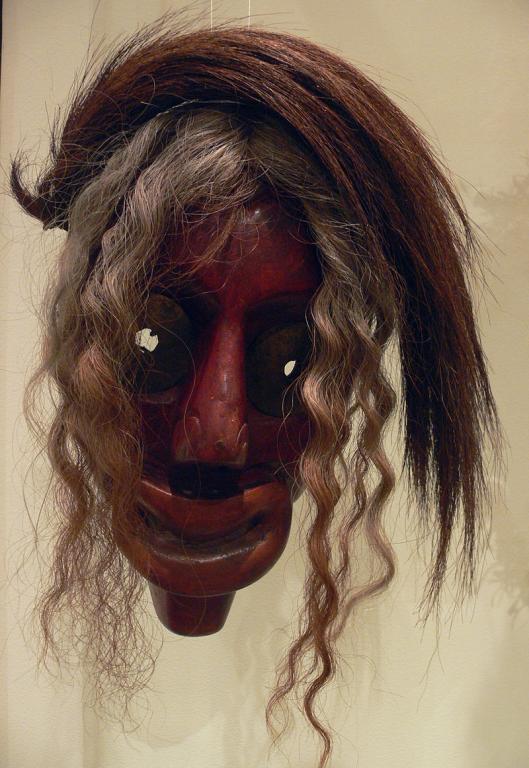
Haudenosaunee, False Face Society, mask. Versions of these mask prove quit important in Cahokia Jazz
WR: I’m curious along these lines. We’ve talked a little bit about the Jesuits, but Cahokia is clearly an enchanted city in a way that I don’t think any city in the United States in our 1920s could have been. There are many different ways in which you invite the reader to wrestle with perhaps their own metaphysical and ontological assumptions. Particularly, the way that religion relates to both indigeneity and I think just like the story that we tell about ourselves versus the other stories that exist. I’m curious if you could talk a little bit about this sort of dichotomy that exists in Cahokia between the founding myth they tell for white people about the Aztec prince, but then the dichotomy between that, and the real mythos of the city that goes back to this connection between the Sun and the Eucharist in the cathedral. I think that what first tips off “The Man” and leads him first go to the Joe, is that it’s clear whoever committed this murder doesn’t actually know the true myth of the city.
FS: No, indeed, whoever did the murder has an outsider’s ignorant take on the myths rather than something rooted within the culture, which is why the Man of the Sun – the uncrowned prince of the city – is reassured by the details of the murder in Act One. Whoever did this, they don’t get it. This is both angering and reassuring because it means that it’s not coming from inside the house.
It’s true that in actual historical 1922, I don’t think you could find an American city that felt enchanted in that sense. Somewhere where myth was fully alive to define experience. Though, I will also observe that enchantment is a permanent quality of human perception, which is therefore insuppressible and constantly reasserts itself in different terms. I take Charles Taylor’s point about the disenchantment of modernity, but I think re-enchantment of endless different kinds proliferates uncontrollably, because that’s what human culture does. And I would say that if you were looking around real early 20th century America, you could find sources of enchantment. You can see this in the way artists idolize the southwest or even in the way the United States describes itself as learning to do empire but “righteously” this time. Indeed, New England as purified old England is a kind of collective fantasy too. I don’t think that American history is short of incipiently enchanted things like that. But on the other hand, modernity is a very unmagical experience. Very material. Yet even there, actually, turn of the 20th century America is at a kind of early, magical stage of technology as well. It’s got Tesla doing things with lightning, it’s got electric street cars magically moving people at forty or even fifty miles an hour.
But pushing all of that stuff to one side. Yes. And, I knew that I was returning a kind of enchantment to this story, as part of it being alternative rather than real history. I was saying, rather than a few seeds of a kind of Le Guin-ean enchantment in real American history, what if we let them sprout and burgeon and grow out properly? A perceptive friend read the book and said, “It’s not actually science fiction is it, it’s more of a fantasy novel.” In that, Joe’s endless attempts to escape being the chosen one, are a fantasy novel trope. The city is in some ways a fantasy city, in its sense of possibility. This is generated by a sense, never quite definite, at the corner of book’s eye there is some unearthly patternmaking going on there. The way that Joe is always just in time, because as The Man says, he is in time with the song the city is playing. This is actually magical thinking not ordinary, prosaic, this-worldly thinking, and the novel makes good on it. He’s always where he needs to be. However reluctantly, he is there.
And of course, the other thing is that while the Catholicism of Cahokia is a kind of penetrable veil, something you can you could see through to much older mythological structures, the Catholicism is also part of the fusion. It’s not just decoration. It is contributing a specific, theological enchantment. Because as somebody quietly pointed out, there is a kind of Girardian logic of sacrifice going on. It’s a book written by a sacramental Christian though not by someone who is himself a Catholic. (Half my family are Catholics; I’m from the other half, the Anglican/Episcopalian half.) It’s a book written by somebody who is trying to be anthropologically cautious and serious about syncretism. But who, necessarily, because of my own faith, can’t think that what the Jesuits brought to Cahokia was just loss. It has to be gain as well, from my point of view. I mean, the guy was completely right about the story being Girardian. It begins with a gross and exploitative, hatred-inducing simulation of a sacrifice, and it ends with an actual one. With the Latin Mass reaching its not-irrelevant sacramental climax in the background. Joe is suffering for the good of the city. Although, maybe the Man’s giant chauffeur Oscar will turn up with a stretcher ten seconds after the novel ends.
WR: He can be a sacrifice, and he can live, maybe?
FS: Maybe…
WR: My doctoral dissertation circles around Native intellectuals before and during the crisis we describe as the Trail of Tears, and I was fascinated to see how you covered that.
FS: Indeed, part of what I was trying to find, as I inserted my wedge into real American history, was a reasonably plausible way of undoing the Trail of Tears. I couldn’t; I could only try to modify it.
WR: For what it’s worth, I almost cried during the scene of Cahokia welcoming the refugees from the Trail of Tears. It was so moving.
FS: Thank you. I thought I could do that at least. If you look at the history of the so-called “Five Civilized Tribes” you think, these are people who did their absolute damnedest to play by the rules of the American game as they were given the. (Including, in ways, the unattractive rules: the Cherokee taking up slavery, etc.) But they did exactly what it said on the label that you were supposed to do in order to thrive in the United States of America. And it still didn’t bloody work. And they went to the Supreme Court, and sued in an ideally civilized way for their lands, and that still didn’t bloody work. So, I thought, if I’m going to come up with an altered outcome for all that, it has to be further west. It has to be out of reach. In my carefully written-out history that didn’t make it onto the pages of the novel, after Cherokee Nation vs State of Georgia proves ineffective, the Cahokian delegation in Washington re-sues and demonstrates that they do have standing as independent power, outside the American political borders, which can make treaties with bodies other than the United States. But they had to be further west, and they needed to have the benefit of excellent Jesuit gunsmithing from about 1616 onwards. As well as some kind of independent Weberian industrial take-off. Yet all of that too in a way is based off the Five Civilized Tribes. It just had to be given longer to run, more people, and an industrial takeoff—and again, putting my thumb on the historical scales, consistent leadership of genius for Cahokia, which real dynasties don’t actually provide. Another sign of enchantment at work.
WR: One of the other things that you’ve talked about on your Instagram recently is you showcase several of your mother-in-law’s quilts, which I absolutely loved. They’re quite beautiful. Like quilts, jazz and the blues have all been used by scholars of America as perhaps a more helpful way of thinking about what America is than a melting pot where everything sort of loses its particularity. I’m wondering if thinking about, as you said, the American story being everyone’s problem now, because we’re the Metropole, jazz and quilts can be metaphors that help us think about both the world of Cahokia and also our own world. About the ways in which the alternative past can help us make sense of things as they are. Because there are definitely moments in Cahokia Jazz that rhyme with things we’ve experienced in the US recently. And not to put too fine a point on it, I’m thinking in particular of the cavalry charge.
FS: That’s not a coincidence. (I was also conscious that I was doing a kind of wicked reverse Eisenstein there in which the cavalry are the good guys. Just delightful to reverse the Western trope of having the cavalry appear on the horizon.) Anyway, that’s a very good question. And I’m not sure I can give it a good enough answer. I am very drawn to the idea that coexistence in quilting, or maybe coexistence in mosaic since after all a quilt is a fabric mosaic, is actually a better metaphor than an idealized unity in being melted together. The melting pot is a slightly weird notion as an ideal for an environment. High temperatures? Everything turning to goo? And actually the dominant stuff in the pot gets less melted than the other stuff. The melted mixture of America is a lot less Native American or, say, Yiddish-inflected, than it is an amplified version of what was going on in the Thirteen Colonies, spread out to continental scale.
Jazz, on the other hand, strikes me as one of the points where a metaphor of unity or fusion is actually positive. And something you can straightforwardly get behind, because jazz remains fundamentally African-American music, and yet it has been palpably open to being created in lots of ways. With the condition that, in order to enter into what jazz does and makes, you have to reckon with the blues, which is a paradox, a joyful tragedy music, made from the dark matter of American history being, not denied but transfigured. Jazz has room for everybody but it requires you to acknowledge the weight of history before you get to the lightness of the clarinet solo. My book is called Cahokia Jazz because it’s doing a kind of riff or remix or jam on the old standard tune of history. But also, because there seems to me to be something slightly utopian about jazz and its ability to generate joy from suffering. Again, it’s not the music of denial. But it’s not a music that just reproduces suffering either. It’s a transforming music. And from really early on, it’s being played by obsessed white guys as well. And it’s a 20th century American music, which tries to do something redeeming with all the bad shit inherited from the 19th century. Yes, let’s stick with the word “redeeming”. It tries to redeem America, and that seems to me to be very promising.
Religious Art
History and Religion
Previous Post
April 16, 2024
Sola Scriptura? On Paratexts and Devotional Practice
Next Post
April 18, 2024 The Historical Mythology of Clergy Sexual Abuse
Recent Comments
"I love horror but would have to acclimate back to Lovecraft and especially Machen. Have ..."
Fairies, Witches, Folk Horror, and the ..."
"Very good point about MacDonald.I am certainly a Machen fan!"
Fairies, Witches, Folk Horror, and the ..."
"The Scottish author George MacDonald integrated fairy world into his fiction in a way that ..."
Fairies, Witches, Folk Horror, and the ..."
"I like the idea that we can have different streams. The coffee analogy is genius."
How Do You Take Your Evangelicalism?
Browse Our Archives
Select a Category abolitionism Abortion Abraham Joshua Heschel Abraham Kuyper Abraham Lincoln Academia Activism Adam Renberg Advent Adventist africa African American Religion Agnes Howard Albert Camus American History American Religious History American Revolution American West Anabaptists Ancient History Andrea Turpin Andrei Tarkovsky Anglicanism Annales Ansley Lillian Quiros anti-Catholicism Antisemitism Anxious Bench apologetics Apparitions Arash Azizi Archaeology archives art Artificial Intelligence Asia Asian Americans Augustine Authors Bad Bunny Baptism Baptists Barack Obama Battle of Hastings Benjamin Franklin Bernard-Henri Levy Beth Allison Barr Beth Moore Bethany Mannon Bible Bill Cunningham Billy Graham Black Music Bob Dylan Body Boenhoffer Books Breastfeeding Bruce Springsteen C.S. Lewis Calvinism Cancel Culture Capitalism Carmelites Catholicism Cedric Robinson Cesar Chavez Charismaticism charity Charles Dickens Charles Lindbergh Che Guevara Chicago Children Chinese Christianity Chris Gehrz Christ Christian death Christian Higher Education Christian life Christian Nation Christian Nationalism Christianity Today Christmas Church life Church Practice cinema Civil Religion Civil Rights Movement Civil War civility Classics Climate Change Cold War Colonial Mexico colonialism Comer Communism community complementarianism Conference on Faith and History Congregationalism Conspiracies Conspiracy Conversion Narratives Coronavirus Costa Rica Council of Nicaea Covid-19 Creation Critical Race Theory Crusades Culture culture wars Daniel K. Williams David Barton David Swartz Death Ways death with dignity DEI democracy Democratic Party Devotion Digital Age Diplomacy discipleship diversity Donald Trump Drama Dua Lipa Early Church early modern Early modern Catholicism Easter Eastern Christianity economic exploitation Education elections Elie Wiesel Elizabeth II Elizabeth Taylor emotions Empire Engineering England enslavement Entertainment Episcopal Church Erica Ramirez eschatology Eurocentrism Evangelicalism Evangelicals Exegesis Family Feminism Film Flannery O'Connor folk music Food Foreign Policy founding fathers Franciscans Franciscus Junius fundamentalism Funerals G.K. Chesterton Gender Genocide genre geography George W. Bush George Washington George Whitefield Global Christianity Global church Grief Guadalupe guest post Guest Post gun control gun violence Gustavo Gutierrez Hamid Dabashi Harold John Ockenga Harvest Hate Hawaiian Christianity Healing health care Heather Cox Richardson Hell Heresy Hermeneutics Higher Education Hinduism Hippocratic oath Historical Fiction Historical Methodology Historical Profession Historical Profession Historical Theology Historical Thinking historiography Holidays Holocaust horror movies Human rights Humanitarian Work humanities Hummingbirds Hungary hymns Imago Dei Immigration Injustice Interviews Iran Islam Islamophobia Israel Ivan's Childhood Jacob Randolph James Bratt Janine Giordano Drake Japanese history Japanese Literature Jean Paul Sartre Jesse Miranda Jesus Jesus Christ Jimmy Carter Joan Baez Joan Didion Joanne Freeman João B. Chaves Joao Chaves Joey Cochran John Calvin John Fea John Tillotson John Turner Johnny Cash Jonathan Edwards Jonathan Tran Joseph Smith Josh Howerton Journalism Jr. Judaism Jürgen Moltmann Just War Justice Justin Brierley Karl Barth Katelyn Beaty koi ponds Kris Kristofferson Kristin Kobes Du Mez Latin American Religious History Latino Americans Lectio Divina Leisure Lent Leonard Cohen liberal arts liberalism Liberation Theology Linda Ronstadt Lisa Clark Diller Literature Lou Reed Lynchings Lynneth Miller Renberg Mainline Protestantism Malcolm Foley Marilyn Monroe Maritime history Mark Noll Marriage Martin Luther Martin Luther King Martyrdom Marxism Mary Masih Alinejad mass shootings material culture medieval Christianity Medieval Ethiopia Melissa Borja memory Mennonites Mental Health Mental Illness Methodism Mexican Americans Mexicans Mike Madrid Miles Mullin Min Jin Lee Miscarriage Missionaries Mister Rogers Mitt Romney modernity Monasticism Mormonism Motherhood Mothers of the Church Moving Music Musicals Nadya Williams Nahua Christianity Native Americans Natsume Sōseki New Contributor New England New Year New York Nico Non-Violent Protest Orthodoxy pacifism Paleo Evangelicals Palestinians Parenting Patti Smith Paul Kingsnorth Pedro Calderón de la Barca Pentecostalism Philip Jenkins Phillis Wheatley physician-assisted suicide pilgrimage Pilgrims pluralism Plutocracy Poetry Politics Pope Francis Pope Leo XIV post-modernism prayer preaching Presbyterians prosperity gospel Protest Public history Publishing Puritans purity culture Quakers race Race Massacres Racial Capitalism racial reconciliation racialization Racism Raha Bahloulipour Re-Enchantment reading Reformation Refugees religion and the university religion and war Religious Freedom Religious Nones Religious Pluralism Religious Symbols religious violence Republican Party Revival Rita Coolidge Ritual Roger Williams Roman Catholic church Royalty Russell Moore same-sex marriage Sarah Irving-Stonebraker Scandinavia Science Science and Technology Scopes trial Scriptural Interpretation secularism Selena Quintanilla seminary Seventh-Day Adventists sexual morality Sexuality Sikhs Silence slaveholders theology Slavery Slavoj Zizek social justice Social Media Southern Baptist Convention Southern Religion Spain Spiritual Autobiography Spiritual but not religious Spiritual Discipline Sports Stanley Hauerwas Suffering Summer Camps Sunday Night Odds and Ends Supernatural Supreme Court Syriac Christianity Tal Howard Taylor Swift Teaching Technology Television Thanksgiving The Beatles The Mission theater TheoBros Theology Thomas Dixon Thomas Jefferson Thomas Kidd Thomas Merton Tim Gloege Tim Walz Tom Holland Tourism tradition Tragedy Translation Transnationalism Travel Trump Ukraine Uncategorized Unitarians United Methodist Church US History Vanessa Chan Velvet Underground Verónica A. Gutiérrez Veronica Gutierrez Vikings Violence Virgin Mary Virtue Virtue ethics Visions Voting War WCTU Wendell Berry Westminster Assembly White Evangelicalism Wildfires Winnie the Pooh Witches women Women in Ministry Women's and Gender Studies Work Worship writing Yasunari Kawabata Zena Hitz
Select a Month October 2026 September 2026 August 2026 July 2026 June 2026 May 2026 April 2026 March 2026 February 2026 January 2026 December 2025 November 2025 October 2025 September 2025 August 2025 July 2025 June 2025 May 2025 April 2025 March 2025 February 2025 January 2025 December 2024 November 2024 October 2024 September 2024 August 2024 July 2024 June 2024 May 2024 April 2024 March 2024 February 2024 January 2024 December 2023 November 2023 October 2023 September 2023 August 2023 July 2023 June 2023 May 2023 April 2023 March 2023 February 2023 January 2023 December 2022 November 2022 October 2022 September 2022 August 2022 July 2022 June 2022 May 2022 April 2022 March 2022 February 2022 January 2022 December 2021 November 2021 October 2021 September 2021 August 2021 July 2021 June 2021 May 2021 April 2021 March 2021 February 2021 January 2021 December 2020 November 2020 October 2020 September 2020 August 2020 July 2020 June 2020 May 2020 April 2020 March 2020 February 2020 January 2020 December 2019 November 2019 October 2019 September 2019 August 2019 July 2019 June 2019 May 2019 April 2019 March 2019 February 2019 January 2019 December 2018 November 2018 October 2018 September 2018 August 2018 July 2018 June 2018 May 2018 April 2018 March 2018 February 2018 January 2018 December 2017 November 2017 October 2017 September 2017 August 2017 July 2017 June 2017 May 2017 April 2017 March 2017 February 2017 January 2017 December 2016 November 2016 October 2016 September 2016 August 2016 July 2016 June 2016 May 2016 April 2016 March 2016 February 2016 January 2016 December 2015 November 2015 October 2015 September 2015 August 2015 July 2015 June 2015 May 2015 April 2015 March 2015 February 2015 January 2015 December 2014 November 2014 October 2014 September 2014 August 2014 July 2014 June 2014 May 2014 April 2014 March 2014 February 2014 January 2014 December 2013 November 2013 October 2013 September 2013 August 2013 July 2013 June 2013 May 2013 April 2013 March 2013 February 2013 January 2013 December 2012 November 2012 October 2012 September 2012 August 2012 July 2012 June 2012 May 2012
Follow Us!
TAKE THE
Religious Wisdom Quiz
What does "Jehovah Rapha" mean?
Select your answer to see how you score.
The Lord Saves The Lord is Holy The Lord Provides The Lord Heals
Related posts from Anxious Bench

What to the Black Christian Historian is America's...
Something Still Could: Courage for a Turbid Anniversary

Marilyn Monroe and the Life of the Mind
Does Persecution Make Faith Stronger?
TRENDING AT PATHEOS Evangelical

Pope Leo Celebrates Mass for Nurses & Docs...
I don't have any idea how he did it, but Pope Leo...

The Sermon on the Mount, Part I: Matthew...
The Sermon on the Mount, Part I (Matthew 4:12-5:12) St. Matthew moves...

What's up from Crossway: Reviewing some of their latest A few weeks...

Janie Learns the Way of the Cross: A...
Teaching children about Jesus' Passion can be challenging. Many parents and educators...

Looking For Good Catholic Writing - October 2026
He alone extends the heavens, and he walks upon the waves of...

In "Irreplaceable," our book on vocation and technology, Trevor Sutton and I...
view all Evangelical blogs
What Are Your Thoughts?leave a comment
Ad-Free & Subscriber Log-In Subscription Support
- About Us
- 2026 Calendar
- Videos
- Podcasts
- Library of World Religions
- Faith In Media Tracker
- Advertise With Us
- Write for Us
- Privacy Policy
- Terms of Service
- Do Not Sell My Data
- Contact Us
- Radiant Digital
- Manage Newsletter Subscriptions
- Unsubscribe From Notifications
- Sitemap
Copyright 2008-2026, Patheos. All rights reserved.
Subscription Support Ad-Free & Subscriber Log-In
Follow Patheos