
BuddhistCatholicContemplativeEvangelicalGeneral ChristianHinduJewishLatter-day SaintMuslimNew VisionsProgressive Christian
Beliefs
- Buddhist
- Catholic
- Contemplative
- Evangelical
- General Christian
- Hindu
- Jewish
- Latter-day Saint
- More Voices
- Muslim
- New Visions
- Pagan
- Progressive Christian
Topics
- Religion News
- Food and Religion
- Sports and Religion
- Religious Art
- Religious Music and Entertainment
- Religious Events
- History and Religion
- Style and Religion
- Politics and Religion
- Women in Religion
- Recreation Outdoors and Religion
- Business Finance and Religion
- Careers Workplace and Religion
- Education and Religion
- Family Parenting and Religion
- Health Fitness and Religion
- Home and Religion
- Relationships and Religion
- Technology and Religion
- Travel and Religion
Columnists
- Buddhist Columnists
- Business Finance and Religion Columnists
- Careers Workplace and Religion Columnists
- Catholic Columnists
- Contemplative Columnists
- Education and Religion Columnists
- Evangelists Columnists
- Family Parenting and Religion Columnists
- General Christian Columnists
- Health Fitness and Religion Columnists
- Hindu Columnists
- History and Religion Columnists
- Home and Religion Columnists
- Jewish Columnists
- More Voices Columnists
- Latter Day Columnists
- Muslim Columnists
- New Visions Columnists
- Nonreligious Columnists
- Pagan Columnists
- Politics and Religion Columnists
- Progressive Columnists
- Recreation Outdoors and Religion Columnists
- Relationships and Religion Columnists
- Religion News Columnists
- Religious Art Columnists
- Religious Events Columnists
- Religious Music and Entertainment Columnists
- Sports and Religion Columnists
- Style and Religion Columnists
- Technology and Religion Columnists
- Travel and Religion Columnists
- Women in Religion Columnists
Resource Library
- 2026 Calendar
- Library of World Religions
- The 100 Most Holy Places on Earth
- Patheos Answers
- Podcasts
- Videos
- Faith Leaders Database
- Anglican Episcopalian
- Bahai
- Baptist
- Buddhism
- Christianity
- Confucianism
- Eastern Orthodoxy
- Hinduism
- Holiness and Pentecostal
- ISKCON
- Islam
- Judaism
- Lutheran
- Methodist
- The Church of Jesus Christ of Latter-day Saints
- New Age
- Paganism
- Presbytarian and Reformed
- Protestantism
- Religion Behind the Scenes
- Roman Catholic
- Scientology
- Shia Islam
- Sikhism
- Sufism
- Sunni Islam
- Taoism
- Zen
- See all religions
Research Tools
 Ad-Free & Subscriber Log-In Subscription Support
Follow Patheos 

- Trending:
- Advent
- |
- Forgiveness
- |
- Thanksgiving
- |
- Election
- |
- Seasonal Holidays
- |
- Marriage

-
About the Authors
- Home
- Evangelical
- History and Religion
- Undiscerned Retrieval: Ockenga and Protestant History
Undiscerned Retrieval: Ockenga and Protestant History
Last updated on: March 18, 2024 at 12:24 am by Joey Cochran
Undiscerned Retrieval: Ockenga and Protestant History 2024-03-18T00:24:12-04:00 Joey Cochran
Patheos Explore the world's faith through different perspectives on religion and spirituality! Patheos has the views of the prevalent religions and spiritualities of the world.
Evangelicals in the States like to have the Reformers and Puritans on their side. However, an undiscerned retrieval of the theology and piety of Reformers and Puritans is ill advised. Wrested from their cultural and historical context, this literature doesn’t hit the same way that it did when it was written. While there is much that might be soberly retrieved for the sake of godly living, caution ought to be exercised.
Pious theology inevitably leads to public theology, and no small amount of pious theology, throughout history, has been crafted with its cultural and political underpinnings in mind. Whether it be the Definition of Chalcedon in the Early Church, the role of the Munus Triplex or the Communion disputes among Protestant Reformers, or the Priesthood of Believers among the Puritans—politics and piety are indelibly entangled. We are creatures of the Word and the sword. We are citizens of two cities, the city of God and city of men. That said, appropriation of the past must be done with care lest retrieval becomes haphazard and sloppy.
I am concerned that too many U. S. Protestants embrace the pious ideas of Reformers and Puritans without giving due consideration to how they will consequently shape their public theology. The public theology of Douglas Wilson, Wayne Grudem, William Wolfe, Ben Sasse and TGC, et al. has not occurred in a vacuous state. While there is a range of consequences and interpretations that may occur, the reality is that it is risky to seek to have the Reformers and Puritans on our side. If our aims are to preserve democracy, then let us not practice undiscerned retrieval.
Harold John Ockenga’s Undiscerned Retrieval of Reformers and Puritans
Perhaps the undiscerned retrieval of Harold John Ockenga is worth considering. In the late 1930s, Ockenga felt the rise of Nationalism in the spirit of his age, and he attempted to appropriate the Reformers and Puritans on his side in order to preserve democracy.
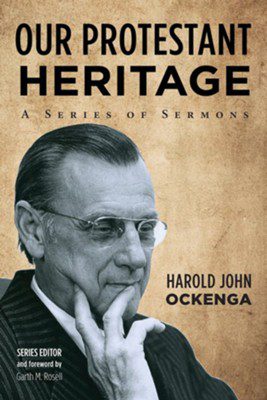
Our Protestant Heritage by Harold John Ockenga
Zondervan published an eight-sermon series from Park Street Church of Boston pastor, Harold John Ockenga, in 1938. The series entitled Our Protestant Heritage argued that the political trajectory of Protestantism moved inevitably to dissent, independency, and soul liberty, which were all principles that undergirded healthy democracy. In his preface, Ockenga claimed, “In the proportion that Protestantism dies, the cardinal principles of American Democracy die and we may expect the end of our present government, for America is the product of Protestantism.”[1]
While I am not able to fully address this here, this statement is quite fraught. It already assumes a superiority of Protestantism to Catholicism and it is laden with a deep sense of antipathy towards American Catholics. Considering how Anti-Catholicism has been a perennial failing and feature of Evangelicalism in the U.S., this should come as no surprise. Furthermore, Ockenga’s notion of “America” would be challenged by many of the Latina/o community in the Southwest of the U. S. let alone all those who call themselves Americans, in the broad sense, who live South of the States. Ockenga is only describing a certain kind of America—a White, Male, Protestant dominated breed of America—which had long protected its legacy and supremacy.
Setting Protestant superiority aside, there are other causes for alarm from the undiscerned retrieval found in this series. The first six sermons are designed and executed with the seventh sermon in mind. Ockenga knew his objective and had to trace a pathway from the superiority of Protestant theology in Germany to its culmination in the political philosophy of Roger Williams in the British Colonies. The first three sermons treat the emerging history of Protestant political philosophy by looking to doctrinal principles from three of the chief ministers of the Protestant Reformation: 1) the reformation truths of Martin Luther in Germany, 2) followed by the Swiss reformer Ulrich Zwingli’s reformed doctrine of communion, and 3) then turns to the predestination doctrine of John Calvin. The second set of three sermons are studies on 1) William of Orange’s employment of Christian Liberty, 2) the power of conscience in the efforts of John Knox of Scotland, and 3) the providence of God in Oliver Cromwell’s England. Overall, Ockenga provides a subtle and seamless narrative from Luther to Williams. Yet, much of it is sophistry that is full of counter-factual historical problems.
Most glaring of which is that Ockenga credits the Lord Protector, Oliver Cromwell for the birth of the spirit of independent religion and religious toleration in Britain.[2] This is giving Cromwell far too much credit for a notion that emerges nearer in proximity to the Glorious Revolution when Parliament recognized a mixed-establishment of religion, which included the Church of England, Presbyterianism, and Congregationalism.[3]
If we were to credit any one individual for the merits of toleration, it seems most likely the case that the honor ought to be bestowed on John Locke, who published his Letter Concerning Toleration in 1689, alongside his Two Treatises on Human Government and his Essay Concerning Human Understanding that same year—all as a result of his newfound freedom to safely return to England out of exile in France and back into the patronage of the Earl of Shaftesbury, Anthony Ashley Cooper, who, too, had found himself back into the good graces of England’s new Co-Sovereigns.
However, bestowing this honor upon its rightful heir does not fit conveniently within the golden chain of political developments that Ockenga wished to trace from Martin Luther to Roger Williams. Cromwell fills an essential role as a humble farmer and pious Puritan whose high political aspirations are attained.
As exhibited by Cromwell, in each of these sermons, Ockenga highlights the intersection between the historical subject and that person’s involvement in political and pious affairs. Each sermon demonstrates the argument and claim I’ve already asserted that pious theology is entangled with public theology. Those that produce the former are inevitably implicated in the latter. This is not a claim that needs to be refuted, nor is it a problem that must be undone. This is simply the way of being, thinking, and living in the world. Our identity, rationale, and practice is one of a body/soul composite that has political and spiritual consequences. The problem isn’t that we are political and spiritual creatures. The problem lies in the kind of political and spiritual creatures we become and how we become those creatures. Since we become what we consume, undiscerned retrieval of past political and spiritual creatures might reproduce problems from the past.
Harold John Ockenga’s Fear of Christian Nationalism
The motive for Ockenga’s program of retrieving the Reformers and Puritans to be on the side of democracy becomes apparent in sermon seven on Roger Williams. The anxiety that underlies the whole sermon series is the rise of Christian Nationalism in the U. S., the phenomena of which Ockenga indicates parallels the rise of nationalism in other places, such as Germany. After arguing for Williams’ view of soul liberty, the idea that individuals should have freedom from compulsory and State enforced religious belief, Ockenga asks whether this principle is endangered today.
He goes on to quote a statement from Dr. Samuel M. Shoemaker, the American leader of the Oxford Group Movement, which concludes with an endorsement that the State be empowered to control the Church. “We really want the state to take the responsibility for keeping things in order, so that we may continue our religious practice as we wish.” Ockenga then pairs Shoemaker’s comments with Frank Buchman’s “praise of Hitler as the Savior of Europe.” Ockenga then appeals to the response of “a brilliant religious editor” whom he quotes at length:
What does this mean? Only one thing, if it is logically carried out, namely, the rule of the churches and of religion by the state, and that is precisely what is being attempted in Germany, in Spain, in Mexico, and in Russia. To give the state authority to decide what is good religion and what constitutes a good church is to throw civilization back in benighted monarchism, which is what we have as a matter of fact in present day dictatorships.
Ockenga goes on to make his own comments on the situation of the U. S.:
A few years ago such state control of religions was on the wane, but now voices in favor of it are rising on every hand. At the close of the last century the greatest amount of tolerance that the world has seen existed, but today it is being repudiated. Liberalism today is on the wane. Soul liberty is greatly in danger. Roger Williams’ thesis, ‘Live and Let Live,’ is being rapidly discarded.[4]
While it is admirable that Ockenga went to such lengths to defend democracy from the rise of Christian Nationalism, he failed to do so in a prudent way. If you carefully read the prior six sermons, you encounter logical fallacy after fallacy that indicate that having the Reformers and Puritans on your side is not the look Ockenga really wants. For some, such as Ockenga, it seems de rigueur to have the Reformers and the Puritans on your side, whether it’s the first half of the twentieth century or the first half of the twenty-first century. But let me show you how problematic undiscerned retrieval really is by turning to the notable interpretation of an expert interpreter of Roger Williams and an outstanding, careful, detailed historian of religion in America, Edwin Gaustad.
Edwin Gaustad on Williams
Roger Williams was one among several early Bostonians who created diasporic communities of dissent from the Boston politic they contested. As John Winthrop consolidated his power from 1636–38, in short order various men peeled off Boston to settle other areas. These men’s departure from Boston were either prompted by exile or ambition. Thomas Hooker and Samuel Stone were among the first. They set out in 1636 to found Hartford. From this Hartford settlement, came the earliest democratic constitution in the world, The Fundamental Orders. Prior to its ratification, Thomas Hooker famously preached, “The foundation of authority is laid in the free consent of the people…As God has given us liberty let us take it.” Anne Hutchinson’s brother-in-law, John Wheelwright, departed in November of 1637 after his fast-day sermon led to an ecclesiastical trial that concluded with his exile to Hampton, New Hampshire and ultimately Maine. Next in the Boston exodus were John Davenport and Theophilus Eaton, who departed in 1638, on their own initiative, to settle the New Haven colony.
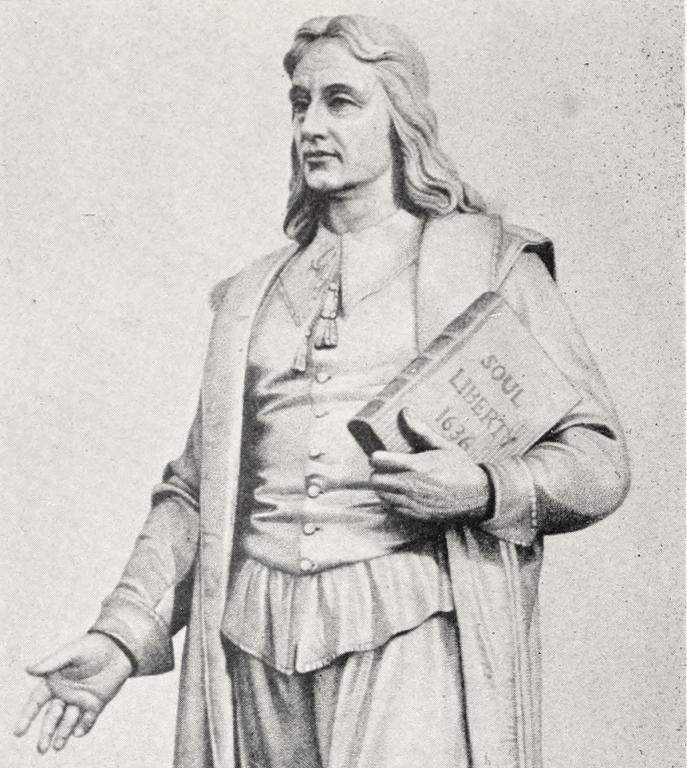
Statue of Roger Williams clutching a book with the title Soul Liberty.
Why did these people depart from Boston? Gaustad indicates that the Bostonian leaders, under the propitious power of John Winthrop, had simply recreated the same political dilemma that existed in Britain. Rather than the political corruption deriving from the Stuart monarchy, the same corrupting impulses emerged from among the Church Elders and General Assembly Counsel Members, nearly all of which, if not all, had dual appointments in both spheres. Even when others peeled away from Boston, the Bostonian Counsel repeatedly attempted to over-reach their ecclesial and political power by interfering and intervening in the affairs of these other fledgling colonies. Simply reading some of the letters and overtures of Boston ambassadors to Rhode Island reported in David Hall’s documentary history of the Hutchinsonian Controversy substantiates this over-reach.[5]
The story of the first to depart from Boston, Roger Williams, has its own intriguing backstory that demonstrates this over-reach. Williams and his wife Mary left England aboard the Lyon in late 1630 and arrived in Boston in February, 1631. He was eagerly welcomed as “a godly minister” by Governor Winthrop and offered to be Boston’s minister. Noting the Boston governor’s and charter members’ commitments to the Crown and Church of England, Williams determined they were not separatist enough for his tastes. Roger summarily turned down the offer, and he and Mary headed to Salem. After a stint in Salem, the couple journeyed to the decidedly religious separatist Plymouth, where they settled until 1633. Williams’ reputation for “radicalism” got him in trouble in Plymouth and so he returned to Salem. However, Boston could not simply leave him be in Salem. In Salem he tussled with John Cotton, Boston’s minister, over women being veiled during prayer, and he was implicated in an episode where Salem’s John Endecott came under fire from Boston for desecrating the British National flag; the papal cross had been cut from the flag. Roger Williams’ resistance to the status quo persisted when he protested to Natives being deprived of their land without due compensation.[6]
The breaking point that led to exile was when Williams criticized the Massachusetts policy that all male inhabitants, under the age of 16, must swear an oath of allegiance to the colony and Crown, concluding with “so help me God.” Williams’ protest to this policy ostentatiously concerned his views of religious tolerance and freedom and subtly displayed his views on freedom of speech and conduct. Suppose someone did not believe in God. Imposing such an oath upon a person would cause him to speak against his conscience. Williams had not long before been appointed to pastoral duties in Salem, elevating the status of his opinions and providing a public platform for his ideas.
Boston officials, seeing the imminent danger to the status quo, brought him to court in Boston in July, 1635. This action encroached on affairs in Salem and breached what Williams thought was charitable and respectable behavior between government and church. As a result, Williams sent a letter to the “Elders of the Church at Boston,” indicating his belief that this should be handled in the sphere of the church. Doing so would leave open the possibility that the Boston church might respect the independency of the Salem church’s practices, preventing political over-reach of Boston into Salem and ensuring the independency and autonomy that might have its locus within the churches. By October, the Salem church had become split in its views and Boston government officials decidedly took action, summoning Williams to court on October 8. Williams was given a final day to recant. Returning to court on October 9 of the same mind the court so ordered “that the said Mr. Williams shall depart out of this jurisdiction within six weeks.”[7]
Ad Fontes, Bypassing the Danger of Undiscerned Retrieval
Gaustad’s interpretation of the Williams events demonstrates how out of sync and radical Williams’ ideas, as well as the Plymouth separatists, were from Magisterial Reformers like Martin Luther and Thomas Cranmer; Republican-minded reformers like Ulrich Zwingli, John Calvin, and John Knox; or pious political figureheads like William of Orange or Oliver Cromwell. All of the aforesaid did not have such a radical notion of separation of Church and State. Rather, all of these figures, in their given place and time, to one degree or another, permitted much permeation and convergence between the State and the Church relation, and they were all quite rigorous proponents of a Church established by the State. Roger Williams’ perspective was quite radical at the time and the consequences of it would not be articulated with clarity until Isaac Backus became sharpened, as iron sharpens iron, by his publication war interlocutor, Joseph Fish, in the 1760s and 70s.[8]
It’s altogether too simplistic to argue for a streamlined evolution of political thought from one individual to another, such as Ockenga attempted. The geo-political context of each of these people contributed unique features. While some borrowing and exchange took place, we have to compartmentalize the advancements of each of these figures and hold the body of literature they produced and represented within their own contexts.
I have a fond appreciation of the Reformers, the Puritans, and the Neo-Evangelicals. My library is filled with primary and secondary works on all these subjects of history, which I’ve cursorily discussed here. This is not a takedown of Reformed, Puritan, and Neo-Evangelical thought. It is a critical re-assessment that suggests we should employ discernment and deep study on these subjects before cherry-picking, ransacking their writings, or weaponizing them for our own ends. I propose that people today can prevent undiscerned retrieval by taking seriously the notion of ad fontes.
Rather than receiving an interpretive history handed down from generation to generation, we should go “to the sources” themselves and re-evaluate them. The legacy of our interpretive history alone existed in a context itself that slanted in some direction, and we ought to be weary of that slant. Before we appropriate Great Thinkers and Great Books, for the purpose of enlisting them to be on our side, we should first read these people and works and study their historical and social context in depth. Doing so will prevent undiscerned retrieval and foster a studied and rich appreciation of the past.
Furthermore, we might be saved from naïve or ignorant employment of their ideas to support our own arguments. We might then see how indelibly linked their pious reflections were to their public theology and also perceive how those in our own day have been shaped by the undiscerned retrieval of Great Thinkers and Great Books they have consumed, such that, it seemingly has led them to appropriate the same tyranny, of which Revolutionary patriots and Early Republic citizens were so weary, the tyranny of a State regulated Church, which today is known as Christian Nationalism.
[1] Harold John Ockenga, Our Protestant Heritage (Eugene: Wipf and Stock/Grand Rapids: Zondervan, 1938), vi.
[2] Ockenga, Our Protestant Heritage, 101, 104–05.
[3] On the mixed-establishment of religion in the British Empire, see Katherine Carté, Religion and the American Revolution: An Imperial History(Chapel Hill: University of North Carolina Press, 2021).
[4] Ockenga, Our Protestant Heritage, 120–21.
[5] David Hall ed., The Antinomian Controversy, 1636–1638: A Documentary History (Middletown: Wesleyan University Press, 1968).
[6] Edwin Gaustad, Roger Williams (New York: Oxford University Press, 2005), 6–9.
[7] Gaustad, Roger Williams, 10–13.
[8] Joseph Fish, The Church of Christ a Firm and Durable House (New London, 1767); Isaac Backus, A Fish Caught in His Own Net (Boston, 1768); Joseph Fish, The Examiner Examined (New London, 1771); Isaac Backus, An Appeal to the Public for Religious Liberty (Boston, 1773); Isaac Backus, The Nature and Necessity of an Internal Call to Preach the Gospel (Boston, 1792).
History and Religion
Previous Post
March 15, 2024
Open-Air Worship: Outdoor Chapels for New World Nahuas
Next Post

March 18, 2024 Megachurch Pastor Performs The Gettysburg Address
Recent Comments
"Every religion is "made up," even Adam and Eve were made up thousands of years ..."
Forging Druids and Inventing a Nation
"I have an identical twin, and Thomas was always the disciple I connected with most. ..."
In the Footsteps of Thomas: A ..."
"I've never thought of Constantine as a villain. Do Christians generally? Maybe the ones who ..."
"The TV sitcom BEWITCHED was an old favorite of mine"
How Scotland Gave Us Our Modern ..."
Browse Our Archives
Select a Category abolitionism Abortion Abraham Joshua Heschel Abraham Kuyper Abraham Lincoln Academia Activism Adam Renberg Advent Adventist africa African American Religion Agnes Howard Albert Camus American History American Religious History American Revolution American West Anabaptists Ancient History Andrea Turpin Andrei Tarkovsky Anglicanism Annales Ansley Lillian Quiros anti-Catholicism Antisemitism Anxious Bench apologetics Apparitions Arash Azizi Archaeology archives art Artificial Intelligence Asia Asian Americans Augustine Authors Bad Bunny Baptism Baptists Barack Obama Battle of Hastings Benjamin Franklin Bernard-Henri Levy Beth Allison Barr Beth Moore Bethany Mannon Bible Bill Cunningham Billy Graham Black Music Bob Dylan Body Boenhoffer Books Breastfeeding Bruce Springsteen C.S. Lewis Calvinism Cancel Culture Capitalism Carmelites Catholicism Cedric Robinson Cesar Chavez Charismaticism charity Charles Dickens Charles Lindbergh Che Guevara Chicago Children Chinese Christianity Chris Gehrz Christ Christian death Christian Higher Education Christian life Christian Nation Christian Nationalism Christianity Today Christmas Church life Church Practice cinema Civil Religion Civil Rights Movement Civil War civility Classics Climate Change Cold War Colonial Mexico colonialism Comer Communism community complementarianism Conference on Faith and History Congregationalism Conspiracies Conspiracy Conversion Narratives Coronavirus Costa Rica Council of Nicaea Covid-19 Creation Critical Race Theory Crusades Culture culture wars Daniel K. Williams David Barton David Swartz Death Ways death with dignity DEI democracy Democratic Party Devotion Digital Age Diplomacy discipleship diversity Donald Trump Drama Dua Lipa Early Church early modern Early modern Catholicism Easter Eastern Christianity economic exploitation Education elections Elie Wiesel Elizabeth II Elizabeth Taylor emotions Empire Engineering England enslavement Entertainment Episcopal Church Erica Ramirez eschatology Eurocentrism Evangelicalism Evangelicals Exegesis Family Feminism Film Flannery O'Connor folk music Food Foreign Policy founding fathers Franciscans Franciscus Junius fundamentalism Funerals G.K. Chesterton Gender Genocide genre geography George W. Bush George Washington George Whitefield Global Christianity Global church Grief Guadalupe Guest Post guest post gun control gun violence Gustavo Gutierrez Hamid Dabashi Harold John Ockenga Harvest Hate Hawaiian Christianity Healing health care Heather Cox Richardson Hell Heresy Hermeneutics Higher Education Hinduism Hippocratic oath Historical Fiction Historical Methodology Historical Profession Historical Profession Historical Theology Historical Thinking historiography Holidays Holocaust horror movies Human rights Humanitarian Work humanities Hummingbirds Hungary hymns Imago Dei Immigration Injustice Interviews Iran Islam Islamophobia Israel Ivan's Childhood Jacob Randolph James Bratt Janine Giordano Drake Japanese history Japanese Literature Jean Paul Sartre Jesse Miranda Jesus Jesus Christ Jimmy Carter Joan Baez Joan Didion Joanne Freeman João B. Chaves Joao Chaves Joey Cochran John Calvin John Fea John Tillotson John Turner Johnny Cash Jonathan Edwards Jonathan Tran Joseph Smith Josh Howerton Journalism Jr. Judaism Jürgen Moltmann Just War Justice Justin Brierley Karl Barth Katelyn Beaty koi ponds Kris Kristofferson Kristin Kobes Du Mez Latin American Religious History Latino Americans Lectio Divina Leisure Lent Leonard Cohen liberal arts liberalism Liberation Theology Linda Ronstadt Lisa Clark Diller Literature Lou Reed Lynchings Lynneth Miller Renberg Mainline Protestantism Malcolm Foley Marilyn Monroe Maritime history Mark Noll Marriage Martin Luther Martin Luther King Martyrdom Marxism Mary Masih Alinejad mass shootings material culture medieval Christianity Medieval Ethiopia Melissa Borja memory Mennonites Mental Health Mental Illness Methodism Mexican Americans Mexicans Mike Madrid Miles Mullin Min Jin Lee Miscarriage Missionaries Mister Rogers Mitt Romney modernity Monasticism Mormonism Motherhood Mothers of the Church Moving Music Musicals Nadya Williams Nahua Christianity Native Americans Natsume Sōseki New Contributor New England New Year New York Nico Non-Violent Protest Orthodoxy pacifism Paleo Evangelicals Palestinians Parenting Patti Smith Paul Kingsnorth Pedro Calderón de la Barca Pentecostalism Philip Jenkins Phillis Wheatley physician-assisted suicide pilgrimage Pilgrims Piracy pluralism Plutocracy Poetry Politics Pope Francis Pope Leo XIV post-modernism prayer preaching Presbyterians prosperity gospel Protest Public Executions Public history Publishing Puritans purity culture Quakers race Race Massacres Racial Capitalism racial reconciliation racialization Racism Raha Bahloulipour Re-Enchantment reading Reformation Refugees religion and the university religion and war Religious Freedom Religious Nones Religious Pluralism Religious Symbols religious violence Republican Party Revival Rita Coolidge Ritual Roger Williams Roman Catholic church Royalty Russell Moore same-sex marriage Sarah Irving-Stonebraker Scandinavia Science Science and Technology Scopes trial Scriptural Interpretation secularism Selena Quintanilla seminary Seventh-Day Adventists sexual morality Sexuality Sikhs Silence slaveholders theology Slavery Slavoj Zizek social justice Social Media Southern Baptist Convention Southern Religion Spain Spiritual Autobiography Spiritual but not religious Spiritual Discipline Sports Stanley Hauerwas Suffering Summer Camps Sunday Night Odds and Ends Supernatural Supreme Court Syriac Christianity Tal Howard Taylor Swift Teaching Technology Television Thanksgiving The Beatles The Mission theater TheoBros Theology Thomas Dixon Thomas Jefferson Thomas Kidd Thomas Merton Tim Gloege Tim Walz Tom Holland Tourism tradition Tragedy Translation Transnationalism Travel Trump Ukraine Uncategorized Unitarians United Methodist Church US History Vanessa Chan Velvet Underground Verónica A. Gutiérrez Veronica Gutierrez Vikings Violence Virgin Mary Virtue Virtue ethics Visions Voting War WCTU Wendell Berry Westminster Assembly White Evangelicalism Wildfires Winnie the Pooh Witches women Women in Ministry Women's and Gender Studies Work Worship writing Yasunari Kawabata Zena Hitz
Select a Month November 2026 October 2026 September 2026 August 2026 July 2026 June 2026 May 2026 April 2026 March 2026 February 2026 January 2026 December 2025 November 2025 October 2025 September 2025 August 2025 July 2025 June 2025 May 2025 April 2025 March 2025 February 2025 January 2025 December 2024 November 2024 October 2024 September 2024 August 2024 July 2024 June 2024 May 2024 April 2024 March 2024 February 2024 January 2024 December 2023 November 2023 October 2023 September 2023 August 2023 July 2023 June 2023 May 2023 April 2023 March 2023 February 2023 January 2023 December 2022 November 2022 October 2022 September 2022 August 2022 July 2022 June 2022 May 2022 April 2022 March 2022 February 2022 January 2022 December 2021 November 2021 October 2021 September 2021 August 2021 July 2021 June 2021 May 2021 April 2021 March 2021 February 2021 January 2021 December 2020 November 2020 October 2020 September 2020 August 2020 July 2020 June 2020 May 2020 April 2020 March 2020 February 2020 January 2020 December 2019 November 2019 October 2019 September 2019 August 2019 July 2019 June 2019 May 2019 April 2019 March 2019 February 2019 January 2019 December 2018 November 2018 October 2018 September 2018 August 2018 July 2018 June 2018 May 2018 April 2018 March 2018 February 2018 January 2018 December 2017 November 2017 October 2017 September 2017 August 2017 July 2017 June 2017 May 2017 April 2017 March 2017 February 2017 January 2017 December 2016 November 2016 October 2016 September 2016 August 2016 July 2016 June 2016 May 2016 April 2016 March 2016 February 2016 January 2016 December 2015 November 2015 October 2015 September 2015 August 2015 July 2015 June 2015 May 2015 April 2015 March 2015 February 2015 January 2015 December 2014 November 2014 October 2014 September 2014 August 2014 July 2014 June 2014 May 2014 April 2014 March 2014 February 2014 January 2014 December 2013 November 2013 October 2013 September 2013 August 2013 July 2013 June 2013 May 2013 April 2013 March 2013 February 2013 January 2013 December 2012 November 2012 October 2012 September 2012 August 2012 July 2012 June 2012 May 2012
Follow Us!
TAKE THE
Religious Wisdom Quiz
Who was the last apostle to die?
Select your answer to see how you score.
James Peter John Paul
Related posts from Anxious Bench
Best Books of 2026 on American Christianity
Public Executions and the Pirate Curse of Nix's...
Constantine Wasn’t the Only Ruler to Convert
Paris & CT Burn 50 Years After Newsweek's...
TRENDING AT PATHEOS Evangelical

The Late Francis Frangipane & the Failure Too...
I learned today that another one of my heroes has gone to...

Thomas Paine, the Smiths, the apostles in England,...
I'm pleased to announce that the Becoming Brigham Black Friday Sale,...

CatholicTV Series: Six Black Catholics on Path to...
WATERTOWN, Mass., November 9, 2026 – In recognition of Black Catholic History...

New Advent Journal Invites Catholics to Be Pilgrims
Florissant, MO, November 16, 2026— What if Advent were more than a...

INNER CIRCLE: John's Quantum Gospel
INTRODUCTION In this next Inner Circle series, which I anticipate will...
"Three B's" of My Apologetics Ministry (+ VIDEO)
In early December 2026 (less than a week from the time...
view all Evangelical blogs
What Are Your Thoughts?leave a comment
Ad-Free & Subscriber Log-In Subscription Support
- About Us
- 2026 Calendar
- Videos
- Podcasts
- Library of World Religions
- Faith In Media Tracker
- Advertise With Us
- Write for Us
- Privacy Policy
- Terms of Service
- Do Not Sell My Data
- Contact Us
- Radiant Digital
- Manage Newsletter Subscriptions
- Unsubscribe From Notifications
- Sitemap
Copyright 2008-2026, Patheos, part of the Radiant Digital network of media brands. All rights reserved.
Subscription Support Ad-Free & Subscriber Log-In
Follow Patheos