
BuddhistCatholicContemplativeEvangelicalGeneral ChristianHinduJewishLatter-day SaintMuslimNew VisionsProgressive Christian
Beliefs
- Buddhist
- Catholic
- Contemplative
- Evangelical
- General Christian
- Hindu
- Jewish
- Latter-day Saint
- More Voices
- Muslim
- New Visions
- Pagan
- Progressive Christian
Topics
- Religion News
- Food and Religion
- Sports and Religion
- Religious Art
- Religious Music and Entertainment
- Religious Events
- History and Religion
- Style and Religion
- Politics and Religion
- Women in Religion
- Recreation Outdoors and Religion
- Business Finance and Religion
- Careers Workplace and Religion
- Education and Religion
- Family Parenting and Religion
- Health Fitness and Religion
- Home and Religion
- Relationships and Religion
- Technology and Religion
- Travel and Religion
Columnists
- Buddhist Columnists
- Business Finance and Religion Columnists
- Careers Workplace and Religion Columnists
- Catholic Columnists
- Contemplative Columnists
- Education and Religion Columnists
- Evangelists Columnists
- Family Parenting and Religion Columnists
- General Christian Columnists
- Health Fitness and Religion Columnists
- Hindu Columnists
- History and Religion Columnists
- Home and Religion Columnists
- Jewish Columnists
- More Voices Columnists
- Latter Day Columnists
- Muslim Columnists
- New Visions Columnists
- Nonreligious Columnists
- Pagan Columnists
- Politics and Religion Columnists
- Progressive Columnists
- Recreation Outdoors and Religion Columnists
- Relationships and Religion Columnists
- Religion News Columnists
- Religious Art Columnists
- Religious Events Columnists
- Religious Music and Entertainment Columnists
- Sports and Religion Columnists
- Style and Religion Columnists
- Technology and Religion Columnists
- Travel and Religion Columnists
- Women in Religion Columnists
Resource Library
- 2026 Calendar
- Library of World Religions
- The 100 Most Holy Places on Earth
- Patheos Answers
- Podcasts
- Videos
- Faith Leaders Database
- Anglican Episcopalian
- Bahai
- Baptist
- Buddhism
- Christianity
- Confucianism
- Eastern Orthodoxy
- Hinduism
- Holiness and Pentecostal
- ISKCON
- Islam
- Judaism
- Lutheran
- Methodist
- The Church of Jesus Christ of Latter-day Saints
- New Age
- Paganism
- Presbytarian and Reformed
- Protestantism
- Religion Behind the Scenes
- Roman Catholic
- Scientology
- Shia Islam
- Sikhism
- Sufism
- Sunni Islam
- Taoism
- Zen
- See all religions
Research Tools
 Ad-Free & Subscriber Log-In Subscription Support
Ad-Free & Subscriber Log-In Subscription Support
Follow Patheos 

- Trending:
- Forgiveness
- |
- Marriage
- |
- Consciousness
- |
- Death Penalty
- |
- Election
- |
- Halloween

-
About the Authors
- Home
- Evangelical
- Did God Prepare Native Peoples for Christ? Part II
Did God Prepare Native Peoples for Christ? Part II
Last updated on: April 12, 2024 at 1:16 pm by Verónica A. Gutiérrez
Did God Prepare Native Peoples for Christ? Part II 2024-04-12T13:16:09-04:00 Verónica A. Gutiérrez
Patheos Explore the world's faith through different perspectives on religion and spirituality! Patheos has the views of the prevalent religions and spiritualities of the world.
Guadalupe and the Flower World Prophecy: Did an Ancient Indigenous Tradition Prepare the Americas for Millions of Conversions to Christianity? Part II
This (long) post serves as part two of my response to Guadalupe and the Flower World Prophecy: How God Prepared the Americas for Conversion Before the Lady Appeared. Part I provides an outline of the book’s argument, which I will not discuss here.
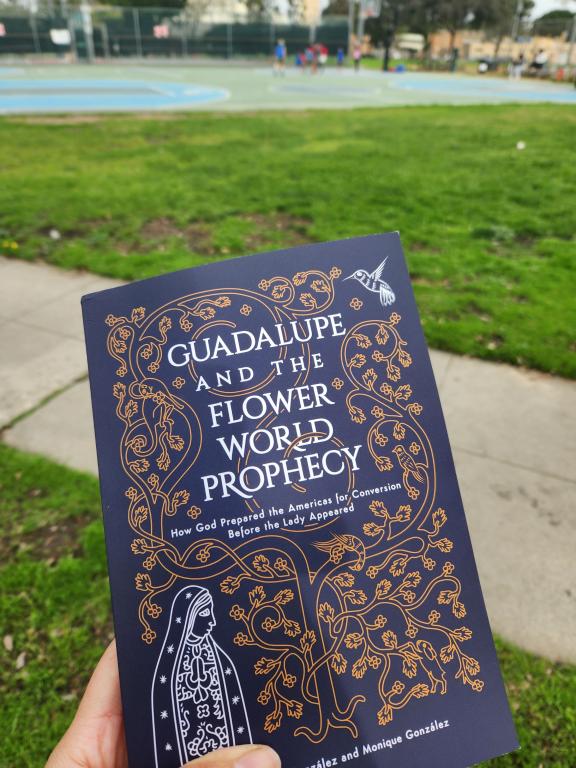
Reading Guadalupe and the Flower World Prophecy: How God Prepared the Americas for Conversion Before the Lady Appeared at the park while my children were in PE
I thoroughly enjoyed immersing myself in Juan Diego’s world via the Mesoamerican philosophy, anthropology, art, and flower-songs (poetry) in this book. Its content neatly aligns with themes in my APU course: “Native People Before and After Iberian Invasion,” especially because students read sample chapters of my Juan Diego book this week.
Ultimately, Guadalupe and the Flower World Prophecy is impressive for what it is – a book written by Catholic authors (who are not trained scholars) for a Catholic press formulating a new argument about the spread of a Catholic devotion. Challenging its classification as a devotional text, the book incorporates a range of interdisciplinary scholarship including anthropology, philosophy, theology, literary criticism, and history penned by European AND indigenous authors. The book’s dedication to locating its discussion within a native context is a departure from similar devotional approaches to Guadalupe, and thus laudable. The indigenous-inspired line drawings that pepper the text further reflect the desire to immerse readers in Nahua culture, and the authors’ translation of some Nahuatl material is noteworthy. Despite my own study of Nahuatl my mastery of this complex tongue remains elementary, so for reference I pulled out James Lockhart’s Nahuatl as Written and consulted the online Nahuatl Dictionary.
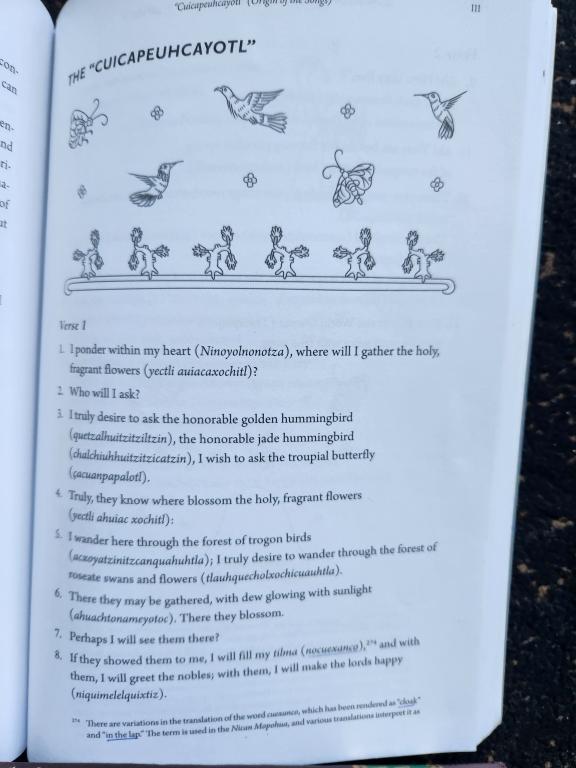
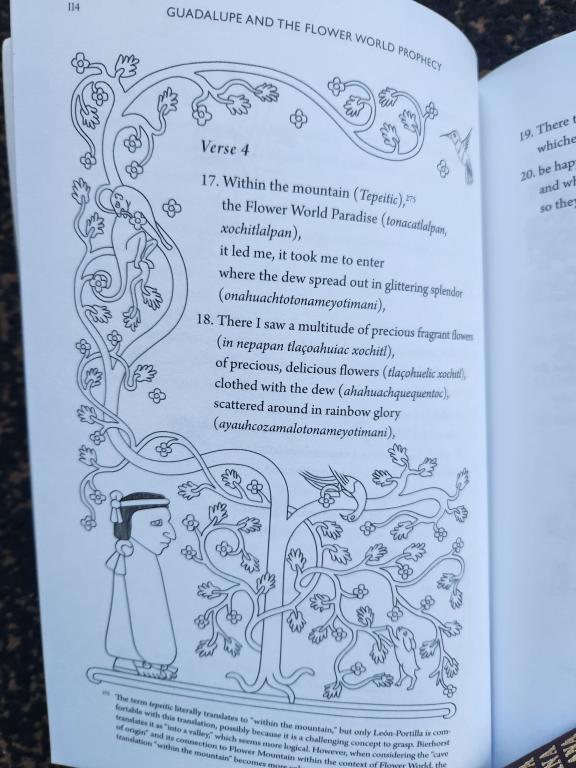
Indigenous-inspired images accompanying the English translation of the Cuicapeuhcayotl
Reading this book did not consist of the simple act of turning its pages. Inspired, I would set the book aside, pull a text off my shelf, and lose myself in it. I didn’t get past the first page’s opening quote from fray Toribio de Benevente Motolinia’s 1541 Historia de los indios de la Nueva España without pulling out my own copy, purchased in Mexico City some 20 years ago. One night I reread Steven Turley’s Franciscan Spirituality and Mission in New Spain, 1524-1599: Conflict Beneath the Sycamore Tree (Luke 19:1-10), and turned frequently to Camilla Townsend’s Fifth Sun: A New History of the Aztecs. During discussion of the Guadalupe narrative I had The Story of Guadalupe: Luis Laso de la Vega’s Huei tlamahuiçoltica of 1649, translated by Lisa Sousa, Stafford Poole, and James Lockhart, open beside me. I also pulled out my heavily annotated copy of Stafford Poole’s Our Lady of Guadalupe: The Origins and Sources of a Mexican National Symbol, 1531-1797, which I read in my first History Graduate Seminar at Penn State with Matthew Restall, and my equally worn copy of Robert Ricard’s 1933 seminal work, The Spiritual Conquest of Mexico, which I read during that same Seminar. Last to come off the shelf was Miguel León Portilla’s 1956 Aztec Thought and Culture. Surrounded by old friends, I felt transported back to my graduate school days.
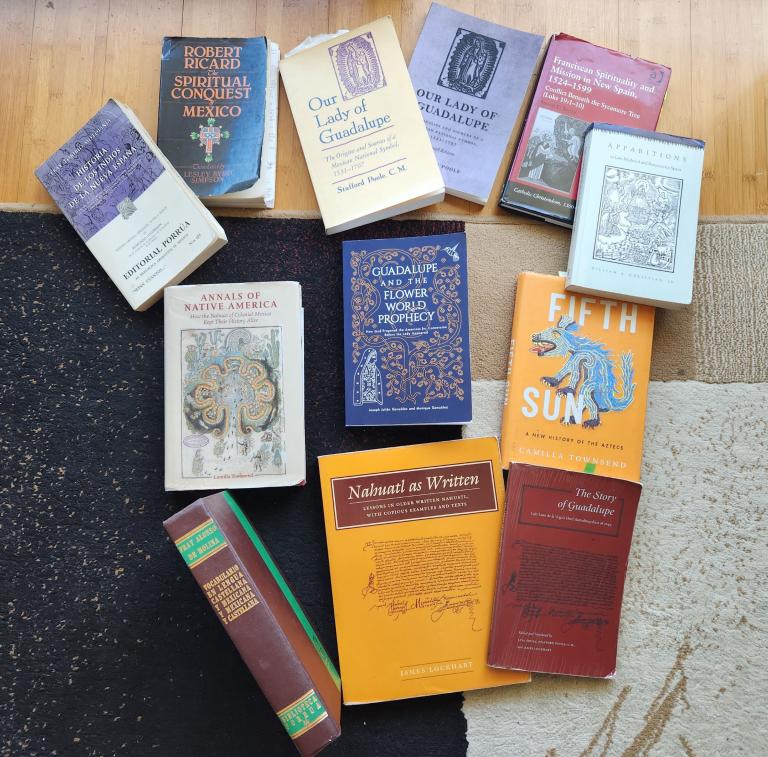
My current read surrounded by old friends
References to the foundational work of Mexican historian Miguel León-Portilla proliferated Flower World Prophecy, but not until I leafed through Aztec Thought and Culture did I realize how much the book’s arguments hinge upon his scholarship. In essence, Flower World Prophecy merges León-Portilla’s understanding of Nahua philosophy as a search for “the only truth” (Aztec, 96) with more recent scholarship among linguists, anthropologists, and art historians demonstrating a Pan-Mesoamerican belief in the Flower World to argue that “for close to three thousand years, the people of Pan-Mesoamerica were supernaturally pointed in one direction, and that was their Christian conversion through the fulfillment of the Guadalupe Event of 1531” (20).
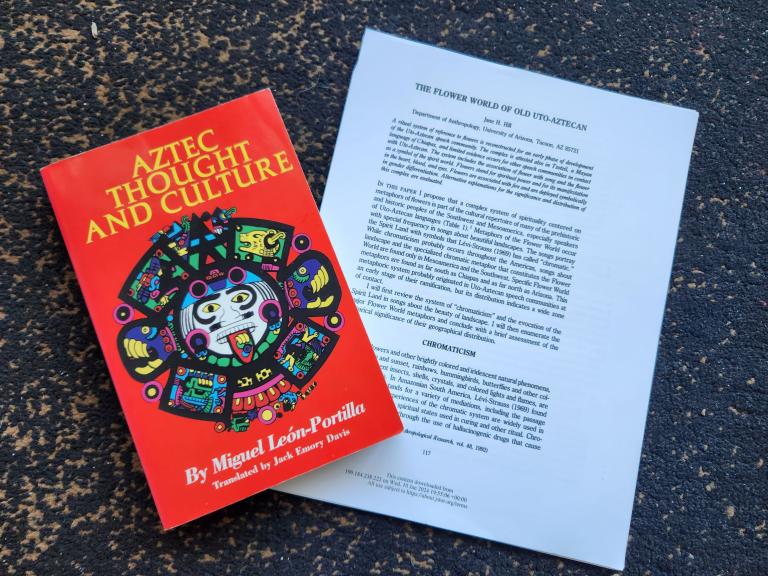
Miguel León Portilla’s 1956 Aztec Thought and Culture and Jane Hill’s “The Flower World of Old Uto-Aztecan” which introduced the pan-Mesoamerican Flower World concept
This realization gave me pause, as our understanding of Nahua culture, language, and philosophy has advanced significantly in the nearly 70 years since León-Portilla published in the 1950s, not least because of the rich archival record uncovered by generations of scholars, many trained in native languages. Contemporary scholars like Camilla Townsend recognize that “it is … difficult to grasp spiritual concepts in the Nahua world due to the limited nature of the evidence. Many have made assertions, but recent work indicates how dangerous such guesswork often has been” (Fifth Sun, 242, fn 50). The sources we have, are, by and large, colonial. This, then, is why the book gave me pause, compelling me to stop and cross-reference its claims. The scholarship anchoring the text is outdated.
Let me set that aside for now. The authors, noting how J.R.R. Tolkien used the language of mythology to share his faith with C.S. Lewis, ask their readers to imitate Lewis, set aside our biases, and approach the Guadalupe Event as “true myth.” Taken as “true myth,” the book’s argument holds and is, in fact, rather compelling, for the authors trace the continuity of two Nahuatl phrases – in xochitlalpan in tonacatlalpan (Flower World Paradise) and in Tloque in Nahuaque (the God of Far and Near) from ancient Nahuatl flower-songs to indigenous paintings decorating colonial Catholic churches. Viewed through a critical historical lens, however, the book’s claims falter.
The core argument rests on what the authors term the Four Conceptual Pillars or Bridges of Understanding:
- The Transcendentals: Beauty, Truth, and Goodness
- Life After Death
- The One Supreme God
- Worthiness to Enter Heaven
I don’t have space to respond as I would like, so I will focus on #4, problematic given its western assumptions about “sin” and the related concept of “worthiness.” The authors make much of lines 27 and 28 of the “Cuicapeuhcayotl,” or Origin of Songs (quoted in part in my first post): “Could one be accompanied to the Flower World Paradise (in xochitlalpan in tonacatlalpan) who is nothing, afflicted, and who sins on earth? Indeed, it is the God of Far and Near (in Tloque in Nahuaque) who makes one worthy here on earth” (117) [emphasis mine]. Based on these lines, the authors argue that the speaker of the poem, and by extension all Nahuas, had recognized since ancient times that their sins barred them from Flower World unless the God of Far and Near (i.e., the Christian God) made them worthy. Two issues: 1) The Cantares Mexicanos, a collection of flower-songs of which the “Cuicapeuhcayotl” is the first, was complied in the sixteenth century by fray Bernardino de Sahagún and his indigenous Christian aides, so it’s possible the words and/or their meaning shifted when filtered through Christian transcribers; and 2) as Louise Burkhart points out, tlatlacolli, the Nahuatl root word translated as sin, is imperfect, because “though used for moral misdeeds, it also encompassed a broad range of accidents, crimes, and other breakdowns of established order. It failed to convey the sense of personal moral responsibility, with its accompanying burden of guilt, that sin bears in Christian theology” (Holy Wednesday: A Nahua Drama from Early Colonial Mexico, 170). Further, the authors tie the idea of worth to the root word macehualli, generally meaning “commoner” or “man” in general, asserting that for the Nahuas, the term macehaul [sic] meant “one’s deserving or not deserving of the Flower World Paradise after death” (101). This interpretation applies a Christian gloss to an ostensibly precontact term; recall that the friars alphabetized Nahuatl for the purposes of evangelization, developing, in essence, ecclesiastical Nahuatl. Any definition applied to any Nahuatl word would have been necessarily applied in a post-Christian world, hence, one should use caution when defining precontact terms with postcontact glosses. Consider that Camilla Townsend glosses macehualli as a word meaning more than “commoner; etymologically, it referred to those deserving of the land, and hence of their own space in the polity” (Fifth Sun, 35). According to this definition, the idea of worth is tied to the land, not to the hereafter. The notion that Nahuas were awaiting redemption for their sins to become worthy to enter the Flower World appears repeatedly throughout the book, but it does not make sense in a Nahua world that lacks the concept of moral responsibility for personal sin that affects one’s worth in the afterlife. Despite their wide reading of Nahua culture and philosophy, the authors build their argument on shaky understanding of the Nahuatl world and thus pillar #4 falters.
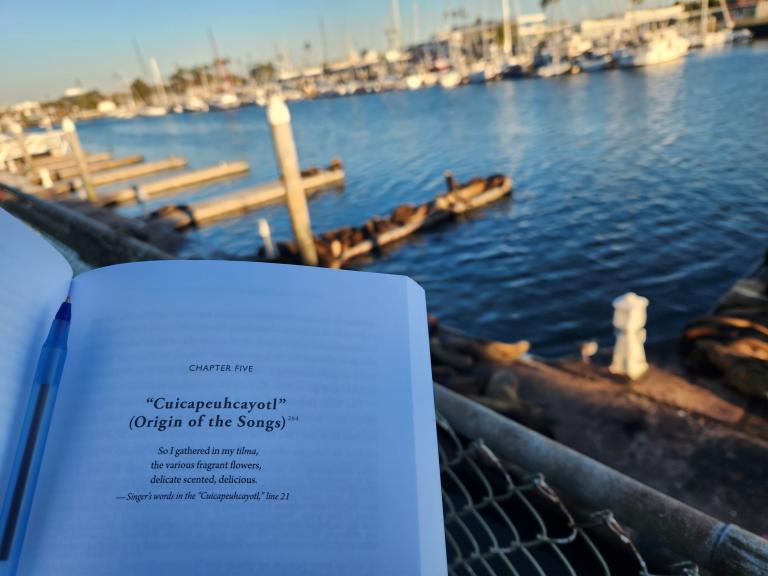
Reading the Cuicapeuhcayotl chapter as the sea lions doze, turn, and bark
My primary critique is that the authors accept all printed sources at face value. As a history professor, I insist that my students interrogate primary sources, asking WHAT kind of document it is, WHO wrote it, WHY the author(s) wrote it, WHEN was it written/published, and WHERE was it written/published. The latter is a particularly critical question when dealing with early colonial indigenous-authored texts since their reflections on the Mexica-Castilian War and Christianity differ drastically depending on their altepetl (polity) of origin. Lastly, students must discern AUDIENCE, which is not always obvious. For example, who’s really the audience for El Requerimiento, a Latin or Spanish-language declaration meant to be read to newly-encountered native peoples to justify conquest if native peoples could not understand it?
Though Flower World Prophecy quotes Franciscan chroniclers and colonial, Christianized, indigenous historians without critical or historical analysis, the most egregious error is the authors’ use of the Coloquios, a reconstruction of conversations about Christianity that took place in 1524 between the newly-arrived Franciscans and the Nahua tlatoque (lords) and tlamatinime (wise men/priests). Fray Bernardino de Sahagún, a Franciscan humanist whose arrival to New Spain in 1529 means he was not present at these exchanges, fashioned the event as one conversation. Serving as the principal instructor at the Colegio de la Santa Cruz de Tlatelolco (founded in 1536), Sahagún became masterful at Nahuatl, co-authoring several important ethnographic sources with his trilingual (Nahuatl, Castilian, Latin) native students. After acknowledging that this 1524 exchange would have necessitated a translator, Flower World Prophecy quotes a portion of the Coloquios, then analyzes “why the Franciscans would use these Nahuatl terms [including in Tloque Nahuaque (the God of Far and Near)] to describe the One Supreme God” (156). What? Notes about this series of conversations would have been written in Spanish, because Nahuatl remained pictographic until the friars understood it well enough to alphabetize it. As Camilla Townsend astutely notes, “No one alive in 1524 could possibly have written in Nahuatl with the fluency that the document exhibits” (Fifth Sun, 136). The friars in 1524 did not choose these Nahuatl terms, Sahagún did decades later. This entire section (pp. 153-163) falters (which isn’t to say they couldn’t have used this source in another way if they had contextualized it!).
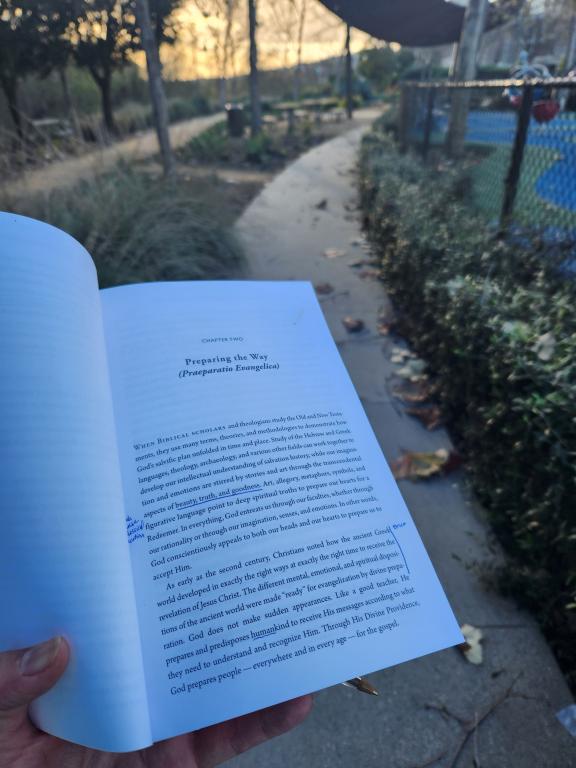
As a homeschooling mom, I had to fit in my reading whenever I could; given the theme of the book being a flowery paradise, I quite enjoyed that I read most of the book outdoors as my children played
The authors fail to properly contextualize the accepted Guadalupe account, Luis Laso de la Vega’s 1649 Huei tlamahuiçoltica, ignoring its grammatical errors and its relationship to Miguel Sánchez’s 1648 Imagen de la Virgen Mariía, Madre de Dios de Guadalupe, nor do they engage with the fact that despite being composed in Nahuatl with Nahuatl expressions for Flower World and the God of Far and Near, its narrative follows the formula for the European genre of apparition literature as outlined in William Christian Jr.’s Apparitions in Late Medieval & Early Modern Spain (Princeton, 1981): a marginalized figure not immediately believed by Church hierarchy receives a sign to be believed. This fact is mentioned in the Story of Guadalupe, 18, a source the authors cite several times. The authors likewise gloss over details that would have resonated with colonial Nahuas, for example, mentioning that “[i]ndividuals from [Juan Diego’s] hometown of Cuauhtitlan came and assisted him at times in cleaning and sweeping the chapel [dedicated to Our Lady of Guadalupe],” but overlooking how daily sweeping for home deities was a precontact Nahua ritual. THIS would have resonated with the Nahuas, because it would have signaled an act reserved to the divine and indicated that others could participate in honoring the divine, i.e., God, to whom the Guadalupana points.
The authors end by marshalling evidence detailing how friars converted 8 to 10 million native peoples post-1531 after news of the Virgin’s appearance spread from altepetl to altepetl by way of flower-songs. The evidence might have convinced me, had I not been trained to interrogate the sources and had I not known that the story doesn’t end here, for the Mexican Catholic Church’s enthusiasm for native peoples waned in the sixteenth century. Whereas clergymen initially supported the ordination of native priests and in 1539 approved their ordination to the minor orders, by 1544 the clergy decreed native people incapable of civilization and Christianization without the Spaniards, and the First Mexican Provincial Council in 1555 forbid native ordination and decreed that native people must not touch the sacred vessels (Stafford Poole, “The Declining Image of the Indian Among Churchmen in Sixteenth-Century New Spain” in Indian-Religious Relations in Colonial Spanish America). This reality hardly supports the authors’ conclusion that the Nahuas’ “about-face was profound. They went from being immersed in heavy pagan ritual to becoming sincere, committed, and model Christians” (227) and that “[t]he friars were witness to a remarkable and resolute commitment from the Nahua as they wholeheartedly embraced complete Christian conversion” (228). [Side note: I’d be out of a career if Christianization of native peoples unfolded this way!] Significantly, internal dispositions are impossible to measure and scholars have moved away from discussing sincerity of belief. Even the humanistically-trained friars themselves recognized that conversion, from the Latin “convertere” or “turn around, transform,” was a daily decision.
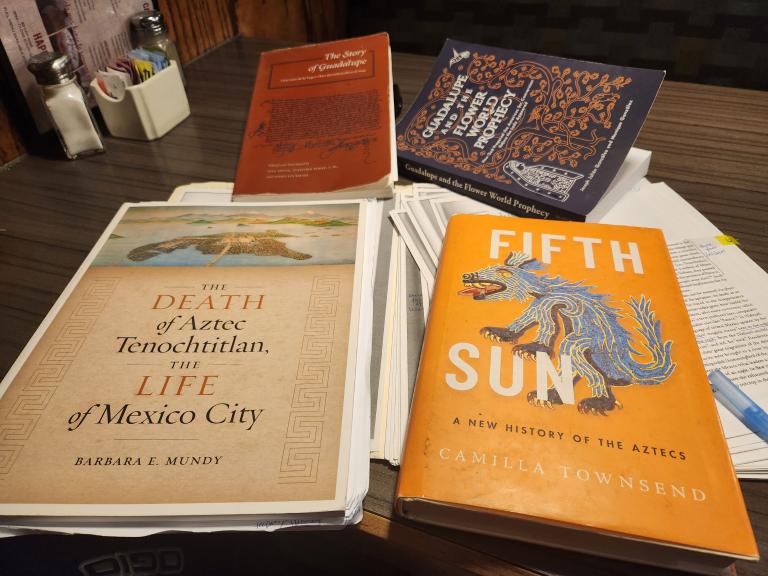
Dining out with new and old friends
The theory expounded in this book is beautiful and the argument compelling. Were I not a historian specializing in the origins of Mexican Catholicism I might have been convinced. Perhaps I would have been convinced by the beauty of the argument itself. I love the idea that God prepared native peoples in the Americas to accept Christ (as I write these words, a jade hummingbird, inhabitant of the Flower World, hovers outside my window!). So, I suppose I accept the conclusion without accepting the premises.
I’ll end with something my 10-year-old daughter told me when I shared my thoughts with her. She said, “Mama, it’s too bad the authors of the book didn’t talk to you before they published it; you could have helped make it better.” I certainly would have enjoyed trying.
* A formal book review will appear in Fides et Historia later this year.
Latin American Religious History
Previous Post
February 15, 2024
Of Missionaries, Native Americans, Lunatics, and Martians
Next Post

February 17, 2024 The Racial Escapism of American Evangelical Missions
Recent Comments
"Very good point about MacDonald.I am certainly a Machen fan!"
Fairies, Witches, Folk Horror, and the ..."
"The Scottish author George MacDonald integrated fairy world into his fiction in a way that ..."
Fairies, Witches, Folk Horror, and the ..."
"I like the idea that we can have different streams. The coffee analogy is genius."
How Do You Take Your Evangelicalism?
"Geography lesson: Southern California is actually in North Texas. I've lived her for 40 years, ..."
How Do You Take Your Evangelicalism?
Browse Our Archives
Select a Category abolitionism Abortion Abraham Joshua Heschel Abraham Kuyper Abraham Lincoln Academia Activism Adam Renberg Advent Adventist africa African American Religion Agnes Howard Albert Camus American History American Religious History American Revolution American West Anabaptists Ancient History Andrea Turpin Andrei Tarkovsky Anglicanism Annales Ansley Lillian Quiros anti-Catholicism Antisemitism Anxious Bench apologetics Apparitions Arash Azizi Archaeology archives art Artificial Intelligence Asia Asian Americans Augustine Authors Bad Bunny Baptism Baptists Barack Obama Battle of Hastings Benjamin Franklin Bernard-Henri Levy Beth Allison Barr Beth Moore Bethany Mannon Bible Bill Cunningham Billy Graham Black Music Bob Dylan Body Boenhoffer Books Breastfeeding Bruce Springsteen C.S. Lewis Calvinism Cancel Culture Capitalism Carmelites Catholicism Cedric Robinson Cesar Chavez Charismaticism charity Charles Dickens Charles Lindbergh Che Guevara Chicago Children Chinese Christianity Chris Gehrz Christ Christian death Christian Higher Education Christian life Christian Nation Christian Nationalism Christianity Today Christmas Church life Church Practice cinema Civil Religion Civil Rights Movement Civil War civility Classics Climate Change Cold War Colonial Mexico colonialism Comer Communism community complementarianism Conference on Faith and History Congregationalism Conspiracies Conspiracy Conversion Narratives Coronavirus Costa Rica Council of Nicaea Covid-19 Creation Critical Race Theory Crusades Culture culture wars Daniel K. Williams David Barton David Swartz Death Ways death with dignity DEI democracy Democratic Party Devotion Digital Age Diplomacy discipleship diversity Donald Trump Drama Dua Lipa Early Church early modern Early modern Catholicism Easter Eastern Christianity economic exploitation Education elections Elie Wiesel Elizabeth II Elizabeth Taylor emotions Empire Engineering England enslavement Entertainment Episcopal Church Erica Ramirez eschatology Eurocentrism Evangelicalism Evangelicals Exegesis Family Feminism Film Flannery O'Connor folk music Food Foreign Policy founding fathers Franciscans Franciscus Junius fundamentalism Funerals G.K. Chesterton Gender Genocide genre geography George W. Bush George Washington George Whitefield Global Christianity Global church Grief Guadalupe guest post Guest Post gun control gun violence Gustavo Gutierrez Hamid Dabashi Harold John Ockenga Harvest Hate Hawaiian Christianity Healing health care Heather Cox Richardson Hell Heresy Hermeneutics Higher Education Hinduism Hippocratic oath Historical Fiction Historical Methodology Historical Profession Historical Profession Historical Theology Historical Thinking historiography Holidays Holocaust horror movies Human rights Humanitarian Work humanities Hummingbirds Hungary hymns Imago Dei Immigration Injustice Interviews Iran Islam Islamophobia Israel Ivan's Childhood Jacob Randolph James Bratt Janine Giordano Drake Japanese history Japanese Literature Jean Paul Sartre Jesse Miranda Jesus Jesus Christ Jimmy Carter Joan Baez Joan Didion Joanne Freeman João B. Chaves Joao Chaves Joey Cochran John Calvin John Fea John Tillotson John Turner Johnny Cash Jonathan Edwards Jonathan Tran Joseph Smith Josh Howerton Journalism Jr. Judaism Jürgen Moltmann Just War Justice Justin Brierley Karl Barth Katelyn Beaty koi ponds Kris Kristofferson Kristin Kobes Du Mez Latin American Religious History Latino Americans Lectio Divina Leisure Lent Leonard Cohen liberal arts liberalism Liberation Theology Linda Ronstadt Lisa Clark Diller Literature Lou Reed Lynchings Lynneth Miller Renberg Mainline Protestantism Malcolm Foley Marilyn Monroe Maritime history Mark Noll Marriage Martin Luther Martin Luther King Martyrdom Marxism Mary Masih Alinejad mass shootings material culture medieval Christianity Medieval Ethiopia Melissa Borja memory Mennonites Mental Health Mental Illness Methodism Mexican Americans Mexicans Mike Madrid Miles Mullin Min Jin Lee Miscarriage Missionaries Mister Rogers Mitt Romney modernity Monasticism Mormonism Motherhood Mothers of the Church Moving Music Musicals Nadya Williams Nahua Christianity Native Americans Natsume Sōseki New Contributor New England New Year New York Nico Non-Violent Protest Orthodoxy pacifism Paleo Evangelicals Palestinians Parenting Patti Smith Paul Kingsnorth Pedro Calderón de la Barca Pentecostalism Philip Jenkins Phillis Wheatley physician-assisted suicide pilgrimage Pilgrims pluralism Plutocracy Poetry Politics Pope Francis Pope Leo XIV post-modernism prayer preaching Presbyterians prosperity gospel Protest Public history Publishing Puritans purity culture Quakers race Race Massacres Racial Capitalism racial reconciliation racialization Racism Raha Bahloulipour Re-Enchantment reading Reformation Refugees religion and the university religion and war Religious Freedom Religious Nones Religious Pluralism Religious Symbols religious violence Republican Party Revival Rita Coolidge Ritual Roger Williams Roman Catholic church Royalty Russell Moore same-sex marriage Sarah Irving-Stonebraker Scandinavia Science Science and Technology Scopes trial Scriptural Interpretation secularism Selena Quintanilla seminary Seventh-Day Adventists sexual morality Sexuality Sikhs Silence slaveholders theology Slavery Slavoj Zizek social justice Social Media Southern Baptist Convention Southern Religion Spain Spiritual Autobiography Spiritual but not religious Spiritual Discipline Sports Stanley Hauerwas Suffering Summer Camps Sunday Night Odds and Ends Supernatural Supreme Court Syriac Christianity Tal Howard Taylor Swift Teaching Technology Television Thanksgiving The Beatles The Mission theater TheoBros Theology Thomas Dixon Thomas Jefferson Thomas Kidd Thomas Merton Tim Gloege Tim Walz Tom Holland Tourism tradition Tragedy Translation Transnationalism Travel Trump Ukraine Uncategorized Unitarians United Methodist Church US History Vanessa Chan Velvet Underground Verónica A. Gutiérrez Veronica Gutierrez Vikings Violence Virgin Mary Virtue Virtue ethics Visions Voting War WCTU Wendell Berry Westminster Assembly White Evangelicalism Wildfires Winnie the Pooh Witches women Women in Ministry Women's and Gender Studies Work Worship writing Yasunari Kawabata Zena Hitz
Select a Month October 2026 September 2026 August 2026 July 2026 June 2026 May 2026 April 2026 March 2026 February 2026 January 2026 December 2025 November 2025 October 2025 September 2025 August 2025 July 2025 June 2025 May 2025 April 2025 March 2025 February 2025 January 2025 December 2024 November 2024 October 2024 September 2024 August 2024 July 2024 June 2024 May 2024 April 2024 March 2024 February 2024 January 2024 December 2023 November 2023 October 2023 September 2023 August 2023 July 2023 June 2023 May 2023 April 2023 March 2023 February 2023 January 2023 December 2022 November 2022 October 2022 September 2022 August 2022 July 2022 June 2022 May 2022 April 2022 March 2022 February 2022 January 2022 December 2021 November 2021 October 2021 September 2021 August 2021 July 2021 June 2021 May 2021 April 2021 March 2021 February 2021 January 2021 December 2020 November 2020 October 2020 September 2020 August 2020 July 2020 June 2020 May 2020 April 2020 March 2020 February 2020 January 2020 December 2019 November 2019 October 2019 September 2019 August 2019 July 2019 June 2019 May 2019 April 2019 March 2019 February 2019 January 2019 December 2018 November 2018 October 2018 September 2018 August 2018 July 2018 June 2018 May 2018 April 2018 March 2018 February 2018 January 2018 December 2017 November 2017 October 2017 September 2017 August 2017 July 2017 June 2017 May 2017 April 2017 March 2017 February 2017 January 2017 December 2016 November 2016 October 2016 September 2016 August 2016 July 2016 June 2016 May 2016 April 2016 March 2016 February 2016 January 2016 December 2015 November 2015 October 2015 September 2015 August 2015 July 2015 June 2015 May 2015 April 2015 March 2015 February 2015 January 2015 December 2014 November 2014 October 2014 September 2014 August 2014 July 2014 June 2014 May 2014 April 2014 March 2014 February 2014 January 2014 December 2013 November 2013 October 2013 September 2013 August 2013 July 2013 June 2013 May 2013 April 2013 March 2013 February 2013 January 2013 December 2012 November 2012 October 2012 September 2012 August 2012 July 2012 June 2012 May 2012
Follow Us!
TAKE THE
Religious Wisdom Quiz
How many times does Jesus perform a miracle in the Gospel of John?
Select your answer to see how you score.
7 12 10 5
Related posts from Anxious Bench
Guadalupe's Pilgrim Image Visits Our Parish School

Singing Seafarers: Sailing a 16th-Century Spanish Galleon
Candles in the Darkness: Ephrem on the Incarnation
Heralds of Heaven: Hummingbirds on a Hillside
TRENDING AT PATHEOS Evangelical

The Sermon on the Mount, Part I: Matthew...
The Sermon on the Mount, Part I (Matthew 4:12-5:12) St. Matthew moves...

What's up from Crossway: Reviewing some of their latest A few weeks...

Janie Learns the Way of the Cross: A...
Teaching children about Jesus' Passion can be challenging. Many parents and educators...

Looking For Good Catholic Writing - October 2026
He alone extends the heavens, and he walks upon the waves of...

In "Irreplaceable," our book on vocation and technology, Trevor Sutton and I...

I was strolling through the top floor of the brand new Parthenon...
view all Evangelical blogs
What Are Your Thoughts?leave a comment
Ad-Free & Subscriber Log-In Subscription Support
- About Us
- 2026 Calendar
- Videos
- Podcasts
- Library of World Religions
- Faith In Media Tracker
- Advertise With Us
- Write for Us
- Privacy Policy
- Terms of Service
- Do Not Sell My Data
- Contact Us
- Radiant Digital
- Manage Newsletter Subscriptions
- Unsubscribe From Notifications
- Sitemap
Copyright 2008-2026, Patheos. All rights reserved.
Subscription Support Ad-Free & Subscriber Log-In
Follow Patheos