
BuddhistCatholicContemplativeEvangelicalGeneral ChristianHinduJewishLatter-day SaintMuslimNew VisionsProgressive Christian
Beliefs
- Buddhist
- Catholic
- Contemplative
- Evangelical
- General Christian
- Hindu
- Jewish
- Latter-day Saint
- More Voices
- Muslim
- New Visions
- Pagan
- Progressive Christian
Topics
- Religion News
- Food and Religion
- Sports and Religion
- Religious Art
- Religious Music and Entertainment
- Religious Events
- History and Religion
- Style and Religion
- Politics and Religion
- Women in Religion
- Recreation Outdoors and Religion
- Business Finance and Religion
- Careers Workplace and Religion
- Education and Religion
- Family Parenting and Religion
- Health Fitness and Religion
- Home and Religion
- Relationships and Religion
- Technology and Religion
- Travel and Religion
Columnists
- Buddhist Columnists
- Business Finance and Religion Columnists
- Careers Workplace and Religion Columnists
- Catholic Columnists
- Contemplative Columnists
- Education and Religion Columnists
- Evangelists Columnists
- Family Parenting and Religion Columnists
- General Christian Columnists
- Health Fitness and Religion Columnists
- Hindu Columnists
- History and Religion Columnists
- Home and Religion Columnists
- Jewish Columnists
- More Voices Columnists
- Latter Day Columnists
- Muslim Columnists
- New Visions Columnists
- Nonreligious Columnists
- Pagan Columnists
- Politics and Religion Columnists
- Progressive Columnists
- Recreation Outdoors and Religion Columnists
- Relationships and Religion Columnists
- Religion News Columnists
- Religious Art Columnists
- Religious Events Columnists
- Religious Music and Entertainment Columnists
- Sports and Religion Columnists
- Style and Religion Columnists
- Technology and Religion Columnists
- Travel and Religion Columnists
- Women in Religion Columnists
Resource Library
- 2026 Calendar
- Library of World Religions
- The 100 Most Holy Places on Earth
- Patheos Answers
- Podcasts
- Videos
- Faith Leaders Database
- Anglican Episcopalian
- Bahai
- Baptist
- Buddhism
- Christianity
- Confucianism
- Eastern Orthodoxy
- Hinduism
- Holiness and Pentecostal
- ISKCON
- Islam
- Judaism
- Lutheran
- Methodist
- The Church of Jesus Christ of Latter-day Saints
- New Age
- Paganism
- Presbytarian and Reformed
- Protestantism
- Religion Behind the Scenes
- Roman Catholic
- Scientology
- Shia Islam
- Sikhism
- Sufism
- Sunni Islam
- Taoism
- Zen
- See all religions
Research Tools
 Ad-Free & Subscriber Log-In Subscription Support
Follow Patheos 

- Trending:
- Advent
- |
- Forgiveness
- |
- Thanksgiving
- |
- Election
- |
- Seasonal Holidays
- |
- Marriage

-
About the Authors
- Home
- Evangelical
- Relationships and Religion
- “Each Separate Anguish”: Death, Influence, and Carrying On
“Each Separate Anguish”: Death, Influence, and Carrying On
Last updated on: January 17, 2024 at 3:53 am by Wyatt Reynolds
“Each Separate Anguish”: Death, Influence, and Carrying On 2024-01-17T03:53:15-04:00 Wyatt Reynolds
Patheos Explore the world's faith through different perspectives on religion and spirituality! Patheos has the views of the prevalent religions and spiritualities of the world.

One of America’s greatest poets and bards, Billy Joel, told us only the good die young. I’ve been thinking a lot recently about the good and about dying young. This was triggered, you might say, by two events. Last semester, I had a fascinating conversation with one of my favorite professors about dying young. Many figures in the 19th century died young and often not in the ways one might expect. Nearly every person of color in the period I study (and many white activists) died before the age of forty. Some were murdered or assassinated, others died from disease, still others perished after simply using up their bodies on behalf of causes they loved. Second, I found out in the last few days that a dear friend, who is also not yet forty, has entered hospice and his final days. Jonathan was diagnosed a little over a year ago.
He’s special to me for many reasons. When I was a first year at Washington University in St. Louis, he was in the midst of his doctoral work in the English department. He guest lectured in my freshman writing seminar the week we read an essay by Walker Percy, which he had suggested for the syllabus. Jonathan also made one of the most important contributions to my young literary life. He told me I should read a novel called Gilead by Marilynne Robinson. I hadn’t heard of the book or author. I also taught his daughter in Sunday school for three years. His illness hit me harder than I could have expected. I thought then it would be fitting to reflect on those who die young and leave behind unfinished business which the rest of us are called to continue. This will serve both to introduce my work and a bit of my perspective on the project of history. So, I want to tell you two stories.
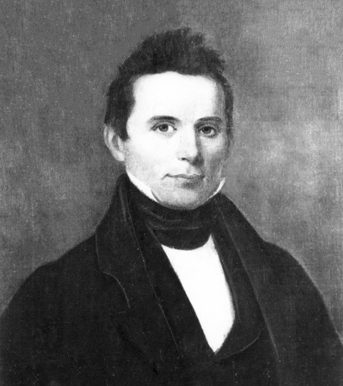 Elias Boudinot may seem a strange name for a Cherokee man born in 1800. I think it’s worth noting how and why Boudinot chose and took up this name. It was a custom among the Cherokee that a child would be given a name at birth and then take a second, adult name from a figure they admired—warrior, holy person, leader, etc. Boudinot’s birth name was Gallegina Watie (or Uwatie or OoWatie depending on the source). At some point before leaving to attend a mission school in Connecticut, he was given the nickname “Buck,” which seems to have stuck for some time. It was only in 1818 as he journeyed to the mission school that he took the name by which he has been known to history. Traveling with other students, he stopped and met several famous figures including Thomas Jefferson, but the one who left the strongest impression on the young Cherokee man was Elias Boudinot.[1] The elderly Boudinot had been a member of the Continental Congress and a congressman under the new Constitution. In 1818, he was the president of the American Bible Society, which he had helped to found.[2] The elder Boudinot gave Gallegina permission to use his name, and the freshly minted Elias Boudinot the younger continued on his journey to Connecticut.
Ever since I learned about him, I have felt a greater kinship with him than perhaps any other person I have studied. He is also among the most controversial. For many years, most scholars regarded him as having committed cultural treachery against his people for signing a treaty which agreed that the Cherokee Nation would move West to Indian Territory. For this crime, he was assassinated along with his cousin John Ridge and his uncle Major Ridge weeks after arriving in Indian Territory on the far side of the Trail of Tears. He was asked for medicine and when he turned towards his house to help who he believed was his hurting neighbor, three men tomahawked and knifed him to death in his front yard. Why did Boudinot choose to make these decisions? From a new name to signing a treaty agreeing to removal to that fateful moment of his assassination, An answer requires a short biography of the intervening twenty-one years.
During his time at the Cornwall School, Boudinot was an (one might even say “the”) exemplary student. Several of his instructors sent his work to Yale professors as evidence of the project’s success while lamenting that he could not attend the University because he was an Indian. He wrote fundraising letters for the Cornwall school to donors across the United States and Europe. Then he became sick. The school’s authorities feared he might die. In an attempt to nurse him back to health, he was placed in the care of a local family. The family’s youngest daughter, a woman named Harriet Ruggles Gold, tended him. They fell in love, and after a lengthy disputation, which turned into a national crisis, they were married. I’ll most likely return to this subject in a later column. For the moment, suffice it to say that it is not an exaggeration to say that their marriage was the most controversial inter-racial marriage of the nineteenth century.
By this time, Boudinot had been commissioned by the Cherokee national council to raise money from sympathetic whites for the purpose of starting a national newspaper. He spoke in around a dozen cities and raised enough money to purchase a printing press and commission a set of type in the characters of the Cherokee syllabary. This meant that when the Cherokee Phoenix began printing in February of 1828, the newspaper was published in both Cherokee and English and could be read by audiences who read either language. Boudinot continued as editor and as the leading promoter of Indigenous rights within the United States until 1832 when he resigned from the Phoenix. He found himself disallowed by the national government of the Cherokee Nation from presenting his actual views in the newspaper. Boudinot had become convinced that the Cherokee should remove to Indian Territory instead of fighting to remain any longer. He feared that Jackson and his allies would wage a war of extirpation in order to take the Cherokee’s land. Thus, if the people were to continue, they must do so in other lands. Knowing he was taking his life into his hands, Boudinot signed the Treaty of New Echota, agreeing to removal. It was for this “crime” that he would be assassinated.
Boudinot and his compatriots’ stories have also already inspired future generations. As Alisse Portnoy and others have shown, American abolitionists, whatever their faults (and they had quite a few), were inspired by the failure of those working on behalf of Indian rights. Many abolitionists were in fact the children and grandchildren of the activists who attempted to prevent the trails of tears. They watched earlier an earlier generation’s failure vowed to find a way to succeed with their own cause.
When my friend Jonathan first told me to read Gilead, there’s no way I could have known how it would influence me. Perhaps though, he had an inkling. I asked Jonathan if, when I finished reading it, we could sit down and dissect the book. I was fresh out of my Shakespeare seminar and eager to tear meaning out of texts with or without the author’s consent. We were standing in our church’s basement with aging, yellowed walls and a distinct scent that I once heard described as the afterlife of generations of casseroles. He looked back at me with a gleam in his eye and said something I’ll never forget. “When you finish reading it, you won’t want to dissect. All you’ll want to do is bask in the glory of God.” I nodded and walked away, thinking to myself that I had no time for basking. Dissecting and tearing. That was the stuff University was teaching me.
Of course, he was correct. I quit reading Gilead with sixty pages left because I didn’t want it to end. I wept. I wasn’t sure if any book would ever be so beautiful to me again. Indeed, I could not have imagined how much Percy and Robinson would come to shape my thought and approach to life. Reading them for the first time left a nuclear fallout of beauty in my life, and I still carry the marks.
The Percy essay I read unknowingly at Jonathan’s behest is titled “The Loss of the Creature” and comes from Percy’s remarkable volume The Message in the Bottle. The essays begins by talking about how nearly impossible it is to enjoy the Grand Canyon due to its cultural mythology shaping our experience of it. (Hence, the picture above this article taken as I thought about that Percy essay, sitting on the edge and trying not to take photographs. Percy guarantees that the one certain way to ensure you miss the Grand Canyon is to take pictures).
Eventually, I would get to interview Marilynne Robinson for a journal of Christian thought at WashU and bask in the goodness of God with her. I would even have the opportunity take a class with her amidst Covid during my master’s. As she wrote in Home, “There’s so much to be grateful for, words are poor things.” That is what I owe to Jonathan. I also owe to him a phrase from Claude McKay that echoes in most bios I’m forced to write: “Rebellious Traditionalist.” If that doesn’t have a ring to it, I’m not sure what does.
Jonathan’s work has centered on writers like McKay, an avowed communist who converted to Catholicism but maintained his communitarian principles. He has called them the “Christian literary left,” and their ranks include such luminaries as W.H. Auden, Walker Percy, Dorothy Day, T.S. Eliot, and lesser-known figures like Vida Scutter, Ralph Adams Cram, and James Dabbs. He pulls all of them together in his book, Communion of Radicals: The Literary Christian Left in Twentieth-Century America. As one reviewer put it, “McGregor creates quite the challenge for himself: Develop a theory of radical Christian literature, fit writers into it and ground a revival of such literature.” But this is Jonathan’s way. He is a poet, a storyteller, and a scholar I aspire to be like. After receiving my first course evaluations from students at the close of this past semester, I decided to glance at Jonathan’s. What I saw didn’t surprise me in the least. His students loved him because he cared about them and helped them learn deeply.
I ended up having to take a leave of absence from WashU after my dad died. Jonathan and his dad comforted me during that time, and he graduated with his PhD before I returned. Jonathan and all his family moved so he could take an academic post in another state. We lost touch for nearly six years. We saw each other occasionally on social media, but enveloped in chaotic schedules that was about it. Until, one day I saw a Facebook post that scared me: Jonathan’s mom had posted a meal train. It made me think he was sick, and I decided to reach out. We had two phone calls this past fall. We talked about academia and family and the weirdness of being southern and intellectuals. And it seemed like he might get better. Until a couple days into the new year when I saw an update from his mother. I learned that Jonathan had moved into hospice and had been given a prognosis of months at the absolute best. They had shifted from trying to cure to pain management. I wept again. I lost my father when I was twenty, and we didn’t have a great relationship. What could it be like to lose a father so much better and at a much younger age? I still struggle to think about it without welling-up with tears. Like the deaths of these other men, it is unjust. It’s the calumny and cruelty of a world not set right yet—a world in waiting and error pining—as a song many of us sang short weeks ago reminds us.
We are left to wonder then, are these merely a string of sad stories? Surely each of these stories could have had an ending that we hope would have been better. And yet, to quote Marilynne Robinson once more, “In eternity this world will be Troy, I believe, and all that has passed here will be the epic of the universe, the ballad they sing in the streets. Because I don’t imagine any reality putting this one in the shade entirely, and I think piety forbids me to try.” These stories are the epic of eternity, and as a historian, I have the privilege of being a memory keeper. My research focuses on the forgotten and misremembered. It is figures like these whom I study and hope to emulate in my vocation—prophetically calling the church and the nation to stand up to the height of their promises and highest ideals.
In telling the history of the great sins of the United States and its empire, we must write clearly and without whitewashing—of any sort—but we must also tirelessly describe those who resisted. No matter how futile that resistance may seem to us. Just as there were always prophets who confronted monarchs who turned from God in the Hebrew Bible, throughout history, there has never been a time of great evil when there were not those who stood in opposition. The Native and African American figures I study did this in their own ways against the expansionist United States Empire and its “Manifest Destiny.” Jonathan wrote about how other Christians did this in the mid-20th century and along the way helped inspire me to pay attention to such forgottens. They are truly the ones the writer of Hebrews tells us the world was not worthy of. I’ll leave you know with this poem by Emily Dickinson from which the title of this post is taken:
I shall know why—when Time is over
And I have ceased to wonder why
Christ will explain each separate anguish
In the fair schoolroom of the sky
He will tell me what “Peter” promised
And I—for wonder at his woe
I shall forget the drop of Anguish
That scalds me now—that scalds me now!
[1] John Demos, The Heathen School, p 148
[2] Ralph Henry Gabriel, Elias Boudinot p 30; Teresa Gaul, To Marry an Indian, p 6; Theda Perdue, Cherokee Editor, pp 3-6
Relationships and Religion
History and Religion
Previous Post
January 16, 2024
Naked Baptism in the Early Church
Next Post

January 18, 2024 Protestants, and Other Mythical Beasts
Recent Comments
"Every religion is "made up," even Adam and Eve were made up thousands of years ..."
Forging Druids and Inventing a Nation
"I have an identical twin, and Thomas was always the disciple I connected with most. ..."
In the Footsteps of Thomas: A ..."
"I've never thought of Constantine as a villain. Do Christians generally? Maybe the ones who ..."
"The TV sitcom BEWITCHED was an old favorite of mine"
How Scotland Gave Us Our Modern ..."
Browse Our Archives
Select a Category abolitionism Abortion Abraham Joshua Heschel Abraham Kuyper Abraham Lincoln Academia Activism Adam Renberg Advent Adventist africa African American Religion Agnes Howard Albert Camus American History American Religious History American Revolution American West Anabaptists Ancient History Andrea Turpin Andrei Tarkovsky Anglicanism Annales Ansley Lillian Quiros anti-Catholicism Antisemitism Anxious Bench apologetics Apparitions Arash Azizi Archaeology archives art Artificial Intelligence Asia Asian Americans Augustine Authors Bad Bunny Baptism Baptists Barack Obama Battle of Hastings Benjamin Franklin Bernard-Henri Levy Beth Allison Barr Beth Moore Bethany Mannon Bible Bill Cunningham Billy Graham Black Music Bob Dylan Body Boenhoffer Books Breastfeeding Bruce Springsteen C.S. Lewis Calvinism Cancel Culture Capitalism Carmelites Catholicism Cedric Robinson Cesar Chavez Charismaticism charity Charles Dickens Charles Lindbergh Che Guevara Chicago Children Chinese Christianity Chris Gehrz Christ Christian death Christian Higher Education Christian life Christian Nation Christian Nationalism Christianity Today Christmas Church life Church Practice cinema Civil Religion Civil Rights Movement Civil War civility Classics Climate Change Cold War Colonial Mexico colonialism Comer Communism community complementarianism Conference on Faith and History Congregationalism Conspiracies Conspiracy Conversion Narratives Coronavirus Costa Rica Council of Nicaea Covid-19 Creation Critical Race Theory Crusades Culture culture wars Daniel K. Williams David Barton David Swartz Death Ways death with dignity DEI democracy Democratic Party Devotion Digital Age Diplomacy discipleship diversity Donald Trump Drama Dua Lipa Early Church early modern Early modern Catholicism Easter Eastern Christianity economic exploitation Education elections Elie Wiesel Elizabeth II Elizabeth Taylor emotions Empire Engineering England enslavement Entertainment Episcopal Church Erica Ramirez eschatology Eurocentrism Evangelicalism Evangelicals Exegesis Family Feminism Film Flannery O'Connor folk music Food Foreign Policy founding fathers Franciscans Franciscus Junius fundamentalism Funerals G.K. Chesterton Gender Genocide genre geography George W. Bush George Washington George Whitefield Global Christianity Global church Grief Guadalupe guest post Guest Post gun control gun violence Gustavo Gutierrez Hamid Dabashi Harold John Ockenga Harvest Hate Hawaiian Christianity Healing health care Heather Cox Richardson Hell Heresy Hermeneutics Higher Education Hinduism Hippocratic oath Historical Fiction Historical Methodology Historical Profession Historical Profession Historical Theology Historical Thinking historiography Holidays Holocaust horror movies Human rights Humanitarian Work humanities Hummingbirds Hungary hymns Imago Dei Immigration Injustice Interviews Iran Islam Islamophobia Israel Ivan's Childhood Jacob Randolph James Bratt Janine Giordano Drake Japanese history Japanese Literature Jean Paul Sartre Jesse Miranda Jesus Jesus Christ Jimmy Carter Joan Baez Joan Didion Joanne Freeman João B. Chaves Joao Chaves Joey Cochran John Calvin John Fea John Tillotson John Turner Johnny Cash Jonathan Edwards Jonathan Tran Joseph Smith Josh Howerton Journalism Jr. Judaism Jürgen Moltmann Just War Justice Justin Brierley Karl Barth Katelyn Beaty koi ponds Kris Kristofferson Kristin Kobes Du Mez Latin American Religious History Latino Americans Lectio Divina Leisure Lent Leonard Cohen liberal arts liberalism Liberation Theology Linda Ronstadt Lisa Clark Diller Literature Lou Reed Lynchings Lynneth Miller Renberg Mainline Protestantism Malcolm Foley Marilyn Monroe Maritime history Mark Noll Marriage Martin Luther Martin Luther King Martyrdom Marxism Mary Masih Alinejad mass shootings material culture medieval Christianity Medieval Ethiopia Melissa Borja memory Mennonites Mental Health Mental Illness Methodism Mexican Americans Mexicans Mike Madrid Miles Mullin Min Jin Lee Miscarriage Missionaries Mister Rogers Mitt Romney modernity Monasticism Mormonism Motherhood Mothers of the Church Moving Music Musicals Nadya Williams Nahua Christianity Native Americans Natsume Sōseki New Contributor New England New Year New York Nico Non-Violent Protest Orthodoxy pacifism Paleo Evangelicals Palestinians Parenting Patti Smith Paul Kingsnorth Pedro Calderón de la Barca Pentecostalism Philip Jenkins Phillis Wheatley physician-assisted suicide pilgrimage Pilgrims Piracy pluralism Plutocracy Poetry Politics Pope Francis Pope Leo XIV post-modernism prayer preaching Presbyterians prosperity gospel Protest Public Executions Public history Publishing Puritans purity culture Quakers race Race Massacres Racial Capitalism racial reconciliation racialization Racism Raha Bahloulipour Re-Enchantment reading Reformation Refugees religion and the university religion and war Religious Freedom Religious Nones Religious Pluralism Religious Symbols religious violence Republican Party Revival Rita Coolidge Ritual Roger Williams Roman Catholic church Royalty Russell Moore same-sex marriage Sarah Irving-Stonebraker Scandinavia Science Science and Technology Scopes trial Scriptural Interpretation secularism Selena Quintanilla seminary Seventh-Day Adventists sexual morality Sexuality Sikhs Silence slaveholders theology Slavery Slavoj Zizek social justice Social Media Southern Baptist Convention Southern Religion Spain Spiritual Autobiography Spiritual but not religious Spiritual Discipline Sports Stanley Hauerwas Suffering Summer Camps Sunday Night Odds and Ends Supernatural Supreme Court Syriac Christianity Tal Howard Taylor Swift Teaching Technology Television Thanksgiving The Beatles The Mission theater TheoBros Theology Thomas Dixon Thomas Jefferson Thomas Kidd Thomas Merton Tim Gloege Tim Walz Tom Holland Tourism tradition Tragedy Translation Transnationalism Travel Trump Ukraine Uncategorized Unitarians United Methodist Church US History Vanessa Chan Velvet Underground Verónica A. Gutiérrez Veronica Gutierrez Vikings Violence Virgin Mary Virtue Virtue ethics Visions Voting War WCTU Wendell Berry Westminster Assembly White Evangelicalism Wildfires Winnie the Pooh Witches women Women in Ministry Women's and Gender Studies Work Worship writing Yasunari Kawabata Zena Hitz
Select a Month November 2026 October 2026 September 2026 August 2026 July 2026 June 2026 May 2026 April 2026 March 2026 February 2026 January 2026 December 2025 November 2025 October 2025 September 2025 August 2025 July 2025 June 2025 May 2025 April 2025 March 2025 February 2025 January 2025 December 2024 November 2024 October 2024 September 2024 August 2024 July 2024 June 2024 May 2024 April 2024 March 2024 February 2024 January 2024 December 2023 November 2023 October 2023 September 2023 August 2023 July 2023 June 2023 May 2023 April 2023 March 2023 February 2023 January 2023 December 2022 November 2022 October 2022 September 2022 August 2022 July 2022 June 2022 May 2022 April 2022 March 2022 February 2022 January 2022 December 2021 November 2021 October 2021 September 2021 August 2021 July 2021 June 2021 May 2021 April 2021 March 2021 February 2021 January 2021 December 2020 November 2020 October 2020 September 2020 August 2020 July 2020 June 2020 May 2020 April 2020 March 2020 February 2020 January 2020 December 2019 November 2019 October 2019 September 2019 August 2019 July 2019 June 2019 May 2019 April 2019 March 2019 February 2019 January 2019 December 2018 November 2018 October 2018 September 2018 August 2018 July 2018 June 2018 May 2018 April 2018 March 2018 February 2018 January 2018 December 2017 November 2017 October 2017 September 2017 August 2017 July 2017 June 2017 May 2017 April 2017 March 2017 February 2017 January 2017 December 2016 November 2016 October 2016 September 2016 August 2016 July 2016 June 2016 May 2016 April 2016 March 2016 February 2016 January 2016 December 2015 November 2015 October 2015 September 2015 August 2015 July 2015 June 2015 May 2015 April 2015 March 2015 February 2015 January 2015 December 2014 November 2014 October 2014 September 2014 August 2014 July 2014 June 2014 May 2014 April 2014 March 2014 February 2014 January 2014 December 2013 November 2013 October 2013 September 2013 August 2013 July 2013 June 2013 May 2013 April 2013 March 2013 February 2013 January 2013 December 2012 November 2012 October 2012 September 2012 August 2012 July 2012 June 2012 May 2012
Follow Us!
TAKE THE
Religious Wisdom Quiz
Why was Daniel thrown into the lion’s den?
Select your answer to see how you score.
He spoke against the king He stole from the treasury He prayed to God He refused to bow to the king
Related posts from Anxious Bench
Angelina Grimké's Forgotten Turn to Apocalyptic Faith
Angelina Grimké and the Turmoils of Perfection
Corrupting the Youth? What Universities Are Really For

What to the Black Christian Historian is America's...
TRENDING AT PATHEOS Evangelical

Adventurous Lectionary -1st. Sunday of Advent - November...
The Adventurous Lectionary - The First Sunday of Advent – November 29,...

Will Islam become the world's biggest religion by 2035? Congo will replace...

The resilience of the Christian faith in the english speaking world of...

An Advent Calendar, and a Tree full of...
I've spent the weekend deeply invested in internet drama about a $150...

How to Have Financial Transparency in Marriage
Despite the fact that financial issues and money problems are the number...
The Healing Power of Forgiveness in Marriage
Learning how to give and accept apologies are essential ingredients of a...
view all Evangelical blogs
What Are Your Thoughts?leave a comment
Ad-Free & Subscriber Log-In Subscription Support
- About Us
- 2026 Calendar
- Videos
- Podcasts
- Library of World Religions
- Faith In Media Tracker
- Advertise With Us
- Write for Us
- Privacy Policy
- Terms of Service
- Do Not Sell My Data
- Contact Us
- Radiant Digital
- Manage Newsletter Subscriptions
- Unsubscribe From Notifications
- Sitemap
Copyright 2008-2026, Patheos. All rights reserved.
Subscription Support Ad-Free & Subscriber Log-In
Follow Patheos