
BuddhistCatholicContemplativeEvangelicalGeneral ChristianHinduJewishLatter-day SaintMuslimNew VisionsProgressive Christian
Beliefs
- Buddhist
- Catholic
- Contemplative
- Evangelical
- General Christian
- Hindu
- Jewish
- Latter-day Saint
- More Voices
- Muslim
- New Visions
- Pagan
- Progressive Christian
Topics
- Religion News
- Food and Religion
- Sports and Religion
- Religious Art
- Religious Music and Entertainment
- Religious Events
- History and Religion
- Style and Religion
- Politics and Religion
- Women in Religion
- Recreation Outdoors and Religion
- Business Finance and Religion
- Careers Workplace and Religion
- Education and Religion
- Family Parenting and Religion
- Health Fitness and Religion
- Home and Religion
- Relationships and Religion
- Technology and Religion
- Travel and Religion
Columnists
- Buddhist Columnists
- Business Finance and Religion Columnists
- Careers Workplace and Religion Columnists
- Catholic Columnists
- Contemplative Columnists
- Education and Religion Columnists
- Evangelists Columnists
- Family Parenting and Religion Columnists
- General Christian Columnists
- Health Fitness and Religion Columnists
- Hindu Columnists
- History and Religion Columnists
- Home and Religion Columnists
- Jewish Columnists
- More Voices Columnists
- Latter Day Columnists
- Muslim Columnists
- New Visions Columnists
- Nonreligious Columnists
- Pagan Columnists
- Politics and Religion Columnists
- Progressive Columnists
- Recreation Outdoors and Religion Columnists
- Relationships and Religion Columnists
- Religion News Columnists
- Religious Art Columnists
- Religious Events Columnists
- Religious Music and Entertainment Columnists
- Sports and Religion Columnists
- Style and Religion Columnists
- Technology and Religion Columnists
- Travel and Religion Columnists
- Women in Religion Columnists
Resource Library
- 2026 Calendar
- Library of World Religions
- The 100 Most Holy Places on Earth
- Patheos Answers
- Podcasts
- Videos
- Faith Leaders Database
- Anglican Episcopalian
- Bahai
- Baptist
- Buddhism
- Christianity
- Confucianism
- Eastern Orthodoxy
- Hinduism
- Holiness and Pentecostal
- ISKCON
- Islam
- Judaism
- Lutheran
- Methodist
- The Church of Jesus Christ of Latter-day Saints
- New Age
- Paganism
- Presbytarian and Reformed
- Protestantism
- Religion Behind the Scenes
- Roman Catholic
- Scientology
- Shia Islam
- Sikhism
- Sufism
- Sunni Islam
- Taoism
- Zen
- See all religions
Research Tools
 Ad-Free & Subscriber Log-In Subscription Support
Ad-Free & Subscriber Log-In Subscription Support
Follow Patheos 

- Trending:
- Forgiveness
- |
- Marriage
- |
- Consciousness
- |
- Death Penalty
- |
- Election
- |
- Halloween

-
About the Authors
- Home
- Evangelical
- The Reverend Mr. Saunders and the Sufis
The Reverend Mr. Saunders and the Sufis
Last updated on: November 9, 2023 at 12:09 am by Philip Jenkins
The Reverend Mr. Saunders and the Sufis 2023-11-03T07:33:20-04:00 Philip Jenkins
Patheos Explore the world's faith through different perspectives on religion and spirituality! Patheos has the views of the prevalent religions and spiritualities of the world.
My current work involves the topic of Lived Religion, which over the past few decades has come to represent a major theme in religious studies scholarship. Briefly, it represents the study of what people actually do in religious matters, independent of official dogmas or institutions. In the words of the French founders of the idea, lived religion, religion vécue, is distinct from “prescribed religion”, religion prescrite. That is today a very familiar idea. But what interests me is how those real-world practices of everyday religion echo each other across different faiths, even if the case-studies are widely separated in time and space. It almost looks as if we are finding universal human responses, regardless of whether the practitioners are notionally Christian, Muslim, Hindu, or other.
Let me offer a case study of such “echoing.” I will first offer an example from the Christian religious experience, but then suggest how very closely, and almost shockingly, it reflects Islamic realities. There is no conceivable path of influence between the two. Both sides just suffered from a common condition called “being human.” Together, the examples give us a good sense of what we might call the default religion of the pre-modern world.
Popular Christian Devotions
In the Middle Ages, European Christians developed a very wide range of religious practices and devotions, usually with the full support of the church. At the Reformation, most of those practices were condemned by the new Protestant religious establishments, which enforced their views with varying degrees of severity. However, older ways survived in regions far removed from the reach of authority, whether civil or religious, and some of those survivals were impressive.
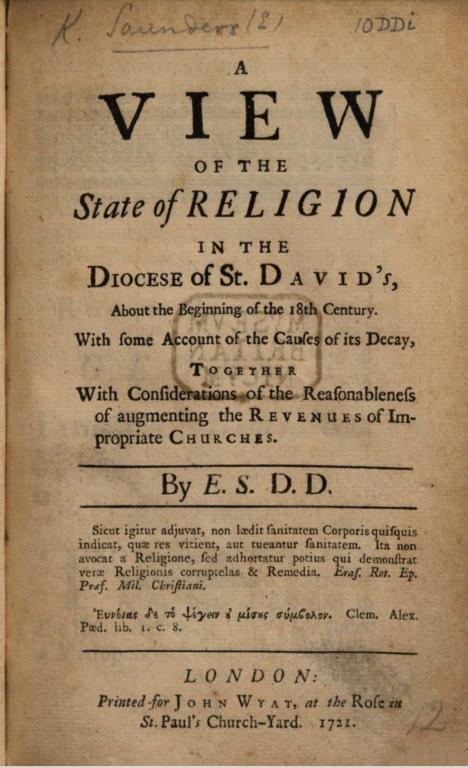
I have previously blogged at this site about a much-quoted source about religious life in one remote corner of the British Isles in the early eighteenth century, more than 150 years after the notional success of the Reformation. In 1721, Welsh Anglican cleric Erasmus Saunders (1670-1724) published his book A View of the State of Religion in the Diocese of St. David’s, About the Beginning of the Eighteenth Century, With Some Account of the Causes of its Decay, together with Considerations of the Reasonableness of Augmenting the Revenues of Impropriate Churches. The title says it all. Saunders was describing the historic Welsh diocese of St. David’s, which covered a large and thinly populated area of south and west Wales. The church operated through large and miserably poor funded parishes, so that its footprint was exceedingly light, and most people rarely had access to religious services. The physical condition of the churches was parlous, and most were semi-ruinous. The solution to this crisis, thought Saunders, was giving more money to the parishes whose tithes had been lost.
For present purposes, Saunders’s work is invaluable for what it says about the lived religion of a society passionately interested to forms of spirituality, but operating largely free of any official sanctions. He portrays the wide survival of older customs that closely follow medieval devotions, but which may conceivably include some pagan remnants, and free-floating superstitions. He describes these manifestations with horror, and that attitude is reflected by the many later historians who quote him to demonstrate just what a spiritual desert Wales was before the evangelical revivals of the eighteenth century. Please read that earlier blogpost of mine for details of his complaints, which I quote at length, and will not repeat in detail here (and see also this post). Here is an extract:
There is, I believe, no part of the nation more inclined to be religious, and to be delighted with it, than the poor inhabitants of these mountains. They do not think it too much, when neither ways nor weather are inviting, over cold and bleak hills to travel three or four miles, or more, on foot, to attend the public prayers— and sometimes as many more, to hear a sermon; and they seldom grudge many times for several hours together, in their damp and cold churches, to wait the coming of their minister, who by occasional duties in his other curacies, or by other accidents, may be obliged to disappoint them and to be often variable in his hours of prayer.
Saints, Shrines and Pilgrims
Faith was not in short supply, but the problem, from a Protestant view, was that so much of this devotion was expressed in very medieval and Catholic-looking terms.
Another ancient practice, namely that of crossing themselves, as the first Christians were wont to do upon many occasions, is much in use among them, with a short ejaculation that through the Cross of Christ they might be safe or saved.And as we are told by Eusebius and others, that the first Christians were wont to meet at the graves of martyrs, and others of their deceased friends to say their prayers there, and to pay some respect and honor to their memory, there is also something of the same kind that is observed here. In most mountainous parts, where old customs and simplicity are most prevailing, there we shall observe that when the people come to church, they go immediately to the graves of their friends, and there kneeling, offer up their prayer to God; but especially at the feast of the Nativity of our Lord ; for they then come to church about cock-crowing, and bring either candles or torches with them, which they set to burn, every one, one or more upon the grave of his departed friend, and then set themselves to sing their carols, and continue so to do, to welcome the approaching festival, until prayer-time.
But with these innocent good old customs, they have also learned some of the Roman superstitious practices in the later ages, such as many times in their ejaculations to invocate not only the Deity, but the Holy Virgin and other saints; for Mair-Wen [Holy Mary], Jago [James], Teilaw Mawr, Celer, Celynnog and others are often thus remembered as if they had hardly yet forgotten the use of praying to them. And there being not only churches and chapels but springs and fountains dedicated to those saints, they do at certain times go and bathe themselves in them, and sometimes leave their small oblations behind them either to the keeper of the place or in a charity box prepared for that purpose by way of acknowledgment for the benefit they have, or hope to have thereby. Nay, in many parts of North Wales they continue in effect still to pay for obits, by giving oblations to the ministers at the burial of their friends, as they were formerly taught to do to pray them out of purgatory, without which useful perquisites the poor curates in many places would be very hard pushed to get their livelihood.
And thus it is the Christian religion labours to keep ground here. Superstition and religion, error and truth, are so very oddly mixed, that it should in charity be concluded to be rather the misfortune of many that they are misled. For the generality are, I am afraid, more obliged, if not to their natural probity, to their religious observance of those ancient customs, or to the instruction that they get from their carols, or the Vicar of Llanymddyfry’s poems, than to any benefit received from the catechizing and preaching of a regular ministry.
Other evangelical reformers offered accounts of Wales very similar to Saunders, so he was clearly not making up his allegations. Moreover, we find very similar accounts elsewhere in the British Isles and in Western and Northern Europe more generally, in such notorious “dark corner of the land.” These were the same subterranean worlds of religion and superstition that anthropologists were collecting across well into the last century.
Saunders is describing what we might term a “ghost religion,” the faith of what had been a clerical/priestly religion once those clergy and priests are removed. What remains four or five generations later? I highlight several obvious points:
i.Most obvious is the continuing need for religious practice of some kind, whether or not that is approved by the official church.
ii.People retain their veneration for the holy names and figures of the old faith, even if they actual knowledge of them is limited.
iii.They retain core customs that sanctify and sacralize everyday life, such as crossing themselves. In Catholic language, they love the sacramentals, those habits and customs that fall short of being central dogmas or institutions of the faith, but which are still so deeply loved. Candles and sources of light provide a universal spiritual symbol.
iv.Their religious ideas have a strong element of material holiness, the idea that special power resides in objects.
v.Following directly on from that, believers know that power and holiness reside in special places, from which healing and other benefits can be sought. Wells and other sites are thin spaces, points of transition between worlds.
vi.Holiness is especially to be found in individuals of particular merit, charismatic saints who have gained a special place in the heavenly realms, and to whom ordinary mortals can turn for assistance.
vii.People know and keep a ritual calendar, in which days and seasons have special value and holiness, calling for particular actions. The Christmas season is pivotal.
viii.Regardless of any theological doctrines, people are deeply conscious of the spiritual well-being of their friends and relatives after death, and think that what they do in this world can assist the departed. As with the instance of the saints above, this suggests a belief in connections and continuities between the two realms. Death is central to faith.
ix.People believe that those who receive spiritual services or benefits should supply material goods in exchange. That does not necessarily mean that such services are for sale, but rather than exchange and sacrifice are a basic part of life in this world and the other.
x.All these ideas are expressed and reinforced through popular story-telling and superstition, which supplement or replace official religious teachings.
Although the holy figures and the ritual calendar are explicitly Christian, basically nothing of what is recorded here in any way reflects Christian theology, whether Protestant or Catholic. Interestingly, Christ himself scarcely appears in this religious thought-world, nor do such critical doctrines as the Trinity, or Incarnation, or Atonement, or Resurrection. This is a religion of holy places where holy people are commemorated and, ideally, contacted and petitioned.
Through an Islamic Mirror
All the people Saunders is describing would unhesitatingly describe themselves as faithful Christians. If however we shift our focus to other parts of the world – to North Africa or Central Asia or South Asia – we find a very large number of people doing essentially the same things as those in Wales, fulfilling all the points in the list I just enumerated, and they would with equal conviction call themselves faithful Muslims.
In modern times, and under the influence of reformist and fundamentalist movements, the normal practice of Islam has come to be more austere and defined by clerical orthodoxy than in virtually all previous eras. Around much of the world, until very modern times, the normal and approved practice of faith focused on the work of mystical Sufi orders, whose rituals involved music. The deceased former leaders of the sect were commemorated at shrines that became the center of pilgrimage, to which faithful believers resorted for blessings or healing. This was the standard nature of “lived” Islam across most of its territories for centuries. (I hasten to add that the Sufi orders were firmly part of the orthodox Islam of their time, and in no sense some kind of deviant or heterodox sect).
Those shrines are commonly known by the Persian word Dargah, which combines two words meaning “door place”, a portal or threshold – an intriguing name in its own right, which corresponds nicely to “thin space.”
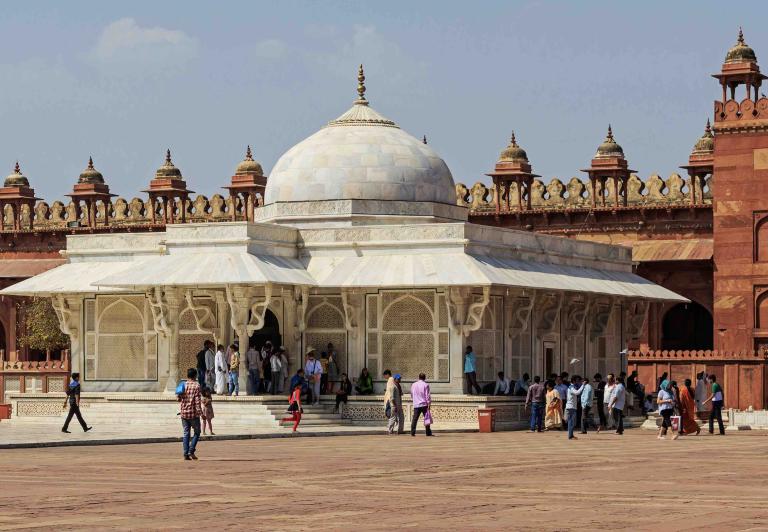
Such shrines are the settings for festivals that celebrate the saint on the anniversary of his passing. Those events involve plenty of candles or, in modern times, electric lights. They are also the venue for musical performances, often of very high artistic quality. If you want to get a sense of how these devotions work, and how they dominate spiritual sensibilities, you could do much worse than to read Erasmus Saunders’s accounts of Christian Wales three centuries ago.
In the Levant, James Grehan’s excellent 2014 study of Everyday Religion In Ottoman Syria And Palestine memorably reconstructs a faith based on the veneration of holy individuals, whose tombs are visited by the faithful, but these form part of a whole sacred landscape marked by stones, caves, water, and trees. No less central to religious life are protective amulets and talismans, and a potent belief in dreams and visions. Grehan aptly terms this assemblage of practices “agrarian religion,” suggesting its broad relevance to pre-industrial societies within the Islamic world and beyond.
Even in recent times, such ideas persist. In 2012, a Pew survey found that
In most of the 23 countries where the question was asked, majorities endorse visiting shrines of Muslim saints as a legitimate form of worship. This view is especially widespread in Central Asia, Southeast Asia and South Asia. … There is also substantial approval of devotional poetry or singing as a form of worship.
In societies where multiple religions coexist, there is very long evidence of the interfaith sharing of shrines and pilgrimage sites, with a remarkable harmony about the figures venerated there, and the ways in which they are celebrated. Again in the Levant, many shrines have indiscriminately attracted Muslims, Christians and Jews, commonly in devotions to the Virgin Mary, and usually in quest of healing or exorcism. The Marian Christian shrine of Saidnaya in Syria was long popular with pilgrims – with Christians, of course, but also the many Muslims who came on Fridays to pay their respects to the Virgin. Believers of both kinds came for healing, women usually in quest of healthy pregnancies. Such free interchange was the historic norm for over a millennium, and really ended only in the civil wars of the present century.
The Passing of an Old Order
Over the past half century, such devotions have been the focus of what is one of the most important religious developments of modern times. As fundamentalist Islam has become more common, and more rigid, so militants have tried to root out those Sufi devotions, often by armed force. This has involved for instance frequent terror attacks against Sufi devotees and shrines in Pakistan and Afghanistan, and the widespread suppression of sites in Egypt and across North Africa. In the name of reform, such acts constitute a war against what was for centuries the norm and mainstay of Islamic practice, of its lived religion. As in the case of the eighteenth century evangelical reformers within Christianity, those older practices were now denounced as syncretistic, as pagan, and as absolutely not legitimate within the newly defined orthodoxy, the religion prescrite.
The other mighty force undermining Sufi traditions is migration. Most of the Islamic migrants who traveled from North Africa to Western Europe over the past seventy years came from societies where religious faith was dominated by shrines, saints, and sacralized landscapes. All those features were lacking in the new land, where migrant families and especially their children moved to newer and more fundamentalist forms of faith, commonly with an extremist tinge.
On the lighter side, within what is otherwise a very grim and depressing story, you get a great sense of the way in which those older vernacular devotions operate from the 2019 Moroccan film The Unknown Saint. This is (oddly) a rollicking comedy about thieves who bury a treasure in an out of the way location, only to return some years later to find that it has become a popular Sufi shrine to an unknown saint, and they have to find a way to extract their loot. It is well worth watching, not least for the portrayal of the landscape and the shrine itself.
In remarking the many parallels between Christian and Islamic practices, I am in no sense suggesting that those eighteenth century Welsh Christian believers were drawing on Islamic influences (!). Nor were or are the Sufis themselves consciously imitating popular Catholic devotion: if there was any Christian inheritance in lands like North Africa, it was a very distant legacy indeed. Rather, I point out that much religious practice arises from the fact of being human, with our particular life cycle, and our hard wired realities. I have previously called these the building blocks of faith. These provide, if you like, the underlying grammar of our religious behavior, however that manifests in particular traditions. Normally, religious institutions regulate such manifestations, at least to some extent. But when central authority is slim or non-existent, that “underlying” behavior comes back to the fore. And that Erasmus Saunders example offers an excellent example of what it looked like.
Idealists sometimes dream of a “universal” religion. Such a grand unifying theoretical system might never happen, but ordinary religious practices of a pretty “universal” kind are not too hard to seek.
Previous Post
November 8, 2023
Atrocity and Your Imagination
Next Post

November 10, 2023 Still Adventist? Why Retain Denominational Identities
Recent Comments
"I love horror but would have to acclimate back to Lovecraft and especially Machen. Have ..."
Fairies, Witches, Folk Horror, and the ..."
"Very good point about MacDonald.I am certainly a Machen fan!"
Fairies, Witches, Folk Horror, and the ..."
"The Scottish author George MacDonald integrated fairy world into his fiction in a way that ..."
Fairies, Witches, Folk Horror, and the ..."
"I like the idea that we can have different streams. The coffee analogy is genius."
How Do You Take Your Evangelicalism?
Browse Our Archives
Select a Category abolitionism Abortion Abraham Joshua Heschel Abraham Kuyper Abraham Lincoln Academia Activism Adam Renberg Advent Adventist africa African American Religion Agnes Howard Albert Camus American History American Religious History American Revolution American West Anabaptists Ancient History Andrea Turpin Andrei Tarkovsky Anglicanism Annales Ansley Lillian Quiros anti-Catholicism Antisemitism Anxious Bench apologetics Apparitions Arash Azizi Archaeology archives art Artificial Intelligence Asia Asian Americans Augustine Authors Bad Bunny Baptism Baptists Barack Obama Battle of Hastings Benjamin Franklin Bernard-Henri Levy Beth Allison Barr Beth Moore Bethany Mannon Bible Bill Cunningham Billy Graham Black Music Bob Dylan Body Boenhoffer Books Breastfeeding Bruce Springsteen C.S. Lewis Calvinism Cancel Culture Capitalism Carmelites Catholicism Cedric Robinson Cesar Chavez Charismaticism charity Charles Dickens Charles Lindbergh Che Guevara Chicago Children Chinese Christianity Chris Gehrz Christ Christian death Christian Higher Education Christian life Christian Nation Christian Nationalism Christianity Today Christmas Church life Church Practice cinema Civil Religion Civil Rights Movement Civil War civility Classics Climate Change Cold War Colonial Mexico colonialism Comer Communism community complementarianism Conference on Faith and History Congregationalism Conspiracies Conspiracy Conversion Narratives Coronavirus Costa Rica Council of Nicaea Covid-19 Creation Critical Race Theory Crusades Culture culture wars Daniel K. Williams David Barton David Swartz Death Ways death with dignity DEI democracy Democratic Party Devotion Digital Age Diplomacy discipleship diversity Donald Trump Drama Dua Lipa Early Church early modern Early modern Catholicism Easter Eastern Christianity economic exploitation Education elections Elie Wiesel Elizabeth II Elizabeth Taylor emotions Empire Engineering England enslavement Entertainment Episcopal Church Erica Ramirez eschatology Eurocentrism Evangelicalism Evangelicals Exegesis Family Feminism Film Flannery O'Connor folk music Food Foreign Policy founding fathers Franciscans Franciscus Junius fundamentalism Funerals G.K. Chesterton Gender Genocide genre geography George W. Bush George Washington George Whitefield Global Christianity Global church Grief Guadalupe Guest Post guest post gun control gun violence Gustavo Gutierrez Hamid Dabashi Harold John Ockenga Harvest Hate Hawaiian Christianity Healing health care Heather Cox Richardson Hell Heresy Hermeneutics Higher Education Hinduism Hippocratic oath Historical Fiction Historical Methodology Historical Profession Historical Profession Historical Theology Historical Thinking historiography Holidays Holocaust horror movies Human rights Humanitarian Work humanities Hummingbirds Hungary hymns Imago Dei Immigration Injustice Interviews Iran Islam Islamophobia Israel Ivan's Childhood Jacob Randolph James Bratt Janine Giordano Drake Japanese history Japanese Literature Jean Paul Sartre Jesse Miranda Jesus Jesus Christ Jimmy Carter Joan Baez Joan Didion Joanne Freeman João B. Chaves Joao Chaves Joey Cochran John Calvin John Fea John Tillotson John Turner Johnny Cash Jonathan Edwards Jonathan Tran Joseph Smith Josh Howerton Journalism Jr. Judaism Jürgen Moltmann Just War Justice Justin Brierley Karl Barth Katelyn Beaty koi ponds Kris Kristofferson Kristin Kobes Du Mez Latin American Religious History Latino Americans Lectio Divina Leisure Lent Leonard Cohen liberal arts liberalism Liberation Theology Linda Ronstadt Lisa Clark Diller Literature Lou Reed Lynchings Lynneth Miller Renberg Mainline Protestantism Malcolm Foley Marilyn Monroe Maritime history Mark Noll Marriage Martin Luther Martin Luther King Martyrdom Marxism Mary Masih Alinejad mass shootings material culture medieval Christianity Medieval Ethiopia Melissa Borja memory Mennonites Mental Health Mental Illness Methodism Mexican Americans Mexicans Mike Madrid Miles Mullin Min Jin Lee Miscarriage Missionaries Mister Rogers Mitt Romney modernity Monasticism Mormonism Motherhood Mothers of the Church Moving Music Musicals Nadya Williams Nahua Christianity Native Americans Natsume Sōseki New Contributor New England New Year New York Nico Non-Violent Protest Orthodoxy pacifism Paleo Evangelicals Palestinians Parenting Patti Smith Paul Kingsnorth Pedro Calderón de la Barca Pentecostalism Philip Jenkins Phillis Wheatley physician-assisted suicide pilgrimage Pilgrims pluralism Plutocracy Poetry Politics Pope Francis Pope Leo XIV post-modernism prayer preaching Presbyterians prosperity gospel Protest Public history Publishing Puritans purity culture Quakers race Race Massacres Racial Capitalism racial reconciliation racialization Racism Raha Bahloulipour Re-Enchantment reading Reformation Refugees religion and the university religion and war Religious Freedom Religious Nones Religious Pluralism Religious Symbols religious violence Republican Party Revival Rita Coolidge Ritual Roger Williams Roman Catholic church Royalty Russell Moore same-sex marriage Sarah Irving-Stonebraker Scandinavia Science Science and Technology Scopes trial Scriptural Interpretation secularism Selena Quintanilla seminary Seventh-Day Adventists sexual morality Sexuality Sikhs Silence slaveholders theology Slavery Slavoj Zizek social justice Social Media Southern Baptist Convention Southern Religion Spain Spiritual Autobiography Spiritual but not religious Spiritual Discipline Sports Stanley Hauerwas Suffering Summer Camps Sunday Night Odds and Ends Supernatural Supreme Court Syriac Christianity Tal Howard Taylor Swift Teaching Technology Television Thanksgiving The Beatles The Mission theater TheoBros Theology Thomas Dixon Thomas Jefferson Thomas Kidd Thomas Merton Tim Gloege Tim Walz Tom Holland Tourism tradition Tragedy Translation Transnationalism Travel Trump Ukraine Uncategorized Unitarians United Methodist Church US History Vanessa Chan Velvet Underground Verónica A. Gutiérrez Veronica Gutierrez Vikings Violence Virgin Mary Virtue Virtue ethics Visions Voting War WCTU Wendell Berry Westminster Assembly White Evangelicalism Wildfires Winnie the Pooh Witches women Women in Ministry Women's and Gender Studies Work Worship writing Yasunari Kawabata Zena Hitz
Select a Month October 2026 September 2026 August 2026 July 2026 June 2026 May 2026 April 2026 March 2026 February 2026 January 2026 December 2025 November 2025 October 2025 September 2025 August 2025 July 2025 June 2025 May 2025 April 2025 March 2025 February 2025 January 2025 December 2024 November 2024 October 2024 September 2024 August 2024 July 2024 June 2024 May 2024 April 2024 March 2024 February 2024 January 2024 December 2023 November 2023 October 2023 September 2023 August 2023 July 2023 June 2023 May 2023 April 2023 March 2023 February 2023 January 2023 December 2022 November 2022 October 2022 September 2022 August 2022 July 2022 June 2022 May 2022 April 2022 March 2022 February 2022 January 2022 December 2021 November 2021 October 2021 September 2021 August 2021 July 2021 June 2021 May 2021 April 2021 March 2021 February 2021 January 2021 December 2020 November 2020 October 2020 September 2020 August 2020 July 2020 June 2020 May 2020 April 2020 March 2020 February 2020 January 2020 December 2019 November 2019 October 2019 September 2019 August 2019 July 2019 June 2019 May 2019 April 2019 March 2019 February 2019 January 2019 December 2018 November 2018 October 2018 September 2018 August 2018 July 2018 June 2018 May 2018 April 2018 March 2018 February 2018 January 2018 December 2017 November 2017 October 2017 September 2017 August 2017 July 2017 June 2017 May 2017 April 2017 March 2017 February 2017 January 2017 December 2016 November 2016 October 2016 September 2016 August 2016 July 2016 June 2016 May 2016 April 2016 March 2016 February 2016 January 2016 December 2015 November 2015 October 2015 September 2015 August 2015 July 2015 June 2015 May 2015 April 2015 March 2015 February 2015 January 2015 December 2014 November 2014 October 2014 September 2014 August 2014 July 2014 June 2014 May 2014 April 2014 March 2014 February 2014 January 2014 December 2013 November 2013 October 2013 September 2013 August 2013 July 2013 June 2013 May 2013 April 2013 March 2013 February 2013 January 2013 December 2012 November 2012 October 2012 September 2012 August 2012 July 2012 June 2012 May 2012
Follow Us!
TAKE THE
Religious Wisdom Quiz
What does the Sword of the Spirit represent?
Select your answer to see how you score.
The Holy Spirit The power of prayer Faith The Word of God
Related posts from Anxious Bench

Fairies, Witches, Folk Horror, and the Secret Commonwealth

Hogg’s Justified Sinner: A Gothic Classic for Halloween

James Hogg, Weird Wives, and Feminist Witches

How an Explosive Book Rewrote the Study of...
TRENDING AT PATHEOS Evangelical

How to Make a Decision When You Can't...
Main point: It’s much more valuable to stay close to God so...

Archdiocese Hosts Military Marriage Retreat in Germany
RASTATT, Germany — The transient military lifestyle, with its frequent deployments and...

Nearly every morning, I make the drive to Detroit with my high-school-age...

The Real AI Story Is Adoption Without Trust
Artificial intelligence has crossed a political threshold. It is no longer a...

A new article, written by Jeff Lindsay and Gale L. Pooley,...

Swimfan: Forgotten Aughts Pleasures
This is a recovery effort. In 2002, My Big Fat Greek Wedding...
view all Evangelical blogs
What Are Your Thoughts?leave a comment
Ad-Free & Subscriber Log-In Subscription Support
- About Us
- 2026 Calendar
- Videos
- Podcasts
- Library of World Religions
- Faith In Media Tracker
- Advertise With Us
- Write for Us
- Privacy Policy
- Terms of Service
- Do Not Sell My Data
- Contact Us
- Radiant Digital
- Manage Newsletter Subscriptions
- Unsubscribe From Notifications
- Sitemap
Copyright 2008-2026, Patheos. All rights reserved.
Subscription Support Ad-Free & Subscriber Log-In
Follow Patheos