
BuddhistCatholicContemplativeEvangelicalGeneral ChristianHinduJewishLatter-day SaintMuslimNew VisionsProgressive Christian
Beliefs
- Buddhist
- Catholic
- Contemplative
- Evangelical
- General Christian
- Hindu
- Jewish
- Latter-day Saint
- More Voices
- Muslim
- New Visions
- Pagan
- Progressive Christian
Topics
- Religion News
- Food and Religion
- Sports and Religion
- Religious Art
- Religious Music and Entertainment
- Religious Events
- History and Religion
- Style and Religion
- Politics and Religion
- Women in Religion
- Recreation Outdoors and Religion
- Business Finance and Religion
- Careers Workplace and Religion
- Education and Religion
- Family Parenting and Religion
- Health Fitness and Religion
- Home and Religion
- Relationships and Religion
- Technology and Religion
- Travel and Religion
Columnists
- Buddhist Columnists
- Business Finance and Religion Columnists
- Careers Workplace and Religion Columnists
- Catholic Columnists
- Contemplative Columnists
- Education and Religion Columnists
- Evangelists Columnists
- Family Parenting and Religion Columnists
- General Christian Columnists
- Health Fitness and Religion Columnists
- Hindu Columnists
- History and Religion Columnists
- Home and Religion Columnists
- Jewish Columnists
- More Voices Columnists
- Latter Day Columnists
- Muslim Columnists
- New Visions Columnists
- Nonreligious Columnists
- Pagan Columnists
- Politics and Religion Columnists
- Progressive Columnists
- Recreation Outdoors and Religion Columnists
- Relationships and Religion Columnists
- Religion News Columnists
- Religious Art Columnists
- Religious Events Columnists
- Religious Music and Entertainment Columnists
- Sports and Religion Columnists
- Style and Religion Columnists
- Technology and Religion Columnists
- Travel and Religion Columnists
- Women in Religion Columnists
Resource Library
- 2026 Calendar
- Library of World Religions
- The 100 Most Holy Places on Earth
- Patheos Answers
- Podcasts
- Videos
- Faith Leaders Database
- Anglican Episcopalian
- Bahai
- Baptist
- Buddhism
- Christianity
- Confucianism
- Eastern Orthodoxy
- Hinduism
- Holiness and Pentecostal
- ISKCON
- Islam
- Judaism
- Lutheran
- Methodist
- The Church of Jesus Christ of Latter-day Saints
- New Age
- Paganism
- Presbytarian and Reformed
- Protestantism
- Religion Behind the Scenes
- Roman Catholic
- Scientology
- Shia Islam
- Sikhism
- Sufism
- Sunni Islam
- Taoism
- Zen
- See all religions
Research Tools
 Ad-Free & Subscriber Log-In Subscription Support
Ad-Free & Subscriber Log-In Subscription Support
Follow Patheos 

- Trending:
- Forgiveness
- |
- Marriage
- |
- Consciousness
- |
- Death Penalty
- |
- Election
- |
- Halloween

-
About the Authors
- Home
- Evangelical
- Megachurch Pastor Canvasses The Frankfurt School
Megachurch Pastor Canvasses The Frankfurt School
Last updated on: September 2, 2023 at 9:16 am by Erica Ramirez
Megachurch Pastor Canvasses The Frankfurt School 2023-09-02T09:16:23-04:00 Erica Ramirez
Patheos Explore the world's faith through different perspectives on religion and spirituality! Patheos has the views of the prevalent religions and spiritualities of the world.
(Before I begin, I’d like to note that my last article has proven prescient: in response to the arrest of Trump, his supporters have embraced him as a anti-hero, an outlaw. Read here.)
I am back this week with the first installment of a promised series about Texas megachurches.
About 70% of the church-going public attends only 10% of existing churches– many of these are megachurches. Often evangelical and charismatic, often non-denominational, these hugely influential churches get left off landscape surveys that are framed in terms of denominations. Frankly, to miss what’s happening in megachurches is to get religion in the US skewed. But it’s very hard to get at non-denominational church data.
Fortunately, I live in San Antonio and we have our fair share of megachurches. Today, I am going to reflect on my visits to Community Bible Church (CBC) and, in particular, yesterday’s sermon. My chief interests are as follows: a. the degree of race and gender diversity in their pews and on their stages, b. the salience of charismatic influence in their worship styles and rhetoric, and c. the way leaders may be playing any role in stoking authoritarianism and white supremacy. I am also looking for Christian Nationalism. In what follows, you’ll see: CBC is surprising.
**********************************************************************************************************************
I doubt you know the name Ed Newton.
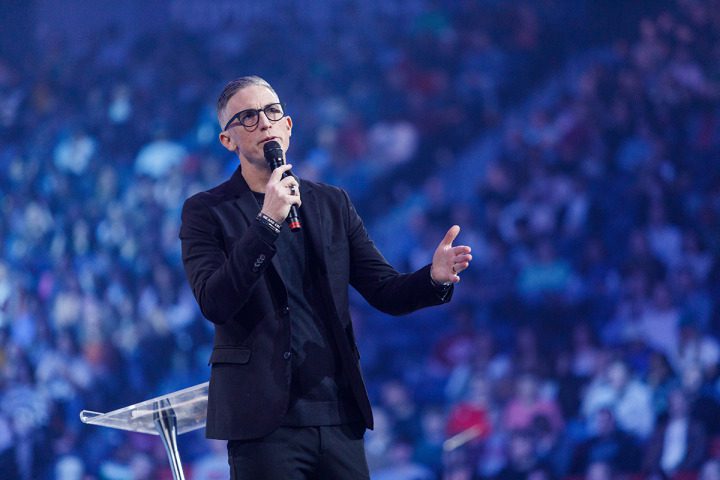
San Antonio MegaChurch Pastor
You’ve heard of T.D. Jakes, I think, and Joel Osteen. You know the big names of charismatic megachurches. I would guess you know the term, “prosperity gospel.” By now, you know about Paula White.
But you probably don’t know Dr. Ed Newton, and until 2016, most people in San Antonio didn’t either. Today, Ed Newton pastors one of San Antonio’s most vibrant megachurch congregations, Community Bible Church (CBC). Like the other four megachurches I’ll profile this fall, Community Bible Church is located on the north side of San Antonio’s loop 1604. When Ed Newton took over CBC, the church was processing a bit of struggle that saw its founding pastor move on. When megachurches trade on the charisma of their leaders, which they are almost uniformly touted to do by scholars and journalists, such a transition is very challenging to navigate without significant loss in members. But Newton has managed to maintain the church’s footprint: today CBC has six services with 18,000 attendees. CBC’s youtube following is at 22.7k and since he preached yesterday morning, 2.7k people have caught the online version. (It’s only been 22 hrs and the video isn’t up on CBC’s own website yet.) CBC’s total church membership is touted to be 27k.
There are things about Pastor Newton that surprise me. At 48, he’s boyish. He used to have a grey beard, but now it’s mostly clean-shaven. He’s energetic– like someone in his 20s. Ed Newton wears converse-like tennis shoes to preach. The few times I have seen him in person, he is wearing all black. (He used to wear more traditional suits, which you can find in older videos.) Yesterday’s look was a loose and untucked button-up black shirt. I’ve seen him at other times in a slim-fitting black suit, black shirt, tennis shoes– no tie. Newton’s hair is close shaven; he looks tan and like he works out. He wears bracelets on his wrist. I have a memory of his saying he recently bought cowboy boots, with over-the-top enthusiasm.
I asked myself if there is a celebrity analog to Newton that I could invoke here, so that you’d be able to picture him better. But the one reference who came up is Woody, from Toy Story, and I am not trying to be disrespectful. The fact that Woody comes up for me reveals, I think, the way Ed Newton doesn’t surprise me. Woody is a cowboy sheriff, right? Jesus and John Wayne has already demonstrated that cowboys are core to evangelical culture. That Ed Newton has a woody-like bearing suggests the range of the myth: Woody is friendly; he’s sentimental. He’s sweet and the hero of Toy Story, a Disney franchise that has grossed 3.3 billion worldwide and has been well-argued to be the “greatest movie trilogy of all time.” Woody might be a global icon.
Ed Newton feels familiar. He says ain’t and has a twang that suggests he’s of the people. He is self-deprecating; funny in a way I think echoes populist humor of the (both American and pentecostal) past–which I have written about. In yesterday’s message he gently pilloried congregants who make rude gestures, “use the middle finger,” at each other in their scramble to find parking. He invited people to greet each other by saying something like, “let your neighbors smell your coffee breath” (21:59). He didn’t make fun of anyone else really, but there was one point in the sermon where he said that communism suggests you can “trust elites with your money.” The audience readily laughed. Newton didn’t mention Nancy Pelosi, Hillary Clinton, or Hunter Biden, but I imagine that this audience can create those connections in their minds. I don’t think this was a dog whistle, but I do imagine that when Trump or a Trump-like politician advances a similar idea, s/he simply changes the tone of what Newton invoked with his statement and adds specific names. Thus, the laughter that emits in a Trump rally is different in tone, but can be received as congruent to, and an extension of, what laughter emanates in Community Bible Church. Still, tone is important.
To the best of my recollection, Newton is married to Stephanie, a hispanic woman, and he says he is trying to learn Spanish. Lots of Spanish is attempted at CBC. Songs are sung in Spanish, sometimes, and translations of English songs and preaching appear on screens. Kate Bowler’s The Preacher’s Wife admonishes that megachurch pastors’ wives trend blonde, so Stephanie’s dark brown hair surprises me. Bowler’s work suggests that Stephanie is allowed to teach because she’s married to Pastor Ed, and this may be true. Megachurch pastors are always married and their wives, I’ve argued, play an important role in making the church intelligible as a family. At the same time, the women in CBC leadership don’t uniformly look like the prim ladies we’ve come to know, like Victoria Osteen, and they seem independent in their roles of leadership. CBC’s staff and leadership pages show the significant presence of women, pictured on their own with titles. CBC doesn’t immediately read as masculinist and doesn’t readily read as culturally white. In an highly visible embedded video on CBC’s website, Newton is still in black but wearing a Mexican guayabera. On his left is a menorah, a clear signal that indicates Newton and his church participate in zionism. The aesthetics of CBC aren’t detectably *white* Christian Nationalism. The church is known to be radically generous on behalf of the city. Once, I saw Pastor Newton instruct members to put money in an offering basket if they could, and to take money from the basket if they need it.
Particularly interesting to me is the style of worship that CBC advances. CBC’s hispanic music leader Phil Vega and (often) Aleena Barrientos (the two aren’t married) sing the same newer songs that researchers have shown are produced by four powerhouses of charismatic music production (Hillsong, Elevate, Bethel and Passion), but they do so from acoustic and electrical guitars, in jeans and tennis shoes. It’s my understanding that Kristin Kobes Du Mez will be blessing us with a book soon on the culture of evangelical femininity and its injunctions to laugh, live and love. Barrientos presents in a different manner. She’s a mother, but she’s not married to the worship leader and from her instagram, it seems as though she’s recently revealed she’s in a new romantic relationship. She does not read as someone who primps.
As you can see from this video, the worship at CBC is not only less prim than one might think. It is also more interracial than one might expect. One of this Sunday’s memorable images features a black young man leading worship while the words to the song crawl across the screen below him, both in spanish and english. You cannot see the crowd from this video, but like most megachurches, CBC is interracial. Given that there are six services a weekend and online watchers, it’s hard to say exactly how interracial, but the audience always seems diverse in terms of race.
I said I would visit this church to check it for Christian Nationalism, so here is my analysis:
Ed Newton said things yesterday that seem aligned with what scholars term Christian Nationalism. He asserted this nation was founded on Judeo-Christian values and that God has been kicked out of government and out of schools. When I am looking for Christian Nationalism, I focus on this idea: that this nation is “built on” Jewish laws and that it must remain so; I think this is core to a Christian Nationalist vision. In one section of his sermon Newton problematized pluralism as “very difficult” because it violates the “principle of non-contradiction,” by which he means: not all religions can be equally true. It seems safe to say that Newton does not have a positive vision for a plural public square; from his preaching it seems like he thinks it just isn’t feasible. Newton sometimes invoked kingdom language that made me think he easily slides from thinking about the nation to thinking about the kingdom of God.
But Ed Newton also said surprising things: he said woke-ism is a problem, but being woke is not. One should be awake, Newton says, to injustices and that black people in particular deserve this recognition of having been unjustly treated both under slavery and its “residues”– which he termed Jim Crow racism–and which residues, he asserted, still obtain in public life. He decried racism as sin, said it requires repentance, and then also said that all LGBTQ persons are welcome at CBC. They are welcome, Newton reasoned, because everyone at CBC is a sinner and no sin is more or less damning than another. He then pointedly stated that if any congregant in the church wanted LGBTQ attendees to be excised from the congregation, that congregant instead should find another church. All this was a bit unexpected.
Also unexpected was Newton’s entire deconstruction of race as a category that, he said, proceeds from darwinism and evolution. I recognized something like early anthropological and colonial accounts of race in Newton’s retelling; he wanted his listeners to understand race as a construct built by science and social scientists who (in the past, yes) advocated for the idea that white people were the most evolved. Newton vehemently made recourse to the equality of ethnicities based on imago dei. In one hazardous rhetorical turn, Newton lamented a person’s being referred to as a monkey as an insult rooted in both racist and darwinist logic. Being made by God means, in this sermon, that all persons are equal. Science is racist, good theology is not was not what I was expected to hear here. Since evangelicals have no love for science as an authoritative discourse, this was a savvy rhetorical move.
The most surprising thing I heard in Newton’s sermon was his invocation of The Frankfurt School. Critical theories and Marxism, Newton said, were problematic because of their deconstructive and divisive approach to society. In one fell swoop Newton offered that critical theory had done the important work of making women aware of long-term pay discrepancies and this was, he owned, very important and true. But isms, Newton then offered, are the problem. Critical theories, Marxism and one can deduce, feminism are problematic inso much as they re-inscribe their own new, maximally important binary: the oppressor and the oppressed. Given this binary, critical theories’ final vision and outcome is for (not liberation, a word I do not think he uttered) but instead destruction. Deconstruction leads to the destruction of the society, per Newton. So while being awake to injustice or woke like Marcus Garvey is good (Newton did invoke Garvey), while black lives do matter and we need to “empathize” with their aim for fair treatment, BLM the entity is bad because it “seeks to destroy” the nuclear family (this has changed, but Newton doesn’t seem to know it) and by extension, society.
Listening to Newton rehearse a history of the term woke, its transformation into “woke-ism,” the benefits and flaws of critical theory, the problem of new binaries; The Frankfurt School, the 1619 project, his transgender friends, and his own mixed-race family–all together make me think Newton is a formidable rhetorician. Since as many as 20k people may hear this sermon, it strikes me as interesting this may be the first or only time they hear about The Frankfurt School.
I think I can safely say that CBC participates in what scholars term Christian Nationalism. But I also think there are ways the church subverts the category. Most important, to me, was a moment when Newton developed a dichotomy between democracy and communism, which category he substantiated as “Russia, China, Venezuela, and Cuba.” Earlier in this same sermon, Newton problematized critical theory as something made by Germans. It occurs to me: this is how pastors do geopolitics. This is where and how church goers get their views of how the US fits into the world–in this case, as a protagonist of democracy and perhaps not the only one. One glance at CBC’s website illustrates the church is also pro-Israel. Newton did not seem to forward the US as perfect, uniquely blessed by God, a city on a hill, or even explicitly exceptional. Instead he invoked communist nations as godless ones, quoting Marx, and invited his fellow Christians to “double down” on the truth of the gospel.
But in depicting polarization as bad and the goals/ends of activism as the destruction of the nation and the family, Newton seems both classically evangelical and Christian Nationalist. In so much as such a vision depends on the centrality of the hetero-patriachal family unit and “the word of God” to this society, Newton’s vision of the family and the nation and the world readily lines up with those of Christian Nationalists. Newton does not, however, seem at all aligned with White Christian Nationalism.
The end of this online version of yesterday’s sermon featured an advertisement for Rebel, a bible study group for men. At the end of Newton’s sermon he pointedly asserted that our culture is trying to break men down. Rebel, I surmise, is the place where they learn to withstand this pressure.
More to come, soon.
General Christian
Previous Post

August 23, 2023
The Evangelical Imagination: An Interview with Karen Swallow Prior
Next Post

August 29, 2023 History's Invitation to Belong
Recent Comments
"Life Force is a guilty pleasure of mine! Not a great film, but a fun ..."
Fairies, Witches, Folk Horror, and the ..."
"I love horror but would have to acclimate back to Lovecraft and especially Machen. Have ..."
Fairies, Witches, Folk Horror, and the ..."
"Very good point about MacDonald.I am certainly a Machen fan!"
Fairies, Witches, Folk Horror, and the ..."
"The Scottish author George MacDonald integrated fairy world into his fiction in a way that ..."
Fairies, Witches, Folk Horror, and the ..."
Browse Our Archives
Select a Category abolitionism Abortion Abraham Joshua Heschel Abraham Kuyper Abraham Lincoln Academia Activism Adam Renberg Advent Adventist africa African American Religion Agnes Howard Albert Camus American History American Religious History American Revolution American West Anabaptists Ancient History Andrea Turpin Andrei Tarkovsky Anglicanism Annales Ansley Lillian Quiros anti-Catholicism Antisemitism Anxious Bench apologetics Apparitions Arash Azizi Archaeology archives art Artificial Intelligence Asia Asian Americans Augustine Authors Bad Bunny Baptism Baptists Barack Obama Battle of Hastings Benjamin Franklin Bernard-Henri Levy Beth Allison Barr Beth Moore Bethany Mannon Bible Bill Cunningham Billy Graham Black Music Bob Dylan Body Boenhoffer Books Breastfeeding Bruce Springsteen C.S. Lewis Calvinism Cancel Culture Capitalism Carmelites Catholicism Cedric Robinson Cesar Chavez Charismaticism charity Charles Dickens Charles Lindbergh Che Guevara Chicago Children Chinese Christianity Chris Gehrz Christ Christian death Christian Higher Education Christian life Christian Nation Christian Nationalism Christianity Today Christmas Church life Church Practice cinema Civil Religion Civil Rights Movement Civil War civility Classics Climate Change Cold War Colonial Mexico colonialism Comer Communism community complementarianism Conference on Faith and History Congregationalism Conspiracies Conspiracy Conversion Narratives Coronavirus Costa Rica Council of Nicaea Covid-19 Creation Critical Race Theory Crusades Culture culture wars Daniel K. Williams David Barton David Swartz Death Ways death with dignity DEI democracy Democratic Party Devotion Digital Age Diplomacy discipleship diversity Donald Trump Drama Dua Lipa Early Church early modern Early modern Catholicism Easter Eastern Christianity economic exploitation Education elections Elie Wiesel Elizabeth II Elizabeth Taylor emotions Empire Engineering England enslavement Entertainment Episcopal Church Erica Ramirez eschatology Eurocentrism Evangelicalism Evangelicals Exegesis Family Feminism Film Flannery O'Connor folk music Food Foreign Policy founding fathers Franciscans Franciscus Junius fundamentalism Funerals G.K. Chesterton Gender Genocide genre geography George W. Bush George Washington George Whitefield Global Christianity Global church Grief Guadalupe Guest Post guest post gun control gun violence Gustavo Gutierrez Hamid Dabashi Harold John Ockenga Harvest Hate Hawaiian Christianity Healing health care Heather Cox Richardson Hell Heresy Hermeneutics Higher Education Hinduism Hippocratic oath Historical Fiction Historical Methodology Historical Profession Historical Profession Historical Theology Historical Thinking historiography Holidays Holocaust horror movies Human rights Humanitarian Work humanities Hummingbirds Hungary hymns Imago Dei Immigration Injustice Interviews Iran Islam Islamophobia Israel Ivan's Childhood Jacob Randolph James Bratt Janine Giordano Drake Japanese history Japanese Literature Jean Paul Sartre Jesse Miranda Jesus Jesus Christ Jimmy Carter Joan Baez Joan Didion Joanne Freeman João B. Chaves Joao Chaves Joey Cochran John Calvin John Fea John Tillotson John Turner Johnny Cash Jonathan Edwards Jonathan Tran Joseph Smith Josh Howerton Journalism Jr. Judaism Jürgen Moltmann Just War Justice Justin Brierley Karl Barth Katelyn Beaty koi ponds Kris Kristofferson Kristin Kobes Du Mez Latin American Religious History Latino Americans Lectio Divina Leisure Lent Leonard Cohen liberal arts liberalism Liberation Theology Linda Ronstadt Lisa Clark Diller Literature Lou Reed Lynchings Lynneth Miller Renberg Mainline Protestantism Malcolm Foley Marilyn Monroe Maritime history Mark Noll Marriage Martin Luther Martin Luther King Martyrdom Marxism Mary Masih Alinejad mass shootings material culture medieval Christianity Medieval Ethiopia Melissa Borja memory Mennonites Mental Health Mental Illness Methodism Mexican Americans Mexicans Mike Madrid Miles Mullin Min Jin Lee Miscarriage Missionaries Mister Rogers Mitt Romney modernity Monasticism Mormonism Motherhood Mothers of the Church Moving Music Musicals Nadya Williams Nahua Christianity Native Americans Natsume Sōseki New Contributor New England New Year New York Nico Non-Violent Protest Orthodoxy pacifism Paleo Evangelicals Palestinians Parenting Patti Smith Paul Kingsnorth Pedro Calderón de la Barca Pentecostalism Philip Jenkins Phillis Wheatley physician-assisted suicide pilgrimage Pilgrims pluralism Plutocracy Poetry Politics Pope Francis Pope Leo XIV post-modernism prayer preaching Presbyterians prosperity gospel Protest Public history Publishing Puritans purity culture Quakers race Race Massacres Racial Capitalism racial reconciliation racialization Racism Raha Bahloulipour Re-Enchantment reading Reformation Refugees religion and the university religion and war Religious Freedom Religious Nones Religious Pluralism Religious Symbols religious violence Republican Party Revival Rita Coolidge Ritual Roger Williams Roman Catholic church Royalty Russell Moore same-sex marriage Sarah Irving-Stonebraker Scandinavia Science Science and Technology Scopes trial Scriptural Interpretation secularism Selena Quintanilla seminary Seventh-Day Adventists sexual morality Sexuality Sikhs Silence slaveholders theology Slavery Slavoj Zizek social justice Social Media Southern Baptist Convention Southern Religion Spain Spiritual Autobiography Spiritual but not religious Spiritual Discipline Sports Stanley Hauerwas Suffering Summer Camps Sunday Night Odds and Ends Supernatural Supreme Court Syriac Christianity Tal Howard Taylor Swift Teaching Technology Television Thanksgiving The Beatles The Mission theater TheoBros Theology Thomas Dixon Thomas Jefferson Thomas Kidd Thomas Merton Tim Gloege Tim Walz Tom Holland Tourism tradition Tragedy Translation Transnationalism Travel Trump Ukraine Uncategorized Unitarians United Methodist Church US History Vanessa Chan Velvet Underground Verónica A. Gutiérrez Veronica Gutierrez Vikings Violence Virgin Mary Virtue Virtue ethics Visions Voting War WCTU Wendell Berry Westminster Assembly White Evangelicalism Wildfires Winnie the Pooh Witches women Women in Ministry Women's and Gender Studies Work Worship writing Yasunari Kawabata Zena Hitz
Select a Month October 2026 September 2026 August 2026 July 2026 June 2026 May 2026 April 2026 March 2026 February 2026 January 2026 December 2025 November 2025 October 2025 September 2025 August 2025 July 2025 June 2025 May 2025 April 2025 March 2025 February 2025 January 2025 December 2024 November 2024 October 2024 September 2024 August 2024 July 2024 June 2024 May 2024 April 2024 March 2024 February 2024 January 2024 December 2023 November 2023 October 2023 September 2023 August 2023 July 2023 June 2023 May 2023 April 2023 March 2023 February 2023 January 2023 December 2022 November 2022 October 2022 September 2022 August 2022 July 2022 June 2022 May 2022 April 2022 March 2022 February 2022 January 2022 December 2021 November 2021 October 2021 September 2021 August 2021 July 2021 June 2021 May 2021 April 2021 March 2021 February 2021 January 2021 December 2020 November 2020 October 2020 September 2020 August 2020 July 2020 June 2020 May 2020 April 2020 March 2020 February 2020 January 2020 December 2019 November 2019 October 2019 September 2019 August 2019 July 2019 June 2019 May 2019 April 2019 March 2019 February 2019 January 2019 December 2018 November 2018 October 2018 September 2018 August 2018 July 2018 June 2018 May 2018 April 2018 March 2018 February 2018 January 2018 December 2017 November 2017 October 2017 September 2017 August 2017 July 2017 June 2017 May 2017 April 2017 March 2017 February 2017 January 2017 December 2016 November 2016 October 2016 September 2016 August 2016 July 2016 June 2016 May 2016 April 2016 March 2016 February 2016 January 2016 December 2015 November 2015 October 2015 September 2015 August 2015 July 2015 June 2015 May 2015 April 2015 March 2015 February 2015 January 2015 December 2014 November 2014 October 2014 September 2014 August 2014 July 2014 June 2014 May 2014 April 2014 March 2014 February 2014 January 2014 December 2013 November 2013 October 2013 September 2013 August 2013 July 2013 June 2013 May 2013 April 2013 March 2013 February 2013 January 2013 December 2012 November 2012 October 2012 September 2012 August 2012 July 2012 June 2012 May 2012
Follow Us!
TAKE THE
Religious Wisdom Quiz
What does the Greek word "Agape" mean in the Bible?
Select your answer to see how you score.
Eternal Life Unconditional Love Grace Peace
Related posts from Anxious Bench

Angelina Grimké's Forgotten Turn to Apocalyptic Faith

Profiting on Promoting 250 Years of Christian Nationalism

Christmas in July: Candles in the Darkness Release
Something Still Could: Courage for a Turbid Anniversary
TRENDING AT PATHEOS Evangelical

In one sense walking into Westminster Abbey is like walking down the...

'Super Scam Me' Exposes AI Jon Bon Jovi...
Leslie Pickett believed she was in a relationship with Jon Bon Jovi....

The Brazilian Remake of Kendricks' 'Flywheel' Opens in...
“Flywheel,” the story that launched the Kendrick Brothers’ filmmaking career is getting...

The Dangers of Gradual Accommodation (Winking at Sin)
Recently, the “law of gradualness” resurfaced during the opening of a weeklong,...

The Iron Gates and the Lion of the...
Yesterday, I didn't finish my report about, well, yesterday. So I'll...

The Image: On the Horror of Capitalism and...
The Image Then went the Pharisees, and took counsel how they might...
view all Evangelical blogs
What Are Your Thoughts?leave a comment
Ad-Free & Subscriber Log-In Subscription Support
- About Us
- 2026 Calendar
- Videos
- Podcasts
- Library of World Religions
- Faith In Media Tracker
- Advertise With Us
- Write for Us
- Privacy Policy
- Terms of Service
- Do Not Sell My Data
- Contact Us
- Radiant Digital
- Manage Newsletter Subscriptions
- Unsubscribe From Notifications
- Sitemap
Copyright 2008-2026, Patheos. All rights reserved.
Subscription Support Ad-Free & Subscriber Log-In
Follow Patheos