
BuddhistCatholicContemplativeEvangelicalGeneral ChristianHinduJewishLatter-day SaintMuslimNew VisionsProgressive Christian
Beliefs
- Buddhist
- Catholic
- Contemplative
- Evangelical
- General Christian
- Hindu
- Jewish
- Latter-day Saint
- More Voices
- Muslim
- New Visions
- Pagan
- Progressive Christian
Topics
- Religion News
- Food and Religion
- Sports and Religion
- Religious Art
- Religious Music and Entertainment
- Religious Events
- History and Religion
- Style and Religion
- Politics and Religion
- Women in Religion
- Recreation Outdoors and Religion
- Business Finance and Religion
- Careers Workplace and Religion
- Education and Religion
- Family Parenting and Religion
- Health Fitness and Religion
- Home and Religion
- Relationships and Religion
- Technology and Religion
- Travel and Religion
Columnists
- Buddhist Columnists
- Business Finance and Religion Columnists
- Careers Workplace and Religion Columnists
- Catholic Columnists
- Contemplative Columnists
- Education and Religion Columnists
- Evangelists Columnists
- Family Parenting and Religion Columnists
- General Christian Columnists
- Health Fitness and Religion Columnists
- Hindu Columnists
- History and Religion Columnists
- Home and Religion Columnists
- Jewish Columnists
- More Voices Columnists
- Latter Day Columnists
- Muslim Columnists
- New Visions Columnists
- Nonreligious Columnists
- Pagan Columnists
- Politics and Religion Columnists
- Progressive Columnists
- Recreation Outdoors and Religion Columnists
- Relationships and Religion Columnists
- Religion News Columnists
- Religious Art Columnists
- Religious Events Columnists
- Religious Music and Entertainment Columnists
- Sports and Religion Columnists
- Style and Religion Columnists
- Technology and Religion Columnists
- Travel and Religion Columnists
- Women in Religion Columnists
Resource Library
- 2026 Calendar
- Library of World Religions
- The 100 Most Holy Places on Earth
- Patheos Answers
- Podcasts
- Videos
- Faith Leaders Database
- Anglican Episcopalian
- Bahai
- Baptist
- Buddhism
- Christianity
- Confucianism
- Eastern Orthodoxy
- Hinduism
- Holiness and Pentecostal
- ISKCON
- Islam
- Judaism
- Lutheran
- Methodist
- The Church of Jesus Christ of Latter-day Saints
- New Age
- Paganism
- Presbytarian and Reformed
- Protestantism
- Religion Behind the Scenes
- Roman Catholic
- Scientology
- Shia Islam
- Sikhism
- Sufism
- Sunni Islam
- Taoism
- Zen
- See all religions
Research Tools
 Ad-Free & Subscriber Log-In Subscription Support
Follow Patheos 

- Trending:
- Advent
- |
- Forgiveness
- |
- Thanksgiving
- |
- Election
- |
- Seasonal Holidays
- |
- Marriage

-
About the Authors
- Home
- Evangelical
- The World Her Wilderness
The World Her Wilderness
Last updated on: July 27, 2023 at 6:03 am by Philip Jenkins
The World Her Wilderness 2023-07-27T06:03:46-04:00 Philip Jenkins
Patheos Explore the world's faith through different perspectives on religion and spirituality! Patheos has the views of the prevalent religions and spiritualities of the world.
Last time I wrote about the English novelist Rose Macaulay (1881-1958), arguing that she was a far more significant figure than her reputation as a comic writer might suggest. I particularly praised her book Crewe Train (1926), which was the subject of my recent Christian Century column. But Macaulay wrote over twenty other novels, several of which demand attention. One in particular here is a powerful historical document for the religious thought of the mid-twentieth century. Christian conversion – specifically, in its Anglican form – is a central motif.
Crewe Train concerned what we might call a radical nonconformist, a young woman absolutely incapable of living up to the expectations she faces about her class and her gender. She does not know and cannot learn social rules and niceties, and always prefers solitude over company of any kind, and the social whirl of other proper young ladies. The clash with her relatives drives her to a kind of damnation, where she is forced to accept their bizarre ways – a round peg brutally hammered into a square hole.
In her 1950 book The World My Wilderness, Macaulay offered another young female character in Barbary Deniston, who is so far at odds with her surroundings and family that she is close to feral. Viewing the world through her eyes – specifically the world of immediately post-WWII England – we see that society as utterly strange, hostile, and threatening. Barbary is beyond a mere outsider or loner: she is living more as an anarchist or bandit, in a state of constant resistance against conformity and propriety. The word “radical” seems barely adequate for such a picture. She is, well, a modern-day barbarian.
You can read the plot summary easily enough, but here is a lightning version. Barbary Deniston is raised in southern France during the Second World War, which teaches her life lessons about the evils of authority, and the need to resist them at all costs. Her experiences in active resistance and sabotage campaigns have made her thoroughly familiar with the dilemmas of collaboration, collusion, co-optation, and betrayal. Aged seventeen, she is brought to a heavily bombed and ruined London, which she interprets according to her wartime knowledge. However well intentioned they may seem, she thinks, all (British) authority figures are de facto occupation forces, and it is quite acceptable to steal or lie to survive. Observing the thriving subculture of thieves, spivs, black marketeers, deserters, and lowlife criminals, she assumes they are all fellow resisters and guerrillas, deserving her respect and assistance.
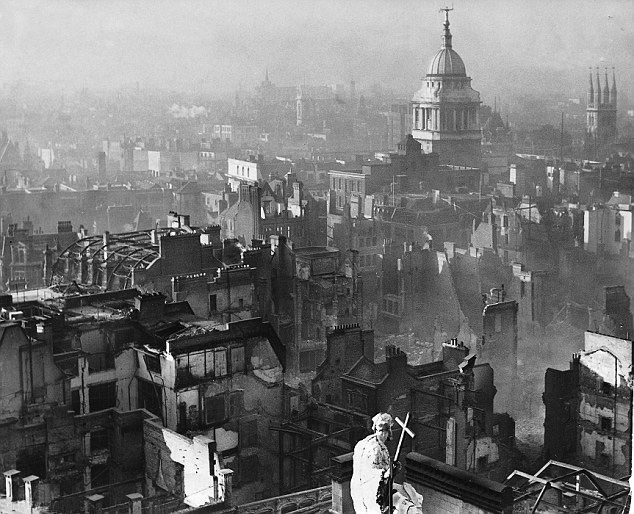
She establishes her own home in a bombed out church, which in turn forms part of a ruined but astonishingly beautiful city, where wild flowers grow unchecked amidst the devastation. Morally, spiritually, and physically, London is a wilderness. Much of the book reads like a post-apocalyptic science fiction story, which to a degree was the situation that England faced at this time. This is London Year Zero.
The basic ideas are startling enough, not least the anarchistic view of London, but the physical descriptions of the urban landscape are achingly lovely:
The children stood still, gazing down on a wilderness of little streets, caves and cellars, the foundations of a wrecked merchant city, grown over by green and golden fennel and ragwort, coltsfoot, purple loosestrife, rosebay willow herb, bracken, bramble and tall nettles, among which rabbits burrowed and wild cats crept and hens laid eggs.
Ruined churches dominate the landscape, sending a potent visual message about the collapse of the old religious order, as much as the city’s material destruction. The children see
empty shells of churches with their towers still strangely spiring above the wilderness, their empty window arches where green boughs pushed in, their broken pavement floors–St Vedast’s, St Alban’s, St Anne’s and St Agnes’, St Giles Cripplegate, its tower high above the rest, the ghosts of churches burnt in an earlier fire, St Olave’s and St John Zachary’s, haunting the green-flowered churchyards that bore their names
With her partner, Barbary uses her deserted church home to construct an eclectic religious system, with its rituals drawn freely from memories of Catholic France, and the rich customary semi- paganismof Provence. Barbary often recalls the words of the Dies Irae, so ideal for this landscape of Judgment and Fire. The black kitten that they place on the church altar is pleasantly surprised to find that literal animal sacrifice forms no part of their neo-pagan religious scheme: their sacrifice is strictly symbolic, and anyway, they like having kittens around. At worst, it is a Black Mass Lite.
It is helpful to read Barbary’s story in the light of Rose Macaulay’s own spiritual journey. Her strong mystical inclination contributed to her dislike of organized faith, and especially of Christianity, which she regularly satirized. Precisely in the years around 1950, however, she was drawing ever closer to Anglicanism and in its very high Anglo-Catholic form. The epigraph for The World My Wilderness comes from The Waste Land, the work of that other very high Anglo-Catholic, T. S. Eliot. In fact, The Waste Land is referenced so frequently throughout the novel that it almost seems like an extended commentary on that poem. Macaulay’s best-known novel was The Towers of Trebizond (1956), with its wonderfully-named high Anglican cleric, Canon Hugh Chantry-Pigg. The other main character is the obsessively High Church Aunt Dot, who is probably based on Dorothy Sayers.
The World My Wilderness helps us understand how she reached that improbable Anglo-Catholic destination. After all, the portrait of London suggests the vanity of human planning, and the brutal power of spiritual evil, lessons that emerged from the wartime experiences of so many of her contemporaries. For anyone of traditional aesthetic tastes, the emerging post-war world seemed thoroughly disheartening, with its threats of bland egalitarian conformity. At worst, might that future be ruled by some new Communist or Socialist order? Recall that George Orwell’s 1984 had appeared only two years earlier, in 1948, and its title represented an inversion of that present day.
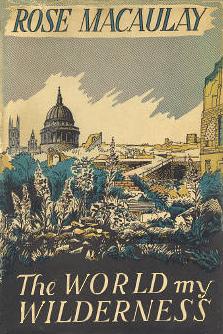
Against that background, might religion be a way of recovering the best of the old order, of a now bygone Europe? In an English context, that would signal the appeal of Roman Catholicism, or of its Anglo-Catholic counterpart. Or must the world resign itself to dealing only with “empty shells of churches”?
Here is Macaulay’s account of the hardened young veteran Richmond Deniston (Richie), Barbary’s brother: the passage deserves careful reading, and re-reading:
Richie, himself trapped into barbarism for three long, unbelievable years, shrank back from it, reacted towards gentleness, towards bland tolerance, towards an excessive civility. The rich elegances of life, now so little probable, the fine decoration, the exquisite glow of colour and grace of structure, the beauty that wealth and knowledge can bring, the fineness, the ivory tower of aristocratic culture, that war and peace had undermined, had set tottering, had all but brought down with a crash, to replace by pre-fabs for the multitude, by a thin, weak, tainted mass culture–it was towards these obsolescent things that Richie nostalgically turned, pursuing their light retreating steps as one chases beloved ghosts.
In this pursuit he was impelled sometimes beyond his reasoning self, to grasp at the rich, trailing panoplies, the swinging censers, of churches from whose creeds and uses he was alien, because at least they embodied some continuance, some tradition; while cities and buildings, lovely emblems of history, fell shattered, or lost shape and line in a sprawl of common mass newness, while pastoral beauty was overrun and spoilt, while ancient communities were engulfed in the gaping maw of the beast of prey, and Europe dissolved into wavering anonymities, bitter of tongue, servile of deed, faint of heart, always treading the frail plank over the abyss, rotten-ripe for destruction, turning a slanting, doomed eye on death that waited round the corner–during all this frightening evanescence and dissolution the historic churches kept their strange courses, kept their improbable, incommunicable secret, linking the dim past with the disrupted present and intimidating future, frail, tough chain of legend, myth, and mystery, stronghold of reaction and preserved values.
Might the Church truly be the rock against which the gates of contemporary Hell could never prevail? Richie’s strong temptation is to become a Roman Catholic, but that would be very hard to explain to his family. But there was an acceptable alternative:
Anglican, then, he compromised, and that would go better with his father, suggesting to him college chapels, good glass windows, Byrd anthems, Gothic cathedrals, the Temple church, the benchers at lunch on Sundays at Lincoln’s Inn.
Of course, we can’t assume that Macaulay was speaking directly through her character, but the words do echo what we know about her own views around this time. We may not agree with the characterizations of the romanticized past, or of the stereotyped present, but it is a powerful vision, of a kind that attracted a great many individuals in the twentieth century, especially in the immediate aftermath of each of the two world wars.
Previous Post

July 26, 2023
The Great Potsdam Castle Bathroom Incident, or, How I Changed My Mind
Recent Comments
"Every religion is "made up," even Adam and Eve were made up thousands of years ..."
Forging Druids and Inventing a Nation
"I have an identical twin, and Thomas was always the disciple I connected with most. ..."
In the Footsteps of Thomas: A ..."
"I've never thought of Constantine as a villain. Do Christians generally? Maybe the ones who ..."
"The TV sitcom BEWITCHED was an old favorite of mine"
How Scotland Gave Us Our Modern ..."
Browse Our Archives
Select a Category abolitionism Abortion Abraham Joshua Heschel Abraham Kuyper Abraham Lincoln Academia Activism Adam Renberg Advent Adventist africa African American Religion Agnes Howard Albert Camus American History American Religious History American Revolution American West Anabaptists Ancient History Andrea Turpin Andrei Tarkovsky Anglicanism Annales Ansley Lillian Quiros anti-Catholicism Antisemitism Anxious Bench apologetics Apparitions Arash Azizi Archaeology archives art Artificial Intelligence Asia Asian Americans Augustine Authors Bad Bunny Baptism Baptists Barack Obama Battle of Hastings Benjamin Franklin Bernard-Henri Levy Beth Allison Barr Beth Moore Bethany Mannon Bible Bill Cunningham Billy Graham Black Music Bob Dylan Body Boenhoffer Books Breastfeeding Bruce Springsteen C.S. Lewis Calvinism Cancel Culture Capitalism Carmelites Catholicism Cedric Robinson Cesar Chavez Charismaticism charity Charles Dickens Charles Lindbergh Che Guevara Chicago Children Chinese Christianity Chris Gehrz Christ Christian death Christian Higher Education Christian life Christian Nation Christian Nationalism Christianity Today Christmas Church life Church Practice cinema Civil Religion Civil Rights Movement Civil War civility Classics Climate Change Cold War Colonial Mexico colonialism Comer Communism community complementarianism Conference on Faith and History Congregationalism Conspiracies Conspiracy Conversion Narratives Coronavirus Costa Rica Council of Nicaea Covid-19 Creation Critical Race Theory Crusades Culture culture wars Daniel K. Williams David Barton David Swartz Death Ways death with dignity DEI democracy Democratic Party Devotion Digital Age Diplomacy discipleship diversity Donald Trump Drama Dua Lipa Early Church early modern Early modern Catholicism Easter Eastern Christianity economic exploitation Education elections Elie Wiesel Elizabeth II Elizabeth Taylor emotions Empire Engineering England enslavement Entertainment Episcopal Church Erica Ramirez eschatology Eurocentrism Evangelicalism Evangelicals Exegesis Family Feminism Film Flannery O'Connor folk music Food Foreign Policy founding fathers Franciscans Franciscus Junius fundamentalism Funerals G.K. Chesterton Gender Genocide genre geography George W. Bush George Washington George Whitefield Global Christianity Global church Grief Guadalupe Guest Post guest post gun control gun violence Gustavo Gutierrez Hamid Dabashi Harold John Ockenga Harvest Hate Hawaiian Christianity Healing health care Heather Cox Richardson Hell Heresy Hermeneutics Higher Education Hinduism Hippocratic oath Historical Fiction Historical Methodology Historical Profession Historical Profession Historical Theology Historical Thinking historiography Holidays Holocaust horror movies Human rights Humanitarian Work humanities Hummingbirds Hungary hymns Imago Dei Immigration Injustice Interviews Iran Islam Islamophobia Israel Ivan's Childhood Jacob Randolph James Bratt Janine Giordano Drake Japanese history Japanese Literature Jean Paul Sartre Jesse Miranda Jesus Jesus Christ Jimmy Carter Joan Baez Joan Didion Joanne Freeman João B. Chaves Joao Chaves Joey Cochran John Calvin John Fea John Tillotson John Turner Johnny Cash Jonathan Edwards Jonathan Tran Joseph Smith Josh Howerton Journalism Jr. Judaism Jürgen Moltmann Just War Justice Justin Brierley Karl Barth Katelyn Beaty koi ponds Kris Kristofferson Kristin Kobes Du Mez Latin American Religious History Latino Americans Lectio Divina Leisure Lent Leonard Cohen liberal arts liberalism Liberation Theology Linda Ronstadt Lisa Clark Diller Literature Lou Reed Lynchings Lynneth Miller Renberg Mainline Protestantism Malcolm Foley Marilyn Monroe Maritime history Mark Noll Marriage Martin Luther Martin Luther King Martyrdom Marxism Mary Masih Alinejad mass shootings material culture medieval Christianity Medieval Ethiopia Melissa Borja memory Mennonites Mental Health Mental Illness Methodism Mexican Americans Mexicans Mike Madrid Miles Mullin Min Jin Lee Miscarriage Missionaries Mister Rogers Mitt Romney modernity Monasticism Mormonism Motherhood Mothers of the Church Moving Music Musicals Nadya Williams Nahua Christianity Native Americans Natsume Sōseki New Contributor New England New Year New York Nico Non-Violent Protest Orthodoxy pacifism Paleo Evangelicals Palestinians Parenting Patti Smith Paul Kingsnorth Pedro Calderón de la Barca Pentecostalism Philip Jenkins Phillis Wheatley physician-assisted suicide pilgrimage Pilgrims Piracy pluralism Plutocracy Poetry Politics Pope Francis Pope Leo XIV post-modernism prayer preaching Presbyterians prosperity gospel Protest Public Executions Public history Publishing Puritans purity culture Quakers race Race Massacres Racial Capitalism racial reconciliation racialization Racism Raha Bahloulipour Re-Enchantment reading Reformation Refugees religion and the university religion and war Religious Freedom Religious Nones Religious Pluralism Religious Symbols religious violence Republican Party Revival Rita Coolidge Ritual Roger Williams Roman Catholic church Royalty Russell Moore same-sex marriage Sarah Irving-Stonebraker Scandinavia Science Science and Technology Scopes trial Scriptural Interpretation secularism Selena Quintanilla seminary Seventh-Day Adventists sexual morality Sexuality Sikhs Silence slaveholders theology Slavery Slavoj Zizek social justice Social Media Southern Baptist Convention Southern Religion Spain Spiritual Autobiography Spiritual but not religious Spiritual Discipline Sports Stanley Hauerwas Suffering Summer Camps Sunday Night Odds and Ends Supernatural Supreme Court Syriac Christianity Tal Howard Taylor Swift Teaching Technology Television Thanksgiving The Beatles The Mission theater TheoBros Theology Thomas Dixon Thomas Jefferson Thomas Kidd Thomas Merton Tim Gloege Tim Walz Tom Holland Tourism tradition Tragedy Translation Transnationalism Travel Trump Ukraine Uncategorized Unitarians United Methodist Church US History Vanessa Chan Velvet Underground Verónica A. Gutiérrez Veronica Gutierrez Vikings Violence Virgin Mary Virtue Virtue ethics Visions Voting War WCTU Wendell Berry Westminster Assembly White Evangelicalism Wildfires Winnie the Pooh Witches women Women in Ministry Women's and Gender Studies Work Worship writing Yasunari Kawabata Zena Hitz
Select a Month November 2026 October 2026 September 2026 August 2026 July 2026 June 2026 May 2026 April 2026 March 2026 February 2026 January 2026 December 2025 November 2025 October 2025 September 2025 August 2025 July 2025 June 2025 May 2025 April 2025 March 2025 February 2025 January 2025 December 2024 November 2024 October 2024 September 2024 August 2024 July 2024 June 2024 May 2024 April 2024 March 2024 February 2024 January 2024 December 2023 November 2023 October 2023 September 2023 August 2023 July 2023 June 2023 May 2023 April 2023 March 2023 February 2023 January 2023 December 2022 November 2022 October 2022 September 2022 August 2022 July 2022 June 2022 May 2022 April 2022 March 2022 February 2022 January 2022 December 2021 November 2021 October 2021 September 2021 August 2021 July 2021 June 2021 May 2021 April 2021 March 2021 February 2021 January 2021 December 2020 November 2020 October 2020 September 2020 August 2020 July 2020 June 2020 May 2020 April 2020 March 2020 February 2020 January 2020 December 2019 November 2019 October 2019 September 2019 August 2019 July 2019 June 2019 May 2019 April 2019 March 2019 February 2019 January 2019 December 2018 November 2018 October 2018 September 2018 August 2018 July 2018 June 2018 May 2018 April 2018 March 2018 February 2018 January 2018 December 2017 November 2017 October 2017 September 2017 August 2017 July 2017 June 2017 May 2017 April 2017 March 2017 February 2017 January 2017 December 2016 November 2016 October 2016 September 2016 August 2016 July 2016 June 2016 May 2016 April 2016 March 2016 February 2016 January 2016 December 2015 November 2015 October 2015 September 2015 August 2015 July 2015 June 2015 May 2015 April 2015 March 2015 February 2015 January 2015 December 2014 November 2014 October 2014 September 2014 August 2014 July 2014 June 2014 May 2014 April 2014 March 2014 February 2014 January 2014 December 2013 November 2013 October 2013 September 2013 August 2013 July 2013 June 2013 May 2013 April 2013 March 2013 February 2013 January 2013 December 2012 November 2012 October 2012 September 2012 August 2012 July 2012 June 2012 May 2012
Follow Us!
TAKE THE
Religious Wisdom Quiz
Which of the following is NOT part of the armor of God?
Select your answer to see how you score.
Sword of the Spirit Shield of Knowledge Helmet of Salvation Belt of Truth
Related posts from Anxious Bench
Forging Druids and Inventing a Nation
Why Do Forgeries Explode in Some Eras and...
In the Footsteps of Thomas: A Christian Story...
Fairies, Witches, Folk Horror, and the Secret Commonwealth
TRENDING AT PATHEOS Evangelical

Rock N' Roll-- Morphing into/for a New Generation...
Well, should we be grateful, or is rock n' roll just dead? ...

Ansley Gordon Brings Faith and Fresh Stories to...
For screenwriter and actress Ansley Gordon, Christmas has always been about more...

Chris Pratt on Veterans, Faith, “The Way of...
For Chris Pratt, service is not something that ends when a person...

Chapter 5, Sarah: The Quest for Safety in...
Open and Relational Theology & Social Psychology About this series: This series...

When Worry Gets You Nowhere, How Can Faith...
Sometimes, we think that by worrying, we can somehow predict the future....

The Wasp And I: Meditations on Repentance
How can we enter the power and joy of the repentant self...
view all Evangelical blogs
What Are Your Thoughts?leave a comment
Ad-Free & Subscriber Log-In Subscription Support
- About Us
- 2026 Calendar
- Videos
- Podcasts
- Library of World Religions
- Faith In Media Tracker
- Advertise With Us
- Write for Us
- Privacy Policy
- Terms of Service
- Do Not Sell My Data
- Contact Us
- Radiant Digital
- Manage Newsletter Subscriptions
- Unsubscribe From Notifications
- Sitemap
Copyright 2008-2026, Patheos, part of the Radiant Digital network of media brands. All rights reserved.
Subscription Support Ad-Free & Subscriber Log-In
Follow Patheos