
BuddhistCatholicContemplativeEvangelicalGeneral ChristianHinduJewishLatter-day SaintMuslimNew VisionsProgressive Christian
Beliefs
- Buddhist
- Catholic
- Contemplative
- Evangelical
- General Christian
- Hindu
- Jewish
- Latter-day Saint
- More Voices
- Muslim
- New Visions
- Pagan
- Progressive Christian
Topics
- Religion News
- Food and Religion
- Sports and Religion
- Religious Art
- Religious Music and Entertainment
- Religious Events
- History and Religion
- Style and Religion
- Politics and Religion
- Women in Religion
- Recreation Outdoors and Religion
- Business Finance and Religion
- Careers Workplace and Religion
- Education and Religion
- Family Parenting and Religion
- Health Fitness and Religion
- Home and Religion
- Relationships and Religion
- Technology and Religion
- Travel and Religion
Columnists
- Buddhist Columnists
- Business Finance and Religion Columnists
- Careers Workplace and Religion Columnists
- Catholic Columnists
- Contemplative Columnists
- Education and Religion Columnists
- Evangelists Columnists
- Family Parenting and Religion Columnists
- General Christian Columnists
- Health Fitness and Religion Columnists
- Hindu Columnists
- History and Religion Columnists
- Home and Religion Columnists
- Jewish Columnists
- More Voices Columnists
- Latter Day Columnists
- Muslim Columnists
- New Visions Columnists
- Nonreligious Columnists
- Pagan Columnists
- Politics and Religion Columnists
- Progressive Columnists
- Recreation Outdoors and Religion Columnists
- Relationships and Religion Columnists
- Religion News Columnists
- Religious Art Columnists
- Religious Events Columnists
- Religious Music and Entertainment Columnists
- Sports and Religion Columnists
- Style and Religion Columnists
- Technology and Religion Columnists
- Travel and Religion Columnists
- Women in Religion Columnists
Resource Library
- 2026 Calendar
- Library of World Religions
- The 100 Most Holy Places on Earth
- Patheos Answers
- Podcasts
- Videos
- Faith Leaders Database
- Anglican Episcopalian
- Bahai
- Baptist
- Buddhism
- Christianity
- Confucianism
- Eastern Orthodoxy
- Hinduism
- Holiness and Pentecostal
- ISKCON
- Islam
- Judaism
- Lutheran
- Methodist
- The Church of Jesus Christ of Latter-day Saints
- New Age
- Paganism
- Presbytarian and Reformed
- Protestantism
- Religion Behind the Scenes
- Roman Catholic
- Scientology
- Shia Islam
- Sikhism
- Sufism
- Sunni Islam
- Taoism
- Zen
- See all religions
Research Tools
 Ad-Free & Subscriber Log-In Subscription Support
Ad-Free & Subscriber Log-In Subscription Support
Follow Patheos 

- Trending:
- Forgiveness
- |
- Marriage
- |
- Consciousness
- |
- Death Penalty
- |
- Election
- |
- Halloween

-
About the Authors
- Home
- Evangelical
- War, Pestilence, and the Life Verse(s) of Victorian America
War, Pestilence, and the Life Verse(s) of Victorian America
Last updated on: January 5, 2023 at 12:55 am by Philip Jenkins
War, Pestilence, and the Life Verse(s) of Victorian America 2023-01-02T19:09:32-04:00 Philip Jenkins
Patheos Explore the world's faith through different perspectives on religion and spirituality! Patheos has the views of the prevalent religions and spiritualities of the world.
Can a whole society have a life verse?
As I argue in my recent book, Psalm 91 is one of the scriptures most used by Christians and Jews through history to confront a variety of dangers, most tellingly war and disease. The psalm, after all, appears to promise that those who invoke not only may be protected from harm, but that they assuredly will. We find examples of such invocations throughout the past couple of millennia, but I was struck just how very commonplace they were in a period dear to my heart, namely the nineteenth century US. At the time, it was assuredly the most commonly used psalm, far more so than the 23rd. It became the life verse of a society – well, more accurately perhaps, its death verse.
The War Psalm
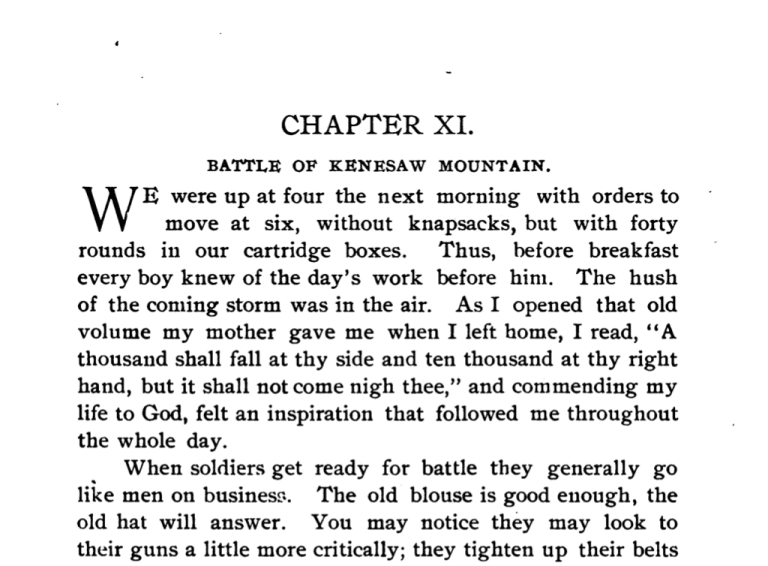
The obvious occasion for such uses was the Civil War, when 91 was so often invoked for protection.Who could fail to turn to a psalm that promised the believer that “A thousand shall fall at thy side, and ten thousand at thy right hand; but it shall not come nigh thee”?
There are so many possible examples to choose from that I can only graze here. When the survivors of the Union’s Taylor’s Battery gathered for a reunion in 1880, they recalled the opening days of the war in a scene that must have occurred (at least) hundreds of times across the nation in those weeks, North and South:
A kind Providence certainly watched over this battery from that Sabbath day, May 28, 1861, when in a body we attended the First Presbyterian Church [Chicago], and when the pastor, Dr Humphrey, called our attention to Psalm XCI [ie, 91, which is then quoted in full]… Then devoutly and with much earnestness he besought God in prayer to be gracious to us, and to protect us while in camp, on the march and in the field. Who of us today will not say that the prayers of that pastor and his church were wonderfully answered and that God was “our refuge and our fortress?…. Nothing but the Divine protection saved us again and again from being captured or entirely crushed.
On the other side of the conflict, here is the nineteen year old Confederate soldier Randolph Harrison McKim, writing in July 1861, and freely quoting 91:
Do not, my precious mother, be too much alarmed and too anxious about me. I trust and hope that God will protect me from “the terror by night” and “the destruction that wasteth at noon-day.” I feel as if my life was to be spared. I hope yet to preach the Gospel of the Jesus Christ; but, my dear mother, we are in God’s hands, and He doth not willingly afflict or grieve the children of men. “He that dwelleth in the secret place of the most High shall abide under the shadow of the Almighty.” He does all things well, and He will give you grace to bear this trial too.
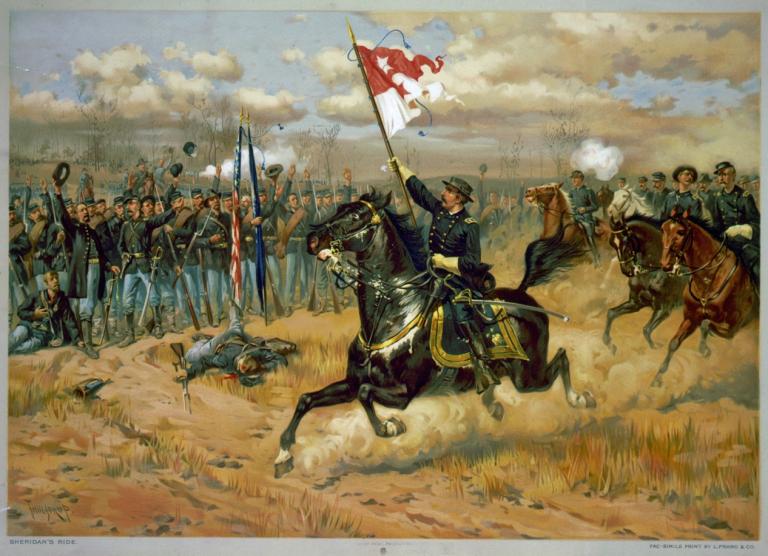
When Confederate Cadets marched off to war in Petersburg, VA, in September 1861, the Rev. Robert Newton Sledd preached a sermon assuring them that:
And surely if any one has need of the constant protecting care and power of an almighty hand, that one is the soldier. …. And although he may escape the missiles of the foe, the air which he breathes is loaded with disease; and often when he thinks himself the most secure, the enemy is fixing its deadly fangs in his vitals. Oh, then, humbly submit yourselves to God! Seek shelter “in the secret place of the Most High,” that you may find protection from “the arrow that flieth by day,” and “the pestilence that walketh in darkness.” Let the God of Jacob be your God, His will your will, and his glory your end. Then may you claim that promise which saith, “A thousand shall fall at thy side, and ten thousand at thy right hand; but it shall not come nigh thee. Only with thine eyes shalt thou behold and see the reward of the wicked.”
Also in 1861, a Mississippi cavalry commander submitted an official report of his unit’s actions in the day’s battle: “And first allow me to record with gratitude the kind Providence which shielded us in the day of battle and saved so many from ‘the destruction that wasteth at noonday.’ ” Another of the many soldiers to leave his recollections was the Union’s John Beatty, later a prominent figure in Ohio politics. In January 1863, he noted how his unit’s morale was rising: “I draw closer to the camp-fire, and, pushing the brands together, take out my little Bible, and as I open it my eyes fall on the XCI [91st] Psalm,” which he then quotes in full.
The psalm features regularly in accounts of heroic and dying soldiers—not by any means as the only scripture so employed, but as a deeply valued text. When Stonewall Jackson was killed in 1863, it was only natural to commemorate the great Godly warrior through that Psalm. One sermon, preached in Lynchburg’s First Presbyterian Church, took its text from the Psalm, “I will set him on high, because he hath known my name”:
Our text which is but a statement of this truth, is a concentration of Gen. JACKSON’S whole history. It is his life and his character, his fame and its secret source, all in a single sentence. It declares the secret of his great eminence. God set him on high, because he honored God. This whole Psalm beautifully and strikingly applies to him. It describes the Divine protection and honor of the man that dwelleth in the secret place of the Most High, that says of the Lord, He is my refuge and my fortress : my God, in him will I trust. It is of him that God here says, “I will set him on high, because he hath known my name.”
Warding Off Evil
The Psalm was meant to be apotropaic, that is, to ward off evils. Here is the Union’s Major Henry Meyer in 1862, after the battle of Cedar Mountain:
I then took out my pocket Testament and went to a picket fire near where I was, leaning over to read a verse or two by its light, when I heard a rustle in the bushes. Immediately I grasped my weapons and was on the alert, when a colored man crawled through the bushes and said to me, “What’s that you got there, a Testament?” On admitting it, he said, “Do you know the chapter General Washington always used to read before he went into a fight?” I told him I did not, whereupon he said, “You turn to the Ninety-first Psalm.” “Now,” he said, “you read it.” I then read aloud:
“Surely He shall deliver thee from the snare of the fowler and from the noisome pestilence.
“He shall cover thee with His feathers and under His wings shalt thou trust; His truth shall be thy shield and buckler.
“Thou shalt not be afraid for the terror by night nor for the arrow that flieth by day.
“Nor for the pestilence that walketh in darkness, nor for the destruction that wasteth at noon day.
“A thousand shall fall at thy side and ten thousand at thy right hand; but it shall not come nigh thee.”
At the reading of each of these verses he exclaimed, “You see, he didn’t get hit.” The contraband [ie, the escaped slave] evidently was perfectly sincere in the belief that if I read this verse before a battle I would never get hurt.
In 1865, Confederate soldier Henry Morton returned to his home in Tennessee, amazed to be still alive. As he wrote,
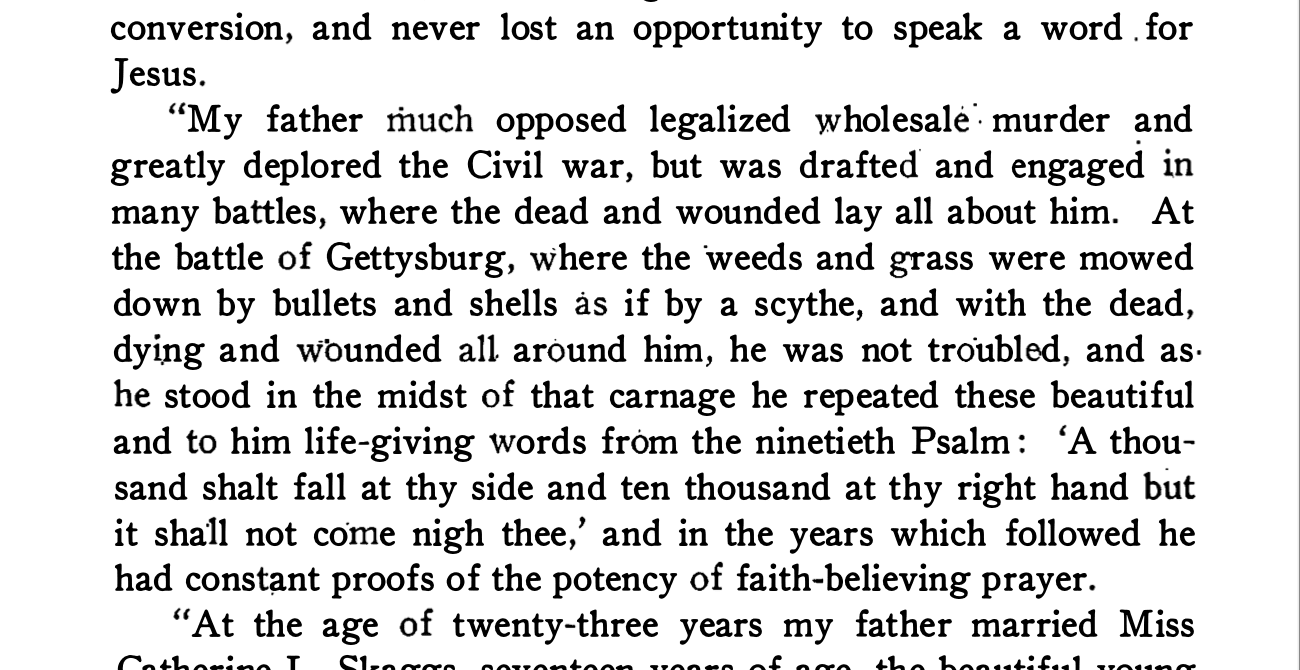
When I left home three years previously, in the Spring of 1862, my mother had given me a small pocket Testament, on the fly leaf of which she had written ‘ A thousand shall fall st thy side, and ten thousand at thy right hand, but it shall not come nigh thee” (Ps.91.7). It seemed almost like a prophecy, and was literally fulfilled, for in all my war experience, I had never received a wound.
One of the more remarkable (and still insufficiently known) memoirs of this era is that of Levi Branham (1852-1944), born a slave in Georgia, and who survived his later encounters with the Ku Klux Klan. He cited the three scriptural texts that he cherished, and which had allowed him to pass through those menaces unscathed. Those were Psalm 91 (of course), together with Psalm 23, and Ecclesiastes 1.1-18. His memoir concludes with the full text of all three.
Interpreting the War
The psalm’s words and imagery inevitably framed understandings of the larger conflict. In a sense, Psalm 91 was the founding text of abolitionism. When the American Anti-Slavery Society held its inaugural meeting in Philadelphia in 1833, its commemorative Declaration included a potent image of a warrior defeating threatening creatures, with the psalm’s v. 13 quoted underneath: “Thou shalt tread upon the lion and adder: the young lion and the dragon shalt thou trample under feet.”
In 1859, after John Brown’s raid, the Staunton Spectator [Virginia] framed the coming conflict entirely in terms of 91:
the people of the South place their trust in a higher power, whose protecting care they expect in time of peril. They believe that an institution of slavery is ordained in Heaven, and that the slaveholder who trusts in the Almighty arm will find that arm a refuge and a fortress. They expect to be delivered from the snare of the Abolition fowler and the noisome pestilence of fanaticism. Truth is their shield and buckler, and they are not afraid of the terror by night nor the arrow that flieth by day.–And in any contest that may arise in so righteous a cause will have an abiding confidence that a thousand shall fall at their side and ten thousand at their right hand, until they come off conquerors.
Our psalm’s v. 6 became a common metaphor for the war and its sufferings. Here is a typical sermon at the start of the war, from Rev. Frederick H. Hedge, in Brookline, Mass., who warned of clandestine enemies within Union ranks:
There never was a conflict so complicated and embarrassing as ours. Had we only the known, declared, and open enemy to encounter, our task would be comparatively light. But we have to contend with secret foes; our enemies are partly those of our own household; Treason lurks in our own ranks, in league with Rebellion outside, and furthering its cause. If we fail at last, it will be the treachery that walketh in darkness, not the destruction that wasteth at noonday, to which we succumb.
(Hedge himself was a leading light among the Transcendentalists). In 1864, Frederick Douglass drew on the familiar rhetorical arsenal when he declared that the Confederacy and its cause “rivaled the earthquake, the whirlwind, the pestilence that walketh in darkness, and wasteth at noonday.”
It is hard to overstate how frequently the “pestilence that walketh” verse appears in accounts of individuals and events, whether we are looking at memoirs, regimental histories, or obituaries: such quotations and recollections could be multiplied almost endlessly. Of course the verse was quoted when Harvard University – and countless other institutions – celebrated the war’s end in 1865.
Pestilence
The words had a special relevance because of the “pestilence” element: as soldiers knew from grim experience, disease was almost as effective a killer during the war as was actual combat. Already in December 1861, a Confederate doctor in North Carolina observed that “our brave troops have suffered very much from sickness. Some, in their encounter with the enemy, whilst defending ‘the land of the free and the home of the brave,’ have fallen victims of the arrow that flieth by day; but a far greater number have fallen to the pestilence that walketh in darkness.” A Union veteran recorded the hideous conditions in the notorious Confederate prison camp at Andersonville: “Making that prison pen a very breeding place for disease and death, where ‘the pestilence that walketh in darkness and the destruction that walketh at noonday’ found no opposition.”
Quite apart from the war itself, literal pestilence was also very common, far more so than we often recall in our visions of nineteenth century US life, and 91 was often used to frame and understand it. Around the English-speaking world, Psalm 91 supplied the images and metaphors that were regularly used for cholera, which launched deadly assaults on the US in 1832, 1848, and 1866. In 1832, Orville Dewey of the Unitarian Church in New Bedford preached on “The Moral Uses Of The Pestilence, Denominated Asiatic Cholera”:
But if there is a Power, beneficent as it is mighty, that stays, at its pleasure, the pestilence that walketh in darkness and the destruction that wasteth at noon-day; if it suffers the prevalence of disease to answer wise purposes; if this calamity, however singular, is, nevertheless, a part of the universal providence; if it is, like all other means for the reform and improvement of the world, to do more good than evil; then surely may we learn to look upon it with calmness and acquiescence.
Alluding to the cholera epidemic of that same year, Cherokee editor Elias Boudinot warned of the dreadful dangers facing his nation at the hands of
an overwhelming white population, a population overcharged with high notions of color dignity, and greatness-at once overbearing and impudent to those whom, in their sovereign pleasure, they consider as their inferiors. … Such a population, and the evils and vices it would bring with it, the chief of which would be the deluging the country with ardent spirits, would create an enemy, a hundred fold more to be dreaded than the unseen messenger of God’s anger, now traversing the earth-‘the pestilence that walketh in darkness ‘ the destruction that wasteth at noon day.’
In 1896, an Iowa writer recalled the horrible cholera outbreak in that state in 1851. He concluded, typically: “What man would not much prefer taking his chances in a bloodier battle than any of the great Civil War to meeting the pestilence that walketh in darkness; this destruction which wasteth at noonday?”
Yellow fever was called the “yellow demon,” with appropriate citations of the psalm’s “noonday demon.” When a yellow fever epidemic struck Mobile, Alabama, in 1853, Methodist minister John Wesley Starr wrote, “The pestilence walketh in the darkness, and the destruction wasteth at noonday. Day and night, more or less, I am visiting the victims of the plague.” (The disease killed Starr shortly thereafter.)
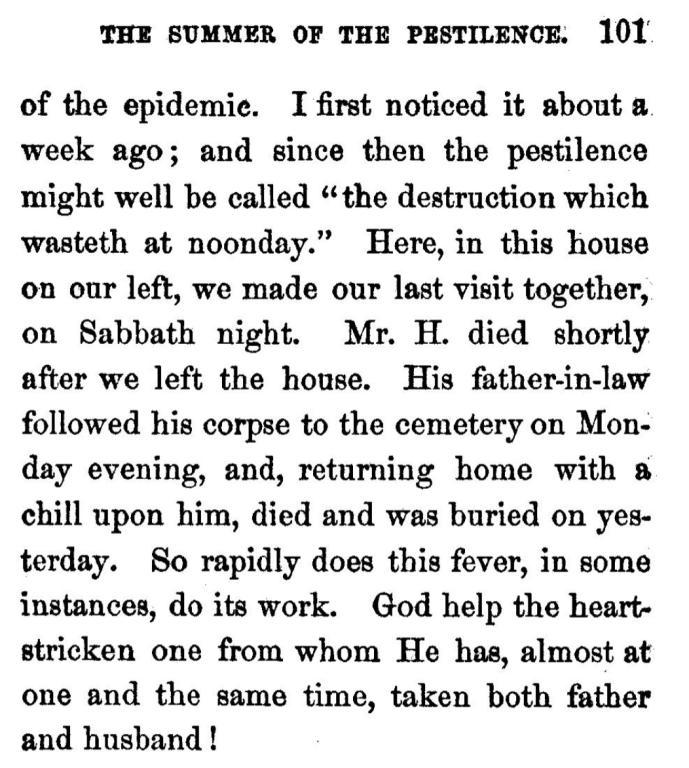
Similar words, with the same verse quoted, featured regularly across the U.S. South over the following decades. When yellow fever ravaged Shreveport, Louisiana, in 1873, one preacher “faced the pestilence that walketh in darkness and wasteth at noonday, until his exhausted strength succumbed to the deadly miasm [sic for miasma].” The same language permeated secular accounts.
Very few of those who used the psalm in this “biblical” way were seriously attributing a given epidemic to supernatural or angelic forces. Rather, the words were attractive because they were so well known and offered an effective rhetorical tool for stressing the potential threat of a particular ailment. The Rev. Starr knew very well that he was not dealing with literal “plague,” but the word carried so much Old Testament freight.
Crisis
When Grover Cleveland was inaugurated as President in 1893, the great financial panic of that year was just beginning, inaugurating an annus horribilis that would closely foreshadow the horrors of the Great Depression of the 1930s, with threats of starvation and open revolution. Presumably conscious of those approaching threats, Cleveland took his oath of office on a Bible opened at Psalm 91: 12-16: “They shall bear thee up in their hands, lest thou dash thy foot against a stone. Thou shalt tread upon the Lion and the Adder; the young Lion and the Dragon shalt thou trample under feet.” Had I been present at the event, Cleveland’s choice of text would not have filled me with any great sense of confidence about the nation’s imminent future, and I would have been dead right.
We really could use the psalm as a lens for understanding many aspects of the social and cultural history of the US in that era. And if you delve into the documents of the American nineteenth century – notably in the Civil War years – you can’t fail to find many more examples. When you know to look for the key words, you will find them everywhere.
And yes, you could do exactly the same digging for many other eras of war, definitely including World War I, and probably the Second World War as well.
Previous Post
January 3, 2023
A Response to Kevin DeYoung on John Witherspoon
Next Post
January 7, 2023 On Defending the Indefensible: A Call for Moral Clarity
Recent Comments
"I love horror but would have to acclimate back to Lovecraft and especially Machen. Have ..."
Fairies, Witches, Folk Horror, and the ..."
"Very good point about MacDonald.I am certainly a Machen fan!"
Fairies, Witches, Folk Horror, and the ..."
"The Scottish author George MacDonald integrated fairy world into his fiction in a way that ..."
Fairies, Witches, Folk Horror, and the ..."
"I like the idea that we can have different streams. The coffee analogy is genius."
How Do You Take Your Evangelicalism?
Browse Our Archives
Select a Category abolitionism Abortion Abraham Joshua Heschel Abraham Kuyper Abraham Lincoln Academia Activism Adam Renberg Advent Adventist africa African American Religion Agnes Howard Albert Camus American History American Religious History American Revolution American West Anabaptists Ancient History Andrea Turpin Andrei Tarkovsky Anglicanism Annales Ansley Lillian Quiros anti-Catholicism Antisemitism Anxious Bench apologetics Apparitions Arash Azizi Archaeology archives art Artificial Intelligence Asia Asian Americans Augustine Authors Bad Bunny Baptism Baptists Barack Obama Battle of Hastings Benjamin Franklin Bernard-Henri Levy Beth Allison Barr Beth Moore Bethany Mannon Bible Bill Cunningham Billy Graham Black Music Bob Dylan Body Boenhoffer Books Breastfeeding Bruce Springsteen C.S. Lewis Calvinism Cancel Culture Capitalism Carmelites Catholicism Cedric Robinson Cesar Chavez Charismaticism charity Charles Dickens Charles Lindbergh Che Guevara Chicago Children Chinese Christianity Chris Gehrz Christ Christian death Christian Higher Education Christian life Christian Nation Christian Nationalism Christianity Today Christmas Church life Church Practice cinema Civil Religion Civil Rights Movement Civil War civility Classics Climate Change Cold War Colonial Mexico colonialism Comer Communism community complementarianism Conference on Faith and History Congregationalism Conspiracies Conspiracy Conversion Narratives Coronavirus Costa Rica Council of Nicaea Covid-19 Creation Critical Race Theory Crusades Culture culture wars Daniel K. Williams David Barton David Swartz Death Ways death with dignity DEI democracy Democratic Party Devotion Digital Age Diplomacy discipleship diversity Donald Trump Drama Dua Lipa Early Church early modern Early modern Catholicism Easter Eastern Christianity economic exploitation Education elections Elie Wiesel Elizabeth II Elizabeth Taylor emotions Empire Engineering England enslavement Entertainment Episcopal Church Erica Ramirez eschatology Eurocentrism Evangelicalism Evangelicals Exegesis Family Feminism Film Flannery O'Connor folk music Food Foreign Policy founding fathers Franciscans Franciscus Junius fundamentalism Funerals G.K. Chesterton Gender Genocide genre geography George W. Bush George Washington George Whitefield Global Christianity Global church Grief Guadalupe Guest Post guest post gun control gun violence Gustavo Gutierrez Hamid Dabashi Harold John Ockenga Harvest Hate Hawaiian Christianity Healing health care Heather Cox Richardson Hell Heresy Hermeneutics Higher Education Hinduism Hippocratic oath Historical Fiction Historical Methodology Historical Profession Historical Profession Historical Theology Historical Thinking historiography Holidays Holocaust horror movies Human rights Humanitarian Work humanities Hummingbirds Hungary hymns Imago Dei Immigration Injustice Interviews Iran Islam Islamophobia Israel Ivan's Childhood Jacob Randolph James Bratt Janine Giordano Drake Japanese history Japanese Literature Jean Paul Sartre Jesse Miranda Jesus Jesus Christ Jimmy Carter Joan Baez Joan Didion Joanne Freeman João B. Chaves Joao Chaves Joey Cochran John Calvin John Fea John Tillotson John Turner Johnny Cash Jonathan Edwards Jonathan Tran Joseph Smith Josh Howerton Journalism Jr. Judaism Jürgen Moltmann Just War Justice Justin Brierley Karl Barth Katelyn Beaty koi ponds Kris Kristofferson Kristin Kobes Du Mez Latin American Religious History Latino Americans Lectio Divina Leisure Lent Leonard Cohen liberal arts liberalism Liberation Theology Linda Ronstadt Lisa Clark Diller Literature Lou Reed Lynchings Lynneth Miller Renberg Mainline Protestantism Malcolm Foley Marilyn Monroe Maritime history Mark Noll Marriage Martin Luther Martin Luther King Martyrdom Marxism Mary Masih Alinejad mass shootings material culture medieval Christianity Medieval Ethiopia Melissa Borja memory Mennonites Mental Health Mental Illness Methodism Mexican Americans Mexicans Mike Madrid Miles Mullin Min Jin Lee Miscarriage Missionaries Mister Rogers Mitt Romney modernity Monasticism Mormonism Motherhood Mothers of the Church Moving Music Musicals Nadya Williams Nahua Christianity Native Americans Natsume Sōseki New Contributor New England New Year New York Nico Non-Violent Protest Orthodoxy pacifism Paleo Evangelicals Palestinians Parenting Patti Smith Paul Kingsnorth Pedro Calderón de la Barca Pentecostalism Philip Jenkins Phillis Wheatley physician-assisted suicide pilgrimage Pilgrims pluralism Plutocracy Poetry Politics Pope Francis Pope Leo XIV post-modernism prayer preaching Presbyterians prosperity gospel Protest Public history Publishing Puritans purity culture Quakers race Race Massacres Racial Capitalism racial reconciliation racialization Racism Raha Bahloulipour Re-Enchantment reading Reformation Refugees religion and the university religion and war Religious Freedom Religious Nones Religious Pluralism Religious Symbols religious violence Republican Party Revival Rita Coolidge Ritual Roger Williams Roman Catholic church Royalty Russell Moore same-sex marriage Sarah Irving-Stonebraker Scandinavia Science Science and Technology Scopes trial Scriptural Interpretation secularism Selena Quintanilla seminary Seventh-Day Adventists sexual morality Sexuality Sikhs Silence slaveholders theology Slavery Slavoj Zizek social justice Social Media Southern Baptist Convention Southern Religion Spain Spiritual Autobiography Spiritual but not religious Spiritual Discipline Sports Stanley Hauerwas Suffering Summer Camps Sunday Night Odds and Ends Supernatural Supreme Court Syriac Christianity Tal Howard Taylor Swift Teaching Technology Television Thanksgiving The Beatles The Mission theater TheoBros Theology Thomas Dixon Thomas Jefferson Thomas Kidd Thomas Merton Tim Gloege Tim Walz Tom Holland Tourism tradition Tragedy Translation Transnationalism Travel Trump Ukraine Uncategorized Unitarians United Methodist Church US History Vanessa Chan Velvet Underground Verónica A. Gutiérrez Veronica Gutierrez Vikings Violence Virgin Mary Virtue Virtue ethics Visions Voting War WCTU Wendell Berry Westminster Assembly White Evangelicalism Wildfires Winnie the Pooh Witches women Women in Ministry Women's and Gender Studies Work Worship writing Yasunari Kawabata Zena Hitz
Select a Month October 2026 September 2026 August 2026 July 2026 June 2026 May 2026 April 2026 March 2026 February 2026 January 2026 December 2025 November 2025 October 2025 September 2025 August 2025 July 2025 June 2025 May 2025 April 2025 March 2025 February 2025 January 2025 December 2024 November 2024 October 2024 September 2024 August 2024 July 2024 June 2024 May 2024 April 2024 March 2024 February 2024 January 2024 December 2023 November 2023 October 2023 September 2023 August 2023 July 2023 June 2023 May 2023 April 2023 March 2023 February 2023 January 2023 December 2022 November 2022 October 2022 September 2022 August 2022 July 2022 June 2022 May 2022 April 2022 March 2022 February 2022 January 2022 December 2021 November 2021 October 2021 September 2021 August 2021 July 2021 June 2021 May 2021 April 2021 March 2021 February 2021 January 2021 December 2020 November 2020 October 2020 September 2020 August 2020 July 2020 June 2020 May 2020 April 2020 March 2020 February 2020 January 2020 December 2019 November 2019 October 2019 September 2019 August 2019 July 2019 June 2019 May 2019 April 2019 March 2019 February 2019 January 2019 December 2018 November 2018 October 2018 September 2018 August 2018 July 2018 June 2018 May 2018 April 2018 March 2018 February 2018 January 2018 December 2017 November 2017 October 2017 September 2017 August 2017 July 2017 June 2017 May 2017 April 2017 March 2017 February 2017 January 2017 December 2016 November 2016 October 2016 September 2016 August 2016 July 2016 June 2016 May 2016 April 2016 March 2016 February 2016 January 2016 December 2015 November 2015 October 2015 September 2015 August 2015 July 2015 June 2015 May 2015 April 2015 March 2015 February 2015 January 2015 December 2014 November 2014 October 2014 September 2014 August 2014 July 2014 June 2014 May 2014 April 2014 March 2014 February 2014 January 2014 December 2013 November 2013 October 2013 September 2013 August 2013 July 2013 June 2013 May 2013 April 2013 March 2013 February 2013 January 2013 December 2012 November 2012 October 2012 September 2012 August 2012 July 2012 June 2012 May 2012
Follow Us!
TAKE THE
Religious Wisdom Quiz
True or False: James says that if anyone is a hearer of the word and not a doer, he is blessed in what he does.
Select your answer to see how you score.
FALSE TRUE
Related posts from Anxious Bench

Fairies, Witches, Folk Horror, and the Secret Commonwealth

Hogg’s Justified Sinner: A Gothic Classic for Halloween

James Hogg, Weird Wives, and Feminist Witches

How an Explosive Book Rewrote the Study of...
TRENDING AT PATHEOS Evangelical

Nearly every morning, I make the drive to Detroit with my high-school-age...

The Real AI Story Is Adoption Without Trust
Artificial intelligence has crossed a political threshold. It is no longer a...

A new article, written by Jeff Lindsay and Gale L. Pooley,...

Swimfan: Forgotten Aughts Pleasures
This is a recovery effort. In 2002, My Big Fat Greek Wedding...

Top Three Anti-Catholic Lies About Catholicism
This is my initial transcript for the video, "THE 3 WORST...

Pope Leo Celebrates Mass for Nurses & Docs...
I don't have any idea how he did it, but Pope Leo...
view all Evangelical blogs
What Are Your Thoughts?leave a comment
Ad-Free & Subscriber Log-In Subscription Support
- About Us
- 2026 Calendar
- Videos
- Podcasts
- Library of World Religions
- Faith In Media Tracker
- Advertise With Us
- Write for Us
- Privacy Policy
- Terms of Service
- Do Not Sell My Data
- Contact Us
- Radiant Digital
- Manage Newsletter Subscriptions
- Unsubscribe From Notifications
- Sitemap
Copyright 2008-2026, Patheos. All rights reserved.
Subscription Support Ad-Free & Subscriber Log-In
Follow Patheos