
BuddhistCatholicContemplativeEvangelicalGeneral ChristianHinduJewishLatter-day SaintMuslimNew VisionsProgressive Christian
Beliefs
- Buddhist
- Catholic
- Contemplative
- Evangelical
- General Christian
- Hindu
- Jewish
- Latter-day Saint
- More Voices
- Muslim
- New Visions
- Pagan
- Progressive Christian
Topics
- Religion News
- Food and Religion
- Sports and Religion
- Religious Art
- Religious Music and Entertainment
- Religious Events
- History and Religion
- Style and Religion
- Politics and Religion
- Women in Religion
- Recreation Outdoors and Religion
- Business Finance and Religion
- Careers Workplace and Religion
- Education and Religion
- Family Parenting and Religion
- Health Fitness and Religion
- Home and Religion
- Relationships and Religion
- Technology and Religion
- Travel and Religion
Columnists
- Buddhist Columnists
- Business Finance and Religion Columnists
- Careers Workplace and Religion Columnists
- Catholic Columnists
- Contemplative Columnists
- Education and Religion Columnists
- Evangelists Columnists
- Family Parenting and Religion Columnists
- General Christian Columnists
- Health Fitness and Religion Columnists
- Hindu Columnists
- History and Religion Columnists
- Home and Religion Columnists
- Jewish Columnists
- More Voices Columnists
- Latter Day Columnists
- Muslim Columnists
- New Visions Columnists
- Nonreligious Columnists
- Pagan Columnists
- Politics and Religion Columnists
- Progressive Columnists
- Recreation Outdoors and Religion Columnists
- Relationships and Religion Columnists
- Religion News Columnists
- Religious Art Columnists
- Religious Events Columnists
- Religious Music and Entertainment Columnists
- Sports and Religion Columnists
- Style and Religion Columnists
- Technology and Religion Columnists
- Travel and Religion Columnists
- Women in Religion Columnists
Resource Library
- 2026 Calendar
- Library of World Religions
- The 100 Most Holy Places on Earth
- Patheos Answers
- Podcasts
- Videos
- Faith Leaders Database
- Anglican Episcopalian
- Bahai
- Baptist
- Buddhism
- Christianity
- Confucianism
- Eastern Orthodoxy
- Hinduism
- Holiness and Pentecostal
- ISKCON
- Islam
- Judaism
- Lutheran
- Methodist
- The Church of Jesus Christ of Latter-day Saints
- New Age
- Paganism
- Presbytarian and Reformed
- Protestantism
- Religion Behind the Scenes
- Roman Catholic
- Scientology
- Shia Islam
- Sikhism
- Sufism
- Sunni Islam
- Taoism
- Zen
- See all religions
Research Tools
 Ad-Free & Subscriber Log-In Subscription Support
Ad-Free & Subscriber Log-In Subscription Support
Follow Patheos 

- Trending:
- Forgiveness
- |
- Marriage
- |
- Consciousness
- |
- Death Penalty
- |
- Election
- |
- Halloween

-
About the Authors
- Home
- Evangelical
- Politics and Religion
- When the Cholulteca Folded onto the Earth: Contested Commemorations of the 1519 Cholula Massacre
When the Cholulteca Folded onto the Earth: Contested Commemorations of the 1519 Cholula Massacre
Last updated on: November 18, 2022 at 10:56 am by Verónica A. Gutiérrez
When the Cholulteca Folded onto the Earth: Contested Commemorations of the 1519 Cholula Massacre 2022-11-18T10:56:05-04:00 Verónica A. Gutiérrez
Patheos Explore the world's faith through different perspectives on religion and spirituality! Patheos has the views of the prevalent religions and spiritualities of the world.
“Don’t believe those indios, Vero,” the Mexican scholar told me in Spanish as we walked away from the Franciscan friary. “They don’t know their history; they’re inventing rituals. Talk to the scholars here instead.”
I didn’t know how to respond and nearly tripped over the colonial cobblestones in surprise. I knew that prejudice against native people persisted in modern Mexico, but didn’t expect to hear a renowned Mexican historian who specializes in native peoples express the same sentiment. Perhaps I was naïve.
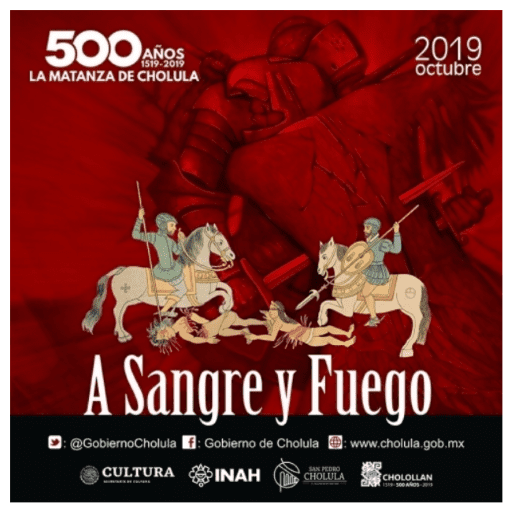
It was October 2019 and I had traveled to Mexico to participate in a series of events commemorating the 500-year anniversary of the Cholula massacre. Long-time friend, mentor, and renowned colonial Mexican historian, fray Francisco Morales Valerio, O.F.M., Ph.D, had invited me to speak at a 2-day symposium, “Mirada retrospectiva sobre Tollan Cholollan Tlachihualtépetl a cinco siglos de la masacre” (Retrospective Look at Tollan Cholollan Tlachihualtepetl Five Centuries After the Massacre), held October 18 and 19, 2019 in the Biblioteca Franciscana (Franciscan Library), associated with the University of the Americas-Puebla, in Cholula, Puebla, Mexico. Cholula has long been my research site and it was my honor to be the only scholar invited from outside Mexico to participate.
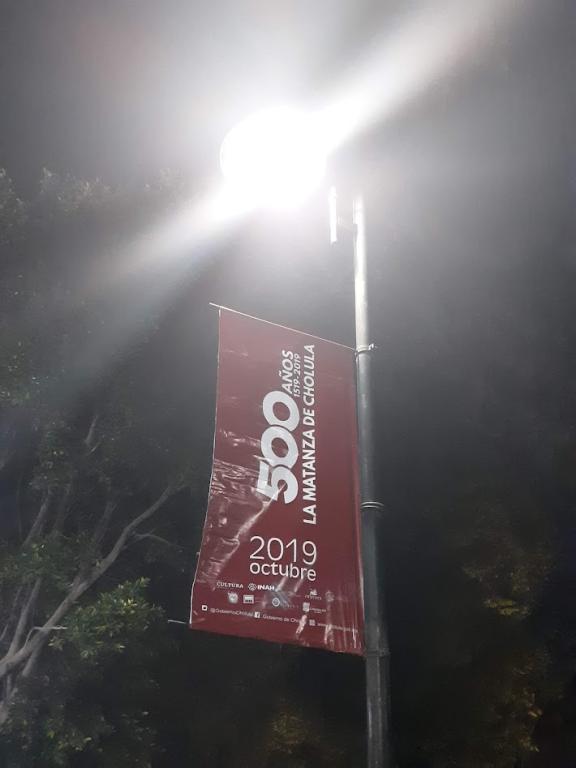
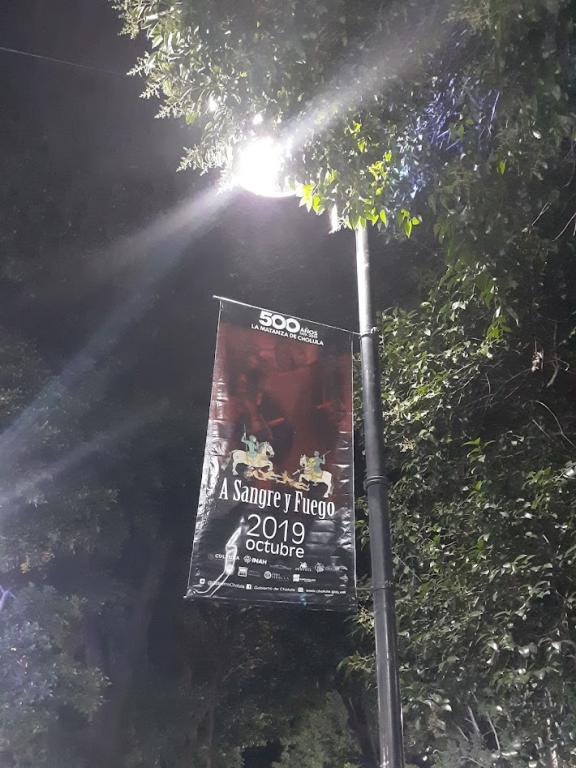
Despite the red and white banners affixed to streetlights throughout Cholula, and the posters fastened to chain link fences that gravely acknowledged the commemoration, my taxi driver the night I arrived was unaware of the massacre. More poignant was a display in the town square near the site of the massacre: an oversized “500” illuminated in red affixed to a capitalized “CHOLULA,” illuminated in white, which drew passersby for selfies. Red and White. Blood and Innocence.
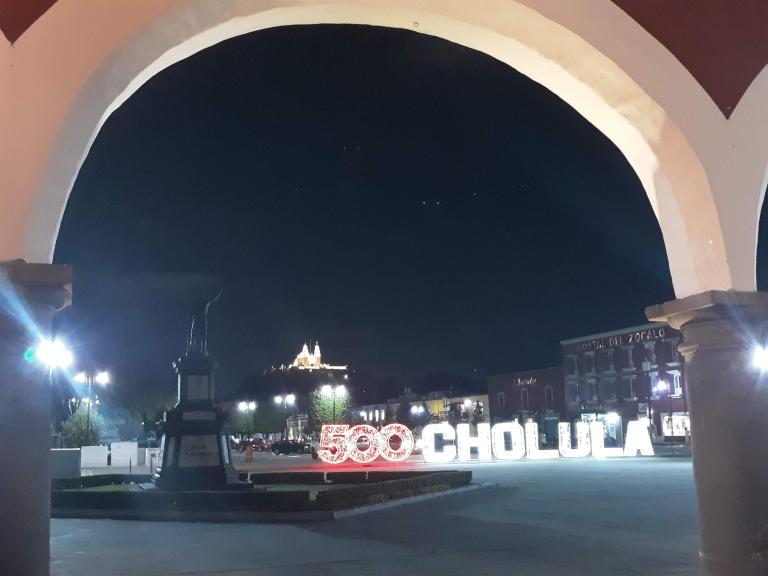
View of plaza with the church atop the Tlachihualtepetl (Man-Made Mountain) in the distance
Such appeared to be the unifying theme of Cholula’s commemorations of the quincentennial of the massacre: innocent inhabitants overwhelmed by the brutality of Castilian invaders, who paused here in October 1519, en route to vanquish Tenochtitlan, modern-day Mexico City, sixty miles to the west. The traditional narrative oversimplifies the event, effacing the presence of indigenous aggressors – Cortés’ thousands of indigenous allies – and overlooks the deeply-rooted regional divisions predating Iberian arrival. Historians like Matthew Restall, in When Montezuma Met Cortés: The True Story of the Meeting that Changed History, place the Cholula Massacre within the larger narrative of the Spanish Invasion and March to Tenochtitlan. Analyzed this way, complexities emerge, prompting Restall to argue that Cortés’ allies from Tlaxcallan, who hated the Cholulteca and outnumbered the Europeans, essentially forced an exhausted Cortés and his men to pass through Cholollan, as it was known, to slaughter their enemies before taking him to Tenochtitlan. Not all scholars accept this argument. In contrast, the traditional narrative, largely drawn from European sources, appears to diminish native agency in the past, and to efface native peoples as actors in the present even as they commemorate the past.
Disagreement over how to interpret the past and understand the present reflected but one example of the dissonance that manifested in contemporary Cholula during the quincentennial activities. Due to the limitations of this blog post, I will address only a few.
The official commemoration events began on Tuesday morning, October 15, 2019 with a Nahuatl-language Ceremonia luctuosa (mourning ceremony) in the patio of the church of San Gabriel, part of Cholula’s sixteenth-century Franciscan evangelization complex. This patio, which once served the sumptuous teocalli (god-house) dedicated to Quetzalcoatl, the Plumed Serpent, was the site of the massacre. When Franciscans settled in Cholula in the winter of 1528/1529, they would hold Mass outdoors next to the temple’s rubble to accommodate the large numbers of native Cholulteca, a common practice in colonial Mexico. It would be twenty years before they organized native laborers to build the church. Contrary to what one might think, native Cholulteca enthusiastically constructed it, not necessarily because they accepted the Christian God, but because as historian James Lockhart has demonstrated, like all Mesoamerican peoples they viewed the monumental structure as an analogue of the pre-contact temple, symbolizing Cholula’s sovereignty and corporate identity.
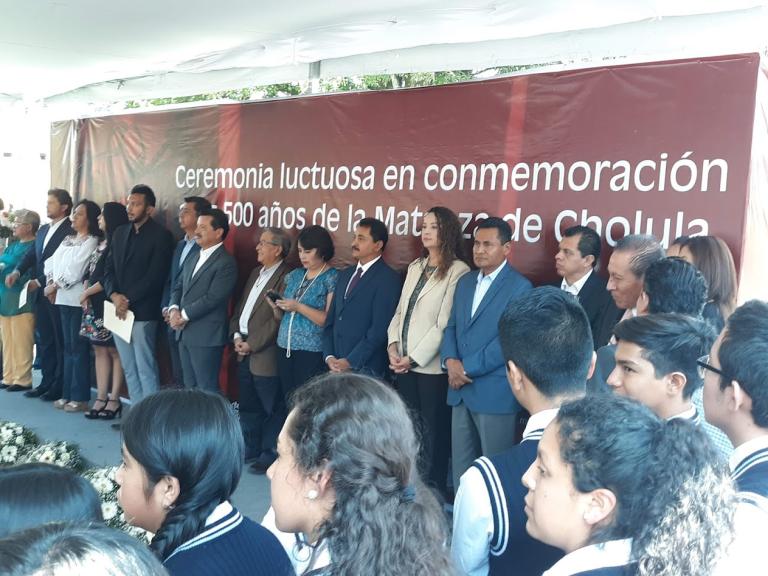
Michael Bricaire Torres (San Pedro Cholula’s Secretary of Culture) is in black, 5th from the left; Luis Alberto Arriaga (President of San Pedro Cholula) is 7th from the left; next to him is fray Francisco Morales Valerio, OFM, PhD in brown; also present was Karina Pérez Popoca (President of the neighboring municipality of San Andrés Cholula)
A line of officials welcomed us to the mourning ritual, proposing reconciliation and harmony, recollecting death and devastation, and recognizing resistance and resilience. The microphone lingered with Capitana Guadalupe Tonatiuh, a Cholulteca dancer whose very name reflects the blended past and present that comprises contemporary Cholula. She approached this day not in sorrow, she told us, but as a reminder to be good people who respect everyone.
A conch shell’s lonely lament erupted and resonated, its cry catalyzing the cluster of indigenous dancers nearby. Our attention diverted toward the atrial cross, the hum of Spanish, the conqueror’s language, ceded to Nahuatl, Cholula’s ancestral language. The ensuing chant honored Quetzalcoatl, the Plumed Serpent, whose regional worship once centered here, beneath our feet, in a hallowed ceremonial precinct in Cholollan. Plumage, incandescent in the sun, yielded to the ritual rhythms of the dance; the rattle of ayoyotes (shell anklets/wristlets) accompanied the incensing of ritual bundles at the foot of the cross. The dancers moved and the soil in the church patio shuddered, reminiscent of the trembling of the earth in this sacred place in October 1519, when a Castilian harquebus initiated a massacre of thousands of native Cholulteca in a matter of hours.
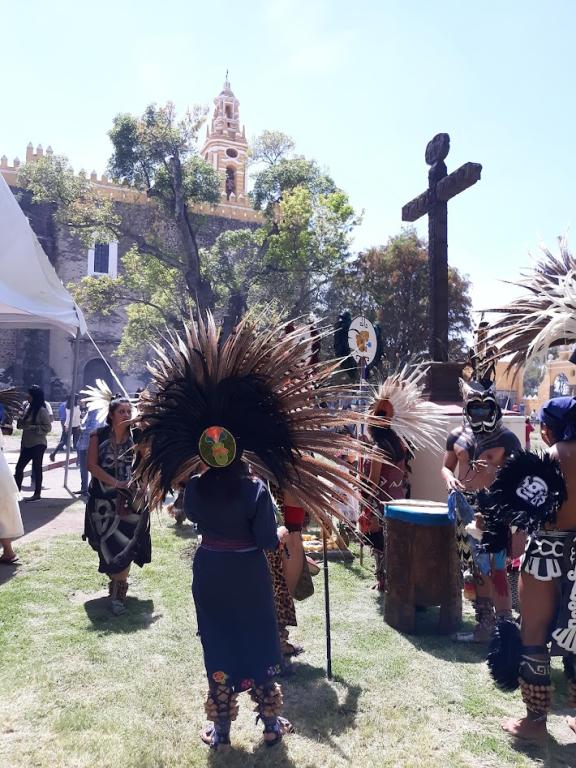
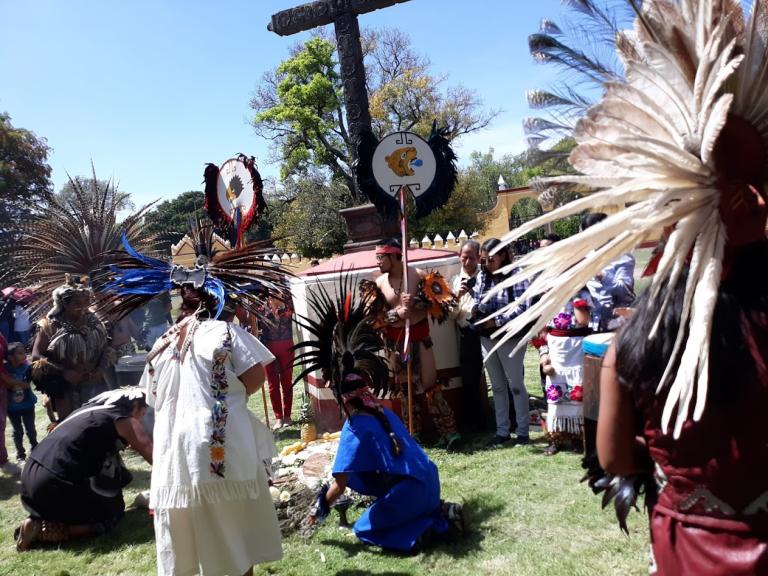
According to San Pedro Cholula’s Secretary of Culture, Michael Bricaire Torres, the mourning ritual marked the first time in 500 years that native Cholulteca had been allowed to perform purely indigenous – rather than indigenous-Christian – ritual in the church atrium. According to Huitzil, the Cholulteca who in the year 2000 founded the group that danced during the ceremonia luctuosa, this marked the second such occasion. Huitzil (which means hummingbird) would seem to be correct, for newspaper articles from 2018 include photos of San Pedro Cholula’s president receiving incense from indigenous dancers in the patio of the Franciscan friary during a commemoration of the 499th anniversary of the massacre.
After the ceremony concluded and officials had lined up with native dancers for photos, reporters surrounded the municipal president, Luis Alberto Arriaga, a medical doctor and former television journalist, who announced that from this day forward, native Cholulteca would be welcome to commemorate the massacre in the church patio every October 15. Considering this a positive, I turned to speak with the native dancers and learned that they had a different perspective. The municipal government and local academics did not include them in planning commemorative events, they said, and dismissed them when they disagreed about the placement of a commemorative monument. Most of the time, they told me, the scholars and native dancers operated independently. When I invited the indigenous dancers to the symposium, they politely declined.
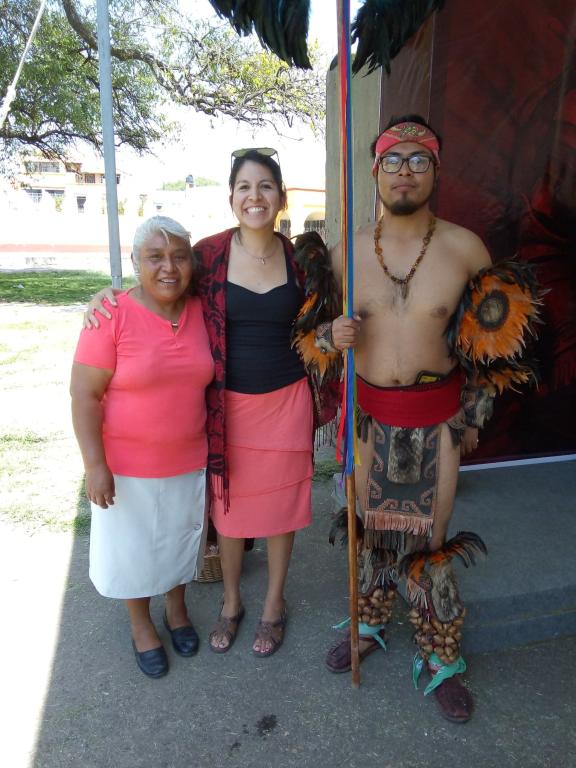
With my late friend Matilde and Tula, a Cholulteca dancer
Like many commemorations, Cholula’s quincentennial defies simple classification, revealing more about the present than the past. How does one commemorate a massacre that serves as one episode in the larger narrative of Iberian Invasion in a country where violence against native peoples prevails? How does one commemorate an attack on a culture the world generally perceives, however incorrectly, as violent? How does one commemorate a violent event that resulted in Mexico’s current identity as a land of mestizaje, in a country that is predominately culturally, if not actually, Catholic?
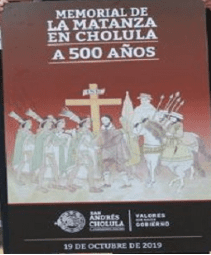
Poster announcing a Memorial of the massacre with native people and Castilians uniting around a cross
More than a singular commemoration, Cholula offered a repertoire of parallel commemorations, holding distinct meanings for its various actors, with each faction preparing its own events and no grand design aside from the opening and closing event in the church patio, the site of the massacre. Mimicking the conflicting accounts of the 1519 massacre found in Castilian and indigenous chronicles produced in the colonial period, the quincentennial commemorations evidenced contested official and unofficial narratives, with an underlying privileging of the traditional account. Even the expression used to speak of the past proved contentious: whereas scholars typically apply “pre-contact,” “pre-Hispanic,” or “pre-Columbian,” to the indigenous period, native Cholulteca protested the Eurocentric nature of these expressions, proposing the term tiempos pre-cuauhtémicos (pre-Cuauhtémoc times), that is, the time before the death of the last independent Mexica ruler, Cuauhtemoc, whom Iberian conquistador Hernando Cortés hung in modern-day Honduras in 1525 after taking him on expedition.
Several events during the commemorations underscored the disconnect between native Cholulteca and the people who studied them; I will mention two. On the first night of our symposium, we had a beautiful choral concert in the church of ancient sacred music in Nahuatl, using indigenous instruments performed by native Cholulteca. The performers were professionally trained and sang in multiple languages to an enthusiastic crowd.
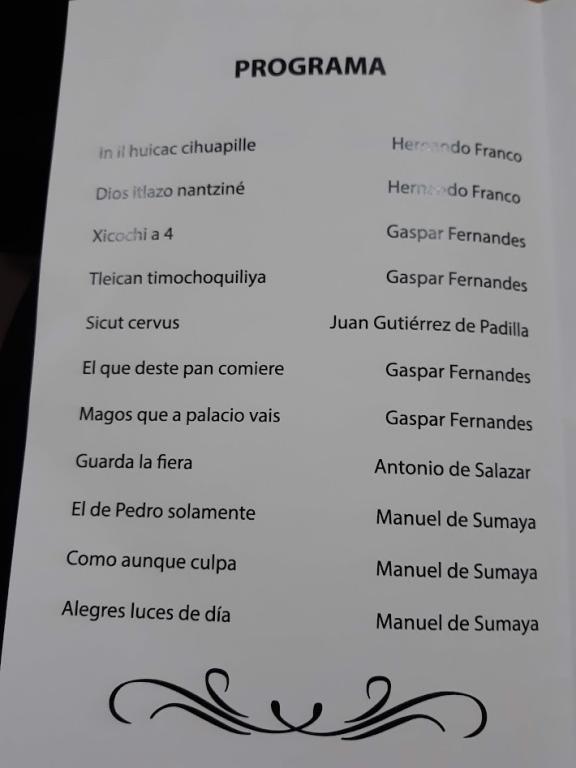
Program for our “Concierto coral de música sacra antigua en Nahuatl”
As we filed out of the church afterwards, we heard the chants of native Cholulteca in the plaza across the street; I was the only academic who crossed over to witness the indigenous commemoration. The dancers, who had gathered while we were in concert, had laid bundles on a sidewalk near the not-yet-revealed commemorative monument. They moved amidst a “Gallery of art in the open air” whose photographs explored “500 years since the desecration of our wisdom.” The translation on the introductory plaque reads:
They plucked our fruits,
cut our branches,
burned our trunk,
but they could not kill our roots.
No native dancers attended the concert, and no local concert-goers (I am a foreigner) attended the ritual dance.
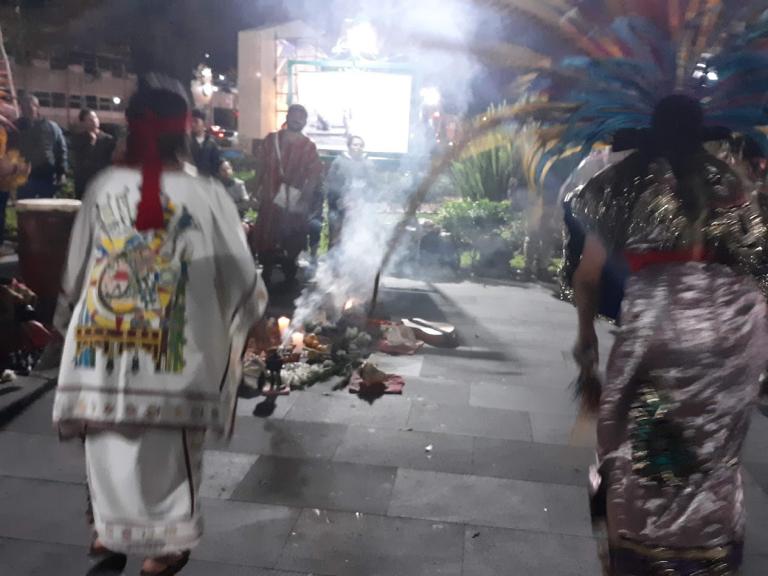
Cholulteca ritual near the unrevealed monument to the massacre
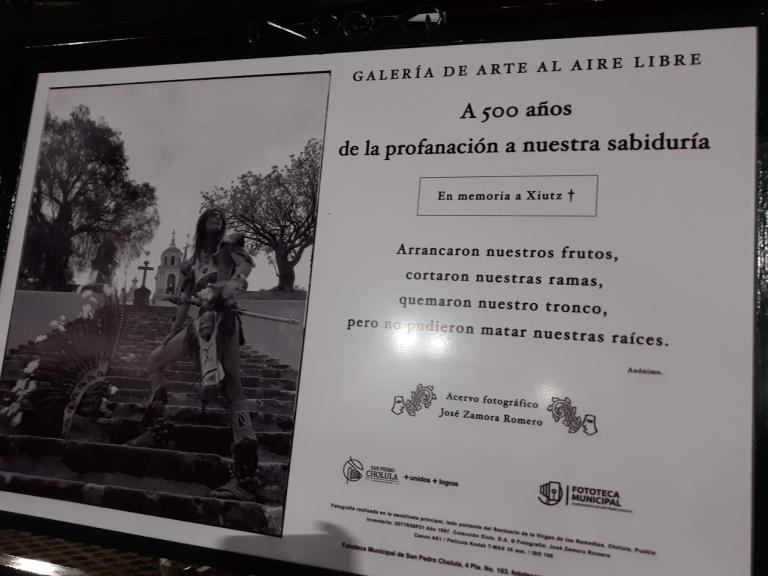
“Gallery of art in the open air” exploring “500 years since the desecration of our wisdom”
As a second example, at the end of the second day of our symposium, speakers, participants, and officials gathered across the street near the place where the dancers had incensed their bundles the night before. Notably, no native dancers were present as the municipal president unveiled the monument commemorating the massacre. Instead, noted colonial Mexican scholar Francisco González-Hermosillo Adams, from the National Institute for Anthropology and History (INAH) in Mexico City, read the Nahuatl inscription. His words – in Spanish – are etched into a stone nearby. The monument itself consists of an image from the Lienzo de Tlaxcala, a sixteenth-century indigenous text produced by Cortés’ largest contingent of allies to demonstrate their value during the three-year war to take Tenochtitlan.

The new monument in the town square’s park commemorating the 1519 Cholula Massacre
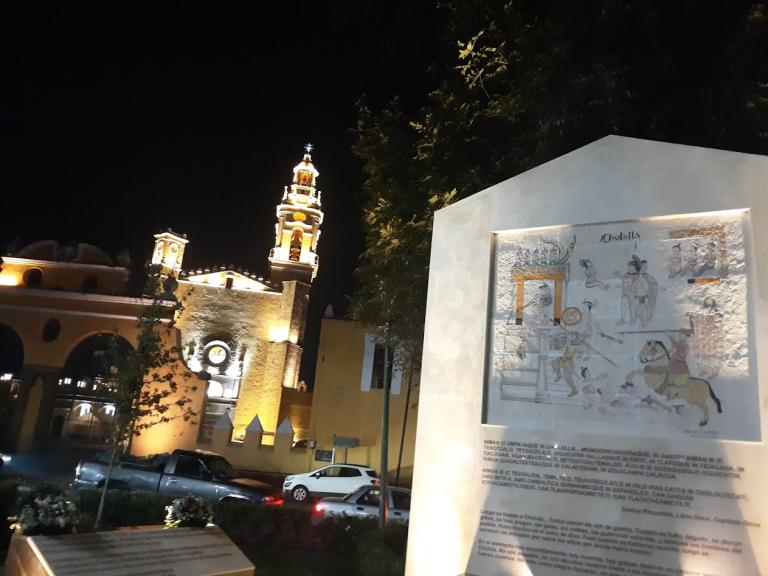
The church of San Gabriel and the monument by night
Cholula has many active participants in various capacities dedicated to preserving its past. Scholars. Friars. Students. Officials. Local native people. Each commemorated the massacre in their own way, reflecting Cholula’s fragmented contemporary reality. Just as the history of the Iberian invasion remains contested, so too does the massacre. Even with 500 years of space and time to consult one another, to reflect together, to work together, Cholula’s quincentennial reveals Mexico’s contemporary reality, which laments the treatment of colonial native peoples and extols the accomplishments of native peoples in the past while retaining pejorative attitudes towards native people in their midst.
Cholula is a beautiful place, but like many places living with a colonial legacy, it has yet to escape its past.
Politics and Religion
History and Religion
Previous Post

November 17, 2022
How the Churches Forgot the Amalekites
Browse Our Archives
Select a Category abolitionism Abortion Abraham Joshua Heschel Abraham Kuyper Abraham Lincoln Academia Activism Adam Renberg Advent Adventist africa African American Religion Agnes Howard Albert Camus American History American Religious History American Revolution American West Anabaptists Ancient History Andrea Turpin Andrei Tarkovsky Anglicanism Annales Ansley Lillian Quiros anti-Catholicism Antisemitism Anxious Bench apologetics Apparitions Arash Azizi Archaeology archives art Artificial Intelligence Asia Asian Americans Augustine Authors Bad Bunny Baptism Baptists Barack Obama Battle of Hastings Benjamin Franklin Bernard-Henri Levy Beth Allison Barr Beth Moore Bethany Mannon Bible Bill Cunningham Billy Graham Black Music Bob Dylan Body Boenhoffer Books Breastfeeding Bruce Springsteen C.S. Lewis Calvinism Cancel Culture Capitalism Carmelites Catholicism Cedric Robinson Cesar Chavez Charismaticism charity Charles Dickens Charles Lindbergh Che Guevara Chicago Children Chinese Christianity Chris Gehrz Christ Christian death Christian Higher Education Christian life Christian Nation Christian Nationalism Christianity Today Christmas Church life Church Practice cinema Civil Religion Civil Rights Movement Civil War civility Classics Climate Change Cold War Colonial Mexico colonialism Comer Communism community complementarianism Conference on Faith and History Congregationalism Conspiracies Conspiracy Conversion Narratives Coronavirus Costa Rica Council of Nicaea Covid-19 Creation Critical Race Theory Crusades Culture culture wars Daniel K. Williams David Barton David Swartz Death Ways death with dignity DEI democracy Democratic Party Devotion Digital Age Diplomacy discipleship diversity Donald Trump Drama Dua Lipa Early Church early modern Early modern Catholicism Easter Eastern Christianity economic exploitation Education elections Elie Wiesel Elizabeth II Elizabeth Taylor emotions Empire Engineering England enslavement Entertainment Episcopal Church Erica Ramirez eschatology Eurocentrism Evangelicalism Evangelicals Exegesis Family Feminism Film Flannery O'Connor folk music Food Foreign Policy founding fathers Franciscans Franciscus Junius fundamentalism Funerals G.K. Chesterton Gender Genocide genre geography George W. Bush George Washington George Whitefield Global Christianity Global church Grief Guadalupe Guest Post guest post gun control gun violence Gustavo Gutierrez Hamid Dabashi Harold John Ockenga Harvest Hate Hawaiian Christianity Healing health care Heather Cox Richardson Hell Heresy Hermeneutics Higher Education Hinduism Hippocratic oath Historical Fiction Historical Methodology Historical Profession Historical Profession Historical Theology Historical Thinking historiography Holidays Holocaust horror movies Human rights Humanitarian Work humanities Hummingbirds Hungary hymns Imago Dei Immigration Injustice Interviews Iran Islam Islamophobia Israel Ivan's Childhood Jacob Randolph James Bratt Janine Giordano Drake Japanese history Japanese Literature Jean Paul Sartre Jesse Miranda Jesus Jesus Christ Jimmy Carter Joan Baez Joan Didion Joanne Freeman João B. Chaves Joao Chaves Joey Cochran John Calvin John Fea John Tillotson John Turner Johnny Cash Jonathan Edwards Jonathan Tran Joseph Smith Josh Howerton Journalism Jr. Judaism Jürgen Moltmann Just War Justice Justin Brierley Karl Barth Katelyn Beaty koi ponds Kris Kristofferson Kristin Kobes Du Mez Latin American Religious History Latino Americans Lectio Divina Leisure Lent Leonard Cohen liberal arts liberalism Liberation Theology Linda Ronstadt Lisa Clark Diller Literature Lou Reed Lynchings Lynneth Miller Renberg Mainline Protestantism Malcolm Foley Marilyn Monroe Maritime history Mark Noll Marriage Martin Luther Martin Luther King Martyrdom Marxism Mary Masih Alinejad mass shootings material culture medieval Christianity Medieval Ethiopia Melissa Borja memory Mennonites Mental Health Mental Illness Methodism Mexican Americans Mexicans Mike Madrid Miles Mullin Min Jin Lee Miscarriage Missionaries Mister Rogers Mitt Romney modernity Monasticism Mormonism Motherhood Mothers of the Church Moving Music Musicals Nadya Williams Nahua Christianity Native Americans Natsume Sōseki New Contributor New England New Year New York Nico Non-Violent Protest Orthodoxy pacifism Paleo Evangelicals Palestinians Parenting Patti Smith Paul Kingsnorth Pedro Calderón de la Barca Pentecostalism Philip Jenkins Phillis Wheatley physician-assisted suicide pilgrimage Pilgrims pluralism Plutocracy Poetry Politics Pope Francis Pope Leo XIV post-modernism prayer preaching Presbyterians prosperity gospel Protest Public history Publishing Puritans purity culture Quakers race Race Massacres Racial Capitalism racial reconciliation racialization Racism Raha Bahloulipour Re-Enchantment reading Reformation Refugees religion and the university religion and war Religious Freedom Religious Nones Religious Pluralism Religious Symbols religious violence Republican Party Revival Rita Coolidge Ritual Roger Williams Roman Catholic church Royalty Russell Moore same-sex marriage Sarah Irving-Stonebraker Scandinavia Science Science and Technology Scopes trial Scriptural Interpretation secularism Selena Quintanilla seminary Seventh-Day Adventists sexual morality Sexuality Sikhs Silence slaveholders theology Slavery Slavoj Zizek social justice Social Media Southern Baptist Convention Southern Religion Spain Spiritual Autobiography Spiritual but not religious Spiritual Discipline Sports Stanley Hauerwas Suffering Summer Camps Sunday Night Odds and Ends Supernatural Supreme Court Syriac Christianity Tal Howard Taylor Swift Teaching Technology Television Thanksgiving The Beatles The Mission theater TheoBros Theology Thomas Dixon Thomas Jefferson Thomas Kidd Thomas Merton Tim Gloege Tim Walz Tom Holland Tourism tradition Tragedy Translation Transnationalism Travel Trump Ukraine Uncategorized Unitarians United Methodist Church US History Vanessa Chan Velvet Underground Verónica A. Gutiérrez Veronica Gutierrez Vikings Violence Virgin Mary Virtue Virtue ethics Visions Voting War WCTU Wendell Berry Westminster Assembly White Evangelicalism Wildfires Winnie the Pooh Witches women Women in Ministry Women's and Gender Studies Work Worship writing Yasunari Kawabata Zena Hitz
Select a Month October 2026 September 2026 August 2026 July 2026 June 2026 May 2026 April 2026 March 2026 February 2026 January 2026 December 2025 November 2025 October 2025 September 2025 August 2025 July 2025 June 2025 May 2025 April 2025 March 2025 February 2025 January 2025 December 2024 November 2024 October 2024 September 2024 August 2024 July 2024 June 2024 May 2024 April 2024 March 2024 February 2024 January 2024 December 2023 November 2023 October 2023 September 2023 August 2023 July 2023 June 2023 May 2023 April 2023 March 2023 February 2023 January 2023 December 2022 November 2022 October 2022 September 2022 August 2022 July 2022 June 2022 May 2022 April 2022 March 2022 February 2022 January 2022 December 2021 November 2021 October 2021 September 2021 August 2021 July 2021 June 2021 May 2021 April 2021 March 2021 February 2021 January 2021 December 2020 November 2020 October 2020 September 2020 August 2020 July 2020 June 2020 May 2020 April 2020 March 2020 February 2020 January 2020 December 2019 November 2019 October 2019 September 2019 August 2019 July 2019 June 2019 May 2019 April 2019 March 2019 February 2019 January 2019 December 2018 November 2018 October 2018 September 2018 August 2018 July 2018 June 2018 May 2018 April 2018 March 2018 February 2018 January 2018 December 2017 November 2017 October 2017 September 2017 August 2017 July 2017 June 2017 May 2017 April 2017 March 2017 February 2017 January 2017 December 2016 November 2016 October 2016 September 2016 August 2016 July 2016 June 2016 May 2016 April 2016 March 2016 February 2016 January 2016 December 2015 November 2015 October 2015 September 2015 August 2015 July 2015 June 2015 May 2015 April 2015 March 2015 February 2015 January 2015 December 2014 November 2014 October 2014 September 2014 August 2014 July 2014 June 2014 May 2014 April 2014 March 2014 February 2014 January 2014 December 2013 November 2013 October 2013 September 2013 August 2013 July 2013 June 2013 May 2013 April 2013 March 2013 February 2013 January 2013 December 2012 November 2012 October 2012 September 2012 August 2012 July 2012 June 2012 May 2012
Follow Us!
TAKE THE
Religious Wisdom Quiz
Who said, "Let us build us a city and a tower, whose top may reach unto heaven"?
Select your answer to see how you score.
Israelites Chaldeans Egyptians People of Babel
Related posts from Anxious Bench
Guadalupe's Pilgrim Image Visits Our Parish School

Singing Seafarers: Sailing a 16th-Century Spanish Galleon
Heralds of Heaven: Hummingbirds on a Hillside
Something Still Could: Courage for a Turbid Anniversary
TRENDING AT PATHEOS Evangelical

Emotion in Early Christianity by Andrew Crislip
Andrew Crislip’s Emotion in Early Christianity examines an often overlooked dimension of...

16 Spiritual Touchstones for a More Grounded Life
After decades of spiritual study, here are 16 principles I try...

Catholic Evangelization: Sharing Your Faith Every Day
Welcome back to the Graceful Awakening mini-series called, “From Faith to Mission.” ...

The Pillar of the Boatmen: the Ancient Monument...
The Pillar of the Boatmen is a Romano-Gaulish sculpture that dates from...

In one sense walking into Westminster Abbey is like walking down the...

'Super Scam Me' Exposes AI Jon Bon Jovi...
Leslie Pickett believed she was in a relationship with Jon Bon Jovi....
view all Evangelical blogs
Ad-Free & Subscriber Log-In Subscription Support
- About Us
- 2026 Calendar
- Videos
- Podcasts
- Library of World Religions
- Faith In Media Tracker
- Advertise With Us
- Write for Us
- Privacy Policy
- Terms of Service
- Do Not Sell My Data
- Contact Us
- Radiant Digital
- Manage Newsletter Subscriptions
- Unsubscribe From Notifications
- Sitemap
Copyright 2008-2026, Patheos. All rights reserved.
Subscription Support Ad-Free & Subscriber Log-In
Follow Patheos