
BuddhistCatholicContemplativeEvangelicalGeneral ChristianHinduJewishLatter-day SaintMuslimNew VisionsProgressive Christian
Beliefs
- Buddhist
- Catholic
- Contemplative
- Evangelical
- General Christian
- Hindu
- Jewish
- Latter-day Saint
- More Voices
- Muslim
- New Visions
- Pagan
- Progressive Christian
Topics
- Religion News
- Food and Religion
- Sports and Religion
- Religious Art
- Religious Music and Entertainment
- Religious Events
- History and Religion
- Style and Religion
- Politics and Religion
- Women in Religion
- Recreation Outdoors and Religion
- Business Finance and Religion
- Careers Workplace and Religion
- Education and Religion
- Family Parenting and Religion
- Health Fitness and Religion
- Home and Religion
- Relationships and Religion
- Technology and Religion
- Travel and Religion
Columnists
- Buddhist Columnists
- Business Finance and Religion Columnists
- Careers Workplace and Religion Columnists
- Catholic Columnists
- Contemplative Columnists
- Education and Religion Columnists
- Evangelists Columnists
- Family Parenting and Religion Columnists
- General Christian Columnists
- Health Fitness and Religion Columnists
- Hindu Columnists
- History and Religion Columnists
- Home and Religion Columnists
- Jewish Columnists
- More Voices Columnists
- Latter Day Columnists
- Muslim Columnists
- New Visions Columnists
- Nonreligious Columnists
- Pagan Columnists
- Politics and Religion Columnists
- Progressive Columnists
- Recreation Outdoors and Religion Columnists
- Relationships and Religion Columnists
- Religion News Columnists
- Religious Art Columnists
- Religious Events Columnists
- Religious Music and Entertainment Columnists
- Sports and Religion Columnists
- Style and Religion Columnists
- Technology and Religion Columnists
- Travel and Religion Columnists
- Women in Religion Columnists
Resource Library
- 2026 Calendar
- Library of World Religions
- The 100 Most Holy Places on Earth
- Patheos Answers
- Podcasts
- Videos
- Faith Leaders Database
- Anglican Episcopalian
- Bahai
- Baptist
- Buddhism
- Christianity
- Confucianism
- Eastern Orthodoxy
- Hinduism
- Holiness and Pentecostal
- ISKCON
- Islam
- Judaism
- Lutheran
- Methodist
- The Church of Jesus Christ of Latter-day Saints
- New Age
- Paganism
- Presbytarian and Reformed
- Protestantism
- Religion Behind the Scenes
- Roman Catholic
- Scientology
- Shia Islam
- Sikhism
- Sufism
- Sunni Islam
- Taoism
- Zen
- See all religions
Research Tools
 Ad-Free & Subscriber Log-In Subscription Support
Ad-Free & Subscriber Log-In Subscription Support
Follow Patheos 

- Trending:
- Forgiveness
- |
- Marriage
- |
- Consciousness
- |
- Death Penalty
- |
- Election
- |
- Halloween

-
About the Authors
- Home
- Evangelical
- Religious Music & Entertainment
- The Christmas Movie We Need Right Now
The Christmas Movie We Need Right Now
Last updated on: November 29, 2022 at 12:20 am by Melissa Borja
The Christmas Movie We Need Right Now 2022-11-29T00:20:53-04:00 Melissa Borja
Patheos Explore the world's faith through different perspectives on religion and spirituality! Patheos has the views of the prevalent religions and spiritualities of the world.
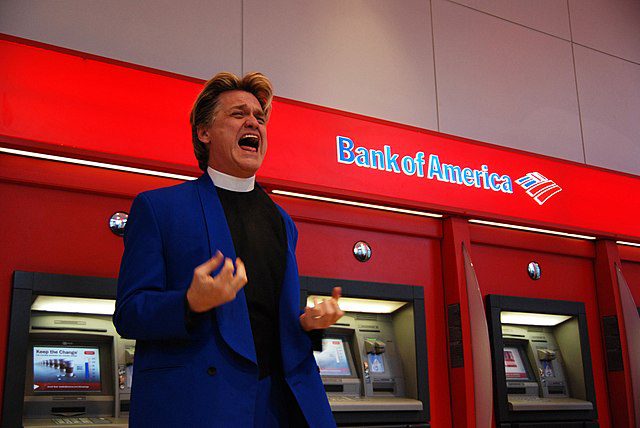
Reverend Billy from The Church of Stop Shopping attempting to exorcise bad loans and toxic assets from the Bank of America ATM in Union Square, New York City, April 2009 (Jonathan McIntosh)
Now that Thanksgiving is past and the holiday season has officially begun, I’m ready for my favorite Christmas tradition: watching holiday movies. I admit that I have something of a small addiction. I love the classics, of course—It’s a Wonderful Life, Love Actually, Die Hard. I enjoy the new shows, too, especially if they have diverse characters (Dash and Lily, Happiest Season) or involve royalty falling in love in generic European countries with lots of snow (the Christmas Prince trilogy, the Princess Switch trilogy).
But my favorite Christmas movie of all time actually has no royalty, no romantic cookie-baking scenes, and no magic kisses under the first snowfall of the year. The holiday film I love most is What Would Jesus Buy?, a documentary about Reverend Billy and the Church of Stop Shopping and their crusade to help Americans confront one of the greatest problems of our era: unrepentant consumerism and the harm it brings to our culture, our communities, and our climate. The film, released in 2007, turns 15 years old this month, but the lessons it shares are more important than ever.
Reverend Billy is played by William Talen, an actor and playwright who was raised in a Dutch Calvinist family in the upper Midwest. According to his website, Talen developed the character of Reverend Billy in the 1990s in collaboration with Reverend Sidney Lanier, the vicar of St. Clement’s Episcopal Church and a famed producer of experimental theater.
Reverend Billy made his New York debut in 1998, when he stood outside the Disney Store in Times Square and declared that Mickey Mouse is “the anti-Christ.” From the very beginning, Reverend Billy’s street preaching against the evils of consumerism, the displacement of small businesses by large corporations, and the exploitation of workers drew attention and pushed boundaries. His Disney Store campaign—which at one point involved him duct-taping Mickey Mouse to a cross—led to multiple arrests.
Reverend Billy continued to preach, protest, and perform, eventually organizing the Church of Stop Shopping and doing shows with its musical ensemble, the Stop Shopping Choir. Co-founded and directed by the artist and activist Savitri Durkee, who is also Talen’s partner, the Stop Shopping Choir performs original gospel music and describes itself as a “a radical performance community” that is “grounded in the work of Justice and in service to the Earth.”
Over the past two and a half decades, Reverend Billy and the Church of Stop Shopping have expanded the scope of their concerns beyond Disney and Mickey Mouse to address a wide array of issues, from gentrification and economic inequality to homophobia and immigrant justice. In recent years, they have focused especially on climate change. But while their songs and sermons have changed, their core mission has remained the same: to offer a call to conscience about how Americans’ choices are damaging the planet and its people. Their message has a moral urgency well-suited to the fiery sermons of an impassioned preacher.
Reverend Billy is indeed a compelling preacher. In portraying Reverend Billy, Talen draws on a figure familiar to many Americans—the flamboyant, pompadoured, radical religious leader seen on television, on street corners, and on revivalist circuits. But Reverend Billy is more than a role for Talen. His sermons about the evils of consumerism, capitalism, and corporate greed are powered by genuine conviction, and he and the choir are earnest in their efforts to urge their audiences to reflect, repent of their sins, and experience a conversion toward a more just, ethical, and sustainable way of life.
The work that Reverend Billy and the Stop Shopping Choir do together shares many of the features of what religion scholar Melissa Wilcox describes as “serious parody”: a powerful merging of performance and activism that blurs the boundary between the religious and the secular, the absurd and the important. When asked to describe his work, Talen said, “It’s definitely a church service,” but added that it’s also “a political rally, it’s theater, it’s all three, it’s none of them.” Alisa Solomon, a Village Voice theater critic who edited a volume of reflections by Talen and Savitri D, noted that for Reverend Billy, “the collar is fake, the calling is real.”
The film What Would Jesus Buy? offers a delightful portrait of how Reverend Billy and the Stop Shopping Choir live out this calling. Produced by Morgan Spurlock and directed by Rob VanAlkemade, the documentary follows Reverend Billy and the Stop Shopping Choir during their cross-country “Shopocalypse” tour in the month leading up to Christmas 2005.
Watching Reverend Billy and the Church of Stop Shopping bring their distinctive brand of performance activism to audiences across America—and observing how surprised spectators respond—is the highlight of the film. We see Reverend Billy perform a “credit card exorcism” in a local church, listen to a woman admit to her shopping mishaps in a confession booth set up in a store parking lot, and cry out to God to repent of his own sins of using fossil fuels as he pumps gas into the choir’s bus. We witness how he and the choir urge people to stop shopping and reject the commercialization of Christmas along Chicago’s Miracle Mile and in the Mall of America. We laugh and sing along as they knock on the doors of affluent suburban homes and troll classic Christmas carols rewritten with anti-consumerist lyrics. We wait with excitement as the group prepares for the grand finale of their tour: a guerrilla performance in Disneyland on Christmas Day.
In between footage of the performances, the filmmakers offer important context about Reverend Billy, the Church of Stop Shopping, and the mission they undertake. We learn about the history of American consumerism, especially during the holiday season, and its particular impact on children and families. And through interviews, we learn about the performers—not only Talen, but also the choir members— and develop a deeper understanding of why they chose to put their lives on hold to urge Americans to change their consumerist ways.
Of course, much has changed since 2007, the year What Would Jesus Buy? was released. A decade and a half ago, the Great Recession hadn’t yet fully hit. The children in the film pined for Xbox 360s in their stockings. People still crowded into malls and shopped at brick and mortar stores. 2007 was, no doubt, a different era.
But Reverend Billy’s call to curb our consumerism is still relevant and perhaps even more necessary today. The internet, with its influencers and onslaught of online advertisements, has made it easier than ever to make people desire things, at the same time that new technology has made it easier to buy things. Research suggests that many Americans do their shopping online, often just using their smartphones. The Pew Research Center reported, for example, that about three-quarters of adults in the United States buy things with their smartphones, and about one-third do so at least once a week. Shopping has become so convenient that it now demands little more than reaching into our pockets and tapping a few buttons.
The increased ease of shopping has occurred as our climate crisis has worsened. Our insatiable appetite for more and more stuff is one of the reasons we are witnessing alarming forms of environmental degradation, from polluted waterways to emissions that disrupt our climate and dislocate vulnerable populations. Consider, for example, one item: a pair of leggings that I recently saw Amazon selling for $8. The simple black leggings are made primarily of polyester, a petroleum-based material that contributes to microplastic pollution that harms marine life. They are made in China, their transoceanic journey from manufacturer to retailer to consumer made possible through abundant use of fossil fuels, which account for over 75 percent of global greenhouse gas emissions and nearly 90 percent of all carbon dioxide emissions. They are likely wrapped in single-use plastic, which I would discard upon opening, and probably sturdy enough to use for only a season or two before they wear out and I would be forced to send them to a landfill. Consider the short lifestyle of these cheap leggings alongside their outsized environmental impact, and it becomes clear why fashion accounts for 20 percent of the world’s annual plastic production and 10 percent of the world’s carbon dioxide emissions—an amount that exceeds international flights and shipping combined.
Ultimately, our decision to buy more and buy faster is destroying our planet—and may destroy our future, if we let it.
And yet, despite these developments, we continue onward in our march toward the Shopocalypse with nary a concern. Yes, some people participated in “Buy Nothing Day” last week. But most Americans—abetted by the frenzied news coverage of Black Friday deals and “must have” gift recommendations—continue their collective and uncritical embrace of consumerism, revealing a relentless and foolish faith in the salvation of spending and the gospel of getting even more.

Reverend Billy on Day 40 of Occupy Wall Street in New York, October 2011 (David Shankbone)
The success of Christmas movies lies in their ability to help viewers experience hope and joy. But in my view, the very best Christmas movies do even more than that—they also inspire us change our lives so we can live better and love better. Take, for example, the story of George Bailey, the community-spirited protagonist in It’s a Wonderful Life, or the story of Billy Mack, the washed-out rockstar in Love Actually. For these two characters in these beloved holiday films, Christmas is magical because it’s a season that brings their self-transformation.
And that is why What Would Jesus Buy? embodies the very best of the Christmas film genre. There isn’t a princess or a scene when characters fall in love under a sparkling snowfall. But it’s a film that centers on hope, joy, and the beautiful possibility of transformation. As Reverend Billy says as he’s escorted out of the Mall of America: “You can walk away from the product! Drive the moneychangers out of the temple this year! We are all ending up inside these super malls! These products are taking over our lives! Stop shopping! Hallelujah! Change-a-lujah!”
A little change-a-lujah is what we need most this Christmas.
Religious Music & Entertainment
Religious Art
Politics and Religion
Previous Post

November 24, 2022
Advent, and the End Times
Browse Our Archives
Select a Category abolitionism Abortion Abraham Joshua Heschel Abraham Kuyper Abraham Lincoln Academia Activism Adam Renberg Advent Adventist africa African American Religion Agnes Howard Albert Camus American History American Religious History American Revolution American West Anabaptists Ancient History Andrea Turpin Andrei Tarkovsky Anglicanism Annales Ansley Lillian Quiros anti-Catholicism Antisemitism Anxious Bench apologetics Apparitions Arash Azizi Archaeology archives art Artificial Intelligence Asia Asian Americans Augustine Authors Bad Bunny Baptism Baptists Barack Obama Battle of Hastings Benjamin Franklin Bernard-Henri Levy Beth Allison Barr Beth Moore Bethany Mannon Bible Bill Cunningham Billy Graham Black Music Bob Dylan Body Boenhoffer Books Breastfeeding Bruce Springsteen C.S. Lewis Calvinism Cancel Culture Capitalism Carmelites Catholicism Cedric Robinson Cesar Chavez Charismaticism charity Charles Dickens Charles Lindbergh Che Guevara Chicago Children Chinese Christianity Chris Gehrz Christ Christian death Christian Higher Education Christian life Christian Nation Christian Nationalism Christianity Today Christmas Church life Church Practice cinema Civil Religion Civil Rights Movement Civil War civility Classics Climate Change Cold War Colonial Mexico colonialism Comer Communism community complementarianism Conference on Faith and History Congregationalism Conspiracies Conspiracy Conversion Narratives Coronavirus Costa Rica Council of Nicaea Covid-19 Creation Critical Race Theory Crusades Culture culture wars Daniel K. Williams David Barton David Swartz Death Ways death with dignity DEI democracy Democratic Party Devotion Digital Age Diplomacy discipleship diversity Donald Trump Drama Dua Lipa Early Church early modern Early modern Catholicism Easter Eastern Christianity economic exploitation Education elections Elie Wiesel Elizabeth II Elizabeth Taylor emotions Empire Engineering England enslavement Entertainment Episcopal Church Erica Ramirez eschatology Eurocentrism Evangelicalism Evangelicals Exegesis Family Feminism Film Flannery O'Connor folk music Food Foreign Policy founding fathers Franciscans Franciscus Junius fundamentalism Funerals G.K. Chesterton Gender Genocide genre geography George W. Bush George Washington George Whitefield Global Christianity Global church Grief Guadalupe Guest Post guest post gun control gun violence Gustavo Gutierrez Hamid Dabashi Harold John Ockenga Harvest Hate Hawaiian Christianity Healing health care Heather Cox Richardson Hell Heresy Hermeneutics Higher Education Hinduism Hippocratic oath Historical Fiction Historical Methodology Historical Profession Historical Profession Historical Theology Historical Thinking historiography Holidays Holocaust horror movies Human rights Humanitarian Work humanities Hummingbirds Hungary hymns Imago Dei Immigration Injustice Interviews Iran Islam Islamophobia Israel Ivan's Childhood Jacob Randolph James Bratt Janine Giordano Drake Japanese history Japanese Literature Jean Paul Sartre Jesse Miranda Jesus Jesus Christ Jimmy Carter Joan Baez Joan Didion Joanne Freeman João B. Chaves Joao Chaves Joey Cochran John Calvin John Fea John Tillotson John Turner Johnny Cash Jonathan Edwards Jonathan Tran Joseph Smith Josh Howerton Journalism Jr. Judaism Jürgen Moltmann Just War Justice Justin Brierley Karl Barth Katelyn Beaty koi ponds Kris Kristofferson Kristin Kobes Du Mez Latin American Religious History Latino Americans Lectio Divina Leisure Lent Leonard Cohen liberal arts liberalism Liberation Theology Linda Ronstadt Lisa Clark Diller Literature Lou Reed Lynchings Lynneth Miller Renberg Mainline Protestantism Malcolm Foley Marilyn Monroe Maritime history Mark Noll Marriage Martin Luther Martin Luther King Martyrdom Marxism Mary Masih Alinejad mass shootings material culture medieval Christianity Medieval Ethiopia Melissa Borja memory Mennonites Mental Health Mental Illness Methodism Mexican Americans Mexicans Mike Madrid Miles Mullin Min Jin Lee Miscarriage Missionaries Mister Rogers Mitt Romney modernity Monasticism Mormonism Motherhood Mothers of the Church Moving Music Musicals Nadya Williams Nahua Christianity Native Americans Natsume Sōseki New Contributor New England New Year New York Nico Non-Violent Protest Orthodoxy pacifism Paleo Evangelicals Palestinians Parenting Patti Smith Paul Kingsnorth Pedro Calderón de la Barca Pentecostalism Philip Jenkins Phillis Wheatley physician-assisted suicide pilgrimage Pilgrims pluralism Plutocracy Poetry Politics Pope Francis Pope Leo XIV post-modernism prayer preaching Presbyterians prosperity gospel Protest Public history Publishing Puritans purity culture Quakers race Race Massacres Racial Capitalism racial reconciliation racialization Racism Raha Bahloulipour Re-Enchantment reading Reformation Refugees religion and the university religion and war Religious Freedom Religious Nones Religious Pluralism Religious Symbols religious violence Republican Party Revival Rita Coolidge Ritual Roger Williams Roman Catholic church Royalty Russell Moore same-sex marriage Sarah Irving-Stonebraker Scandinavia Science Science and Technology Scopes trial Scriptural Interpretation secularism Selena Quintanilla seminary Seventh-Day Adventists sexual morality Sexuality Sikhs Silence slaveholders theology Slavery Slavoj Zizek social justice Social Media Southern Baptist Convention Southern Religion Spain Spiritual Autobiography Spiritual but not religious Spiritual Discipline Sports Stanley Hauerwas Suffering Summer Camps Sunday Night Odds and Ends Supernatural Supreme Court Syriac Christianity Tal Howard Taylor Swift Teaching Technology Television Thanksgiving The Beatles The Mission theater TheoBros Theology Thomas Dixon Thomas Jefferson Thomas Kidd Thomas Merton Tim Gloege Tim Walz Tom Holland Tourism tradition Tragedy Translation Transnationalism Travel Trump Ukraine Uncategorized Unitarians United Methodist Church US History Vanessa Chan Velvet Underground Verónica A. Gutiérrez Veronica Gutierrez Vikings Violence Virgin Mary Virtue Virtue ethics Visions Voting War WCTU Wendell Berry Westminster Assembly White Evangelicalism Wildfires Winnie the Pooh Witches women Women in Ministry Women's and Gender Studies Work Worship writing Yasunari Kawabata Zena Hitz
Select a Month October 2026 September 2026 August 2026 July 2026 June 2026 May 2026 April 2026 March 2026 February 2026 January 2026 December 2025 November 2025 October 2025 September 2025 August 2025 July 2025 June 2025 May 2025 April 2025 March 2025 February 2025 January 2025 December 2024 November 2024 October 2024 September 2024 August 2024 July 2024 June 2024 May 2024 April 2024 March 2024 February 2024 January 2024 December 2023 November 2023 October 2023 September 2023 August 2023 July 2023 June 2023 May 2023 April 2023 March 2023 February 2023 January 2023 December 2022 November 2022 October 2022 September 2022 August 2022 July 2022 June 2022 May 2022 April 2022 March 2022 February 2022 January 2022 December 2021 November 2021 October 2021 September 2021 August 2021 July 2021 June 2021 May 2021 April 2021 March 2021 February 2021 January 2021 December 2020 November 2020 October 2020 September 2020 August 2020 July 2020 June 2020 May 2020 April 2020 March 2020 February 2020 January 2020 December 2019 November 2019 October 2019 September 2019 August 2019 July 2019 June 2019 May 2019 April 2019 March 2019 February 2019 January 2019 December 2018 November 2018 October 2018 September 2018 August 2018 July 2018 June 2018 May 2018 April 2018 March 2018 February 2018 January 2018 December 2017 November 2017 October 2017 September 2017 August 2017 July 2017 June 2017 May 2017 April 2017 March 2017 February 2017 January 2017 December 2016 November 2016 October 2016 September 2016 August 2016 July 2016 June 2016 May 2016 April 2016 March 2016 February 2016 January 2016 December 2015 November 2015 October 2015 September 2015 August 2015 July 2015 June 2015 May 2015 April 2015 March 2015 February 2015 January 2015 December 2014 November 2014 October 2014 September 2014 August 2014 July 2014 June 2014 May 2014 April 2014 March 2014 February 2014 January 2014 December 2013 November 2013 October 2013 September 2013 August 2013 July 2013 June 2013 May 2013 April 2013 March 2013 February 2013 January 2013 December 2012 November 2012 October 2012 September 2012 August 2012 July 2012 June 2012 May 2012
Follow Us!
TAKE THE
Religious Wisdom Quiz
Who was Aquila's wife?
Select your answer to see how you score.
Ruth Mary Priscilla Lydia
Related posts from Anxious Bench

What Coffee Reveals About America's Evangelical Varieties

A Casserole is Not a Counterpoint
George Rogers and the Pentecostal Case Against Movies

Angelina Grimké's Forgotten Turn to Apocalyptic Faith
TRENDING AT PATHEOS Evangelical

How to Make a Decision When You Can't...
Main point: It’s much more valuable to stay close to God so...

Archdiocese Hosts Military Marriage Retreat in Germany
RASTATT, Germany — The transient military lifestyle, with its frequent deployments and...

Nearly every morning, I make the drive to Detroit with my high-school-age...

The Real AI Story Is Adoption Without Trust
Artificial intelligence has crossed a political threshold. It is no longer a...

A new article, written by Jeff Lindsay and Gale L. Pooley,...

Swimfan: Forgotten Aughts Pleasures
This is a recovery effort. In 2002, My Big Fat Greek Wedding...
view all Evangelical blogs
Ad-Free & Subscriber Log-In Subscription Support
- About Us
- 2026 Calendar
- Videos
- Podcasts
- Library of World Religions
- Faith In Media Tracker
- Advertise With Us
- Write for Us
- Privacy Policy
- Terms of Service
- Do Not Sell My Data
- Contact Us
- Radiant Digital
- Manage Newsletter Subscriptions
- Unsubscribe From Notifications
- Sitemap
Copyright 2008-2026, Patheos. All rights reserved.
Subscription Support Ad-Free & Subscriber Log-In
Follow Patheos