
BuddhistCatholicContemplativeEvangelicalGeneral ChristianHinduJewishLatter-day SaintMuslimNew VisionsProgressive Christian
Beliefs
- Buddhist
- Catholic
- Contemplative
- Evangelical
- General Christian
- Hindu
- Jewish
- Latter-day Saint
- More Voices
- Muslim
- New Visions
- Pagan
- Progressive Christian
Topics
- Religion News
- Food and Religion
- Sports and Religion
- Religious Art
- Religious Music and Entertainment
- Religious Events
- History and Religion
- Style and Religion
- Politics and Religion
- Women in Religion
- Recreation Outdoors and Religion
- Business Finance and Religion
- Careers Workplace and Religion
- Education and Religion
- Family Parenting and Religion
- Health Fitness and Religion
- Home and Religion
- Relationships and Religion
- Technology and Religion
- Travel and Religion
Columnists
- Buddhist Columnists
- Business Finance and Religion Columnists
- Careers Workplace and Religion Columnists
- Catholic Columnists
- Contemplative Columnists
- Education and Religion Columnists
- Evangelists Columnists
- Family Parenting and Religion Columnists
- General Christian Columnists
- Health Fitness and Religion Columnists
- Hindu Columnists
- History and Religion Columnists
- Home and Religion Columnists
- Jewish Columnists
- More Voices Columnists
- Latter Day Columnists
- Muslim Columnists
- New Visions Columnists
- Nonreligious Columnists
- Pagan Columnists
- Politics and Religion Columnists
- Progressive Columnists
- Recreation Outdoors and Religion Columnists
- Relationships and Religion Columnists
- Religion News Columnists
- Religious Art Columnists
- Religious Events Columnists
- Religious Music and Entertainment Columnists
- Sports and Religion Columnists
- Style and Religion Columnists
- Technology and Religion Columnists
- Travel and Religion Columnists
- Women in Religion Columnists
Resource Library
- 2026 Calendar
- Library of World Religions
- The 100 Most Holy Places on Earth
- Patheos Answers
- Podcasts
- Videos
- Faith Leaders Database
- Anglican Episcopalian
- Bahai
- Baptist
- Buddhism
- Christianity
- Confucianism
- Eastern Orthodoxy
- Hinduism
- Holiness and Pentecostal
- ISKCON
- Islam
- Judaism
- Lutheran
- Methodist
- The Church of Jesus Christ of Latter-day Saints
- New Age
- Paganism
- Presbytarian and Reformed
- Protestantism
- Religion Behind the Scenes
- Roman Catholic
- Scientology
- Shia Islam
- Sikhism
- Sufism
- Sunni Islam
- Taoism
- Zen
- See all religions
Research Tools
 Ad-Free & Subscriber Log-In Subscription Support
Follow Patheos 

- Trending:
- Advent
- |
- Forgiveness
- |
- Thanksgiving
- |
- Election
- |
- Seasonal Holidays
- |
- Marriage

-
About the Authors
- Home
- Evangelical
- I’m Sorry, But You’ve Been Canceled
I’m Sorry, But You’ve Been Canceled
Last updated on: August 10, 2022 at 10:46 am by Joey Cochran
I’m Sorry, But You’ve Been Canceled 2022-08-10T10:46:22-04:00 Joey Cochran
Patheos Explore the world's faith through different perspectives on religion and spirituality! Patheos has the views of the prevalent religions and spiritualities of the world.
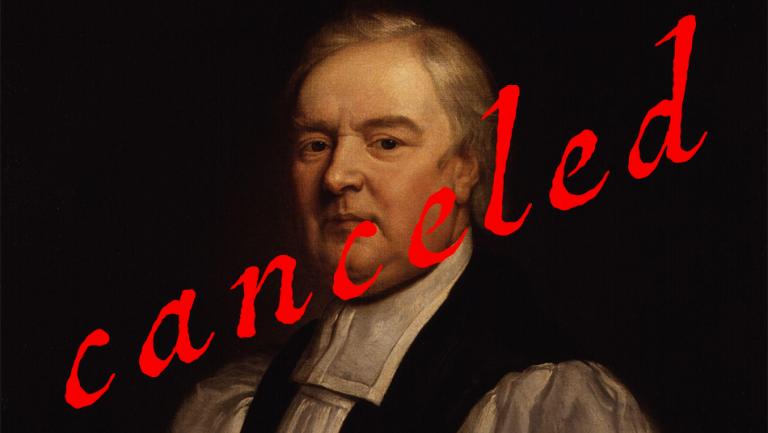
George Whitefield canceled John Tillotson. Tillotson was one of the most influential ecclesial figures during the seventeenth century, on both sides of the Atlantic basin and continental Europe. He garnered the regard and friendship of philosophes like Voltaire and Locke. Increase Mather esteemed him. Jonathan Edwards referred to him as “one of the greatest divines on the other side of the question in hand”—the “other side” being Arminianism.
Many considered this former Lord Archbishop of Canterbury to be the hallmark preacher of his era. He was widely regarded for his moderating spirit and moral temperament. This well-documented fact had been a key argument in Tillotson’s favor prior to Whitefield’s campaign against him. Despite the credibility of Tillotson’s social network, his pastoral skill, uncheckered moral character, and transatlantic renown—Whitefield successfully canceled him during the Great Awakening.
How Whitefield Canceled Tillotson
During his first itinerant preaching tour of the colonies in America, Whitefield altered public opinion of Tillotson by what he said about him in front of large audiences, especially the influential audience at Harvard College. He leveraged personal clout with his social network of pastors and allies to the evangelical cause. The popular print publication of Whitefield’s journals recorded his arguments to cancel Tillotson, which circulated among a mixed readership of influential lay people and vocational ministers.
What Arguments Canceled Tillotson
During his address at Harvard College, Whitefield lumped Tillotson and Samuel Clarke together as author’s of bad books. Clarke’s 1704 Boyle lectures implicated him with charges of universalism and arianism. While Whitefield did not use the popular derisive, Arminian, to describe Tillotson, lumping him into a category with Clarke did just as much. Arminianism was not merely a soteriological counterpoint to Calvinism in the seventeenth and eighteenth century, but an epithet for anyone left of center and on the slippery slope towards universalism, arianism, or, heaven forbid, popery (Catholicism).
Whitefield also compared Tillotson’s knowledge of Christianity to Mahomet’s (The Prophet of Islam), hinting at his judgment of Tillotson’s unconverted state. If there was one threat greater to the Protestant cause than popery, it was Mahometanism.
Whitefield’s subtle deployment of ad hominem in both arguments proved to be an effective tactic in his campaign to cancel Tillotson.
Why Whitefield Canceled Tillotson
Tillotson represented the established church. To be clear, by established church I do not simply mean the Church of England. Rather, the established church constituted high-brow, elitist Protestantism of the British Empire, which could be any of the recognized denominations of the mixed-established church: the Anglican churches of England or Ireland, the Congregational churches of New England, or the Presbyterian churches of Scotland or the Middle Colonies.
In Whitefield’s view, the established church had drifted too far from the center and become corrupted. Whitefield believed an overhaul was necessary for the established church. He distrusted established church ministers and university scholars, challenging the authenticity of their conversions. He championed Methodist tactics, such as small group meetings and bible study. He advocated Reformed doctrine and heart religion, characterized with true conversion.
Tillotson was a convenient target because he couldn’t defend himself. He had passed away some time ago. Whitefield could disinter and defame the memory of Tillotson with little opposition, especially while in the outer rim of the British Empire—in the dissenting contexts of either New England Congregationalism or the Presbyterians of the Middle Colonies, or even the disorganized and fragmented Church of England churches in the Chesapeake colonies.
Whitefield effectively muted the memory of Tillotson in evangelical history. To this day, evangelicals know little to nothing about Tillotson, partly because Whitefield then occupied the celebrity pastor space Tillotson had once filled in British imperial history.
Josh Howerton, Canceled
I recalled afresh the story of Whitefield’s campaign to cancel Tillotson, after witnessing this past week’s calls to hold accountable megachurch pastor, Josh Howerton.
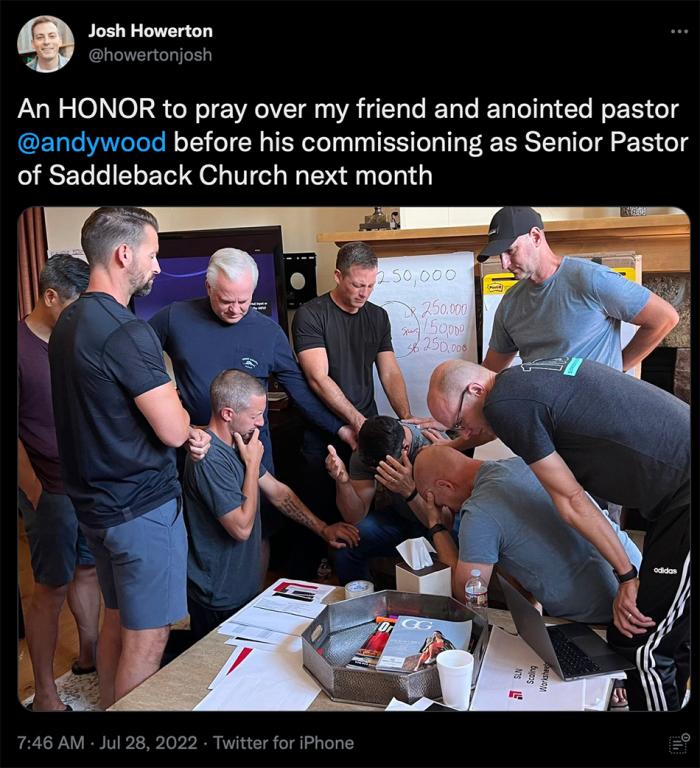
Josh Howerton (@howertonjosh), pastor of Lakepoint Church in Rockwall Texas, has been the recent recipient of ire for affirming Andy Wood as the incoming pastor at Saddleback Church. On July 28, Howerton tweeted an image of men laying hands and praying for Wood. This image incited an inferno of criticism.
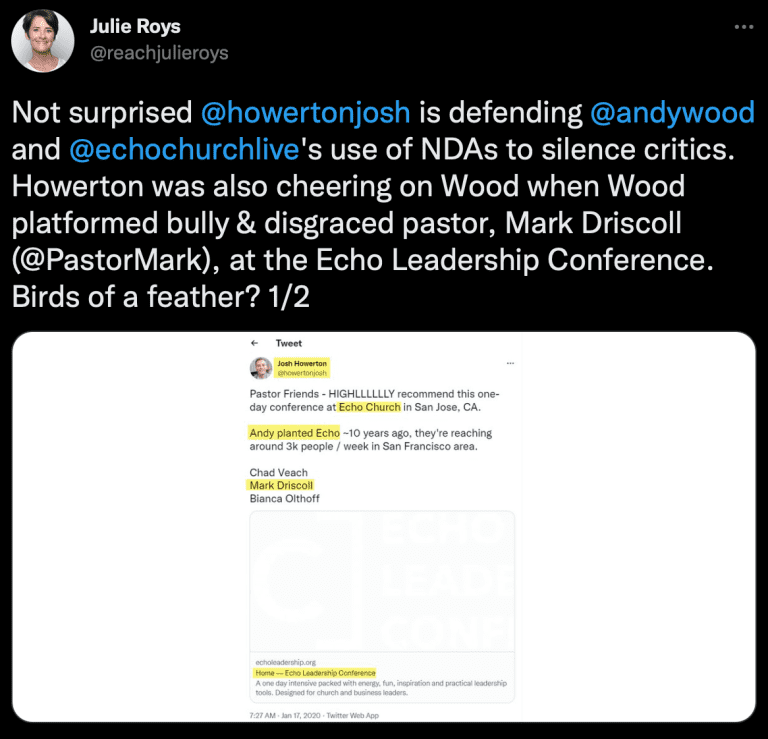
Julie Roys (@reachjulieroys), of The Roys Report (TRR), entered the conversation early and shared a tweet of Howerton’s from the archive. Howerton’s tweet affirmed a one-day conference at Echo Church, where Andy Wood once-pastored. This January 2020 conference platformed Mark Driscoll, after he had relaunched into the public eye as a pastor, once again. Howerton redressed Roys and requested she tear down her post. The two sparred back and forth with an exchange of tweets. Central to the discussion was an article from TRR covering how abuse victim’s challenged the Vanderbloemen Group report, which cleared Wood of abuse charges and gave him the green-light to succeed Rick Warren at Saddleback.
Howerton admonished Roys concerning the dangerous use of “concept creep” and fended off the charge that he supported the use of NDAs (Non-Disclosure Agreements). Concerning NDAs, Howerton boldly claimed, “Nor have I ever used one in any church I’ve pastored.”
At this point, Erin Harding (@ErinMHarding) stepped in and presented a piece of evidence to the contrary. It was an employee agreement, in use at Lakepoint Church since 2020, that included a confidentiality statement and mediation agreement.

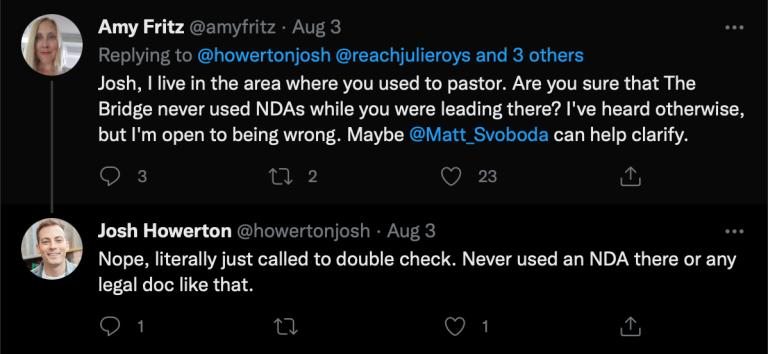
This evidence was supplied after Amy Fritz (@amyfritz), an abuse survivor from Dave Ramsey’s financial ministry, pressed into the conversation with Howerton to clarify his meaning of NDA and his history of using one at The Bridge, where Howerton formerly pastored.
At various points, other defenders of church spiritual and sexual abuse victims brought forward their concerns. Boz Tchividjian (@BozT), a lawyer who defends abuse victims, clarified the criteria of what constitutes an NDA. Sheila Gregoire (@sheilagregoire), author of The Great Sex Rescue, posed the notion that ministers, who affirm abusers like Driscoll or Wood, themselves, may be disqualified from ministry. And Warren Throckmorton (@wthrockmorton) pulled from the archive a 2011 tweet from Howerton that affirmingly quoted Mark Driscoll, who said, “Sometimes God brings big donors so you can do big things.”
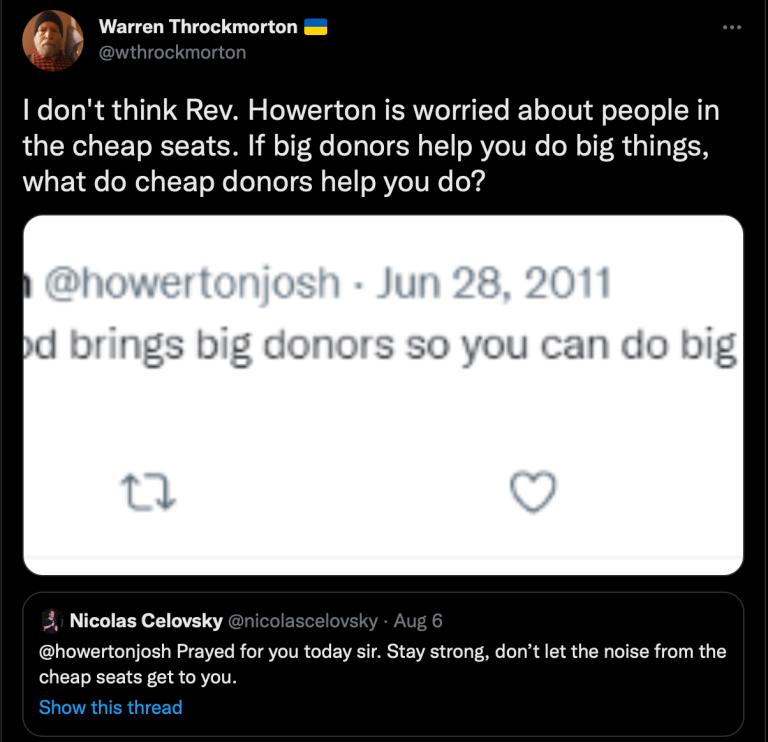
The Throckmorton tweet quote tweeted (QT’d) an admirer of Howerton, who had come to his support. Nicolas Celovsky (@nicolascelovsky) publicly shared how he had prayed for Howerton that day and encouraged him to not “let the noise from the cheap seats get to you.” Celovsky’s tweet elicited intense criticism about social status and hierarchies from multiple corners of Twitter, including a clever subtweet from Scott Coley (@scott_m_coley): “Jesus spent all his time in the cheap seats.” Howerton and Celovsky offered a correction that “cheap seats” referred not to social hierarchy but to the point of view of those not directly involved in a situation (appealing to the Urban Dictionary definition). Howerton rallied support from many, including a public statement from Daniel Darling (@dandarling), thanking Howerton for his faithful gospel ministry.
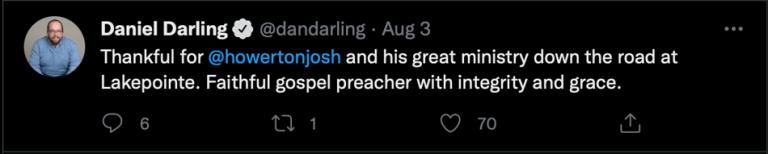
Nonetheless, after days of enduring what Howerton and his supporters might be perceive as a campaign to cancel him, Howerton seemed ready to withdraw, admitting he needed to focus on church ministry until he had margin to reflect on what had recently unfolded. His last thread included the forlorn conclusion of whether he could “stay on the Twitter streets or need to move.”
Cancel Culture Is a Feature of the Evangelical Story
Observing these events unfold on social media over the past week and comparing them to a story from the evangelical past has proven beneficial for me. It’s provided me objective space to reflect on the panoramic picture unfolding in the evangelical story. It has created a safe distance for me to study and recognize parallels to the past. It’s helped me consider the problematic elements and the beneficial function of cancellation, and explore and discern what constitutes cancellation. Whitefield engineered a damaging and problematic campaign to cancel Tillotson. On the other hand, Howerton has been confronted and called to account for his incautious support of an abuser. His failure to heed correction may indeed lead to cancellation.
When others hint at cracks in evangelicalism’s foundation or allude to the fragmentation of evangelicals, I perceive isolated tremors, like the Howerton debacle, as prescient warnings of impending seismic activity afoot for evangelicalism. I won’t forecast what rupture will ultimately cause a permanent alteration in the evangelical landscape. I’ll leave that to evangelical meteorologists superior to me. What I will do in this, and other successive posts, is point us to patterns from the evangelical past that parallel features we witness today.
You see, despite what many might assume, cancellation is not novel to twenty-first century evangelicalism. Canceling pastors is as old as the evangelical story. George Whitefield, who John Stackhouse has recently depicted as one among the quintessential ur-evangelicals, trail-blazed evangelical cancel culture when he canceled John Tillotson.
The spectacle of the public fall of celebrity pastors has indeed escalated over the course of the twenty-first century. There are features of the information and digital age that has accelerated this phenomenon. The rapid and real-time capacity of digital technology has collapsed the length of time in which a celebrity pastor’s downfall may occur. In the twenty-first century, figures like Howerton might be canceled in a week or even a weekend. All it takes is the right circumstances and a league of people to mobilize in the effort of holding accountable those who have not been brought to account for their indiscretions.
The recent attempt to hold Howerton accountable is just one instance in a growing pile of attempts to hold twenty-first century celebrity pastors accountable, and the pile will likely only grow higher in coming days.
The Function of Christian Cancel Culture
Why will the count escalate? A league of public personalities, who seek justice for the spiritually or sexually abused, has developed. This collective has organized itself and acts in concert to do what evangelical churches and their leadership have failed to do. This article has introduced you to a number of the personalities that are part of this loose coalition. By no means have I mentioned them all.
Many of those invested in seeking justice for the abused were themselves victims in the past. Their stories of suffering drive their participation in the righteous cause against abuses. Their opponents perceive that this pre-existing condition inhibits them from judging circumstances objectively and impartially. Of course, this riposte is insufficient at best.
Cancel culture will exist and continue to exist wherever adequate and equitable church discipline does not exist. It has become a necessary last resort, and a populist technique, when the God given mechanisms for accountability in the church have failed. As the case of George Whitefield and John Tillotson demonstrates, cancellation is no novel, modern, digital age phenomenon in evangelical history. It’s a ubiquitous feature of the evangelical story. I can produce numerous stories where evangelicals from the right or left have had to resort to cancellation. Some reasons are noble and necessary. Others are not. These episodes are portents of impending ruptures. They are tremors indicating seismic activity is imminent.
It’s possible that one of the unexpected outcomes of The Rise and Fall of Mars Hill podcast has been that it contributed a well-produced case study for how present-day evangelicals may mobilize and engineer an effective contemporary, cancellation campaign—in order to challenge, confront, and resist the evangelical church in the US. In the wake of this podcast, there seems to have been an escalation in campaigns to cancel pastors and confront church leadership. People who listened to the podcast and resonated with it, found one another on social media. They have organized and are collaborating to do what the evangelical church has failed to do. They are confronting injustices in the evangelical church in the US and calling it to account for those abuses. They are working systems that have become necessary, where other systems have failed.
While some might argue that these efforts are part of a conspiracy to undermine, subvert, or wreck evangelicalism, it’s altogether more likely that those in league are simply part of the harrowing legacy of its revivalist tradition.
Previous Post

August 8, 2022
Another Piece on Albania
Next Post

August 10, 2022 The Roman Bathsheba: A Narrative Without God
Browse Our Archives
Select a Category abolitionism Abortion Abraham Joshua Heschel Abraham Kuyper Abraham Lincoln Academia Activism Adam Renberg Advent Adventist africa African American Religion Agnes Howard Albert Camus American History American Religious History American Revolution American West Anabaptists Ancient History Andrea Turpin Andrei Tarkovsky Anglicanism Annales Ansley Lillian Quiros anti-Catholicism Antisemitism Anxious Bench apologetics Apparitions Arash Azizi Archaeology archives art Artificial Intelligence Asia Asian Americans Augustine Authors Bad Bunny Baptism Baptists Barack Obama Battle of Hastings Benjamin Franklin Bernard-Henri Levy Beth Allison Barr Beth Moore Bethany Mannon Bible Bill Cunningham Billy Graham Black Music Bob Dylan Body Boenhoffer Books Breastfeeding Bruce Springsteen C.S. Lewis Calvinism Cancel Culture Capitalism Carmelites Catholicism Cedric Robinson Cesar Chavez Charismaticism charity Charles Dickens Charles Lindbergh Che Guevara Chicago Children Chinese Christianity Chris Gehrz Christ Christian death Christian Higher Education Christian life Christian Nation Christian Nationalism Christianity Today Christmas Church life Church Practice cinema Civil Religion Civil Rights Movement Civil War civility Classics Climate Change Cold War Colonial Mexico colonialism Comer Communism community complementarianism Conference on Faith and History Congregationalism Conspiracies Conspiracy Conversion Narratives Coronavirus Costa Rica Council of Nicaea Covid-19 Creation Critical Race Theory Crusades Culture culture wars Daniel K. Williams David Barton David Swartz Death Ways death with dignity DEI democracy Democratic Party Devotion Digital Age Diplomacy discipleship diversity Donald Trump Drama Dua Lipa Early Church early modern Early modern Catholicism Easter Eastern Christianity economic exploitation Education elections Elie Wiesel Elizabeth II Elizabeth Taylor emotions Empire Engineering England enslavement Entertainment Episcopal Church Erica Ramirez eschatology Eurocentrism Evangelicalism Evangelicals Exegesis Family Feminism Film Flannery O'Connor folk music Food Foreign Policy founding fathers Franciscans Franciscus Junius fundamentalism Funerals G.K. Chesterton Gender Genocide genre geography George W. Bush George Washington George Whitefield Global Christianity Global church Grief Guadalupe guest post Guest Post gun control gun violence Gustavo Gutierrez Hamid Dabashi Harold John Ockenga Harvest Hate Hawaiian Christianity Healing health care Heather Cox Richardson Hell Heresy Hermeneutics Higher Education Hinduism Hippocratic oath Historical Fiction Historical Methodology Historical Profession Historical Profession Historical Theology Historical Thinking historiography Holidays Holocaust horror movies Human rights Humanitarian Work humanities Hummingbirds Hungary hymns Imago Dei Immigration Injustice Interviews Iran Islam Islamophobia Israel Ivan's Childhood Jacob Randolph James Bratt Janine Giordano Drake Japanese history Japanese Literature Jean Paul Sartre Jesse Miranda Jesus Jesus Christ Jimmy Carter Joan Baez Joan Didion Joanne Freeman João B. Chaves Joao Chaves Joey Cochran John Calvin John Fea John Tillotson John Turner Johnny Cash Jonathan Edwards Jonathan Tran Joseph Smith Josh Howerton Journalism Jr. Judaism Jürgen Moltmann Just War Justice Justin Brierley Karl Barth Katelyn Beaty koi ponds Kris Kristofferson Kristin Kobes Du Mez Latin American Religious History Latino Americans Lectio Divina Leisure Lent Leonard Cohen liberal arts liberalism Liberation Theology Linda Ronstadt Lisa Clark Diller Literature Lou Reed Lynchings Lynneth Miller Renberg Mainline Protestantism Malcolm Foley Marilyn Monroe Maritime history Mark Noll Marriage Martin Luther Martin Luther King Martyrdom Marxism Mary Masih Alinejad mass shootings material culture medieval Christianity Medieval Ethiopia Melissa Borja memory Mennonites Mental Health Mental Illness Methodism Mexican Americans Mexicans Mike Madrid Miles Mullin Min Jin Lee Miscarriage Missionaries Mister Rogers Mitt Romney modernity Monasticism Mormonism Motherhood Mothers of the Church Moving Music Musicals Nadya Williams Nahua Christianity Native Americans Natsume Sōseki New Contributor New England New Year New York Nico Non-Violent Protest Orthodoxy pacifism Paleo Evangelicals Palestinians Parenting Patti Smith Paul Kingsnorth Pedro Calderón de la Barca Pentecostalism Philip Jenkins Phillis Wheatley physician-assisted suicide pilgrimage Pilgrims Piracy pluralism Plutocracy Poetry Politics Pope Francis Pope Leo XIV post-modernism prayer preaching Presbyterians prosperity gospel Protest Public Executions Public history Publishing Puritans purity culture Quakers race Race Massacres Racial Capitalism racial reconciliation racialization Racism Raha Bahloulipour Re-Enchantment reading Reformation Refugees religion and the university religion and war Religious Freedom Religious Nones Religious Pluralism Religious Symbols religious violence Republican Party Revival Rita Coolidge Ritual Roger Williams Roman Catholic church Royalty Russell Moore same-sex marriage Sarah Irving-Stonebraker Scandinavia Science Science and Technology Scopes trial Scriptural Interpretation secularism Selena Quintanilla seminary Seventh-Day Adventists sexual morality Sexuality Sikhs Silence slaveholders theology Slavery Slavoj Zizek social justice Social Media Southern Baptist Convention Southern Religion Spain Spiritual Autobiography Spiritual but not religious Spiritual Discipline Sports Stanley Hauerwas Suffering Summer Camps Sunday Night Odds and Ends Supernatural Supreme Court Syriac Christianity Tal Howard Taylor Swift Teaching Technology Television Thanksgiving The Beatles The Mission theater TheoBros Theology Thomas Dixon Thomas Jefferson Thomas Kidd Thomas Merton Tim Gloege Tim Walz Tom Holland Tourism tradition Tragedy Translation Transnationalism Travel Trump Ukraine Uncategorized Unitarians United Methodist Church US History Vanessa Chan Velvet Underground Verónica A. Gutiérrez Veronica Gutierrez Vikings Violence Virgin Mary Virtue Virtue ethics Visions Voting War WCTU Wendell Berry Westminster Assembly White Evangelicalism Wildfires Winnie the Pooh Witches women Women in Ministry Women's and Gender Studies Work Worship writing Yasunari Kawabata Zena Hitz
Select a Month November 2026 October 2026 September 2026 August 2026 July 2026 June 2026 May 2026 April 2026 March 2026 February 2026 January 2026 December 2025 November 2025 October 2025 September 2025 August 2025 July 2025 June 2025 May 2025 April 2025 March 2025 February 2025 January 2025 December 2024 November 2024 October 2024 September 2024 August 2024 July 2024 June 2024 May 2024 April 2024 March 2024 February 2024 January 2024 December 2023 November 2023 October 2023 September 2023 August 2023 July 2023 June 2023 May 2023 April 2023 March 2023 February 2023 January 2023 December 2022 November 2022 October 2022 September 2022 August 2022 July 2022 June 2022 May 2022 April 2022 March 2022 February 2022 January 2022 December 2021 November 2021 October 2021 September 2021 August 2021 July 2021 June 2021 May 2021 April 2021 March 2021 February 2021 January 2021 December 2020 November 2020 October 2020 September 2020 August 2020 July 2020 June 2020 May 2020 April 2020 March 2020 February 2020 January 2020 December 2019 November 2019 October 2019 September 2019 August 2019 July 2019 June 2019 May 2019 April 2019 March 2019 February 2019 January 2019 December 2018 November 2018 October 2018 September 2018 August 2018 July 2018 June 2018 May 2018 April 2018 March 2018 February 2018 January 2018 December 2017 November 2017 October 2017 September 2017 August 2017 July 2017 June 2017 May 2017 April 2017 March 2017 February 2017 January 2017 December 2016 November 2016 October 2016 September 2016 August 2016 July 2016 June 2016 May 2016 April 2016 March 2016 February 2016 January 2016 December 2015 November 2015 October 2015 September 2015 August 2015 July 2015 June 2015 May 2015 April 2015 March 2015 February 2015 January 2015 December 2014 November 2014 October 2014 September 2014 August 2014 July 2014 June 2014 May 2014 April 2014 March 2014 February 2014 January 2014 December 2013 November 2013 October 2013 September 2013 August 2013 July 2013 June 2013 May 2013 April 2013 March 2013 February 2013 January 2013 December 2012 November 2012 October 2012 September 2012 August 2012 July 2012 June 2012 May 2012
Follow Us!
TAKE THE
Religious Wisdom Quiz
What Christian denomination is known for circuit riders and revival meetings in America?
Select your answer to see how you score.
Episcopalian Methodist Presbyterian Catholic
Related posts from Anxious Bench

Best Books of 2026 on American Christianity
Public Executions and the Pirate Curse of Nix's...
Paris & CT Burn 50 Years After Newsweek's...

What Coffee Reveals About America's Evangelical Varieties
TRENDING AT PATHEOS Evangelical

Prioritizing Jesus This Advent
Miller’s Station UMC| 29 November 2026| Mathew 19:16-27 When we prioritize Jesus,...

A Subtle Indicator of Legalism
Legalism was invented by pastors who don’t want to be woken up...
The Two Advents of the Babe and the...
We just celebrated the great family holiday of Thanksgiving and after going...

What are your dreams trying to tell you?...
Dreams can seem crazy. You’re suddenly with a person you haven’t seen...

Advent Begins in the Waiting: Preparing for Jesus
The Christmas season seems to arrive earlier every year. Before Halloween decorations...

As was predicted many years ago, the Interpreter Foundation's website is...
view all Evangelical blogs
Ad-Free & Subscriber Log-In Subscription Support
- About Us
- 2026 Calendar
- Videos
- Podcasts
- Library of World Religions
- Faith In Media Tracker
- Advertise With Us
- Write for Us
- Privacy Policy
- Terms of Service
- Do Not Sell My Data
- Contact Us
- Radiant Digital
- Manage Newsletter Subscriptions
- Unsubscribe From Notifications
- Sitemap
Copyright 2008-2026, Patheos, part of the Radiant Digital network of media brands. All rights reserved.
Subscription Support Ad-Free & Subscriber Log-In
Follow Patheos