
BuddhistCatholicContemplativeEvangelicalGeneral ChristianHinduJewishLatter-day SaintMuslimNew VisionsProgressive Christian
Beliefs
- Buddhist
- Catholic
- Contemplative
- Evangelical
- General Christian
- Hindu
- Jewish
- Latter-day Saint
- More Voices
- Muslim
- New Visions
- Pagan
- Progressive Christian
Topics
- Religion News
- Food and Religion
- Sports and Religion
- Religious Art
- Religious Music and Entertainment
- Religious Events
- History and Religion
- Style and Religion
- Politics and Religion
- Women in Religion
- Recreation Outdoors and Religion
- Business Finance and Religion
- Careers Workplace and Religion
- Education and Religion
- Family Parenting and Religion
- Health Fitness and Religion
- Home and Religion
- Relationships and Religion
- Technology and Religion
- Travel and Religion
Columnists
- Buddhist Columnists
- Business Finance and Religion Columnists
- Careers Workplace and Religion Columnists
- Catholic Columnists
- Contemplative Columnists
- Education and Religion Columnists
- Evangelists Columnists
- Family Parenting and Religion Columnists
- General Christian Columnists
- Health Fitness and Religion Columnists
- Hindu Columnists
- History and Religion Columnists
- Home and Religion Columnists
- Jewish Columnists
- More Voices Columnists
- Latter Day Columnists
- Muslim Columnists
- New Visions Columnists
- Nonreligious Columnists
- Pagan Columnists
- Politics and Religion Columnists
- Progressive Columnists
- Recreation Outdoors and Religion Columnists
- Relationships and Religion Columnists
- Religion News Columnists
- Religious Art Columnists
- Religious Events Columnists
- Religious Music and Entertainment Columnists
- Sports and Religion Columnists
- Style and Religion Columnists
- Technology and Religion Columnists
- Travel and Religion Columnists
- Women in Religion Columnists
Resource Library
- 2026 Calendar
- Library of World Religions
- The 100 Most Holy Places on Earth
- Patheos Answers
- Podcasts
- Videos
- Faith Leaders Database
- Anglican Episcopalian
- Bahai
- Baptist
- Buddhism
- Christianity
- Confucianism
- Eastern Orthodoxy
- Hinduism
- Holiness and Pentecostal
- ISKCON
- Islam
- Judaism
- Lutheran
- Methodist
- The Church of Jesus Christ of Latter-day Saints
- New Age
- Paganism
- Presbytarian and Reformed
- Protestantism
- Religion Behind the Scenes
- Roman Catholic
- Scientology
- Shia Islam
- Sikhism
- Sufism
- Sunni Islam
- Taoism
- Zen
- See all religions
Research Tools
 Ad-Free & Subscriber Log-In Subscription Support
Ad-Free & Subscriber Log-In Subscription Support
Follow Patheos 

- Trending:
- Forgiveness
- |
- Marriage
- |
- Consciousness
- |
- Death Penalty
- |
- Election
- |
- Halloween

-
About the Authors
- Home
- Evangelical
- Women in Religion
- Exhibiting Evangelicalism: An Interview with Devin Manzullo-Thomas
Exhibiting Evangelicalism: An Interview with Devin Manzullo-Thomas
Last updated on: August 17, 2022 at 1:11 pm by David Swartz
Exhibiting Evangelicalism: An Interview with Devin Manzullo-Thomas 2022-08-17T13:11:06-04:00 David Swartz
Patheos Explore the world's faith through different perspectives on religion and spirituality! Patheos has the views of the prevalent religions and spiritualities of the world.
I’m pleased to welcome Devin Manzullo-Thomas to the Anxious Bench. He is assistant professor of American religious history, director of the E. Morris and Leone Sider Institute for Anabaptist, Pietist and Wesleyan Studies, and director of archives at Messiah University. What follows is a conversation we recently had about his new book, Exhibiting Evangelicalism: Commemoration and Religion’s Presence of the Past, which looks at how evangelicals have narrated themselves in museums. —David R. Swartz
***
DRS: What led you to research evangelical public history?
DMZ: In graduate school, one of the books I read in an Intro to Public History course was Roy Rosenzweig and David Thelen’s The Presence of the Past: Popular Uses of History in American Life, an analysis of a nationwide survey of how Americans relate to the past. It chronicled the ways that people in the United States consume the past—books, documentaries, museums, etc.—and what they do with the past: make sense of their identities, build community, envision the future. It also explored the distinctive ways that different groups in American public life—African Americans, women, etc.—engage with the past.
While I found the book fascinating, I was quite bothered by one of the decisions that the authors made: they “did not ask explicitly about religion” (120) when surveying their sample. Although I recognize that a single monograph can’t do everything, it seemed to me that excluding from their study any considerations of the way that religious Americans engage with the past was a significant oversight. In my experience, religious Americans—especially the white evangelical Protestants around whom I grew up—were especially avid consumers of the past, with distinctive ways of thinking about the relationship between the past and their faith and about the role of history in American public life (e.g., the common belief in the church of my youth that America was a “Christian nation” and needed Christians’ deliberate custodianship).
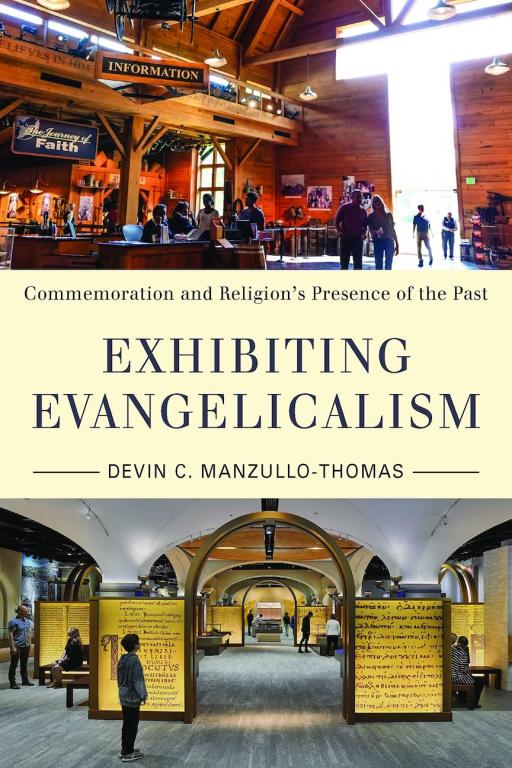 To be fair, Rosenzweig and Thelen didn’t completely overlook these realities. In fact, they admitted that “a significant minority . . . [of] respondents forced us to see [religion’s] crucial role in determining how people think about and use the past” (120). And they gave direct attention to evangelicals, noting that “the historical vision of evangelical Christians is extraordinarily consistent and powerful” and that “few other Americans have such a vivid sense of how a specific set of past events guides their behavior in the present” (121). Still, it seemed to me that much more could be said about these religious Americans in particular. Fortunately, my graduate advisor agreed! I focused my dissertation on these questions, and from that project Exhibiting Evangelicalism was eventually born.
I could have focused on a great many religious Americans who create museums, historic sites, and other spaces to make their history public. Catholics and Mormons certainly do this sort of thing. (Consider, for instance, Keith A. Erekson’s work on the history of the Joseph Smith Birthplace, or Emily (Davis) Arledge’s forthcoming history of American Catholic shrines.) But I chose to focus on Protestants, and especially on evangelicals, for two reasons. First, I had already published some scholarship on evangelicals, so I knew the general historical literature on this group pretty well… and I knew that very little had been said about the way that they narrate their history in public spaces. Second, I was particularly drawn toward the public history of a group that puts a great deal of emphasis on the mind. Beliefs, rather than rituals or practices, have always been paramount for Protestants and especially for evangelical Protestants. So why would a group that emphasizes cognition spend time, energy, and especially money creating spaces for exhibiting historical artifacts?
DRS: How did you pick your case studies? Or are these pretty much all the evangelical museums in the country?
DMZ: There aren’t that many museums owned and operated by evangelical Christians in the United States, but there are more than you might think. As I worked on this project, I determined early on that I would focus on institutions that claimed at least some level of identity as history museums. That led me to exclude sites like the Creation Museum and the Ark Encounter (which I nevertheless visited during my research!) since they are more like natural history museums. I could definitely have incorporated more historically oriented theme parks into the analysis, such as Jim and Tammy Faye Bakker’s wildly popular but ultimately ill-fated Heritage USA (which makes a brief cameo in Chapter 4). But the sites I chose were ultimately ones that I felt were historically significant—innovators in some sense—and/or ones with significant visibility or a national profile.
DRS: You show that early work in this area was largely driven by women. Who were they, and why haven’t we heard their names or stories until now?
DMZ: Two women played key roles in the creation of evangelical museums in the United States, at least in the version of the story that I tell in Exhibiting Evangelicalism: Helen Thompson Sunday and Lois Ferm.
Sunday was the wife of Billy Sunday, the famous Gilded Age baseball preacher. Born into an upper-middle-class Presbyterian family on Chicago’s west side, she was schooled in business administration by her father and deployed those skills early in her life, as when she started running her church’s large Christian Endeavor youth group at age 18. She married Billy in 1888, before he became a household name. By the time he died in 1935, Helen had amassed significant influence in the wider evangelical world. She had managed the many administrative and logistical aspects of Billy’s crusades, significantly contributing to his success, and had written a nationally syndicated newspaper column titled “Ma Sunday Speaks.” In keeping with what the historian Kate Bowler has argued about women in evangelical spaces more broadly, Sunday’s fame and authority were closely tied to her status as a wife and mother. Thus, after Billy’s death, her status was in jeopardy. How could she remain in the spotlight now that her tie to institutional power was gone? In part, Helen did so by curating Billy’s memory. She appeared onstage with post-World War II figures who claimed the evangelical label, such as Billy Graham, and when she did so she always spoke about her husband and his halcyon days, tying Billy’s legacy to these up-and-coming movement leaders. As she told the crowd at Graham’s 1952 crusade in Washington, D.C., “Billy Sunday was a great man. Give Billy Graham another [few] years and he’ll be a whiz too.”
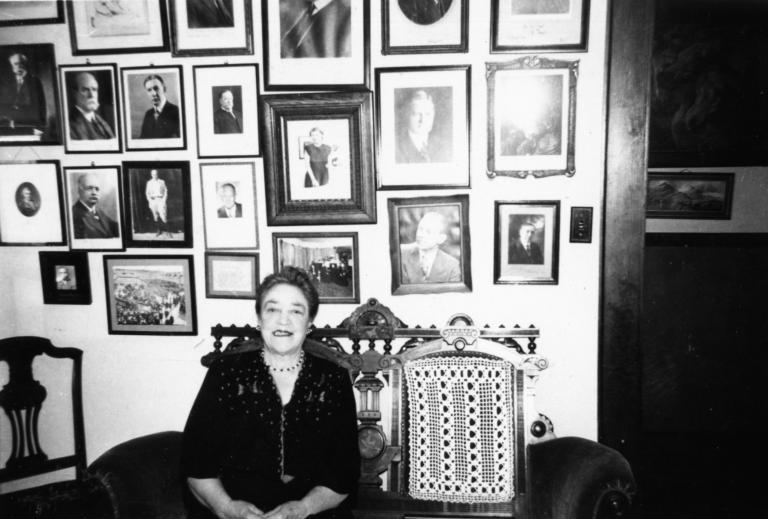
Helen Thompson Sunday sitting in front of a wall of photographs of famous Americans, in the bedroom of the house she shared with her husband, Billy Sunday. This wall featured prominently in a recording made of her house museum tour in the 1940s. (Used with permission from Archives and Special Collections, Morgan Library, Grace College and Seminary, Winona Lake, IN)
Sunday also retained her fame and authority by curating Billy’s memory in a material sense: by turning their home in the Midwest resort town of Winona Lake, Indiana, into a house museum. Starting at least in the 1940s and continuing until her death in 1957, Sunday opened her home—where she continued to live—to the many Protestants of all different denominations who flocked to the lake each summer. Her tours crafted Billy’s legacy in different ways, especially by displaying and highlighting material artifacts that emblemized certain aspects of his career. Indeed, Sunday’s work as a house museum curator in many ways set the stage for other experiments in evangelical public history.
Fast-forward a couple decades, to the 1970s—and to the work of Lois Ferm. A Houghton College graduate who eventually earned a PhD from the University of Minnesota, Ferm had already built a career as a librarian when she was tapped by Billy Graham in the early 1970s to help him brainstorm what he should do with the material legacy of his career—the large archive of artifacts, documents, and other records his organization had amassed in its two-decade existence. (Ferm’s husband, Bob, had been working for Graham’s organization in various capacities since the 1950s.) Ferm helped Graham to see the value of a museum and to strategize the purposes of such a site. Among other features, she argued that the site should not be a staid place for the exhibition of dusty artifacts. Instead, the museum should do what Graham had done at his many, many crusades: it should lead people to conversion. Ferm believed that by bearing witness to the grand history of American evangelicalism and to Billy’s personal story within that grander narrative, visitors might be compelled to give their hearts to Jesus.
Ferm was eventually removed from the project, sidelined by the all-male board of the Billy Graham Evangelistic Association. (My argument is that they were intimidated by her professional credentials and her proximity to Graham.) But her ideas were not erased. Indeed, the site that emerged after more years of planning and strategizing—the Billy Graham Center Museum, on the campus of Wheaton College outside Chicago—did exactly what Ferm advocated for. If you visit the Museum today, you’ll encounter a narrative of evangelicalism in America and you’ll hear the story of Graham and his ministry, but you’ll also find yourself in the Walk Through the Gospel exhibit, which uses sensory experience to replicate the biblical story of Christ’s death and resurrection. At the end of that exhibit hall, you’ll be invited to convert to Christian faith. Curators built on Ferm’s original idea, resulting in the museum that still stands today.
These women are fascinating—among my favorite historical actors in the story I tell in Exhibiting Evangelicalism. Unfortunately, as I note in the book, their work has been obscured. In part that’s because the Sunday house museum never became a national site (the Winona Lake Bible Conference to which it was connected filed for bankruptcy and dissolved about a decade after Sunday’s death) and because Ferm was pushed out of the project.
But I think their obscurity is also a historiographical problem—too much (though not all!) of the historical scholarship on evangelicalism has centered on male actors. That’s not the case in the historiography of public history, which has long acknowledged the role of women as preservationists, curators, archivists, and more. But unfortunately—again as I note in the book—these historiographies have not intersected or interacted. Part of what I’m trying to do with Exhibiting Evangelicalism is draw them together, show the resonances and connections over time.
DRS: You describe an “experiential turn” in public history. What does that look and feel and sound like at evangelical commemorative sites?
DMZ: Probably the best way to answer this question is to explain the Billy Graham Center Museum at Wheaton College, which was developed in the 1970s (at the peak of this “experiential turn” within the wider public history world) and finally opened to the public in 1980.
The museum in its original form contained a number of exhibits that engaged visitors’ emotions and gave them tangible experiences with the past. For example, in the exhibit on “The History of Revival and Evangelism in America,” visitors encountered traditional text panels, object displays, and timelines—but they also encountered a large, walk-through diorama of a nineteenth-century frontier revival tent, complete with long wooden benches (on which visitors could sit) and hidden speakers that piped in the sounds of a revival service: voices raised in worship, sentimental piano music, and more. The diorama invited visitors to imagine what might have happened at the service and, in this way, to identify with the people who might have attended it, thereby building historical knowledge through experience and emotion.
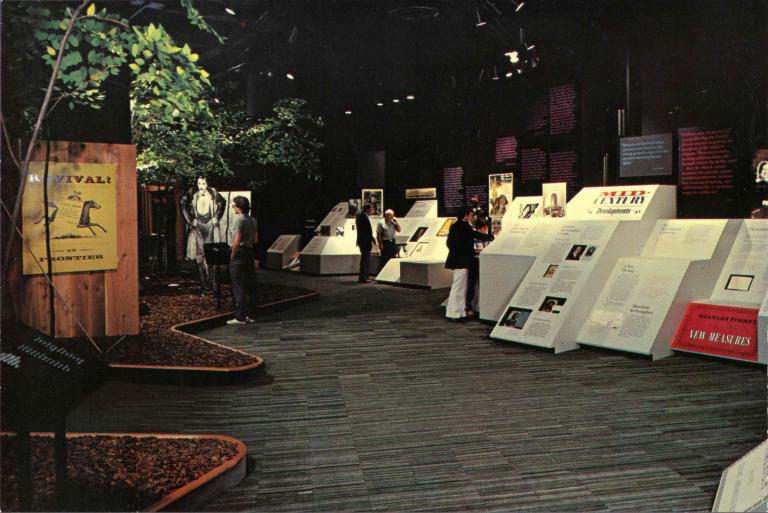
The original “History of Revival and Evangelism in America” exhibit at the Billy Graham Center Museum at Wheaton College. Opened in 1980, the exhibit was remodeled in the early 1990s. In this version, traditional interpretive text panels and object displays narrating the history of evangelical ministry in the United States lined the right-hand wall. Along the left-hand wall, visitors could enter a replica of a canvas revival tent (note the sign stating “Revival”) or stand before life-size cutouts of famous evangelists and listen to their biographies and sermons through headphones. (Courtesy of the Wheaton College Billy Graham Center Archives, Wheaton, IL)
The most experiential exhibit in the original museum—which still remains today!—was the Walk Through the Gospel exhibit mentioned above. Visitors began this exhibit walking through a doorway shaped like the cross, into a series of labyrinthine, black-walled, dimly-lit hallways meant to symbolize Christ’s crucifixion and death. The only texts here were Bible verses, drawn from the gospels. Curators intended these hallways to evoke visitors’ feelings of guilt for sin and anguish over Christ’s sacrifice. But then visitors turned a corner, finding themselves in a blindingly bright room, the walls painted in hues of cerulean and white, enveloped in the sounds of “The Credo” from Bach’s B-minor mass. This room—known affectionately to visitors as the “Heaven Room”—was meant to signify Christ’s resurrection and ascension, and curators hoped it would fill visitors with feelings of joy and hope.
Similar experiential exhibits were incorporated into the museum’s mid-1990s renovation. For example, visitors to the museum today can stand in the pulpit that Billy Graham used throughout his career. They can literally put themselves in Graham’s shoes—standing where he stood, looking at facsimiles of the sermon notes he used. The walls surrounding the pulpit are even painted to look like a crusade crowd, so that you’re surrounded by listeners while standing in Graham’s stead. Again, the curatorial intent here is to get you to feel like Graham—to consider how you, too, might contribute to God’s work of evangelism.
DRS: I was fascinated by the decisive turn southward as your book progresses. Early on the key sites of evangelical public history were Winona Lake, Indiana; Boston, Massachusetts; and Wheaton, Illinois. In more recent years, you’re dealing with Charlotte, Washington, D.C., and other points south of the Mason-Dixon line. What does this geographical shift say about evangelicalism more broadly?
DMZ: This is a great question, and one that I wasn’t consciously aware of as I put the book together. But you’re right—there is a turn southward. My initial impulse is to think about this geographic move as one of market location: sites like the Billy Graham Library (which is different than the Wheaton museum) are going to draw more visitors in the Bible Belt than, say, in “secular” museum havens like Philadelphia or New York.
At the same time, I think the southward movement also has to do with respectability. The Museum of the Bible, which opened in Washington, D.C., in 2017, is situated right in the heart of America’s national commemorative landscape, just a stone’s throw from the federally operated Smithsonian museums that line the National Mall. Curators at the MotB strove for intellectual respectability, resisting efforts by major donors to get them to hand out tracts or incorporate other kinds of evangelistic methods (as sites like the Billy Graham Library do). They wanted the MotB to be taken seriously in the world of American public history.
DRS: I really appreciated your warning in the epilogue about not just deconstructing treasured narratives. You write, “If we are committed to revealing the inadequacies of certain historical imaginaries embraced by our visitors, what are we giving to visitors even as we take away their comfortable, deeply held ways of relating to the past?” What specific advice would you give one of your case studies?
DMZ: I think the biggest piece of advice I would give to these sites to embrace complexity. It seems to me that the public rhetoric of many evangelicals, especially evangelical leaders with large platforms, avoids complexity and nuance. That’s certainly the case at these sites, which—as I point out repeatedly throughout the book—minimize unflattering or problematic aspects of the histories they’re presenting. The Billy Graham Center Museum, for instance, in its historical exhibit on the history of evangelism and revival in America, stresses the work of evangelicals who called for the abolition of slavery… while conveniently leaving out the many, many evangelicals who supported the institution, often by appealing to the Bible. Similarly, the Billy Graham Library, in Charlotte, North Carolina, in narrating Graham’s life and ministry, emphasizes (one might say over-emphasizes) his achievements but doesn’t mention any of his failures, such as his unwavering public support for Richard Nixon, even after his role in the Watergate coverup was revealed, or the anti-Semitic language that Graham employed in some of his taped conversations with the president.
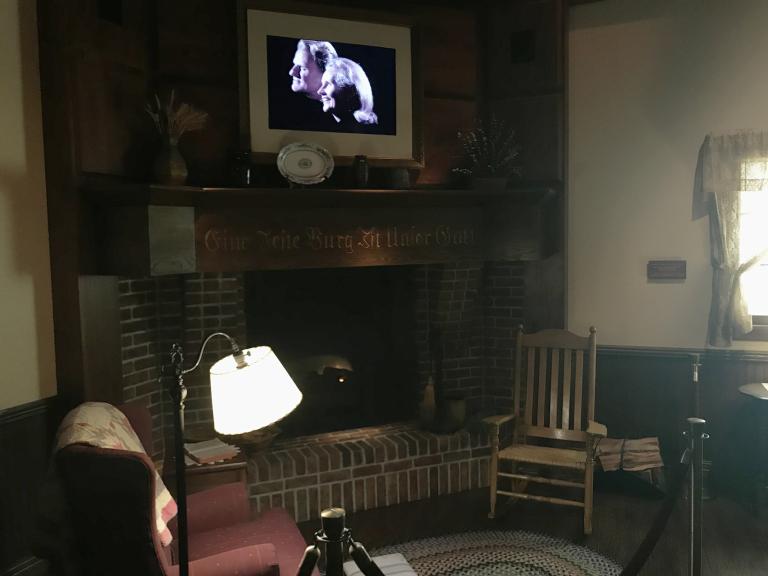
The “Footprints of a Pilgrim” gallery, one of many exhibit display areas at the version of the Billy Graham Library that opened in 2007 in Charlotte, North Carolina. (The Library is currently undergoing a major renovation.) The gallery features an in-situ recreation of the Grahams’ living room at their home in Montreat, North Carolina, and uses the space to celebrate a vision of conservative vision of Christian womanhood, domesticity, and heterosexual marriage. (Photograph by Devin Manzullo-Thomas)
These aspects of evangelicals’ shared past are left out of the exhibit hall because they don’t advance what evangelicals believe are the purposes of history: they’re not inspirational or instrumental, at least not on the surface. They don’t invite visitors to embrace Christian faith. But I would argue that, if we accept evangelicals’ premise that history should have some sort of didactic purpose, then these aspects of the past do belong in the exhibit hall. They inform (or remind) visitors of an essential element of evangelical theology: sin. Evangelicals believe that all people—even evangelicals, even Billy Graham—are sinners, who sometimes act against God’s will and must seek repentance. Wouldn’t it make sense to showcase this very real (at least to evangelicals) aspect of human existence? Wouldn’t it serve the ultimate purpose of evangelical public history—to draw visitors to Christian faith—to remind us that, like people throughout history, we are sinners who need to confess our misdeeds and seek God’s forgiveness?
Women in Religion
History and Religion
Previous Post
August 16, 2022
Down with the Patriarchy! Remembering the Medieval Mary Magdalene
Next Post

August 18, 2022 Google's Revolution in Historical Research
Browse Our Archives
Select a Category abolitionism Abortion Abraham Joshua Heschel Abraham Kuyper Abraham Lincoln Academia Activism Adam Renberg Advent Adventist africa African American Religion Agnes Howard Albert Camus American History American Religious History American Revolution American West Anabaptists Ancient History Andrea Turpin Andrei Tarkovsky Anglicanism Annales Ansley Lillian Quiros anti-Catholicism Antisemitism Anxious Bench apologetics Apparitions Arash Azizi Archaeology archives art Artificial Intelligence Asia Asian Americans Augustine Authors Bad Bunny Baptism Baptists Barack Obama Battle of Hastings Benjamin Franklin Bernard-Henri Levy Beth Allison Barr Beth Moore Bethany Mannon Bible Bill Cunningham Billy Graham Black Music Bob Dylan Body Boenhoffer Books Breastfeeding Bruce Springsteen C.S. Lewis Calvinism Cancel Culture Capitalism Carmelites Catholicism Cedric Robinson Cesar Chavez Charismaticism charity Charles Dickens Charles Lindbergh Che Guevara Chicago Children Chinese Christianity Chris Gehrz Christ Christian death Christian Higher Education Christian life Christian Nation Christian Nationalism Christianity Today Christmas Church life Church Practice cinema Civil Religion Civil Rights Movement Civil War civility Classics Climate Change Cold War Colonial Mexico colonialism Comer Communism community complementarianism Conference on Faith and History Congregationalism Conspiracies Conspiracy Conversion Narratives Coronavirus Costa Rica Council of Nicaea Covid-19 Creation Critical Race Theory Crusades Culture culture wars Daniel K. Williams David Barton David Swartz Death Ways death with dignity DEI democracy Democratic Party Devotion Digital Age Diplomacy discipleship diversity Donald Trump Drama Dua Lipa Early Church early modern Early modern Catholicism Easter Eastern Christianity economic exploitation Education elections Elie Wiesel Elizabeth II Elizabeth Taylor emotions Empire Engineering England enslavement Entertainment Episcopal Church Erica Ramirez eschatology Eurocentrism Evangelicalism Evangelicals Exegesis Family Feminism Film Flannery O'Connor folk music Food Foreign Policy founding fathers Franciscans Franciscus Junius fundamentalism Funerals G.K. Chesterton Gender Genocide genre geography George W. Bush George Washington George Whitefield Global Christianity Global church Grief Guadalupe Guest Post guest post gun control gun violence Gustavo Gutierrez Hamid Dabashi Harold John Ockenga Harvest Hate Hawaiian Christianity Healing health care Heather Cox Richardson Hell Heresy Hermeneutics Higher Education Hinduism Hippocratic oath Historical Fiction Historical Methodology Historical Profession Historical Profession Historical Theology Historical Thinking historiography Holidays Holocaust horror movies Human rights Humanitarian Work humanities Hummingbirds Hungary hymns Imago Dei Immigration Injustice Interviews Iran Islam Islamophobia Israel Ivan's Childhood Jacob Randolph James Bratt Janine Giordano Drake Japanese history Japanese Literature Jean Paul Sartre Jesse Miranda Jesus Jesus Christ Jimmy Carter Joan Baez Joan Didion Joanne Freeman João B. Chaves Joao Chaves Joey Cochran John Calvin John Fea John Tillotson John Turner Johnny Cash Jonathan Edwards Jonathan Tran Joseph Smith Josh Howerton Journalism Jr. Judaism Jürgen Moltmann Just War Justice Justin Brierley Karl Barth Katelyn Beaty koi ponds Kris Kristofferson Kristin Kobes Du Mez Latin American Religious History Latino Americans Lectio Divina Leisure Lent Leonard Cohen liberal arts liberalism Liberation Theology Linda Ronstadt Lisa Clark Diller Literature Lou Reed Lynchings Lynneth Miller Renberg Mainline Protestantism Malcolm Foley Marilyn Monroe Maritime history Mark Noll Marriage Martin Luther Martin Luther King Martyrdom Marxism Mary Masih Alinejad mass shootings material culture medieval Christianity Medieval Ethiopia Melissa Borja memory Mennonites Mental Health Mental Illness Methodism Mexican Americans Mexicans Mike Madrid Miles Mullin Min Jin Lee Miscarriage Missionaries Mister Rogers Mitt Romney modernity Monasticism Mormonism Motherhood Mothers of the Church Moving Music Musicals Nadya Williams Nahua Christianity Native Americans Natsume Sōseki New Contributor New England New Year New York Nico Non-Violent Protest Orthodoxy pacifism Paleo Evangelicals Palestinians Parenting Patti Smith Paul Kingsnorth Pedro Calderón de la Barca Pentecostalism Philip Jenkins Phillis Wheatley physician-assisted suicide pilgrimage Pilgrims pluralism Plutocracy Poetry Politics Pope Francis Pope Leo XIV post-modernism prayer preaching Presbyterians prosperity gospel Protest Public history Publishing Puritans purity culture Quakers race Race Massacres Racial Capitalism racial reconciliation racialization Racism Raha Bahloulipour Re-Enchantment reading Reformation Refugees religion and the university religion and war Religious Freedom Religious Nones Religious Pluralism Religious Symbols religious violence Republican Party Revival Rita Coolidge Ritual Roger Williams Roman Catholic church Royalty Russell Moore same-sex marriage Sarah Irving-Stonebraker Scandinavia Science Science and Technology Scopes trial Scriptural Interpretation secularism Selena Quintanilla seminary Seventh-Day Adventists sexual morality Sexuality Sikhs Silence slaveholders theology Slavery Slavoj Zizek social justice Social Media Southern Baptist Convention Southern Religion Spain Spiritual Autobiography Spiritual but not religious Spiritual Discipline Sports Stanley Hauerwas Suffering Summer Camps Sunday Night Odds and Ends Supernatural Supreme Court Syriac Christianity Tal Howard Taylor Swift Teaching Technology Television Thanksgiving The Beatles The Mission theater TheoBros Theology Thomas Dixon Thomas Jefferson Thomas Kidd Thomas Merton Tim Gloege Tim Walz Tom Holland Tourism tradition Tragedy Translation Transnationalism Travel Trump Ukraine Uncategorized Unitarians United Methodist Church US History Vanessa Chan Velvet Underground Verónica A. Gutiérrez Veronica Gutierrez Vikings Violence Virgin Mary Virtue Virtue ethics Visions Voting War WCTU Wendell Berry Westminster Assembly White Evangelicalism Wildfires Winnie the Pooh Witches women Women in Ministry Women's and Gender Studies Work Worship writing Yasunari Kawabata Zena Hitz
Select a Month October 2026 September 2026 August 2026 July 2026 June 2026 May 2026 April 2026 March 2026 February 2026 January 2026 December 2025 November 2025 October 2025 September 2025 August 2025 July 2025 June 2025 May 2025 April 2025 March 2025 February 2025 January 2025 December 2024 November 2024 October 2024 September 2024 August 2024 July 2024 June 2024 May 2024 April 2024 March 2024 February 2024 January 2024 December 2023 November 2023 October 2023 September 2023 August 2023 July 2023 June 2023 May 2023 April 2023 March 2023 February 2023 January 2023 December 2022 November 2022 October 2022 September 2022 August 2022 July 2022 June 2022 May 2022 April 2022 March 2022 February 2022 January 2022 December 2021 November 2021 October 2021 September 2021 August 2021 July 2021 June 2021 May 2021 April 2021 March 2021 February 2021 January 2021 December 2020 November 2020 October 2020 September 2020 August 2020 July 2020 June 2020 May 2020 April 2020 March 2020 February 2020 January 2020 December 2019 November 2019 October 2019 September 2019 August 2019 July 2019 June 2019 May 2019 April 2019 March 2019 February 2019 January 2019 December 2018 November 2018 October 2018 September 2018 August 2018 July 2018 June 2018 May 2018 April 2018 March 2018 February 2018 January 2018 December 2017 November 2017 October 2017 September 2017 August 2017 July 2017 June 2017 May 2017 April 2017 March 2017 February 2017 January 2017 December 2016 November 2016 October 2016 September 2016 August 2016 July 2016 June 2016 May 2016 April 2016 March 2016 February 2016 January 2016 December 2015 November 2015 October 2015 September 2015 August 2015 July 2015 June 2015 May 2015 April 2015 March 2015 February 2015 January 2015 December 2014 November 2014 October 2014 September 2014 August 2014 July 2014 June 2014 May 2014 April 2014 March 2014 February 2014 January 2014 December 2013 November 2013 October 2013 September 2013 August 2013 July 2013 June 2013 May 2013 April 2013 March 2013 February 2013 January 2013 December 2012 November 2012 October 2012 September 2012 August 2012 July 2012 June 2012 May 2012
Follow Us!
TAKE THE
Religious Wisdom Quiz
What does Paul say we see now as in a mirror dimly, but will one day see face to face?
Select your answer to see how you score.
Heaven Christ Knowledge God
Related posts from Anxious Bench

What Coffee Reveals About America's Evangelical Varieties

A Casserole is Not a Counterpoint

Angelina Grimké's Forgotten Turn to Apocalyptic Faith
TRENDING AT PATHEOS Evangelical

Nearly every morning, I make the drive to Detroit with my high-school-age...

The Real AI Story Is Adoption Without Trust
Artificial intelligence has crossed a political threshold. It is no longer a...

A new article, written by Jeff Lindsay and Gale L. Pooley,...

Swimfan: Forgotten Aughts Pleasures
This is a recovery effort. In 2002, My Big Fat Greek Wedding...

Top Three Anti-Catholic Lies About Catholicism
This is my initial transcript for the video, "THE 3 WORST...

Pope Leo Celebrates Mass for Nurses & Docs...
I don't have any idea how he did it, but Pope Leo...
view all Evangelical blogs
Ad-Free & Subscriber Log-In Subscription Support
- About Us
- 2026 Calendar
- Videos
- Podcasts
- Library of World Religions
- Faith In Media Tracker
- Advertise With Us
- Write for Us
- Privacy Policy
- Terms of Service
- Do Not Sell My Data
- Contact Us
- Radiant Digital
- Manage Newsletter Subscriptions
- Unsubscribe From Notifications
- Sitemap
Copyright 2008-2026, Patheos. All rights reserved.
Subscription Support Ad-Free & Subscriber Log-In
Follow Patheos