
BuddhistCatholicContemplativeEvangelicalGeneral ChristianHinduJewishLatter-day SaintMuslimNew VisionsProgressive Christian
Beliefs
- Buddhist
- Catholic
- Contemplative
- Evangelical
- General Christian
- Hindu
- Jewish
- Latter-day Saint
- More Voices
- Muslim
- New Visions
- Pagan
- Progressive Christian
Topics
- Religion News
- Food and Religion
- Sports and Religion
- Religious Art
- Religious Music and Entertainment
- Religious Events
- History and Religion
- Style and Religion
- Politics and Religion
- Women in Religion
- Recreation Outdoors and Religion
- Business Finance and Religion
- Careers Workplace and Religion
- Education and Religion
- Family Parenting and Religion
- Health Fitness and Religion
- Home and Religion
- Relationships and Religion
- Technology and Religion
- Travel and Religion
Columnists
- Buddhist Columnists
- Business Finance and Religion Columnists
- Careers Workplace and Religion Columnists
- Catholic Columnists
- Contemplative Columnists
- Education and Religion Columnists
- Evangelists Columnists
- Family Parenting and Religion Columnists
- General Christian Columnists
- Health Fitness and Religion Columnists
- Hindu Columnists
- History and Religion Columnists
- Home and Religion Columnists
- Jewish Columnists
- More Voices Columnists
- Latter Day Columnists
- Muslim Columnists
- New Visions Columnists
- Nonreligious Columnists
- Pagan Columnists
- Politics and Religion Columnists
- Progressive Columnists
- Recreation Outdoors and Religion Columnists
- Relationships and Religion Columnists
- Religion News Columnists
- Religious Art Columnists
- Religious Events Columnists
- Religious Music and Entertainment Columnists
- Sports and Religion Columnists
- Style and Religion Columnists
- Technology and Religion Columnists
- Travel and Religion Columnists
- Women in Religion Columnists
Resource Library
- 2026 Calendar
- Library of World Religions
- The 100 Most Holy Places on Earth
- Patheos Answers
- Podcasts
- Videos
- Faith Leaders Database
- Anglican Episcopalian
- Bahai
- Baptist
- Buddhism
- Christianity
- Confucianism
- Eastern Orthodoxy
- Hinduism
- Holiness and Pentecostal
- ISKCON
- Islam
- Judaism
- Lutheran
- Methodist
- The Church of Jesus Christ of Latter-day Saints
- New Age
- Paganism
- Presbytarian and Reformed
- Protestantism
- Religion Behind the Scenes
- Roman Catholic
- Scientology
- Shia Islam
- Sikhism
- Sufism
- Sunni Islam
- Taoism
- Zen
- See all religions
Research Tools
 Ad-Free & Subscriber Log-In Subscription Support
Ad-Free & Subscriber Log-In Subscription Support
Follow Patheos 

- Trending:
- Forgiveness
- |
- Marriage
- |
- Consciousness
- |
- Death Penalty
- |
- Election
- |
- Halloween

-
About the Authors
- Home
- Evangelical
- Remembering the Regress of a Righteous Pilgrim of Color | Phillis Wheatley (1753–84)
Remembering the Regress of a Righteous Pilgrim of Color | Phillis Wheatley (1753–84)
Last updated on: July 29, 2022 at 1:55 pm by Joey Cochran
Remembering the Regress of a Righteous Pilgrim of Color | Phillis Wheatley (1753–84) 2022-07-29T13:55:17-04:00 Joey Cochran
Patheos Explore the world's faith through different perspectives on religion and spirituality! Patheos has the views of the prevalent religions and spiritualities of the world.
Those who are righteous will be long remembered…
Their good deeds will be remembered forever.
They will have influence and honor.
Psalm 112:6b, 9b
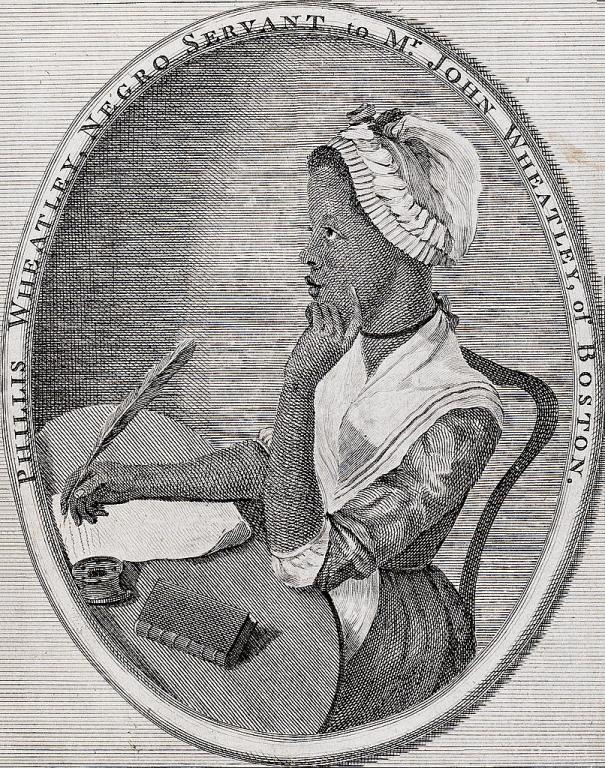
The historical memory of Phillis Wheatley’s pronounced life has been protracted despite its brief measure of thirty-one years. Many Americans recognize who she is because she is renown as America’s first African-American poet. Beyond that, few are familiar with her poems and correspondence, let alone the story of her auspicious rise and abrupt decline. American history surveys typically pay anywhere between one sentence and one page of homage to her legacy.
The Rise of a Pilgrim of Color
A little girl of 7 years arrived in Boston aboard a slave ship called the Phillis on July 11, 1763. She had been enslaved in West Africa and survived the brutal trans-Atlantic middle passage. Upon being purchased by John and Susanna Wheatley, she became a maid servant in the prominent merchant’s Boston home. The Wheatley’s had eighteen-year-old twins, Nathaniel and Mary. The daughter, Mary Wheatley, brought Phillis under her tutelage, teaching her to be an African of Letters. She learned English within eighteen months and advanced in the coming years to learn history, Sacred Writings, Classical Literature, and some Latin.
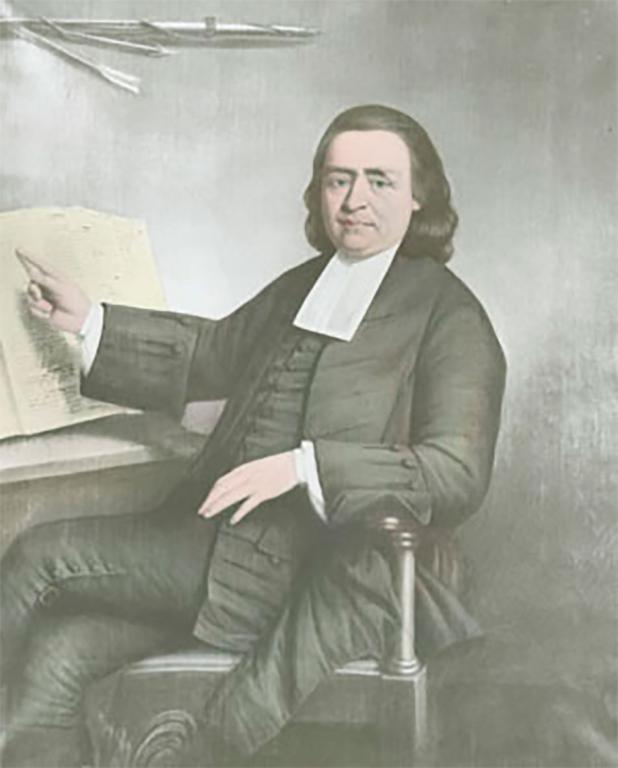
She likely heard George Whitefield preach at Old South Church during his last preaching tour of America in 1770. Even if not, we know certainly that Samuel Cooper baptized her in this church on August 18, 1771, and prior to baptism, in the later part of 1770, Phillis wrote a beautiful elegy of the Great Awakening revivalist, Whitefield, which was published in both Boston and London newspapers shortly after his death. Wheatley sent a letter to Selena Hastings, the Countess of Huntingdon, dated Oct 25, 1770, which enclosed a hand-drafted copy of her elegy of Whitefield, who was the Countess’s chaplain. The successful publication of her poetic elegy of Whitefield, the letter to the Countess, and later correspondence prompted the Countess to invite Phillis to England and sponsor a printed collection of her poems.
Accompanied by her mistress, Susanna, and her young master, Nathaniel, Phillis arrived in London and met Lords, Ladies, and other elite. She was introduced to a sophisticate and genteel society. In July of 1772, a year prior to her visit, Lord Mansfield ruled in favor of an African slave from Boston, James Sommerset, on a case that set a precedent for all slaves who sojourned to England. The ruling, popularly known today as the Sommerset Decision, protected slaves from being forced to return to their land of enslavement once they reached freedom’s shore in England. Some speculate that John and Susanna Wheatley convinced Phillis to voluntarily return to New England on the condition that they would free her shortly after her return. Regardless of what motivated her voluntary return to Boston, she did indeed return, and her masters manumitted her shortly thereafter.
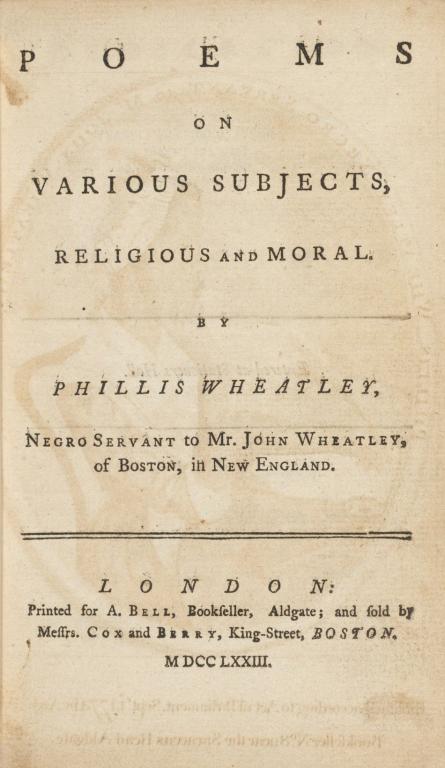 Poems on Various Subject, Religious and Moral was published in 1773 from London. Over 300 copies were transported to New England and sold by Cox and Berry in Boston. Advertisements for subscriptions appeared in the Boston Censor, the Massachusetts Gazette, and the Boston News-Letter during 1772 and 1773. Wheatley’s first and only publication could be reserved at a subscription price that ranged from two to four shillings, depending on the bookseller, quality of paper, the type, and the binding of the text. The solitary likeliness we have of Phillis is due to the Countess’s insistence that a frontispiece of Phillis ought to be commissioned. This likeness of Phillis appeared in the first and subsequent printings of her volume of poetry. Poems on Various Subjects was 86 pages in length and included 39 original pieces of poetry.
Besides her elegy to Whitefield, other noteworthy poems included her first poem penned at age 15 “To the University of Cambridge, in New England” (a poem of encouragement to Harvard University students), “To the King’s Most Excellent Majesty. 1768” (a poem to George III, after he revoked the Stamp Act), “Goliath of Gath” (a poetic recount of David slaying Goliath), and “Niobe in Distress for her children slain by Apollo” (a poem derived from Ovid’s epic Metamorphoses).
Wheatley’s poems were preceded with an endorsement from a council of leading Bostonian men. Eighteen ministerial, intellectual, and political leaders met with Phillis and judged her rational and artistic capacity to produce poetry. Among this council were seven ordained ministers, three poets, six future loyalists, and several future revolutionaries. Almost all were Harvard graduates. Henry Louis Gates, Jr. describes this meeting as a trial and asserts, “Their interrogation of this witness, and her answers, would determine not only this woman’s fate but the subsequent direction of the antislavery movement, as well as the birth of what a later commentator would call ‘a new species of literature,’ the literature written by slaves” (Gates, The Trials of Phillis Wheatley, 7). The countess’s patronage as well as the Bostonian literati’s endorsement influenced the short-term course of Phillis Wheatley’s New England life, launching her into the public eye as an artist, gentlewoman, and celebrity.
By 1773, a decade after her enslavement, Phillis had become a literate intellectual, the first published African-American woman, and a person who fluidly moved among the transatlantic elite of London and Boston society. After her manumission, she continued to compose new pieces of poetry and participate in the “Republic of Letters.”
The Philosophical Genius of a Pilgrim of Color
 Her letter to the Mohegan minister, Samson Occom, dated February 11, 1774 reveals her piercing convictions concerning chattel slavery, abolition, and insight to her subtle philosophic brilliance. She writes:
Rev’d and honor’d Sir, I have this Day received your obliging kind Epistle, and am greatly satisfied with your Reasons respecting the Negroes, and think highly reasonable what you offer in Vindication of their natural Rights: Those that invade them cannot be insensible that the divine Light is chasing away the thick Darkness which broods over the Land of Africa; and the Chaos which has reign’d so long, is converting into beautiful Order, and reveals more and more clearly the glorious Dispensation of civile and religious Liberty, which are so inseparably united, that there is little or no Enjoyment of one without the other: Otherwise, perhaps, the Israelites had been less solicitous for their Freedom from Egyptian Slavery; I don’t say they would have been contented without it, by no Means, for in every human Breast, God has implanted a Principle, which we call Love of Freedom; it is impatient of Oppression, and pants for Deliverence; and by the Leave of our modern Egyptians I will assert that the same Principle lives in us. God grant Deliverance in his own Way and Time, and get him honor upon all those whose Avarice impels them to countenance and help forward the Calamities of their fellow Creatures. This I desire not for their Hurt, but to convince them of the strange Absurdity of their Conduct whose Words and Actions are so diametrically opposite. How well the cry for Liberty, and the reverse Disposition for the exercise of oppressive Power over others agree,—I humbly think it does not require the Penetrations of a Philosopher to determine. (Ed. by Carter et all, Documentary History of Religion in America, 100)
Two observations concerning this letter are noteworthy for comprehending the philosophical genius of Phillis Wheatley. First, it appears, if nothing else than in semantics, she was fluent in the language of the New Divinity movement, a language with which Samson Occom was quite conversant. The New Divinity movement and New England Theology was Jonathan Edwards’s theological legacy. If Wheatley had not read Edwards, then she had minimally been immersed and saturated in a cultural community fluent in the discourse of the New Divinity movement, and she appears to be an avid participant in this discourse.
Second, perhaps, as a result, her profession that the principle of liberty had been implanted in every human breast was a nod to both Locke and Edwards. While Locke’s Essay Concerning Human Understanding overturned the idea of innate ideas implanted in the human mind by a divine being, Edwards followed an Augustan tradition that adopted the will as the control center for the soul. Wheatley professed her loyalty to this voluntarist tradition and indicated that the human impulse or habit was to cry for liberty. If Locke’s assertion that God does not indeed incept ideas into the intellect, the Lord may still implant them in the affections. One might even speculate that the notion of implantation subverts Newtonian mechanics and hints toward adopting Friedrich Christoph Oetinger’s organic system, which united biblical revelation with history and nature (W. R. Ward, Early Evangelicalism, 158–60).
The subtlety and brilliance of this single line from Wheatley’s letter tell us much about how well she fits into the classical tradition of both a poet and a philosopher, despite her cheeky conclusion that these insights do not require “the penetrations of a philosopher.” Bruce Hindmarsh makes similar observations concerning Wheatley’s acumen with scientific and philosophical reflection, including her affinity for the voluntarist tradition, in her poem, “Thoughts on the Works of Providence” (Bruce Hindmarsh, The Spirit of Early Evangelicalism, 160–63).
Finding a Match to the Prestige of a Pilgrim of Color
In 1774, the British evangelical patron and philanthropist, John Thorton, and the Newport, Rhode Island minister, Samuel Hopkins, collaborated to convince Phillis to join John Quamino and Bristol Yamma in re-colonizing Africa. At the time, Quamino and Yamma were the first African-Americans enrolled at the College of New Jersey (now Princeton University), studying directly with its President, John Witherspoon. From Wheatley’s letter to politely decline this invitation, it appears she interpreted the invitation to join the re-colonizers as an attempt to find a marital match for either Quamino or Yamma. Quamino was already married. Nonetheless, the 21 year-old Wheatley considered herself ready for society, and she did indeed marry in the coming years.
In 1778, Mary Wheatley’s husband, the minister, John Lathrop, performed the nuptials between Phillis Wheatley and John Peters, a grocer. Until recently, there was scant documentary evidence for the period from 1778 and Phillis’s death in 1784. However, historian Cornelia Dayton recently recovered much of the mystery of this story when she found 120 documents (called the Middleton Dosier) related to litigation involving John Peters. The newly married Phillis Wheatley Peters moved with her husband John to settle at the Wilkins Estate in the village of Middleton, Massachusetts. Middleton had annexed from the western part of Salem Village (now Danvers) in 1728. Its elite included Major Ezra Putnam, one of the scions of the notorious Putnam family, who were implicated in the Salem Witch trials of 1692. Lieutenant John Wilkins, having no immediate sons or other male heirs, left a bequest to Peters and gave him influence over the probate of the estate in his will. Wilkins’s widow, Naomi, deeded the home and 100 acres of the estate to John, in order to convince him to settle on the estate, manage the farm, and care for her in her late age.
John Peters was no mere grocer. The documentary evidence reveals that he was a savvy merchant and barrister, who managed his own business and legal affairs, as well as the Wilkins’s farm for years. During the Middleton period of Phillis’s life, she and her husband arrived at a rank in society akin to John and Susanna Wheatley, Phillis’s masters in Boston. For Phillis, this had likely been her longing since her manumission. While in the Wheatley home, Phillis had been a daughter to them. In fact, her arrival in their home came on the 9-year memorial of their loss of Sarah Wheatley, who passed at 7 years-of-age. Around the time Sarah would have entered into society, Susanna found a surrogate 7 year-old daughter, Phillis, to raise. Now she had arrived at the station and rank fitting for a Wheatley daughter. Cornelia Dayton develops a portrait for why Phillis’s affections were drawn to Peters: “John Peters’s wide range of skills, resourcefulness, legal literacy, mien of manly gravitas, and fierce defense of his rights are very much in evidence; these suggest some of the reasons Phillis Wheatley married him” (Cornelia H. Dayton, “Lost Years Recovered: John Peters and Phillis Wheatley Peters in Middleton,” The New England Quarterly, 94, No. 3 [Sep. 2021]: 312).
The Regress of Righteous Pilgrims of Color
Unfortunately, the rest of Middleton did not wish to condescend to the rank of the black Peters couple, who were maintaining the Wilkins Estate until it became the Peters Estate. The Putnams, Esteys, and other white elite Middleton families colluded with Naomi Wilkins’s nephews to legally wrest the estate from John Peters. Benjamin Wilkins, Jr. received legal control to manage the Wilkins’s farm until the legal dispute between John Peters and the Wilkins’s was settled.
The Peters were forced to remove to the West End of Boston in the summer of 1783, liquidating fine furnishings, Phillis’s books, and other symbols of status in society, in order to cover mounting legal expenses. Travel back and forth from Boston to Middleton and other legal expenses left the Peters couple destitute and put John into debtors prison.
During the Middleton period, Phillis had at least one miscarriage and likely loss a 2-year old child. While pregnant with another child, she worked as a scullery maid and advertised in Boston newspapers, in an effort to acquire the necessary subscriptions to put a second volume of her poetry to print. She gave birth to a newborn infant, and subsequently died from an infection contracted after the birth. Her infant perished in her arms during one of the coldest winters on record in New England. John was likely given “liberty of the yard” to attend her funeral on Thursday, December 9, 1784.
Interpreting the History of a Righteous Pilgrim of Color
How does someone like Phillis Wheatley Peters go from transatlantic celebrity to destitution and anonymity? While she was a pawn in play for evangelical white knights and ladies, her life had value. Once this pawn came into her own as a black queen and found her king, the two became a threat that might up-end the chess board.
Phillis had sophisticated experiences. Provincial Middletonians had rarely been to Boston, let alone traveled to England and been in the audience of the Earl of Dartmouth. How likely would it have been for any of her Middleton neighbors to be published—let alone for the likes of Voltaire or Jefferson to have read and engaged the publication? What would it have been like for a Middletonian to sit in the parlor room of the Peters, sense their fine furnishings and library, feel a copy of Phillis’s Poems on Various Subject, Religious and Moral, and perceive their blackness?
The station and rank of the black Peters agitated their white supremacist neighbors enough to drive them out of town, bankrupt them, and abandon them to despair and death. This may not simply be the anecdotal story of America’s first African-American woman poet. Rather, it’s a pilgrim history—one that very well might be an allegory of one particular righteous pilgrim’s regress in a world that has been unkind and brutal to pilgrims of color. In its own way, this pilgrim history is a similitude that portrays the long story of systemic injustice to people of color in America.
Previous Post

July 28, 2022
Climate Change, Weather Disasters, and Crying Wolf
Next Post
August 1, 2022 Signs, Wonders, and the Making of Religious History
Browse Our Archives
Select a Category abolitionism Abortion Abraham Joshua Heschel Abraham Kuyper Abraham Lincoln Academia Activism Adam Renberg Advent Adventist africa African American Religion Agnes Howard Albert Camus American History American Religious History American Revolution American West Anabaptists Ancient History Andrea Turpin Andrei Tarkovsky Anglicanism Annales Ansley Lillian Quiros anti-Catholicism Antisemitism Anxious Bench apologetics Apparitions Arash Azizi Archaeology archives art Artificial Intelligence Asia Asian Americans Augustine Authors Bad Bunny Baptism Baptists Barack Obama Battle of Hastings Benjamin Franklin Bernard-Henri Levy Beth Allison Barr Beth Moore Bethany Mannon Bible Bill Cunningham Billy Graham Black Music Bob Dylan Body Boenhoffer Books Breastfeeding Bruce Springsteen C.S. Lewis Calvinism Cancel Culture Capitalism Carmelites Catholicism Cedric Robinson Cesar Chavez Charismaticism charity Charles Dickens Charles Lindbergh Che Guevara Chicago Children Chinese Christianity Chris Gehrz Christ Christian death Christian Higher Education Christian life Christian Nation Christian Nationalism Christianity Today Christmas Church life Church Practice cinema Civil Religion Civil Rights Movement Civil War civility Classics Climate Change Cold War Colonial Mexico colonialism Comer Communism community complementarianism Conference on Faith and History Congregationalism Conspiracies Conspiracy Conversion Narratives Coronavirus Costa Rica Council of Nicaea Covid-19 Creation Critical Race Theory Crusades Culture culture wars Daniel K. Williams David Barton David Swartz Death Ways death with dignity DEI democracy Democratic Party Devotion Digital Age Diplomacy discipleship diversity Donald Trump Drama Dua Lipa Early Church early modern Early modern Catholicism Easter Eastern Christianity economic exploitation Education elections Elie Wiesel Elizabeth II Elizabeth Taylor emotions Empire Engineering England enslavement Entertainment Episcopal Church Erica Ramirez eschatology Eurocentrism Evangelicalism Evangelicals Exegesis Family Feminism Film Flannery O'Connor folk music Food Foreign Policy founding fathers Franciscans Franciscus Junius fundamentalism Funerals G.K. Chesterton Gender Genocide genre geography George W. Bush George Washington George Whitefield Global Christianity Global church Grief Guadalupe guest post Guest Post gun control gun violence Gustavo Gutierrez Hamid Dabashi Harold John Ockenga Harvest Hate Hawaiian Christianity Healing health care Heather Cox Richardson Hell Heresy Hermeneutics Higher Education Hinduism Hippocratic oath Historical Fiction Historical Methodology Historical Profession Historical Profession Historical Theology Historical Thinking historiography Holidays Holocaust horror movies Human rights Humanitarian Work humanities Hummingbirds Hungary hymns Imago Dei Immigration Injustice Interviews Iran Islam Islamophobia Israel Ivan's Childhood Jacob Randolph James Bratt Janine Giordano Drake Japanese history Japanese Literature Jean Paul Sartre Jesse Miranda Jesus Jesus Christ Jimmy Carter Joan Baez Joan Didion Joanne Freeman João B. Chaves Joao Chaves Joey Cochran John Calvin John Fea John Tillotson John Turner Johnny Cash Jonathan Edwards Jonathan Tran Joseph Smith Josh Howerton Journalism Jr. Judaism Jürgen Moltmann Just War Justice Justin Brierley Karl Barth Katelyn Beaty koi ponds Kris Kristofferson Kristin Kobes Du Mez Latin American Religious History Latino Americans Lectio Divina Leisure Lent Leonard Cohen liberal arts liberalism Liberation Theology Linda Ronstadt Lisa Clark Diller Literature Lou Reed Lynchings Lynneth Miller Renberg Mainline Protestantism Malcolm Foley Marilyn Monroe Maritime history Mark Noll Marriage Martin Luther Martin Luther King Martyrdom Marxism Mary Masih Alinejad mass shootings material culture medieval Christianity Medieval Ethiopia Melissa Borja memory Mennonites Mental Health Mental Illness Methodism Mexican Americans Mexicans Mike Madrid Miles Mullin Min Jin Lee Miscarriage Missionaries Mister Rogers Mitt Romney modernity Monasticism Mormonism Motherhood Mothers of the Church Moving Music Musicals Nadya Williams Nahua Christianity Native Americans Natsume Sōseki New Contributor New England New Year New York Nico Non-Violent Protest Orthodoxy pacifism Paleo Evangelicals Palestinians Parenting Patti Smith Paul Kingsnorth Pedro Calderón de la Barca Pentecostalism Philip Jenkins Phillis Wheatley physician-assisted suicide pilgrimage Pilgrims pluralism Plutocracy Poetry Politics Pope Francis Pope Leo XIV post-modernism prayer preaching Presbyterians prosperity gospel Protest Public history Publishing Puritans purity culture Quakers race Race Massacres Racial Capitalism racial reconciliation racialization Racism Raha Bahloulipour Re-Enchantment reading Reformation Refugees religion and the university religion and war Religious Freedom Religious Nones Religious Pluralism Religious Symbols religious violence Republican Party Revival Rita Coolidge Ritual Roger Williams Roman Catholic church Royalty Russell Moore same-sex marriage Sarah Irving-Stonebraker Scandinavia Science Science and Technology Scopes trial Scriptural Interpretation secularism Selena Quintanilla seminary Seventh-Day Adventists sexual morality Sexuality Sikhs Silence slaveholders theology Slavery Slavoj Zizek social justice Social Media Southern Baptist Convention Southern Religion Spain Spiritual Autobiography Spiritual but not religious Spiritual Discipline Sports Stanley Hauerwas Suffering Summer Camps Sunday Night Odds and Ends Supernatural Supreme Court Syriac Christianity Tal Howard Taylor Swift Teaching Technology Television Thanksgiving The Beatles The Mission theater TheoBros Theology Thomas Dixon Thomas Jefferson Thomas Kidd Thomas Merton Tim Gloege Tim Walz Tom Holland Tourism tradition Tragedy Translation Transnationalism Travel Trump Ukraine Uncategorized Unitarians United Methodist Church US History Vanessa Chan Velvet Underground Verónica A. Gutiérrez Veronica Gutierrez Vikings Violence Virgin Mary Virtue Virtue ethics Visions Voting War WCTU Wendell Berry Westminster Assembly White Evangelicalism Wildfires Winnie the Pooh Witches women Women in Ministry Women's and Gender Studies Work Worship writing Yasunari Kawabata Zena Hitz
Select a Month October 2026 September 2026 August 2026 July 2026 June 2026 May 2026 April 2026 March 2026 February 2026 January 2026 December 2025 November 2025 October 2025 September 2025 August 2025 July 2025 June 2025 May 2025 April 2025 March 2025 February 2025 January 2025 December 2024 November 2024 October 2024 September 2024 August 2024 July 2024 June 2024 May 2024 April 2024 March 2024 February 2024 January 2024 December 2023 November 2023 October 2023 September 2023 August 2023 July 2023 June 2023 May 2023 April 2023 March 2023 February 2023 January 2023 December 2022 November 2022 October 2022 September 2022 August 2022 July 2022 June 2022 May 2022 April 2022 March 2022 February 2022 January 2022 December 2021 November 2021 October 2021 September 2021 August 2021 July 2021 June 2021 May 2021 April 2021 March 2021 February 2021 January 2021 December 2020 November 2020 October 2020 September 2020 August 2020 July 2020 June 2020 May 2020 April 2020 March 2020 February 2020 January 2020 December 2019 November 2019 October 2019 September 2019 August 2019 July 2019 June 2019 May 2019 April 2019 March 2019 February 2019 January 2019 December 2018 November 2018 October 2018 September 2018 August 2018 July 2018 June 2018 May 2018 April 2018 March 2018 February 2018 January 2018 December 2017 November 2017 October 2017 September 2017 August 2017 July 2017 June 2017 May 2017 April 2017 March 2017 February 2017 January 2017 December 2016 November 2016 October 2016 September 2016 August 2016 July 2016 June 2016 May 2016 April 2016 March 2016 February 2016 January 2016 December 2015 November 2015 October 2015 September 2015 August 2015 July 2015 June 2015 May 2015 April 2015 March 2015 February 2015 January 2015 December 2014 November 2014 October 2014 September 2014 August 2014 July 2014 June 2014 May 2014 April 2014 March 2014 February 2014 January 2014 December 2013 November 2013 October 2013 September 2013 August 2013 July 2013 June 2013 May 2013 April 2013 March 2013 February 2013 January 2013 December 2012 November 2012 October 2012 September 2012 August 2012 July 2012 June 2012 May 2012
Follow Us!
TAKE THE
Religious Wisdom Quiz
Who denied Jesus three times before the rooster crowed?
Select your answer to see how you score.
Thomas John Judas Peter
Related posts from Anxious Bench

What Coffee Reveals About America's Evangelical Varieties

A Casserole is Not a Counterpoint

Angelina Grimké's Forgotten Turn to Apocalyptic Faith
TRENDING AT PATHEOS Evangelical

The Real AI Story Is Adoption Without Trust
Artificial intelligence has crossed a political threshold. It is no longer a...

A new article, written by Jeff Lindsay and Gale L. Pooley,...

Swimfan: Forgotten Aughts Pleasures
This is a recovery effort. In 2002, My Big Fat Greek Wedding...

Top Three Anti-Catholic Lies About Catholicism
This is my initial transcript for the video, "THE 3 WORST...

Pope Leo Celebrates Mass for Nurses & Docs...
I don't have any idea how he did it, but Pope Leo...

The Sermon on the Mount, Part I: Matthew...
The Sermon on the Mount, Part I (Matthew 4:12-5:12) St. Matthew moves...
view all Evangelical blogs
Ad-Free & Subscriber Log-In Subscription Support
- About Us
- 2026 Calendar
- Videos
- Podcasts
- Library of World Religions
- Faith In Media Tracker
- Advertise With Us
- Write for Us
- Privacy Policy
- Terms of Service
- Do Not Sell My Data
- Contact Us
- Radiant Digital
- Manage Newsletter Subscriptions
- Unsubscribe From Notifications
- Sitemap
Copyright 2008-2026, Patheos. All rights reserved.
Subscription Support Ad-Free & Subscriber Log-In
Follow Patheos