
BuddhistCatholicContemplativeEvangelicalGeneral ChristianHinduJewishLatter-day SaintMuslimNew VisionsProgressive Christian
Beliefs
- Buddhist
- Catholic
- Contemplative
- Evangelical
- General Christian
- Hindu
- Jewish
- Latter-day Saint
- More Voices
- Muslim
- New Visions
- Pagan
- Progressive Christian
Topics
- Religion News
- Food and Religion
- Sports and Religion
- Religious Art
- Religious Music and Entertainment
- Religious Events
- History and Religion
- Style and Religion
- Politics and Religion
- Women in Religion
- Recreation Outdoors and Religion
- Business Finance and Religion
- Careers Workplace and Religion
- Education and Religion
- Family Parenting and Religion
- Health Fitness and Religion
- Home and Religion
- Relationships and Religion
- Technology and Religion
- Travel and Religion
Columnists
- Buddhist Columnists
- Business Finance and Religion Columnists
- Careers Workplace and Religion Columnists
- Catholic Columnists
- Contemplative Columnists
- Education and Religion Columnists
- Evangelists Columnists
- Family Parenting and Religion Columnists
- General Christian Columnists
- Health Fitness and Religion Columnists
- Hindu Columnists
- History and Religion Columnists
- Home and Religion Columnists
- Jewish Columnists
- More Voices Columnists
- Latter Day Columnists
- Muslim Columnists
- New Visions Columnists
- Nonreligious Columnists
- Pagan Columnists
- Politics and Religion Columnists
- Progressive Columnists
- Recreation Outdoors and Religion Columnists
- Relationships and Religion Columnists
- Religion News Columnists
- Religious Art Columnists
- Religious Events Columnists
- Religious Music and Entertainment Columnists
- Sports and Religion Columnists
- Style and Religion Columnists
- Technology and Religion Columnists
- Travel and Religion Columnists
- Women in Religion Columnists
Resource Library
- 2026 Calendar
- Library of World Religions
- The 100 Most Holy Places on Earth
- Patheos Answers
- Podcasts
- Videos
- Faith Leaders Database
- Anglican Episcopalian
- Bahai
- Baptist
- Buddhism
- Christianity
- Confucianism
- Eastern Orthodoxy
- Hinduism
- Holiness and Pentecostal
- ISKCON
- Islam
- Judaism
- Lutheran
- Methodist
- The Church of Jesus Christ of Latter-day Saints
- New Age
- Paganism
- Presbytarian and Reformed
- Protestantism
- Religion Behind the Scenes
- Roman Catholic
- Scientology
- Shia Islam
- Sikhism
- Sufism
- Sunni Islam
- Taoism
- Zen
- See all religions
Research Tools
 Ad-Free & Subscriber Log-In Subscription Support
Ad-Free & Subscriber Log-In Subscription Support
Follow Patheos 

- Trending:
- Forgiveness
- |
- Marriage
- |
- Consciousness
- |
- Death Penalty
- |
- Election
- |
- Halloween

-
About the Authors
- Home
- Evangelical
- “Every Protestant Heart Owes Catharine… Because She Made Luther Happy”: Luther, Women, and Reformation History in America
“Every Protestant Heart Owes Catharine… Because She Made Luther Happy”: Luther, Women, and Reformation History in America
Last updated on: June 22, 2022 at 5:00 am by Andrea L. Turpin
“Every Protestant Heart Owes Catharine… Because She Made Luther Happy”: Luther, Women, and Reformation History in America 2022-06-22T00:43:52-04:00 Andrea L. Turpin
Patheos Explore the world's faith through different perspectives on religion and spirituality! Patheos has the views of the prevalent religions and spiritualities of the world.
 I am excited to welcome to the Anxious Bench for today’s guest post Samuel L. Young (PhD, Baylor University), a postdoctoral teaching fellow for Baylor’s Department of History. Young’s dissertation, “‘Saint of the Republic’: Martin Luther, Myth, and National Identity in Antebellum America” (May 2022), explores how early Americans used the long-deceased sixteenth-century German reformer to articulate what it meant to be a citizen of the new nation. Young was the 2021 recipient of the Sidney E. Mead Prize from the American Society of Church History and has published articles for Lutheran Quarterly and U.S. Catholic Historian*, along with a forthcoming piece for* Church History*. In this post and one next month, he examines Luther’s complicated legacy for American women.*
Martin Luther is having something of a moment. Since the 500th anniversary of the Protestant Reformation in 2017, there has been a trend among American academics, journalists, and writers to try to make sense of contemporary circumstances by looking back to the German reformer. Does Luther explain the rise of Donald Trump? Is he the progenitor of modern democracy and American liberty? Are today’s civil rights movements indebted to his life and work? Or as, Lutheran theologian Amy Marga recently asked, would you find “Martin Luther at the Women’s March?”
This is not the first time the United States has had a “Luther moment.” In the early decades of the nineteenth century, many Americans were convinced that Luther was a proto-American hero whose stand against a tyrannical Roman Catholic Church paved the way for the religious liberty, freedom of conscience, and representative government protected under the U.S. Constitution. The tying of Luther to the American founding became so cliche’ that an unhappy Roman Catholic bishop quipped in 1838 that you couldn’t go to any public gathering–Fourth of July, election day, graduation–without somebody singing the reformer’s praises. By 1850, Americans testified to this American Luther myth in their poetry, textbooks, sermons, songs, periodicals, speeches, and art.
The ubiquity of the American Luther myth meant that Americans could employ the reformer in debates over any number of cultural, social, and political questions. For instance, advocates of the widespread “cult of domesticity” (the notion that ideal femininity required pious service to husband and children in the home) used Luther and the Reformation as support for their views. Because of Luther’s opposition to convents and vows of celibacy, these readings of the reformer largely affirmed the Protestant Reformation as a liberation of women.
But these authors didn’t mean by women’s liberation what is often meant to today. They argued that, in his life and teaching, Luther had exalted women to their divinely appointed status as wives, mothers, and keepers of the home. As Marie Anne Pagliarini and Cassandra Yacovazzi have argued, Roman Catholicism, women religious, and vows of celibacy constituted unique threats to this conception of Protestant femininity. Catholicism relegated pious women to convents, denying them the glories of motherhood and condemning them to the imagined harm of lecherous priests, confessors, and mother superiors.
As a way to counter the competing Catholic conception of femininity, by the 1830s accounts of Luther’s life emphasized the effect of his Reformation on the lives of women. Antebellum authors brought attention to the women in Luther’s life, examined how the reformer’s teachings affected women, and explored how women participated in shaping the reformer. In these narratives, there was no ambiguity about the kind of femininity recommended by Luther. His teaching on motherhood and parenting–as well as his own marriage with Katharina–testified to the domestic life as the pinnacle of Protestant womanhood. This was one common example of how the Luther myth shaped American culture in the nineteenth century.
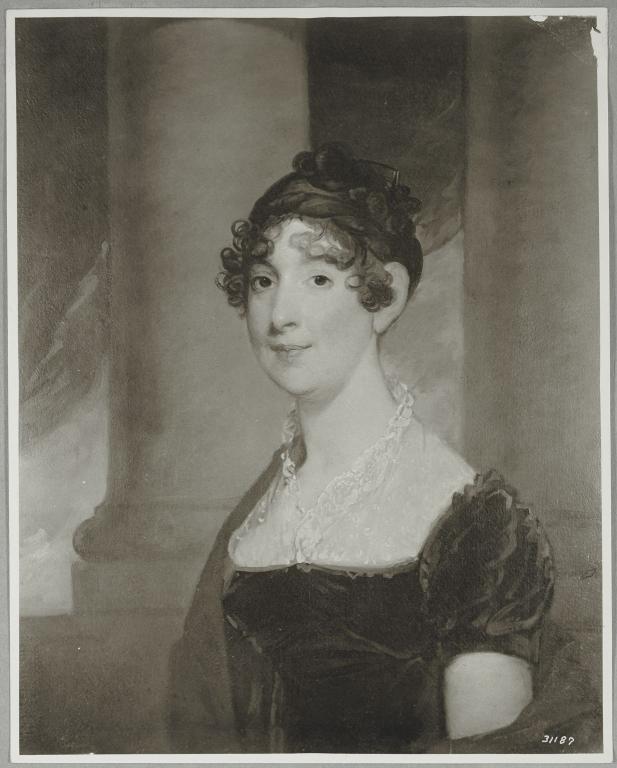
Hannah Farnham Lee, Portrait by Gilbert Stewart, 1808. Courtesy of Wikimedia Commons.
The first major Luther biography to incorporate female characters was Hannah Farnham Lee’s 1839 Life and Times of Martin Luther. Lee came from a wealthy Unitarian family in Boston and would go on to write several works of historical fiction, including volumes on the Huguenots and Thomas Cranmer. Her take on Luther’s life was decidedly dramatic: she scripted conversations between historical actors and added vivid descriptions of their thoughts and emotions. Though she assured her readers that this “more graphic” approach was all based on academic research and Luther’s writing, the final work more closely resembled an historical romance novel than a straightforward biography (i).
More significant than the form of her narrative was the way in which Lee altered the traditional structure of Reformation history by adding multiple female characters. Going beyond the sideline characters of previous histories, these women were principal actors in the story. The narrative revolves around the relationship of three couples: the highly embellished story of Count Albert of Mansfield and his wife Alice; Philip Melanchthon and his wife Margaret; and Luther and Katharina.
The events of the Reformation serve as a stage for the development of these three love stories. Alice lives tucked away in the Castle Wartburg, mourning the mysterious death of her parents. She submits herself to the mentorship of an old and corrupt Dominican, Father Francis. After meeting the young and handsome Count Albert–an early devotee of Luther’s Reformation–Alice’s bright and inquisitive mind begins questioning the overbearing and exacting theology of Father Francis. Unable to resist the priest’s manipulation, she spurns the overtures of Albert and the teachings of the Reformation by pledging herself to a convent. After several years of absence, Albert returns to the Wartburg, and their romance is rekindled. When Alice discovers that Father Francis had tortured and killed her parents as an Inquisitor, she renounces Roman Catholicism, escapes to Wittenberg, and marries Albert.
In her narrative, Lee attributed much of Luther’s early theological development to his relationship with Phillip Melanchthon and his wife Margaret. It was in observing their marriage that Luther, “witnessing this happy union” and “seeing every domestic virtue in beautiful exercise,” becomes fully convinced of the glories of marriage and the evil of clerical celibacy. Throughout the story, every major event or theological breakthrough for Luther is discussed in the Melanchthon home, in the company of Phillip and Margaret (106).

Katharina von Bora, Portrait by Lucas Cranach the Elder, 1526. Courtesy of Wikimedia Commons.
The Melanchthon home is also the setting for Katharina’s religious awakening. Lee cast the former nun as a tragic figure. Forced into a convent, her story is filled with conniving Mother Superiors preying on young nuns as their “pets” (118-19). Inspired by Luther’s actions, Katharina realizes the depths of her “superstition” and “darkness” of thought. Escaping to Wittenberg while Luther is in exile at the Wartburg, she stays with the Melanchthons and converts to the Protestant cause (125-28). After Luther returns to Wittenberg from his exile in the Wartburg, the Melanchthons set the couple up and they marry.
Immediately following their marriage, Lee narrated the domestic arrangement of the Luther home. The reformer’s quotes on love, home life, and family are peppered with Katharina’s responses and questions. While Luther complains about particular events or figures, she quietly listens, cooks, and picks him flowers. Whereas Luther had aided in the conversion of Katharina, Katharina was responsible for civilizing Luther:
The care of the house, of course, devolved on Catherine… The neat little parlour, with its windows shaded by vines instead of silken drapery, opened into a garden, where both she and Luther, like our first parents, cultivated the earth. Their table was supplied with vegetables from it… Nothing could be pleasenter than the dwelling and garden of Luther. In his household, with Catherine by his side, he was no longer the austere Saxon Reformer. Every object brought to his well-stored mind some pleasant thought or allegory; in the latter, he took great delight (206-7).
Katharina’s domestic prowess earned the respect of her husband; she was his “empress” in whom he delighted (211).
Lee’s narrative affirmed the notion of Protestant femininity as a two-fold liberation from the strictures and oppression of Roman Catholicism. First, the Reformation emancipated women to their rightful status as wife and keeper of the house. Every woman in Lee’s narrative that converts to Protestantism also gets married in the process. Katharina earns her husband’s respect and blesses him by keeping a well-ordered home.
Second, Lee presented the Reformation as an emancipation of women from the intellectual tyranny of Catholicism. Luther’s teachings become the basis for individual women to challenge the authority of corrupt religious leaders, and indeed, Lee argued that women were often more capable than men in exercising their curiosity and freedom of conscience in this way. This liberation of the intellect, however, had to be tempered by a deference to male authority. Female characters gain their freedom by submitting to Luther’s teaching, but Lee’s Luther chastises women for speaking out of turn and overstepping their position in the home. Melanchthon’s marriage turns dysfunctional due to Margaret’s “presentiments,” “delicate cast of mind,” and “ill-timed remarks”–domestic discord that disclosed a direct contrast to the harmonious relationship between Luther and Katharina (103-4, 287).
Lee’s Life and Times was the first of many publications that tried to inspire female readers to greater piety by giving greater attention to the women in Luther’s life. References to Katharina in these works contrasted her previous life in the convent to the liberation she found in marriage to the great reformer. Dependent entirely on Luther’s discussion of his wife in his letters and correspondence, such reconstructions of this sixteenth-century woman relied on determining the ways in which she had influenced Luther, and in turn, the ways Luther had shaped her. Like in Lee’s biography, this dynamic often narrowed descriptions of her virtues to her roles as wife and housekeeper.
Daniel Wise, a Methodist minister from Ohio, made this clear in the introduction to his 1849 piece on Katharina for the Ladies’ Repository. She belongs “in the ranks of superior women,” he argued, because she “made Luther happy in his domestic life.” Coaxed out of the tyrannical life of the convent by “the voice of Luther,” Katharina’s poise in domestic virtue became the basis for the reformer’s worldly successes. They had “truly a happy marriage,” Wise surmised, and “every Protestant heart owes Catharine grateful and affectionate remembrance, because she made Luther happy.“
Katharina’s relegation to Luther’s domestic shadow was especially clear in the first stand-alone biography published in the United States, John G. Morris’s 1856 Catherine De Bora. Morris, a Lutheran minister from Baltimore, spent the majority of his book focusing not on Katharina, but on the impact of marriage and parenthood on the Reformation. Morris’s work only discussed Katharina’s personal development and character in a single chapter, and even here he made clear that there was “nothing remarkably striking” in Katharina’s history “considered apart from her relation to her illustrious husband.” She had “no extraordinary talents,” read and wrote very little, and died poor. Katharina’s single point of pride was that “she possessed sufficient independence of mind to reject several brilliant offers of marriage” and commit herself to Luther. In this marriage, she was “a pattern of every domestic and Christian virtue” and Morris hoped that the “daughters and wives of the present day” would “imitate her example.” (120-25). In these accounts by Wise and Morris, Katharina’s honor depended solely on her role as wife to Luther, as mother to his children, and as administrator of his household.
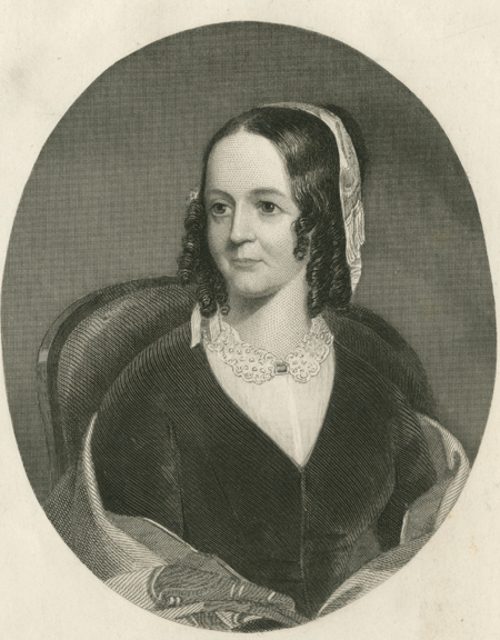
Sarah Josepha Hale, Godey’s Lady’s Book, 1850. Courtesy of Wikimedia Commons.
Sarah Josepha Hale, editor of Godey’s Lady’s Book, offered a more nuanced portrait of Katharina in her 1853 Woman’s Record. Rather than extolling the former nun for her relationship with Luther, Hale judged Katharina as a noble figure well before–and independent of–her marriage with the reformer. After all, it was Katharina who boldly left the convent, and it was this “heroism” and “excellent qualities of mind and heart” that attracted Luther to the young woman. She was already an extraordinary figure, and she carried this depth of character into her marriage.
It was this self-evident caliber of his wife that became the source of Luther’s domestic joy. She was “modest and gentle, decent in her attire and economical in the house,” containing “all the hospitality of the German noblesse” but “without their pride.” After her husband’s death left their family in poverty, she proved her worth again by working tirelessly to support her children (86). Like Wise and Morris, Hale’s brief account of Katharina lauded the woman’s domestic skills and parental acumen but grounded these appreciations in a broader account of her piety and virtue–characteristics that pre-dated and outlasted her relationship to Luther.
All of these examinations of the women in Luther’s life emphasized the domestic and parental ideals of Protestant femininity. Indeed, the “liberation” of women in the Reformation was the necessary precondition for imbuing seemingly simple acts–marriage, rearing children, keeping home–with world-historical significance. Luther’s glorious legacy included, in part, his elevating of these feminine roles to their place of eminence. American women could look to him and the women around him for inspiration in their own efforts to fulfill their divine calling to love their husbands, raise their children, and keep their homes.
But this is not the whole story. As Beth Allison Barr has recently illustrated in her Making of Biblical Womanhood, the Reformation contained deep incoherences on these questions surrounding the roles, equality, and spiritual power of women. These discrepancies were not lost on antebellum readers. As I’ll discuss next month in part two of this piece, the identification of Luther as a liberator of women could go beyond the domestic realm. Some early woman’s rights activists looked to the reformer as an inspiration for expanding legal rights for women, but questioned whether Luther’s inauguration of Protestant femininity did more harm than good.
Previous Post

June 21, 2022
My Farewell to The Anxious Bench
Next Post

June 23, 2022 Byzantine and Roman
Browse Our Archives
Select a Category abolitionism Abortion Abraham Joshua Heschel Abraham Kuyper Abraham Lincoln Academia Activism Adam Renberg Advent Adventist africa African American Religion Agnes Howard Albert Camus American History American Religious History American Revolution American West Anabaptists Ancient History Andrea Turpin Andrei Tarkovsky Anglicanism Annales Ansley Lillian Quiros anti-Catholicism Antisemitism Anxious Bench apologetics Apparitions Arash Azizi Archaeology archives art Artificial Intelligence Asia Asian Americans Augustine Authors Bad Bunny Baptism Baptists Barack Obama Battle of Hastings Benjamin Franklin Bernard-Henri Levy Beth Allison Barr Beth Moore Bethany Mannon Bible Bill Cunningham Billy Graham Black Music Bob Dylan Body Boenhoffer Books Breastfeeding Bruce Springsteen C.S. Lewis Calvinism Cancel Culture Capitalism Carmelites Catholicism Cedric Robinson Cesar Chavez Charismaticism charity Charles Dickens Charles Lindbergh Che Guevara Chicago Children Chinese Christianity Chris Gehrz Christ Christian death Christian Higher Education Christian life Christian Nation Christian Nationalism Christianity Today Christmas Church life Church Practice cinema Civil Religion Civil Rights Movement Civil War civility Classics Climate Change Cold War Colonial Mexico colonialism Comer Communism community complementarianism Conference on Faith and History Congregationalism Conspiracies Conspiracy Conversion Narratives Coronavirus Costa Rica Council of Nicaea Covid-19 Creation Critical Race Theory Crusades Culture culture wars Daniel K. Williams David Barton David Swartz Death Ways death with dignity DEI democracy Democratic Party Devotion Digital Age Diplomacy discipleship diversity Donald Trump Drama Dua Lipa Early Church early modern Early modern Catholicism Easter Eastern Christianity economic exploitation Education elections Elie Wiesel Elizabeth II Elizabeth Taylor emotions Empire Engineering England enslavement Entertainment Episcopal Church Erica Ramirez eschatology Eurocentrism Evangelicalism Evangelicals Exegesis Family Feminism Film Flannery O'Connor folk music Food Foreign Policy founding fathers Franciscans Franciscus Junius fundamentalism Funerals G.K. Chesterton Gender Genocide genre geography George W. Bush George Washington George Whitefield Global Christianity Global church Grief Guadalupe guest post Guest Post gun control gun violence Gustavo Gutierrez Hamid Dabashi Harold John Ockenga Harvest Hate Hawaiian Christianity Healing health care Heather Cox Richardson Hell Heresy Hermeneutics Higher Education Hinduism Hippocratic oath Historical Fiction Historical Methodology Historical Profession Historical Profession Historical Theology Historical Thinking historiography Holidays Holocaust horror movies Human rights Humanitarian Work humanities Hummingbirds Hungary hymns Imago Dei Immigration Injustice Interviews Iran Islam Islamophobia Israel Ivan's Childhood Jacob Randolph James Bratt Janine Giordano Drake Japanese history Japanese Literature Jean Paul Sartre Jesse Miranda Jesus Jesus Christ Jimmy Carter Joan Baez Joan Didion Joanne Freeman João B. Chaves Joao Chaves Joey Cochran John Calvin John Fea John Tillotson John Turner Johnny Cash Jonathan Edwards Jonathan Tran Joseph Smith Josh Howerton Journalism Jr. Judaism Jürgen Moltmann Just War Justice Justin Brierley Karl Barth Katelyn Beaty koi ponds Kris Kristofferson Kristin Kobes Du Mez Latin American Religious History Latino Americans Lectio Divina Leisure Lent Leonard Cohen liberal arts liberalism Liberation Theology Linda Ronstadt Lisa Clark Diller Literature Lou Reed Lynchings Lynneth Miller Renberg Mainline Protestantism Malcolm Foley Marilyn Monroe Maritime history Mark Noll Marriage Martin Luther Martin Luther King Martyrdom Marxism Mary Masih Alinejad mass shootings material culture medieval Christianity Medieval Ethiopia Melissa Borja memory Mennonites Mental Health Mental Illness Methodism Mexican Americans Mexicans Mike Madrid Miles Mullin Min Jin Lee Miscarriage Missionaries Mister Rogers Mitt Romney modernity Monasticism Mormonism Motherhood Mothers of the Church Moving Music Musicals Nadya Williams Nahua Christianity Native Americans Natsume Sōseki New Contributor New England New Year New York Nico Non-Violent Protest Orthodoxy pacifism Paleo Evangelicals Palestinians Parenting Patti Smith Paul Kingsnorth Pedro Calderón de la Barca Pentecostalism Philip Jenkins Phillis Wheatley physician-assisted suicide pilgrimage Pilgrims pluralism Plutocracy Poetry Politics Pope Francis Pope Leo XIV post-modernism prayer preaching Presbyterians prosperity gospel Protest Public history Publishing Puritans purity culture Quakers race Race Massacres Racial Capitalism racial reconciliation racialization Racism Raha Bahloulipour Re-Enchantment reading Reformation Refugees religion and the university religion and war Religious Freedom Religious Nones Religious Pluralism Religious Symbols religious violence Republican Party Revival Rita Coolidge Ritual Roger Williams Roman Catholic church Royalty Russell Moore same-sex marriage Sarah Irving-Stonebraker Scandinavia Science Science and Technology Scopes trial Scriptural Interpretation secularism Selena Quintanilla seminary Seventh-Day Adventists sexual morality Sexuality Sikhs Silence slaveholders theology Slavery Slavoj Zizek social justice Social Media Southern Baptist Convention Southern Religion Spain Spiritual Autobiography Spiritual but not religious Spiritual Discipline Sports Stanley Hauerwas Suffering Summer Camps Sunday Night Odds and Ends Supernatural Supreme Court Syriac Christianity Tal Howard Taylor Swift Teaching Technology Television Thanksgiving The Beatles The Mission theater TheoBros Theology Thomas Dixon Thomas Jefferson Thomas Kidd Thomas Merton Tim Gloege Tim Walz Tom Holland Tourism tradition Tragedy Translation Transnationalism Travel Trump Ukraine Uncategorized Unitarians United Methodist Church US History Vanessa Chan Velvet Underground Verónica A. Gutiérrez Veronica Gutierrez Vikings Violence Virgin Mary Virtue Virtue ethics Visions Voting War WCTU Wendell Berry Westminster Assembly White Evangelicalism Wildfires Winnie the Pooh Witches women Women in Ministry Women's and Gender Studies Work Worship writing Yasunari Kawabata Zena Hitz
Select a Month October 2026 September 2026 August 2026 July 2026 June 2026 May 2026 April 2026 March 2026 February 2026 January 2026 December 2025 November 2025 October 2025 September 2025 August 2025 July 2025 June 2025 May 2025 April 2025 March 2025 February 2025 January 2025 December 2024 November 2024 October 2024 September 2024 August 2024 July 2024 June 2024 May 2024 April 2024 March 2024 February 2024 January 2024 December 2023 November 2023 October 2023 September 2023 August 2023 July 2023 June 2023 May 2023 April 2023 March 2023 February 2023 January 2023 December 2022 November 2022 October 2022 September 2022 August 2022 July 2022 June 2022 May 2022 April 2022 March 2022 February 2022 January 2022 December 2021 November 2021 October 2021 September 2021 August 2021 July 2021 June 2021 May 2021 April 2021 March 2021 February 2021 January 2021 December 2020 November 2020 October 2020 September 2020 August 2020 July 2020 June 2020 May 2020 April 2020 March 2020 February 2020 January 2020 December 2019 November 2019 October 2019 September 2019 August 2019 July 2019 June 2019 May 2019 April 2019 March 2019 February 2019 January 2019 December 2018 November 2018 October 2018 September 2018 August 2018 July 2018 June 2018 May 2018 April 2018 March 2018 February 2018 January 2018 December 2017 November 2017 October 2017 September 2017 August 2017 July 2017 June 2017 May 2017 April 2017 March 2017 February 2017 January 2017 December 2016 November 2016 October 2016 September 2016 August 2016 July 2016 June 2016 May 2016 April 2016 March 2016 February 2016 January 2016 December 2015 November 2015 October 2015 September 2015 August 2015 July 2015 June 2015 May 2015 April 2015 March 2015 February 2015 January 2015 December 2014 November 2014 October 2014 September 2014 August 2014 July 2014 June 2014 May 2014 April 2014 March 2014 February 2014 January 2014 December 2013 November 2013 October 2013 September 2013 August 2013 July 2013 June 2013 May 2013 April 2013 March 2013 February 2013 January 2013 December 2012 November 2012 October 2012 September 2012 August 2012 July 2012 June 2012 May 2012
Follow Us!
TAKE THE
Religious Wisdom Quiz
Who denied Jesus three times before the rooster crowed?
Select your answer to see how you score.
Thomas John Judas Peter
Related posts from Anxious Bench

Angelina Grimké's Forgotten Turn to Apocalyptic Faith
Angelina Grimké and the Turmoils of Perfection

How Modern Citizenship Debates Echo the Reformation

The Sunday School Democrats: Carter and Talarico
TRENDING AT PATHEOS Evangelical

The Real AI Story Is Adoption Without Trust
Artificial intelligence has crossed a political threshold. It is no longer a...

A new article, written by Jeff Lindsay and Gale L. Pooley,...

Swimfan: Forgotten Aughts Pleasures
This is a recovery effort. In 2002, My Big Fat Greek Wedding...

Top Three Anti-Catholic Lies About Catholicism
This is my initial transcript for the video, "THE 3 WORST...

Pope Leo Celebrates Mass for Nurses & Docs...
I don't have any idea how he did it, but Pope Leo...

The Sermon on the Mount, Part I: Matthew...
The Sermon on the Mount, Part I (Matthew 4:12-5:12) St. Matthew moves...
view all Evangelical blogs
Ad-Free & Subscriber Log-In Subscription Support
- About Us
- 2026 Calendar
- Videos
- Podcasts
- Library of World Religions
- Faith In Media Tracker
- Advertise With Us
- Write for Us
- Privacy Policy
- Terms of Service
- Do Not Sell My Data
- Contact Us
- Radiant Digital
- Manage Newsletter Subscriptions
- Unsubscribe From Notifications
- Sitemap
Copyright 2008-2026, Patheos. All rights reserved.
Subscription Support Ad-Free & Subscriber Log-In
Follow Patheos