
BuddhistCatholicContemplativeEvangelicalGeneral ChristianHinduJewishLatter-day SaintMuslimNew VisionsProgressive Christian
Beliefs
- Buddhist
- Catholic
- Contemplative
- Evangelical
- General Christian
- Hindu
- Jewish
- Latter-day Saint
- More Voices
- Muslim
- New Visions
- Pagan
- Progressive Christian
Topics
- Religion News
- Food and Religion
- Sports and Religion
- Religious Art
- Religious Music and Entertainment
- Religious Events
- History and Religion
- Style and Religion
- Politics and Religion
- Women in Religion
- Recreation Outdoors and Religion
- Business Finance and Religion
- Careers Workplace and Religion
- Education and Religion
- Family Parenting and Religion
- Health Fitness and Religion
- Home and Religion
- Relationships and Religion
- Technology and Religion
- Travel and Religion
Columnists
- Buddhist Columnists
- Business Finance and Religion Columnists
- Careers Workplace and Religion Columnists
- Catholic Columnists
- Contemplative Columnists
- Education and Religion Columnists
- Evangelists Columnists
- Family Parenting and Religion Columnists
- General Christian Columnists
- Health Fitness and Religion Columnists
- Hindu Columnists
- History and Religion Columnists
- Home and Religion Columnists
- Jewish Columnists
- More Voices Columnists
- Latter Day Columnists
- Muslim Columnists
- New Visions Columnists
- Nonreligious Columnists
- Pagan Columnists
- Politics and Religion Columnists
- Progressive Columnists
- Recreation Outdoors and Religion Columnists
- Relationships and Religion Columnists
- Religion News Columnists
- Religious Art Columnists
- Religious Events Columnists
- Religious Music and Entertainment Columnists
- Sports and Religion Columnists
- Style and Religion Columnists
- Technology and Religion Columnists
- Travel and Religion Columnists
- Women in Religion Columnists
Resource Library
- 2026 Calendar
- Library of World Religions
- The 100 Most Holy Places on Earth
- Patheos Answers
- Podcasts
- Videos
- Faith Leaders Database
- Anglican Episcopalian
- Bahai
- Baptist
- Buddhism
- Christianity
- Confucianism
- Eastern Orthodoxy
- Hinduism
- Holiness and Pentecostal
- ISKCON
- Islam
- Judaism
- Lutheran
- Methodist
- The Church of Jesus Christ of Latter-day Saints
- New Age
- Paganism
- Presbytarian and Reformed
- Protestantism
- Religion Behind the Scenes
- Roman Catholic
- Scientology
- Shia Islam
- Sikhism
- Sufism
- Sunni Islam
- Taoism
- Zen
- See all religions
Research Tools
 Ad-Free & Subscriber Log-In Subscription Support
Ad-Free & Subscriber Log-In Subscription Support
Follow Patheos 

- Trending:
- Forgiveness
- |
- Marriage
- |
- Consciousness
- |
- Death Penalty
- |
- Election
- |
- Halloween

-
About the Authors
- Home
- Evangelical
- Rome to Rotterdam: The Weaver-Swartzes Go on Pilgrimage
Rome to Rotterdam: The Weaver-Swartzes Go on Pilgrimage
Last updated on: May 4, 2022 at 9:00 am by David Swartz
Rome to Rotterdam: The Weaver-Swartzes Go on Pilgrimage 2022-05-04T09:00:14-04:00 David Swartz
Patheos Explore the world's faith through different perspectives on religion and spirituality! Patheos has the views of the prevalent religions and spiritualities of the world.
Lisa and I each grew up in different close—and relatively closed—communities. As conservative Mennonites with Swiss-German ethnicity raised in the American Midwest (Lisa in Kansas and David in Ohio), the European Anabaptist narrative loomed large in our imaginations. We sang “Stille Nacht, Heilige Nacht” at Christmastime, read gruesome stories of persecution in The Martyrs Mirror (and even acted them out in a capture-the-flag-style simulation game called “Persecution”), ate verenike at church fundraisers, and imagined the long trans-Atlantic voyage from Europe to the New World. Our families and church communities taught us to understand our spiritual progenitors–those true Anabaptists who followed Jesus’s way of peace–as heroes. These brave men and women, as William Estep put it in The Anabaptist Story (1963), “shone like so many meteors against the night”—the night, of course, referring to the spiritually benighted medieval Catholics who could not see clearly through their Constantinian cataracts. Such imagery formed us deeply as children.
As adults, the Anabaptist mythology we inherited has experienced some damaging blows. Our historical and sociological training generated discomfiting questions: Is this narrative interpretively legitimate? How might this mythology reduce or distort “the other”? Does it reduce human reality, as French historian Marc Bloch warns, “to a picture in black and white”? How should we narrate religious tradition to ourselves and to our children?
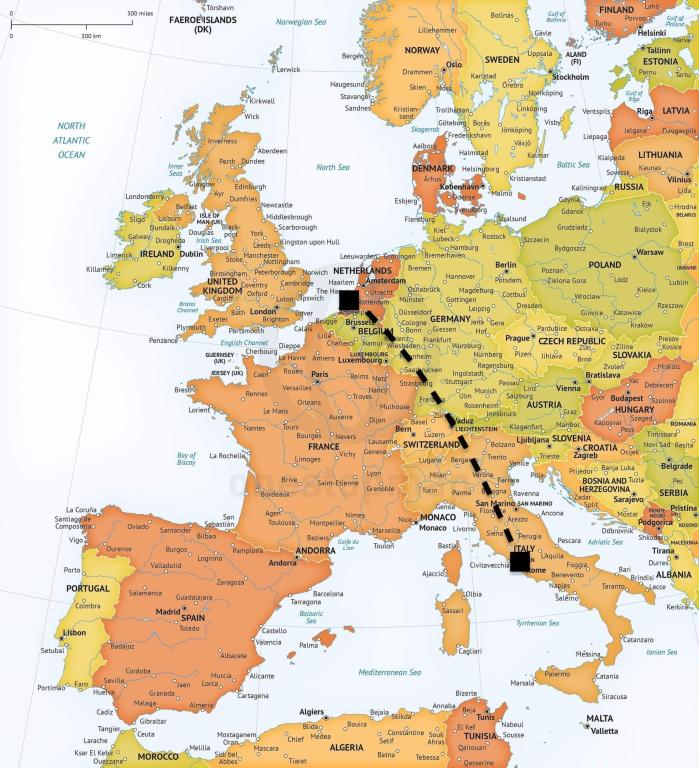 Over the next month, we will engage these questions by retracing our familial and spiritual heritage from Rome to Rotterdam. This pilgrimage will begin in Rome, where the Colosseum, the Roman Forum, the Altar of Peace, the Appian Way, and Aqueduct Park represent the heart of a vast empire. The city of Rome also hosted some of the earliest Christians, including St. Paul and St. Peter, who traveled there to preach a savior other than Caesar, who, in turn, persecuted them and forced their followers to the catacombs. Later, at the Milvian Bridge, a new iteration of empire coopted Christian resistance. The Arch of Constantine stands as a symbol of Christian assent to empire.
From Rome, our journey proceeds north to Switzerland, where reformers opposed Catholic empire. From there, we travel west to Bern and Zurich, where the Anabaptists opposed Protestant empire. These dissenters, according to Estep’s narrative, emerged as meteors against a dark sky that Luther and Calvin and Zwingli had not illuminated quite brightly enough. We then proceed to the Black Forest and Hesse regions of Germany, where better prospects among the Pietists promised our Müller, Weaver, and Schwartzendruber ancestors a better, freer life. Finally, the pilgrimage heads to the Netherlands, where our forebears fled after persecution followed them even to Germany. It ends at the Port of Rotterdam, where they boarded ships like The Phoenix on their journey to America.
This pilgrimage has several aims. First, it seeks to interrogate the moral judgments of our ecclesial tradition. Perhaps, after reading Peter Leithart’s Defending Constantine and Brad Gregory’s Salvation at Stake (which David has already done as a Mennonite in a Reformation history course taught by Gregory himself at the Catholic University of Notre Dame), we will remain unrepentant critics of Reformation violence and Constantinian Catholicism. Nevertheless, we maintain the importance of trying to comprehend seemingly unintelligible contexts. What compelled Calvinists to slaughter Catholics, Catholics to burn Calvinists at the stake—and everyone to kill Anabaptists? Answering this fraught question requires us, says Miroslav Volf, to maintain—or, indeed, to recover—the integrity of the imago dei by acknowledging that each person has a social location and history that exhibits their very humanity. “God sees each human being concretely,” he writes. “God notes not only their common humanity, but also their specific histories, their particular psychological, social, and embodied selves with their specific needs.” Attending to Volf’s call means taking seriously human complexity, even Judas in Palestine and Catholic and Reformed persecutors in the Swiss and German Reformations. Anglican bishop Rowan Williams even advises a “pastoral imagination which mimics God’s own charitable knowing of us.” Against modernist conceits of a single story, historical empathy concedes other perspectives.
We will also turn the gaze back on ourselves. Interrogation of the past should extend beyond moral judgment to moral reflection, a move that considers the ways that we—and our traditions—are complicit. How do we explain the violence of radical Anabaptists at Münster? What were the ways in which our own ancestors, who were victims of European empire, went on to buttress American empire through settler colonialism? In what ways do we still serve Pax Americana? These can be difficult to discern because, as diarist Anais Nin contends, “We don’t see things as they are; we see them as we are.”
Peter Berger suggests that sociology can help. He writes, “The perspective of sociology, particularly of the sociology of knowledge, can have a definitively liberating effect. While other analytic disciplines free us from the dead weight of the past, sociology frees us from the tyranny of the present.” Moral reflection can help remove our own cataracts, and it can make us more circumspect about moral judging others. As George Marsden writes, we should “avoid explicit moralizing because we, like the historical actors we write and teach about, are flawed humans. … We can point out that we ourselves probably have similar blind spots and that, even though our mistreatment or neglect of our neighbors may not be as notorious or spectacular, we share a common humanity with those whose action we deplore.” We all embody a beautiful and terrible inheritance.
Second, Lisa and I are teachers, and this pilgrimage will explore a more expansive pedagogy. James K. A. Smith, a critic of the intellectualist faith-learning paradigm, suggests that humans are imaginative, desiring, loving, affective creatures more than automatons driven by cognitive, intellectual perceptions. He writes, “We feel our way around our world more than we think our way through it.” As such, our imaginations need to be converted and enacted through “intentional practices that are tactile, bodily, repetitive, and narratival.” He juxtaposes this very human anthropology with the modern bureaucratic university’s emphasis on efficiency, regimentation, dispassionate instrumentalism, and building educational “superhighways” instead of undertaking educational “journeys.”
The concept of pilgrimage offers an ideal way of exploring Smith’s pedagogical vision. It can be contrasted with tourism, which, according to Ashley Woodiwiss, is “detached, disengaged, and disconnected from the object of their gaze.” Tourism, says David I. Smith and Susan Felch, tilts “the image of travel toward comfort, efficiency, and consumption”—not unlike superficial learning that skims texts and metabolizes ideas toward instrumental ends more than personal transformation. By contrast, pilgrims connect the personal to the public, their own stories to others’ stories. They linger amidst exotic smells (of Neopolitan pizza), sights (of ancestral homes), tastes (of Roman gelato), and sounds (of Gregorian chants). They seek to suffuse travel with all manner of sustenance and connection.
Travel can also be fraught. Like Adam and Eve, Abraham, and the Hebrews in Egypt and Babylon who pilgrimed on dusty roads through the precarious landscape of the ancient near east, we do not know what we will encounter. Certainly, we will experience fatigue, discomfort, and tedium. We will wish for familiar food. We will want to be there already. Will there also be logistical nightmares caused by Covid testing? Closed borders because of a new variant? Ukrainian refugees? Russian troops? Always, as they say, there is the vulnerability of the road. In its promises and limits, pilgrimage engages our affections. We’ll be looking for ways to incorporate these dimensions into our teaching.
Third, this experience will take seriously the notion of pilgrim as Christian identity. Leaving the comforts of ritual and home for foreign spaces helps us remember that this world is not our home. It is a ritual of kenotic embodiment. Self-emptying with the intent to inhabit strange worlds of the past could even provoke a kind of identity crisis as we realize that we have been picking and choosing facts of the past, interpreting in them in light of our own assumptions. Richard White, in a narrative of an early twentieth-century Irish immigrant to Chicago, writes, “Any good history begins in strangeness. The past should not be comfortable. The past should not be a familiar echo of the present, for if it is familiar, why revisit it? The past should be so strange that you wonder how you and people you know and love could come from such a time.” Or as historian John Fea puts it, “The more we discover about these people’s mental universes, the more we should be shocked by the cultural distance that separates us from them.” We will need to be open to the strangeness of our ancestors and, consequently, open to the strangeness of our own narratives. Our attempt at identification might, in fact, decenter our narratives and remind us that we are pilgrims in a land that is not our own.
In the end, pilgrimage may serve to reinforce humility by reminding us that our Anabaptist story is one among many. Our journey represents just one strand of the Reformation, which itself represents one strand of Roman Catholicism, which itself represents just one of the five patriarchates—Rome, Antioch, Alexandria, Constantinople, and Jerusalem—recognized by the Council of Ephesus in 431. Even by 500 there wasn’t yet much of a “Christian Europe”; Syria was the center of the Christian world. Nevertheless, the journey from Rome to Rotterdam is our story. And we hope that tracing a journey that took place centuries ago is renewing and transforming. Perhaps we will even, as T. S. Eliot puts it, “arrive where we started / And know the place for the first time.”
Yes, it’s the nerdiest trip ever. Our friends call it “the dork trip.” But we’re excited to embark, and if you want to follow us on our journey, click over to my website at www.davidrswartz.com in about a week.
Previous Post

May 3, 2022
What the End of Roe v. Wade Will Mean for Abortion Rates (part 1)
Next Post

May 5, 2022 The Lost Letters of Saint Paul, and How They Were Lost
Browse Our Archives
Select a Category abolitionism Abortion Abraham Joshua Heschel Abraham Kuyper Abraham Lincoln Academia Activism Adam Renberg Advent Adventist africa African American Religion Agnes Howard Albert Camus American History American Religious History American Revolution American West Anabaptists Ancient History Andrea Turpin Andrei Tarkovsky Anglicanism Annales Ansley Lillian Quiros anti-Catholicism Antisemitism Anxious Bench apologetics Apparitions Arash Azizi Archaeology archives art Artificial Intelligence Asia Asian Americans Augustine Authors Bad Bunny Baptism Baptists Barack Obama Battle of Hastings Benjamin Franklin Bernard-Henri Levy Beth Allison Barr Beth Moore Bethany Mannon Bible Bill Cunningham Billy Graham Black Music Bob Dylan Body Boenhoffer Books Breastfeeding Bruce Springsteen C.S. Lewis Calvinism Cancel Culture Capitalism Carmelites Catholicism Cedric Robinson Cesar Chavez Charismaticism charity Charles Dickens Charles Lindbergh Che Guevara Chicago Children Chinese Christianity Chris Gehrz Christ Christian death Christian Higher Education Christian life Christian Nation Christian Nationalism Christianity Today Christmas Church life Church Practice cinema Civil Religion Civil Rights Movement Civil War civility Classics Climate Change Cold War Colonial Mexico colonialism Comer Communism community complementarianism Conference on Faith and History Congregationalism Conspiracies Conspiracy Conversion Narratives Coronavirus Costa Rica Council of Nicaea Covid-19 Creation Critical Race Theory Crusades Culture culture wars Daniel K. Williams David Barton David Swartz Death Ways death with dignity DEI democracy Democratic Party Devotion Digital Age Diplomacy discipleship diversity Donald Trump Drama Dua Lipa Early Church early modern Early modern Catholicism Easter Eastern Christianity economic exploitation Education elections Elie Wiesel Elizabeth II Elizabeth Taylor emotions Empire Engineering England enslavement Entertainment Episcopal Church Erica Ramirez eschatology Eurocentrism Evangelicalism Evangelicals Exegesis Family Feminism Film Flannery O'Connor folk music Food Foreign Policy founding fathers Franciscans Franciscus Junius fundamentalism Funerals G.K. Chesterton Gender Genocide genre geography George W. Bush George Washington George Whitefield Global Christianity Global church Grief Guadalupe guest post Guest Post gun control gun violence Gustavo Gutierrez Hamid Dabashi Harold John Ockenga Harvest Hate Hawaiian Christianity Healing health care Heather Cox Richardson Hell Heresy Hermeneutics Higher Education Hinduism Hippocratic oath Historical Fiction Historical Methodology Historical Profession Historical Profession Historical Theology Historical Thinking historiography Holidays Holocaust horror movies Human rights Humanitarian Work humanities Hummingbirds Hungary hymns Imago Dei Immigration Injustice Interviews Iran Islam Islamophobia Israel Ivan's Childhood Jacob Randolph James Bratt Janine Giordano Drake Japanese history Japanese Literature Jean Paul Sartre Jesse Miranda Jesus Jesus Christ Jimmy Carter Joan Baez Joan Didion Joanne Freeman João B. Chaves Joao Chaves Joey Cochran John Calvin John Fea John Tillotson John Turner Johnny Cash Jonathan Edwards Jonathan Tran Joseph Smith Josh Howerton Journalism Jr. Judaism Jürgen Moltmann Just War Justice Justin Brierley Karl Barth Katelyn Beaty koi ponds Kris Kristofferson Kristin Kobes Du Mez Latin American Religious History Latino Americans Lectio Divina Leisure Lent Leonard Cohen liberal arts liberalism Liberation Theology Linda Ronstadt Lisa Clark Diller Literature Lou Reed Lynchings Lynneth Miller Renberg Mainline Protestantism Malcolm Foley Marilyn Monroe Maritime history Mark Noll Marriage Martin Luther Martin Luther King Martyrdom Marxism Mary Masih Alinejad mass shootings material culture medieval Christianity Medieval Ethiopia Melissa Borja memory Mennonites Mental Health Mental Illness Methodism Mexican Americans Mexicans Mike Madrid Miles Mullin Min Jin Lee Miscarriage Missionaries Mister Rogers Mitt Romney modernity Monasticism Mormonism Motherhood Mothers of the Church Moving Music Musicals Nadya Williams Nahua Christianity Native Americans Natsume Sōseki New Contributor New England New Year New York Nico Non-Violent Protest Orthodoxy pacifism Paleo Evangelicals Palestinians Parenting Patti Smith Paul Kingsnorth Pedro Calderón de la Barca Pentecostalism Philip Jenkins Phillis Wheatley physician-assisted suicide pilgrimage Pilgrims pluralism Plutocracy Poetry Politics Pope Francis Pope Leo XIV post-modernism prayer preaching Presbyterians prosperity gospel Protest Public history Publishing Puritans purity culture Quakers race Race Massacres Racial Capitalism racial reconciliation racialization Racism Raha Bahloulipour Re-Enchantment reading Reformation Refugees religion and the university religion and war Religious Freedom Religious Nones Religious Pluralism Religious Symbols religious violence Republican Party Revival Rita Coolidge Ritual Roger Williams Roman Catholic church Royalty Russell Moore same-sex marriage Sarah Irving-Stonebraker Scandinavia Science Science and Technology Scopes trial Scriptural Interpretation secularism Selena Quintanilla seminary Seventh-Day Adventists sexual morality Sexuality Sikhs Silence slaveholders theology Slavery Slavoj Zizek social justice Social Media Southern Baptist Convention Southern Religion Spain Spiritual Autobiography Spiritual but not religious Spiritual Discipline Sports Stanley Hauerwas Suffering Summer Camps Sunday Night Odds and Ends Supernatural Supreme Court Syriac Christianity Tal Howard Taylor Swift Teaching Technology Television Thanksgiving The Beatles The Mission theater TheoBros Theology Thomas Dixon Thomas Jefferson Thomas Kidd Thomas Merton Tim Gloege Tim Walz Tom Holland Tourism tradition Tragedy Translation Transnationalism Travel Trump Ukraine Uncategorized Unitarians United Methodist Church US History Vanessa Chan Velvet Underground Verónica A. Gutiérrez Veronica Gutierrez Vikings Violence Virgin Mary Virtue Virtue ethics Visions Voting War WCTU Wendell Berry Westminster Assembly White Evangelicalism Wildfires Winnie the Pooh Witches women Women in Ministry Women's and Gender Studies Work Worship writing Yasunari Kawabata Zena Hitz
Select a Month October 2026 September 2026 August 2026 July 2026 June 2026 May 2026 April 2026 March 2026 February 2026 January 2026 December 2025 November 2025 October 2025 September 2025 August 2025 July 2025 June 2025 May 2025 April 2025 March 2025 February 2025 January 2025 December 2024 November 2024 October 2024 September 2024 August 2024 July 2024 June 2024 May 2024 April 2024 March 2024 February 2024 January 2024 December 2023 November 2023 October 2023 September 2023 August 2023 July 2023 June 2023 May 2023 April 2023 March 2023 February 2023 January 2023 December 2022 November 2022 October 2022 September 2022 August 2022 July 2022 June 2022 May 2022 April 2022 March 2022 February 2022 January 2022 December 2021 November 2021 October 2021 September 2021 August 2021 July 2021 June 2021 May 2021 April 2021 March 2021 February 2021 January 2021 December 2020 November 2020 October 2020 September 2020 August 2020 July 2020 June 2020 May 2020 April 2020 March 2020 February 2020 January 2020 December 2019 November 2019 October 2019 September 2019 August 2019 July 2019 June 2019 May 2019 April 2019 March 2019 February 2019 January 2019 December 2018 November 2018 October 2018 September 2018 August 2018 July 2018 June 2018 May 2018 April 2018 March 2018 February 2018 January 2018 December 2017 November 2017 October 2017 September 2017 August 2017 July 2017 June 2017 May 2017 April 2017 March 2017 February 2017 January 2017 December 2016 November 2016 October 2016 September 2016 August 2016 July 2016 June 2016 May 2016 April 2016 March 2016 February 2016 January 2016 December 2015 November 2015 October 2015 September 2015 August 2015 July 2015 June 2015 May 2015 April 2015 March 2015 February 2015 January 2015 December 2014 November 2014 October 2014 September 2014 August 2014 July 2014 June 2014 May 2014 April 2014 March 2014 February 2014 January 2014 December 2013 November 2013 October 2013 September 2013 August 2013 July 2013 June 2013 May 2013 April 2013 March 2013 February 2013 January 2013 December 2012 November 2012 October 2012 September 2012 August 2012 July 2012 June 2012 May 2012
Follow Us!
TAKE THE
Religious Wisdom Quiz
What does the Hebrew word 'Shekinah' mean?
Select your answer to see how you score.
God’s Glory Divine Presence Holy Fire Everlasting Light
Related posts from Anxious Bench
Corrupting the Youth? What Universities Are Really For
The Best Books for Understanding Christian History in...
Just War, Non-Violence, and Pete Hegseth

Toward Healing? Teaching the Reformation in Mixed Company
TRENDING AT PATHEOS Evangelical

Emotion in Early Christianity by Andrew Crislip
Andrew Crislip’s Emotion in Early Christianity examines an often overlooked dimension of...

16 Spiritual Touchstones for a More Grounded Life
After decades of spiritual study, here are 16 principles I try...

Catholic Evangelization: Sharing Your Faith Every Day
Welcome back to the Graceful Awakening mini-series called, “From Faith to Mission.” ...

The Pillar of the Boatmen: the Ancient Monument...
The Pillar of the Boatmen is a Romano-Gaulish sculpture that dates from...

In one sense walking into Westminster Abbey is like walking down the...

'Super Scam Me' Exposes AI Jon Bon Jovi...
Leslie Pickett believed she was in a relationship with Jon Bon Jovi....
view all Evangelical blogs
Ad-Free & Subscriber Log-In Subscription Support
- About Us
- 2026 Calendar
- Videos
- Podcasts
- Library of World Religions
- Faith In Media Tracker
- Advertise With Us
- Write for Us
- Privacy Policy
- Terms of Service
- Do Not Sell My Data
- Contact Us
- Radiant Digital
- Manage Newsletter Subscriptions
- Unsubscribe From Notifications
- Sitemap
Copyright 2008-2026, Patheos. All rights reserved.
Subscription Support Ad-Free & Subscriber Log-In
Follow Patheos