
BuddhistCatholicContemplativeEvangelicalGeneral ChristianHinduJewishLatter-day SaintMuslimNew VisionsProgressive Christian
Beliefs
- Buddhist
- Catholic
- Contemplative
- Evangelical
- General Christian
- Hindu
- Jewish
- Latter-day Saint
- More Voices
- Muslim
- New Visions
- Pagan
- Progressive Christian
Topics
- Religion News
- Food and Religion
- Sports and Religion
- Religious Art
- Religious Music and Entertainment
- Religious Events
- History and Religion
- Style and Religion
- Politics and Religion
- Women in Religion
- Recreation Outdoors and Religion
- Business Finance and Religion
- Careers Workplace and Religion
- Education and Religion
- Family Parenting and Religion
- Health Fitness and Religion
- Home and Religion
- Relationships and Religion
- Technology and Religion
- Travel and Religion
Columnists
- Buddhist Columnists
- Business Finance and Religion Columnists
- Careers Workplace and Religion Columnists
- Catholic Columnists
- Contemplative Columnists
- Education and Religion Columnists
- Evangelists Columnists
- Family Parenting and Religion Columnists
- General Christian Columnists
- Health Fitness and Religion Columnists
- Hindu Columnists
- History and Religion Columnists
- Home and Religion Columnists
- Jewish Columnists
- More Voices Columnists
- Latter Day Columnists
- Muslim Columnists
- New Visions Columnists
- Nonreligious Columnists
- Pagan Columnists
- Politics and Religion Columnists
- Progressive Columnists
- Recreation Outdoors and Religion Columnists
- Relationships and Religion Columnists
- Religion News Columnists
- Religious Art Columnists
- Religious Events Columnists
- Religious Music and Entertainment Columnists
- Sports and Religion Columnists
- Style and Religion Columnists
- Technology and Religion Columnists
- Travel and Religion Columnists
- Women in Religion Columnists
Resource Library
- 2026 Calendar
- Library of World Religions
- The 100 Most Holy Places on Earth
- Patheos Answers
- Podcasts
- Videos
- Faith Leaders Database
- Anglican Episcopalian
- Bahai
- Baptist
- Buddhism
- Christianity
- Confucianism
- Eastern Orthodoxy
- Hinduism
- Holiness and Pentecostal
- ISKCON
- Islam
- Judaism
- Lutheran
- Methodist
- The Church of Jesus Christ of Latter-day Saints
- New Age
- Paganism
- Presbytarian and Reformed
- Protestantism
- Religion Behind the Scenes
- Roman Catholic
- Scientology
- Shia Islam
- Sikhism
- Sufism
- Sunni Islam
- Taoism
- Zen
- See all religions
Research Tools
 Ad-Free & Subscriber Log-In Subscription Support
Ad-Free & Subscriber Log-In Subscription Support
Follow Patheos 

- Trending:
- Forgiveness
- |
- Marriage
- |
- Consciousness
- |
- Death Penalty
- |
- Election
- |
- Halloween

-
About the Authors
- Home
- Evangelical
- In The Beginning, All The World Was America, And More So Than That Is Now
In The Beginning, All The World Was America, And More So Than That Is Now
Last updated on: December 17, 2021 at 12:40 am by Philip Jenkins
In The Beginning, All The World Was America, And More So Than That Is Now 2021-12-16T07:22:39-04:00 Philip Jenkins
Patheos Explore the world's faith through different perspectives on religion and spirituality! Patheos has the views of the prevalent religions and spiritualities of the world.
I have been reading the sizable new book The Dawn of Everything, by David Graeber and David Wengrow. This wildly ambitious work basically tries to rewrite the whole history of humanity, and in the process, it inverts what “everybody knows” about the “rise of civilization.” What follows is not, repeat not, a review of the book, but rather an exploration of a few of its critical themes.
To oversimplify a complex argument, Graeber and Wengrow suggest that early human societies were quite capable of making very substantial leaps to everything we characterize as “civilized” organization and development without forfeiting their early egalitarian structures. In order to live fully and happily, human beings did not have to make the Faustian bargains that cursed them with hierarchy, domination, inequality, and property, whether in the secular or the spiritual sphere. What we usually think is that early people progressed to developing new technologies and forms of civilization, and then built on those to advance further. The Dawn of Everything suggests that societies through the ages have made those “advances” (note my quotes) at various points – but then decided they weren’t worth bothering with, and renounced them. Been there, invented that, decided it wasn’t worth the trouble. Those early societies consciously preferred what we think of as the primitive, as a more humane and creative way of living. This is overtly an anarchist vision of human development.
I have quite a few problems with the book. In my view, the authors’ interpretation of lots of the archaeological evidence they cite is poorly substantiated and, let’s be kind here, optimistic. More generally, for all the scholarly apparatus, the book has the standard flaws of most soft primitivism, and a large dose of ethnographic credulity that sometimes becomes actively embarrassing. I strongly endorse the painstaking and seriously critical review by Kwame Anthony Appiah in the current New York Review of Books [paywalled].
Just to give a specific example, the authors make really extensive use of the reported words of an early Native American named Kandiaronk, who was deeply unimpressed by the French society he encountered at the end of the seventeenth century. Here, think Graeber and Wengrow, we have the authentic words of primitive and democratic humanity, the determined foe of property and inequality, and the explosive views that he presented had a significant impact on Enlightenment thought. As the authors rightly note, it has always been assumed that Kandiaronk’s opinions as they were expressed were not in fact his, but were projected onto him by the French author who reported his views in 1703: at the very least, that author embellished his words, very substantially. Graeber and Wengrow reject this interpretation, and to think (or affect to think) that we really are hearing the authentic words of the ideal Native Sage, at his most savage and most noble. They are utterly and self-evidently wrong about this, or at least, it is very odd indeed that Kandiaronk spends so much time spouting familiar themes that had clearly originated in early Enlightenment Europe. (More on this below).
Nor are the authors apparently aware of the very common Greek and Roman habit of placing their own social and political critiques in the mouths of barbarians who feature in their narratives, even when there is no conceivable way the writers could have known the actual content of those speeches. (Tacitus was very good at this). Barbarian outsiders were always precious vehicles for channeling radical ideas. Every educated French person around 1703 had been raised on those Classical historians, and knew that rhetorical tactic intimately. In more modern times, historians have had great fun tracing the mythical “speeches” attributed to Chief Seattle, which evolved according to the needs and interests of the non-Native interpreters in any given era.
Having said all that, The Dawn of Everything offers so much to argue with and about that it is eminently worth reading, discussing, teaching, and occasionally, throwing across the room. Quite seriously, what else do you need in an ideal Christmas gift?
Inventing Savages and Barbarians
I want here to expand a bit on what they say about the rise of the ideas that they are struggling against. How did we come to believe that civilization demanded the destruction of that original supposed world of egalitarian freedom? How did primitive or savage automatically come to mean something so horribly bad? I am building here on my recent post about Thomas Hobbes’s book Leviathan, which he published in 1651, and an extremely significant influence on Western political thought during the Enlightenment. Like so many others of his time, Hobbes was deeply interested in the origins of society, and how people came to form the communities they did. To establish their point, Locke, Hobbes, and others used Native Americans as a symbol of the primitive order – sometimes, but not necessarily, as ruthless savages. Those texts make for powerful (I almost said “enlightening”) and troubling reading today. They also offer a new perspective on the history of the very word “American.”
When those English observers were discussing Native peoples, they confined themselves almost exclusively to the Eastern Woodland cultures they knew from accounts of New England and Virginia. From Spanish writers, the English knew vaguely about the great Classical cultures that had existed in Mexico and Peru, but those really did not fit their argument. For their purposes, the more primitive the societies they were sketching, the better.
Some of those comparative accounts were actually quite insightful. Around 1670, the brilliant antiquary John Aubrey assembled what information he could about Britain’s ancient Celtic societies, as they would have existed just before the Roman invasions. Those Celts used iron and practiced agriculture, and (as he wrongly believed) built great monuments like Stonehenge and Avebury. Thus, “they were two or three degrees I suppose less salvage [savage] than the Americans.” Like his contemporaries, he uses “American” to refer to the indigenous peoples, rather than the settlers, a practice than continued well into the eighteenth century. As late as 1729, Jonathan Swift would imagine a cannibalistic “American” – that is, an Indian – in his Modest Proposal.
Aubrey is applying what we can only call an evolutionary theory of anthropology. The word “savage” does not of itself mean brutal or violent, or even anything undesirable. Rather, he imagines an evolutionary sequence from people living in the woods or forests, the silvae, where they have the appropriate ways of living and finding food, and are thus silvaticus or savage – that is, woodlanders. That connotation still survives in other languages. In my high school French class, a friend earned the teacher’s mockery for translating mouton sauvage as “savage sheep,” rather than merely a wild variety, with no necessary implications about its sadistic or aggressive potential. Italian selvaggio just means wild or uncontrolled: Dante’s Divine Comedy famously opens in a selva selvaggia, a “wild wood.” In Aubrey’s day too, English retained the original L in “salvage,” which still implied wild and woody, in a non-judgmental way. That is exactly the sense in which modern anthropologists speak of Eastern Woodland cultures. Savage originally meant woodland, and vice versa, neither more nor less.
As they develop agriculture, thought Aubrey, those “savages” move to a higher stage of development, which nineteenth century theorists called barbarian, before emerging into the light of full civilization.
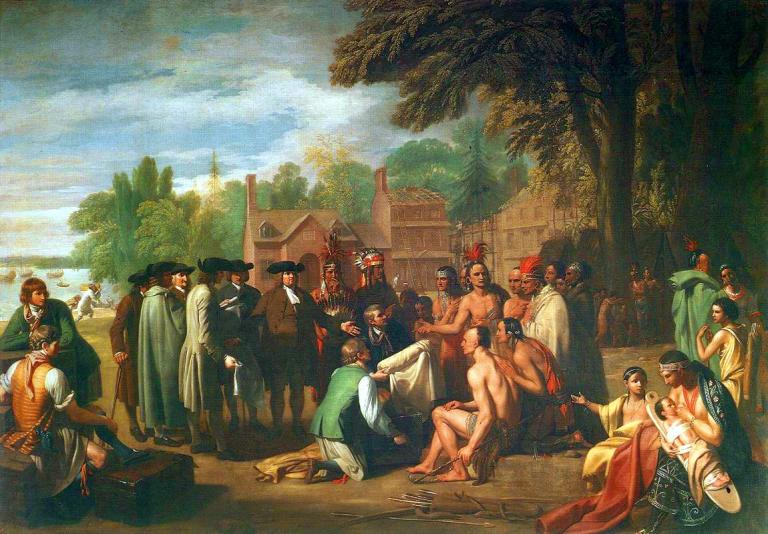
Noble Savages
“Savages” could in themselves be perfectly decent and even honorable people. In a famous essay on the New World published in 1580, Michel de Montaigne had spoken admiringly of the “savages” of Brazil, who lived close to Nature, and in a sense represented a perfect human society (“Of Cannibals”). In a founding text of cultural relativism, Montaigne also noted “that everyone gives the title of barbarism to everything that is not in use in his own country” (chacun appelle barbarie ce qui n’est pas de son usage). To borrow a later phrase, savages could be noble. That essay was widely translated, and Shakespeare probably borrowed from one of those English versions in The Tempest. In 1672, a character in John Dryden’s The Conquest of Granada uttered the famous lines,
I am as free as nature first made man,
Ere the base laws of servitude began,
When wild in woods the noble savage ran.
Noble savages were thoroughly in vogue long before the appearance of Kandiaronk, who supposedly presented exactly the views that his European audience had come to expect. The sentiments attributed to him reflected those European expectations and stereotypes as they existed c.1700. Graeber and Wengrow are quite naughty here, as they badly underplay those older pre-1700 accounts so as to make the supposed words of Kandiaronk into a bombshell revelation, entirely unsuspected by European intellectuals prior to that point. They were nothing of the kind. (Unforgivably, the authors refer to Montaigne’s seminal essay only in a footnote).
If Kandiaronk’s account had not existed c.1700, it would have been necessary to invent it. Oh, wait, somebody did.
Savages At Their Most Savage, And Ignoble
Going back to John Aubrey, in his view, ancient British savages were neither better nor worse than the slightly more advanced barbarians. Of the Anglo-Saxons who followed the Britons, he writes that “They lived sluttishly in poor houses, where they eat a great deal of beef and mutton, and drank good ale in a brown mazard; and their very kings were but a sort of farmers.” If they were superior to mere savages, they were of themselves nothing to write home about. By the by, the phrase “their very kings were but a sort of farmers” cries out to be set as a “Discuss” in an exam question.
Having said that about Aubrey, other scholars used the notion of savagery in pretty much the modern English usage of animalistic or “brutish,” and in so doing, they formulated the hierarchical and state-centered vision that Graeber and Wengrow are challenging. Hobbes famously imagined the State of Nature that would have existed before organized society and states, and despite what Montaigne had said, this was a dreadful thing it was to imagine:
In [the state of nature] there is no place for Industry; because the fruit thereof is uncertain: and consequently no Culture of the Earth; no Navigation, nor use of the commodities that may be imported by Sea; no commodious Building; no Instruments of moving, and removing such things as require much force; no Knowledge of the face of the Earth; no account of Time; no Arts; no Letters; no Society; and which is worst of all, continuall feare, and danger of violent death; And the life of man, solitary, poore, nasty, brutish, and short …
Perhaps that extreme model did not exist all over the world, but it was assuredly to be found in certain particular localities in his own time: “For the savage people in many places of America, except the government of small Families, the concord whereof dependeth on naturall lust, have no government at all; and live at this day in that brutish manner, as I said before.” No great linguistic distance separated the concept of “brutish” from “brutal,” in our modern sense. Civilized people could themselves fall back easily into that kind of calamitous situation, through wars or civil wars (Hobbes is thinking of the Thirty Years War, or the English Civil War of the 1640s). At such times, civilization failed, and people reverted to the brutality and dreadful situation that characterized ordinary Indian life: they fall back into a Hobbesian State of Nature. So appalling were such conditions that people demanded protection through an absolute sovereign.
Locke on America
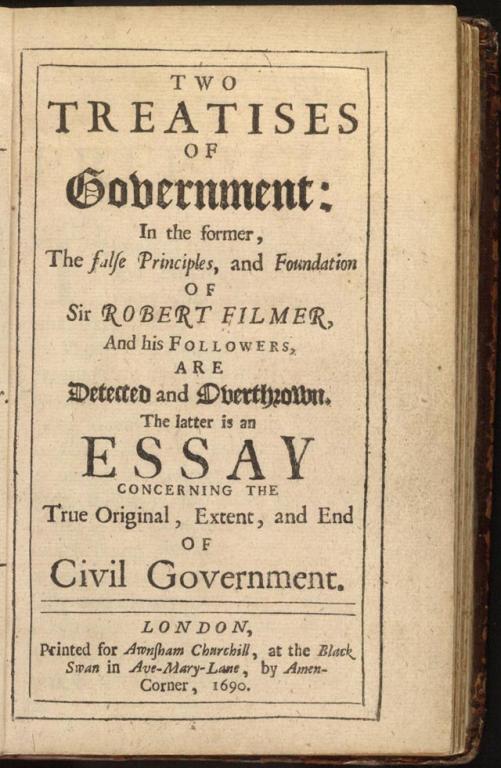
The most influential use of the idea of Indian “savagery” was offered by John Locke in his Second Treatise on Government, written around 1680, and another prime text of Enlightenment thought: arguably, it was the founding text of the American Revolution. Like Hobbes, Locke uses the Indians to imagine a world that in economic terms is a blank slate, a ground zero from which later progress can occur. Such improvement could only take place once the right of property had been established, which led to a new value being placed on land and its improvement, and to the rise of money and wealth. Property gave the foundation for all later civilization:
For I ask whether in the wild woods and uncultivated waste of America left to Nature, without any improvement, tillage or husbandry, a thousand acres will yield the needy and wretched inhabitants as many conveniencies of life as ten acres of equally fertile land doe in Devonshire where they are well cultivated?
The nations of the “Americans”
are rich in Land, and poor in all the Comforts of Life; whom Nature having furnished as liberally as any other people, with the materials of Plenty, i.e. a fruitful Soil, apt to produce in abundance, what might serve for food, raiment, and delight; yet for want of improving it by labour, have not one hundredth part of the Conveniencies we enjoy: And a King of a large fruitful Territory there feeds, lodges, and is clad worse than a day Labourer in England.
Locke continues with the much-quoted phrase that I use for my title:
Thus in the beginning all the World was America, and more so than that is now; for no such thing as Money was any where known. Find out something that hath the Use and Value of Money amongst his Neighbours, you shall see the same Man will begin presently to enlarge his Possessions.
Without those structures of property, and the attendant hierarchy and inequality, humans could know neither safety nor comfort nor “conveniencies.” That was the price you paid. I may be wrong here, but I could not find that wonderful “in the beginning” quote in The Dawn of Everything: how could they have resisted it?
Like Aubrey, Locke was not suggesting any natural flaw or evil in Native Americans, but rather that they had simply failed to reach the stage of social or economic development that they could actually care for their lands, or develop them in any fruitful way. (I am reporting Locke’s views: do not blame me for the obvious critique of unchecked development and over-exploitation). But religious writers inevitably used that kind of analysis to frame Indian “savages” in a way that was literally diabolical.
I’ll be returning to those religious implications in my next post. As I say, I often disagree with The Dawn of Everything, but it does provoke thinking. Do read it.
David Graeber and David Wengrow
Next Post

December 20, 2021 Religious Decline, and the Secular Religion of Community
Browse Our Archives
Select a Category abolitionism Abortion Abraham Joshua Heschel Abraham Kuyper Abraham Lincoln Academia Activism Adam Renberg Advent Adventist africa African American Religion Agnes Howard Albert Camus American History American Religious History American Revolution American West Anabaptists Ancient History Andrea Turpin Andrei Tarkovsky Anglicanism Annales Ansley Lillian Quiros anti-Catholicism Antisemitism Anxious Bench apologetics Apparitions Arash Azizi Archaeology archives art Artificial Intelligence Asia Asian Americans Augustine Authors Bad Bunny Baptism Baptists Barack Obama Battle of Hastings Benjamin Franklin Bernard-Henri Levy Beth Allison Barr Beth Moore Bethany Mannon Bible Bill Cunningham Billy Graham Black Music Bob Dylan Body Boenhoffer Books Breastfeeding Bruce Springsteen C.S. Lewis Calvinism Cancel Culture Capitalism Carmelites Catholicism Cedric Robinson Cesar Chavez Charismaticism charity Charles Dickens Charles Lindbergh Che Guevara Chicago Children Chinese Christianity Chris Gehrz Christ Christian death Christian Higher Education Christian life Christian Nation Christian Nationalism Christianity Today Christmas Church life Church Practice cinema Civil Religion Civil Rights Movement Civil War civility Classics Climate Change Cold War Colonial Mexico colonialism Comer Communism community complementarianism Conference on Faith and History Congregationalism Conspiracies Conspiracy Conversion Narratives Coronavirus Costa Rica Council of Nicaea Covid-19 Creation Critical Race Theory Crusades Culture culture wars Daniel K. Williams David Barton David Swartz Death Ways death with dignity DEI democracy Democratic Party Devotion Digital Age Diplomacy discipleship diversity Donald Trump Drama Dua Lipa Early Church early modern Early modern Catholicism Easter Eastern Christianity economic exploitation Education elections Elie Wiesel Elizabeth II Elizabeth Taylor emotions Empire Engineering England enslavement Entertainment Episcopal Church Erica Ramirez eschatology Eurocentrism Evangelicalism Evangelicals Exegesis Family Feminism Film Flannery O'Connor folk music Food Foreign Policy founding fathers Franciscans Franciscus Junius fundamentalism Funerals G.K. Chesterton Gender Genocide genre geography George W. Bush George Washington George Whitefield Global Christianity Global church Grief Guadalupe guest post Guest Post gun control gun violence Gustavo Gutierrez Hamid Dabashi Harold John Ockenga Harvest Hate Hawaiian Christianity Healing health care Heather Cox Richardson Hell Heresy Hermeneutics Higher Education Hinduism Hippocratic oath Historical Fiction Historical Methodology Historical Profession Historical Profession Historical Theology Historical Thinking historiography Holidays Holocaust horror movies Human rights Humanitarian Work humanities Hummingbirds Hungary hymns Imago Dei Immigration Injustice Interviews Iran Islam Islamophobia Israel Ivan's Childhood Jacob Randolph James Bratt Janine Giordano Drake Japanese history Japanese Literature Jean Paul Sartre Jesse Miranda Jesus Jesus Christ Jimmy Carter Joan Baez Joan Didion Joanne Freeman João B. Chaves Joao Chaves Joey Cochran John Calvin John Fea John Tillotson John Turner Johnny Cash Jonathan Edwards Jonathan Tran Joseph Smith Josh Howerton Journalism Jr. Judaism Jürgen Moltmann Just War Justice Justin Brierley Karl Barth Katelyn Beaty koi ponds Kris Kristofferson Kristin Kobes Du Mez Latin American Religious History Latino Americans Lectio Divina Leisure Lent Leonard Cohen liberal arts liberalism Liberation Theology Linda Ronstadt Lisa Clark Diller Literature Lou Reed Lynchings Lynneth Miller Renberg Mainline Protestantism Malcolm Foley Marilyn Monroe Maritime history Mark Noll Marriage Martin Luther Martin Luther King Martyrdom Marxism Mary Masih Alinejad mass shootings material culture medieval Christianity Medieval Ethiopia Melissa Borja memory Mennonites Mental Health Mental Illness Methodism Mexican Americans Mexicans Mike Madrid Miles Mullin Min Jin Lee Miscarriage Missionaries Mister Rogers Mitt Romney modernity Monasticism Mormonism Motherhood Mothers of the Church Moving Music Musicals Nadya Williams Nahua Christianity Native Americans Natsume Sōseki New Contributor New England New Year New York Nico Non-Violent Protest Orthodoxy pacifism Paleo Evangelicals Palestinians Parenting Patti Smith Paul Kingsnorth Pedro Calderón de la Barca Pentecostalism Philip Jenkins Phillis Wheatley physician-assisted suicide pilgrimage Pilgrims pluralism Plutocracy Poetry Politics Pope Francis Pope Leo XIV post-modernism prayer preaching Presbyterians prosperity gospel Protest Public history Publishing Puritans purity culture Quakers race Race Massacres Racial Capitalism racial reconciliation racialization Racism Raha Bahloulipour Re-Enchantment reading Reformation Refugees religion and the university religion and war Religious Freedom Religious Nones Religious Pluralism Religious Symbols religious violence Republican Party Revival Rita Coolidge Ritual Roger Williams Roman Catholic church Royalty Russell Moore same-sex marriage Sarah Irving-Stonebraker Scandinavia Science Science and Technology Scopes trial Scriptural Interpretation secularism Selena Quintanilla seminary Seventh-Day Adventists sexual morality Sexuality Sikhs Silence slaveholders theology Slavery Slavoj Zizek social justice Social Media Southern Baptist Convention Southern Religion Spain Spiritual Autobiography Spiritual but not religious Spiritual Discipline Sports Stanley Hauerwas Suffering Summer Camps Sunday Night Odds and Ends Supernatural Supreme Court Syriac Christianity Tal Howard Taylor Swift Teaching Technology Television Thanksgiving The Beatles The Mission theater TheoBros Theology Thomas Dixon Thomas Jefferson Thomas Kidd Thomas Merton Tim Gloege Tim Walz Tom Holland Tourism tradition Tragedy Translation Transnationalism Travel Trump Ukraine Uncategorized Unitarians United Methodist Church US History Vanessa Chan Velvet Underground Verónica A. Gutiérrez Veronica Gutierrez Vikings Violence Virgin Mary Virtue Virtue ethics Visions Voting War WCTU Wendell Berry Westminster Assembly White Evangelicalism Wildfires Winnie the Pooh Witches women Women in Ministry Women's and Gender Studies Work Worship writing Yasunari Kawabata Zena Hitz
Select a Month October 2026 September 2026 August 2026 July 2026 June 2026 May 2026 April 2026 March 2026 February 2026 January 2026 December 2025 November 2025 October 2025 September 2025 August 2025 July 2025 June 2025 May 2025 April 2025 March 2025 February 2025 January 2025 December 2024 November 2024 October 2024 September 2024 August 2024 July 2024 June 2024 May 2024 April 2024 March 2024 February 2024 January 2024 December 2023 November 2023 October 2023 September 2023 August 2023 July 2023 June 2023 May 2023 April 2023 March 2023 February 2023 January 2023 December 2022 November 2022 October 2022 September 2022 August 2022 July 2022 June 2022 May 2022 April 2022 March 2022 February 2022 January 2022 December 2021 November 2021 October 2021 September 2021 August 2021 July 2021 June 2021 May 2021 April 2021 March 2021 February 2021 January 2021 December 2020 November 2020 October 2020 September 2020 August 2020 July 2020 June 2020 May 2020 April 2020 March 2020 February 2020 January 2020 December 2019 November 2019 October 2019 September 2019 August 2019 July 2019 June 2019 May 2019 April 2019 March 2019 February 2019 January 2019 December 2018 November 2018 October 2018 September 2018 August 2018 July 2018 June 2018 May 2018 April 2018 March 2018 February 2018 January 2018 December 2017 November 2017 October 2017 September 2017 August 2017 July 2017 June 2017 May 2017 April 2017 March 2017 February 2017 January 2017 December 2016 November 2016 October 2016 September 2016 August 2016 July 2016 June 2016 May 2016 April 2016 March 2016 February 2016 January 2016 December 2015 November 2015 October 2015 September 2015 August 2015 July 2015 June 2015 May 2015 April 2015 March 2015 February 2015 January 2015 December 2014 November 2014 October 2014 September 2014 August 2014 July 2014 June 2014 May 2014 April 2014 March 2014 February 2014 January 2014 December 2013 November 2013 October 2013 September 2013 August 2013 July 2013 June 2013 May 2013 April 2013 March 2013 February 2013 January 2013 December 2012 November 2012 October 2012 September 2012 August 2012 July 2012 June 2012 May 2012
Follow Us!
TAKE THE
Religious Wisdom Quiz
Who said, "The stone the builders rejected has become the cornerstone"?
Select your answer to see how you score.
Isaiah Paul Jesus David
Related posts from Anxious Bench

Fairies, Witches, Folk Horror, and the Secret Commonwealth

Hogg’s Justified Sinner: A Gothic Classic for Halloween

James Hogg, Weird Wives, and Feminist Witches

How an Explosive Book Rewrote the Study of...
TRENDING AT PATHEOS Evangelical

The Problem with False Prophets
Miller’s Station UMC| 10/18/26| Anchor Verse: Jeremiah 23: 1, 9-23 I...

Emotion in Early Christianity by Andrew Crislip
Andrew Crislip’s Emotion in Early Christianity examines an often overlooked dimension of...

16 Spiritual Touchstones for a More Grounded Life
After decades of spiritual study, here are 16 principles I try...

Catholic Evangelization: Sharing Your Faith Every Day
Welcome back to the Graceful Awakening mini-series called, “From Faith to Mission.” ...

The Pillar of the Boatmen: the Ancient Monument...
The Pillar of the Boatmen is a Romano-Gaulish sculpture that dates from...

In one sense walking into Westminster Abbey is like walking down the...
view all Evangelical blogs
Ad-Free & Subscriber Log-In Subscription Support
- About Us
- 2026 Calendar
- Videos
- Podcasts
- Library of World Religions
- Faith In Media Tracker
- Advertise With Us
- Write for Us
- Privacy Policy
- Terms of Service
- Do Not Sell My Data
- Contact Us
- Radiant Digital
- Manage Newsletter Subscriptions
- Unsubscribe From Notifications
- Sitemap
Copyright 2008-2026, Patheos. All rights reserved.
Subscription Support Ad-Free & Subscriber Log-In
Follow Patheos