
BuddhistCatholicContemplativeEvangelicalGeneral ChristianHinduJewishLatter-day SaintMuslimNew VisionsProgressive Christian
Beliefs
- Buddhist
- Catholic
- Contemplative
- Evangelical
- General Christian
- Hindu
- Jewish
- Latter-day Saint
- More Voices
- Muslim
- New Visions
- Pagan
- Progressive Christian
Topics
- Religion News
- Food and Religion
- Sports and Religion
- Religious Art
- Religious Music and Entertainment
- Religious Events
- History and Religion
- Style and Religion
- Politics and Religion
- Women in Religion
- Recreation Outdoors and Religion
- Business Finance and Religion
- Careers Workplace and Religion
- Education and Religion
- Family Parenting and Religion
- Health Fitness and Religion
- Home and Religion
- Relationships and Religion
- Technology and Religion
- Travel and Religion
Columnists
- Buddhist Columnists
- Business Finance and Religion Columnists
- Careers Workplace and Religion Columnists
- Catholic Columnists
- Contemplative Columnists
- Education and Religion Columnists
- Evangelists Columnists
- Family Parenting and Religion Columnists
- General Christian Columnists
- Health Fitness and Religion Columnists
- Hindu Columnists
- History and Religion Columnists
- Home and Religion Columnists
- Jewish Columnists
- More Voices Columnists
- Latter Day Columnists
- Muslim Columnists
- New Visions Columnists
- Nonreligious Columnists
- Pagan Columnists
- Politics and Religion Columnists
- Progressive Columnists
- Recreation Outdoors and Religion Columnists
- Relationships and Religion Columnists
- Religion News Columnists
- Religious Art Columnists
- Religious Events Columnists
- Religious Music and Entertainment Columnists
- Sports and Religion Columnists
- Style and Religion Columnists
- Technology and Religion Columnists
- Travel and Religion Columnists
- Women in Religion Columnists
Resource Library
- 2026 Calendar
- Library of World Religions
- The 100 Most Holy Places on Earth
- Patheos Answers
- Podcasts
- Videos
- Faith Leaders Database
- Anglican Episcopalian
- Bahai
- Baptist
- Buddhism
- Christianity
- Confucianism
- Eastern Orthodoxy
- Hinduism
- Holiness and Pentecostal
- ISKCON
- Islam
- Judaism
- Lutheran
- Methodist
- The Church of Jesus Christ of Latter-day Saints
- New Age
- Paganism
- Presbytarian and Reformed
- Protestantism
- Religion Behind the Scenes
- Roman Catholic
- Scientology
- Shia Islam
- Sikhism
- Sufism
- Sunni Islam
- Taoism
- Zen
- See all religions
Research Tools
 Ad-Free & Subscriber Log-In Subscription Support
Ad-Free & Subscriber Log-In Subscription Support
Follow Patheos 

- Trending:
- Forgiveness
- |
- Marriage
- |
- Consciousness
- |
- Death Penalty
- |
- Election
- |
- Halloween

-
About the Authors
- Home
- Evangelical
- The Haunting of Dorothy Scarborough: A Texas Woman’s Ghost Story
The Haunting of Dorothy Scarborough: A Texas Woman’s Ghost Story
Last updated on: October 28, 2021 at 11:29 am by Beth Allison Barr
The Haunting of Dorothy Scarborough: A Texas Woman’s Ghost Story 2021-10-28T11:29:04-04:00 Beth Allison Barr
Patheos Explore the world's faith through different perspectives on religion and spirituality! Patheos has the views of the prevalent religions and spiritualities of the world.
This is one of my favorite posts from my Anxious Bench archives. It is the first essay I wrote after finishing the final edits for The Making of Biblical Womanhood, and I sometimes wonder if I should have tried to include it in the book (you’ll see why). One day I hope to do a larger project on Dorothy Scarborough. Until then, enjoy this Texas ghost story.
 I couldn’t tell you how many times I had walked past her. Dozens for sure. Maybe hundreds. Located in the oldest part of Baylor University campus, on the wall of a brick pavillion right between Old Main (built in 1887) and Burleson (originally built as the women’s residence hall in 1888), there is an engraved stone tablet memorializing one of Baylor’s early female professors.
But it wasn’t until a student prompted me that I finally noticed her. “Dr. Barr,” the student said, “I think you will like Dorothy Scarborough.” Then she handed me a note, taken from her afternoon research in the Texas Collection. I taped it on my computer monitor so that I wouldn’t lose it. This is what it said: “Emily Dorothy Scarborough prof. at Baylor from 1905-1915 taught a college men’s Sunday School class at FBC Waco.” The note stayed stuck on my monitor for quite a long time. So long, that the name stuck in my head too. And then, one day, as I walked through that brick pavillion, I looked up and saw her. Dorothy Scarborough. Baylor graduate, faculty member at both Baylor and Columbia, folklorist and novelist. Right where 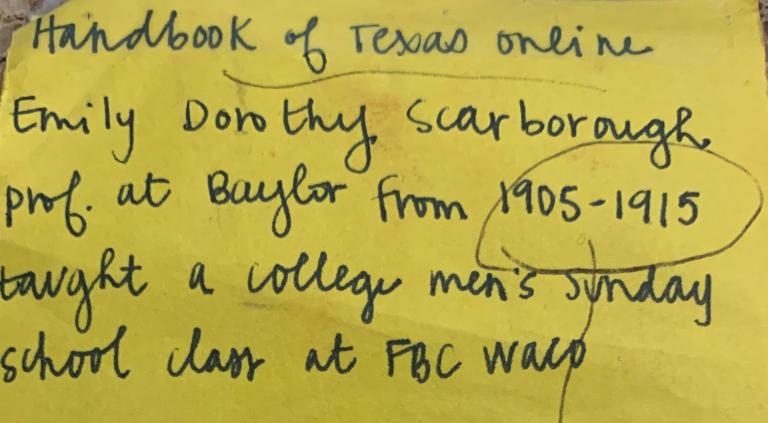 she had always been, in the Folmar Pavillion facing Founder’s Mall.
There is so much I could tell you about Dorothy Scarborough. I could tell you how she was Texas born and bred, living for several years in West Texas not far from where my father grew up. I could tell you how her family home in Waco was 1717 Speight Avenue–now the site of the women’s dormitory Memorial Hall on Baylor campus (that the Baptist women at my current church raised money to help fund during the 1930s and that my sister once lived in during the 1990s). I could tell you how she was one of the early women graduates from Baylor as well as one of Baylor’s first female professors. (Did you know that Baylor was one of the first coeducational universities, second in the nation after Oberlin College?)
I could tell you how relentlessly Dorothy Scarborough pursued her PhD in literature–spending summers in graduate school at the University of Chicago, one year in residence at Oxford University, and finally earning her PhD from Columbia University in 1917. I could tell you about her superb skills as a teacher and researcher. Columbia immediately hired her as faculty after she completed her doctorate, and her dissertation was so “widely acclaimed by her peers” that it became “a basic reference in the field”. Baylor 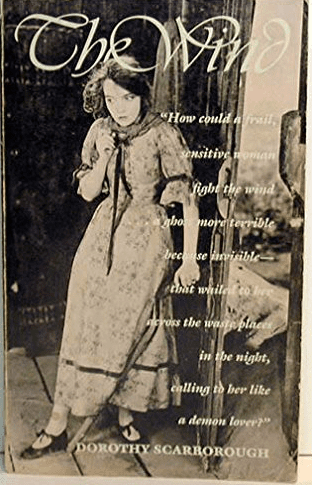 later recognized the scholarship of Scarborough, awarding her an honorary doctorate in 1923 after the publication of her first novel. Or I could tell you how Scarborough, a single woman, taught a “popular and influential” Sunday School class at First Baptist Church in Waco–the college-men’s class! I could even tell you how bad her handwriting was (although I was secretly pleased to see a fellow scholar with handwriting almost as bad as mine…).
But this is Halloween. So why don’t I tell you about Dorothy Scarborough’s most popular ghost story.
Scarborough always liked a good ghost story. Afterall, she wrote her acclaimed dissertation (published immediately after defense) on The Supernatural in Modern English Fiction. “The night of the soul attracts us all,” she wrote. “The spirit feeds on mystery. It lives not by fact alone but by the unknowable, and there is no highest mystery without the supernatural.” She also edited two volumes of ghost stories that you can still find in print and digital format–Humorous Ghost Stories and Famous Ghost Stories, and wrote the introduction to The Best Psychic Stories. Because she wrote that “Ghosts are the true immortals, and the dead grow more alive all the time,” she would probably be gratified that her stories about ghosts continue to live long after her own death.
Her most famous ghost story also continues to live. It was first published in 1925. In a publicity stunt, that didn’t turn out especially well, it was published anonymously and only later revealed to be her work. Although you probably won’t find the first line of this novel on any lists for ‘famous first line of books’, I think it belongs there.
“The wind was the cause of it all. The sand, too, had a share in it, and human beings were involved, but the wind was the primal force, and but for it the whole series of events would not have happened. It took place in West Texas, years and years ago, before the great ranges had begun to be cut up into farms and ploughed and planted to crops, when there was nothing to break the sweep of the wind across the treeless prairies, when the sand blew in blinding fury across the plains, or lay in mocking waves that never broke on any howsoever-distant beach, or piled in mounds that fickle gusts removed almost as soon as they were erected–when for endless miles there seemed nothing but wind and sand and empty, far off sky.” (1)
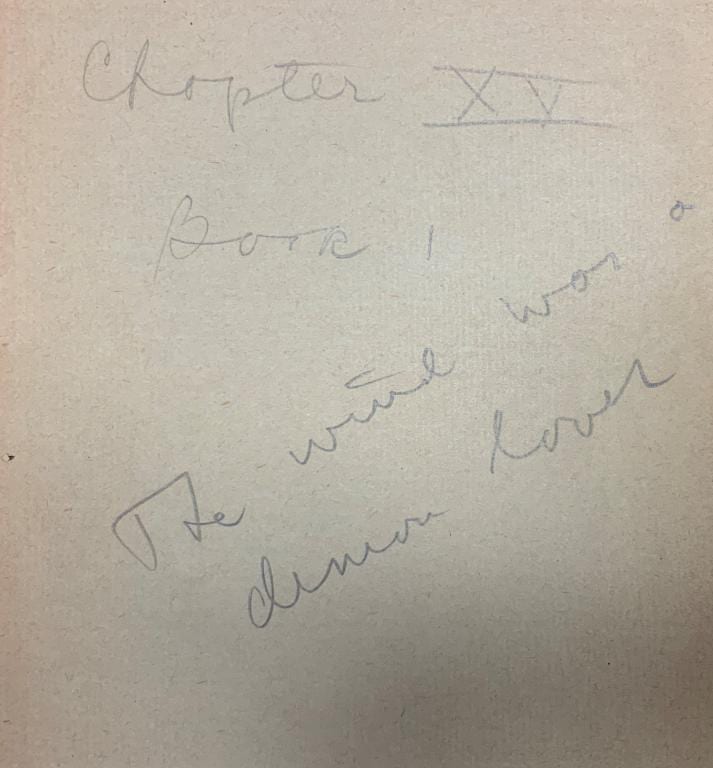
Dorothy Scarborough Papers #153 Series II, Box 2, Folder 2, The Texas Collection at Baylor University
This was the opening paragraph for Scarborough’s novel The Wind. The ghost in the story is the primeval force of the wind itself, or as Scarborough calls it,”a demon lover.” The relentless, invisible force of the West Texas weather drives Letty, the main character, into severe anxiety, despair, madness, and finally to her own death. “Hell was a place where the winds blew all the time, winds that tormented you, but would not let you you die,” thought Letty towards the end of the novel (275). “Winds that drove you almost crazy, but didn’t let you know the relief that complete insanity would bring. . . . Demon winds! . . .” The story proved gripping enough to immediately attract the attention of famous actress Lillian Gish. She convinced MGM studios to turn it into a movie released in 1928. Rotten Tomatoes applauds the film as “one of the few silents to stand the test of time” as well as “one of Lillian Gish’s greatest achievements in a powerfully dramatic silent film.” Indeed, one of the best scenes in the movie shows Gish, wild-eyed with fear, watching as the wind mercilessly strips away the sand hiding the evidence of her crime–the buried corpse of the man she had murdered.
Scarborough’s writings show that she was fascinated not only with ghosts, but also with the manifestation of the supernatural through primeval forces like the wind. But the wind, I think for Scarborough, represented more than just a force of nature. Listen to how she describes it taking Letty in the end (sorry for the spoiler!)
“Why struggle against a force that was a devil, and all-powerful? She had known all along that the wind would get her!…No use to fight any more! She would give up. The wind had risen almost to cyclonic fury now. Again the curtains of sand were rolled up from the plains to the sky, wavering, shifting, their gigantic folds writhing with hideous suggestion. What horrors did those curtains hide? With a laugh that strangled on a scream, the woman sped to the door, flung it open and rushed out. She fled across the prairies like a leaf blown in a gale, borne along in the force of the wind that was at last to have its way with her.” (337)
Anyone else hear the overtones of sexual violence? Rape, even? Letty was a young woman left adrift after the death of her mother. She left her beloved Virginia to live with an unknown relative in Texas, because she had no other choices. She had no livelihood and no money. “I didn’t know what else to do,” she explains to a stranger on the train as she traveled to her new home. “Oh, why aren’t girls taught to make their living and take care of themselves, the same as men?” (22) Her lack of choices drove her to marry a man she didn’t love for the protection he could offer (patriarchal bargain, anyone?). At the climax of the book, we find her huddled in her house, hiding from the wind and trying to figure out what she could have done differently. Even with the power of hindsight she can’t see a different future for herself. “Life had got her in a corner and had driven her to do things she hadn’t wanted to, and that didn’t rightly represent her. Life, in that last year, had been like a norther that battered her and scared her almost to death, so she couldn’t know what to do. She had just tried to struggle on the best she could, through one hour to the next. . .” (290) Finally, when she had lost all her agency, beaten down by the mercilessness of her circumstances, she surrendered to the primeval force that she had never been able to escape. I find it really interesting that Scarborough emphasizes that the deciding factor in Letty moving west, and hence the decision that led to her becoming a victim of the demon wind, was her Virginia pastor. “The pastor fixed it up for me!” she proclaimed hysterically. “He thought it would be the best thing I could do. He said he had prayed over it!” (266)
Umm, anyone want to guess what the wind might have represented?
Let me give you two hints.
- Dorothy Scarborough knew all to well the difficulties of being a woman in a man’s world. She struggled for many years to earn her PhD and faced what must have been a bitter disappointment at Oxford University. She learned when she arrived in 1910 that Oxford was not yet granting degrees to women. As Patricia Wallace records, Scarborough was dismayed “that this celebrated university did not at that time deem women worthy of receiving a degree!” So she returned to Waco in 1911 to continue teaching at Baylor and attending summer classes at the University of Chicago. It would take her another 6 years to earn her doctorate finally at Columbia. Her experience at Oxford led to the publication of a serial novel in 1925 aptly named The Unfair Sex. The main character, Ginger, channels Scarborough’s outrage that “Oxford, the seat of intellectual development for the Anglo-Saxon world, was actually behind Texas when it came to giving women a chance for education.” Scarborough also found that, when The Wind was published, at least one reviewer assumed the author had to be a man. “Here is a powerful novel whose author is anonymous,” wrote a reviewer for The News in St. Joseph, Missouri. “It is a piece of American realism which is as searching, and relentless as its name. One wonders why so fine a piece of work is hidden under the veil of anonymity. One thing is certain, a man wrote it. No woman ever dealt so cleverly of the upper surface of a woman’s mind and left the deeper ones untouched. Also it needed a man to handle the terrific tragedy so convincingly. A woman would shrink from its realistic horrors.” (Dorothy Scarborough Papers #153, Series II, Box 2, Folder 1, The Texas Collection, Baylor University) The Wind did very well when it was anonymous, but the sales decreased significantly when Dorothy Scarborough’s name became known–could it have been because she was a woman?
- Dorothy Scarborough wanted The Wind to show how the masculine narrative of conquering the West, as cowboys and ranchers, looked different when seen through the eyes of a woman. Listen to what she writes in response to a negative review of The Wind: “I was trying to show the woman’s side of pioneer life, because most of the western fiction had been about men and their struggles.” (Dorothy Scarborough Papers #153, Series II, Box 2, Folder 1) Surely, she also wrote, because Letty was a young girl, “she would naturally take a different view of many things from that held by the cowboys.” Scarborough, a woman born long before the 19th Amendment gave us the right to vote and even before most women had the opportunity for a college education (much less advanced degrees), understood that women experienced life differently from men. While the cowboys were out riding with each other, herding cattle along the trails, the women were left alone on the homestead. As she wrote in her notes for the novel, “A westerner thinks of wind differently. It is life-giving. How should we have any water in our windmills if there was no wind? We should die, and our cattle should die. But the women never get used to it, of course.” (Dorothy Scarborough Papers #153, Series II, Box 2, Folder 2) Scarborough captures the vulnerability of these women–showing in one chapter how Letty is caught off guard, in her bed sleeping, when a cowboy comes stalking into her home uninvited and unwelcome. Some women, like Letty’s neighbor Cora, could make the patriarchal bargain of their Wild West marriages successful–carving out a relatively stable and happy life. Yet other women, like Letty, would find the burden of patriarchy too heavy a load to carry. It is telling that the song Letty sings shortly before choosing a loveless marriage is about her fear of the strong forces in her life. “Lord, I don’t want to die in a storm, in a storm! Lord, I don’t want to die in a storm, in a storm! When the wind blows east, and the wind blows west, Lord, I don’t want to die in a storm!” (156 and 173)
Could Scarborough’s wind be the relentless force of a masculine-centered society on the life of a vulnerable woman? Could the unrelenting winds that screamed at her and tore at her body, beating her down until she lost the will to live, have been her lack of choices? Letty’s inability to escape a life and a marriage she never wanted? Could Dorothy Scarborough, a well-educated single woman with her own vocation, be haunted by the what-ifs of her own life? What if she hadn’t achieved her education and job? What if she had never been taught to make her own decisions? Was she haunted by the fate of other women in her world–women with fewer choices than she had?
Of course, maybe I am reading too much into the story. Maybe The Wind is no more than what it appears: a good ghost story spun by a talented writer. A classic European Gothic horror novel with a West Texas twist. Then again, as she prepared to write The Wind, Dorothy Scarborough reminded herself to “read Hardy’s Tess, to get the effect of a girl driven to desperation by forces outside that are too strong for her….” (Dorothy Scarborough Papers #153, Series II, Box 2, Folder 2).
Just something to think about. Happy Halloween, y’all!
For more about Dorothy Scarborough: See Jean Fair’s Baylor MA Thesis, “I Only Love Them:” Dorothy Scarborough and the Supernatural in Literature; Patricia Wallace, A Spirit so Rare: A History of the Women of Waco (1984); and the Dorothy Scarborough Papers housed in the Texas Collection at Baylor University. All quotations from The Wind were taken from the 1979 edition by the University of Texas.
Next Post

October 29, 2021 Why "The Wailing" is the Perfect Halloween Film
Browse Our Archives
Select a Category abolitionism Abortion Abraham Joshua Heschel Abraham Kuyper Abraham Lincoln Academia Activism Adam Renberg Advent Adventist africa African American Religion Agnes Howard Albert Camus American History American Religious History American Revolution American West Anabaptists Ancient History Andrea Turpin Andrei Tarkovsky Anglicanism Annales Ansley Lillian Quiros anti-Catholicism Antisemitism Anxious Bench apologetics Apparitions Arash Azizi Archaeology archives art Artificial Intelligence Asia Asian Americans Augustine Authors Bad Bunny Baptism Baptists Barack Obama Battle of Hastings Benjamin Franklin Bernard-Henri Levy Beth Allison Barr Beth Moore Bethany Mannon Bible Bill Cunningham Billy Graham Black Music Bob Dylan Body Boenhoffer Books Breastfeeding Bruce Springsteen C.S. Lewis Calvinism Cancel Culture Capitalism Carmelites Catholicism Cedric Robinson Cesar Chavez Charismaticism charity Charles Dickens Charles Lindbergh Che Guevara Chicago Children Chinese Christianity Chris Gehrz Christ Christian death Christian Higher Education Christian life Christian Nation Christian Nationalism Christianity Today Christmas Church life Church Practice cinema Civil Religion Civil Rights Movement Civil War civility Classics Climate Change Cold War Colonial Mexico colonialism Comer Communism community complementarianism Conference on Faith and History Congregationalism Conspiracies Conspiracy Conversion Narratives Coronavirus Costa Rica Council of Nicaea Covid-19 Creation Critical Race Theory Crusades Culture culture wars Daniel K. Williams David Barton David Swartz Death Ways death with dignity DEI democracy Democratic Party Devotion Digital Age Diplomacy discipleship diversity Donald Trump Drama Dua Lipa Early Church early modern Early modern Catholicism Easter Eastern Christianity economic exploitation Education elections Elie Wiesel Elizabeth II Elizabeth Taylor emotions Empire Engineering England enslavement Entertainment Episcopal Church Erica Ramirez eschatology Eurocentrism Evangelicalism Evangelicals Exegesis Family Feminism Film Flannery O'Connor folk music Food Foreign Policy founding fathers Franciscans Franciscus Junius fundamentalism Funerals G.K. Chesterton Gender Genocide genre geography George W. Bush George Washington George Whitefield Global Christianity Global church Grief Guadalupe guest post Guest Post gun control gun violence Gustavo Gutierrez Hamid Dabashi Harold John Ockenga Harvest Hate Hawaiian Christianity Healing health care Heather Cox Richardson Hell Heresy Hermeneutics Higher Education Hinduism Hippocratic oath Historical Fiction Historical Methodology Historical Profession Historical Profession Historical Theology Historical Thinking historiography Holidays Holocaust horror movies Human rights Humanitarian Work humanities Hummingbirds Hungary hymns Imago Dei Immigration Injustice Interviews Iran Islam Islamophobia Israel Ivan's Childhood Jacob Randolph James Bratt Janine Giordano Drake Japanese history Japanese Literature Jean Paul Sartre Jesse Miranda Jesus Jesus Christ Jimmy Carter Joan Baez Joan Didion Joanne Freeman João B. Chaves Joao Chaves Joey Cochran John Calvin John Fea John Tillotson John Turner Johnny Cash Jonathan Edwards Jonathan Tran Joseph Smith Josh Howerton Journalism Jr. Judaism Jürgen Moltmann Just War Justice Justin Brierley Karl Barth Katelyn Beaty koi ponds Kris Kristofferson Kristin Kobes Du Mez Latin American Religious History Latino Americans Lectio Divina Leisure Lent Leonard Cohen liberal arts liberalism Liberation Theology Linda Ronstadt Lisa Clark Diller Literature Lou Reed Lynchings Lynneth Miller Renberg Mainline Protestantism Malcolm Foley Marilyn Monroe Maritime history Mark Noll Marriage Martin Luther Martin Luther King Martyrdom Marxism Mary Masih Alinejad mass shootings material culture medieval Christianity Medieval Ethiopia Melissa Borja memory Mennonites Mental Health Mental Illness Methodism Mexican Americans Mexicans Mike Madrid Miles Mullin Min Jin Lee Miscarriage Missionaries Mister Rogers Mitt Romney modernity Monasticism Mormonism Motherhood Mothers of the Church Moving Music Musicals Nadya Williams Nahua Christianity Native Americans Natsume Sōseki New Contributor New England New Year New York Nico Non-Violent Protest Orthodoxy pacifism Paleo Evangelicals Palestinians Parenting Patti Smith Paul Kingsnorth Pedro Calderón de la Barca Pentecostalism Philip Jenkins Phillis Wheatley physician-assisted suicide pilgrimage Pilgrims pluralism Plutocracy Poetry Politics Pope Francis Pope Leo XIV post-modernism prayer preaching Presbyterians prosperity gospel Protest Public history Publishing Puritans purity culture Quakers race Race Massacres Racial Capitalism racial reconciliation racialization Racism Raha Bahloulipour Re-Enchantment reading Reformation Refugees religion and the university religion and war Religious Freedom Religious Nones Religious Pluralism Religious Symbols religious violence Republican Party Revival Rita Coolidge Ritual Roger Williams Roman Catholic church Royalty Russell Moore same-sex marriage Sarah Irving-Stonebraker Scandinavia Science Science and Technology Scopes trial Scriptural Interpretation secularism Selena Quintanilla seminary Seventh-Day Adventists sexual morality Sexuality Sikhs Silence slaveholders theology Slavery Slavoj Zizek social justice Social Media Southern Baptist Convention Southern Religion Spain Spiritual Autobiography Spiritual but not religious Spiritual Discipline Sports Stanley Hauerwas Suffering Summer Camps Sunday Night Odds and Ends Supernatural Supreme Court Syriac Christianity Tal Howard Taylor Swift Teaching Technology Television Thanksgiving The Beatles The Mission theater TheoBros Theology Thomas Dixon Thomas Jefferson Thomas Kidd Thomas Merton Tim Gloege Tim Walz Tom Holland Tourism tradition Tragedy Translation Transnationalism Travel Trump Ukraine Uncategorized Unitarians United Methodist Church US History Vanessa Chan Velvet Underground Verónica A. Gutiérrez Veronica Gutierrez Vikings Violence Virgin Mary Virtue Virtue ethics Visions Voting War WCTU Wendell Berry Westminster Assembly White Evangelicalism Wildfires Winnie the Pooh Witches women Women in Ministry Women's and Gender Studies Work Worship writing Yasunari Kawabata Zena Hitz
Select a Month October 2026 September 2026 August 2026 July 2026 June 2026 May 2026 April 2026 March 2026 February 2026 January 2026 December 2025 November 2025 October 2025 September 2025 August 2025 July 2025 June 2025 May 2025 April 2025 March 2025 February 2025 January 2025 December 2024 November 2024 October 2024 September 2024 August 2024 July 2024 June 2024 May 2024 April 2024 March 2024 February 2024 January 2024 December 2023 November 2023 October 2023 September 2023 August 2023 July 2023 June 2023 May 2023 April 2023 March 2023 February 2023 January 2023 December 2022 November 2022 October 2022 September 2022 August 2022 July 2022 June 2022 May 2022 April 2022 March 2022 February 2022 January 2022 December 2021 November 2021 October 2021 September 2021 August 2021 July 2021 June 2021 May 2021 April 2021 March 2021 February 2021 January 2021 December 2020 November 2020 October 2020 September 2020 August 2020 July 2020 June 2020 May 2020 April 2020 March 2020 February 2020 January 2020 December 2019 November 2019 October 2019 September 2019 August 2019 July 2019 June 2019 May 2019 April 2019 March 2019 February 2019 January 2019 December 2018 November 2018 October 2018 September 2018 August 2018 July 2018 June 2018 May 2018 April 2018 March 2018 February 2018 January 2018 December 2017 November 2017 October 2017 September 2017 August 2017 July 2017 June 2017 May 2017 April 2017 March 2017 February 2017 January 2017 December 2016 November 2016 October 2016 September 2016 August 2016 July 2016 June 2016 May 2016 April 2016 March 2016 February 2016 January 2016 December 2015 November 2015 October 2015 September 2015 August 2015 July 2015 June 2015 May 2015 April 2015 March 2015 February 2015 January 2015 December 2014 November 2014 October 2014 September 2014 August 2014 July 2014 June 2014 May 2014 April 2014 March 2014 February 2014 January 2014 December 2013 November 2013 October 2013 September 2013 August 2013 July 2013 June 2013 May 2013 April 2013 March 2013 February 2013 January 2013 December 2012 November 2012 October 2012 September 2012 August 2012 July 2012 June 2012 May 2012
Follow Us!
TAKE THE
Religious Wisdom Quiz
Which disciple of Jesus was a former zealot?
Select your answer to see how you score.
Judas Iscariot Simon Thaddeus Bartholomew
Related posts from Anxious Bench

Updating the Readings: Recent Books on Women and...
Medieval Mothers of the Church: Queen Margrete and...
Abuse and Ownership, Past and Present

Trondenes Kirke: The Northernmost Medieval Church
TRENDING AT PATHEOS Evangelical

Looking at the Largest Orthodox Cathedral on Earth
There is often a considerable amount of anger and, shall we...

The Problem with False Prophets
Miller’s Station UMC| 10/18/26| Anchor Verse: Jeremiah 23: 1, 9-23 I...

Emotion in Early Christianity by Andrew Crislip
Andrew Crislip’s Emotion in Early Christianity examines an often overlooked dimension of...

16 Spiritual Touchstones for a More Grounded Life
After decades of spiritual study, here are 16 principles I try...

Catholic Evangelization: Sharing Your Faith Every Day
Welcome back to the Graceful Awakening mini-series called, “From Faith to Mission.” ...

The Pillar of the Boatmen: the Ancient Monument...
The Pillar of the Boatmen is a Romano-Gaulish sculpture that dates from...
view all Evangelical blogs
Ad-Free & Subscriber Log-In Subscription Support
- About Us
- 2026 Calendar
- Videos
- Podcasts
- Library of World Religions
- Faith In Media Tracker
- Advertise With Us
- Write for Us
- Privacy Policy
- Terms of Service
- Do Not Sell My Data
- Contact Us
- Radiant Digital
- Manage Newsletter Subscriptions
- Unsubscribe From Notifications
- Sitemap
Copyright 2008-2026, Patheos. All rights reserved.
Subscription Support Ad-Free & Subscriber Log-In
Follow Patheos