
BuddhistCatholicContemplativeEvangelicalGeneral ChristianHinduJewishLatter-day SaintMuslimNew VisionsProgressive Christian
Beliefs
- Buddhist
- Catholic
- Contemplative
- Evangelical
- General Christian
- Hindu
- Jewish
- Latter-day Saint
- More Voices
- Muslim
- New Visions
- Pagan
- Progressive Christian
Topics
- Religion News
- Food and Religion
- Sports and Religion
- Religious Art
- Religious Music and Entertainment
- Religious Events
- History and Religion
- Style and Religion
- Politics and Religion
- Women in Religion
- Recreation Outdoors and Religion
- Business Finance and Religion
- Careers Workplace and Religion
- Education and Religion
- Family Parenting and Religion
- Health Fitness and Religion
- Home and Religion
- Relationships and Religion
- Technology and Religion
- Travel and Religion
Columnists
- Buddhist Columnists
- Business Finance and Religion Columnists
- Careers Workplace and Religion Columnists
- Catholic Columnists
- Contemplative Columnists
- Education and Religion Columnists
- Evangelists Columnists
- Family Parenting and Religion Columnists
- General Christian Columnists
- Health Fitness and Religion Columnists
- Hindu Columnists
- History and Religion Columnists
- Home and Religion Columnists
- Jewish Columnists
- More Voices Columnists
- Latter Day Columnists
- Muslim Columnists
- New Visions Columnists
- Nonreligious Columnists
- Pagan Columnists
- Politics and Religion Columnists
- Progressive Columnists
- Recreation Outdoors and Religion Columnists
- Relationships and Religion Columnists
- Religion News Columnists
- Religious Art Columnists
- Religious Events Columnists
- Religious Music and Entertainment Columnists
- Sports and Religion Columnists
- Style and Religion Columnists
- Technology and Religion Columnists
- Travel and Religion Columnists
- Women in Religion Columnists
Resource Library
- 2026 Calendar
- Library of World Religions
- The 100 Most Holy Places on Earth
- Patheos Answers
- Podcasts
- Videos
- Faith Leaders Database
- Anglican Episcopalian
- Bahai
- Baptist
- Buddhism
- Christianity
- Confucianism
- Eastern Orthodoxy
- Hinduism
- Holiness and Pentecostal
- ISKCON
- Islam
- Judaism
- Lutheran
- Methodist
- The Church of Jesus Christ of Latter-day Saints
- New Age
- Paganism
- Presbytarian and Reformed
- Protestantism
- Religion Behind the Scenes
- Roman Catholic
- Scientology
- Shia Islam
- Sikhism
- Sufism
- Sunni Islam
- Taoism
- Zen
- See all religions
Research Tools
 Ad-Free & Subscriber Log-In Subscription Support
Ad-Free & Subscriber Log-In Subscription Support
Follow Patheos 

- Trending:
- Forgiveness
- |
- Marriage
- |
- Consciousness
- |
- Death Penalty
- |
- Election
- |
- Halloween

-
About the Authors
- Home
- Evangelical
- Don’t Turn (Refugees) Away
Don’t Turn (Refugees) Away
Last updated on: August 23, 2021 at 3:24 pm by Melissa Borja
Don’t Turn (Refugees) Away 2021-08-23T15:24:54-04:00 Melissa Borja
Patheos Explore the world's faith through different perspectives on religion and spirituality! Patheos has the views of the prevalent religions and spiritualities of the world.
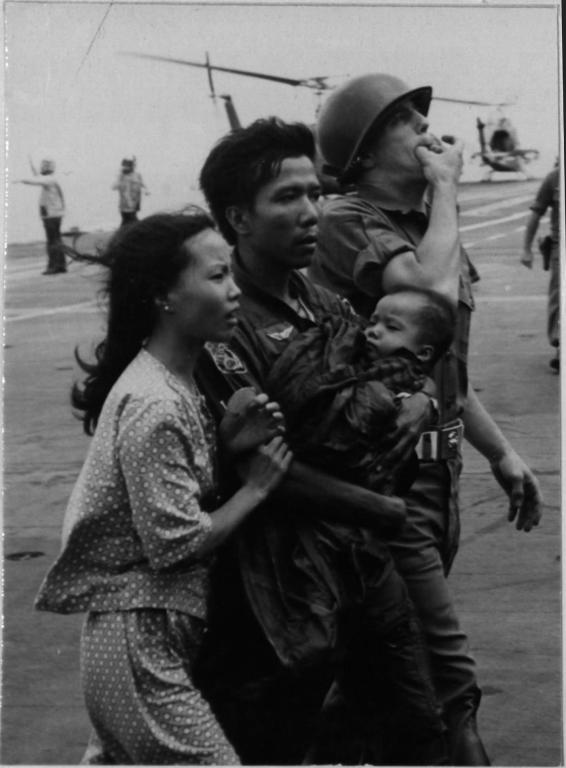
Operation “Frequent Wind” — A South Vietnamese helicopter pilot and his family, safely aboard the USS Hancock, are escorted by a Marine Security Guard to the refugee area during the evacuation of Saigon, Republic of Vietnam. November 7, 1975. National Archives.
Chaotic scenes of people surrounding military aircraft and hoping desperately to be evacuated: this is what we saw on our television screens last week. It is also what Kathleen, a woman in Saint Paul, Minnesota, witnessed 46 years ago. It was the spring of 1975, and she was recovering from surgery in the hospital when the news broke: Saigon had been captured. She recalled,
I’m watching the TV in my room, and here [are] these people, you know, scrambling under the helicopters…I’m thinking, I have people coming in changing my sheets, giving me a drink of water, medicine, whatever I wanted. You know, I got totally out of my self-pity party and just said, ‘When I get well, we’re going to find a way that someone can stay here.’
Kathleen kept her promise, and as soon as she was able, she got to work. She contacted the International Institute, a local affiliate of one of the voluntary agencies that works with the U.S. government to resettle refugees. She organized a refugee sponsorship committee at her congregation, Dayton Avenue Presbyterian Church, which formed partnerships with two other local congregations, Macalester-Plymouth Church and House of Hope Church. She recruited volunteers, raised money, and set up a new home for a Southeast Asian refugee family. And less than a year later, on February 17, 1976, she traveled to the airport to meet the Vang family, the first group of Hmong refugees resettled in the Twin Cities.
Resting in her hospital room, Kathleen could have chosen to turn off the television and turn away from the upsetting images coming from Vietnam—but she chose not to. Instead, she chose to see and, more importantly, to do something. The cumulative effect of thousands of similar acts of compassion must not be overlooked. In Kathleen’s case, the family that she resettled was the first of hundreds of thousands of Hmong people who migrated to Minnesota and made the state home to a thriving Hmong American community. And her church’s sponsorship committee was one of hundreds of local efforts across the country to welcome Southeast Asian refugees in the wake of the Vietnam War. Ultimately, the resettlement of one million Southeast Asian refugees was possible because individuals like Kathleen made the crucial decision not to ignore the harrowing events in Vietnam. Kathleen looked at the helicopters filled with people desperate to leave. She saw Vietnamese refugees as humans of worth and dignity. And, just as important, she saw herself as somebody who could possibly do something to alleviate their pain.
The resettlement of Southeast Asian refugees was far from easy. It was both logistically and politically complicated, and Kathleen and other like-minded Americans faced significant opposition. As the historian Carl Bon Tempo argued in Americans at the Gate, it is something of a miracle that Southeast Asian refugees were admitted for resettlement at all.
Throughout U.S. history, refugee resettlement has never been a popular undertaking. In January 1939, for example, a Gallup poll found that only 30 percent of Americans surveyed said that the U.S. should resettle Jewish refugees; 61 percent said that it should not. Similarly, a Gallup poll conducted in May 1975, just one month after the fall of Saigon, found that only 36 percent of Americans surveyed favored the resettlement of Southeast Asian refugees, while 54 percent of Americans surveyed opposed it. Those who objected to resettling Southeast Asian refugees articulated a number of concerns: that refugees would be an economic burden, that they posed a national security threat, and that they would bring tropical diseases. The opposition sometimes boiled down to plain racism. At a high school near Niceville, Florida, located by the military-run refugee reception center at Eglin Air Force base, anti-refugee students even considered establishing a “gook klux klan.” In the Twin Cities, where Kathleen worked, Southeast Asian refugees found themselves targeted in acts of verbal harassment, vandalism, and violence.
And yet despite this opposition, many refugee advocates insisted on doing what they could to ensure that the U.S. would aid and resettle Southeast Asian refugees. In Washington, D.C., they met with key government officials to lobby for increasing the number of refugees admitted to the U.S. In military-run refugee camps at Camp Pendleton and Fort Chaffee, they helped provide food and clothing for refugees being processed for resettlement. And in cities and towns across the country, volunteers organized efforts to sponsor refugees, as Kathleen and her church did, and provided critical manpower and material resources to support a wide range of projects critical to the resettlement mission: teaching English, supporting job placement efforts, aiding refugees in the face of anti-refugee hostility, and, eventually, helping refugees sponsor and resettle their own relatives.
The motivations behind the effort to admit and resettle Southeast Asian refugees varied. Some people, like Kathleen, were driven by deep humanitarian concern. Others acted out of a sense of loyalty to the Southeast Asian soldiers who had allied with the U.S. military. (Then, as now, members of the military worried about the fates of the people who had worked alongside them during the war, and they played an important part in advocating for refugee admissions.) Still others had staunchly opposed the Vietnam War and saw the resettlement effort as a way for the U.S. to do penance for a war that was sinful and wrong. “It may sound improbable at first that sponsoring a refugee will earn you God’s forgiveness,” said Joseph Aurele-Plourde, the Archbishop of the Roman Catholic Archdiocese of Ottawa, in 1979. “But we do have some sins to be forgiven as a nation. We ought to help the refugees now so we’ll have the forgiveness of God to help us through troubles we may have in the future.”
Indeed, religion was an important element in the resettlement effort in two crucial ways. First, religious institutions were and continue to be integral to the public-private refugee resettlement system in the U.S. Concerned individuals like Kathleen often aided and resettled refugees by working through faith-based voluntary agencies, congregations, and church-affiliated charities. Most of the major resettlement agencies in the U.S. are faith-based, and the majority of Southeast Asian refugees were resettled by religious organizations.
Second, religious convictions often animated resettlement work, which churches and volunteers often pursued as a profound expression of their faith. The story of Maryann, a pastor’s wife and a volunteer with Lutheran Immigration and Refugee Service (LIRS), reveals the centrality of faith in Christian refugee resettlement efforts. In the spring of 1975, Maryann arrived at Marine Corps Base Camp Pendleton, where she was part of a corps of volunteers that helped to receive over a hundred thousand Vietnamese refugees airlifted from staging areas in the Pacific.
Maryann described the work of resettlement as an exhilarating religious awakening. Until she and her husband arrived at Camp Pendleton, Maryann said that they had wondered, “What does Christ look like?” It was in the refugees, she explained in an article she wrote for the LIRS Bulletin, that she and her husband truly “saw the face of Christ.” For her, the daily work of feeding the hungry and comforting the grief-stricken was a holy encounter with Jesus.
Maryann hoped that her story would encourage other Lutherans to contribute to the resettlement effort. In making her case, she described refugee resettlement as an act of religious ministry. “You are the ones who can minister to these ‘Christs’ through our love and assistance,” she said. “…A thrilling experience awaits you as you share your gifts from the hand of a loving Father with others of his creation. You are his hands and heart in ministry, in holy spirit, [that] lives and moves to call, gather, enlighten and sanctify.” Refugee resettlement, ultimately, was not merely an opportunity for Christians to share their gifts with refugees. Rather, refugees themselves were gifts to Christians. “Christ ministered to me also through these people,” Maryann said.[1]
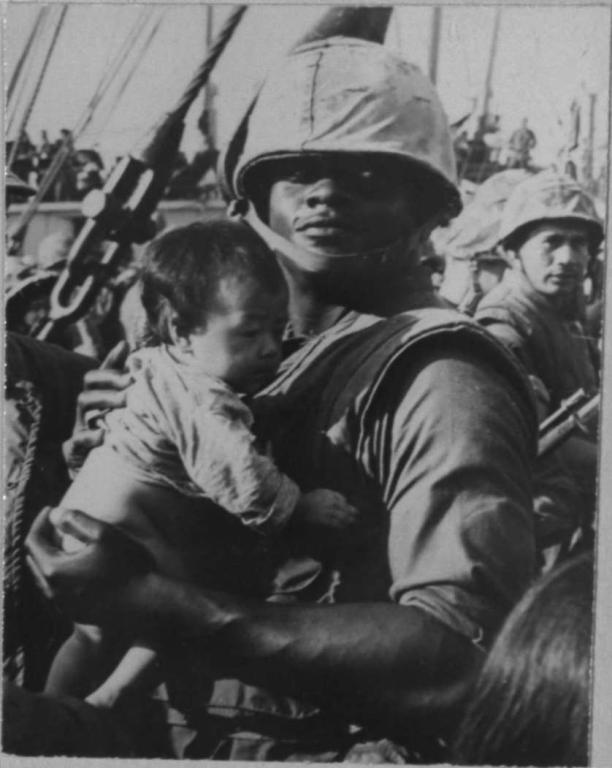
A Marine holds a refugee baby, one of many Vietnamese civilians rescued during the evacuation exercises of Phnom Penh and Saigon. National Archives.
In the current moment, there are numerous crises that demand Americans’ attention: the resurgence of Covid-19 cases, the multiple catastrophes associated with climate change, and the fragility of our democratic institutions, our economic prosperity, and our social fabric. Given the number of calamities we face, it may be tempting to turn away from the images coming out of Afghanistan, to feel numb to the ongoing horrors of the world, and to do nothing or say nothing out of a sense of helplessness. But we need more people to respond as Kathleen did. We need Americans to rise to meet the needs of the current moment by serving, organizing, and advocating. We need Americans to refuse to look away and, instead, to take responsibility.
To be sure, the evacuation efforts in Afghanistan can feel distant and complex to most Americans, but there are many things that people can do to help here in the U.S. First, people can support organizations that are experienced in serving refugees from Afghanistan and elsewhere around the world. Many refugee advocacy organizations and voluntary agencies are accepting donations and recruiting volunteers. (Princeton’s Religion and Resettlement Project, for which I serve as a senior advisor, created this map of refugee resettlement agencies, which can help you find a resettlement organization near you.) These organizations not only address the immediate needs of refugees as they are evacuated and resettled in the U.S., but they also attend to refugees’ long-term needs. Even when the evacuation from Afghanistan comes to a close and the images of Kabul airport no longer make the evening news, Afghan refugees will still need support as they adjust to life in the U.S.
Supporting these organizations also matters because the institutional infrastructure of refugee resettlement needs rapid rebuilding. When the Trump administration cut refugee admissions by 85%, over 100 resettlement organizations were forced to close. Supporting these organizations will not only make a difference for refugees from Afghanistan in the near term, but will also restore the organizations’ capacity to resettle people who are fleeing violence and persecution in other parts of the world.
Second, we need to make active efforts to foster a culture that welcomes refugees. On this matter, American Christians would be wise to dedicate time and effort to talk to their own communities about refugee issues. As the examples of Kathleen and Maryann show, American Christians have proven themselves to be among the most dedicated supporters of refugee resettlement. However, certain Christian groups have expressed strong opposition. A 2018 Pew survey, for example, found that 68% of white evangelicals believed that the U.S. government does not have a responsibility to accept refugees, with only 25% believing that the U.S. government does have a responsibility to do so. (In contrast, 63% of Black Protestants and 51% of Americans overall believed that the U.S. government has a responsibility to accept refugees.) That white evangelical Protestants were so opposed to refugee resettlement and that Black Protestants were so supportive suggest that stances on refugees may be shaped as much by race as by religion. To this point, Marcia Morgan, associate professor of philosophy at Muhlenberg College and author of Care Ethics and the Refugee Crisis, argued that anti-refugee attitudes owe to “the deadly combination of Christian fundamentalism and white nationalism emboldened by the Trump administration.”
That said, some of the work done at the grassroots level shows that careful efforts to build coalitions and engage in local concerns can change minds, even as immigration and refugee issues remain highly polarizing. Take, for example, the work of Canopy of Northwest Arkansas, a refugee resettlement agency started in 2016 in Fayetteville, Arkansas. “We knew that in order to be successful, we had to get the whole community involved and on board—and in a deep red state, that meant we needed the buy-in of our neighbors across the political spectrum,” said Emily Linn, former executive director of Canopy. Canopy made a concerted effort to seek the support of members of the business and military communities, and they also reached out to local faith leaders, with whom they emphasized shared moral commitments. During a period when the number of refugees resettled in the U.S. declined overall, Canopy resettled 200 refugees from a dozen countries, and Gov. Asa Hutchinson, who had opposed refugee resettlement in 2015, declared his support for refugee resettlement in 2019.
Finally, as Americans confront the humanitarian disaster unfolding in Afghanistan and attempt to find a way forward, we would benefit from taking a moment to reflect on our past—in particular, on the moments when the U.S. chose to do right by the people who were uprooted from the countries where Americans had waged war. As Viet Thanh Nguyen, author of The Sympathizer and a scholar of war and memory at the University of Southern California, wrote last week,
History is happening again, and again as tragedy and farce. The wars in Vietnam and Afghanistan happened as a result of American hubris, and in both cases Americans mostly focused on the political costs of war for them. But in each case, the Vietnamese (and Laotians, Cambodians and Hmong), and now the Afghans, have paid the much greater toll in human suffering. In April 1975, the United States recognized its moral responsibility and evacuated about 130,000 Vietnamese people, and then accepted hundreds of thousands more from Vietnam, Laos and Cambodia in subsequent decades. This is what must happen now, and anything short of such a vision of responsibility and hospitality will compound the American failure in Afghanistan.
Joe Biden, a senator in 1975, surely remembers that the majority of Americans did not want to accept Southeast Asian refugees. Nevertheless, Congress did the right thing, and the subsequent flourishing of Southeast Asian American communities throughout the United States has shown the wisdom of that moral decision. While the politics of these two moments in America’s flawed wars differ, the morality does not. Tens of thousands of Afghans believed in the American promise of ushering in freedom, democracy and an open, tolerant society. And now, they’re stuck. For Afghans, the war hasn’t ended simply because we, the United States, declared it to be over.
What we do now at this critical moment matters, and by “we,” I mean all Americans in all positions of society, from national leaders like President Biden to local church organizers like Kathleen. We can choose to keep our promises, act with integrity, and lead with compassion. We can choose to talk to our neighbors and church members, organize our communities, and foster a climate of hospitality and welcome. We can choose not to turn away. We can choose not to turn Afghan refugees away.
[1] Maryann Lund, “What Does Christ Look Like?” LIRS Bulletin, Standing Committee, Protocol, Minutes, January 8-9, 1976, Lutheran Council in the U.S.A., Department of Immigration and Refugee Service, 10/1, Evangelical Lutheran Church of America Archive.
Previous Post

August 20, 2021
Saigon, Kabul, and the Myth of the Graveyard of Empires
Next Post

August 24, 2021 John Piper's "Wishful Thinking" about Jonathan Edwards and Slavery
Browse Our Archives
Select a Category abolitionism Abortion Abraham Joshua Heschel Abraham Kuyper Abraham Lincoln Academia Activism Adam Renberg Advent Adventist africa African American Religion Agnes Howard Albert Camus American History American Religious History American Revolution American West Anabaptists Ancient History Andrea Turpin Andrei Tarkovsky Anglicanism Annales Ansley Lillian Quiros anti-Catholicism Antisemitism Anxious Bench apologetics Apparitions Arash Azizi Archaeology archives art Artificial Intelligence Asia Asian Americans Augustine Authors Bad Bunny Baptism Baptists Barack Obama Battle of Hastings Benjamin Franklin Bernard-Henri Levy Beth Allison Barr Beth Moore Bethany Mannon Bible Bill Cunningham Billy Graham Black Music Bob Dylan Body Boenhoffer Books Breastfeeding Bruce Springsteen C.S. Lewis Calvinism Cancel Culture Capitalism Carmelites Catholicism Cedric Robinson Cesar Chavez Charismaticism charity Charles Dickens Charles Lindbergh Che Guevara Chicago Children Chinese Christianity Chris Gehrz Christ Christian death Christian Higher Education Christian life Christian Nation Christian Nationalism Christianity Today Christmas Church life Church Practice cinema Civil Religion Civil Rights Movement Civil War civility Classics Climate Change Cold War Colonial Mexico colonialism Comer Communism community complementarianism Conference on Faith and History Congregationalism Conspiracies Conspiracy Conversion Narratives Coronavirus Costa Rica Council of Nicaea Covid-19 Creation Critical Race Theory Crusades Culture culture wars Daniel K. Williams David Barton David Swartz Death Ways death with dignity DEI democracy Democratic Party Devotion Digital Age Diplomacy discipleship diversity Donald Trump Drama Dua Lipa Early Church early modern Early modern Catholicism Easter Eastern Christianity economic exploitation Education elections Elie Wiesel Elizabeth II Elizabeth Taylor emotions Empire Engineering England enslavement Entertainment Episcopal Church Erica Ramirez eschatology Eurocentrism Evangelicalism Evangelicals Exegesis Family Feminism Film Flannery O'Connor folk music Food Foreign Policy founding fathers Franciscans Franciscus Junius fundamentalism Funerals G.K. Chesterton Gender Genocide genre geography George W. Bush George Washington George Whitefield Global Christianity Global church Grief Guadalupe guest post Guest Post gun control gun violence Gustavo Gutierrez Hamid Dabashi Harold John Ockenga Harvest Hate Hawaiian Christianity Healing health care Heather Cox Richardson Hell Heresy Hermeneutics Higher Education Hinduism Hippocratic oath Historical Fiction Historical Methodology Historical Profession Historical Profession Historical Theology Historical Thinking historiography Holidays Holocaust horror movies Human rights Humanitarian Work humanities Hummingbirds Hungary hymns Imago Dei Immigration Injustice Interviews Iran Islam Islamophobia Israel Ivan's Childhood Jacob Randolph James Bratt Janine Giordano Drake Japanese history Japanese Literature Jean Paul Sartre Jesse Miranda Jesus Jesus Christ Jimmy Carter Joan Baez Joan Didion Joanne Freeman João B. Chaves Joao Chaves Joey Cochran John Calvin John Fea John Tillotson John Turner Johnny Cash Jonathan Edwards Jonathan Tran Joseph Smith Josh Howerton Journalism Jr. Judaism Jürgen Moltmann Just War Justice Justin Brierley Karl Barth Katelyn Beaty koi ponds Kris Kristofferson Kristin Kobes Du Mez Latin American Religious History Latino Americans Lectio Divina Leisure Lent Leonard Cohen liberal arts liberalism Liberation Theology Linda Ronstadt Lisa Clark Diller Literature Lou Reed Lynchings Lynneth Miller Renberg Mainline Protestantism Malcolm Foley Marilyn Monroe Maritime history Mark Noll Marriage Martin Luther Martin Luther King Martyrdom Marxism Mary Masih Alinejad mass shootings material culture medieval Christianity Medieval Ethiopia Melissa Borja memory Mennonites Mental Health Mental Illness Methodism Mexican Americans Mexicans Mike Madrid Miles Mullin Min Jin Lee Miscarriage Missionaries Mister Rogers Mitt Romney modernity Monasticism Mormonism Motherhood Mothers of the Church Moving Music Musicals Nadya Williams Nahua Christianity Native Americans Natsume Sōseki New Contributor New England New Year New York Nico Non-Violent Protest Orthodoxy pacifism Paleo Evangelicals Palestinians Parenting Patti Smith Paul Kingsnorth Pedro Calderón de la Barca Pentecostalism Philip Jenkins Phillis Wheatley physician-assisted suicide pilgrimage Pilgrims pluralism Plutocracy Poetry Politics Pope Francis Pope Leo XIV post-modernism prayer preaching Presbyterians prosperity gospel Protest Public history Publishing Puritans purity culture Quakers race Race Massacres Racial Capitalism racial reconciliation racialization Racism Raha Bahloulipour Re-Enchantment reading Reformation Refugees religion and the university religion and war Religious Freedom Religious Nones Religious Pluralism Religious Symbols religious violence Republican Party Revival Rita Coolidge Ritual Roger Williams Roman Catholic church Royalty Russell Moore same-sex marriage Sarah Irving-Stonebraker Scandinavia Science Science and Technology Scopes trial Scriptural Interpretation secularism Selena Quintanilla seminary Seventh-Day Adventists sexual morality Sexuality Sikhs Silence slaveholders theology Slavery Slavoj Zizek social justice Social Media Southern Baptist Convention Southern Religion Spain Spiritual Autobiography Spiritual but not religious Spiritual Discipline Sports Stanley Hauerwas Suffering Summer Camps Sunday Night Odds and Ends Supernatural Supreme Court Syriac Christianity Tal Howard Taylor Swift Teaching Technology Television Thanksgiving The Beatles The Mission theater TheoBros Theology Thomas Dixon Thomas Jefferson Thomas Kidd Thomas Merton Tim Gloege Tim Walz Tom Holland Tourism tradition Tragedy Translation Transnationalism Travel Trump Ukraine Uncategorized Unitarians United Methodist Church US History Vanessa Chan Velvet Underground Verónica A. Gutiérrez Veronica Gutierrez Vikings Violence Virgin Mary Virtue Virtue ethics Visions Voting War WCTU Wendell Berry Westminster Assembly White Evangelicalism Wildfires Winnie the Pooh Witches women Women in Ministry Women's and Gender Studies Work Worship writing Yasunari Kawabata Zena Hitz
Select a Month October 2026 September 2026 August 2026 July 2026 June 2026 May 2026 April 2026 March 2026 February 2026 January 2026 December 2025 November 2025 October 2025 September 2025 August 2025 July 2025 June 2025 May 2025 April 2025 March 2025 February 2025 January 2025 December 2024 November 2024 October 2024 September 2024 August 2024 July 2024 June 2024 May 2024 April 2024 March 2024 February 2024 January 2024 December 2023 November 2023 October 2023 September 2023 August 2023 July 2023 June 2023 May 2023 April 2023 March 2023 February 2023 January 2023 December 2022 November 2022 October 2022 September 2022 August 2022 July 2022 June 2022 May 2022 April 2022 March 2022 February 2022 January 2022 December 2021 November 2021 October 2021 September 2021 August 2021 July 2021 June 2021 May 2021 April 2021 March 2021 February 2021 January 2021 December 2020 November 2020 October 2020 September 2020 August 2020 July 2020 June 2020 May 2020 April 2020 March 2020 February 2020 January 2020 December 2019 November 2019 October 2019 September 2019 August 2019 July 2019 June 2019 May 2019 April 2019 March 2019 February 2019 January 2019 December 2018 November 2018 October 2018 September 2018 August 2018 July 2018 June 2018 May 2018 April 2018 March 2018 February 2018 January 2018 December 2017 November 2017 October 2017 September 2017 August 2017 July 2017 June 2017 May 2017 April 2017 March 2017 February 2017 January 2017 December 2016 November 2016 October 2016 September 2016 August 2016 July 2016 June 2016 May 2016 April 2016 March 2016 February 2016 January 2016 December 2015 November 2015 October 2015 September 2015 August 2015 July 2015 June 2015 May 2015 April 2015 March 2015 February 2015 January 2015 December 2014 November 2014 October 2014 September 2014 August 2014 July 2014 June 2014 May 2014 April 2014 March 2014 February 2014 January 2014 December 2013 November 2013 October 2013 September 2013 August 2013 July 2013 June 2013 May 2013 April 2013 March 2013 February 2013 January 2013 December 2012 November 2012 October 2012 September 2012 August 2012 July 2012 June 2012 May 2012
Follow Us!
TAKE THE
Religious Wisdom Quiz
True or False: Paul instructed Titus that the grace of God teaches us to say 'No' to ungodliness and worldly passions.
Select your answer to see how you score.
TRUE FALSE
Related posts from Anxious Bench

Just War, Non-Violence, and Pete Hegseth
The Bells of Nagasaki Ring Again 80 Years...

Min Jin Lee and the Art of Historical...

Joan vs Joan: Feelings and Tanks
TRENDING AT PATHEOS Evangelical

How to Make a Decision When You Can't...
Main point: It’s much more valuable to stay close to God so...

Archdiocese Hosts Military Marriage Retreat in Germany
RASTATT, Germany — The transient military lifestyle, with its frequent deployments and...

Nearly every morning, I make the drive to Detroit with my high-school-age...

The Real AI Story Is Adoption Without Trust
Artificial intelligence has crossed a political threshold. It is no longer a...

A new article, written by Jeff Lindsay and Gale L. Pooley,...

Swimfan: Forgotten Aughts Pleasures
This is a recovery effort. In 2002, My Big Fat Greek Wedding...
view all Evangelical blogs
Ad-Free & Subscriber Log-In Subscription Support
- About Us
- 2026 Calendar
- Videos
- Podcasts
- Library of World Religions
- Faith In Media Tracker
- Advertise With Us
- Write for Us
- Privacy Policy
- Terms of Service
- Do Not Sell My Data
- Contact Us
- Radiant Digital
- Manage Newsletter Subscriptions
- Unsubscribe From Notifications
- Sitemap
Copyright 2008-2026, Patheos. All rights reserved.
Subscription Support Ad-Free & Subscriber Log-In
Follow Patheos