
BuddhistCatholicContemplativeEvangelicalGeneral ChristianHinduJewishLatter-day SaintMuslimNew VisionsProgressive Christian
Beliefs
- Buddhist
- Catholic
- Contemplative
- Evangelical
- General Christian
- Hindu
- Jewish
- Latter-day Saint
- More Voices
- Muslim
- New Visions
- Pagan
- Progressive Christian
Topics
- Religion News
- Food and Religion
- Sports and Religion
- Religious Art
- Religious Music and Entertainment
- Religious Events
- History and Religion
- Style and Religion
- Politics and Religion
- Women in Religion
- Recreation Outdoors and Religion
- Business Finance and Religion
- Careers Workplace and Religion
- Education and Religion
- Family Parenting and Religion
- Health Fitness and Religion
- Home and Religion
- Relationships and Religion
- Technology and Religion
- Travel and Religion
Columnists
- Buddhist Columnists
- Business Finance and Religion Columnists
- Careers Workplace and Religion Columnists
- Catholic Columnists
- Contemplative Columnists
- Education and Religion Columnists
- Evangelists Columnists
- Family Parenting and Religion Columnists
- General Christian Columnists
- Health Fitness and Religion Columnists
- Hindu Columnists
- History and Religion Columnists
- Home and Religion Columnists
- Jewish Columnists
- More Voices Columnists
- Latter Day Columnists
- Muslim Columnists
- New Visions Columnists
- Nonreligious Columnists
- Pagan Columnists
- Politics and Religion Columnists
- Progressive Columnists
- Recreation Outdoors and Religion Columnists
- Relationships and Religion Columnists
- Religion News Columnists
- Religious Art Columnists
- Religious Events Columnists
- Religious Music and Entertainment Columnists
- Sports and Religion Columnists
- Style and Religion Columnists
- Technology and Religion Columnists
- Travel and Religion Columnists
- Women in Religion Columnists
Resource Library
- 2026 Calendar
- Library of World Religions
- The 100 Most Holy Places on Earth
- Patheos Answers
- Podcasts
- Videos
- Faith Leaders Database
- Anglican Episcopalian
- Bahai
- Baptist
- Buddhism
- Christianity
- Confucianism
- Eastern Orthodoxy
- Hinduism
- Holiness and Pentecostal
- ISKCON
- Islam
- Judaism
- Lutheran
- Methodist
- The Church of Jesus Christ of Latter-day Saints
- New Age
- Paganism
- Presbytarian and Reformed
- Protestantism
- Religion Behind the Scenes
- Roman Catholic
- Scientology
- Shia Islam
- Sikhism
- Sufism
- Sunni Islam
- Taoism
- Zen
- See all religions
Research Tools
 Ad-Free & Subscriber Log-In Subscription Support
Ad-Free & Subscriber Log-In Subscription Support
Follow Patheos 

- Trending:
- Forgiveness
- |
- Marriage
- |
- Consciousness
- |
- Death Penalty
- |
- Election
- |
- Halloween

-
About the Authors
- Home
- Evangelical
- Religion, Race, and “Never Have I Ever” – A Roundtable on Season Two
Religion, Race, and “Never Have I Ever” – A Roundtable on Season Two
Last updated on: July 26, 2021 at 8:42 pm by Melissa Borja
Religion, Race, and “Never Have I Ever” – A Roundtable on Season Two 2021-07-26T20:42:50-04:00 Melissa Borja
Patheos Explore the world's faith through different perspectives on religion and spirituality! Patheos has the views of the prevalent religions and spiritualities of the world.
After a painful and exhausting year that found Asian Americans reeling from a surge in anti-Asian racism and violence, the arrival of Season Two of Mindy Kaling’s acclaimed comedy Never Have I Ever was a long-anticipated moment of joy. Especially for Asian American women, who have experienced the lion’s share of anti-Asian attacks during the Covid-19 pandemic, the opportunity to watch a television show created by Asian American women and about Asian American women was a moment to celebrate. Not only are we being seen, but we are telling our own stories, as we choose to tell them.
The word “stories” is plural because–wow–there are a lot of stories in Season Two, which overflows with new characters, conflicts, and cringe-worthy moments. And that’s exactly the point. As Deepa Shivaram wrote in NPR:
“The significance of Never Have I Ever…is that it doesn’t just bring Asian Americans to the forefront. The show quietly smashes perceived stereotypes by simply allowing its characters to be fully human. And it gives Devi and others the space to be what Asian Americans are often denied on screen: the chance to be in charge of their own narrative, as complicated as they want.”
The show does more than portray Asian American individuals as rich and complicated and fully human. By including complex characters of different backgrounds and experiences, Never Have I Ever makes a statement about Asian America as a whole: that Asian Americans are incredibly diverse, and that there is not just one Asian American experience, but many. Within the broad category of “Asian American” is a great mosaic of stories.
Just as we did last summer, three scholars of Asian American history, religion, and media gathered together to offer some reflections on Season Two of Never Have I Ever and the different stories it told. We each addressed different themes: I discussed the show’s depiction of Asian American religious life, Dr. Himanee Gupta-Carlson examined the intersection of patriarchy and model minority myth, and Dr. Swapnil Rai reflected on the experiences of Indian American families living in between cultures.
Gentle warning: we include some spoilers here, so you might want to watch Season Two in full before proceeding with this roundtable.
https://www.youtube.com/watch?v=FakCjoNnxik
“A Halal Moment of Rebellion”: Religious Diversity on Never Have I Ever
Dr. Melissa Borja, Assistant Professor at the University of Michigan
Last year, when the first season of Never Have I Ever was released, I was immediately intrigued by the show’s representation of Asian American religious life. The opening scene of the first episode featured an earnest Devi positioned before an altar in her bedroom. “Hey Gods!” she said. “Its Devi Vishwakumar, your favorite Hindu girl in the San Fernando Valley. What’s a-poppin’?” It was one of several moments throughout the season when the show depicted the Hindu practices of Devi and her family–an effort that was, as Dr. Rupa Pillai observed in last summer’s roundtable, an “attempt to demystify Hinduism to the mainstream American viewer.”
But there was a problem with Season One’s portrayal of Indian American life. “The centering of Hinduism in our introduction to Devi…is less about exploring her relationship with faith and more about exhibiting how our collective (mis)understanding of Indian culture in the United States is reduced to Hinduism,” wrote Pillai. “…Although the series does briefly point out that India is a country of many religions, ultimately to be Indian in Never Have I Ever is to be Hindu.” Centering the experience of upper-caste, middle-class, model minority Hindu Americans is dangerous, Pillai argued, because it “promotes Islamophobia, casteism, and patriarchy.”
Season Two of Never Have I Ever presents a new set of stories, populated by a new set of characters who offer a more complex depiction of Asian American religious life. This time around, the show illuminates the religious diversity that exists not only in America, but within Asian America and within Indian America in particular. In so doing, the show highlights an important but often overlooked fact: that Asian Americans are an extremely religiously diverse–arguably the most religiously diverse–racial group in the U.S.
In Season Two, the most significant addition to the cast of Never Have I Ever is Aneesa, a Muslim teenager who becomes Devi’s Indian American frenemy. Aneesa complicates several common narratives. For one, she’s both Muslim and Indian American*.* Importantly, Aneesa’s Indian-ness is never in question, and she’s so good at being a proper Indian girl (as revealed by her polite way of greeting Devi’s family) that Devi feels threatened. If the first season received criticism for centering the Indian American story on Hindus, the second season goes in a different direction and, through Aneesa, depicts a more religiously diverse Indian America, one that includes Muslims as model community members.
Aneesa not only upends Hindu-centric narratives about Indian Americans but also challenges stereotypes of Muslims, especially Muslim women. Muslim women have long been unfairly perceived as and portrayed to be quiet and subservient. (Take, for example, Donald Trump’s comments about Ghazala Khan not being “allowed” to speak at the 2016 Democratic National Convention.) But Aneesa is anything but quiet and subservient. To the contrary, she’s outspoken and outgoing, as well as athletic, intelligent, pretty, and popular. In sum, she’s cool.
Her coolness is central to how the show portrays her experiences as a Muslim teenage girl. Faced with potentially embarrassing or perilous moments, she reveals an admirable self-assurance, which comes in handy when she faces various challenges as a Muslim teen. When she’s introduced to Devi’s history class and the teacher awkwardly displays his eagerness to respect her religious needs (“I insist that you pray in my class anytime you need to!” he says), Aneesa responds to the attention paid to her being Muslim with a gracious and confident comment. Her self-confidence and wit are further on display later in the same episode, when Devi’s mother discovers that Devi and her friends had snuck out to get Devi a nose ring. Aneesa calms Devi’s mother and describes the decision to get a nose ring as “a halal moment of rebellion.” (Eleanor, in turn, offers her support and agrees that a nose ring is “halal as hell.”)
Through Aneesa, we see a more nuanced story about religious diversity in America. The familiar concerns of religious pluralism–accommodating requests for places to pray, for instance–aren’t necessarily top of mind to Muslim teenage girls, whose experiences of contending with Islamophobia and being a religious minority intersect with the everyday challenges of coming of age in America. Aneesa finds herself struggling with the pain of not fitting in (which owes in part to her mother’s expectation that she dress modestly and cover up her body), the desire to be popular (which leads her to hang out with a group of mean girls at her former school), and the pressure to gain social approval by being thin (which gives rise to an eating disorder). She even reveals how her interest in pop culture was sometimes at odds with the piety of her religious parents. (“I recently had to convince my mom that I’m not forsaking my religion because I tweeted, ‘Harry Styles is my god,’” she confesses to Devi.)
The move to include a Muslim character in Season Two matters for several reasons. First, it continues to bring in religion as an important (if often forgotten) aspect of diversity in the U.S. in general and within Asian America in particular. Second, it complicates who is visible as Asian American and, in particular, as Indian American. It upends stereotypical portrayals of Muslims, especially Muslim women. Finally, it shows how the challenges associated with being Muslim in America might take distinctive form in the lives of teenage girls. These struggles, like the human beings who experience them, are too often not taken seriously enough. It’s time for us to pay attention.
Embedding and Up-ending the Model Minority Stereotype
Dr. Himanee Gupta-Carlson, Associate Professor at Empire State College
Watching Season Two of Never Have I Ever allowed me an indulgence in guilty pleasure. For one week of binge-watching the series late at night, I escaped worries about anti-Asian violence amid the still prevalent global Covid 19 pandemic. Season Two picks up where Season One ended, with the main character — Indian American teenager Devi Vishwakumar — passionately making out with ultra-rich Ben while good-looking heartthrob Paxton is texting her, asking her out.
No pandemic is raging. Anti-Asian hate crimes are not in the news. And despite the fact that she shares the name of Devi and her cousin Kamala, the new position of Kamala Harris as vice president is not part of the series’ California teen scene. So, how might we use this season to gut-check the place of Asians in American life? The series’ subtle use of the model minority stereotype offers one means of doing so.
The model minority has been deployed since the 1960s as a means of keeping Asians in their place. It renders them hard-working, docile bodies within the white-dominant political economy of the U.S. and allows for a re-positioning of them as sub-human perpetual foreigners if they take on too much power for themselves. Dismantling the stereotype is about dislodging white supremacy itself.
In early episodes, the model minority asserts clear control over Devi, her new friend Aneesa, and her cousin Kamala. White supremacy and patriarchy establish the norms in the school crowd, with Devi described as an “academic powerhouse” by a school counselor and “invisible” in analytics run by her robotics-expert friend Fabiola. The stereotype shows its damaging effects when Aneesa joins Devi’s class as a transfer student. The whites in the crowd either cannot tell the difference between her and Devi (all Indians look alike) or decide Aneesa is fun and pretty (docile) while Devi is crazy (the dangerous perpetual foreigner). Further damage is revealed through the subjugation of Kamala in her all-male graduate school lab, where her white male director relegates her to washing beakers and continually mispronounces her name, calling up media conversations from summer 2020 over how to pronounce vice-presidential candidate Harris’s name right. Kamala of Never Have I Ever gets little help from her fiance Prashant, a good-looking and economically successful model minority story himself. As she describes her frustrations to him, he urges her to keep quiet and play the game.
The damage of the stereotype is felt also by Devi’s mother Nalini who is applauded in America for her successes as a dermatologist but questioned by family in India for her desire to continue to work if she carries out her plan to return to her home country. As Nalini decides to remain in America, we feel the full breadth of her loneliness as she confides her difficulties of widowhood to Noor, Aneesa’s mother. Though the two mothers differ in religious affiliation, they bond in a shared desire for friendship with other Indians, a source for them of comfort as immigrants in a white dominant world.
Midway through the season, however, a breakthrough occurs. Many of the Asian American characters reject the debilitating definition of the stereotype and assert themselves — as Asian American activists and others did in the wake of the March 2021 shootings at an Atlanta spa that left eight people dead, six of them Asian women — as individuals on their own terms. Paxton discovers through his Japanese grandfather and partly through some tough talk from Devi that if he does work hard, he can be more than a good-looking jock and succeed academically. In doing so, he evolves into a (boy)friend who is defined by more than physique, and we see him by the end of the show as the kind of male partner who would satisfy Devi both intellectually and physically. We also see ultimately in Devi’s sheer incapability to succeed as a model minority a stronger feminist-like “anti-model minority model” that can show us all how to better stand up for ourselves. This anti-model minority model proves helpful for Kamala, as she demands credit for work she has done and appears to be ditching Prashant in the season’s closing scenes for a more independent life.
Meanwhile, Black women — and one man — play a quiet, almost behind-the-scenes role of anti-racist support. In Season Two, we see them as we saw them in Season One, as disciplinarians, therapists, counselors, and path-breakers toward racial justice. They remind us that even as non-whites must deal with white supremacy on multiple levels they have not experienced the oppression that Blacks did, and that perhaps as we can look to Black Lives Matter and other anti-racism movements as a spiritual path out of white supremacy and toward a more just society.
Did Kaling have these ideas in mind as she crafted her script? Perhaps not. But the tensions of real life do tend to embed themselves into the scripts of popular culture. If Asian American Studies scholar Russell Jeung is correct in calling the renewed activism among Asian Americans the end of allowing the model minority to persist, I look forward to further such unveilings in future seasons.
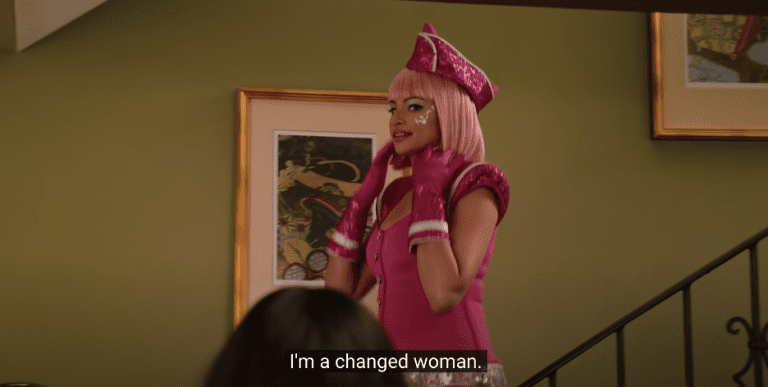
What’s In a Name?: The In-Between World of the South Asian Diaspora in Never Have I Ever”
Dr. Swapnil Rai, Assistant Professor at the University of Michigan
“I am asking for basic respect when I want people to say my name right”
– Maitreyi Ramakrishnan, teen actor who plays Devi on Never Have I Ever, in an interview with Seventeen magazine
Maitreyi Ramakrishan’s statement about her name in many ways epitomises the in-betweenness of the South Asian diaspora in the U.S. As a mom of an elementary schooler also named Maitreyi, I find that this particular problem has a deep resonance. The story of Maitreyi’s name opened up to me a metacognition of the “in-betweenness” of the south Asian diasporic identity. In every context outside the home, I need to explain the pronunciation of my daughter’s name in great detail to the point that she and I now share a well rehearsed understanding about how we will pronounce her name for the Indian/desi audience versus the non-Indians.
Unlike some immigrant groups in the U.S. that are okay with adopting a new English name, South Asians refrain from this. We are attached to our names because they are imbued with deep cultural and personal meaning. Indian Hindu families often have naming ceremonies that involve family elders. In Hinduism namkaran is a samskara, because a child’s name is seen as somehow existentially connected with who the child will be, and what qualities they will embody. So, we love our names until we encounter new cultural spaces where these names are unfamiliar and difficult to pronounce, marking us as outsiders even before an actual encounter. It therefore doesn’t matter if Devi (the word for Goddess in Sanskrit) or Aneesa ( Faithful and Friendly in Arabic) are second generation Indian-Americans, their non-anglophone names already signal their “in-between” biculturalism. The beauty of Kaling’s Never Have I Ever lies in the way she establishes this nuanced bi-cultural Americanness.
Through her all-American desi teens Devi and Aneesa as well as through Nalini, Kamala and Devi’s recently emigrated grandmother, Kaling establishes a south Asian world where the experience of America is generationally diverse. Nalini and Kamala are first generation immigrants who find themselves in the throes of American culture and feel drawn to it, yet establish an arms length relationship with “American-ness.” Their embodied “in-betweenness” vacillates between two cultures, India and America. So, Kamala, a bright Ph.D. student and scientist tries to fit in the “geek” U.S. culture of her lab but is still relegated to the gendered space of an outsider because despite her desperate attempts to join her labmates outside hours she is way too Indian to enjoy cosplay. At the same time, Kamala isn’t Indian enough to make peace with the idea of an arranged marriage even though she likes Prashant, the eligible bachelor her family has picked for her. Both Nalini and Kamala oscillate between their adopted homeland and a nostalgic association with the home they left behind. Or as Nirmala succinctly points out to Nalini, “I love having you here [in India] but you are too westernized now,” dashing Nalini’s hopes of moving back to India with Devi. In America, however, Nalini is too Eastern to learn to embrace western individuality and freedom and hankers for family support. Her claim to an American identity is cinereal and often feels unmoored, capable only of in-between, fractured perceptions of identity and belonging. Devi, on the other hand, proclaims and owns her quintessential American teen identity in declaring that she takes life advice only from Megan Thee Stallion and gets a nose piercing. Aneesa approves of Devi’s act as a “Halal moment of rebellion.” In this encounter and multiple others like the grandmother picking fruits from the neighbor’s yard without permission, Kaling constructs a south Asian diasporic in-betweenness that is nuanced and reveals the complexities of intergenerational south Asian diasporic identity in the U.S.
Previous Post

July 23, 2021
St. Francis and the Climate Apocalypse
Next Post

July 27, 2021 Alvah Hovey and the Northern Baptists
Browse Our Archives
Select a Category abolitionism Abortion Abraham Joshua Heschel Abraham Kuyper Abraham Lincoln Academia Activism Adam Renberg Advent Adventist africa African American Religion Agnes Howard Albert Camus American History American Religious History American Revolution American West Anabaptists Ancient History Andrea Turpin Andrei Tarkovsky Anglicanism Annales Ansley Lillian Quiros anti-Catholicism Antisemitism Anxious Bench apologetics Apparitions Arash Azizi Archaeology archives art Artificial Intelligence Asia Asian Americans Augustine Authors Bad Bunny Baptism Baptists Barack Obama Battle of Hastings Benjamin Franklin Bernard-Henri Levy Beth Allison Barr Beth Moore Bethany Mannon Bible Bill Cunningham Billy Graham Black Music Bob Dylan Body Boenhoffer Books Breastfeeding Bruce Springsteen C.S. Lewis Calvinism Cancel Culture Capitalism Carmelites Catholicism Cedric Robinson Cesar Chavez Charismaticism charity Charles Dickens Charles Lindbergh Che Guevara Chicago Children Chinese Christianity Chris Gehrz Christ Christian death Christian Higher Education Christian life Christian Nation Christian Nationalism Christianity Today Christmas Church life Church Practice cinema Civil Religion Civil Rights Movement Civil War civility Classics Climate Change Cold War Colonial Mexico colonialism Comer Communism community complementarianism Conference on Faith and History Congregationalism Conspiracies Conspiracy Conversion Narratives Coronavirus Costa Rica Council of Nicaea Covid-19 Creation Critical Race Theory Crusades Culture culture wars Daniel K. Williams David Barton David Swartz Death Ways death with dignity DEI democracy Democratic Party Devotion Digital Age Diplomacy discipleship diversity Donald Trump Drama Dua Lipa Early Church early modern Early modern Catholicism Easter Eastern Christianity economic exploitation Education elections Elie Wiesel Elizabeth II Elizabeth Taylor emotions Empire Engineering England enslavement Entertainment Episcopal Church Erica Ramirez eschatology Eurocentrism Evangelicalism Evangelicals Exegesis Family Feminism Film Flannery O'Connor folk music Food Foreign Policy founding fathers Franciscans Franciscus Junius fundamentalism Funerals G.K. Chesterton Gender Genocide genre geography George W. Bush George Washington George Whitefield Global Christianity Global church Grief Guadalupe guest post Guest Post gun control gun violence Gustavo Gutierrez Hamid Dabashi Harold John Ockenga Harvest Hate Hawaiian Christianity Healing health care Heather Cox Richardson Hell Heresy Hermeneutics Higher Education Hinduism Hippocratic oath Historical Fiction Historical Methodology Historical Profession Historical Profession Historical Theology Historical Thinking historiography Holidays Holocaust horror movies Human rights Humanitarian Work humanities Hummingbirds Hungary hymns Imago Dei Immigration Injustice Interviews Iran Islam Islamophobia Israel Ivan's Childhood Jacob Randolph James Bratt Janine Giordano Drake Japanese history Japanese Literature Jean Paul Sartre Jesse Miranda Jesus Jesus Christ Jimmy Carter Joan Baez Joan Didion Joanne Freeman João B. Chaves Joao Chaves Joey Cochran John Calvin John Fea John Tillotson John Turner Johnny Cash Jonathan Edwards Jonathan Tran Joseph Smith Josh Howerton Journalism Jr. Judaism Jürgen Moltmann Just War Justice Justin Brierley Karl Barth Katelyn Beaty koi ponds Kris Kristofferson Kristin Kobes Du Mez Latin American Religious History Latino Americans Lectio Divina Leisure Lent Leonard Cohen liberal arts liberalism Liberation Theology Linda Ronstadt Lisa Clark Diller Literature Lou Reed Lynchings Lynneth Miller Renberg Mainline Protestantism Malcolm Foley Marilyn Monroe Maritime history Mark Noll Marriage Martin Luther Martin Luther King Martyrdom Marxism Mary Masih Alinejad mass shootings material culture medieval Christianity Medieval Ethiopia Melissa Borja memory Mennonites Mental Health Mental Illness Methodism Mexican Americans Mexicans Mike Madrid Miles Mullin Min Jin Lee Miscarriage Missionaries Mister Rogers Mitt Romney modernity Monasticism Mormonism Motherhood Mothers of the Church Moving Music Musicals Nadya Williams Nahua Christianity Native Americans Natsume Sōseki New Contributor New England New Year New York Nico Non-Violent Protest Orthodoxy pacifism Paleo Evangelicals Palestinians Parenting Patti Smith Paul Kingsnorth Pedro Calderón de la Barca Pentecostalism Philip Jenkins Phillis Wheatley physician-assisted suicide pilgrimage Pilgrims pluralism Plutocracy Poetry Politics Pope Francis Pope Leo XIV post-modernism prayer preaching Presbyterians prosperity gospel Protest Public history Publishing Puritans purity culture Quakers race Race Massacres Racial Capitalism racial reconciliation racialization Racism Raha Bahloulipour Re-Enchantment reading Reformation Refugees religion and the university religion and war Religious Freedom Religious Nones Religious Pluralism Religious Symbols religious violence Republican Party Revival Rita Coolidge Ritual Roger Williams Roman Catholic church Royalty Russell Moore same-sex marriage Sarah Irving-Stonebraker Scandinavia Science Science and Technology Scopes trial Scriptural Interpretation secularism Selena Quintanilla seminary Seventh-Day Adventists sexual morality Sexuality Sikhs Silence slaveholders theology Slavery Slavoj Zizek social justice Social Media Southern Baptist Convention Southern Religion Spain Spiritual Autobiography Spiritual but not religious Spiritual Discipline Sports Stanley Hauerwas Suffering Summer Camps Sunday Night Odds and Ends Supernatural Supreme Court Syriac Christianity Tal Howard Taylor Swift Teaching Technology Television Thanksgiving The Beatles The Mission theater TheoBros Theology Thomas Dixon Thomas Jefferson Thomas Kidd Thomas Merton Tim Gloege Tim Walz Tom Holland Tourism tradition Tragedy Translation Transnationalism Travel Trump Ukraine Uncategorized Unitarians United Methodist Church US History Vanessa Chan Velvet Underground Verónica A. Gutiérrez Veronica Gutierrez Vikings Violence Virgin Mary Virtue Virtue ethics Visions Voting War WCTU Wendell Berry Westminster Assembly White Evangelicalism Wildfires Winnie the Pooh Witches women Women in Ministry Women's and Gender Studies Work Worship writing Yasunari Kawabata Zena Hitz
Select a Month October 2026 September 2026 August 2026 July 2026 June 2026 May 2026 April 2026 March 2026 February 2026 January 2026 December 2025 November 2025 October 2025 September 2025 August 2025 July 2025 June 2025 May 2025 April 2025 March 2025 February 2025 January 2025 December 2024 November 2024 October 2024 September 2024 August 2024 July 2024 June 2024 May 2024 April 2024 March 2024 February 2024 January 2024 December 2023 November 2023 October 2023 September 2023 August 2023 July 2023 June 2023 May 2023 April 2023 March 2023 February 2023 January 2023 December 2022 November 2022 October 2022 September 2022 August 2022 July 2022 June 2022 May 2022 April 2022 March 2022 February 2022 January 2022 December 2021 November 2021 October 2021 September 2021 August 2021 July 2021 June 2021 May 2021 April 2021 March 2021 February 2021 January 2021 December 2020 November 2020 October 2020 September 2020 August 2020 July 2020 June 2020 May 2020 April 2020 March 2020 February 2020 January 2020 December 2019 November 2019 October 2019 September 2019 August 2019 July 2019 June 2019 May 2019 April 2019 March 2019 February 2019 January 2019 December 2018 November 2018 October 2018 September 2018 August 2018 July 2018 June 2018 May 2018 April 2018 March 2018 February 2018 January 2018 December 2017 November 2017 October 2017 September 2017 August 2017 July 2017 June 2017 May 2017 April 2017 March 2017 February 2017 January 2017 December 2016 November 2016 October 2016 September 2016 August 2016 July 2016 June 2016 May 2016 April 2016 March 2016 February 2016 January 2016 December 2015 November 2015 October 2015 September 2015 August 2015 July 2015 June 2015 May 2015 April 2015 March 2015 February 2015 January 2015 December 2014 November 2014 October 2014 September 2014 August 2014 July 2014 June 2014 May 2014 April 2014 March 2014 February 2014 January 2014 December 2013 November 2013 October 2013 September 2013 August 2013 July 2013 June 2013 May 2013 April 2013 March 2013 February 2013 January 2013 December 2012 November 2012 October 2012 September 2012 August 2012 July 2012 June 2012 May 2012
Follow Us!
TAKE THE
Religious Wisdom Quiz
What British monarch is also Supreme Governor of the Church of England?
Select your answer to see how you score.
Prime Minister The King/Queen of England Pope Archbishop of Canterbury
Related posts from Anxious Bench

Min Jin Lee and the Art of Historical...

Festivus and the Practice of Religious Pluralism

Sheets of Scattered Sands: A Conversation with Justin...
DEI at the University of Michigan: What Went...
TRENDING AT PATHEOS Evangelical

How to Make a Decision When You Can't...
Main point: It’s much more valuable to stay close to God so...

Archdiocese Hosts Military Marriage Retreat in Germany
RASTATT, Germany — The transient military lifestyle, with its frequent deployments and...

Nearly every morning, I make the drive to Detroit with my high-school-age...

The Real AI Story Is Adoption Without Trust
Artificial intelligence has crossed a political threshold. It is no longer a...

A new article, written by Jeff Lindsay and Gale L. Pooley,...

Swimfan: Forgotten Aughts Pleasures
This is a recovery effort. In 2002, My Big Fat Greek Wedding...
view all Evangelical blogs
Ad-Free & Subscriber Log-In Subscription Support
- About Us
- 2026 Calendar
- Videos
- Podcasts
- Library of World Religions
- Faith In Media Tracker
- Advertise With Us
- Write for Us
- Privacy Policy
- Terms of Service
- Do Not Sell My Data
- Contact Us
- Radiant Digital
- Manage Newsletter Subscriptions
- Unsubscribe From Notifications
- Sitemap
Copyright 2008-2026, Patheos. All rights reserved.
Subscription Support Ad-Free & Subscriber Log-In
Follow Patheos