
BuddhistCatholicContemplativeEvangelicalGeneral ChristianHinduJewishLatter-day SaintMuslimNew VisionsProgressive Christian
Beliefs
- Buddhist
- Catholic
- Contemplative
- Evangelical
- General Christian
- Hindu
- Jewish
- Latter-day Saint
- More Voices
- Muslim
- New Visions
- Pagan
- Progressive Christian
Topics
- Religion News
- Food and Religion
- Sports and Religion
- Religious Art
- Religious Music and Entertainment
- Religious Events
- History and Religion
- Style and Religion
- Politics and Religion
- Women in Religion
- Recreation Outdoors and Religion
- Business Finance and Religion
- Careers Workplace and Religion
- Education and Religion
- Family Parenting and Religion
- Health Fitness and Religion
- Home and Religion
- Relationships and Religion
- Technology and Religion
- Travel and Religion
Columnists
- Buddhist Columnists
- Business Finance and Religion Columnists
- Careers Workplace and Religion Columnists
- Catholic Columnists
- Contemplative Columnists
- Education and Religion Columnists
- Evangelists Columnists
- Family Parenting and Religion Columnists
- General Christian Columnists
- Health Fitness and Religion Columnists
- Hindu Columnists
- History and Religion Columnists
- Home and Religion Columnists
- Jewish Columnists
- More Voices Columnists
- Latter Day Columnists
- Muslim Columnists
- New Visions Columnists
- Nonreligious Columnists
- Pagan Columnists
- Politics and Religion Columnists
- Progressive Columnists
- Recreation Outdoors and Religion Columnists
- Relationships and Religion Columnists
- Religion News Columnists
- Religious Art Columnists
- Religious Events Columnists
- Religious Music and Entertainment Columnists
- Sports and Religion Columnists
- Style and Religion Columnists
- Technology and Religion Columnists
- Travel and Religion Columnists
- Women in Religion Columnists
Resource Library
- 2026 Calendar
- Library of World Religions
- The 100 Most Holy Places on Earth
- Patheos Answers
- Podcasts
- Videos
- Faith Leaders Database
- Anglican Episcopalian
- Bahai
- Baptist
- Buddhism
- Christianity
- Confucianism
- Eastern Orthodoxy
- Hinduism
- Holiness and Pentecostal
- ISKCON
- Islam
- Judaism
- Lutheran
- Methodist
- The Church of Jesus Christ of Latter-day Saints
- New Age
- Paganism
- Presbytarian and Reformed
- Protestantism
- Religion Behind the Scenes
- Roman Catholic
- Scientology
- Shia Islam
- Sikhism
- Sufism
- Sunni Islam
- Taoism
- Zen
- See all religions
Research Tools
 Ad-Free & Subscriber Log-In Subscription Support
Ad-Free & Subscriber Log-In Subscription Support
Follow Patheos 

- Trending:
- Forgiveness
- |
- Marriage
- |
- Consciousness
- |
- Death Penalty
- |
- Election
- |
- Halloween

-
About the Authors
- Home
- Evangelical
- “Sanctified Sinophobia” and the Role of Christian Nationalism in Anti-Asian Racism: An Interview with Lucas Kwong
“Sanctified Sinophobia” and the Role of Christian Nationalism in Anti-Asian Racism: An Interview with Lucas Kwong
Last updated on: June 2, 2025 at 10:01 am by Melissa Borja
“Sanctified Sinophobia” and the Role of Christian Nationalism in Anti-Asian Racism: An Interview with Lucas Kwong 2025-06-02T10:01:24-04:00 Melissa Borja
Patheos Explore the world's faith through different perspectives on religion and spirituality! Patheos has the views of the prevalent religions and spiritualities of the world.

In the stories, images, and video footage of last week’s insurrection at the Capitol, two details drew my attention. First, there was the open display of Christian nationalism. Pro-Trump activists erected a cross at the Michigan Capitol in Lansing, and they danced to Christian music (and sometimes played shofars) in Washington, D.C. As Robert P. Jones argued afterward, the “seditious mob was motivated not just by loyalty to Trump, but by an unholy amalgamation of white supremacy and Christianity that has plagued our nation since its inception and is still with us today.”
As Jones wrote, the siege on the Capitol revealed “a desperate desire by some white Christians to hang onto ownership of a diversifying country,” which relates to a second observation: that the insurrection involved open expressions of xenophobia and Sinophobia. The New York Times described, for example, how the pro-Trump mob ripped up a Chinese scroll found in the Capitol building, while a woman looked on and declared, “We don’t want Chinese bullshit.”
As a religion scholar who is also an expert on the surge in anti-Asian hate during the pandemic, I see the intersection of these forces—Christian nationalism and xenophobia—as important but underrecognized. In October, my research team at Stop AAPI Hate published a report about political candidates and their Twitter activity, and we showed that there are clear partisan patterns in who deploys inflammatory rhetoric that stigmatizes Asian people and blames them for the pandemic. Without exception, only Republican candidates have used stigmatizing terms such as “Wuhan flu” and “China virus.” Donald Trump, in particular, has been a “superspreader” of anti-Asian hate.
The politicians advancing anti-Asian hate have not only been Republican, but Christian, and scholars have begun to call attention to this fact. Most notable among them is Lucas Kwong, Assistant Professor at City Tech and the City University of New York and the author of three recent essays: one about “Sanctified Sinophobia,” another about Christian nationalism’s impact on anti-Asian hate, and a third urging Asian American Christians to take action.
Kwong also launched the Against Christian Xenophobia project, which features “An Open Letter on Anti-Asian Racism and Christian Nationalism.” In it, Kwong decries how American Christian politicians have escalated anti-Asian racism during the COVID-19 pandemic, and he encourages Christians to sign the open letter, educate themselves about the Christian nationalist politicians who have advanced racist, anti-Asian rhetoric and legislation, and learn about these politicians and their connections to churches. Ultimately, Kwong calls for these politicians and their home churches “to confess the link between racist rhetoric and racist actions, condemning both in turn.”
Over the weekend, I interviewed Prof. Kwong about his work. Here are the highlights of the interview, which I have edited lightly for length and clarity.
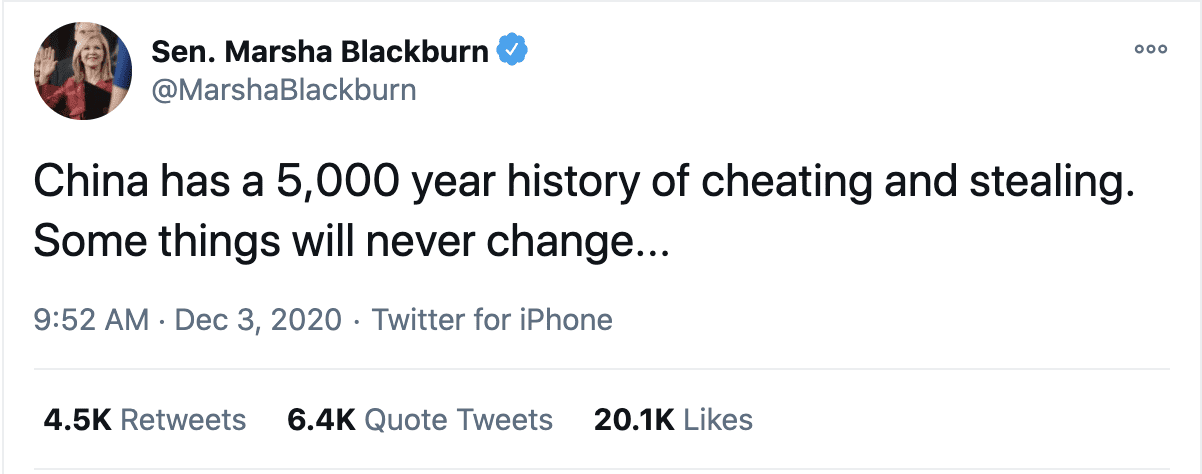
On the origins of the “Against Christian Xenophobia” project:
I think really the precipitating incident was Marsha Blackburn’s tweet on December 3rd, about the 5,000 years of “cheating and stealing.” …I was aware of her membership in Christ Presbyterian in Nashville and aware, as a New Yorker, that they have a pastor, Scott Sauls, that was previously at Redeemer Presbyterian, which is the church that I’m familiar with, like so many New Yorkers who attend church. So I was aware of that connection…I was writing about it, and I thought, ‘You know, I think this goes beyond Marsha Blackburn and Christ Presbyterian, I think that there is a larger pattern here,’ especially as I began to delve in and think about all the major politicians, which Stop AAPI Hate [discussed] in that very helpful report on the candidates’ rhetoric.
Almost to a person, the major drivers of this rhetoric are all outspoken, self-identified Christians. I mean, Bill Hagerty: I was shocked that he tweeted more—almost twice as many—anti-Chinese tweets as Donald Trump in the same period, and he’s a lifelong (or maybe not lifelong, but a longtime) member of an Episcopalian church, I believe, in Nashville. And the same goes for Senators Josh Hawley, Kelly Loeffler, Ted Cruz. And I felt it was very important to point out that although the rhetoric itself is harmful, it is also the legislation—which, again, Stop AAPI Hate was very helpful to direct me toward. All these people jump on the same bills. They try to get the same legislation passed. And so looking at that in light of the long history of the conjunction of Christianity and this reactionary white supremacism, frankly—which in my research I see going back to the 1890s, in a different context in Victorian Britain—I think we can very clearly see these historical patterns, that unless there is a concerted effort to dismantle material networks of power and influence, I think it will continue unabated. So that was what led me to write the letter and to adopt the strategy that I felt was important to adopt, which was to not only ask for repentance, but a clear plan for making amends.

On the deep historical roots of Christian nationalist xenophobia and Sinophobia, as expressed in Dracula and the literature of the Victorian era:
I actually wrote an article about [anti-Chinese sentiment] in Dracula. Dracula, we take for granted because it’s such a major part of the firmament of the cultural imagination, but it really was born out of the 1880s and 90s, when, much like today in the U.S., there was this obsession with the idea of imperial fall and degeneration—of biological degeneration, of political degeneration, even the degeneration of art. It was in this period that works that drew parallels between the fall of the Roman Empire and the fall of the British Empire potentially began to be published. And much like today, if you look at the alt-right and the far right, there is this obsession with Rome and with Greece and with avoiding the degeneration that befell previous great empires in the past. And so, in the 1880s and 90s, what that meant was, “What are the threats to the British Empire? What are the threats to our people, to our race?” …[There was] this fear of the East and this need to have an antagonist that was equal perhaps to the glory and the scope of the British Empire.
…What’s interesting about Dracula is, in Dracula, it’s not China per se. He is sort of on the liminal border between Europe and the Islamic world. The irony of the story is that he is a Christian soldier who fought the Turks and sort of sold his soul to the devil. He lives in Transylvania, which is figurative. In fact, in the story, Jonathan Harker says, the further east you go, the time gets stranger and less linear, and he asks at one point, “I wonder what the clocks are like in China?” So China is still the point of reference, even though they never get to China, as they move east towards Transylvania.
….Dracula sparks this flood of copies that are forgotten today, but that are trying to ape the success of Dracula. M. P. Shiel, who’s a British author, comes out with a book called The Yellow Danger, and The Yellow Danger’s central character—his name is Dr. How—is clearly modeled on Sun Yat-sen. And Dr. How is kind of this evil mastermind, much like in the vein of Dracula. He’s not literally a supernatural being, but he is of both Japanese and Chinese descent, and I think at one point it says he has both the brain of the West and the body of the East…He hatches this scheme to get the different European nations to fight against each other so that in the midst of all that bloodshed, China can rise to the top.
And strikingly, one of the first things that we learn about Dr. How is not just that he is this mastermind and this evil genius, but that he’s godless. I think it says that he has no religious emotion whatsoever. We’re meant to see that this is not just specific to his personality—this is a racial trait. That’s very much in line with [how], when the discipline of comparative religion starts in the late 19th century, race and religion are deeply intertwined…Religion is seen as being the expression of particular races, and you have this hierarchy coming from polytheism at the bottom, moving up to monotheism at the top, and each of the different religious traditions of the world are supposed to correlate to different stages of racial evolution. So when Dr. How is framed as being an atheist, that is representative of the Chinese people. It’s not an anomaly. I think it’s very much in line with the thinking at that time.
We fast forward to 2020, and we see Marsha Blackburn saying China has 5,000 years of “cheating and stealing,” and we hear, particularly this year, an explosion of the term “godless communist China.” I mean, if you just look up that term on Twitter, it is continually being refreshed. It’s not enough to call it communist China; it must be a godless communist China. Really, that trope predates communism. It predates the 1949 revolution and dovetails, of course, with the figure of the “heathen” Chinese in the 19th century.
Even though there are obviously different contexts when we’re talking about Victorian Britain versus America, I do think there is definitely a shared cultural inheritance there that has been revived today. Whether it’s conscious or subliminal, I think in these times, when there are these perceived threats to the social order, particularly to a white-dominated social order, people draw on these reflexes that are embedded in the cultural memory. And I think one of them is looking to the specter of the godless East, particularly the godless Chinese.
On the role of churches and pastors in advancing xenophobia, Sinophobia, and anti-Asian racism:
I think there are different types of relationships that any given pastor has to a candidate. On one hand, I’m thinking of Kevin McCarthy, who is from Bakersfield. He literally had his pastor—I think he’s from Valley Ridge Baptist—come in and give an opening invocation a few years ago for the first session of Congress. There you have a very explicit public identification between the pastor and the politician. Similarly, Mike Pompeo, his home church in Kansas is Eastminster [Presbyterian Church]. Its pastor, Stan Van Den Berg, went on the record in defending Mike Pompeo. So I think you have that on one hand, and then on the other hand, you have something like, for example, the relationship between Marsha Blackburn and Scott Sauls, which is that, at least publicly, there is no acknowledged relationship. The dots are all there to be connected in the public record, and anybody who cares to know will know that Marsha Blackburn is an active member of Christ Presbyterian Nashville, and Pastor Scott Saul is the head pastor of Christ Presbyterian Nashville, but there’s no open acknowledgement of that. I do believe that, despite that wide difference, what they share is the fact that having a regular church, being an active member of the church, being able to say that you are involved in a church, is central to the brand of Christian nationalist politicians.
…It is complicated insofar as Christian nationalists are not necessarily regular churchgoers, that although the most fervent Christian nationalists seem to tend to attend church regularly, a wide swath of people who profess Christian views aren’t necessarily regular churchgoers or don’t attend church. However, I do think, even though they don’t attend church, it seems central to the brand of the politicians whom they admire, that those politicians attend church and have a relationship to the church. It is beneficial to those politicians: whether or not their pastors are publicly in their corner or simply decline to issue a statement dissociating themselves from that politician, it’s in their interest to have that association.
…A lot of these pastors, they are fluent in the language of racial justice. They are fluent in the language of talking about race…Although some of them just flatly do not acknowledge the issue at all, I think a lot of them will have some sort of diversity statement on their site and in fact, will hire non-white staff pastorally and highlight that on their websites. There is clearly, on one hand, this tension between wanting to project this appearance of caring about racial justice and even writing blog posts or tweets that signal, “Hey, this is a church that cares about racial justice and cares about being welcoming to non-white Christians.” But at the same time, there is this huge elephant in the room that just goes completely unaddressed, which is that, well, one of your most prominent congregants is literally capitalizing on their affiliation with you as they pursue Sinophobic, xenophobic legislation and put that out into the mainstream and increase the risk of harm to minorities.
On how religious people must hold their churches and elected officials accountable:
On one hand, although the most fervent Christian nationalists tend to go to church, it also seems like religiosity cross-pressures Christian nationalists when it comes to their attitude toward immigrants, so that they can actually play a role in creating empathy and diminishing the influence of xenophobic rhetoric. It’s for that reason that the letter is specifically pitched—although it is welcome to allies from all backgrounds—to Asian American Christians. This is an issue in which both our faith and our ethnicity is at stake. Our race is targeted, and then our faith is exploited to launder the reputation of the people who are doing the targeting. So what I would hope is that, first for Asian Christians who are part of their communities to see that they have power…I think that there is this powerful idea of the “beloved community” that John Lewis talked about—that, in Hebrews, there is this idea of the “priesthood of all believers,” there is a radical equality that is not subtextual to the New Testament, but is right there on a quite literal level, even if you are a literalist. On that basis, I think, Christians have to go beyond making broad denunciations of racism and think, “What are the material networks of power and influence that my church is supporting, and how can I ally with other people who might not be pastors, who might not be deacons or people in positions of ‘influence,’ but how can we create a community that more accurately reflects that ‘priesthood of all believers,’ that ‘beloved community,’ in which hierarchy is replaced by an equal commitment to love and justice?”
And then I would say for non-Asian Christians, I think it’s a similar thing, but I think it’s also that some reflection is required, particularly for white evangelical Christians. I am a big believer that there are many people out there—and maybe this is optimistic—but I believe there are many people out there who simply have not connected the dots, who simply have not thought about the fact that, “Oh, I’m going to this church that, on one hand, has a diversity statement on its website, proudly features pictures of our Black, Latino, and Asian pastors or pastoral staff, and yet our most visible congregant and possibly wealthiest donor to this church is an unrepentant xenophobe or racist. I wonder what my role is, perhaps as someone who indirectly benefits from that system of mutual beneficiality? What is my role here to dismantle that relationship or to challenge it?” I really would hope that, whether you’re Asian or not, if you are a churchgoer, that [the letter] would at least prompt people to think about how sin is embodied and how it finds expression in flows of influence, power, money, and privilege, and how that intersects with racism today.
Previous Post

January 9, 2021
Will This Week Bring an Epiphany for Evangelicals?
Next Post

January 12, 2021 The Crisis in American Democracy: An International Perspective
Browse Our Archives
Select a Category abolitionism Abortion Abraham Joshua Heschel Abraham Kuyper Abraham Lincoln Academia Activism Adam Renberg Advent Adventist africa African American Religion Agnes Howard Albert Camus American History American Religious History American Revolution American West Anabaptists Ancient History Andrea Turpin Andrei Tarkovsky Anglicanism Annales Ansley Lillian Quiros anti-Catholicism Antisemitism Anxious Bench apologetics Apparitions Arash Azizi Archaeology archives art Artificial Intelligence Asia Asian Americans Augustine Authors Bad Bunny Baptism Baptists Barack Obama Battle of Hastings Benjamin Franklin Bernard-Henri Levy Beth Allison Barr Beth Moore Bethany Mannon Bible Bill Cunningham Billy Graham Black Music Bob Dylan Body Boenhoffer Books Breastfeeding Bruce Springsteen C.S. Lewis Calvinism Cancel Culture Capitalism Carmelites Catholicism Cedric Robinson Cesar Chavez Charismaticism charity Charles Dickens Charles Lindbergh Che Guevara Chicago Children Chinese Christianity Chris Gehrz Christ Christian death Christian Higher Education Christian life Christian Nation Christian Nationalism Christianity Today Christmas Church life Church Practice cinema Civil Religion Civil Rights Movement Civil War civility Classics Climate Change Cold War Colonial Mexico colonialism Comer Communism community complementarianism Conference on Faith and History Congregationalism Conspiracies Conspiracy Conversion Narratives Coronavirus Costa Rica Council of Nicaea Covid-19 Creation Critical Race Theory Crusades Culture culture wars Daniel K. Williams David Barton David Swartz Death Ways death with dignity DEI democracy Democratic Party Devotion Digital Age Diplomacy discipleship diversity Donald Trump Drama Dua Lipa Early Church early modern Early modern Catholicism Easter Eastern Christianity economic exploitation Education elections Elie Wiesel Elizabeth II Elizabeth Taylor emotions Empire Engineering England enslavement Entertainment Episcopal Church Erica Ramirez eschatology Eurocentrism Evangelicalism Evangelicals Exegesis Family Feminism Film Flannery O'Connor folk music Food Foreign Policy founding fathers Franciscans Franciscus Junius fundamentalism Funerals G.K. Chesterton Gender Genocide genre geography George W. Bush George Washington George Whitefield Global Christianity Global church Grief Guadalupe guest post Guest Post gun control gun violence Gustavo Gutierrez Hamid Dabashi Harold John Ockenga Harvest Hate Hawaiian Christianity Healing health care Heather Cox Richardson Hell Heresy Hermeneutics Higher Education Hinduism Hippocratic oath Historical Fiction Historical Methodology Historical Profession Historical Profession Historical Theology Historical Thinking historiography Holidays Holocaust horror movies Human rights Humanitarian Work humanities Hummingbirds Hungary hymns Imago Dei Immigration Injustice Interviews Iran Islam Islamophobia Israel Ivan's Childhood Jacob Randolph James Bratt Janine Giordano Drake Japanese history Japanese Literature Jean Paul Sartre Jesse Miranda Jesus Jesus Christ Jimmy Carter Joan Baez Joan Didion Joanne Freeman João B. Chaves Joao Chaves Joey Cochran John Calvin John Fea John Tillotson John Turner Johnny Cash Jonathan Edwards Jonathan Tran Joseph Smith Josh Howerton Journalism Jr. Judaism Jürgen Moltmann Just War Justice Justin Brierley Karl Barth Katelyn Beaty koi ponds Kris Kristofferson Kristin Kobes Du Mez Latin American Religious History Latino Americans Lectio Divina Leisure Lent Leonard Cohen liberal arts liberalism Liberation Theology Linda Ronstadt Lisa Clark Diller Literature Lou Reed Lynchings Lynneth Miller Renberg Mainline Protestantism Malcolm Foley Marilyn Monroe Maritime history Mark Noll Marriage Martin Luther Martin Luther King Martyrdom Marxism Mary Masih Alinejad mass shootings material culture medieval Christianity Medieval Ethiopia Melissa Borja memory Mennonites Mental Health Mental Illness Methodism Mexican Americans Mexicans Mike Madrid Miles Mullin Min Jin Lee Miscarriage Missionaries Mister Rogers Mitt Romney modernity Monasticism Mormonism Motherhood Mothers of the Church Moving Music Musicals Nadya Williams Nahua Christianity Native Americans Natsume Sōseki New Contributor New England New Year New York Nico Non-Violent Protest Orthodoxy pacifism Paleo Evangelicals Palestinians Parenting Patti Smith Paul Kingsnorth Pedro Calderón de la Barca Pentecostalism Philip Jenkins Phillis Wheatley physician-assisted suicide pilgrimage Pilgrims pluralism Plutocracy Poetry Politics Pope Francis Pope Leo XIV post-modernism prayer preaching Presbyterians prosperity gospel Protest Public history Publishing Puritans purity culture Quakers race Race Massacres Racial Capitalism racial reconciliation racialization Racism Raha Bahloulipour Re-Enchantment reading Reformation Refugees religion and the university religion and war Religious Freedom Religious Nones Religious Pluralism Religious Symbols religious violence Republican Party Revival Rita Coolidge Ritual Roger Williams Roman Catholic church Royalty Russell Moore same-sex marriage Sarah Irving-Stonebraker Scandinavia Science Science and Technology Scopes trial Scriptural Interpretation secularism Selena Quintanilla seminary Seventh-Day Adventists sexual morality Sexuality Sikhs Silence slaveholders theology Slavery Slavoj Zizek social justice Social Media Southern Baptist Convention Southern Religion Spain Spiritual Autobiography Spiritual but not religious Spiritual Discipline Sports Stanley Hauerwas Suffering Summer Camps Sunday Night Odds and Ends Supernatural Supreme Court Syriac Christianity Tal Howard Taylor Swift Teaching Technology Television Thanksgiving The Beatles The Mission theater TheoBros Theology Thomas Dixon Thomas Jefferson Thomas Kidd Thomas Merton Tim Gloege Tim Walz Tom Holland Tourism tradition Tragedy Translation Transnationalism Travel Trump Ukraine Uncategorized Unitarians United Methodist Church US History Vanessa Chan Velvet Underground Verónica A. Gutiérrez Veronica Gutierrez Vikings Violence Virgin Mary Virtue Virtue ethics Visions Voting War WCTU Wendell Berry Westminster Assembly White Evangelicalism Wildfires Winnie the Pooh Witches women Women in Ministry Women's and Gender Studies Work Worship writing Yasunari Kawabata Zena Hitz
Select a Month October 2026 September 2026 August 2026 July 2026 June 2026 May 2026 April 2026 March 2026 February 2026 January 2026 December 2025 November 2025 October 2025 September 2025 August 2025 July 2025 June 2025 May 2025 April 2025 March 2025 February 2025 January 2025 December 2024 November 2024 October 2024 September 2024 August 2024 July 2024 June 2024 May 2024 April 2024 March 2024 February 2024 January 2024 December 2023 November 2023 October 2023 September 2023 August 2023 July 2023 June 2023 May 2023 April 2023 March 2023 February 2023 January 2023 December 2022 November 2022 October 2022 September 2022 August 2022 July 2022 June 2022 May 2022 April 2022 March 2022 February 2022 January 2022 December 2021 November 2021 October 2021 September 2021 August 2021 July 2021 June 2021 May 2021 April 2021 March 2021 February 2021 January 2021 December 2020 November 2020 October 2020 September 2020 August 2020 July 2020 June 2020 May 2020 April 2020 March 2020 February 2020 January 2020 December 2019 November 2019 October 2019 September 2019 August 2019 July 2019 June 2019 May 2019 April 2019 March 2019 February 2019 January 2019 December 2018 November 2018 October 2018 September 2018 August 2018 July 2018 June 2018 May 2018 April 2018 March 2018 February 2018 January 2018 December 2017 November 2017 October 2017 September 2017 August 2017 July 2017 June 2017 May 2017 April 2017 March 2017 February 2017 January 2017 December 2016 November 2016 October 2016 September 2016 August 2016 July 2016 June 2016 May 2016 April 2016 March 2016 February 2016 January 2016 December 2015 November 2015 October 2015 September 2015 August 2015 July 2015 June 2015 May 2015 April 2015 March 2015 February 2015 January 2015 December 2014 November 2014 October 2014 September 2014 August 2014 July 2014 June 2014 May 2014 April 2014 March 2014 February 2014 January 2014 December 2013 November 2013 October 2013 September 2013 August 2013 July 2013 June 2013 May 2013 April 2013 March 2013 February 2013 January 2013 December 2012 November 2012 October 2012 September 2012 August 2012 July 2012 June 2012 May 2012
Follow Us!
TAKE THE
Religious Wisdom Quiz
Which king asked Elijah for help against the armies of Moab and Edom?
Select your answer to see how you score.
Jehoram Joram Jehoshaphat Joash
Related posts from Anxious Bench
Christians Helped Invent Race. Some Now Call It...

What Coffee Reveals About America's Evangelical Varieties

A Casserole is Not a Counterpoint

Angelina Grimké's Forgotten Turn to Apocalyptic Faith
TRENDING AT PATHEOS Evangelical

The Sermon on the Mount, Part I: Matthew...
The Sermon on the Mount, Part I (Matthew 4:12-5:12) St. Matthew moves...

What's up from Crossway: Reviewing some of their latest A few weeks...

Janie Learns the Way of the Cross: A...
Teaching children about Jesus' Passion can be challenging. Many parents and educators...

Looking For Good Catholic Writing - October 2026
He alone extends the heavens, and he walks upon the waves of...

In "Irreplaceable," our book on vocation and technology, Trevor Sutton and I...

I was strolling through the top floor of the brand new Parthenon...
view all Evangelical blogs
Ad-Free & Subscriber Log-In Subscription Support
- About Us
- 2026 Calendar
- Videos
- Podcasts
- Library of World Religions
- Faith In Media Tracker
- Advertise With Us
- Write for Us
- Privacy Policy
- Terms of Service
- Do Not Sell My Data
- Contact Us
- Radiant Digital
- Manage Newsletter Subscriptions
- Unsubscribe From Notifications
- Sitemap
Copyright 2008-2026, Patheos. All rights reserved.
Subscription Support Ad-Free & Subscriber Log-In
Follow Patheos