
BuddhistCatholicContemplativeEvangelicalGeneral ChristianHinduJewishLatter-day SaintMuslimNew VisionsProgressive Christian
Beliefs
- Buddhist
- Catholic
- Contemplative
- Evangelical
- General Christian
- Hindu
- Jewish
- Latter-day Saint
- More Voices
- Muslim
- New Visions
- Pagan
- Progressive Christian
Topics
- Religion News
- Food and Religion
- Sports and Religion
- Religious Art
- Religious Music and Entertainment
- Religious Events
- History and Religion
- Style and Religion
- Politics and Religion
- Women in Religion
- Recreation Outdoors and Religion
- Business Finance and Religion
- Careers Workplace and Religion
- Education and Religion
- Family Parenting and Religion
- Health Fitness and Religion
- Home and Religion
- Relationships and Religion
- Technology and Religion
- Travel and Religion
Columnists
- Buddhist Columnists
- Business Finance and Religion Columnists
- Careers Workplace and Religion Columnists
- Catholic Columnists
- Contemplative Columnists
- Education and Religion Columnists
- Evangelists Columnists
- Family Parenting and Religion Columnists
- General Christian Columnists
- Health Fitness and Religion Columnists
- Hindu Columnists
- History and Religion Columnists
- Home and Religion Columnists
- Jewish Columnists
- More Voices Columnists
- Latter Day Columnists
- Muslim Columnists
- New Visions Columnists
- Nonreligious Columnists
- Pagan Columnists
- Politics and Religion Columnists
- Progressive Columnists
- Recreation Outdoors and Religion Columnists
- Relationships and Religion Columnists
- Religion News Columnists
- Religious Art Columnists
- Religious Events Columnists
- Religious Music and Entertainment Columnists
- Sports and Religion Columnists
- Style and Religion Columnists
- Technology and Religion Columnists
- Travel and Religion Columnists
- Women in Religion Columnists
Resource Library
- 2026 Calendar
- Library of World Religions
- The 100 Most Holy Places on Earth
- Patheos Answers
- Podcasts
- Videos
- Faith Leaders Database
- Anglican Episcopalian
- Bahai
- Baptist
- Buddhism
- Christianity
- Confucianism
- Eastern Orthodoxy
- Hinduism
- Holiness and Pentecostal
- ISKCON
- Islam
- Judaism
- Lutheran
- Methodist
- The Church of Jesus Christ of Latter-day Saints
- New Age
- Paganism
- Presbytarian and Reformed
- Protestantism
- Religion Behind the Scenes
- Roman Catholic
- Scientology
- Shia Islam
- Sikhism
- Sufism
- Sunni Islam
- Taoism
- Zen
- See all religions
Research Tools
 Ad-Free & Subscriber Log-In Subscription Support
Ad-Free & Subscriber Log-In Subscription Support
Follow Patheos 

- Trending:
- Forgiveness
- |
- Marriage
- |
- Consciousness
- |
- Death Penalty
- |
- Election
- |
- Halloween

-
About the Authors
- Home
- Evangelical
- Katherine Anne Porter, Sam Peckinpah, and the Swallow’s Flight
Katherine Anne Porter, Sam Peckinpah, and the Swallow’s Flight
Last updated on: December 29, 2020 at 10:25 am by Philip Jenkins
Katherine Anne Porter, Sam Peckinpah, and the Swallow’s Flight 2020-12-29T10:25:30-04:00 Philip Jenkins
Patheos Explore the world's faith through different perspectives on religion and spirituality! Patheos has the views of the prevalent religions and spiritualities of the world.
Christmas is a time to look back on the year almost passed by, and the findings and discoveries of that year. So what was new or unexpected? In 2020, the short answer was: a huge amount of the unexpected, and virtually none of that good. As Charles Dickens said, it was the worst of times, it was the … oh wait, no, it was just the worst of times.
Having said that, on a personal level, I have a literary and/or cinematic discovery to report. It involves Katherine Anne Porter, Sam Peckinpah, the Mexican Revolution, a heretical pseudo-gospel, and the fall of Muslim Spain. No, really. It also, in a bizarre way, encapsulates many of my longest-standing interests and obsessions. Bear with me on a somewhat strange voyage, during which I shed a little light on what is widely regarded as one of the greatest of American films. Call it my Christmas extravaganza.
By way of background, one of my all-time favorite films is Peckinpah’s 1969 Western The Wild Bunch, which is set during the Mexican Revolution, probably in 1914.
Also, and I would have thought, utterly separately, I have recently been doing a lot of work on a strange gospel that first appeared in the early seventeenth century called the Gospel of Barnabas. This is a subversive retelling of the story of Jesus in which he proclaims a strongly Muslim message, prophesying the coming of Muhammad as the last prophet. Very probably, it was written by the Spanish Muslims who had been forced to convert to Christianity, the Moriscos, and who were eventually expelled from the kingdom in 1614. Some Morisco, at least, got his revenge by writing Barnabas, which currently enjoys vast popularity in the Muslim world as a counterblast to Christian claims. I have a lengthy book chapter on Barnabas coming out in 2021.
So why on earth am I linking those two phenomena, the film and the gospel?
La Golondrina
The link is a song, the beloved Mexican song of departure, exile, and farewell, La Golondrina, which is often today heard at funerals. It is sung heartbreakingly during The Wild Bunch, and is also heard over the final titles:
A donde ira
Veloz y fatigada
La golondrina
Que de aquí se va
Por si en el viento
Se hallara extraviada
Buscando abrigo
Y no lo encontrara
Where can it go
rushed and fatigued
the swallow
passing by
tossed by the wind
looking so lost
with nowhere to hide.
The song’s origins are a little mysterious, if not quite as weird as Barnabas itself. I quote Wikipedia:
“La Golondrina” (English: “The Swallow”) is a song written in 1862 by Mexican physician Narciso Serradell Sevilla (1843-1910), who at the time was exiled to France due to the French intervention in Mexico. The lyrics come from a poem written in Arabic by the last Abencerrages king of Granada, Aben Humeya, in a translation by Niceto de Zamacois, which Sevilla found in a magazine used as packing material.
This demands some explanation. The fall of Muslim Spain was a multiple stage process, and two key events are often confused. In 1492, the Christian kings annexed the Emirate of Granada, the last Muslim state in the peninsular, and expelled its king, whom the Spanish knew as Boabdil. Most of the Muslims accepted notional Christian conversion, becoming the Moriscos, but that conversion was for most a superficial affair. In 1568, the Moriscos rebelled under the Aben Humeya mentioned here, who was killed the following year. All these events attracted deep romantic interest in the nineteenth century, especially in the 1860s, and the two figures – Boabdil and Aben Humeya – were often confused as the “last king of Granada.” At various points, each of the two was given credit for composing the Golondrina.
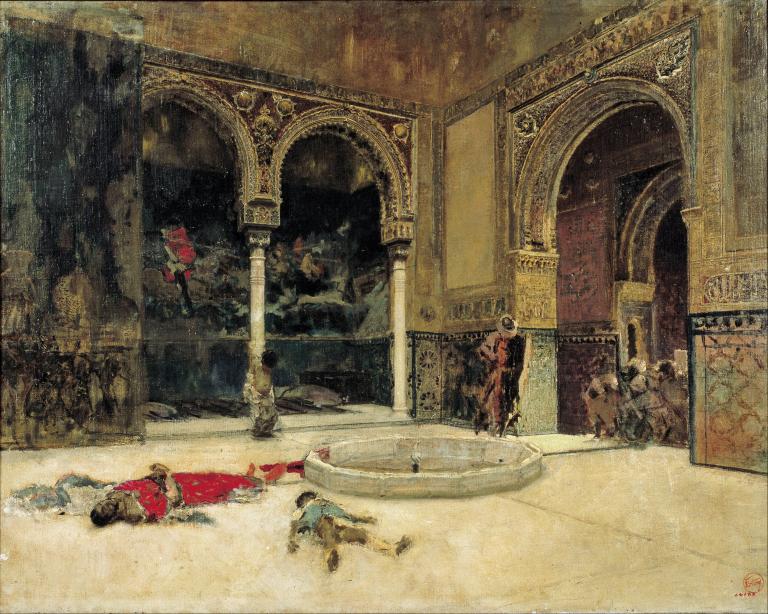
Marià Fortuny, The Slaying of the Abencerrajes (1870)
Now, Serradell’s authorship is undoubted, but the issue is whether he was actually drawing on an older text, and much ink has been spilled over that. You can find an astonishingly detailed history of the song here. Almost certainly, there was not in fact an Arabic original, and that story was part of the common romanticization of the time. The Abencerrages dynasty was the subject of much writing in the nineteenth century, by Washington Irving and others, and it is hardly surprising that a Mexican author in the 1860s would latch on to the legend. But the core fact here is that the song was commonly assumed to be about the Muslims being exiled from Spain, which is my Barnabas link.
Old Mortality
So where did Peckinpah find the song? He spent a lot of time in Mexico, and could have heard it in many places, but here is my discovery. I was recently re-reading Katherine Anne Porter’s classic 1939 collection of three novellas published under the title of Pale Horse, Pale Rider. That was also the title of one of the three stories, which concerns the influenza epidemic of 1918, and on which I have posted at this site. The other two stories were Old Mortality and Noon Wine.
The least known of the three, sadly, is Old Mortality, which concerns the stories (true or false) by which families live, and how these over time become myths that determine the attitudes of later generations. It also centrally concerns generational conflict. The story has an interesting scene at a fancy dress ball, set in Texas at the end of the nineteenth century. That ball is pivotal to the whole narrative:
Harry and Mariana, in conventional disguise of romance, irreproachably betrothed, safe in their happiness, were waltzing slowly to their favorite song, the melancholy farewell of the Moorish King on leaving Granada. They sang in whispers to each other, in their uncertain Spanish, a song of love and parting and that sword’s point of grief that makes the heart tender towards all other lost and disinherited creatures: Oh, mansion of love, my earthly paradise. . . that I shall see no more. . . whither flies the poor swallow, weary and homeless, seeking for shelter where no shelter is? I too am far from home without the power to fly. . . . Come to my heart, sweet bird, beloved pilgrim, build your nest near my bed, let me listen to your song, and weep for my lost land of joy. . . .
Beyond doubt, that is the Golondrina, although it is not named as such, and Porter’s description seems to attribute it to Boabdil, the last king of the older realm of Granada, expelled in 1492. Boabdil (Muhammad XII) was a tragic hero in nineteenth century romantic art and literature, whose “Last Sigh” on departing was much commemorated. (Salman Rushdie took the phrase as the title for his 1995 novel The Moor’s Last Sigh). The supposed location of that sigh – Puerto Del Suspiro del Moro – is a notable mountain pass, and a tourist attraction.
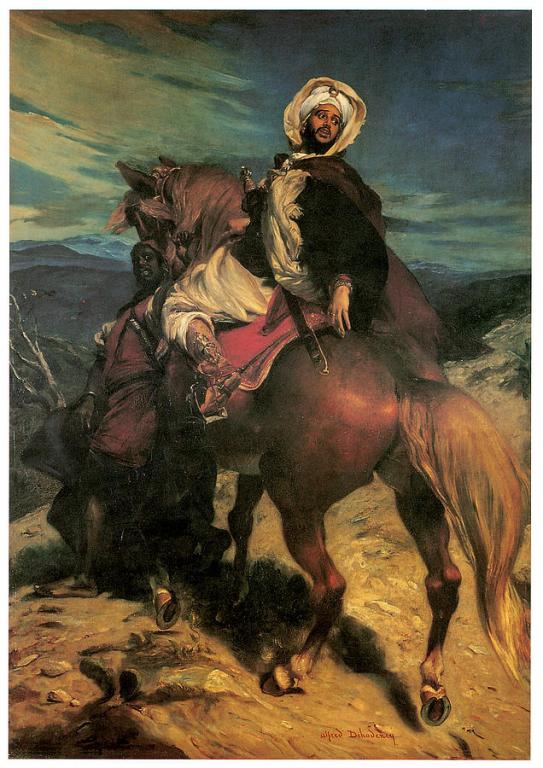
Alfred Dehodencq, Boabdil el Chico (1869)
Note Porter’s “melancholy farewell of the Moorish king,” which perfectly fits Boabdil. As I said, Aben Humeya is normally credited as author, but Porter is absolutely not alone in any confusion on this point.
When Porter was writing in the 1930s, the Golondrina was not well known in Anglo America, and I personally don’t know many early written references to it. But Porter herself knew Mexico very well indeed and was closely associated with Mexican radicals and leftists in the 1920s. A sociable woman, she had probably married a couple of them. (As she declared in her own defense, “I have no hidden marriages. They just sort of escape my mind.”)
Peckinpah and Porter
So what is the Peckinpah link? I’m glad you asked. In 1965, Peckinpah’s career was in meltdown, having had desperate struggles with the studio over his film Major Dundee. He had undoubtedly heard the classic words “You’ll never work in this town again!” Unable to make movies, what he did instead, in 1966, was to write and direct a stunning television production for ABC’s Stage 67, which was so excellent that it restored his career and reputation. Many people still regard his work in this television piece as a classic, a masterpiece of the medium. Based on that new credibility, Peckinpah went off to make his passion project, which was The Wild Bunch. That appeared in 1969, and it left Western fans around the world singing La Golondrina. Some of us still do.
So what was the television production that restored his reputation? It was Porter’s Noon Wine, one of the three novellas in the 1939 collection, and she herself was very pleased with his script. Indeed, without her strong recommendation, he would never have got the contract. Porter herself was at the top of her reputation in 1966, the year she won a Pulitzer Prize and the National Book Award. As a Texan with a deep interest in the borderlands and the West, she shared a common sensibility with the Californian Peckinpah. Both The Wild Bunch and Old Mortality begin in south Texas. In the latter book, not long after the dance scene I quoted earlier, Harry flees to Mexico to escape scandal and potentially lethal violence.
Peckinpah was a literate soul. In order to do his adaptation, he obviously read Noon Wine, the middle story in the collection. It is surely safe to assume that he also read the first piece, which is Old Mortality, with that lovely passage about the Golondrina. I think that is where he got the idea for the song, and how to use it in the film. Given the topics he was obsessed with throughout his career – death, nostalgia, the passing of an old world – how could he have resisted a title like Old Mortality? That would not have been a bad alternate title for The Wild Bunch itself. More to the point, his film addresses so many of the same themes that are central to Old Mortality, such as shifting values, and the legends by which people live and die. Not to mention fleeing to a more authentic West in Mexico.
Porter had a deep interest in film-making, dating back at least to the 1920s. Surely, Peckinpah must have read her 1934 story Hacienda, which is about making a major film in Mexico, and specifically about searching for locations. This grew out of her work with Sergei Eisenstein and his Soviet associates, as they strove to make Que Viva Mexico! Especially in his editing techniques, Eisenstein was a mighty influence on Peckinpah. Sentences like the following from Hacienda must have resonated powerfully with Peckinpah: “The camera had caught and fixed in moments of violence and senseless excitement, of cruel living and tortured death, the almost ecstatic death-expectancy which is in the air of Mexico.” Does that not sound like a foreshadowing of The Wild Bunch? Porter and Peckinpah really would have had a lot to talk about.
A Tribute?
Was the use of La Golondrina in the film an explicit nod to Porter? Without her Noon Wine, there would have been no Wild Bunch. The film is full of other tributes and nods to iconic figures. The final scenes borrow visually from Treasure of the Sierra Madre: that’s why the Wild Bunch riders at that point unaccountably decide to don their hats under the Mexican sun. Musically, the film’s other best known song is the hymn Shall We Gather At The River, which was an instantly recognizable trademark of John Ford. It appears in seven of Ford’s films. (That hymn dates from 1864, Golondrina from 1862). Its use in The Wild Bunch can’t be understood except as a Ford hommage. So why should Peckinpah not salute his fellow Western free spirit, Mrs. Porter?
I think I am the first person to make the Old Mortality connection: do correct me if I am wrong.
It does all make me wonder what other strange linkages I might encounter between fields of interest that on the surface have nothing whatever to do with each other.
Last year, I had the great pleasure of reading W. K. Stratton’s wonderful book The Wild Bunch: Sam Peckinpah, a Revolution in Hollywood, and the Making of a Legendary Film (Bloomsbury 2019). Jerry Holt has a chapter on “La Golondrina: The Secret Text of The Wild Bunch,” in Michael Bliss, ed., A Uniquely American Epic: Intimacy and Action, Tenderness and Violence in Sam Peckinpah’s The Wild Bunch (University Press of Kentucky, 2019). An excellent older read is Thomas F. Walsh, Katherine Anne Porter and Mexico: The Illusion of Eden (University of Texas, 1992). You could easily use that subtitle for a book on Peckinpah’s Mexico.
Previous Post

December 24, 2020
On Pandemic Christmas Eve
Next Post

December 28, 2020 Religion and Violence: A Book Review
Browse Our Archives
Select a Category abolitionism Abortion Abraham Joshua Heschel Abraham Kuyper Abraham Lincoln Academia Activism Adam Renberg Advent Adventist africa African American Religion Agnes Howard Albert Camus American History American Religious History American Revolution American West Anabaptists Ancient History Andrea Turpin Andrei Tarkovsky Anglicanism Annales Ansley Lillian Quiros anti-Catholicism Antisemitism Anxious Bench apologetics Apparitions Arash Azizi Archaeology archives art Artificial Intelligence Asia Asian Americans Augustine Authors Bad Bunny Baptism Baptists Barack Obama Battle of Hastings Benjamin Franklin Bernard-Henri Levy Beth Allison Barr Beth Moore Bethany Mannon Bible Bill Cunningham Billy Graham Black Music Bob Dylan Body Boenhoffer Books Breastfeeding Bruce Springsteen C.S. Lewis Calvinism Cancel Culture Capitalism Carmelites Catholicism Cedric Robinson Cesar Chavez Charismaticism charity Charles Dickens Charles Lindbergh Che Guevara Chicago Children Chinese Christianity Chris Gehrz Christ Christian death Christian Higher Education Christian life Christian Nation Christian Nationalism Christianity Today Christmas Church life Church Practice cinema Civil Religion Civil Rights Movement Civil War civility Classics Climate Change Cold War Colonial Mexico colonialism Comer Communism community complementarianism Conference on Faith and History Congregationalism Conspiracies Conspiracy Conversion Narratives Coronavirus Costa Rica Council of Nicaea Covid-19 Creation Critical Race Theory Crusades Culture culture wars Daniel K. Williams David Barton David Swartz Death Ways death with dignity DEI democracy Democratic Party Devotion Digital Age Diplomacy discipleship diversity Donald Trump Drama Dua Lipa Early Church early modern Early modern Catholicism Easter Eastern Christianity economic exploitation Education elections Elie Wiesel Elizabeth II Elizabeth Taylor emotions Empire Engineering England enslavement Entertainment Episcopal Church Erica Ramirez eschatology Eurocentrism Evangelicalism Evangelicals Exegesis Family Feminism Film Flannery O'Connor folk music Food Foreign Policy founding fathers Franciscans Franciscus Junius fundamentalism Funerals G.K. Chesterton Gender Genocide genre geography George W. Bush George Washington George Whitefield Global Christianity Global church Grief Guadalupe guest post Guest Post gun control gun violence Gustavo Gutierrez Hamid Dabashi Harold John Ockenga Harvest Hate Hawaiian Christianity Healing health care Heather Cox Richardson Hell Heresy Hermeneutics Higher Education Hinduism Hippocratic oath Historical Fiction Historical Methodology Historical Profession Historical Profession Historical Theology Historical Thinking historiography Holidays Holocaust horror movies Human rights Humanitarian Work humanities Hummingbirds Hungary hymns Imago Dei Immigration Injustice Interviews Iran Islam Islamophobia Israel Ivan's Childhood Jacob Randolph James Bratt Janine Giordano Drake Japanese history Japanese Literature Jean Paul Sartre Jesse Miranda Jesus Jesus Christ Jimmy Carter Joan Baez Joan Didion Joanne Freeman João B. Chaves Joao Chaves Joey Cochran John Calvin John Fea John Tillotson John Turner Johnny Cash Jonathan Edwards Jonathan Tran Joseph Smith Josh Howerton Journalism Jr. Judaism Jürgen Moltmann Just War Justice Justin Brierley Karl Barth Katelyn Beaty koi ponds Kris Kristofferson Kristin Kobes Du Mez Latin American Religious History Latino Americans Lectio Divina Leisure Lent Leonard Cohen liberal arts liberalism Liberation Theology Linda Ronstadt Lisa Clark Diller Literature Lou Reed Lynchings Lynneth Miller Renberg Mainline Protestantism Malcolm Foley Marilyn Monroe Maritime history Mark Noll Marriage Martin Luther Martin Luther King Martyrdom Marxism Mary Masih Alinejad mass shootings material culture medieval Christianity Medieval Ethiopia Melissa Borja memory Mennonites Mental Health Mental Illness Methodism Mexican Americans Mexicans Mike Madrid Miles Mullin Min Jin Lee Miscarriage Missionaries Mister Rogers Mitt Romney modernity Monasticism Mormonism Motherhood Mothers of the Church Moving Music Musicals Nadya Williams Nahua Christianity Native Americans Natsume Sōseki New Contributor New England New Year New York Nico Non-Violent Protest Orthodoxy pacifism Paleo Evangelicals Palestinians Parenting Patti Smith Paul Kingsnorth Pedro Calderón de la Barca Pentecostalism Philip Jenkins Phillis Wheatley physician-assisted suicide pilgrimage Pilgrims pluralism Plutocracy Poetry Politics Pope Francis Pope Leo XIV post-modernism prayer preaching Presbyterians prosperity gospel Protest Public history Publishing Puritans purity culture Quakers race Race Massacres Racial Capitalism racial reconciliation racialization Racism Raha Bahloulipour Re-Enchantment reading Reformation Refugees religion and the university religion and war Religious Freedom Religious Nones Religious Pluralism Religious Symbols religious violence Republican Party Revival Rita Coolidge Ritual Roger Williams Roman Catholic church Royalty Russell Moore same-sex marriage Sarah Irving-Stonebraker Scandinavia Science Science and Technology Scopes trial Scriptural Interpretation secularism Selena Quintanilla seminary Seventh-Day Adventists sexual morality Sexuality Sikhs Silence slaveholders theology Slavery Slavoj Zizek social justice Social Media Southern Baptist Convention Southern Religion Spain Spiritual Autobiography Spiritual but not religious Spiritual Discipline Sports Stanley Hauerwas Suffering Summer Camps Sunday Night Odds and Ends Supernatural Supreme Court Syriac Christianity Tal Howard Taylor Swift Teaching Technology Television Thanksgiving The Beatles The Mission theater TheoBros Theology Thomas Dixon Thomas Jefferson Thomas Kidd Thomas Merton Tim Gloege Tim Walz Tom Holland Tourism tradition Tragedy Translation Transnationalism Travel Trump Ukraine Uncategorized Unitarians United Methodist Church US History Vanessa Chan Velvet Underground Verónica A. Gutiérrez Veronica Gutierrez Vikings Violence Virgin Mary Virtue Virtue ethics Visions Voting War WCTU Wendell Berry Westminster Assembly White Evangelicalism Wildfires Winnie the Pooh Witches women Women in Ministry Women's and Gender Studies Work Worship writing Yasunari Kawabata Zena Hitz
Select a Month October 2026 September 2026 August 2026 July 2026 June 2026 May 2026 April 2026 March 2026 February 2026 January 2026 December 2025 November 2025 October 2025 September 2025 August 2025 July 2025 June 2025 May 2025 April 2025 March 2025 February 2025 January 2025 December 2024 November 2024 October 2024 September 2024 August 2024 July 2024 June 2024 May 2024 April 2024 March 2024 February 2024 January 2024 December 2023 November 2023 October 2023 September 2023 August 2023 July 2023 June 2023 May 2023 April 2023 March 2023 February 2023 January 2023 December 2022 November 2022 October 2022 September 2022 August 2022 July 2022 June 2022 May 2022 April 2022 March 2022 February 2022 January 2022 December 2021 November 2021 October 2021 September 2021 August 2021 July 2021 June 2021 May 2021 April 2021 March 2021 February 2021 January 2021 December 2020 November 2020 October 2020 September 2020 August 2020 July 2020 June 2020 May 2020 April 2020 March 2020 February 2020 January 2020 December 2019 November 2019 October 2019 September 2019 August 2019 July 2019 June 2019 May 2019 April 2019 March 2019 February 2019 January 2019 December 2018 November 2018 October 2018 September 2018 August 2018 July 2018 June 2018 May 2018 April 2018 March 2018 February 2018 January 2018 December 2017 November 2017 October 2017 September 2017 August 2017 July 2017 June 2017 May 2017 April 2017 March 2017 February 2017 January 2017 December 2016 November 2016 October 2016 September 2016 August 2016 July 2016 June 2016 May 2016 April 2016 March 2016 February 2016 January 2016 December 2015 November 2015 October 2015 September 2015 August 2015 July 2015 June 2015 May 2015 April 2015 March 2015 February 2015 January 2015 December 2014 November 2014 October 2014 September 2014 August 2014 July 2014 June 2014 May 2014 April 2014 March 2014 February 2014 January 2014 December 2013 November 2013 October 2013 September 2013 August 2013 July 2013 June 2013 May 2013 April 2013 March 2013 February 2013 January 2013 December 2012 November 2012 October 2012 September 2012 August 2012 July 2012 June 2012 May 2012
Follow Us!
TAKE THE
Religious Wisdom Quiz
Though you sit among the coals lamenting, you must remember that_________. What does Lamentations say will not cease?
Select your answer to see how you score.
His compassions His presence His love His covenant
Related posts from Anxious Bench

Fairies, Witches, Folk Horror, and the Secret Commonwealth

Hogg’s Justified Sinner: A Gothic Classic for Halloween

James Hogg, Weird Wives, and Feminist Witches

How an Explosive Book Rewrote the Study of...
TRENDING AT PATHEOS Evangelical

The First Eucharistic Controversy: Christ’s Real Presence
For Catholics, the Eucharist is the source and summit of the Christian...

What a Stop Sign Can Teach Us About...
How to Make a Decision When You Can't Hear God Main point:...

Archdiocese Hosts Military Marriage Retreat in Germany
RASTATT, Germany — The transient military lifestyle, with its frequent deployments and...

Nearly every morning, I make the drive to Detroit with my high-school-age...

The Real AI Story Is Adoption Without Trust
Artificial intelligence has crossed a political threshold. It is no longer a...

A new article, written by Jeff Lindsay and Gale L. Pooley,...
view all Evangelical blogs
Ad-Free & Subscriber Log-In Subscription Support
- About Us
- 2026 Calendar
- Videos
- Podcasts
- Library of World Religions
- Faith In Media Tracker
- Advertise With Us
- Write for Us
- Privacy Policy
- Terms of Service
- Do Not Sell My Data
- Contact Us
- Radiant Digital
- Manage Newsletter Subscriptions
- Unsubscribe From Notifications
- Sitemap
Copyright 2008-2026, Patheos. All rights reserved.
Subscription Support Ad-Free & Subscriber Log-In
Follow Patheos