
BuddhistCatholicContemplativeEvangelicalGeneral ChristianHinduJewishLatter-day SaintMuslimNew VisionsProgressive Christian
Beliefs
- Buddhist
- Catholic
- Contemplative
- Evangelical
- General Christian
- Hindu
- Jewish
- Latter-day Saint
- More Voices
- Muslim
- New Visions
- Pagan
- Progressive Christian
Topics
- Religion News
- Food and Religion
- Sports and Religion
- Religious Art
- Religious Music and Entertainment
- Religious Events
- History and Religion
- Style and Religion
- Politics and Religion
- Women in Religion
- Recreation Outdoors and Religion
- Business Finance and Religion
- Careers Workplace and Religion
- Education and Religion
- Family Parenting and Religion
- Health Fitness and Religion
- Home and Religion
- Relationships and Religion
- Technology and Religion
- Travel and Religion
Columnists
- Buddhist Columnists
- Business Finance and Religion Columnists
- Careers Workplace and Religion Columnists
- Catholic Columnists
- Contemplative Columnists
- Education and Religion Columnists
- Evangelists Columnists
- Family Parenting and Religion Columnists
- General Christian Columnists
- Health Fitness and Religion Columnists
- Hindu Columnists
- History and Religion Columnists
- Home and Religion Columnists
- Jewish Columnists
- More Voices Columnists
- Latter Day Columnists
- Muslim Columnists
- New Visions Columnists
- Nonreligious Columnists
- Pagan Columnists
- Politics and Religion Columnists
- Progressive Columnists
- Recreation Outdoors and Religion Columnists
- Relationships and Religion Columnists
- Religion News Columnists
- Religious Art Columnists
- Religious Events Columnists
- Religious Music and Entertainment Columnists
- Sports and Religion Columnists
- Style and Religion Columnists
- Technology and Religion Columnists
- Travel and Religion Columnists
- Women in Religion Columnists
Resource Library
- 2026 Calendar
- Library of World Religions
- The 100 Most Holy Places on Earth
- Patheos Answers
- Podcasts
- Videos
- Faith Leaders Database
- Anglican Episcopalian
- Bahai
- Baptist
- Buddhism
- Christianity
- Confucianism
- Eastern Orthodoxy
- Hinduism
- Holiness and Pentecostal
- ISKCON
- Islam
- Judaism
- Lutheran
- Methodist
- The Church of Jesus Christ of Latter-day Saints
- New Age
- Paganism
- Presbytarian and Reformed
- Protestantism
- Religion Behind the Scenes
- Roman Catholic
- Scientology
- Shia Islam
- Sikhism
- Sufism
- Sunni Islam
- Taoism
- Zen
- See all religions
Research Tools
 Ad-Free & Subscriber Log-In Subscription Support
Ad-Free & Subscriber Log-In Subscription Support
Follow Patheos 

- Trending:
- Forgiveness
- |
- Marriage
- |
- Consciousness
- |
- Death Penalty
- |
- Election
- |
- Halloween

-
About the Authors
- Home
- Evangelical
- Reading Churches and Reading American History
Reading Churches and Reading American History
Last updated on: December 21, 2020 at 12:39 am by Philip Jenkins
Reading Churches and Reading American History 2020-12-19T14:01:32-04:00 Philip Jenkins
Patheos Explore the world's faith through different perspectives on religion and spirituality! Patheos has the views of the prevalent religions and spiritualities of the world.
This is another in my posts on “reading” churches and their denominations to find what they can tell you about local and regional history, with a strong emphasis on ethnicity. Although I will focus on one area, namely in Central Pennsylvania, a lot of what I say (I think) has much wider application.
When I was growing up in Wales, churches supplied me with a very large part of my education. These were the long lost days before the dark times, before the insurance companies ordered local churches to stay locked always when unsupervised, and generally outside regular service times. In consequence, you could then enter pretty much any medieval church any time, and learn an immense amount about its history, as well as its art, sculpture, architecture, and design, often encountering objects and images of the highest aesthetic quality. All the while, usually, having the place to yourself. On a good day, a substantial church-crawl might take in three or four really old buildings and church-yards. So surely, you can’t compare the lesson to be learned from a thirteenth century British parish church with what you might find in a small village site in Pennsylvania? No – but you can learn lots of different things.
I live part of my life in central Pennsylvania, where I have spent much more time than I expected recently in light of the pandemic. Based in the university town of State College, I often explore the country areas located just a few miles outside town, but which are nevertheless very rural indeed.
Q: How rural are they?
A: The posters about social distancing advise you to stay at least one cow’s length apart. Or two calves. Really.
Every small town and village has a couple of quite imposing older churches, often dating back to the early or mid-nineteenth century. In my particular area, European settlement began only around the Revolutionary War, and not much is visible from before 1800 or so, but tut there was then a major building boom through the first half of the century. Based on a great deal of local church-crawling, I offer the following very general guidelines for wider application.
Everything is Local
The first point is that religious history is strictly local, and the specific things I am observing and describing would not necessarily apply to other parts of Pennsylvania, to the Western or North-Eastern industrial areas of the state, nor to other rural regions. And as to other states, good heavens, no. The principles apply, but the details of economics and ethnicity, of immigration and denominations, vary enormously within just a few miles. That does not mean that findings in this part of Pennsylvania don’t have wider application, and some can be extended across the country, in cities as well as villages. You just have to be very careful about the details. Nuance is all, and the devil is in the denominations … I can’t believe I said that.
As I described in earlier posts, American religion is highly congregational in tone, but denominations still matter as badges of ethnicity and class, at least as much as theology or social teaching. My personal map of this particular area notes denominations as key markers. Where there are Presbyterians, there were Scotch-Irish, very likely arrivals from the years between 1770 and 1830. Germans – Lutheran and Reformed – are the next generation, and on through the nineteenth century. Those German churches can take a little work identifying, because of subsequent mergers and acquisitions. The once very important Reformed later joined the United Church of Christ, UCC, so UCC churches proliferate in these small rural communities.
The Methodists are a confusing bunch. Yes, there were early British/Irish-oriented Methodists in the area. But in the nineteenth century, there were small and Methodist-ish German denominations, such as the Evangelical Association (Evangelical Church) and the United Brethren, who over time merged into the United Methodists. You have to be attentive seeing a United Methodist church today, to see if it had those German roots, or if it had an Anglophone origin.
This set-up was novel to me in various ways, particularly the very strong German grounding. I don’t believe I ever saw a Lutheran church (for instance) in the UK. There might have been a couple in big cities and seaports, to service Scandinavian crews and visitors, or German emigrés. Pennsylvania was my first lived introduction to German realities, and they are everywhere.
Moving On Up
People build churches as expressions of community, and as communities change, so religious buildings alter and evolve. If you date religious buildings with fair accuracy, you can see new social groups emerging, and others vanishing. In the areas of my observation, the basic realities fit the four foundational groups – Presbyterian, Lutheran, Reformed, Methodist. When you see other groups, you can be pretty sure that they arrived to fill some later niche. See the Roman Catholic church for the rise of industrial populations, often the groups building the canals or railroads, or working in the mills. That’s not entirely true, as you can find German Catholics settling as farmers and merchants but they are rarer. Then, a bit later, you find Episcopalians settling, as a town acquires some social pretensions, and some professional prosperity. Like I say, the picture would be different elsewhere, for instance in New England or Maryland, but those are different ecclesiastical planets from Pennsylvania.
As a town booms on the basis of some form of industrial or commercial wealth, so the old established churches rebuild, often on a very impressive scale. Tell me the main denominations with the grand old buildings, and I will show you where the lawyers, merchants, professionals, and mill owners went to pray. In many or most older towns, those churches follow a similar pattern, arranged in rows along a block or two, with a very predictable range of denominations. These are the blocks where you can’t throw a stone without hitting a mainline church, and usually breaking a rather fine stained glass window. Usually, they are not too far removed from the county courthouse, if indeed you are dealing with a county seat. Sometimes the Catholics are in the same region, sometimes they are a few blocks away, literally across the tracks. If there is a Black church, usually AME, it will be located discreetly and humbly.
Right in the middle of those Protestant mainliners, you will pretty much always find the Masonic Temple, usually built on a scale very comparable to the grandest Presbyterian or Methodist quasi-cathedrals. Some people might try to write the history of mainline churches in the US before the 1960s without taking account of the Freemasons, but it is a fool’s game. Except for Catholics, always assume that the leading local clergy were Masons, and that is true across the country.
The Great Rebuilding
The better you know the roots of those mainline churches, the appearance of many of those buildings should surprise. Many originated in Reformation struggles where visual or material symbols of faith were deeply controversial. As large stone churches proliferated in the nineteenth century, and denominations frankly competed to produce the most impressive buildings, so they used a standard range of decoration, following standard architectural guides. Hence Presbyterians and Reformed found no obvious problem in very classically “churchy” products with stained glass windows and sculptures, even with angels and stone crosses. The reactions of their iconoclastic ancestors to such innovations are not recorded. The fact that we don’t find such things startling is testimony to how thoroughly those once “High” styles and customs were mainstreamed and normalized.
Looking at a stately neo-medieval church in a midsize town, it is very difficult indeed to locate it according to denomination. As a case in point, I offer a handsome church of the sort that you might find in any American town or city from the expansive era between 1870 and 1940. This particular example is located in State College, and it dates from 1913. But what is it by denomination? You could easily believe Episcopal, or Methodist, or Lutheran, or even Catholic. It is actually Presbyterian, specifically PCUSA, although no architectural indicator points to that fact.
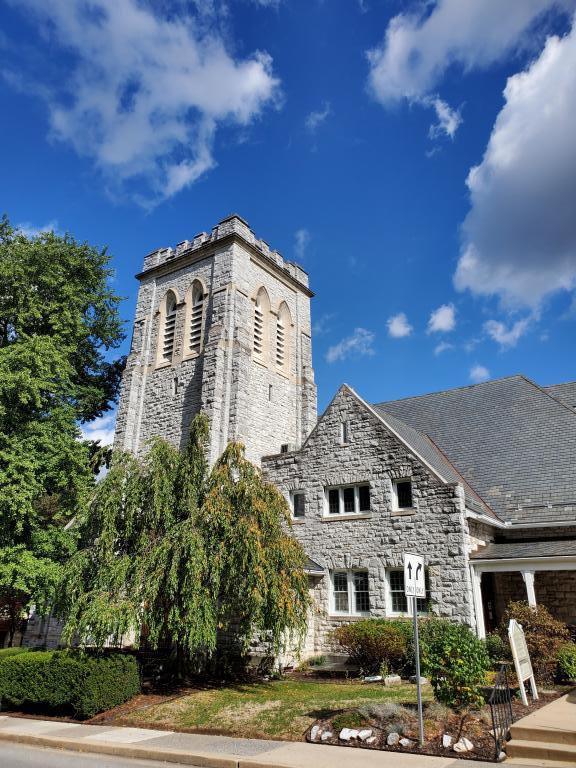
Here is what I consider a lovely church in a smaller Pennsylvania community, namely Centre Hall. In this case, the architecture gives away its German origins, and it was originally German Reformed (it is now UCC). But with its medieval reminiscences, it could easily belong to any of the other mainliners.
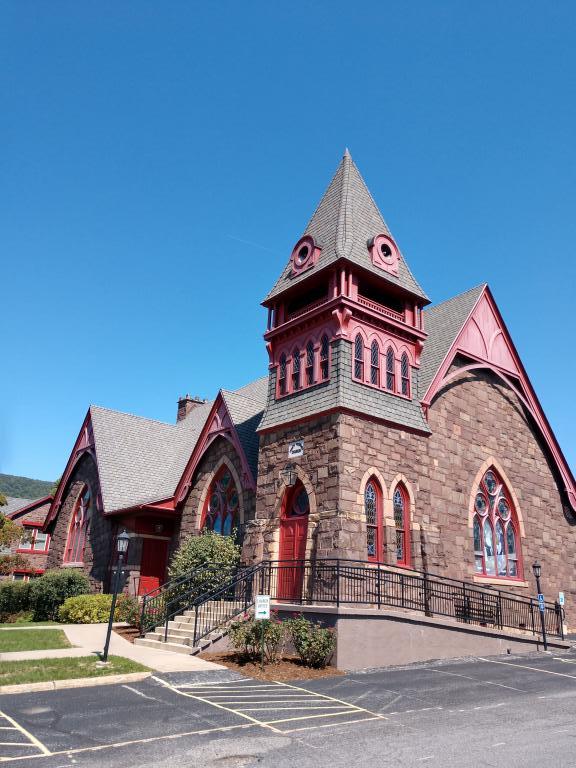
Or how about another very pretty medieval imitation, drawing on fourteenth century English Gothic style, complete with stained glass windows? This one (built in 1932) was also Reformed, but is now UCC.
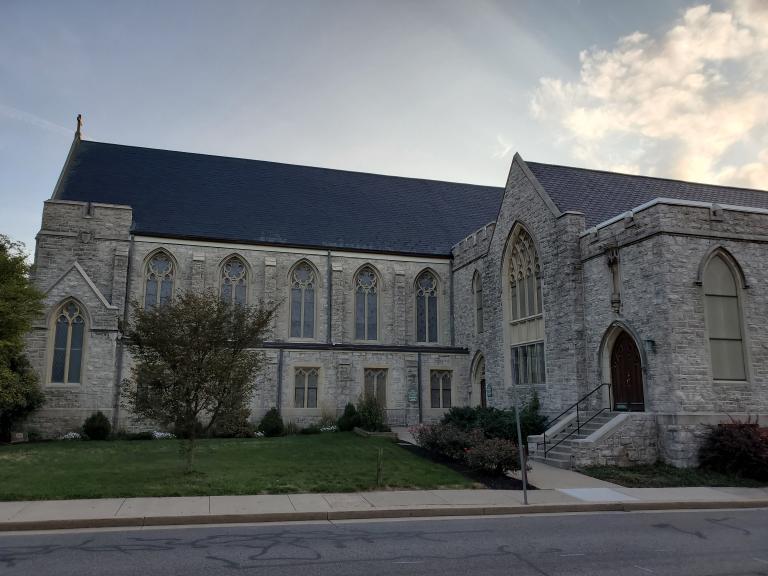
Without any empirical evidence whatever, I offer the suggestion that sharing common styles of church appearance contributed to reducing denominational hostilities and contentions, and in the twentieth century, promoted a sense of a common mainline identity. It certainly took a lot of the old debates about images off the table.
The Only Constant is Change
The buildings you see often did not begin with that particular affiliation. Changes at national level have their impact. I have already written about how denominations change over time, so that a German Reformed church (say) became a UCC institution in the 1950s, usually with little trace of that in the signage. If you didn’t know that history, you would not be able to find out by simply looking. Sometimes a foundation stone allows you to trace the story, but you have to get used to older labels and acronyms. “M.E.”, for instance, signifies Methodist Episcopal.
As communities get wealthier and move on up, so buildings change ownership in ways that can confuse. A congregation expands beyond its original building, or develops higher aspirations, and builds a grander new facility. But the older church building survives and is sold to some other group, so that one historic building can pass through multiple hands. As a case in point, I was looking at one grand UCC church that I knew had previously been Reformed, but was baffled why it had no confirming foundation stone. Then the reality struck. It was built as a first Presbyterian church, which the congregation occupied for a few years, before their aspirations grew even higher and they relocated yet again. When the Reformed moved in, they must have purged that foundation inscription, perhaps as part of a general remodeling.
In more modern times, the move away from historic structures is driven by factors other than growing wealth. It usually reflects demographic factors as the congregation moves out to the suburbs, while the quest for adequate parking for cars inspires new building in the suburbs. Historic buildings can then face several fates, from simple ruin to redevelopment in some other form, as private homes or artists’ studios or community centers. But many continue the sequence of passing to new and rising denominations.
Sometimes, those transitions produce startling results, and I know of cases where really venerable nineteenth century buildings have been acquired by very modern Pentecostal denominations, producing something of a culture clash. One example I cherish involved a very impressive village church of Victorian date where the new Pentecostal owners had put up a sign proclaiming “Established 33 AD”, causing near-road accidents as startled passers-by wondered about improbably early Christian missionary endeavors to Central Pennsylvania.
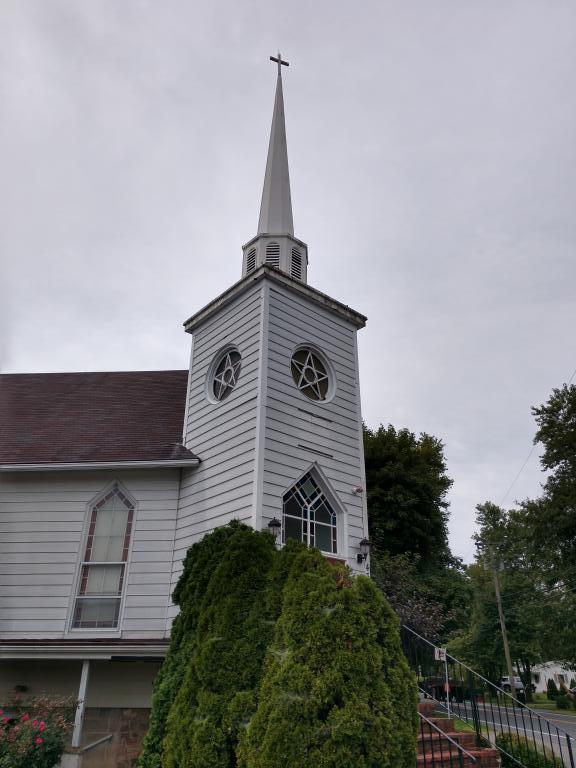
As a less subversive image, I offer this photograph of what was a historic Methodist church in a small village. You would be unlikely to guess that today it is Seventh Day Adventist, a fine denomination but not one usually associated with anything like this kind of architecture.
From my own professional work, I love seeing these processes continue, as old and fading churches with seriously aging congregations revive almost overnight as they initially share space with some new immigrant group. In recent years, the old urban churches have sprouted a lot of Korean signage, not to mention Chinese, Spanish, and so many other languages. Neatly reproducing the older lessons, you can with a little effort trace the origins of those newer congregations with some precision. In the nineteenth century, the newcomers were often not “German” but rather came from some particular region or principality, with its own traditions, which remained alive in the new country for a generation or two. Today, Latino congregations today can be no less diverse internally, and it pays to learn something about the map of Mexico (say). As with the German precedents, follow the food on offer at the fund-raisers, and it will usually point you in the right regional direction.
Of Things Not Seen
I have talked about the main denominations that you see, but scarcely less informative are those that you don’t encounter in particular areas. Some might surprise outsiders. In the area of Central Pennsylvania I am describing, Baptists often do not appear in that early stratum of congregations, and were later additions. In agricultural areas where the Germans and Scotch-Irish so predominated, the Baptist presence was often imported by later English industrial migrants, and mainly confined to regions near mines, mills, or ironworks.
Many years ago, the British humor writer Stephen Potter advised readers how to bluff their way through difficult social situations, when they are caught out speaking about matters on which they are quite unqualified. Imagine that you have just made an impressive-sounding pronouncement about conditions in, let’s say, Uzbekistan. Unfortunately, another person in the group has just returned from some years living and working in that country, and objects that your observation is totally groundless. Stephen Potter advised that you instantly agree with the person challenging or contradicting you, but that you should also nod sagely and add “Ah yes, it’s different in the south.” Needless to say, I would never play such a dishonest trick myself (although the saving tactic does indeed work wonders) but that maxim wholly applies to studying American churches and denominations. Much or most of what I am saying here really is different in the south.
Some things apply, especially about the grand historic churches clustering in select streets of small or midsize towns. But the weakness or absence of Baptists marks a critical difference, and the communities I am describing very rarely have anything like the palatial “First Baptist” edifices that are such a stunning part of the architectural landscape across much of the South. That picture changes somewhat when you wander into the suburban developments and see the newer constructions, where Baptists stand alongside Pentecostal and non-denominational structures. But that just is not true in most of the older areas.
To return to my point about the localism of American religion. If you wander Texas, you will everywhere observe those two mighty and widespread groupings, Baptists (of countless shades) and Churches of Christ. Realities are very different indeed in the North-East and Midwest.
Forward to the Past
Beyond Baptists, other omissions will also strike in the Pennsylvania areas I am talking about. A familiar stereotype links Pennsylvania history with Germans, and surely, that means Amish and other sectarian groups, such as Mennonites and Dunkers. Well, yes, you can find such older churches, but you have to look further afield in the countryside. One historical lesson you learn early about that immigration history is that the vast majority of newly arriving Germans were Christian and Protestant, but belonged to one of the two great institutional strands, the Lutheran or Reformed. They were “church people,” with the “sect people” a small if visible minority.
All of which brings me to a small oddity. If you live in the classic college town of State College, it is a very modern community with few surviving older remains, apart from the churches. But travel twenty or thirty miles and you are deep in an Amish countryside that looks like 1850. Joseph Yoder’s classic 1940 novel Rosanna of the Amish is set about 25 miles from State College. Such a contrast between modern town and older countryside is familiar in Europe, but there is a special story in this part of the world.
We often tend to think that the Amish must always have been in the areas we find them today, and that’s often not right. There has been a lot of change over time, and that is still very much in progress: Amish communities are surprisingly dynamic. Among other things, Rosanna tells you about very old Amish settlements in the Centre County area that the Amish gave up in the nineteenth century, before moving on elsewhere. Now that’s something we don’t often think about: whoever goes looking for the traces of such ex-Amish areas? But at the same time, however archaic they may seem, at least some of the modern-day Amish communities are very recent arrivals, as new migrants have built upon small older settlements. As Amish families prospered in familiar landscapes like Lancaster County, they wearied of all the traffic and tourism. In recent decades, many set up or expanded colonies in the center of the state, and these continue to expand. Witness the steady spread of those buggy road signs.
In this central region at least, the future looks ever more medieval.
Previous Post

December 18, 2020
Credulity, Superstition, and Fanaticism. And Rabbits.
Next Post

December 22, 2020 The Christian Eyewitnesses to Hiroshima
Browse Our Archives
Select a Category abolitionism Abortion Abraham Joshua Heschel Abraham Kuyper Abraham Lincoln Academia Activism Adam Renberg Advent Adventist africa African American Religion Agnes Howard Albert Camus American History American Religious History American Revolution American West Anabaptists Ancient History Andrea Turpin Andrei Tarkovsky Anglicanism Annales Ansley Lillian Quiros anti-Catholicism Antisemitism Anxious Bench apologetics Apparitions Arash Azizi Archaeology archives art Artificial Intelligence Asia Asian Americans Augustine Authors Bad Bunny Baptism Baptists Barack Obama Battle of Hastings Benjamin Franklin Bernard-Henri Levy Beth Allison Barr Beth Moore Bethany Mannon Bible Bill Cunningham Billy Graham Black Music Bob Dylan Body Boenhoffer Books Breastfeeding Bruce Springsteen C.S. Lewis Calvinism Cancel Culture Capitalism Carmelites Catholicism Cedric Robinson Cesar Chavez Charismaticism charity Charles Dickens Charles Lindbergh Che Guevara Chicago Children Chinese Christianity Chris Gehrz Christ Christian death Christian Higher Education Christian life Christian Nation Christian Nationalism Christianity Today Christmas Church life Church Practice cinema Civil Religion Civil Rights Movement Civil War civility Classics Climate Change Cold War Colonial Mexico colonialism Comer Communism community complementarianism Conference on Faith and History Congregationalism Conspiracies Conspiracy Conversion Narratives Coronavirus Costa Rica Council of Nicaea Covid-19 Creation Critical Race Theory Crusades Culture culture wars Daniel K. Williams David Barton David Swartz Death Ways death with dignity DEI democracy Democratic Party Devotion Digital Age Diplomacy discipleship diversity Donald Trump Drama Dua Lipa Early Church early modern Early modern Catholicism Easter Eastern Christianity economic exploitation Education elections Elie Wiesel Elizabeth II Elizabeth Taylor emotions Empire Engineering England enslavement Entertainment Episcopal Church Erica Ramirez eschatology Eurocentrism Evangelicalism Evangelicals Exegesis Family Feminism Film Flannery O'Connor folk music Food Foreign Policy founding fathers Franciscans Franciscus Junius fundamentalism Funerals G.K. Chesterton Gender Genocide genre geography George W. Bush George Washington George Whitefield Global Christianity Global church Grief Guadalupe guest post Guest Post gun control gun violence Gustavo Gutierrez Hamid Dabashi Harold John Ockenga Harvest Hate Hawaiian Christianity Healing health care Heather Cox Richardson Hell Heresy Hermeneutics Higher Education Hinduism Hippocratic oath Historical Fiction Historical Methodology Historical Profession Historical Profession Historical Theology Historical Thinking historiography Holidays Holocaust horror movies Human rights Humanitarian Work humanities Hummingbirds Hungary hymns Imago Dei Immigration Injustice Interviews Iran Islam Islamophobia Israel Ivan's Childhood Jacob Randolph James Bratt Janine Giordano Drake Japanese history Japanese Literature Jean Paul Sartre Jesse Miranda Jesus Jesus Christ Jimmy Carter Joan Baez Joan Didion Joanne Freeman João B. Chaves Joao Chaves Joey Cochran John Calvin John Fea John Tillotson John Turner Johnny Cash Jonathan Edwards Jonathan Tran Joseph Smith Josh Howerton Journalism Jr. Judaism Jürgen Moltmann Just War Justice Justin Brierley Karl Barth Katelyn Beaty koi ponds Kris Kristofferson Kristin Kobes Du Mez Latin American Religious History Latino Americans Lectio Divina Leisure Lent Leonard Cohen liberal arts liberalism Liberation Theology Linda Ronstadt Lisa Clark Diller Literature Lou Reed Lynchings Lynneth Miller Renberg Mainline Protestantism Malcolm Foley Marilyn Monroe Maritime history Mark Noll Marriage Martin Luther Martin Luther King Martyrdom Marxism Mary Masih Alinejad mass shootings material culture medieval Christianity Medieval Ethiopia Melissa Borja memory Mennonites Mental Health Mental Illness Methodism Mexican Americans Mexicans Mike Madrid Miles Mullin Min Jin Lee Miscarriage Missionaries Mister Rogers Mitt Romney modernity Monasticism Mormonism Motherhood Mothers of the Church Moving Music Musicals Nadya Williams Nahua Christianity Native Americans Natsume Sōseki New Contributor New England New Year New York Nico Non-Violent Protest Orthodoxy pacifism Paleo Evangelicals Palestinians Parenting Patti Smith Paul Kingsnorth Pedro Calderón de la Barca Pentecostalism Philip Jenkins Phillis Wheatley physician-assisted suicide pilgrimage Pilgrims pluralism Plutocracy Poetry Politics Pope Francis Pope Leo XIV post-modernism prayer preaching Presbyterians prosperity gospel Protest Public history Publishing Puritans purity culture Quakers race Race Massacres Racial Capitalism racial reconciliation racialization Racism Raha Bahloulipour Re-Enchantment reading Reformation Refugees religion and the university religion and war Religious Freedom Religious Nones Religious Pluralism Religious Symbols religious violence Republican Party Revival Rita Coolidge Ritual Roger Williams Roman Catholic church Royalty Russell Moore same-sex marriage Sarah Irving-Stonebraker Scandinavia Science Science and Technology Scopes trial Scriptural Interpretation secularism Selena Quintanilla seminary Seventh-Day Adventists sexual morality Sexuality Sikhs Silence slaveholders theology Slavery Slavoj Zizek social justice Social Media Southern Baptist Convention Southern Religion Spain Spiritual Autobiography Spiritual but not religious Spiritual Discipline Sports Stanley Hauerwas Suffering Summer Camps Sunday Night Odds and Ends Supernatural Supreme Court Syriac Christianity Tal Howard Taylor Swift Teaching Technology Television Thanksgiving The Beatles The Mission theater TheoBros Theology Thomas Dixon Thomas Jefferson Thomas Kidd Thomas Merton Tim Gloege Tim Walz Tom Holland Tourism tradition Tragedy Translation Transnationalism Travel Trump Ukraine Uncategorized Unitarians United Methodist Church US History Vanessa Chan Velvet Underground Verónica A. Gutiérrez Veronica Gutierrez Vikings Violence Virgin Mary Virtue Virtue ethics Visions Voting War WCTU Wendell Berry Westminster Assembly White Evangelicalism Wildfires Winnie the Pooh Witches women Women in Ministry Women's and Gender Studies Work Worship writing Yasunari Kawabata Zena Hitz
Select a Month October 2026 September 2026 August 2026 July 2026 June 2026 May 2026 April 2026 March 2026 February 2026 January 2026 December 2025 November 2025 October 2025 September 2025 August 2025 July 2025 June 2025 May 2025 April 2025 March 2025 February 2025 January 2025 December 2024 November 2024 October 2024 September 2024 August 2024 July 2024 June 2024 May 2024 April 2024 March 2024 February 2024 January 2024 December 2023 November 2023 October 2023 September 2023 August 2023 July 2023 June 2023 May 2023 April 2023 March 2023 February 2023 January 2023 December 2022 November 2022 October 2022 September 2022 August 2022 July 2022 June 2022 May 2022 April 2022 March 2022 February 2022 January 2022 December 2021 November 2021 October 2021 September 2021 August 2021 July 2021 June 2021 May 2021 April 2021 March 2021 February 2021 January 2021 December 2020 November 2020 October 2020 September 2020 August 2020 July 2020 June 2020 May 2020 April 2020 March 2020 February 2020 January 2020 December 2019 November 2019 October 2019 September 2019 August 2019 July 2019 June 2019 May 2019 April 2019 March 2019 February 2019 January 2019 December 2018 November 2018 October 2018 September 2018 August 2018 July 2018 June 2018 May 2018 April 2018 March 2018 February 2018 January 2018 December 2017 November 2017 October 2017 September 2017 August 2017 July 2017 June 2017 May 2017 April 2017 March 2017 February 2017 January 2017 December 2016 November 2016 October 2016 September 2016 August 2016 July 2016 June 2016 May 2016 April 2016 March 2016 February 2016 January 2016 December 2015 November 2015 October 2015 September 2015 August 2015 July 2015 June 2015 May 2015 April 2015 March 2015 February 2015 January 2015 December 2014 November 2014 October 2014 September 2014 August 2014 July 2014 June 2014 May 2014 April 2014 March 2014 February 2014 January 2014 December 2013 November 2013 October 2013 September 2013 August 2013 July 2013 June 2013 May 2013 April 2013 March 2013 February 2013 January 2013 December 2012 November 2012 October 2012 September 2012 August 2012 July 2012 June 2012 May 2012
Follow Us!
TAKE THE
Religious Wisdom Quiz
What Christian tradition requires confession to a priest for forgiveness of sins?
Select your answer to see how you score.
Baptist Roman Catholic Methodist Quaker
Related posts from Anxious Bench

Fairies, Witches, Folk Horror, and the Secret Commonwealth

Hogg’s Justified Sinner: A Gothic Classic for Halloween

James Hogg, Weird Wives, and Feminist Witches

How an Explosive Book Rewrote the Study of...
TRENDING AT PATHEOS Evangelical

Pope Leo Celebrates Mass for Nurses & Docs...
I don't have any idea how he did it, but Pope Leo...

The Sermon on the Mount, Part I: Matthew...
The Sermon on the Mount, Part I (Matthew 4:12-5:12) St. Matthew moves...

What's up from Crossway: Reviewing some of their latest A few weeks...

Janie Learns the Way of the Cross: A...
Teaching children about Jesus' Passion can be challenging. Many parents and educators...

Looking For Good Catholic Writing - October 2026
He alone extends the heavens, and he walks upon the waves of...

In "Irreplaceable," our book on vocation and technology, Trevor Sutton and I...
view all Evangelical blogs
Ad-Free & Subscriber Log-In Subscription Support
- About Us
- 2026 Calendar
- Videos
- Podcasts
- Library of World Religions
- Faith In Media Tracker
- Advertise With Us
- Write for Us
- Privacy Policy
- Terms of Service
- Do Not Sell My Data
- Contact Us
- Radiant Digital
- Manage Newsletter Subscriptions
- Unsubscribe From Notifications
- Sitemap
Copyright 2008-2026, Patheos. All rights reserved.
Subscription Support Ad-Free & Subscriber Log-In
Follow Patheos