
BuddhistCatholicContemplativeEvangelicalGeneral ChristianHinduJewishLatter-day SaintMuslimNew VisionsProgressive Christian
Beliefs
- Buddhist
- Catholic
- Contemplative
- Evangelical
- General Christian
- Hindu
- Jewish
- Latter-day Saint
- More Voices
- Muslim
- New Visions
- Pagan
- Progressive Christian
Topics
- Religion News
- Food and Religion
- Sports and Religion
- Religious Art
- Religious Music and Entertainment
- Religious Events
- History and Religion
- Style and Religion
- Politics and Religion
- Women in Religion
- Recreation Outdoors and Religion
- Business Finance and Religion
- Careers Workplace and Religion
- Education and Religion
- Family Parenting and Religion
- Health Fitness and Religion
- Home and Religion
- Relationships and Religion
- Technology and Religion
- Travel and Religion
Columnists
- Buddhist Columnists
- Business Finance and Religion Columnists
- Careers Workplace and Religion Columnists
- Catholic Columnists
- Contemplative Columnists
- Education and Religion Columnists
- Evangelists Columnists
- Family Parenting and Religion Columnists
- General Christian Columnists
- Health Fitness and Religion Columnists
- Hindu Columnists
- History and Religion Columnists
- Home and Religion Columnists
- Jewish Columnists
- More Voices Columnists
- Latter Day Columnists
- Muslim Columnists
- New Visions Columnists
- Nonreligious Columnists
- Pagan Columnists
- Politics and Religion Columnists
- Progressive Columnists
- Recreation Outdoors and Religion Columnists
- Relationships and Religion Columnists
- Religion News Columnists
- Religious Art Columnists
- Religious Events Columnists
- Religious Music and Entertainment Columnists
- Sports and Religion Columnists
- Style and Religion Columnists
- Technology and Religion Columnists
- Travel and Religion Columnists
- Women in Religion Columnists
Resource Library
- 2026 Calendar
- Library of World Religions
- The 100 Most Holy Places on Earth
- Patheos Answers
- Podcasts
- Videos
- Faith Leaders Database
- Anglican Episcopalian
- Bahai
- Baptist
- Buddhism
- Christianity
- Confucianism
- Eastern Orthodoxy
- Hinduism
- Holiness and Pentecostal
- ISKCON
- Islam
- Judaism
- Lutheran
- Methodist
- The Church of Jesus Christ of Latter-day Saints
- New Age
- Paganism
- Presbytarian and Reformed
- Protestantism
- Religion Behind the Scenes
- Roman Catholic
- Scientology
- Shia Islam
- Sikhism
- Sufism
- Sunni Islam
- Taoism
- Zen
- See all religions
Research Tools
 Ad-Free & Subscriber Log-In Subscription Support
Ad-Free & Subscriber Log-In Subscription Support
Follow Patheos 

- Trending:
- Forgiveness
- |
- Marriage
- |
- Consciousness
- |
- Death Penalty
- |
- Election
- |
- Halloween

-
About the Authors
- Home
- Evangelical
- I’m Dreaming of an Asian American Christmas
I’m Dreaming of an Asian American Christmas
Last updated on: December 14, 2020 at 9:46 pm by Melissa Borja
I’m Dreaming of an Asian American Christmas 2020-12-14T21:46:58-04:00 Melissa Borja
Patheos Explore the world's faith through different perspectives on religion and spirituality! Patheos has the views of the prevalent religions and spiritualities of the world.
https://www.youtube.com/watch?v=AmW5GO6btMM
When Irving Berlin wrote that he was “dreaming of a white Christmas,” he was writing about snow, not about racial representation. But the reality is that so many Christmas films—especially the romantic comedies that I confess that I adore—continue to be about white people. The Christmas Prince trilogy offers a useful example: a sweet (white) girl, a handsome (white) man, a romance that blossoms amid freshly fallen (white) snow, and, if there is baking to be done, an adorable mess of (white) flour. There are exceptions, to be sure, but time and again, holiday films have focused on white, middle-class, Christian people and deployed a formula that has drawn criticism for its lack of diversity.
But this year offers a new possibility: Asian American holiday romantic comedies! Last night, Lifetime aired A Sugar & Spice Holiday, about a Chinese American architect who returns home for the holidays, reconnects with a boy from high school, and (of course) participates in a baking competition. And last month, Hallmark released The Christmas Bow, about an Asian American violinist who, while recovering from a hand injury, finds love and hope during the holidays. (A hometown love interest is involved with that story, too, although I’m not sure if there is any baking.)
My favorite option, though, is Netflix’s Dash & Lily. Aside from the issue of racial representation, Dash & Lily has a few characteristics that set it apart in the genre of holiday romantic comedies – it isn’t a film, but a streaming television series, and it’s based on a series of popular young adult novels written by David Levithan and Rachel Cohn.
What I find most interesting, though, is how Dash & Lily portrays the distinctive ways that Asian Americans, and Japanese Americans in particular, celebrate the holidays. In this regard, the series invites some useful questions for consideration. How does centering an Asian American character change the stories we might tell about Christmas and New Year? And how does focusing on different people challenge us to shift our assumptions about the rituals and meanings of the winter holidays?
By centering an Asian American character, Dash & Lily does more than add new faces to the traditionally white genre of holiday films. It also challenges viewers to consider real-life diversity and the rich array of holiday rituals practiced by an increasingly multiracial and multireligious America. Ultimately, Dash & Lily offers an opportunity to reflect on how Asian Americans do Christmas and New Year on their own terms.
An Asian American Holiday Rom-Com
Dash & Lily tells the story of the budding romance between Dash and Lily, two teenagers living in New York City. Lily is biracial and Japanese American, and elements of Asian American life are present throughout the film. We see Lily interact frequently with her large, biracial extended family, especially her stern grandfather and her eccentric aunt. (These relationships reflect reality – according to the Pew Research Center, Asian Americans are the racial group with the highest percentage of multigenerational households in the U.S.)
Lily doesn’t just happen to be Asian American; in fact, her racial identity is important to the story. Midway in the series, Lily reveals that being Asian American is one reason she feels marginalized from her classmates. In a dramatic scene at a downtown poetry slam, Lily stands before a stunned audience and gives an impromptu speech in which she unleashes her anger at Edgar, a boy whose middle school teasing had caused her years of social insecurity and isolation. “I wish I could have stood up to all the bullies who made me feel too weird, too different, too Asian,” she declares.
The pain she articulates—about being an outcast for being too Asian—owes in part to the initiative of Midori Francis, the actor cast as Lily. Although the novel on which the show is based does not specify that Lily is Asian American, Francis seized the opportunity to make Lily an Asian American character who reflected her own experiences. As she explained in an interview with Refinery 29,
For me, a big part of being bullied growing up — because I was. Or teased — was the way I looked. Especially at that time, when there was no representation. If you don’t fit that kind of Eurocentric mold, you’re not attractive. I talked to our showrunner, Joe Tracz, about it. I was like, “Hey, what do you think about this speech being the time where we bring it up?”…So that was such a special cap for that speech for me. Because me, as Midori, if I was going to stick up to any of my bullies, that would be a part of it.
Troy Iwata, who played her brother and is also Asian American, also expressed pride in being part of a project that features “a lot of different kinds of people from different cultures and different backgrounds and different identities.” As he told Elite Daily, “I am proud to be part of a show that is part of that step towards progression when it comes to representation.”
Because Dash & Lily is a holiday film, the effort to provide diverse representation involves more than including Asian American people and reflecting their lived experiences of racism. It also sheds light on the distinctive rituals embraced by many Asian Americans during the holiday season. Especially since the holiday romcom genre typically centers on Christian norms, Dash & Lily’s effort to depict Asian American ritual life offers important religious representation in addition to racial and cultural representation.
When she is first introduced, Lily appears to celebrate Christmas in the same ways that most Americans do. She sings carols in the park. She decorates lavishly. She dons a festive Christmas sweater, complete with a tree that lights up in rainbow colors.
But as the show progresses, we see how Lily’s holiday practices reflect her Japanese roots, too. In one episode, Lily challenges Dash to make mochi (a type of rice cake) with a group of Japanese women. As her family prepares to leave New York City, Lily receives advice from her mother about osoji, the Japanese tradition of cleaning the house at year’s end and “leaving everything bad behind.” And on New Year, she and her family gather at a temple, where Lily’s grandfather gives otoshidama, or envelopes containing gifts of money, to the children.
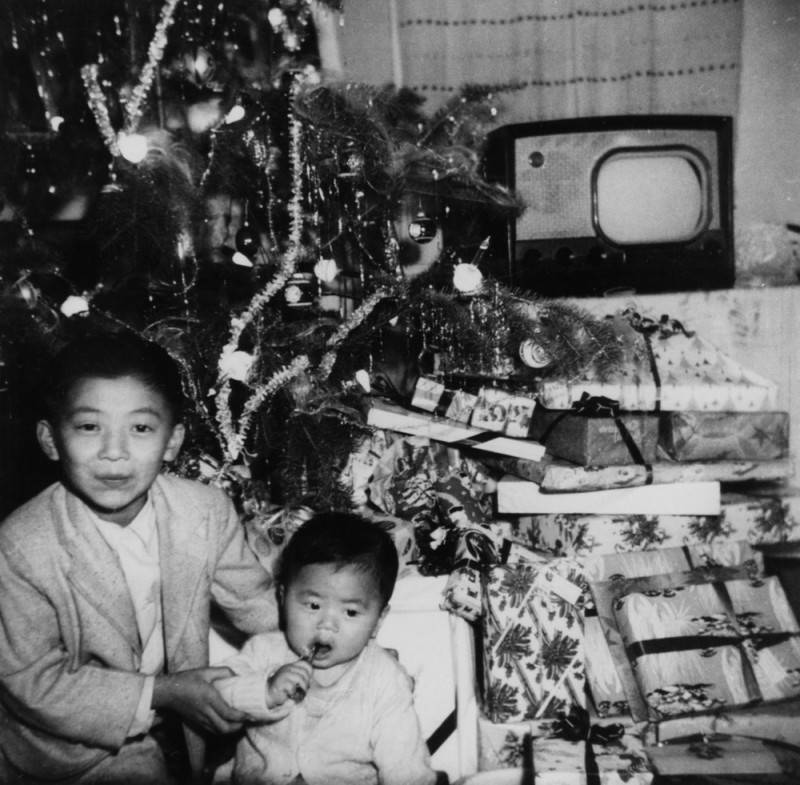
Japanese American children in front of Christmas tree (Shades of L.A. Photo Collection, Digital Collections of the Los Angeles Public Library)
A Japanese American Holiday Season
The show prompts a question that I had never fully considered before: what does an Asian American holiday season look like in real life? Specifically, how do Japanese Americans celebrate the holiday season?
Before answering that question, it’s useful to have an overview of general trends in Japanese American religious life. According to a 2012 study by the Pew Research Center—to date, the most comprehensive study of Asian American religious life—Japanese Americans are a very religiously diverse group. 38% of Japanese American respondents identified as Christian (13% Evangelical, 19% Mainline, 4% Catholic), 25% as Buddhist, 32% as religiously unaffiliated, and the remainder as having unknown or other religions.
Generally speaking, Asian Americans vary a lot by generation. Research suggests that age and nativity shape politics, and the same is true for religion. For example, as the religion scholar Brett Esaki observed in an essay in a new anthology about Japanese American Millennials, younger Japanese Americans—people like Lily—pursue “a religiosity that is increasingly unaffiliated and Protestant Christian.” He found that the percentage of young Japanese Americans who identify as Christian is on the rise. Just as important, those who are religiously unaffiliated have distinct spiritual beliefs and practices and “are certainly not defined by the lack of religion.” As he, Russell Jeung, and Alice Liu wrote in a 2015 article in Religions, Japanese American young adults who identify as religiously unaffiliated nevertheless “maintain hybridized spiritual rituals and value righteous relations.”
In his research, Esaki identified a few key themes in the religious lives of young Japanese Americans. First, they tend to adopt beliefs and practices from different traditions, which relates to their commitment to empathy. As Esaki wrote, “the empathetic nature of young Japanese Americans could be seen to bring them to practice other cultural and religious rituals; the empathy facilitates engagement in belief and practice, and consequentially Christian ritual and belief are part of their religiosity.”
Their ritual lives also reflect the value they place on harmony. Referring to the Toshimaro Ama’s concept of “natural religion,” Esaki noted that the “cultural religion of Japan” involves “ritual obligations, folkloric beliefs, and ideals of community harmony and humility.” Esaki observed that, in the context of the United States,
Japanese American Millennials may be using the unaffiliated religiosity to practice natural religion, including exchanging rituals and beliefs and acting to maintain harmony with others. With the goal of harmony and the ‘ordinary’ in mind, Millennials’ Christian religiosity may not only cultivate harmony across Japanese American religions, but may also help to intertwine them with other American racial groups who are Christian.
These values—hybridity, empathy, and harmony—come together to shape a distinctive approach to the holidays.
So how do Japanese Americans celebrate Christmas? To begin, almost all Japanese Americans celebrate Christmas. According to the 2012 Pew study, 92% of Japanese Americans celebrate Christmas. (To compare, 83% of the general Asian American population observes this holiday.) Participation rates are even higher for young Japanese Americans. According to Jeung, Esaki, and Lui, 100% of young Japanese Americans observe Christmas.
But even though Japanese Americans almost universally celebrate Christmas, the practices vary by generation and religious affiliation. “In contemporary Japan, Christmas (and Valentine’s Day and sometimes weddings) are seen as kitschy western holidays to buy regularized gifts and to wear fun clothes,” said Esaki in an interview. “So Shin-Issei [recently arrived immigrants who tend to have more transnational connections to Japan] do these, but often as extensions of the non-religious Japanese holidays.” In contrast, many Japanese Americans have been in the United States for generations, and their approach to Christmas is somewhat different. “In long-generation families, Christmas is more like a gift-giving time,” Esaki explained. “Most incorporate the whole Santa, cookies and milk, and wrapping in bright colored paper.” Sometimes Japanese Americans incorporate traditional Japanese paper crafts and origami in their gift-wrapping, holiday cards, and tree ornaments. Japanese American Christians might also integrate Japanese elements in their religious observances.
Despite these differences, Japanese American Christmas traditions reveal many of same core themes that shape other aspects of their religious and spiritual lives: hybridity, empathy, and harmony. As Jeung, Esaki, and Liu wrote,
All young Japanese Americans celebrate Christmas, including the unaffiliated. This unanimity illustrates how they may see Christmas as the holiday with the most opportunity to practice hospitality, to have a heartfelt experience with extended family, and to honor parents, elders, and children alike…young Japanese Americans can be unaffiliated yet practice elements of Japanese popular religion.
Japanese Americans also celebrate New Year. “New Year in Japan is probably their biggest holiday,” said Esaki. “There are traditional foods, dances, bells, gifts, Confucian traditions of cleaning and paying off debt. Shin-Issei follow many of these traditions.” But there are important differences between New Year celebrations in Japan as compared to those elsewhere in Asia. In 1872, the Meiji government ended the lunar calendar, which it considered emblematic of the old ways, and adopted the Gregorian calendar in its place. As a result, Japan celebrates the New Year on January 1.
As with Christmas, Japanese American New Year practices vary and are shaped by proximity to ethnic institutions and family. “Those near a Japantown can do the whole gamut,” said Esaki. Community organizations like the Japanese American National Museum, for example, hosts an Oshogatsu Festival, which takes place on the first Sunday after January 1. At this event, participants pound mochi and eat soba (buckwheat noodles), kamaboko (fish cakes), and kuri kinton (sweet potato puree). People might visit a temple, if they live near one. But Japanese Americans located far from Japanese enclaves might find it more difficult to practice traditions that require special ingredients, extended family, and ethnic community. “[P]articipation varies by location near other Japanese Americans, our own level of knowledge and commitment, and whether we associate with recent Japanese immigrants,” explained Eskai. As with many communities, Japanese Americans pursue rituals that reflect their culture and their values, but also the realities of their particular environments.
To be sure, Dash & Lily doesn’t include this level of detail. Nowhere in the show does Lily discuss the challenges of finding gobo for her New Year celebration, the ethics of community harmony, or the intricacies of Japanese popular religion. Then again, most Hallmark Christmas movies don’t engage in much explicit religion-talk, either.
What Dash & Lily does do, though, is widen our imagination about what’s possible to include in the romantic comedies we watch during the holidays. After watching Dash & Lily, I began to brainstorm ideas I might pitch to Lifetime or Hallmark for holiday films that put Asian American characters—and Asian American religious lives—at the center. (If anybody from Lifetime or Hallmark is reading this, I’d love to see a movie about a Filipina American woman who heads home to attend a Misa de Gallo with her Lolo and Lola. At church, she reconnects with an old flame, and later they fall in love while making bibingka for a local baking competition. She and her love interest could exchange their first kiss under a brightly colored parol, and then they could go to the karaoke bar and sing their favorite romantic duets.)
More than anything, Dash & Lily invites us to consider what the holidays mean to diverse Americans today. Asian American religious life, as so many scholars have argued, is charactered by a vibrant hybridity—but that’s true for American religious life in general. May the stories we tell—whether it’s in our scholarship or our holiday romantic comedies—reflect that truth.
Previous Post

December 11, 2020
QAnon: Science Fiction and Menaced Children
Next Post
December 15, 2020 Christmas during a Pandemic: The United States in December 1918
Browse Our Archives
Select a Category abolitionism Abortion Abraham Joshua Heschel Abraham Kuyper Abraham Lincoln Academia Activism Adam Renberg Advent Adventist africa African American Religion Agnes Howard Albert Camus American History American Religious History American Revolution American West Anabaptists Ancient History Andrea Turpin Andrei Tarkovsky Anglicanism Annales Ansley Lillian Quiros anti-Catholicism Antisemitism Anxious Bench apologetics Apparitions Arash Azizi Archaeology archives art Artificial Intelligence Asia Asian Americans Augustine Authors Bad Bunny Baptism Baptists Barack Obama Battle of Hastings Benjamin Franklin Bernard-Henri Levy Beth Allison Barr Beth Moore Bethany Mannon Bible Bill Cunningham Billy Graham Black Music Bob Dylan Body Boenhoffer Books Breastfeeding Bruce Springsteen C.S. Lewis Calvinism Cancel Culture Capitalism Carmelites Catholicism Cedric Robinson Cesar Chavez Charismaticism charity Charles Dickens Charles Lindbergh Che Guevara Chicago Children Chinese Christianity Chris Gehrz Christ Christian death Christian Higher Education Christian life Christian Nation Christian Nationalism Christianity Today Christmas Church life Church Practice cinema Civil Religion Civil Rights Movement Civil War civility Classics Climate Change Cold War Colonial Mexico colonialism Comer Communism community complementarianism Conference on Faith and History Congregationalism Conspiracies Conspiracy Conversion Narratives Coronavirus Costa Rica Council of Nicaea Covid-19 Creation Critical Race Theory Crusades Culture culture wars Daniel K. Williams David Barton David Swartz Death Ways death with dignity DEI democracy Democratic Party Devotion Digital Age Diplomacy discipleship diversity Donald Trump Drama Dua Lipa Early Church early modern Early modern Catholicism Easter Eastern Christianity economic exploitation Education elections Elie Wiesel Elizabeth II Elizabeth Taylor emotions Empire Engineering England enslavement Entertainment Episcopal Church Erica Ramirez eschatology Eurocentrism Evangelicalism Evangelicals Exegesis Family Feminism Film Flannery O'Connor folk music Food Foreign Policy founding fathers Franciscans Franciscus Junius fundamentalism Funerals G.K. Chesterton Gender Genocide genre geography George W. Bush George Washington George Whitefield Global Christianity Global church Grief Guadalupe Guest Post guest post gun control gun violence Gustavo Gutierrez Hamid Dabashi Harold John Ockenga Harvest Hate Hawaiian Christianity Healing health care Heather Cox Richardson Hell Heresy Hermeneutics Higher Education Hinduism Hippocratic oath Historical Fiction Historical Methodology Historical Profession Historical Profession Historical Theology Historical Thinking historiography Holidays Holocaust horror movies Human rights Humanitarian Work humanities Hummingbirds Hungary hymns Imago Dei Immigration Injustice Interviews Iran Islam Islamophobia Israel Ivan's Childhood Jacob Randolph James Bratt Janine Giordano Drake Japanese history Japanese Literature Jean Paul Sartre Jesse Miranda Jesus Jesus Christ Jimmy Carter Joan Baez Joan Didion Joanne Freeman João B. Chaves Joao Chaves Joey Cochran John Calvin John Fea John Tillotson John Turner Johnny Cash Jonathan Edwards Jonathan Tran Joseph Smith Josh Howerton Journalism Jr. Judaism Jürgen Moltmann Just War Justice Justin Brierley Karl Barth Katelyn Beaty koi ponds Kris Kristofferson Kristin Kobes Du Mez Latin American Religious History Latino Americans Lectio Divina Leisure Lent Leonard Cohen liberal arts liberalism Liberation Theology Linda Ronstadt Lisa Clark Diller Literature Lou Reed Lynchings Lynneth Miller Renberg Mainline Protestantism Malcolm Foley Marilyn Monroe Maritime history Mark Noll Marriage Martin Luther Martin Luther King Martyrdom Marxism Mary Masih Alinejad mass shootings material culture medieval Christianity Medieval Ethiopia Melissa Borja memory Mennonites Mental Health Mental Illness Methodism Mexican Americans Mexicans Mike Madrid Miles Mullin Min Jin Lee Miscarriage Missionaries Mister Rogers Mitt Romney modernity Monasticism Mormonism Motherhood Mothers of the Church Moving Music Musicals Nadya Williams Nahua Christianity Native Americans Natsume Sōseki New Contributor New England New Year New York Nico Non-Violent Protest Orthodoxy pacifism Paleo Evangelicals Palestinians Parenting Patti Smith Paul Kingsnorth Pedro Calderón de la Barca Pentecostalism Philip Jenkins Phillis Wheatley physician-assisted suicide pilgrimage Pilgrims pluralism Plutocracy Poetry Politics Pope Francis Pope Leo XIV post-modernism prayer preaching Presbyterians prosperity gospel Protest Public history Publishing Puritans purity culture Quakers race Race Massacres Racial Capitalism racial reconciliation racialization Racism Raha Bahloulipour Re-Enchantment reading Reformation Refugees religion and the university religion and war Religious Freedom Religious Nones Religious Pluralism Religious Symbols religious violence Republican Party Revival Rita Coolidge Ritual Roger Williams Roman Catholic church Royalty Russell Moore same-sex marriage Sarah Irving-Stonebraker Scandinavia Science Science and Technology Scopes trial Scriptural Interpretation secularism Selena Quintanilla seminary Seventh-Day Adventists sexual morality Sexuality Sikhs Silence slaveholders theology Slavery Slavoj Zizek social justice Social Media Southern Baptist Convention Southern Religion Spain Spiritual Autobiography Spiritual but not religious Spiritual Discipline Sports Stanley Hauerwas Suffering Summer Camps Sunday Night Odds and Ends Supernatural Supreme Court Syriac Christianity Tal Howard Taylor Swift Teaching Technology Television Thanksgiving The Beatles The Mission theater TheoBros Theology Thomas Dixon Thomas Jefferson Thomas Kidd Thomas Merton Tim Gloege Tim Walz Tom Holland Tourism tradition Tragedy Translation Transnationalism Travel Trump Ukraine Uncategorized Unitarians United Methodist Church US History Vanessa Chan Velvet Underground Verónica A. Gutiérrez Veronica Gutierrez Vikings Violence Virgin Mary Virtue Virtue ethics Visions Voting War WCTU Wendell Berry Westminster Assembly White Evangelicalism Wildfires Winnie the Pooh Witches women Women in Ministry Women's and Gender Studies Work Worship writing Yasunari Kawabata Zena Hitz
Select a Month October 2026 September 2026 August 2026 July 2026 June 2026 May 2026 April 2026 March 2026 February 2026 January 2026 December 2025 November 2025 October 2025 September 2025 August 2025 July 2025 June 2025 May 2025 April 2025 March 2025 February 2025 January 2025 December 2024 November 2024 October 2024 September 2024 August 2024 July 2024 June 2024 May 2024 April 2024 March 2024 February 2024 January 2024 December 2023 November 2023 October 2023 September 2023 August 2023 July 2023 June 2023 May 2023 April 2023 March 2023 February 2023 January 2023 December 2022 November 2022 October 2022 September 2022 August 2022 July 2022 June 2022 May 2022 April 2022 March 2022 February 2022 January 2022 December 2021 November 2021 October 2021 September 2021 August 2021 July 2021 June 2021 May 2021 April 2021 March 2021 February 2021 January 2021 December 2020 November 2020 October 2020 September 2020 August 2020 July 2020 June 2020 May 2020 April 2020 March 2020 February 2020 January 2020 December 2019 November 2019 October 2019 September 2019 August 2019 July 2019 June 2019 May 2019 April 2019 March 2019 February 2019 January 2019 December 2018 November 2018 October 2018 September 2018 August 2018 July 2018 June 2018 May 2018 April 2018 March 2018 February 2018 January 2018 December 2017 November 2017 October 2017 September 2017 August 2017 July 2017 June 2017 May 2017 April 2017 March 2017 February 2017 January 2017 December 2016 November 2016 October 2016 September 2016 August 2016 July 2016 June 2016 May 2016 April 2016 March 2016 February 2016 January 2016 December 2015 November 2015 October 2015 September 2015 August 2015 July 2015 June 2015 May 2015 April 2015 March 2015 February 2015 January 2015 December 2014 November 2014 October 2014 September 2014 August 2014 July 2014 June 2014 May 2014 April 2014 March 2014 February 2014 January 2014 December 2013 November 2013 October 2013 September 2013 August 2013 July 2013 June 2013 May 2013 April 2013 March 2013 February 2013 January 2013 December 2012 November 2012 October 2012 September 2012 August 2012 July 2012 June 2012 May 2012
Follow Us!
TAKE THE
Religious Wisdom Quiz
Who interpreted Pharaoh's dreams in Egypt?
Select your answer to see how you score.
Joseph Aaron Daniel Moses
Related posts from Anxious Bench
George Rogers and the Pentecostal Case Against Movies
When Pentecostals Took on “Hellywood”

Emulating Odysseus? Ancient History and Modern Politics

Candles in the Darkness: Ephrem on the Incarnation
TRENDING AT PATHEOS Evangelical

In "Irreplaceable," our book on vocation and technology, Trevor Sutton and I...

I was strolling through the top floor of the brand new Parthenon...

What Does Gêvâh Mean For Kimberley Guifoyle &...
This week, a lot of the news is focused on Kimberly Guilfoyle....

INNER CIRCLE: Profound Mystery (Of Christ In All...
Ephesians 5:31-32 “For this reason, a man will leave his father and...

Do Not Rejoice When Your Enemy Falls: The...
Turning an execution into a public spectacle is a disturbing expression of...

'The Chosen' S6 Trailer: The Passion Gets Very...
Not many watching 'The Chosen' worry about spoilers, but just because they...
view all Evangelical blogs
Ad-Free & Subscriber Log-In Subscription Support
- About Us
- 2026 Calendar
- Videos
- Podcasts
- Library of World Religions
- Faith In Media Tracker
- Advertise With Us
- Write for Us
- Privacy Policy
- Terms of Service
- Do Not Sell My Data
- Contact Us
- Radiant Digital
- Manage Newsletter Subscriptions
- Unsubscribe From Notifications
- Sitemap
Copyright 2008-2026, Patheos. All rights reserved.
Subscription Support Ad-Free & Subscriber Log-In
Follow Patheos