
BuddhistCatholicContemplativeEvangelicalGeneral ChristianHinduJewishLatter-day SaintMuslimNew VisionsProgressive Christian
Beliefs
- Buddhist
- Catholic
- Contemplative
- Evangelical
- General Christian
- Hindu
- Jewish
- Latter-day Saint
- More Voices
- Muslim
- New Visions
- Pagan
- Progressive Christian
Topics
- Religion News
- Food and Religion
- Sports and Religion
- Religious Art
- Religious Music and Entertainment
- Religious Events
- History and Religion
- Style and Religion
- Politics and Religion
- Women in Religion
- Recreation Outdoors and Religion
- Business Finance and Religion
- Careers Workplace and Religion
- Education and Religion
- Family Parenting and Religion
- Health Fitness and Religion
- Home and Religion
- Relationships and Religion
- Technology and Religion
- Travel and Religion
Columnists
- Buddhist Columnists
- Business Finance and Religion Columnists
- Careers Workplace and Religion Columnists
- Catholic Columnists
- Contemplative Columnists
- Education and Religion Columnists
- Evangelists Columnists
- Family Parenting and Religion Columnists
- General Christian Columnists
- Health Fitness and Religion Columnists
- Hindu Columnists
- History and Religion Columnists
- Home and Religion Columnists
- Jewish Columnists
- More Voices Columnists
- Latter Day Columnists
- Muslim Columnists
- New Visions Columnists
- Nonreligious Columnists
- Pagan Columnists
- Politics and Religion Columnists
- Progressive Columnists
- Recreation Outdoors and Religion Columnists
- Relationships and Religion Columnists
- Religion News Columnists
- Religious Art Columnists
- Religious Events Columnists
- Religious Music and Entertainment Columnists
- Sports and Religion Columnists
- Style and Religion Columnists
- Technology and Religion Columnists
- Travel and Religion Columnists
- Women in Religion Columnists
Resource Library
- 2026 Calendar
- Library of World Religions
- The 100 Most Holy Places on Earth
- Patheos Answers
- Podcasts
- Videos
- Faith Leaders Database
- Anglican Episcopalian
- Bahai
- Baptist
- Buddhism
- Christianity
- Confucianism
- Eastern Orthodoxy
- Hinduism
- Holiness and Pentecostal
- ISKCON
- Islam
- Judaism
- Lutheran
- Methodist
- The Church of Jesus Christ of Latter-day Saints
- New Age
- Paganism
- Presbytarian and Reformed
- Protestantism
- Religion Behind the Scenes
- Roman Catholic
- Scientology
- Shia Islam
- Sikhism
- Sufism
- Sunni Islam
- Taoism
- Zen
- See all religions
Research Tools
 Ad-Free & Subscriber Log-In Subscription Support
Ad-Free & Subscriber Log-In Subscription Support
Follow Patheos 

- Trending:
- Forgiveness
- |
- Marriage
- |
- Consciousness
- |
- Death Penalty
- |
- Election
- |
- Halloween

-
About the Authors
- Home
- Evangelical
- Veritas: A Cautionary Tale
Veritas: A Cautionary Tale
Last updated on: October 15, 2020 at 1:59 am by johnturner
Veritas: A Cautionary Tale 2020-10-14T22:03:02-04:00 johnturner
Patheos Explore the world's faith through different perspectives on religion and spirituality! Patheos has the views of the prevalent religions and spiritualities of the world.
In 2012, Harvard Divinity School professor Karen King made international news with a “Gospel of Jesus’s Wife.” She had translated a scrap of papyrus whose Coptic text included a statement by Jesus which began with the words, “My wife.”
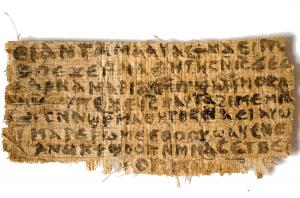 King noted that the fragment in no way proved that the historical Jesus had a wife. However, she used the fragment to assert that relatively early communities of Christians – say, late-second century – believed that he had married. This pointed to an alternative history, one without Christianity’s developing suspicions about female sexuality and its valorization of celibacy.
Almost from the start, other scholars expressed doubts about the fragment’s authenticity, pointing to everything from grammatical errors to odd word choices to penmanship to the fragment’s straight rather than ragged edges.
Rather than slowing down, King doubled down. She published her translation of the fragment and a defense of its authenticity in the Harvard Theological Review.
Enter Ariel Sabar. A journalist, Sabar had followed this story from the beginning. By 2016, he had pieced together the winding tale of a not-very-artful forgery that had duped a famous professor. The forger was Walter Fritz, a German expat living in Florida. A former and mostly failed student of Coptic, Fritz had dabbled in various businesses. His greatest “success” came through a pornography website on which he featured videos of his wife with other men. In 2016, Sabar published his findings in The Atlantic. Confronted with overwhelming evidence, King conceded that the Gospel of Jesus’s wife was a likely forgery.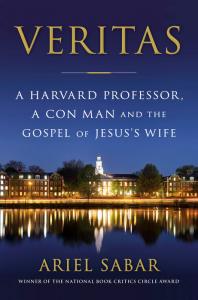
Sabar has now turned his exhaustive research into a gripping book, Veritas. In it, he portrays Karen King as an almost willing participant in a hoax. She set aside her initial suspicions, relied on her friends’ assessment of the papyrus, and ignored radiocarbon dating that estimated a much later date for the fragment. It’s almost as if she wanted to be duped.
Why? For starters, the fragment accorded with her own understanding of a diverse array of early Christian communities, a world in which noncanonical texts are as significant as those of the New Testament. A world in which women exercise leadership and in which theological boundaries remain fluid. As Sabar comments, she evidenced a “disdain for the straitjacket of creed and canon,” because they constrained human beings, especially women. Throughout her career, King cast doubt on the reliability of canonical texts – through her participation in the Jesus Seminar – and translated and analyzed texts such as the Gospel of Judas and the Gospel of Mary Magdalene. As King rightly pointed out, many ideas about early Christianity had been built not on scholarship or facts, but on faith. So we needed more facts. New facts.
In Sabar’s telling, though, King replaced one faith-based history she didn’t like with a new faith-based history partly of her own imagination. If she wanted a fourth-century text to become a second-century text, it became a probable second-century text. After all, in keeping with postmodern theory, facts were illusory. “History,” King wrote in What is Gnosticism?, “is not about truth but about power relations.” With that recognition, she wrote elsewhere, “one need never say no to a story, a song, a poem that gives life, heartens, teaches, or consoles, and need never fail to call it true.” King accordingly could not “say no” to Walter Fritz and his fragment. It was the truth she wanted. The facts of the case were inconvenient.
Sabar’s summary is sharp: “Either the best kind of faith belonged to the people with the most accurate data, the fact finders for whom the universe’s mysteries were less fuel for the contemplation of God than a complex problem that science would eventually solve. Or the best facts were no different from faith, a set of collectively agreed-upon illusions with no more basis in the observable world than belief in an unseen God. If fact and faith were the same, that is, then either faith didn’t exist, or facts didn’t. Not in the way most people thought, anyway. But King wanted it both ways: she sought to expose the Church’s ‘facts’ as positions while promoting her own positions as facts.”
Veritas is a damning account. Undoubtedly, King should have investigated the fragment’s provenance. She should have sought the advice of a wide array of Coptic scholars. She should have heeded all of the flashing-red-light warning signs. She shouldn’t have called her text a “gospel.” It is hard to avoid the conclusion that she wanted the good publicity for herself and – less selfishly – for Harvard Divinity School, then undergoing painful discussions about its future.
And yet, once again, a word of caution is in order. We should be careful when assigning blame and criticism when discussing forgeries. In Veritas, Sabar to some extent portrays Walter Fritz far more sympathetically than he treats Karen King. Sabar investigates and finds credible Fritz’s claim to have been raped by a Catholic priest as a child. “Fritz was never a believing Christian,” Sabar writes. “But the Gnostic gospels gave him the vocabulary to simultaneously skewer the Church for its sins and absolve his mother of hers.” Beyond his childhood, though, Fritz should not be a sympathetic character. He swindled his friends and business contacts, stole items from a museum, and promoted pornography (as Sabar says, “adult video is a legal business). Then he forged the manucript and carefully prepared King to accept its authenticity. Fritz was no master forger, but he played King just right, expressing just the right mixture of knowledge and ignorance, doubt and hope.
Why do we like con artists more than their victims? Because we enjoy watching a high-and-mighty publicity-seeking Harvard professor receive her comeuppance. Schadenfreude. We revel in King’s misfortune. As eager to play fast and loose with the facts as she appears in Veritas, King did not want to sully her academic reputation. She is the victim.
At one point, Sabar compares Fritz to Mark Hofmann, the master forger of fraudulent documents purportedly shedding light on the early history of the Church of Jesus Christ of Latter-day Saints. In one of Hoffman’s forgeries, Martin Harris confirms Joseph Smith’s treasure-seeking activities and narrates that when he attempted to retrieve the golden plates, a spirit appeared, transformed into a “salamander,” “and struck the young seer several times. Hofmann’s creations convinced manuscript dealers and church leaders, who paid handsome sums to obtain them, in part to keep the discoveries under wraps. Prominent historians began using Hofmann’s documents as sources. Many observers enjoyed the extent to which Hofmann embarrased the church. He had convinced the highest-ranking leaders of the church that a “salamander” had whacked the young Joseph Smith!
Hofmann’s success unraveled. Facing mounting debts, he committed murder. A Mormon bishop and another bishop’s wife were killed by pipe bombs that he built, and a third bomb – intended for someone Hofmann feared would expose him – blew up in his own car. The individuals Hofmann murdered were the most obvious victims in the case, but the church, its leaders, and its members were also victims of his fraud.
Perhaps we have a native admiration for the scrappy if disreputable con artist who can pull a fast one on his apparent intellectual superiors. But put yourself in the shoes of the victims of such frauds. At the very least, Karen King deserves a measure of our sympathy and compassion.
My hesitation does not mean that I did not thoroughly enjoy reading Veritas. Sabar is a first-rate journalist and investigator. He doesn’t just leave no stone unturned. He finds all the stones and digs twenty feet under them. He’s a splendid writer as well. Even though I knew the rough outlines of the story, I couldn’t put the book down. Sabar’s reflections on the relationship between facts and faith (whether religious or another sort of ideology) are a cautionary tale for all scholars.
Previous Post

October 14, 2020
College Chapel and COVID-19
Next Post

October 16, 2020 Worcester's Wisdom and Prospero's Steam Engine
Browse Our Archives
Select a Category abolitionism Abortion Abraham Joshua Heschel Abraham Kuyper Abraham Lincoln Academia Activism Adam Renberg Advent Adventist africa African American Religion Agnes Howard Albert Camus American History American Religious History American Revolution American West Anabaptists Ancient History Andrea Turpin Andrei Tarkovsky Anglicanism Annales Ansley Lillian Quiros anti-Catholicism Antisemitism Anxious Bench apologetics Apparitions Arash Azizi Archaeology archives art Artificial Intelligence Asia Asian Americans Augustine Authors Bad Bunny Baptism Baptists Barack Obama Battle of Hastings Benjamin Franklin Bernard-Henri Levy Beth Allison Barr Beth Moore Bethany Mannon Bible Bill Cunningham Billy Graham Black Music Bob Dylan Body Boenhoffer Books Breastfeeding Bruce Springsteen C.S. Lewis Calvinism Cancel Culture Capitalism Carmelites Catholicism Cedric Robinson Cesar Chavez Charismaticism charity Charles Dickens Charles Lindbergh Che Guevara Chicago Children Chinese Christianity Chris Gehrz Christ Christian death Christian Higher Education Christian life Christian Nation Christian Nationalism Christianity Today Christmas Church life Church Practice cinema Civil Religion Civil Rights Movement Civil War civility Classics Climate Change Cold War Colonial Mexico colonialism Comer Communism community complementarianism Conference on Faith and History Congregationalism Conspiracies Conspiracy Conversion Narratives Coronavirus Costa Rica Council of Nicaea Covid-19 Creation Critical Race Theory Crusades Culture culture wars Daniel K. Williams David Barton David Swartz Death Ways death with dignity DEI democracy Democratic Party Devotion Digital Age Diplomacy discipleship diversity Donald Trump Drama Dua Lipa Early Church early modern Early modern Catholicism Easter Eastern Christianity economic exploitation Education elections Elie Wiesel Elizabeth II Elizabeth Taylor emotions Empire Engineering England enslavement Entertainment Episcopal Church Erica Ramirez eschatology Eurocentrism Evangelicalism Evangelicals Exegesis Family Feminism Film Flannery O'Connor folk music Food Foreign Policy founding fathers Franciscans Franciscus Junius fundamentalism Funerals G.K. Chesterton Gender Genocide genre geography George W. Bush George Washington George Whitefield Global Christianity Global church Grief Guadalupe guest post Guest Post gun control gun violence Gustavo Gutierrez Hamid Dabashi Harold John Ockenga Harvest Hate Hawaiian Christianity Healing health care Heather Cox Richardson Hell Heresy Hermeneutics Higher Education Hinduism Hippocratic oath Historical Fiction Historical Methodology Historical Profession Historical Profession Historical Theology Historical Thinking historiography Holidays Holocaust horror movies Human rights Humanitarian Work humanities Hummingbirds Hungary hymns Imago Dei Immigration Injustice Interviews Iran Islam Islamophobia Israel Ivan's Childhood Jacob Randolph James Bratt Janine Giordano Drake Japanese history Japanese Literature Jean Paul Sartre Jesse Miranda Jesus Jesus Christ Jimmy Carter Joan Baez Joan Didion Joanne Freeman João B. Chaves Joao Chaves Joey Cochran John Calvin John Fea John Tillotson John Turner Johnny Cash Jonathan Edwards Jonathan Tran Joseph Smith Josh Howerton Journalism Jr. Judaism Jürgen Moltmann Just War Justice Justin Brierley Karl Barth Katelyn Beaty koi ponds Kris Kristofferson Kristin Kobes Du Mez Latin American Religious History Latino Americans Lectio Divina Leisure Lent Leonard Cohen liberal arts liberalism Liberation Theology Linda Ronstadt Lisa Clark Diller Literature Lou Reed Lynchings Lynneth Miller Renberg Mainline Protestantism Malcolm Foley Marilyn Monroe Maritime history Mark Noll Marriage Martin Luther Martin Luther King Martyrdom Marxism Mary Masih Alinejad mass shootings material culture medieval Christianity Medieval Ethiopia Melissa Borja memory Mennonites Mental Health Mental Illness Methodism Mexican Americans Mexicans Mike Madrid Miles Mullin Min Jin Lee Miscarriage Missionaries Mister Rogers Mitt Romney modernity Monasticism Mormonism Motherhood Mothers of the Church Moving Music Musicals Nadya Williams Nahua Christianity Native Americans Natsume Sōseki New Contributor New England New Year New York Nico Non-Violent Protest Orthodoxy pacifism Paleo Evangelicals Palestinians Parenting Patti Smith Paul Kingsnorth Pedro Calderón de la Barca Pentecostalism Philip Jenkins Phillis Wheatley physician-assisted suicide pilgrimage Pilgrims pluralism Plutocracy Poetry Politics Pope Francis Pope Leo XIV post-modernism prayer preaching Presbyterians prosperity gospel Protest Public history Publishing Puritans purity culture Quakers race Race Massacres Racial Capitalism racial reconciliation racialization Racism Raha Bahloulipour Re-Enchantment reading Reformation Refugees religion and the university religion and war Religious Freedom Religious Nones Religious Pluralism Religious Symbols religious violence Republican Party Revival Rita Coolidge Ritual Roger Williams Roman Catholic church Royalty Russell Moore same-sex marriage Sarah Irving-Stonebraker Scandinavia Science Science and Technology Scopes trial Scriptural Interpretation secularism Selena Quintanilla seminary Seventh-Day Adventists sexual morality Sexuality Sikhs Silence slaveholders theology Slavery Slavoj Zizek social justice Social Media Southern Baptist Convention Southern Religion Spain Spiritual Autobiography Spiritual but not religious Spiritual Discipline Sports Stanley Hauerwas Suffering Summer Camps Sunday Night Odds and Ends Supernatural Supreme Court Syriac Christianity Tal Howard Taylor Swift Teaching Technology Television Thanksgiving The Beatles The Mission theater TheoBros Theology Thomas Dixon Thomas Jefferson Thomas Kidd Thomas Merton Tim Gloege Tim Walz Tom Holland Tourism tradition Tragedy Translation Transnationalism Travel Trump Ukraine Uncategorized Unitarians United Methodist Church US History Vanessa Chan Velvet Underground Verónica A. Gutiérrez Veronica Gutierrez Vikings Violence Virgin Mary Virtue Virtue ethics Visions Voting War WCTU Wendell Berry Westminster Assembly White Evangelicalism Wildfires Winnie the Pooh Witches women Women in Ministry Women's and Gender Studies Work Worship writing Yasunari Kawabata Zena Hitz
Select a Month October 2026 September 2026 August 2026 July 2026 June 2026 May 2026 April 2026 March 2026 February 2026 January 2026 December 2025 November 2025 October 2025 September 2025 August 2025 July 2025 June 2025 May 2025 April 2025 March 2025 February 2025 January 2025 December 2024 November 2024 October 2024 September 2024 August 2024 July 2024 June 2024 May 2024 April 2024 March 2024 February 2024 January 2024 December 2023 November 2023 October 2023 September 2023 August 2023 July 2023 June 2023 May 2023 April 2023 March 2023 February 2023 January 2023 December 2022 November 2022 October 2022 September 2022 August 2022 July 2022 June 2022 May 2022 April 2022 March 2022 February 2022 January 2022 December 2021 November 2021 October 2021 September 2021 August 2021 July 2021 June 2021 May 2021 April 2021 March 2021 February 2021 January 2021 December 2020 November 2020 October 2020 September 2020 August 2020 July 2020 June 2020 May 2020 April 2020 March 2020 February 2020 January 2020 December 2019 November 2019 October 2019 September 2019 August 2019 July 2019 June 2019 May 2019 April 2019 March 2019 February 2019 January 2019 December 2018 November 2018 October 2018 September 2018 August 2018 July 2018 June 2018 May 2018 April 2018 March 2018 February 2018 January 2018 December 2017 November 2017 October 2017 September 2017 August 2017 July 2017 June 2017 May 2017 April 2017 March 2017 February 2017 January 2017 December 2016 November 2016 October 2016 September 2016 August 2016 July 2016 June 2016 May 2016 April 2016 March 2016 February 2016 January 2016 December 2015 November 2015 October 2015 September 2015 August 2015 July 2015 June 2015 May 2015 April 2015 March 2015 February 2015 January 2015 December 2014 November 2014 October 2014 September 2014 August 2014 July 2014 June 2014 May 2014 April 2014 March 2014 February 2014 January 2014 December 2013 November 2013 October 2013 September 2013 August 2013 July 2013 June 2013 May 2013 April 2013 March 2013 February 2013 January 2013 December 2012 November 2012 October 2012 September 2012 August 2012 July 2012 June 2012 May 2012
Follow Us!
TAKE THE
Religious Wisdom Quiz
What animal did Daniel survive with?
Select your answer to see how you score.
Bears Lions Wolves Leopards
Related posts from Anxious Bench
Origen, Eustathius, and the Witch of Endor

Angelina Grimké and the Turmoils of Perfection
Corrupting the Youth? What Universities Are Really For
Candles in the Darkness: Ephrem on the Incarnation
TRENDING AT PATHEOS Evangelical

In "Irreplaceable," our book on vocation and technology, Trevor Sutton and I...

I was strolling through the top floor of the brand new Parthenon...

What Does Gêvâh Mean For Kimberley Guifoyle &...
This week, a lot of the news is focused on Kimberly Guilfoyle....

INNER CIRCLE: Profound Mystery (Of Christ In All...
Ephesians 5:31-32 “For this reason, a man will leave his father and...

Do Not Rejoice When Your Enemy Falls: The...
Turning an execution into a public spectacle is a disturbing expression of...

'The Chosen' S6 Trailer: The Passion Gets Very...
Not many watching 'The Chosen' worry about spoilers, but just because they...
view all Evangelical blogs
Ad-Free & Subscriber Log-In Subscription Support
- About Us
- 2026 Calendar
- Videos
- Podcasts
- Library of World Religions
- Faith In Media Tracker
- Advertise With Us
- Write for Us
- Privacy Policy
- Terms of Service
- Do Not Sell My Data
- Contact Us
- Radiant Digital
- Manage Newsletter Subscriptions
- Unsubscribe From Notifications
- Sitemap
Copyright 2008-2026, Patheos. All rights reserved.
Subscription Support Ad-Free & Subscriber Log-In
Follow Patheos