
BuddhistCatholicContemplativeEvangelicalGeneral ChristianHinduJewishLatter-day SaintMuslimNew VisionsProgressive Christian
Beliefs
- Buddhist
- Catholic
- Contemplative
- Evangelical
- General Christian
- Hindu
- Jewish
- Latter-day Saint
- More Voices
- Muslim
- New Visions
- Pagan
- Progressive Christian
Topics
- Religion News
- Food and Religion
- Sports and Religion
- Religious Art
- Religious Music and Entertainment
- Religious Events
- History and Religion
- Style and Religion
- Politics and Religion
- Women in Religion
- Recreation Outdoors and Religion
- Business Finance and Religion
- Careers Workplace and Religion
- Education and Religion
- Family Parenting and Religion
- Health Fitness and Religion
- Home and Religion
- Relationships and Religion
- Technology and Religion
- Travel and Religion
Columnists
- Buddhist Columnists
- Business Finance and Religion Columnists
- Careers Workplace and Religion Columnists
- Catholic Columnists
- Contemplative Columnists
- Education and Religion Columnists
- Evangelists Columnists
- Family Parenting and Religion Columnists
- General Christian Columnists
- Health Fitness and Religion Columnists
- Hindu Columnists
- History and Religion Columnists
- Home and Religion Columnists
- Jewish Columnists
- More Voices Columnists
- Latter Day Columnists
- Muslim Columnists
- New Visions Columnists
- Nonreligious Columnists
- Pagan Columnists
- Politics and Religion Columnists
- Progressive Columnists
- Recreation Outdoors and Religion Columnists
- Relationships and Religion Columnists
- Religion News Columnists
- Religious Art Columnists
- Religious Events Columnists
- Religious Music and Entertainment Columnists
- Sports and Religion Columnists
- Style and Religion Columnists
- Technology and Religion Columnists
- Travel and Religion Columnists
- Women in Religion Columnists
Resource Library
- 2026 Calendar
- Library of World Religions
- The 100 Most Holy Places on Earth
- Patheos Answers
- Podcasts
- Videos
- Faith Leaders Database
- Anglican Episcopalian
- Bahai
- Baptist
- Buddhism
- Christianity
- Confucianism
- Eastern Orthodoxy
- Hinduism
- Holiness and Pentecostal
- ISKCON
- Islam
- Judaism
- Lutheran
- Methodist
- The Church of Jesus Christ of Latter-day Saints
- New Age
- Paganism
- Presbytarian and Reformed
- Protestantism
- Religion Behind the Scenes
- Roman Catholic
- Scientology
- Shia Islam
- Sikhism
- Sufism
- Sunni Islam
- Taoism
- Zen
- See all religions
Research Tools
 Ad-Free & Subscriber Log-In Subscription Support
Ad-Free & Subscriber Log-In Subscription Support
Follow Patheos 

- Trending:
- Forgiveness
- |
- Marriage
- |
- Consciousness
- |
- Death Penalty
- |
- Election
- |
- Halloween

-
About the Authors
- Home
- Evangelical
- American Girl, American Religion, and Potential Plots for Courtney, SoCal Gamer Girl of the ’80s
American Girl, American Religion, and Potential Plots for Courtney, SoCal Gamer Girl of the ’80s
Last updated on: September 30, 2020 at 3:20 pm by Melissa Borja
American Girl, American Religion, and Potential Plots for Courtney, SoCal Gamer Girl of the ’80s 2020-09-30T15:20:07-04:00 Melissa Borja
Patheos Explore the world's faith through different perspectives on religion and spirituality! Patheos has the views of the prevalent religions and spiritualities of the world.
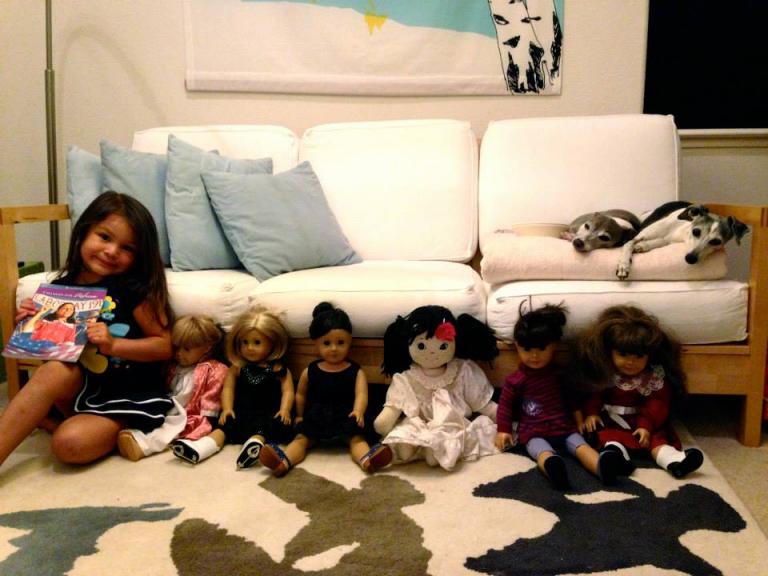
The author’s daughter with her American Girl doll friends, whom she taught about labor organizing by using the Rebecca Rubin books as a text, ca. 2013.
In case the popularity of Stranger Things and Cobra Kai and the renewed appreciation of Phil Collins’ iconic drum solo in “In the Air Tonight” hasn’t made it clear, the 1980s are in right now. And, riding this wave of nostalgia for the Era of Extravagant Bangs, American Girl just released its newest historical character this week: Courtney, a California girl who lives in 1986. She loves Pac-Man, Care Bears, and belt bags, and her hair is indeed glorious.
These features highlight one of the most compelling aspects of the American Girl books—their attention to historical detail. Although its books are meant for children, American Girl wins praise from many scholars for nuanced, carefully researched stories. Professional historians often serve as consultants. For example, when American Girl created the books about Melody, a Black girl living in Detroit in 1963, the series advisory board included the historians Tom Sugrue of New York University and Gloria House of the University of Michigan-Dearborn. The American Girl books address a variety of political, social, and cultural themes in American history, without shying away from difficult topics such as slavery, women’s rights, and labor exploitation, and the characters are racially, geographically, and culturally diverse. “American Girl attempts to reflect a complicated and culturally rich story of America,” observed Marcia Chatelain, a historian and African American studies scholar at Georgetown University.
American Girl offers a complicated and culturally rich portrait of American religion, too. Stories about religious beliefs, rituals, and institutions appear throughout many of the books. For example, Rebecca, a Jewish girl growing up on the Lower East Side of Manhattan in 1914, confronts the “December Dilemma” and wants to celebrate Hanukkah at the same time that she faces pressure at school to assimilate to Christian culture. Kirsten, a Swedish immigrant girl living in Minnesota in 1854, celebrates Saint Lucia Day, an example of how immigrant communities preserve their ethnic identities through home-based religious rituals. And Cecile and Marie-Grace, two girls living in New Orleans during the yellow fever epidemic of 1853, work with nuns at Catholic-run orphanages, attend Mass at Saint Louis Cathedral, and find solace and strength through regular prayer and hymn-singing as their community mourns the death of loved ones.
Since the Courtney dolls only appeared in stores this week, I haven’t yet had a chance to read the Courtney books, but the American Girl website makes clear that Courtney’s interests reflect the cultural, technological, and political developments of the decade. She plays video games, spends time at the mall, follows news about the Challenger launch, and has an ambitious mother who is running for mayor. But what about the religious developments of the period? As I reflect on how well American Girl engages in religion in books set in other times and places, I wonder about the possibilities for a character living in the 1980s. What were the key religious developments of this period, and how might they show up in the stories about Courtney, a Southern California girl living in 1986?
I posed this question to a few colleagues who study religion in the late twentieth century, and they generously shared their ideas for potential themes and stories, written in the form of blurbs. I’m not sure if American Girl will pursue any of these ideas, but perhaps an enterprising fan fic writer on the internet will.
Meet Courtney, a Conservative Pentecostal Girl Who Just Wants to Have Fun
Christopher Cantwell, a historian and scholar of American evangelicalism at the University of Wisconsin, Milwaukee, proposed a story that imagines Courtney as a girl immersed in the world of California-style conservative evangelicalism:
Courtney loves music, video games, and Bop Magazine, but her parents love the Lord. Her dad is a pastor of a local Calvary Chapel church, where her mother also helps lead the local praise band. Though the congregation’s services are charismatic and the music upbeat, the church is suffused with an old-time religion. Many in the church are hopeful that famed televangelist Pat Robertson will heed the call of other charismatic and Pentecostal Christians and run for President in 1988 in order to restore the nation’s morality. While Courtney just wants to be herself, her church sees her attire and musical tastes as a ‘stumbling block’ on the nation’s path to purity. How will she navigate the tension between her family’s insular community and her desire to be a part of the world?
Courtney—who lives in the fictional town of Orange Valley, California, which appears to be based on communities in Southern California—lives in a part of the country that was a hotbed of political and “relevant” evangelical conservatism in the late twentieth century. (Darren Dochuk and Lisa McGirr wrote about these intertwined religious and political developments.) By 1986, the Moral Majority was on its way out, and charismatic Pentecostalism was on the upswing, building to Pat Robertson’s 1988 presidential bid. The Calvary Chapel, which was founded in Orange County in 1965, was growing exponentially in 1980s, and Rick Warren’s Saddleback Church was founded there in 1980, as well. Living in 1986 in Southern California, Courtney might be part of the powerful evangelical subculture that emerged in this region and that would eventually shape the political and religious life of the nation as a whole.
Meet Courtney, a D& D Player (and Possible Devil Worshipper)
Emily Johnson, a historian of religion, politics, and culture at Ball State University, proposed a story that imagines Courtney as a girl accused of being drawn into a Satanism:
Courtney has been best friends with Sarah for as long as they can both remember. They have a secret handshake and a secret fort in the woods behind Sarah’s house. Courtney sometimes goes to youth group at Sarah’s church and loves the games they play on Friday nights. In the summer before 6th grade, a new girl moves next door to Courtney and introduces her to a fun game called Dungeons and Dragons. Courtney invites Sarah to play and is surprised by Sarah’s reaction! Sarah says that Courtney has given her soul to the devil and refuses to speak to her if she keeps playing. Courtney is confused an hurt; she doesn’t want to have to choose between her two friends. Is it possible she really is possessed by Satan?
Johnson, who is currently writing a book on the history of Satanism and the moral panics surrounding it, calls attention to a fascinating religious development of the 1980s: the “Satanic Panic” that gripped America during this period.
Some of the most intense outbursts of Satanic Panic emerged in California in the 1980s. In Kern County, unsubstantiated accusations of Satanic rituals that involved the sexual abuse of children sent 26 people to jail between 1984 and 1986. In Manhattan Beach, parents accused preschool teachers of Satanic ritual abuse in 1983, and the ensuing investigations and trials lasted until 1990. (In the end, all of the charges were dropped.)
The popular culture of the 1980s reflected Americans’ fear of and fascination with Satanism. Take, for example, the role-playing game Dungeons and Dragons. Some Christian groups believed the game promoted devil worship and witchcraft, and one mother, Pat Pulling, blamed her son’s suicide on the game. Pulling founded the organization “Bothered About Dungeons and Dragons” in 1983 and was successful enough in bringing national attention to her accusations that she appeared on 60 Minutes in 1985. Later in the decade, Devil Worship: Exposing Satan’s Underground, a documentary by Geraldo Rivera, found an eager audience and record television ratings.
Meet Courtney, a Compassionate AIDS Activist
Anthony Petro, a scholar of religion, gender, and sexuality at Boston University, proposed a story that imagines Courtney as a girl from a conservative religious family that struggles to navigate the AIDS crisis:
Courtney’s family belongs to the Baptist Church down the street. Her fun uncle used to join her family for Sunday services and even sang in the choir, but lately says he’s been feeling ill and doesn’t want to attend because he doesn’t like the pastor. Courtney misses the times they’d dress up and dance around to Madonna and Prince songs, but now her parents won’t even let her visit her uncle’s apartment. One day, she finally asks her parents, ‘when do we get to see Uncle Tommy again?’ They ignore her question and ask her to finish getting dressed for church. Years later, when Courtney goes off to college in NYC, she joins the feminist group WHAM! and becomes a leader in sexual and health rights activism.
Petro, who wrote about religious responses to AIDS in his book After the Wrath of God: AIDS, Sexuality, and American Religion, points to two related developments in 1980s America: the AIDS epidemic and the culture wars over sex and morality. During this period, religious leaders and AIDS activists shaped national debates over sexual morality and public health, and the emergence of AIDS prompted American Christians across denominations and political persuasions to speak publicly about sexuality, especially homosexuality. Their efforts fostered a moral discourse on sex that spoke not only to personal concerns but to anxieties about the health of the nation. These debates would have a profound impact on future generations.
Meet Courtney, a Caring Friend in an Interfaith World
Samira Mehta, a gender studies and Jewish studies scholar at the University of Colorado, Boulder, proposed a story that imagines Courtney as a girl growing up in a religious world where interfaith families and friendships are common and where the meaning of being Jewish is changing:
Courtney and Rachel have always been good friends. Courtney has always spent Rosh Hashanah dinner with Rachel’s family, and Rachel’s family has always come over on Christmas eve because her mom misses having a Christmas tree. But now, Rachel is starting serious Hebrew school, and some of the other kids are saying that, because her mom is not Jewish, neither is she! Courtney does not know the rules (you do not need a Presbyterian mom to be Presbyterian) and does not know how to help Rachel, but it is really sad to see her friend so sad. How can she help?
Mehta, who wrote about the history of Jewish-Christian interfaith families in her book Beyond Chrismukkah, explains that a child who was born in 1978 to a Jewish father and a non-Jewish mother would not have been considered Jewish by the largest Jewish movements in the United States because interpretations of Jewish law at that time held that Judaism is passed down through the mother. That changed in 1983, when the Reform movement, the largest Jewish movement in the United States, decided to accept both patrilineal descent and matrilineal descent. Under these new rules, children counted as Jewish as long as they had one Jewish parent and a Jewish education. Courtney’s friend Rachel would have counted as Jewish for the Reform movement and the much smaller Reconstructionist movement, but not for other Jews and not for the Nation State of Israel. Even in the Reform movement, however, this policy was controversial, and while it was accepted formally, there was plenty of “on the ground” talk about “patrilineal Jews not really being Jewish.”
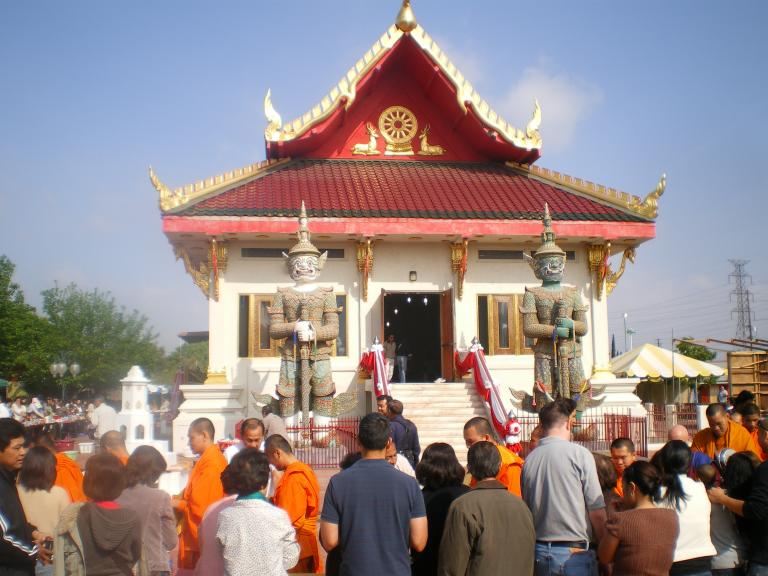
Songkran at Wat Thai in Los Angeles, April 2008 (Wikimedia Commons)
Meet Courtney, an Advocate for Refugees and Religious Pluralism
I couldn’t resist the opportunity to write my own blurb, since my current book project about Southeast Asian refugee resettlement addresses how the arrival of new immigrants and refugees during the 1980s transformed the ethnic and religious demographics of Southern California and the United States as a whole:
A few years ago, Courtney’s church decided to sponsor a Vietnamese refugee family for resettlement. Since then, many refugees from Vietnam have arrived in Courtney’s town, and for the most part, people have welcomed them—until the Vietnamese refugees in her town begin to organize efforts to build a Buddhist temple. Many of her neighbors become upset and angry about the temple, and Courtney, who doesn’t know anything about Buddhism, admits that their beliefs and rituals seem strange to her. But when vandals deface the temple attended by Tran, her Vietnamese friend, Courtney must confront an important question: what does it mean to be a good neighbor?
The last quarter of the twentieth century saw significant changes in the American immigrant population. In contrast to earlier in the twentieth century, when most immigrants came from Europe, the 1970s and 1980s saw many more Asian immigrants and refugees, who migrated because of changing immigration policies in the United States, as well as war, political turmoil, and limited economic opportunity in Asia. These Asian immigrants and refugees changed the ethnic, racial, and religious composition of American society, and it was because of them that the United States became home to unprecedented numbers of Buddhists, Hindus, Muslims, and more. These demographic changes were felt most acutely in California, which became home to many Asian immigrants and Southeast Asian refugees.
This new religious diversity was not always welcome, though, and some Americans reacted angrily, and even violently, to the presence of new racial and religious groups. Southeast Asian refugees, in particular, experienced harassment, vandalism, and other hate incidents because they were seen as an economic, cultural, and national security threat. In some places, violence erupted. In Texas, for example, the KKK skirmished with Vietnamese fishermen in the early 1980s, and in 1989, a man in Stockton, California, opened fire on the busy playground of Cleveland Elementary School, where he killed five people and injured thirty others. Nearly all of his victims were Southeast Asian refugees. (An important side note: hostility against Asian Americans is once again on the rise, as Asian people are being scapegoated for the coronavirus. If you or somebody you know experiences a hate incident, please report it to the Stop AAPI Hate Reporting Center.)
Although the 1980s saw terrible acts of hate against Asian Americans, personal relationships across boundaries of racial and religious difference did mitigate animosity. Many Christian and Jewish groups helped to sponsor and resettle Southeast Asian refugees, and they served as important local allies when refugees faced racist hostility from other members of the community. These refugee-sponsor relationships also provided people an opportunity to learn about different religions and to try to put new ideals of religious pluralism into practice.

Next Post
October 1, 2020 After Jesus and John Wayne
Browse Our Archives
Select a Category abolitionism Abortion Abraham Joshua Heschel Abraham Kuyper Abraham Lincoln Academia Activism Adam Renberg Advent Adventist africa African American Religion Agnes Howard Albert Camus American History American Religious History American Revolution American West Anabaptists Ancient History Andrea Turpin Andrei Tarkovsky Anglicanism Annales Ansley Lillian Quiros anti-Catholicism Antisemitism Anxious Bench apologetics Apparitions Arash Azizi Archaeology archives art Artificial Intelligence Asia Asian Americans Augustine Authors Bad Bunny Baptism Baptists Barack Obama Battle of Hastings Benjamin Franklin Bernard-Henri Levy Beth Allison Barr Beth Moore Bethany Mannon Bible Bill Cunningham Billy Graham Black Music Bob Dylan Body Boenhoffer Books Breastfeeding Bruce Springsteen C.S. Lewis Calvinism Cancel Culture Capitalism Carmelites Catholicism Cedric Robinson Cesar Chavez Charismaticism charity Charles Dickens Charles Lindbergh Che Guevara Chicago Children Chinese Christianity Chris Gehrz Christ Christian death Christian Higher Education Christian life Christian Nation Christian Nationalism Christianity Today Christmas Church life Church Practice cinema Civil Religion Civil Rights Movement Civil War civility Classics Climate Change Cold War Colonial Mexico colonialism Comer Communism community complementarianism Conference on Faith and History Congregationalism Conspiracies Conspiracy Conversion Narratives Coronavirus Costa Rica Council of Nicaea Covid-19 Creation Critical Race Theory Crusades Culture culture wars Daniel K. Williams David Barton David Swartz Death Ways death with dignity DEI democracy Democratic Party Devotion Digital Age Diplomacy discipleship diversity Donald Trump Drama Dua Lipa Early Church early modern Early modern Catholicism Easter Eastern Christianity economic exploitation Education elections Elie Wiesel Elizabeth II Elizabeth Taylor emotions Empire Engineering England enslavement Entertainment Episcopal Church Erica Ramirez eschatology Eurocentrism Evangelicalism Evangelicals Exegesis Family Feminism Film Flannery O'Connor folk music Food Foreign Policy founding fathers Franciscans Franciscus Junius fundamentalism Funerals G.K. Chesterton Gender Genocide genre geography George W. Bush George Washington George Whitefield Global Christianity Global church Grief Guadalupe guest post Guest Post gun control gun violence Gustavo Gutierrez Hamid Dabashi Harold John Ockenga Harvest Hate Hawaiian Christianity Healing health care Heather Cox Richardson Hell Heresy Hermeneutics Higher Education Hinduism Hippocratic oath Historical Fiction Historical Methodology Historical Profession Historical Profession Historical Theology Historical Thinking historiography Holidays Holocaust horror movies Human rights Humanitarian Work humanities Hummingbirds Hungary hymns Imago Dei Immigration Injustice Interviews Iran Islam Islamophobia Israel Ivan's Childhood Jacob Randolph James Bratt Janine Giordano Drake Japanese history Japanese Literature Jean Paul Sartre Jesse Miranda Jesus Jesus Christ Jimmy Carter Joan Baez Joan Didion Joanne Freeman João B. Chaves Joao Chaves Joey Cochran John Calvin John Fea John Tillotson John Turner Johnny Cash Jonathan Edwards Jonathan Tran Joseph Smith Josh Howerton Journalism Jr. Judaism Jürgen Moltmann Just War Justice Justin Brierley Karl Barth Katelyn Beaty koi ponds Kris Kristofferson Kristin Kobes Du Mez Latin American Religious History Latino Americans Lectio Divina Leisure Lent Leonard Cohen liberal arts liberalism Liberation Theology Linda Ronstadt Lisa Clark Diller Literature Lou Reed Lynchings Lynneth Miller Renberg Mainline Protestantism Malcolm Foley Marilyn Monroe Maritime history Mark Noll Marriage Martin Luther Martin Luther King Martyrdom Marxism Mary Masih Alinejad mass shootings material culture medieval Christianity Medieval Ethiopia Melissa Borja memory Mennonites Mental Health Mental Illness Methodism Mexican Americans Mexicans Mike Madrid Miles Mullin Min Jin Lee Miscarriage Missionaries Mister Rogers Mitt Romney modernity Monasticism Mormonism Motherhood Mothers of the Church Moving Music Musicals Nadya Williams Nahua Christianity Native Americans Natsume Sōseki New Contributor New England New Year New York Nico Non-Violent Protest Orthodoxy pacifism Paleo Evangelicals Palestinians Parenting Patti Smith Paul Kingsnorth Pedro Calderón de la Barca Pentecostalism Philip Jenkins Phillis Wheatley physician-assisted suicide pilgrimage Pilgrims pluralism Plutocracy Poetry Politics Pope Francis Pope Leo XIV post-modernism prayer preaching Presbyterians prosperity gospel Protest Public history Publishing Puritans purity culture Quakers race Race Massacres Racial Capitalism racial reconciliation racialization Racism Raha Bahloulipour Re-Enchantment reading Reformation Refugees religion and the university religion and war Religious Freedom Religious Nones Religious Pluralism Religious Symbols religious violence Republican Party Revival Rita Coolidge Ritual Roger Williams Roman Catholic church Royalty Russell Moore same-sex marriage Sarah Irving-Stonebraker Scandinavia Science Science and Technology Scopes trial Scriptural Interpretation secularism Selena Quintanilla seminary Seventh-Day Adventists sexual morality Sexuality Sikhs Silence slaveholders theology Slavery Slavoj Zizek social justice Social Media Southern Baptist Convention Southern Religion Spain Spiritual Autobiography Spiritual but not religious Spiritual Discipline Sports Stanley Hauerwas Suffering Summer Camps Sunday Night Odds and Ends Supernatural Supreme Court Syriac Christianity Tal Howard Taylor Swift Teaching Technology Television Thanksgiving The Beatles The Mission theater TheoBros Theology Thomas Dixon Thomas Jefferson Thomas Kidd Thomas Merton Tim Gloege Tim Walz Tom Holland Tourism tradition Tragedy Translation Transnationalism Travel Trump Ukraine Uncategorized Unitarians United Methodist Church US History Vanessa Chan Velvet Underground Verónica A. Gutiérrez Veronica Gutierrez Vikings Violence Virgin Mary Virtue Virtue ethics Visions Voting War WCTU Wendell Berry Westminster Assembly White Evangelicalism Wildfires Winnie the Pooh Witches women Women in Ministry Women's and Gender Studies Work Worship writing Yasunari Kawabata Zena Hitz
Select a Month October 2026 September 2026 August 2026 July 2026 June 2026 May 2026 April 2026 March 2026 February 2026 January 2026 December 2025 November 2025 October 2025 September 2025 August 2025 July 2025 June 2025 May 2025 April 2025 March 2025 February 2025 January 2025 December 2024 November 2024 October 2024 September 2024 August 2024 July 2024 June 2024 May 2024 April 2024 March 2024 February 2024 January 2024 December 2023 November 2023 October 2023 September 2023 August 2023 July 2023 June 2023 May 2023 April 2023 March 2023 February 2023 January 2023 December 2022 November 2022 October 2022 September 2022 August 2022 July 2022 June 2022 May 2022 April 2022 March 2022 February 2022 January 2022 December 2021 November 2021 October 2021 September 2021 August 2021 July 2021 June 2021 May 2021 April 2021 March 2021 February 2021 January 2021 December 2020 November 2020 October 2020 September 2020 August 2020 July 2020 June 2020 May 2020 April 2020 March 2020 February 2020 January 2020 December 2019 November 2019 October 2019 September 2019 August 2019 July 2019 June 2019 May 2019 April 2019 March 2019 February 2019 January 2019 December 2018 November 2018 October 2018 September 2018 August 2018 July 2018 June 2018 May 2018 April 2018 March 2018 February 2018 January 2018 December 2017 November 2017 October 2017 September 2017 August 2017 July 2017 June 2017 May 2017 April 2017 March 2017 February 2017 January 2017 December 2016 November 2016 October 2016 September 2016 August 2016 July 2016 June 2016 May 2016 April 2016 March 2016 February 2016 January 2016 December 2015 November 2015 October 2015 September 2015 August 2015 July 2015 June 2015 May 2015 April 2015 March 2015 February 2015 January 2015 December 2014 November 2014 October 2014 September 2014 August 2014 July 2014 June 2014 May 2014 April 2014 March 2014 February 2014 January 2014 December 2013 November 2013 October 2013 September 2013 August 2013 July 2013 June 2013 May 2013 April 2013 March 2013 February 2013 January 2013 December 2012 November 2012 October 2012 September 2012 August 2012 July 2012 June 2012 May 2012
Follow Us!
TAKE THE
Religious Wisdom Quiz
Each chapter except one is an acrostic poem following the Hebrew alphabet. How many chapters make up this book of mourning?
Select your answer to see how you score.
Three Twelve Seven Five
Related posts from Anxious Bench

Angelina Grimké's Forgotten Turn to Apocalyptic Faith

Marilyn Monroe and the Life of the Mind
Calvin in Corinth: Complementarian, Confused, or Contextual?
On Different Educations and the Global Church
TRENDING AT PATHEOS Evangelical

The Real AI Story Is Adoption Without Trust
Artificial intelligence has crossed a political threshold. It is no longer a...

A new article, written by Jeff Lindsay and Gale L. Pooley,...

Swimfan: Forgotten Aughts Pleasures
This is a recovery effort. In 2002, My Big Fat Greek Wedding...

Top Three Anti-Catholic Lies About Catholicism
This is my initial transcript for the video, "THE 3 WORST...

Pope Leo Celebrates Mass for Nurses & Docs...
I don't have any idea how he did it, but Pope Leo...

The Sermon on the Mount, Part I: Matthew...
The Sermon on the Mount, Part I (Matthew 4:12-5:12) St. Matthew moves...
view all Evangelical blogs
Ad-Free & Subscriber Log-In Subscription Support
- About Us
- 2026 Calendar
- Videos
- Podcasts
- Library of World Religions
- Faith In Media Tracker
- Advertise With Us
- Write for Us
- Privacy Policy
- Terms of Service
- Do Not Sell My Data
- Contact Us
- Radiant Digital
- Manage Newsletter Subscriptions
- Unsubscribe From Notifications
- Sitemap
Copyright 2008-2026, Patheos. All rights reserved.
Subscription Support Ad-Free & Subscriber Log-In
Follow Patheos