
BuddhistCatholicContemplativeEvangelicalGeneral ChristianHinduJewishLatter-day SaintMuslimNew VisionsProgressive Christian
Beliefs
- Buddhist
- Catholic
- Contemplative
- Evangelical
- General Christian
- Hindu
- Jewish
- Latter-day Saint
- More Voices
- Muslim
- New Visions
- Pagan
- Progressive Christian
Topics
- Religion News
- Food and Religion
- Sports and Religion
- Religious Art
- Religious Music and Entertainment
- Religious Events
- History and Religion
- Style and Religion
- Politics and Religion
- Women in Religion
- Recreation Outdoors and Religion
- Business Finance and Religion
- Careers Workplace and Religion
- Education and Religion
- Family Parenting and Religion
- Health Fitness and Religion
- Home and Religion
- Relationships and Religion
- Technology and Religion
- Travel and Religion
Columnists
- Buddhist Columnists
- Business Finance and Religion Columnists
- Careers Workplace and Religion Columnists
- Catholic Columnists
- Contemplative Columnists
- Education and Religion Columnists
- Evangelists Columnists
- Family Parenting and Religion Columnists
- General Christian Columnists
- Health Fitness and Religion Columnists
- Hindu Columnists
- History and Religion Columnists
- Home and Religion Columnists
- Jewish Columnists
- More Voices Columnists
- Latter Day Columnists
- Muslim Columnists
- New Visions Columnists
- Nonreligious Columnists
- Pagan Columnists
- Politics and Religion Columnists
- Progressive Columnists
- Recreation Outdoors and Religion Columnists
- Relationships and Religion Columnists
- Religion News Columnists
- Religious Art Columnists
- Religious Events Columnists
- Religious Music and Entertainment Columnists
- Sports and Religion Columnists
- Style and Religion Columnists
- Technology and Religion Columnists
- Travel and Religion Columnists
- Women in Religion Columnists
Resource Library
- 2026 Calendar
- Library of World Religions
- The 100 Most Holy Places on Earth
- Patheos Answers
- Podcasts
- Videos
- Faith Leaders Database
- Anglican Episcopalian
- Bahai
- Baptist
- Buddhism
- Christianity
- Confucianism
- Eastern Orthodoxy
- Hinduism
- Holiness and Pentecostal
- ISKCON
- Islam
- Judaism
- Lutheran
- Methodist
- The Church of Jesus Christ of Latter-day Saints
- New Age
- Paganism
- Presbytarian and Reformed
- Protestantism
- Religion Behind the Scenes
- Roman Catholic
- Scientology
- Shia Islam
- Sikhism
- Sufism
- Sunni Islam
- Taoism
- Zen
- See all religions
Research Tools
 Ad-Free & Subscriber Log-In Subscription Support
Follow Patheos 

- Trending:
- Advent
- |
- Forgiveness
- |
- Thanksgiving
- |
- Election
- |
- Seasonal Holidays
- |
- Marriage

-
About the Authors
- Home
- Evangelical
- The Religious History of the 19th Amendment
The Religious History of the 19th Amendment
Last updated on: August 18, 2020 at 2:01 am by Chris Gehrz
The Religious History of the 19th Amendment 2020-08-07T17:52:04-04:00 Chris Gehrz
Patheos Explore the world's faith through different perspectives on religion and spirituality! Patheos has the views of the prevalent religions and spiritualities of the world.
One hundred years ago today, the Tennessee state legislature approved the 19th Amendment to the U.S. Constitution, officially ratifying the right of American women to vote. (It was officially certified eight days later.) If, like me, you didn’t already know the suffrage story very well, I highly recommend the new, two-part American Experience episode on “The Vote,” which features commentary from experts like Martha Jones, Elaine Weiss, Marcia Chatelain, and Beth Behn.
Watching that documentary and doing some other reading, I’ve been struck how religion sometimes shaped the motivations and rhetoric of both sides in the suffrage debate. To share just a few examples of the theme…
Religion had been part of the women’s rights movement since before suffrage became its primary objective. In 1848 a “convention to discuss the social, civil, and religious condition and rights of women” was held in the Wesleyan chapel of Seneca Falls, New York. Defying “the circumscribed limits which corrupt customs and a perverted application of the Scriptures have marked out for her,” delegates agreed that woman “should move in the enlarged sphere which her great Creator has assigned her.” That sphere included politics, but also religion. They complained that man allowed woman
in Church as well as State, but a subordinate position, claiming Apostolic authority for her exclusion from the ministry, and with some exceptions, from any public participation in the affairs of the Church… He has usurped the prerogative of Jehovah himself, claiming it as his right to assign for her a sphere of action, when that belongs to her conscience and her God.
As the suffrage campaign gathered strength in the late 19th century, churches and individual Christians bore out historian William O’Neill’s claim that “religion formed the cornerstone of the case against feminine equality.” In 1890, for example, Presbyterians in Virginia concluded that the scriptural “principle of subordination” pertained to “woman’s place, duties, and rights in the home and in the church,” but also “in the state.”
But other Christians supported suffrage, especially those from the more liberal wing of the Protestant tradition. Apart from Elizabeth Cady Stanton, most of the organizers at Seneca Falls had been Quakers, like Lucretia Mott. (Susan B. Anthony was also raised in that tradition.) As leadership of the suffrage movement began to pass to a new generation after 1900, Friends remained influential, none more so than Alice Paul, the young Swarthmore-educated activist who took charge of the push for a federal suffrage amendment in 1912.
In March 1913, Paul organized a historic Woman Suffrage Procession in Washington for the day before the inauguration of President Woodrow Wilson. At least 5,000 women marched down Pennsylvania Avenue, including members of the Women’s Christian Temperance Union and the Young Women’s Christian Association. (Christianity wasn’t the only religious tradition represented in the procession; the Washington Post noted that the New York delegation carried a banner in Yiddish.) One of the 26 floats in the intricately planned event was dedicated to “women of the Bible lands,” including Miriam, Deborah, and the prophet Huldah.
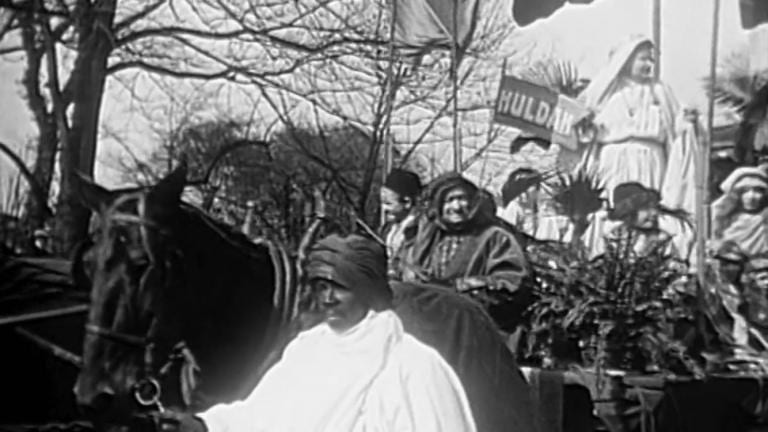
Screen shot from the 1913 film of the procession, On to Washington – public domain
Two years later, one of the most fascinating illustrations of the religious history of women’s suffrage came from members of the movement that its leaders often neglected: African Americans.
Before the Civil War, abolitionism and women’s rights often went hand in hand. But in 1869, Seneca Falls delegate Frederick Douglass had refused to support Stanton and Anthony in their desire to include women in the 15th Amendment, arguing that it was more important to first expand the franchise to include black men. In turn, early 20th century suffrage leaders did not want to lose white support for the 19th Amendment; they pushed black activists like Ida B. Wells to the margins of events like the march in Washington, which Alice Paul decided would be “a purely suffrage demonstration entirely uncomplicated by any other problems such as racial ones.”
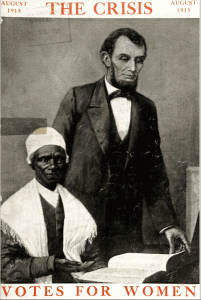
Seeing Sojourner Truth with Abraham Lincoln on that issue’s cover, Harriot Stanton Blatch (daughter of Elizabeth Cady Stanton) told readers of The Crisis, “revives many thrilling childhood memories in my mind” – Modernist Journals Project/public domain
But with New York, Pennsylvania, Massachusetts, and New Jersey preparing to hold referenda on women’s suffrage, W.E.B. DuBois dedicated the August 1915 issue of the NAACP’s magazine to the subject of “Votes for Women.” Once again, religious individuals and arguments played prominent roles. The lead article in The Crisis’ suffrage symposium came from Presbyterian pastor Francis J. Grimké, and AME bishop John Hurst argued that support for women’s rights reflected the impact of Christianity on human civilization:
It discarded and upset the teachings of the past. It gave woman her freedom and womanhood has been lifted to the place where it justly belongs. Christianity established equality and community of woman with man in the privileges of Grace, as being heir together with all the great gifts of life; receiving one faith, one baptism and partaking of the same holy table. It thundering message to all is “There is neither Jew nor Greek, there is neither bond nor free, there is neither male nor female, for we are all one in Christ Jesus” [Gal 3:28] and the echo of its teachings the world over is to “Loose her and let her go.”
It was African American women themselves who made the most compelling arguments in that symposium. “How can any one who is able to use reason, and who believes in dealing out justice to all God’s creatures,” asked suffragist Mary Church Terrell, “think it is right to withhold from one-half the human race rights and privileges freely accorded to the other half, which is neither more deserving nor more capable of exercising them?”
Two other contributors connected the expansion of political and religious roles for women. “The Negro Church means the Negro woman,” began Nannie Helen Burroughs. “She carries the burdens of the Church, and of the school and bears a great deal more than her economic share in the home.” A leader within the National Baptist Convention, Burroughs had come to prominence in 1900 with an address warning that denomination not to “allow these gems to lie unpolished longer” and instead liberate women to follow their “burning zeal to go forward in [Christ’s] name.” Fellow Baptist Mary E. Jackson (a leader in the NAACP, YWCA, and Wells’ Alpha Suffrage Club alike) buttressed her case for suffrage by pointing out to Crisis readers that “in the ministry 7,000 dare preach the gospel with ‘Heads uncovered.’”
(As Beverly Zink-Sawyer has pointed out, women preachers were doubly significant for the suffrage movement. The pulpit, like the speaker’s platform, “became both the vehicle for the promotion of a political message concerning woman’s equality and a symbol of that message itself by the very embodiment of the speaker’s words in the form of a woman speaking publicly.” From 1904 to 1915, the president of the National Woman Suffrage Association was Anna Howard Shaw, one of the first Methodist women to be ordained.)
Three months later, The Crisis added the dissenting voice of mathematician Kelly Miller, then dean of Howard University. He repeated arguments common to most religious conservatives opposed to granting the “weaker” sex the vote:
Woman’s sphere of activity falls mainly within while man’s field of action lies largely without the domestic circle. This represents the traditional and, presumably, the ideal relation between the sexes. It has the sanction of divine authority and the test of human experience. Woman suffrage could not possibly enhance the harmoniousness of this relationship, but might seriously jeopardize it.
Denying that there was “common ground” between women’s rights and civil rights, Miller concluded on a biblical note: “Male and female created He them; what God has made different man strives in vain to make identical.”
DuBois published Miller’s argument, but rebutted it angrily in his own editorial:
The statement that woman is weaker than man is sheer rot: It is the same sort of thing that we hear about “darker races” and “lower classes”…. The sex of Judith, Candace, Queen Elizabeth, Sojourner Truth and Jane Addams was the merest incident of human function and not a mark of weakness and inferiority.
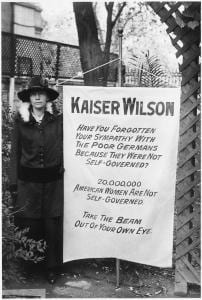
U.S. National Archives
Estimating that 200,000 black voters would be able to participate in the East Coast referenda, DuBois urged them to support women’s suffrage. To no avail: in November 1915, all four states voted against expanding the franchise to women.
Increasingly, the movement’s energy went into federal action. Carrie Chapman Catt led a massive effort to lobby Woodrow Wilson and members of Congress, and Alice Paul organized a protest aimed directly at a Virginia-born president who insisted that suffrage was a matter of states’ rights. “Resistance to tyranny is obedience to God,” proclaimed a sign held by one of the “Silent Sentinels” who picketed the White House day and night in 1917. “Take the beam out of your own eye,” another told “Kaiser Wilson,” as the United States went to war with Germany.
If only to gain new voters for his party before the 1918 and 1920 elections, Wilson did come out in support of the amendment, which finally cleared the Senate in June 1919. Within a year, 35 of the 36 required states had approved the amendment, with Tennessee looming as the decisive battleground after its Democratic governor reluctantly bowed to pressure from Wilson and called a special session of the state legislature. (The president was “my Moses,” explained Albert Roberts.)
Though the Tennessee senate voted overwhelmingly in favor, the amendment faced a tough battle in the state house. The Chattanooga News reported that “every trick of parliamentary procedure” was used by anti-suffragists like house speaker Seth Walker, whose own speech on August 17th linked white supremacy to male patriarchy. “This is now a white man’s country, and we have a white man’s God,” he thundered, warning that “Hell is going to break loose” if the amendment were ratified.
In the end, the measure passed by a single vote, after a young legislator sheepishly explained that he changed his mind because his mother told him “to be a good boy and help Mrs. Cat [sic] put ‘Rat’ in ratification.”
Previous Post

August 17, 2020
The Quest for the Crown of Creation
Next Post

August 19, 2020 Recent Books on Women & Gender in American Religious History
Browse Our Archives
Select a Category abolitionism Abortion Abraham Joshua Heschel Abraham Kuyper Abraham Lincoln Academia Activism Adam Renberg Advent Adventist africa African American Religion Agnes Howard Albert Camus American History American Religious History American Revolution American West Anabaptists Ancient History Andrea Turpin Andrei Tarkovsky Anglicanism Annales Ansley Lillian Quiros anti-Catholicism Antisemitism Anxious Bench apologetics Apparitions Arash Azizi Archaeology archives art Artificial Intelligence Asia Asian Americans Augustine Authors Bad Bunny Baptism Baptists Barack Obama Battle of Hastings Benjamin Franklin Bernard-Henri Levy Beth Allison Barr Beth Moore Bethany Mannon Bible Bill Cunningham Billy Graham Black Music Bob Dylan Body Boenhoffer Books Breastfeeding Bruce Springsteen C.S. Lewis Calvinism Cancel Culture Capitalism Carmelites Catholicism Cedric Robinson Cesar Chavez Charismaticism charity Charles Dickens Charles Lindbergh Che Guevara Chicago Children Chinese Christianity Chris Gehrz Christ Christian death Christian Higher Education Christian life Christian Nation Christian Nationalism Christianity Today Christmas Church life Church Practice cinema Civil Religion Civil Rights Movement Civil War civility Classics Climate Change Cold War Colonial Mexico colonialism Comer Communism community complementarianism Conference on Faith and History Congregationalism Conspiracies Conspiracy Conversion Narratives Coronavirus Costa Rica Council of Nicaea Covid-19 Creation Critical Race Theory Crusades Culture culture wars Daniel K. Williams David Barton David Swartz Death Ways death with dignity DEI democracy Democratic Party Devotion Digital Age Diplomacy discipleship diversity Donald Trump Drama Dua Lipa Early Church early modern Early modern Catholicism Easter Eastern Christianity economic exploitation Education elections Elie Wiesel Elizabeth II Elizabeth Taylor emotions Empire Engineering England enslavement Entertainment Episcopal Church Erica Ramirez eschatology Eurocentrism Evangelicalism Evangelicals Exegesis Family Feminism Film Flannery O'Connor folk music Food Foreign Policy founding fathers Franciscans Franciscus Junius fundamentalism Funerals G.K. Chesterton Gender Genocide genre geography George W. Bush George Washington George Whitefield Global Christianity Global church Grief Guadalupe guest post Guest Post gun control gun violence Gustavo Gutierrez Hamid Dabashi Harold John Ockenga Harvest Hate Hawaiian Christianity Healing health care Heather Cox Richardson Hell Heresy Hermeneutics Higher Education Hinduism Hippocratic oath Historical Fiction Historical Methodology Historical Profession Historical Profession Historical Theology Historical Thinking historiography Holidays Holocaust horror movies Human rights Humanitarian Work humanities Hummingbirds Hungary hymns Imago Dei Immigration Injustice Interviews Iran Islam Islamophobia Israel Ivan's Childhood Jacob Randolph James Bratt Janine Giordano Drake Japanese history Japanese Literature Jean Paul Sartre Jesse Miranda Jesus Jesus Christ Jimmy Carter Joan Baez Joan Didion Joanne Freeman João B. Chaves Joao Chaves Joey Cochran John Calvin John Fea John Tillotson John Turner Johnny Cash Jonathan Edwards Jonathan Tran Joseph Smith Josh Howerton Journalism Jr. Judaism Jürgen Moltmann Just War Justice Justin Brierley Karl Barth Katelyn Beaty koi ponds Kris Kristofferson Kristin Kobes Du Mez Latin American Religious History Latino Americans Lectio Divina Leisure Lent Leonard Cohen liberal arts liberalism Liberation Theology Linda Ronstadt Lisa Clark Diller Literature Lou Reed Lynchings Lynneth Miller Renberg Mainline Protestantism Malcolm Foley Marilyn Monroe Maritime history Mark Noll Marriage Martin Luther Martin Luther King Martyrdom Marxism Mary Masih Alinejad mass shootings material culture medieval Christianity Medieval Ethiopia Melissa Borja memory Mennonites Mental Health Mental Illness Methodism Mexican Americans Mexicans Mike Madrid Miles Mullin Min Jin Lee Miscarriage Missionaries Mister Rogers Mitt Romney modernity Monasticism Mormonism Motherhood Mothers of the Church Moving Music Musicals Nadya Williams Nahua Christianity Native Americans Natsume Sōseki New Contributor New England New Year New York Nico Non-Violent Protest Orthodoxy pacifism Paleo Evangelicals Palestinians Parenting Patti Smith Paul Kingsnorth Pedro Calderón de la Barca Pentecostalism Philip Jenkins Phillis Wheatley physician-assisted suicide pilgrimage Pilgrims Piracy pluralism Plutocracy Poetry Politics Pope Francis Pope Leo XIV post-modernism prayer preaching Presbyterians prosperity gospel Protest Public Executions Public history Publishing Puritans purity culture Quakers race Race Massacres Racial Capitalism racial reconciliation racialization Racism Raha Bahloulipour Re-Enchantment reading Reformation Refugees religion and the university religion and war Religious Freedom Religious Nones Religious Pluralism Religious Symbols religious violence Republican Party Revival Rita Coolidge Ritual Roger Williams Roman Catholic church Royalty Russell Moore same-sex marriage Sarah Irving-Stonebraker Scandinavia Science Science and Technology Scopes trial Scriptural Interpretation secularism Selena Quintanilla seminary Seventh-Day Adventists sexual morality Sexuality Sikhs Silence slaveholders theology Slavery Slavoj Zizek social justice Social Media Southern Baptist Convention Southern Religion Spain Spiritual Autobiography Spiritual but not religious Spiritual Discipline Sports Stanley Hauerwas Suffering Summer Camps Sunday Night Odds and Ends Supernatural Supreme Court Syriac Christianity Tal Howard Taylor Swift Teaching Technology Television Thanksgiving The Beatles The Mission theater TheoBros Theology Thomas Dixon Thomas Jefferson Thomas Kidd Thomas Merton Tim Gloege Tim Walz Tom Holland Tourism tradition Tragedy Translation Transnationalism Travel Trump Ukraine Uncategorized Unitarians United Methodist Church US History Vanessa Chan Velvet Underground Verónica A. Gutiérrez Veronica Gutierrez Vikings Violence Virgin Mary Virtue Virtue ethics Visions Voting War WCTU Wendell Berry Westminster Assembly White Evangelicalism Wildfires Winnie the Pooh Witches women Women in Ministry Women's and Gender Studies Work Worship writing Yasunari Kawabata Zena Hitz
Select a Month November 2026 October 2026 September 2026 August 2026 July 2026 June 2026 May 2026 April 2026 March 2026 February 2026 January 2026 December 2025 November 2025 October 2025 September 2025 August 2025 July 2025 June 2025 May 2025 April 2025 March 2025 February 2025 January 2025 December 2024 November 2024 October 2024 September 2024 August 2024 July 2024 June 2024 May 2024 April 2024 March 2024 February 2024 January 2024 December 2023 November 2023 October 2023 September 2023 August 2023 July 2023 June 2023 May 2023 April 2023 March 2023 February 2023 January 2023 December 2022 November 2022 October 2022 September 2022 August 2022 July 2022 June 2022 May 2022 April 2022 March 2022 February 2022 January 2022 December 2021 November 2021 October 2021 September 2021 August 2021 July 2021 June 2021 May 2021 April 2021 March 2021 February 2021 January 2021 December 2020 November 2020 October 2020 September 2020 August 2020 July 2020 June 2020 May 2020 April 2020 March 2020 February 2020 January 2020 December 2019 November 2019 October 2019 September 2019 August 2019 July 2019 June 2019 May 2019 April 2019 March 2019 February 2019 January 2019 December 2018 November 2018 October 2018 September 2018 August 2018 July 2018 June 2018 May 2018 April 2018 March 2018 February 2018 January 2018 December 2017 November 2017 October 2017 September 2017 August 2017 July 2017 June 2017 May 2017 April 2017 March 2017 February 2017 January 2017 December 2016 November 2016 October 2016 September 2016 August 2016 July 2016 June 2016 May 2016 April 2016 March 2016 February 2016 January 2016 December 2015 November 2015 October 2015 September 2015 August 2015 July 2015 June 2015 May 2015 April 2015 March 2015 February 2015 January 2015 December 2014 November 2014 October 2014 September 2014 August 2014 July 2014 June 2014 May 2014 April 2014 March 2014 February 2014 January 2014 December 2013 November 2013 October 2013 September 2013 August 2013 July 2013 June 2013 May 2013 April 2013 March 2013 February 2013 January 2013 December 2012 November 2012 October 2012 September 2012 August 2012 July 2012 June 2012 May 2012
Follow Us!
TAKE THE
Religious Wisdom Quiz
What structure did humans try to build to reach the heavens, leading God to scatter them?
Select your answer to see how you score.
Tower of Babel Great Pyramid Temple of Solomon Golden Calf
Related posts from Anxious Bench
Updating the Readings: Recent Books on Women and...
Medieval Mothers of the Church: Queen Margrete and...
Abuse and Ownership, Past and Present

Trondenes Kirke: The Northernmost Medieval Church
TRENDING AT PATHEOS Evangelical

Just as the emergence of leaves on the fig tree signals the...
Belief and Disbelief in Christ's Presence in Holy...
A study found that only 29% of Catholics believe that the bread...

Blue Christmas: Making Room for Grief at Church
A Blue Christmas service makes room for grief, remembrance, and hope. Explore...

We Can Trust That God Will Use Our...
A Jesus-loving young friend who is going through deep suffering sent me...

Everything is worship for Quakers. The Quakers emphasize contemplation, equality, pacifism and...

Happy Thanksgiving! I published this Thanksgiving column back in 2017 in...
view all Evangelical blogs
Ad-Free & Subscriber Log-In Subscription Support
- About Us
- 2026 Calendar
- Videos
- Podcasts
- Library of World Religions
- Faith In Media Tracker
- Advertise With Us
- Write for Us
- Privacy Policy
- Terms of Service
- Do Not Sell My Data
- Contact Us
- Radiant Digital
- Manage Newsletter Subscriptions
- Unsubscribe From Notifications
- Sitemap
Copyright 2008-2026, Patheos, part of the Radiant Digital network of media brands. All rights reserved.
Subscription Support Ad-Free & Subscriber Log-In
Follow Patheos