
BuddhistCatholicContemplativeEvangelicalGeneral ChristianHinduJewishLatter-day SaintMuslimNew VisionsProgressive Christian
Beliefs
- Buddhist
- Catholic
- Contemplative
- Evangelical
- General Christian
- Hindu
- Jewish
- Latter-day Saint
- More Voices
- Muslim
- New Visions
- Pagan
- Progressive Christian
Topics
- Religion News
- Food and Religion
- Sports and Religion
- Religious Art
- Religious Music and Entertainment
- Religious Events
- History and Religion
- Style and Religion
- Politics and Religion
- Women in Religion
- Recreation Outdoors and Religion
- Business Finance and Religion
- Careers Workplace and Religion
- Education and Religion
- Family Parenting and Religion
- Health Fitness and Religion
- Home and Religion
- Relationships and Religion
- Technology and Religion
- Travel and Religion
Columnists
- Buddhist Columnists
- Business Finance and Religion Columnists
- Careers Workplace and Religion Columnists
- Catholic Columnists
- Contemplative Columnists
- Education and Religion Columnists
- Evangelists Columnists
- Family Parenting and Religion Columnists
- General Christian Columnists
- Health Fitness and Religion Columnists
- Hindu Columnists
- History and Religion Columnists
- Home and Religion Columnists
- Jewish Columnists
- More Voices Columnists
- Latter Day Columnists
- Muslim Columnists
- New Visions Columnists
- Nonreligious Columnists
- Pagan Columnists
- Politics and Religion Columnists
- Progressive Columnists
- Recreation Outdoors and Religion Columnists
- Relationships and Religion Columnists
- Religion News Columnists
- Religious Art Columnists
- Religious Events Columnists
- Religious Music and Entertainment Columnists
- Sports and Religion Columnists
- Style and Religion Columnists
- Technology and Religion Columnists
- Travel and Religion Columnists
- Women in Religion Columnists
Resource Library
- 2026 Calendar
- Library of World Religions
- The 100 Most Holy Places on Earth
- Patheos Answers
- Podcasts
- Videos
- Faith Leaders Database
- Anglican Episcopalian
- Bahai
- Baptist
- Buddhism
- Christianity
- Confucianism
- Eastern Orthodoxy
- Hinduism
- Holiness and Pentecostal
- ISKCON
- Islam
- Judaism
- Lutheran
- Methodist
- The Church of Jesus Christ of Latter-day Saints
- New Age
- Paganism
- Presbytarian and Reformed
- Protestantism
- Religion Behind the Scenes
- Roman Catholic
- Scientology
- Shia Islam
- Sikhism
- Sufism
- Sunni Islam
- Taoism
- Zen
- See all religions
Research Tools
 Ad-Free & Subscriber Log-In Subscription Support
Follow Patheos 

- Trending:
- Advent
- |
- Forgiveness
- |
- Thanksgiving
- |
- Election
- |
- Seasonal Holidays
- |
- Marriage

-
About the Authors
- Home
- Evangelical
- Healing and Grieving in the Age of Covid-19: Refugees and Lessons on Long-Distance Ritual Life
Healing and Grieving in the Age of Covid-19: Refugees and Lessons on Long-Distance Ritual Life
Last updated on: July 27, 2020 at 2:37 pm by Melissa Borja
Healing and Grieving in the Age of Covid-19: Refugees and Lessons on Long-Distance Ritual Life 2020-07-27T14:37:57-04:00 Melissa Borja
Patheos Explore the world's faith through different perspectives on religion and spirituality! Patheos has the views of the prevalent religions and spiritualities of the world.
Among the many fascinating cultural phenomena of the Covid-19 pandemic, the most intriguing to me has been the burst of ritual creativity borne by the requirements of social distancing. In April, for example, I participated in a virtual toast in celebration of a newborn’s bris; in June, I witnessed a wedding streamed via Facebook Live. Every Sunday, my parents watch Mass on YouTube, and I attend worship services through Zoom, where the gregarious types who like to whisper during church have license to do so through the chat function. Twenty-first century technology has provided helpful, if limited, tools for carrying on with religious rituals, but sometimes solutions have centered on old items newly repurposed for pandemic life. In Detroit, for example, Father Tim Pelc donned a face mask and shield and administered drive-through Holy Week blessings by using a squirt gun to shoot holy water at parishioners in their cars. Similarly, social media buzzed with photos of a Tennessee priest who used a squirt gun for baptizing a baby. (The priest later clarified that the photo was meant “for humor impact” and that the gun, which did not actually contain holy water, was aimed at the baby’s father, not the baby.)
Despite the creativity and occasional whimsy shown by religious people in the current crisis, certain rituals have faced continued obstacles, especially in situations of sickness and death. For example, Catholic priests ministering last rites to Covid-19 patients have been unable to touch people, give them communion, and anoint them with oil, and when these patients have passed away, their families have been unable to gather and grieve together through traditional funeral ceremonies. The pandemic has caused people of all religious traditions to experience exactly what they so often dread: being alone in their suffering, their dying, and their grieving. “The gathered community is essential to the grief process and the funeral process; it’s near as universal as we’ve got,” said William Hoy, a professor at Baylor University and an expert on social support in death, dying, and grief.
The cruel convergence of these distinctive aspects of the pandemic—the reality of sickness and death and the requirements of social distancing in an attempt to prevent that sickness and death—has produced a particularly painful problem. As friends and family die, people long to gather together and conduct the sacred rituals that allow them to show care, grieve, and commemorate the life of a beloved. And yet funerals, typically held in indoor spaces with many people in attendance, can be dangerous affairs, with some documented as lethal “superspreading” events. The pandemic, put simply, has put people in an impossible situation: as Covid-19 claims more lives, the more people wish to congregate for end-of-life rituals, which may, in turn, cause Covid-19 to claim more lives. No wonder, then, that those who mourn the death of loved ones are also, in part, mourning the loss of rituals that traditionally bring comfort and peace, and that funeral-goers who openly defy bans on public gathering have been the focus of such intense criticism and debate.
How, then, have religious people handled end-of-life rituals in the age of the coronavirus? Living through a global event of this scale of death and disruption has been a new experience for most people, but the truth is that this pandemic is not the first time that humans have experienced the peculiar pain of suffering, dying, and grieving from a distance. Migrants—and, in particular, refugees uprooted by war and other calamity—have often faced the dual affliction of death and forced family separation. The spiritual resilience and ritual ingenuity they have demonstrated in these moments offer a useful and hopeful lesson for those who grieve the loss of life and fear the loss of tradition in the chaos of our current crisis.
“A ‘long-distance’ cure”
Hmong refugees, who resettled in the United States beginning in 1976 in the aftermath of the “Secret War” in Laos, offer a particularly useful example to consider. The majority of Hmong refugees arrived in America adhering to a distinctive set of beliefs and practices that combine animism, ancestor worship, and shamanism. In the 1970s and 1980s, they found it difficult to conduct their traditional rituals in the United States, for several reasons. Part of the problem was that many Hmong rituals are complex affairs that require the involvement of the immediate and extended family, as well as elders and ritual experts equipped with specialized skills and knowledge.
However, American refugee policies deprived Hmong refugees of these essential ritual experts by separating refugees from their family, clan, and community. This family separation occurred in two main ways. First, American refugee policies prioritized the resettlement of refugees who had direct ties to the U.S. military. As a result, American refugee policies initially selected for refugees who were younger and less knowledgeable about traditional Hmong rituals, and left behind in the Thai refugee camps were the elders and ritual experts who had the most knowledge and skill about Hmong ceremonies. Second, resettlement planners deliberately dispersed Southeast Asian refugees across the United States in order to reduce the likelihood that refugees would form ethnic enclaves and overburden particular cities and states. This “scatter policy” forced refugees to live apart from their relatives and their community, and while Hmong refugees eventually did reconstitute their families, clans, and communities through secondary migration, this process sometimes took years to fully unfold.
The separation from family, the absence of ritual experts, and the relocation to new geographic settings: together, all of these forces created a crisis for Hmong refugees in their early years in the United States. Although resettling in a new country had held the promise of greater security and freedom, Hmong people in fact found themselves deeply unsettled by life in America, where they were forced to contend with even greater spiritual vulnerability as they struggled with the reality that it was difficult, and sometimes even impossible, to practice the rituals that had long sustained their spiritual and bodily wellbeing. They worried about the future of their souls, but also the fate of their Hmong ritual traditions and cultural identity.
The unsettlement of Hmong ritual life was felt most acutely during times of sickness and death. Hmong people worried, for example, about how they could cure an ailment and remain healthy if they had no shaman available to help them call a soul home during a hu plig ceremony or recapture a wayward soul during a ua neeb ritual. Even if Hmong people had access to a shaman in the United States, they were often constrained by other practical limitations. The particular demands of shamans’ work—for example, the need for a permanent house where a shaman’s spirits can reside—made practicing Hmong shamanism a challenge, especially in the context of the poverty and housing instability that so many refugees experienced in the initial years of resettlement. Nhia Yer Yang, a Hmong shaman in the Twin Cities, was “really happy” about all of the help he had received from Americans, but his lack of permanent housing was one reason why he struggled to continue traditional rituals. He pleaded for more help from the government and pointed out the spiritual consequences of his lack of permanent housing. “I hope the government would understand where this puts me as a shaman,” he said. “It makes it really hard. I don’t have a home…It is most difficult for me, I cannot adapt to this, the house is not my own. I cannot continue the traditional spiritual [traditions], to be ‘in touch.’ It is really hard, but hopefully in the future I can have my own home.” As he explained, the problem was not merely that he did not have a home to call his own, but that his shaman’s spirit needed to move with him every time he moved, and thus the lack of a permanent home created not only housing instability but also spiritual instability. “If I have to move and I’m in touch with the spirit and it lives in that home, I have to ask the spirit to leave,” he said. “Hopefully, one day I will have a steady place and won’t have to move around so much.”
Amid these challenges, Hmong refugees resettled in the United States nevertheless found creative ways to continue to practice the rituals of shamanism, often relying on technology and transpacific social networks to do so. In I Am a Shaman, the anthropologist Dwight Conquergood observed that Hmong refugees sheltering at Ban Vinai, a refugee camp in Thailand, were often actively involved in supporting the ritual lives of Hmong people resettled abroad. In this capacity, they played a vital role in sustaining Hmong traditions in an American context. He recalled how one family conducted a “long-distance” healing ritual by relying on a shaman who conducted a “proxy ceremony,” complete with a ritual pig, at Ban Vinai:
Xiong Houa’s neighbors, two partitions down from his room, had received money from relatives in the United States to buy a huge pig and perform a proxy ceremony for the grandfather now resettled in California. They explained the patient’s symptoms and failure to find satisfaction with Western health practitioners on the tape cassette that accompanied the money. Because it was more difficult to perform these rituals in the United States than in Ban Vinai, and also because they wanted the Ban Vinai relatives to share in the healing ceremony and feast, they were arranging this ‘long-distance’ cure. The shaman in Ban Vinai, Thailand, would perform for the patient in California.
Because this event occurred in the late 1970s or early 1980s, the family used the communication technology available to them: cassette tapes and the postal system.
Conquergood discovered that the Xiong family was not the only family whose rituals spanned the globe; other families’ rituals did so, too. “I first became aware of the practice when I attended healing rituals where no patient was visibly present,” he said. “In response to my question, ‘Where’s the patient?’ the officiants would reply, ‘In Iowa,’ or ‘Paris,’ or ‘St. Paul.’” As he explained, Hmong people conducted these rituals in this fashion because, on both sides of the Pacific, Hmong refugees faced challenges to their rituals, but also had different resources to offer:
The Hmong in the West have greater access to cash but more difficulty in carrying out these elaborate rituals. There is no lack of shamans and appropriate contexts in Ban Vinai, but money to purchase the sacrificial animals and accessories is hard to come by. The Hmong on both sides of the world benefit from this cooperative arrangement. The Hmong resettled in Western countries are able to maintain their traditions and meaningful connections with their relatives left behind. The resident Hmong in Ban Vinai profit from the protein supplement to their diet that comes from the sacrificed animals. Moreover, they are deeply satisfied knowing that they are performing an important spiritual service for the Hmong in the diaspora. They become, in effect, stewards of the sacred practices of their people.
In other words, even if Hmong people in the West have had had the money to conduct rituals, they were no longer had the shamans or the proper settings for shamans. They depended, in the end, on relatives in Asia to be the “stewards of the sacred practices of their people.”
“We just do the simple [rituals] and send everything back to the refugee camp”
Like sickness, death was another occasion when Hmong refugees acutely felt the ritual crisis produced by resettlement. For reasons similar to practicing shamanism—the separation from family, the absence of resources and ritual experts, the change in setting—conducting a traditional Hmong funeral was extremely challenging during the early years of resettlement. During the 1970s and 1980s, Hmong refugees lacked the necessary funeral spaces, material resources, ritual experts, and family and community members to conduct proper Hmong funerals without making any grave errors.
There is some variation in how different clans and sub-clans conduct traditional Hmong funeral rituals, but in general, the purpose of a Hmong funeral is to help the soul of the dead retrace the steps it had taken on earth, return to its homeland, reunite with the ancestors, and eventually be reincarnated. Like the arduous journey undertaken by the soul, traditional funerals are lengthy and demanding events that require a larger number of family members to conduct rituals day and night over the course of three days. During this time, relatives prepare and feast on ritually sacrificed animals and present the deceased with a variety of other items—a crossbow for hunting, a rooster for guidance, a sum of money—with the goal of making the journey and the afterlife as safe and as comfortable as possible. Throughout the funeral, musicians sing funeral chants and play “the death song” on the qeej, a polyphonic bamboo pipe. Hmong people traditionally conduct these elaborate funeral rituals with great care because they believe that if the funeral service is not be completed properly, the consequences are significant: the spirit of the deceased will never rejoin the ancestors and will never be reincarnated, but instead forced to wander or endure other forms of punishment. The spirit may also haunt and trouble living relatives, who face the possibility of spiritual or physical affliction that could possibly last for generations.
Conducting a traditional Hmong funeral completely and properly was very difficult during the early days of resettlement. To begin, Hmong people in the United States did not have the ritual experts or the extended family necessary for the elaborate ceremonies. Hmong funerals are large family and community gatherings, and for very practical reasons: conducting the complex, labor-intensive rituals required many people who are knowledgeable and experienced in Hmong funeral traditions. But with their family, clan, and community forced to live apart, Hmong refugees found that a traditional funeral was virtually impossible. Finding an appropriate space for the funeral presented another problem. American funeral homes, designed to accommodate funerals that lasted no more than a few hours, did not meet the needs of Hmong people, who needed a facility that they could use for seventy-two hours straight. On top of the limitation on hours, American funeral homes did not readily accommodate other traditions typically associated with a proper Hmong burial, such as the preparation and partaking of ritual feasts. Because funeral rituals involve many people who work together over a long period of time, meals are an important part of funerals, and Hmong people usually want to be able to eat at the funeral site, which is something that American funeral homes typically do not allow. Finally, burning paper money, which ensured that the soul of the deceased would enjoy wealth in the afterlife, at times caused concern among non-Hmong neighbors, who called the fire department when they saw smoke and fire.
For all of these reasons, Hmong refugees who resettled in the United States in the 1970s and 1980s faced a painful situation. Traditional Hmong funerals were nearly impossible to conduct properly in the United States. However, doing a traditional funeral was, for many Hmong people, one of the most important obligations to their family. What was at stake was not simply the maintenance of a sacred cultural tradition, but the fate of the soul of the deceased as well as the physical and spiritual wellbeing of the living. Soua, a Hmong funeral expert whom I interviewed in Minnesota, recalled how the inability to do traditional funerals worried Hmong people, who were deeply troubled by the spiritual harm that an improper or incomplete funeral might inflict on the family. “It scared every[one] here,” he said. He even felt the need to explain the circumstances to the souls of the deceased. “[W]e have to tell who passed away that this is not our country, this is not our home, this is not our town,” he said.
Determined to complete the funerals but burdened by the lack of material resources, space, and ritual expertise, Hmong people in the United States improvised and conducted funeral ceremonies as best as they were able. As with the rituals of shamanism, they sometimes used the postal system in order to draw on the expertise of relatives who remained in the refugee camps in Thailand. For example, after a Hmong family buried a relative in the United States, they gathered some of the dirt from the cemetery where the deceased person had been interred and sent the soil by mail to family members in Thailand. There, relatives finished the funeral and conducted the rituals that their Hmong American relatives had been unable to do. As Soua explained, “We just do the simple [rituals] and send everything back to the refugee camp.”
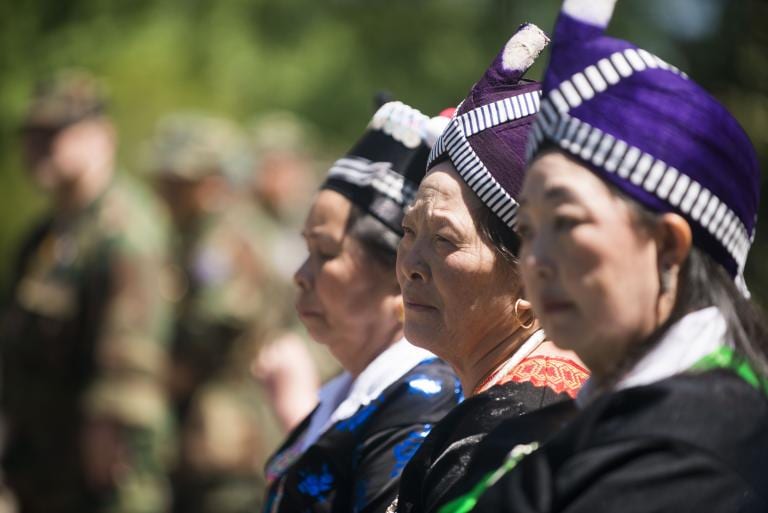
A ceremony honoring Hmong and Lao combat veterans at the memorial tree and plaque in Arlington National Cemetery, May 15, 2105 (Arlington National Cemetery, via Wikimedia Commons)
Paja Thao, a Hmong shaman who lived in Chicago in the late 1970s and early 1980s, offered this lament about his lack of knowledge of Hmong rituals and his uncertainty about continuing Hmong traditions:
But I can remember a little bit
The rhyme and way the words fit together
So I can remember some of the way
How to feed these spirits
Maybe if I try to do it
Maybe I can do it
But all the elders say
If you have never done before
You cannot do it in the right way
So it is with the Bull Spirit
And the Pig Spirit
Maybe I cannot do it
Because I am all alone
Paja Thao lamented the fact that he was “all alone,” a situation that posed a serious threat to Hmong ritual life. He would not be all alone forever, though. Indeed, in the four decades after the first Hmong refugees resettled in the United States, circumstances changed significantly. Hmong people reconstituted their communities by relocating to live closer to family and by sponsoring overseas relatives for resettlement. In ethnic enclaves forged through a combination of primary resettlement, secondary migration, and family sponsorship, Hmong Americans created vibrant communities where they established their own ethnic organizations, cultural education centers, funeral homes, and more to ensure that they have the resources to continue their traditional rituals. Distance, family and community separation, and lack of resources—the problems that once forced them to adjust their healing and funeral ceremonies in the 1970s and 1980s—today no longer pose as much a threat to their traditional ritual life. To be sure, the healing and funeral rituals conducted by Hmong Americans in 2020 are not carbon copies of those conducted by their grandparents, and many Hmong Americans, still finding traditional Hmong rituals difficult to practice in the United States, have adopted Christianity, which translates to kev cai tshiab, which literally means “the new way.” But the fear of Hmong refugees like Paja Thao—that Hmong ritual traditions might be forever lost—never fully came to bear.
What lessons do the Hmong offer for life during a pandemic, an experience that is no doubt different from war and forced migration, but which is also marked by death, despair, and distance? First, Hmong stories remind us that we can, and should, continue to honor the healing and end-of-life rituals that help us to grieve and bring us solace and hope. They remind us that the rituals to which we turn in this moment might need to change, out of necessity. And they remind us that we are spiritually resilient and ritually inventive, and it is precisely because our rituals are so important to us that we will find a way to adapt them, and they will endure. To be sure, there is a certain sorrow that might come with changing the ways that we care for the dying and mourn the loss of life. We might grieve that we can no longer grieve the same way we had before. Hmong refugees did that, too.
But perhaps the greatest lesson that we can draw from Hmong experiences is that in this moment, when we are anxious about the future and nostalgic for the comforts of the past, we can—and must—show compassion to ourselves as we simply do the best we can. We can, as Soua the Hmong funeral expert once did, admit that we are “scared.” Amid our worries, we can, as Paja Thao once did, still figure out how to do “some of the way.” And we might do these things because we can all be, in one way or another, the stewards of the sacred practices of our people.
Previous Post

July 24, 2020
Peter Halket Meets a Stranger
Next Post

July 28, 2020 Faith and History: A Devotional
Browse Our Archives
Select a Category abolitionism Abortion Abraham Joshua Heschel Abraham Kuyper Abraham Lincoln Academia Activism Adam Renberg Advent Adventist africa African American Religion Agnes Howard Albert Camus American History American Religious History American Revolution American West Anabaptists Ancient History Andrea Turpin Andrei Tarkovsky Anglicanism Annales Ansley Lillian Quiros anti-Catholicism Antisemitism Anxious Bench apologetics Apparitions Arash Azizi Archaeology archives art Artificial Intelligence Asia Asian Americans Augustine Authors Bad Bunny Baptism Baptists Barack Obama Battle of Hastings Benjamin Franklin Bernard-Henri Levy Beth Allison Barr Beth Moore Bethany Mannon Bible Bill Cunningham Billy Graham Black Music Bob Dylan Body Boenhoffer Books Breastfeeding Bruce Springsteen C.S. Lewis Calvinism Cancel Culture Capitalism Carmelites Catholicism Cedric Robinson Cesar Chavez Charismaticism charity Charles Dickens Charles Lindbergh Che Guevara Chicago Children Chinese Christianity Chris Gehrz Christ Christian death Christian Higher Education Christian life Christian Nation Christian Nationalism Christianity Today Christmas Church life Church Practice cinema Civil Religion Civil Rights Movement Civil War civility Classics Climate Change Cold War Colonial Mexico colonialism Comer Communism community complementarianism Conference on Faith and History Congregationalism Conspiracies Conspiracy Conversion Narratives Coronavirus Costa Rica Council of Nicaea Covid-19 Creation Critical Race Theory Crusades Culture culture wars Daniel K. Williams David Barton David Swartz Death Ways death with dignity DEI democracy Democratic Party Devotion Digital Age Diplomacy discipleship diversity Donald Trump Drama Dua Lipa Early Church early modern Early modern Catholicism Easter Eastern Christianity economic exploitation Education elections Elie Wiesel Elizabeth II Elizabeth Taylor emotions Empire Engineering England enslavement Entertainment Episcopal Church Erica Ramirez eschatology Eurocentrism Evangelicalism Evangelicals Exegesis Family Feminism Film Flannery O'Connor folk music Food Foreign Policy founding fathers Franciscans Franciscus Junius fundamentalism Funerals G.K. Chesterton Gender Genocide genre geography George W. Bush George Washington George Whitefield Global Christianity Global church Grief Guadalupe Guest Post guest post gun control gun violence Gustavo Gutierrez Hamid Dabashi Harold John Ockenga Harvest Hate Hawaiian Christianity Healing health care Heather Cox Richardson Hell Heresy Hermeneutics Higher Education Hinduism Hippocratic oath Historical Fiction Historical Methodology Historical Profession Historical Profession Historical Theology Historical Thinking historiography Holidays Holocaust horror movies Human rights Humanitarian Work humanities Hummingbirds Hungary hymns Imago Dei Immigration Injustice Interviews Iran Islam Islamophobia Israel Ivan's Childhood Jacob Randolph James Bratt Janine Giordano Drake Japanese history Japanese Literature Jean Paul Sartre Jesse Miranda Jesus Jesus Christ Jimmy Carter Joan Baez Joan Didion Joanne Freeman João B. Chaves Joao Chaves Joey Cochran John Calvin John Fea John Tillotson John Turner Johnny Cash Jonathan Edwards Jonathan Tran Joseph Smith Josh Howerton Journalism Jr. Judaism Jürgen Moltmann Just War Justice Justin Brierley Karl Barth Katelyn Beaty koi ponds Kris Kristofferson Kristin Kobes Du Mez Latin American Religious History Latino Americans Lectio Divina Leisure Lent Leonard Cohen liberal arts liberalism Liberation Theology Linda Ronstadt Lisa Clark Diller Literature Lou Reed Lynchings Lynneth Miller Renberg Mainline Protestantism Malcolm Foley Marilyn Monroe Maritime history Mark Noll Marriage Martin Luther Martin Luther King Martyrdom Marxism Mary Masih Alinejad mass shootings material culture medieval Christianity Medieval Ethiopia Melissa Borja memory Mennonites Mental Health Mental Illness Methodism Mexican Americans Mexicans Mike Madrid Miles Mullin Min Jin Lee Miscarriage Missionaries Mister Rogers Mitt Romney modernity Monasticism Mormonism Motherhood Mothers of the Church Moving Music Musicals Nadya Williams Nahua Christianity Native Americans Natsume Sōseki New Contributor New England New Year New York Nico Non-Violent Protest Orthodoxy pacifism Paleo Evangelicals Palestinians Parenting Patti Smith Paul Kingsnorth Pedro Calderón de la Barca Pentecostalism Philip Jenkins Phillis Wheatley physician-assisted suicide pilgrimage Pilgrims Piracy pluralism Plutocracy Poetry Politics Pope Francis Pope Leo XIV post-modernism prayer preaching Presbyterians prosperity gospel Protest Public Executions Public history Publishing Puritans purity culture Quakers race Race Massacres Racial Capitalism racial reconciliation racialization Racism Raha Bahloulipour Re-Enchantment reading Reformation Refugees religion and the university religion and war Religious Freedom Religious Nones Religious Pluralism Religious Symbols religious violence Republican Party Revival Rita Coolidge Ritual Roger Williams Roman Catholic church Royalty Russell Moore same-sex marriage Sarah Irving-Stonebraker Scandinavia Science Science and Technology Scopes trial Scriptural Interpretation secularism Selena Quintanilla seminary Seventh-Day Adventists sexual morality Sexuality Sikhs Silence slaveholders theology Slavery Slavoj Zizek social justice Social Media Southern Baptist Convention Southern Religion Spain Spiritual Autobiography Spiritual but not religious Spiritual Discipline Sports Stanley Hauerwas Suffering Summer Camps Sunday Night Odds and Ends Supernatural Supreme Court Syriac Christianity Tal Howard Taylor Swift Teaching Technology Television Thanksgiving The Beatles The Mission theater TheoBros Theology Thomas Dixon Thomas Jefferson Thomas Kidd Thomas Merton Tim Gloege Tim Walz Tom Holland Tourism tradition Tragedy Translation Transnationalism Travel Trump Ukraine Uncategorized Unitarians United Methodist Church US History Vanessa Chan Velvet Underground Verónica A. Gutiérrez Veronica Gutierrez Vikings Violence Virgin Mary Virtue Virtue ethics Visions Voting War WCTU Wendell Berry Westminster Assembly White Evangelicalism Wildfires Winnie the Pooh Witches women Women in Ministry Women's and Gender Studies Work Worship writing Yasunari Kawabata Zena Hitz
Select a Month November 2026 October 2026 September 2026 August 2026 July 2026 June 2026 May 2026 April 2026 March 2026 February 2026 January 2026 December 2025 November 2025 October 2025 September 2025 August 2025 July 2025 June 2025 May 2025 April 2025 March 2025 February 2025 January 2025 December 2024 November 2024 October 2024 September 2024 August 2024 July 2024 June 2024 May 2024 April 2024 March 2024 February 2024 January 2024 December 2023 November 2023 October 2023 September 2023 August 2023 July 2023 June 2023 May 2023 April 2023 March 2023 February 2023 January 2023 December 2022 November 2022 October 2022 September 2022 August 2022 July 2022 June 2022 May 2022 April 2022 March 2022 February 2022 January 2022 December 2021 November 2021 October 2021 September 2021 August 2021 July 2021 June 2021 May 2021 April 2021 March 2021 February 2021 January 2021 December 2020 November 2020 October 2020 September 2020 August 2020 July 2020 June 2020 May 2020 April 2020 March 2020 February 2020 January 2020 December 2019 November 2019 October 2019 September 2019 August 2019 July 2019 June 2019 May 2019 April 2019 March 2019 February 2019 January 2019 December 2018 November 2018 October 2018 September 2018 August 2018 July 2018 June 2018 May 2018 April 2018 March 2018 February 2018 January 2018 December 2017 November 2017 October 2017 September 2017 August 2017 July 2017 June 2017 May 2017 April 2017 March 2017 February 2017 January 2017 December 2016 November 2016 October 2016 September 2016 August 2016 July 2016 June 2016 May 2016 April 2016 March 2016 February 2016 January 2016 December 2015 November 2015 October 2015 September 2015 August 2015 July 2015 June 2015 May 2015 April 2015 March 2015 February 2015 January 2015 December 2014 November 2014 October 2014 September 2014 August 2014 July 2014 June 2014 May 2014 April 2014 March 2014 February 2014 January 2014 December 2013 November 2013 October 2013 September 2013 August 2013 July 2013 June 2013 May 2013 April 2013 March 2013 February 2013 January 2013 December 2012 November 2012 October 2012 September 2012 August 2012 July 2012 June 2012 May 2012
Follow Us!
TAKE THE
Religious Wisdom Quiz
What happened when Peter tried to walk on water?
Select your answer to see how you score.
The Spirit descended upon him He led other disciples out He ran ahead of Jesus He sank when he doubted
Related posts from Anxious Bench
Heralds of Heaven: Hummingbirds on a Hillside

Despositio Alleluia – Burying the Alleluia for Lent

Min Jin Lee and the Art of Historical...
Zion: America’s First Techno-Utopia
TRENDING AT PATHEOS Evangelical

God and the Contingency of This World
The great Catholic philosopher Aquinas and the great Lutheran philosopher Leibniz developed...

Pope Francis and The Devil – A Pagan...
According to his private diaries, Pope Francis saw visions of the devil...

Rock N' Roll-- Morphing into/for a New Generation...
Well, should we be grateful, or is rock n' roll just dead? ...

Ansley Gordon Brings Faith and Fresh Stories to...
For screenwriter and actress Ansley Gordon, Christmas has always been about more...

Chris Pratt on Veterans, Faith, “The Way of...
For Chris Pratt, service is not something that ends when a person...

Chapter 5, Sarah: The Quest for Safety in...
Open and Relational Theology & Social Psychology About this series: This series...
view all Evangelical blogs
Ad-Free & Subscriber Log-In Subscription Support
- About Us
- 2026 Calendar
- Videos
- Podcasts
- Library of World Religions
- Faith In Media Tracker
- Advertise With Us
- Write for Us
- Privacy Policy
- Terms of Service
- Do Not Sell My Data
- Contact Us
- Radiant Digital
- Manage Newsletter Subscriptions
- Unsubscribe From Notifications
- Sitemap
Copyright 2008-2026, Patheos, part of the Radiant Digital network of media brands. All rights reserved.
Subscription Support Ad-Free & Subscriber Log-In
Follow Patheos