
BuddhistCatholicContemplativeEvangelicalGeneral ChristianHinduJewishLatter-day SaintMuslimNew VisionsProgressive Christian
Beliefs
- Buddhist
- Catholic
- Contemplative
- Evangelical
- General Christian
- Hindu
- Jewish
- Latter-day Saint
- More Voices
- Muslim
- New Visions
- Pagan
- Progressive Christian
Topics
- Religion News
- Food and Religion
- Sports and Religion
- Religious Art
- Religious Music and Entertainment
- Religious Events
- History and Religion
- Style and Religion
- Politics and Religion
- Women in Religion
- Recreation Outdoors and Religion
- Business Finance and Religion
- Careers Workplace and Religion
- Education and Religion
- Family Parenting and Religion
- Health Fitness and Religion
- Home and Religion
- Relationships and Religion
- Technology and Religion
- Travel and Religion
Columnists
- Buddhist Columnists
- Business Finance and Religion Columnists
- Careers Workplace and Religion Columnists
- Catholic Columnists
- Contemplative Columnists
- Education and Religion Columnists
- Evangelists Columnists
- Family Parenting and Religion Columnists
- General Christian Columnists
- Health Fitness and Religion Columnists
- Hindu Columnists
- History and Religion Columnists
- Home and Religion Columnists
- Jewish Columnists
- More Voices Columnists
- Latter Day Columnists
- Muslim Columnists
- New Visions Columnists
- Nonreligious Columnists
- Pagan Columnists
- Politics and Religion Columnists
- Progressive Columnists
- Recreation Outdoors and Religion Columnists
- Relationships and Religion Columnists
- Religion News Columnists
- Religious Art Columnists
- Religious Events Columnists
- Religious Music and Entertainment Columnists
- Sports and Religion Columnists
- Style and Religion Columnists
- Technology and Religion Columnists
- Travel and Religion Columnists
- Women in Religion Columnists
Resource Library
- 2026 Calendar
- Library of World Religions
- The 100 Most Holy Places on Earth
- Patheos Answers
- Podcasts
- Videos
- Faith Leaders Database
- Anglican Episcopalian
- Bahai
- Baptist
- Buddhism
- Christianity
- Confucianism
- Eastern Orthodoxy
- Hinduism
- Holiness and Pentecostal
- ISKCON
- Islam
- Judaism
- Lutheran
- Methodist
- The Church of Jesus Christ of Latter-day Saints
- New Age
- Paganism
- Presbytarian and Reformed
- Protestantism
- Religion Behind the Scenes
- Roman Catholic
- Scientology
- Shia Islam
- Sikhism
- Sufism
- Sunni Islam
- Taoism
- Zen
- See all religions
Research Tools
 Ad-Free & Subscriber Log-In Subscription Support
Follow Patheos 

- Trending:
- Advent
- |
- Forgiveness
- |
- Thanksgiving
- |
- Election
- |
- Seasonal Holidays
- |
- Marriage

-
About the Authors
- Home
- Evangelical
- The Wounds of Racism and the Pandemic of Anti-Asian Hatred
The Wounds of Racism and the Pandemic of Anti-Asian Hatred
Last updated on: April 2, 2020 at 1:11 pm by Melissa Borja
The Wounds of Racism and the Pandemic of Anti-Asian Hatred 2020-04-02T13:11:38-04:00 Melissa Borja
Patheos Explore the world's faith through different perspectives on religion and spirituality! Patheos has the views of the prevalent religions and spiritualities of the world.
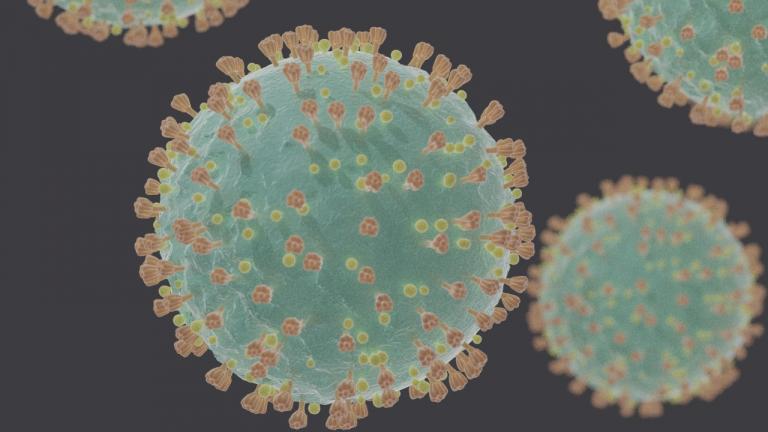
A computer generated representation of COVID-19 virions (SARS-CoV-2) under electron microscope, via WikiMedia Commons
On March 14, an Asian American father brought his two young sons, ages two and six, on a mundane weekend errand: a Saturday trip to the store. But their visit to Sam’s Club in Midland, Texas, turned into a bloody nightmare when a nineteen-year-old man attacked the family, slashing the father and one of his sons across the face. According to the FBI, which has investigated the incident as a hate crime, the stabber had attempted to kill the family “because he thought the family was Chinese and infecting people with the coronavirus.”
The vicious attack prompted the FBI to raise the alarm about increased hate crimes targeting Asian Americans. “The FBI assesses hate crime incidents against Asian Americans likely will surge across the United States, due to the spread of coronavirus disease,” declared a report from the FBI’s Houston office. The FBI based this warning “on the assumption that a portion of the US public will associate Covid-19 with China and Asian American populations.”
The stabbing of this father and his young children is a particularly brutal instance of anti-Asian hatred, but it reflects a broader trend. At the same time that coronavirus cases are climbing, documented cases of anti-Asian harassment and hostility are also on the rise across the country. And just as Americans are uniting to fight the pandemic produced by a novel virus, they must come together to confront a more familiar enemy: racism.
In this battle, religious communities have a special role to play. As they have done in the past, they can support and stand in solidarity with Asian Americans. In addition, they can call Americans to conscience, leading the nation in addressing the deep-rooted problem of anti-Asian hatred, which has plagued our country well before the onset of the current crisis.
“I have never felt the need to shield my eyes until now, in New York, the city of my birth”
Acts of anti-Asian hate are real and rising. At the Stop AAPI Hate Reporting Center, a team of researchers led by Dr. Russell Jeung, Professor of Asian American Studies at San Francisco State University, has been documenting and analyzing reports of anti-Asian hate incidents across the United States. (People who experience acts of hate can report the incident at this online form.) The data collected by the researchers present a clear trend of racial scapegoating. In one week alone, from March 19-26, the Stop AAPI Hate Reporting Center received notice of 673 hate incidents—nearly a hundred each day. These incidents affected Asian Americans of all ethnicities, with women three times more likely to report incidents than men, and they included harassment at everyday places—groceries, pharmacies, and big box stores. In addition, Asian American businesses have reported large decreases in business—approximately 18%—due to fears from customers about exposure to coronavirus in Asian-owned establishments and Asian-dominated ethnic enclaves.
Aware of the dangers and humiliations they risk by going about the simple business of daily life, Asian Americans are anxious. Efforts to venture outside the home are few and fraught, associated with the frightful possibility of physical attack, and for good reason. Beyond the stabbing at the Sam’s Club in Texas, there have been other acts of racist violence. At a subway station in New York City, a man beat an Asian woman with an umbrella and called her a “diseased b****.” And in California, high school students attacked an Asian American teenager accused of having coronavirus. The bullies’ blows were severe enough to send the teenager to the emergency room.
More commonly, there are smaller acts of hate that carry their own emotional and spiritual toll.
For example, there is the story of Father Ricky Manalo, a Filipino American Catholic priest in New York, who was enjoying a stroll when men leaned out of their truck to scream “Asian virus!” at him. The verbal assault forced the stunned priest to seek refuge in a nearby liquor store, and the incident made him warier of his environment, even though New York is his home. Later, on subsequent walks, he wore sunglasses and a scarf to mask his face and hide the fact that he is Asian American. “I have traveled all over the world,” he said, “yet I have never felt the need to shield my eyes until now, in New York, the city of my birth.”
And there is the story of the Korean American physician named David, who stopped for fuel and a cup of coffee at a gas station in a Martinsville, Indiana. The gas station refused to serve him.The business explained to the local police chief that “anyone of Chinese descent is not allowed in the store, and it was directly related to the spread of the coronavirus.” For his part, David found the experience unsettling. “I’ve never experienced anything like this before,” he told local reporters. “Part of me is hurt and angry and saddened that people can actually behave that way to another.”
And there is the story I heard last weekend—of how a friend in California was buying food for the week when another grocery shopper spit at her. As it turned out, the very day this incident happened, I was considering going out for the first time in two weeks. I needed to restock my pantry, and I longed to take a walk in the springtime sun. But after hearing my friend’s story, I wasn’t so sure about leaving the safety of home.
“Faithful Christian witness requires anti-racist work”
Alarmed by the resurgence of Yellow Peril discourses and the reports of harassment, discrimination, and violence, Asian Americans have responded creatively and forcefully.
Asian American politicians have warned against racist rhetoric and have urged their colleagues not to use the stigmatizing term “Chinese virus.” In the House of Representatives last week, Rep. Grace Meng introduced a resolution condemning anti-Asian racism in all its forms and urging law enforcement to document and investigate hate crimes against Asian Americans.
Asian American community groups have advocated for policies and programs to address xenophobia and racism and have worked to hold politicians accountable. In addition, they have worked on developing media campaigns and organizing support for individuals who have been targeted by acts of hatred.
Asian American journalists have called for responsible, fair, and accurate coverage of the coronavirus pandemic. They have urged their fellow journalists to avoid using terms that associate the virus with specific people or places and pairing coronavirus stories with generic images of Chinatown.
Asian American scholars have leaned into their role as educators and researchers. Dr. Jason Oliver Chang, Associate Professor of History and Asian American Studies at the University of Connecticut, created “Treating Yellow Peril,” a comprehensive set of resources to help students and teachers understand current coronavirus-related racism and the deeper history of anti-Asian sentiment in the United States.
And Asian American Christian leaders have drawn on their faith to address the moral crisis of anti-Asian hatred. On Tuesday, the Asian American Christian Collaborative released a statement that denounced both past and present anti-Asian racism and recommended a variety of measures to support Asian American people during this time of vulnerability. More than anything, the AACC urged all Americans, especially fellow Christians, “to speak without ambiguity against racism of every kind.” As the statement declared, “Faithful Christian witness requires anti-racist work, and silence only perpetuates the sins not addressed.” In less than two days, the statement received over 4,500 signatures, including from prominent faith leaders such as Rev. Dr. Walter Kim, President of the National Association of Evangelicals; Tom Lin, President and CEO of InterVarsity Christian Fellowship/USA; Jim Wallis, Founder and President of Sojourners; Shirley Hoogstra, President of the Council for Christian Colleges & Universities; and Jemar Tisby, President of The Witness, A Black Christian Collective.
Many people of faith across the theological spectrum have stepped up as allies and have expressed their support for Asian Americans. Unitarian Universalist ministers have dedicated time on Sundays to preaching about how the current pandemic has had a “disparate impact” on different communities, including Asian Americans, and have used their position of prominence to call for more “love in the time of coronavirus.” Justice-minded members of a Lutheran congregation in New Jersey have decried the hostility toward Asian Americans and denounced the sin of racism. And Muslim Americans, calling attention to the long-standing problem of orientalism, have also denounced anti-Asian prejudice.
Jewish Americans have been particularly vocal in their rejection of racism and their concern for Asian Americans. Former presidential candidate Andrew Yang co-authored an op-ed with Jonathan Greenblatt, President of the Anti-Defamation League, in which they described the long and overlapping histories of Sinophobia and antisemitism and urged “all Americans to come together and stand against the anti-Asian and anti-Jewish blame game.” And yesterday, representatives from over 180 Jewish American organizations issued a collective statement calling for “kindness and solidarity,” not scapegoating. The statement highlighted the importance of showing love, compassion, and empathy to neighbors, but also learning the lessons of Jewish history. Noting that “Jews as a people have a long history of being singled out and stigmatized during times of societal crisis, including being blamed without basis for the spread of disease,” the statement called “all people and particularly all leaders to reject conspiracy theories and the singling out of Asian Americans, foreigners, immigrants, Jews, or any other communities in this moment.”
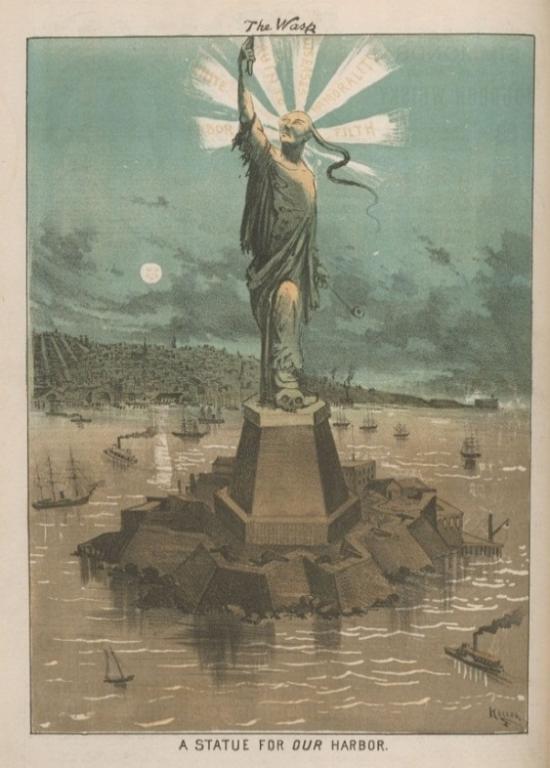
George Keller, “A Statue for Our Harbor,” 1881. The rays around the head of the statue read, from right to left, “Filth, Immorality, Diseases, Ruin to White Labor.”
Learning from the past is important not only for Jewish Americans, but for all Americans. Asian people have long been demonized as threatening vectors of disease and vice. The history of the United States is filled with ugly episodes of anti-Asian racism, from the forced removal, lynching, and exclusion of Chinese migrants in the nineteenth century to the wartime scapegoating and incarceration of Japanese Americans in the twentieth.
But a look to the past also reveals how people of faith can play an important role in serving as allies and calling Americans to their better selves. Through words and actions, they can model what it means to stand on the side of justice and show love and compassion to neighbors, especially those who are vulnerable and suffering. They can offer moral leadership in a world marred by xenophobia and hate.
For example, Americans today might take inspiration from the courage of Rev. Emery Andrews, a Baptist minister who denounced the incarceration of Japanese Americans as “one of the blackest blots on American history; as the time that democracy came the nearest of being wrecked.” Christians who sympathized with Japanese Americans were only a small minority and were not able to prevent incarceration. However, as the historian Robert Shaffer argues, they nonetheless had an important impact—by offering “a spirit of community” to incarcerated Japanese Americans, by facilitating communication between people living within and beyond the camps, and supporting Japanese Americans in the fight against discriminatory laws during and after the war.
Or they might follow the example of the visionary student activists at the center of Stephanie Hinnershitz’ book, Race, Religion, and Civil Rights. She highlights how Filipino, Japanese, and Chinese American civil rights activists drew on their shared Christian values to organize coalitions and contest segregation and discrimination on the West Coast during the Second World War and the Cold War.
In both these historical cases, religion—along with relationships and personal experiences—animated a commitment to stand against racism. Amid the current pandemic, when the specter of death and disaster draws parallels to war, one wonders: will people of faith once again find the courage to take a stand against anti-Asian hatred again today? Some clearly have—but the rising number of hate incidents suggests we have more soul-searching, society-transforming work to do.
The wounds and scars of racism
The other day, I came across photographs of the family stabbed in Texas. The graphic images gave me chills. In one photo, a red, gaping wound reaches across one child’s face, from the eye to the ear. What struck me was not simply the brutality of the attacked that produced this wound, but the fact that the child is so very young–about the same age as my daughter was when she heard her first racist epithet hurled at our family. That verbal attack was short and quick, just a couple words yelled by driver in a car passing us on Second Avenue in Manhattan. We reacted just as the Catholic priest from Brooklyn did—stunned at first, aghast that such words would be uttered in one of the most multicultural cities in the world. My daughter and I were fortunate, and we walked away from the incident with our bodies fully intact. But our hearts were a little broken that day. Since then, it has been harder for both of us to move through the world with the same degree of love and joy and trust.
Racism and acts of xenophobic hate can wound deeply and leave indelible scars—physically, emotionally, and spiritually—on individuals and on our entire society. But I also believe that most cherished values held by religious communities—love, justice, compassion—can offer a way for individuals and societies to heal and also prevent injury in the first place.
During this pandemic, which brings into stark relief the interdependence of our lives, may we all remember that the suffering that afflicts some of us—whether Covid-19 or racism—ultimately shapes the wellbeing and the survival of all of us.
Previous Post

April 1, 2020
Learning in Coronavirus Time: Rereading C.S. Lewis’s Famous Sermon
Next Post

April 3, 2020 Jesus, Robert Graves, and the Mount of Olives
Browse Our Archives
Select a Category abolitionism Abortion Abraham Joshua Heschel Abraham Kuyper Abraham Lincoln Academia Activism Adam Renberg Advent Adventist africa African American Religion Agnes Howard Albert Camus American History American Religious History American Revolution American West Anabaptists Ancient History Andrea Turpin Andrei Tarkovsky Anglicanism Annales Ansley Lillian Quiros anti-Catholicism Antisemitism Anxious Bench apologetics Apparitions Arash Azizi Archaeology archives art Artificial Intelligence Asia Asian Americans Augustine Authors Bad Bunny Baptism Baptists Barack Obama Battle of Hastings Benjamin Franklin Bernard-Henri Levy Beth Allison Barr Beth Moore Bethany Mannon Bible Bill Cunningham Billy Graham Black Music Bob Dylan Body Boenhoffer Books Breastfeeding Bruce Springsteen C.S. Lewis Calvinism Cancel Culture Capitalism Carmelites Catholicism Cedric Robinson Cesar Chavez Charismaticism charity Charles Dickens Charles Lindbergh Che Guevara Chicago Children Chinese Christianity Chris Gehrz Christ Christian death Christian Higher Education Christian life Christian Nation Christian Nationalism Christianity Today Christmas Church life Church Practice cinema Civil Religion Civil Rights Movement Civil War civility Classics Climate Change Cold War Colonial Mexico colonialism Comer Communism community complementarianism Conference on Faith and History Congregationalism Conspiracies Conspiracy Conversion Narratives Coronavirus Costa Rica Council of Nicaea Covid-19 Creation Critical Race Theory Crusades Culture culture wars Daniel K. Williams David Barton David Swartz Death Ways death with dignity DEI democracy Democratic Party Devotion Digital Age Diplomacy discipleship diversity Donald Trump Drama Dua Lipa Early Church early modern Early modern Catholicism Easter Eastern Christianity economic exploitation Education elections Elie Wiesel Elizabeth II Elizabeth Taylor emotions Empire Engineering England enslavement Entertainment Episcopal Church Erica Ramirez eschatology Eurocentrism Evangelicalism Evangelicals Exegesis Family Feminism Film Flannery O'Connor folk music Food Foreign Policy founding fathers Franciscans Franciscus Junius fundamentalism Funerals G.K. Chesterton Gender Genocide genre geography George W. Bush George Washington George Whitefield Global Christianity Global church Grief Guadalupe guest post Guest Post gun control gun violence Gustavo Gutierrez Hamid Dabashi Harold John Ockenga Harvest Hate Hawaiian Christianity Healing health care Heather Cox Richardson Hell Heresy Hermeneutics Higher Education Hinduism Hippocratic oath Historical Fiction Historical Methodology Historical Profession Historical Profession Historical Theology Historical Thinking historiography Holidays Holocaust horror movies Human rights Humanitarian Work humanities Hummingbirds Hungary hymns Imago Dei Immigration Injustice Interviews Iran Islam Islamophobia Israel Ivan's Childhood Jacob Randolph James Bratt Janine Giordano Drake Japanese history Japanese Literature Jean Paul Sartre Jesse Miranda Jesus Jesus Christ Jimmy Carter Joan Baez Joan Didion Joanne Freeman João B. Chaves Joao Chaves Joey Cochran John Calvin John Fea John Tillotson John Turner Johnny Cash Jonathan Edwards Jonathan Tran Joseph Smith Josh Howerton Journalism Jr. Judaism Jürgen Moltmann Just War Justice Justin Brierley Karl Barth Katelyn Beaty koi ponds Kris Kristofferson Kristin Kobes Du Mez Latin American Religious History Latino Americans Lectio Divina Leisure Lent Leonard Cohen liberal arts liberalism Liberation Theology Linda Ronstadt Lisa Clark Diller Literature Lou Reed Lynchings Lynneth Miller Renberg Mainline Protestantism Malcolm Foley Marilyn Monroe Maritime history Mark Noll Marriage Martin Luther Martin Luther King Martyrdom Marxism Mary Masih Alinejad mass shootings material culture medieval Christianity Medieval Ethiopia Melissa Borja memory Mennonites Mental Health Mental Illness Methodism Mexican Americans Mexicans Mike Madrid Miles Mullin Min Jin Lee Miscarriage Missionaries Mister Rogers Mitt Romney modernity Monasticism Mormonism Motherhood Mothers of the Church Moving Music Musicals Nadya Williams Nahua Christianity Native Americans Natsume Sōseki New Contributor New England New Year New York Nico Non-Violent Protest Orthodoxy pacifism Paleo Evangelicals Palestinians Parenting Patti Smith Paul Kingsnorth Pedro Calderón de la Barca Pentecostalism Philip Jenkins Phillis Wheatley physician-assisted suicide pilgrimage Pilgrims Piracy pluralism Plutocracy Poetry Politics Pope Francis Pope Leo XIV post-modernism prayer preaching Presbyterians prosperity gospel Protest Public Executions Public history Publishing Puritans purity culture Quakers race Race Massacres Racial Capitalism racial reconciliation racialization Racism Raha Bahloulipour Re-Enchantment reading Reformation Refugees religion and the university religion and war Religious Freedom Religious Nones Religious Pluralism Religious Symbols religious violence Republican Party Revival Rita Coolidge Ritual Roger Williams Roman Catholic church Royalty Russell Moore same-sex marriage Sarah Irving-Stonebraker Scandinavia Science Science and Technology Scopes trial Scriptural Interpretation secularism Selena Quintanilla seminary Seventh-Day Adventists sexual morality Sexuality Sikhs Silence slaveholders theology Slavery Slavoj Zizek social justice Social Media Southern Baptist Convention Southern Religion Spain Spiritual Autobiography Spiritual but not religious Spiritual Discipline Sports Stanley Hauerwas Suffering Summer Camps Sunday Night Odds and Ends Supernatural Supreme Court Syriac Christianity Tal Howard Taylor Swift Teaching Technology Television Thanksgiving The Beatles The Mission theater TheoBros Theology Thomas Dixon Thomas Jefferson Thomas Kidd Thomas Merton Tim Gloege Tim Walz Tom Holland Tourism tradition Tragedy Translation Transnationalism Travel Trump Ukraine Uncategorized Unitarians United Methodist Church US History Vanessa Chan Velvet Underground Verónica A. Gutiérrez Veronica Gutierrez Vikings Violence Virgin Mary Virtue Virtue ethics Visions Voting War WCTU Wendell Berry Westminster Assembly White Evangelicalism Wildfires Winnie the Pooh Witches women Women in Ministry Women's and Gender Studies Work Worship writing Yasunari Kawabata Zena Hitz
Select a Month November 2026 October 2026 September 2026 August 2026 July 2026 June 2026 May 2026 April 2026 March 2026 February 2026 January 2026 December 2025 November 2025 October 2025 September 2025 August 2025 July 2025 June 2025 May 2025 April 2025 March 2025 February 2025 January 2025 December 2024 November 2024 October 2024 September 2024 August 2024 July 2024 June 2024 May 2024 April 2024 March 2024 February 2024 January 2024 December 2023 November 2023 October 2023 September 2023 August 2023 July 2023 June 2023 May 2023 April 2023 March 2023 February 2023 January 2023 December 2022 November 2022 October 2022 September 2022 August 2022 July 2022 June 2022 May 2022 April 2022 March 2022 February 2022 January 2022 December 2021 November 2021 October 2021 September 2021 August 2021 July 2021 June 2021 May 2021 April 2021 March 2021 February 2021 January 2021 December 2020 November 2020 October 2020 September 2020 August 2020 July 2020 June 2020 May 2020 April 2020 March 2020 February 2020 January 2020 December 2019 November 2019 October 2019 September 2019 August 2019 July 2019 June 2019 May 2019 April 2019 March 2019 February 2019 January 2019 December 2018 November 2018 October 2018 September 2018 August 2018 July 2018 June 2018 May 2018 April 2018 March 2018 February 2018 January 2018 December 2017 November 2017 October 2017 September 2017 August 2017 July 2017 June 2017 May 2017 April 2017 March 2017 February 2017 January 2017 December 2016 November 2016 October 2016 September 2016 August 2016 July 2016 June 2016 May 2016 April 2016 March 2016 February 2016 January 2016 December 2015 November 2015 October 2015 September 2015 August 2015 July 2015 June 2015 May 2015 April 2015 March 2015 February 2015 January 2015 December 2014 November 2014 October 2014 September 2014 August 2014 July 2014 June 2014 May 2014 April 2014 March 2014 February 2014 January 2014 December 2013 November 2013 October 2013 September 2013 August 2013 July 2013 June 2013 May 2013 April 2013 March 2013 February 2013 January 2013 December 2012 November 2012 October 2012 September 2012 August 2012 July 2012 June 2012 May 2012
Follow Us!
TAKE THE
Religious Wisdom Quiz
What garden did Jesus pray in before His arrest?
Select your answer to see how you score.
Eden Olive Grove Gethsemane Bethlehem
Related posts from Anxious Bench
Christians Helped Invent Race. Some Now Call It...

Just War, Non-Violence, and Pete Hegseth

Epic Fury in the End-Times: Exploring Pentecostal War...

Karen Johnson on "Ordinary Heroes of Racial Justice"
TRENDING AT PATHEOS Evangelical

Ghosts, Spirits, and Wizards in Post-Puritan New England
As it is Thanksgiving, I have a seasonal post concerned with New...

Here are two Thanksgiving columns that I originally wrote for the...

Book III, Chapter 3: Christ "Classic" (Matt. 9:9-34)
Book III, Chapter 3: Christ "Classic" (Matt. 9:9-34) In honor of tomorrow's...

Jesus explicitly mentions the book of Jonah twice, but he retells the...

Peggy Sue Got Married: Coppola’s Always Been Like...
I enjoyed Megalopolis (2024). It’s a mess, but I enjoyed it. The...

My dissertation The Place of Mysticism in the Late Middle Ages concerns...
view all Evangelical blogs
Ad-Free & Subscriber Log-In Subscription Support
- About Us
- 2026 Calendar
- Videos
- Podcasts
- Library of World Religions
- Faith In Media Tracker
- Advertise With Us
- Write for Us
- Privacy Policy
- Terms of Service
- Do Not Sell My Data
- Contact Us
- Radiant Digital
- Manage Newsletter Subscriptions
- Unsubscribe From Notifications
- Sitemap
Copyright 2008-2026, Patheos, part of the Radiant Digital network of media brands. All rights reserved.
Subscription Support Ad-Free & Subscriber Log-In
Follow Patheos