
BuddhistCatholicContemplativeEvangelicalGeneral ChristianHinduJewishLatter-day SaintMuslimNew VisionsProgressive Christian
Beliefs
- Buddhist
- Catholic
- Contemplative
- Evangelical
- General Christian
- Hindu
- Jewish
- Latter-day Saint
- More Voices
- Muslim
- New Visions
- Pagan
- Progressive Christian
Topics
- Religion News
- Food and Religion
- Sports and Religion
- Religious Art
- Religious Music and Entertainment
- Religious Events
- History and Religion
- Style and Religion
- Politics and Religion
- Women in Religion
- Recreation Outdoors and Religion
- Business Finance and Religion
- Careers Workplace and Religion
- Education and Religion
- Family Parenting and Religion
- Health Fitness and Religion
- Home and Religion
- Relationships and Religion
- Technology and Religion
- Travel and Religion
Columnists
- Buddhist Columnists
- Business Finance and Religion Columnists
- Careers Workplace and Religion Columnists
- Catholic Columnists
- Contemplative Columnists
- Education and Religion Columnists
- Evangelists Columnists
- Family Parenting and Religion Columnists
- General Christian Columnists
- Health Fitness and Religion Columnists
- Hindu Columnists
- History and Religion Columnists
- Home and Religion Columnists
- Jewish Columnists
- More Voices Columnists
- Latter Day Columnists
- Muslim Columnists
- New Visions Columnists
- Nonreligious Columnists
- Pagan Columnists
- Politics and Religion Columnists
- Progressive Columnists
- Recreation Outdoors and Religion Columnists
- Relationships and Religion Columnists
- Religion News Columnists
- Religious Art Columnists
- Religious Events Columnists
- Religious Music and Entertainment Columnists
- Sports and Religion Columnists
- Style and Religion Columnists
- Technology and Religion Columnists
- Travel and Religion Columnists
- Women in Religion Columnists
Resource Library
- 2026 Calendar
- Library of World Religions
- The 100 Most Holy Places on Earth
- Patheos Answers
- Podcasts
- Videos
- Faith Leaders Database
- Anglican Episcopalian
- Bahai
- Baptist
- Buddhism
- Christianity
- Confucianism
- Eastern Orthodoxy
- Hinduism
- Holiness and Pentecostal
- ISKCON
- Islam
- Judaism
- Lutheran
- Methodist
- The Church of Jesus Christ of Latter-day Saints
- New Age
- Paganism
- Presbytarian and Reformed
- Protestantism
- Religion Behind the Scenes
- Roman Catholic
- Scientology
- Shia Islam
- Sikhism
- Sufism
- Sunni Islam
- Taoism
- Zen
- See all religions
Research Tools
 Ad-Free & Subscriber Log-In Subscription Support
Follow Patheos 

- Trending:
- Advent
- |
- Forgiveness
- |
- Thanksgiving
- |
- Election
- |
- Seasonal Holidays
- |
- Marriage

-
About the Authors
- Home
- Evangelical
- About Martin Luther’s Letter on the Plague…
About Martin Luther’s Letter on the Plague…
Last updated on: March 17, 2020 at 1:33 am by Chris Gehrz
About Martin Luther’s Letter on the Plague… 2020-03-16T21:31:38-04:00 Chris Gehrz
Patheos Explore the world's faith through different perspectives on religion and spirituality! Patheos has the views of the prevalent religions and spiritualities of the world.
On August 2, 1527 the bubonic plague returned to the German city of Wittenberg. It had been nearly two centuries since the Black Death, but that dreaded disease had continued to flare up, killing 30% or more of the population in each of its periodic outbreaks. Though the students and faculty of Wittenberg were told to leave the city, that university’s most famous professor stayed put: teaching, preaching, advising the city council, and ministering to the sick.

17th century image of Luther at work, with portraits of his wife and parents behind him – Wikimedia
My guess is that most of you already know the professor’s name: Martin Luther. As Christians have grappled with the implications of our own public health crisis, many have turned to the letter Luther wrote in 1527, “Whether One May Flee From a Deadly Plague.” Back in late January, when COVID-19 was largely associated with the Chinese city of Wuhan, a medical student named Emmy Yang recommended Luther’s letter to the readers of Christianity Today. For several days now, the most popular post at Patheos has been Grayson Gilbert’s reflection on the same letter. Just yesterday I saw three different Facebook friends share Luther’s words.
For the reformer, Gilbert explained, “there was an obligation to help those who contracted the plague, but so long as they were helped, it was a matter of conscience if one remained to aide [sic] in this great task… What is unique to Martin Luther is that all of these words were backed by his willingness to actually follow his own advice. Not only did he and Katharina open their own home as a ward to the infected, but he recognized the opportunity to preach Christ to those literally days away from death.”
I’d recommend reading Luther’s letter itself, plus the commentaries from writers like Yang and Gilbert. But I’d like to offer some historical and theological context, to help us understand why Luther was writing, how readers might have heard him, and what his advice might be today.
The Plague and the Reformation
First, we should understand that plague was never far from most Europeans’ experience. By one calculation, there was a significant outbreak on average of every nine years from the 1490s through the mid-17th century. Luther himself was no stranger to the disease; it had struck the university town of Erfurt in 1505, in the middle of his famous transition from rising law student to troubled Augustinian monk.
And the plague intersected with the history of the Reformation in several other spots. Eight years before it came to Wittenberg, plague killed 1,500 people in the Swiss canton of Zurich, including Andreas Zwingli. His brother Huldrych, newly called as preacher of the city’s largest church, nearly succumbed himself. Michael Massing concludes that Zwingli’s brush with the plague served as “the precipitating event” for that priest becoming the early leader of the Swiss Reformation, as the nearness of death persuaded the humanist-educated Zwingli that “Erasmian-style exhortations to virtue seemed unavailing; seeking spiritual transformation, Zwingli found redemption in the reborn Christ.” (Erasmus himself, always in precarious health, fled the plague several times before and during the Reformation.)
That same year, 1519, plague also broke out in Paris, one of the intellectual centers of Europe. Among the university students who fled was Conrad Grebel, who ended up returning to Zurich and coming under the influence of Zwingli. Over time, however, Grebel and other Zwinglians broke with their mentor, as their study of Scripture convinced them that infants were not meant to be baptized. With the support of Zwingli, the city council persecuted such early Anabaptists. Grebel managed to escape jail in 1526 and flee to Maienfeld, where another outbreak of the plague dealt a final blow to his weakened health.
A year later the same disease took the life of another Anabaptist leader, Hans Denck, who had taken refuge in Basel. In 1541, that same Swiss city became the final resting place of the radical theologian Andreas Karlstadt. His estranged friend Martin Luther found the cause of death ironic, since Karlstadt was “the plague himself of the Basle Church.”
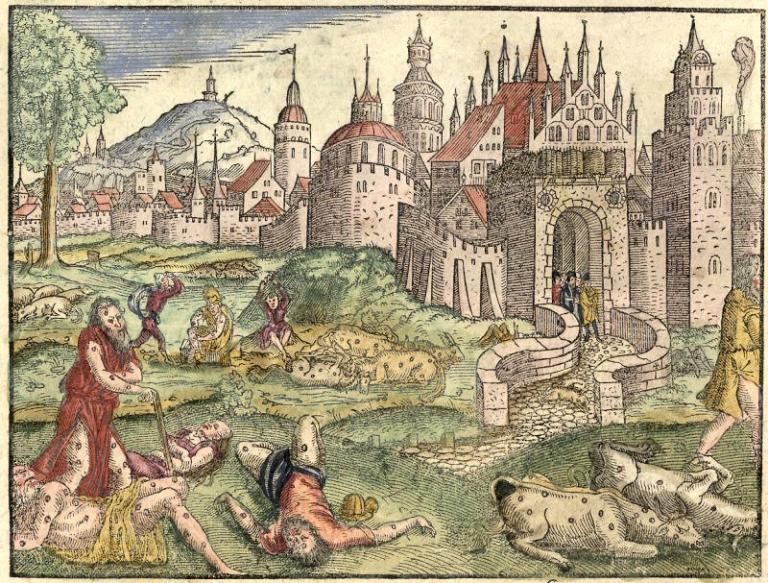
Illustration of the Plague of Boils, from The Wittenberg Bible (1572)
It wasn’t just Protestants who were affected. In 1522 a Dutch scholar sympathetic to Erasmus was inaugurated as Pope Adrian VI, in the middle of an outbreak of plague that was killing nearly three dozen Romans a day. While all but one of his cardinals fled, Adrian stayed, hoping to bring about a moral and intellectual reformation of the Church. He died a year later (not from plague) at age 64 and was succeeded by Clement VII, who was in Rome when plague returned in 1527 — while German soldiers sacked the city and the papal court sheltered in the Castel Sant’Angelo.
That was just a few months before the plague hit Wittenberg. Luther’s response to the crisis was motivated by more than just pastoral concern. When Lutherans fled the disease, a Dominican polemicist used such stories as ammunition in the war of words raging between Catholics and Protestants.
Plague as “God’s Punishment”
As he started his letter, Luther acknowledged that how one responded to the plague could be viewed as a test of faith in God. He could not “censure” those who stayed in a plague-stricken city, believing that “death is God’s punishment, which he sends upon us for our sins… They look upon running away as an outright wrong and as lack of belief in God.”

Andreas Osiander (1498-1552) – Wikimedia
Such a view was hardly unusual in the 16th century. Ten years after Luther’s letter from Wittenberg, plague threatened the city of Nuremberg. That city’s leading Lutheran pastor responded by preaching on the same psalm Philip discussed yesterday. Andreas Osiander gravely affirmed that “this horrible plague of pestilence cometh out of God’s wrath, because of the despising and transgressing of his godly commandments.”
Luther did not doubt the reality of God’s judgments, but refused to condemn those who tried to escape death. Otherwise, he argued, no one should try to escape a burning house or save themselves from drowning. “Why do you eat and drink,” he continued, “instead of letting yourself be punished until hunger and thirst stop of themselves?” Would such Christians no longer join Jesus in praying that God would “deliver us from evil”?
Even someone so highly educated as Martin Luther did not understand the causes of a disease like the bubonic plague. But while Osiander warned against attributing epidemics to “natural” causes rather than God’s mysterious judgments, Luther rebuked Christians who make “no use of intelligence or medicine,” those who
do not avoid places and persons infected by the plague, but lightheartedly make sport of it… They say that it is God’s punishment; if he wants to protect them he can do so without medicines or our carefulness. This is not trusting God, but tempting him. God has created medicines and provided us with intelligence to guard and take good care of the body so that we can live in good health.
And that’s a good word in our own time. Our “intelligence or medicine” is far beyond that of Luther’s day, yet some Christians continue to ignore the advice of doctors, scientists, and public health officials.
The Particularity of Vocation
But as importantly, we should recognize in Luther’s response to the plague his doctrine of Christian vocation.
According to the Lutheran scholar Kathryn Kleinhans, “Luther broadened the concept of vocation from a narrow ecclesiastical focus to describe the life and work of all Christians in response to God’s call.” As Luther helped Protestants extend their understanding of vocation from a special focus on monastic or clerical calling, they learned to “reject the call to be ‘apart from’ the world in favor of a call to be ‘a part of’ the world. It was not the nature of a work itself that was determinative for the Lutheran understanding of vocation, either as affirmation of a special spiritual work or as rejection of a particularly secular work. What was determinative was responding in faith to God’s call to be of service.”
Being called “to be of service” runs through all of Luther’s 1527 letter on the plague. While it was “natural… and not forbidden” to save one’s own life, there was a higher calling to love God and one’s neighbor. It was only “as long as he does not neglect his duty toward his neighbor” that one could choose to flee the plague. Likewise, Osiander’s 1537 sermon on plague criticized those who “out of inordinate fear of this plague, leave their calling and office, maliciously withdrawing the love, help, and faithfulness which they (out of God’s commandment) are bound to show unto their neighbors….”
And particular callings might require particular courage. Not surprisingly, Luther expected healthcare workers to continue to care for the body, and preachers and pastors to keep caring for souls. (Though he also allowed, in each case, that they could leave if enough others remained to care for the sick and dying.) But don’t skip past this paragraph from early in Luther’s letter:
…all those in public office such as mayors, judges, and the like are under obligation to remain. This, too, is God’s word, which institutes secular authority and commands that town and country be ruled, protected, and preserved, as St. Paul teaches in Romans 13 [:4], “The governing authorities are God’s ministers for your own good.”
Though his chief concern here was with maintaining social order, Luther also dreamed of a government so efficient that it would “maintain municipal homes and hospitals staffed with people to take care of the sick… That would indeed be a fine, commendable, and Christian arrangement to which everyone should offer generous help and contributions, particularly the government.”
(The particular calling of political leaders in the midst of a public health crisis was also central to Theodore Beza’s Treatise on the Plague. Writing in 1580, Geneva’s leading theologian held it the “duty of the Christian Magistrate to provide that those things which either breed or nourish the plague, so far as may be, be taken away, and that regard may be had of those that be visited with this sickness, that all be not driven to be careful for all. But how they that serve in any public Civil office may leave their charge in the time of plague, I do not see…”)
So I hope that everyone who is sharing Luther’s letter as a spiritual reassurance also takes it as a prompt to consider how well our current political leaders are fulfilling their calling to service. Faced with a public health crisis, for example, we should hope that the president of the United States would behave as prudently, decisively, and honestly as governors like Mike DeWine (R-Ohio) and Gretchen Whitmer (D-Michigan) have. Alas Donald Trump, without literally fleeing an epidemic, has repeatedly abandoned the reality of the situation. While his sober news conference yesterday was a step in the right direction, it doesn’t erase the fact that he has repeatedly ignored and even contradicted the advice of his own experts, that he took steps before and during the COVID outbreak that undercut the ability of public authorities to preserve the health of citizens.
In one of his table talks, Luther hoped to see government placed in the hands of
understanding, wise, and courageous men, who are to be trusted, and who aim at the common good and prosperity, not seeking their own gain and profit, or following their own desires, pleasures, and delights, but how few governors and rulers think thereon? They make a trade and traffic of government; they cannot govern themselves: how, then, should they govern great territories and multitudes of people….
How, indeed?
The Plurality of Vocation
But even as I want to remind each of you of your calling as citizens of a democratic republic, in which leaders are accountable to the people, it’s also important to underscore that we all have multiple callings. “The arenas of worldly activity identified by Luther,” Kleinhans continued, “are not mutually exclusive: one can be a parent, an employer or an employee, a citizen, and a member of the Christian community simultaneously.”
For Martin Luther, Christian vocation was both particular and plural.
For example, I’ve felt clearly the pull of multiple callings in recent days. As a teacher, I’ve been preparing to move my classes online, at least through Easter and likely far beyond it. But I’ve also wondered if historians, given platforms like this, could draw on the past to help teach the wider public about the demands of the present. That’s certainly part of the motivation for this post, as for the one I wrote last week on Christian responses to the influenza pandemic of 1918.
But historian and teacher are but two of my callings. I’m also a father and a husband, a son and a brother. I’m in a position to serve many, but none need me as much as my family.
I started thinking about this last week. Back when colleges were still holding face-to-face classes, I had asked a friend who is an ordained Lutheran pastor to talk to some of my students. She told the story of her midlife call to ministry, but explained that her most important vocation, in this moment, was that of daughter to her mother, dying of Parkinson’s disease. She had taken a sabbatical from her job as pastor in order to have time to travel to and from her hometown.
As she talked about her multiple vocations, I recognized the most problematic aspect of Luther’s response to the 1527 plague. Was he being faithful to his calling when he continued to teach, preach, and minister, or when he wrote the letter Christians read to this day? Certainly, as a professor and pastor. But what about his calling as a father and husband?
 In the end, Luther’s faithfulness to his pastoral calling proved costly for his family. His decision to stay meant that his wife and children were exposed to the plague. While one-year old Hans recovered from illness and Katy Luther survived to deliver their first daughter, young Elisabeth Luther died less than eight months into her life. That tension between multiple vocations runs through the ambivalent judgment of one of Luther’s best recent biographers, Lyndal Roper:
Luther’s decision to remain in Wittenberg was bold, but also revealed a reckless disregard for his own safety and that of his family. It may have been a residue of his wish for martyrdom, or, perhaps, another example of the remarkable courage that enabled him not to shirk what he felt to be his responsibility to his flock.
Previous Post

March 16, 2020
The Pestilence That Walks in Darkness

Browse Our Archives
Select a Category abolitionism Abortion Abraham Joshua Heschel Abraham Kuyper Abraham Lincoln Academia Activism Adam Renberg Advent Adventist africa African American Religion Agnes Howard Albert Camus American History American Religious History American Revolution American West Anabaptists Ancient History Andrea Turpin Andrei Tarkovsky Anglicanism Annales Ansley Lillian Quiros anti-Catholicism Antisemitism Anxious Bench apologetics Apparitions Arash Azizi Archaeology archives art Artificial Intelligence Asia Asian Americans Augustine Authors Bad Bunny Baptism Baptists Barack Obama Battle of Hastings Benjamin Franklin Bernard-Henri Levy Beth Allison Barr Beth Moore Bethany Mannon Bible Bill Cunningham Billy Graham Black Music Bob Dylan Body Boenhoffer Books Breastfeeding Bruce Springsteen C.S. Lewis Calvinism Cancel Culture Capitalism Carmelites Catholicism Cedric Robinson Cesar Chavez Charismaticism charity Charles Dickens Charles Lindbergh Che Guevara Chicago Children Chinese Christianity Chris Gehrz Christ Christian death Christian Higher Education Christian life Christian Nation Christian Nationalism Christianity Today Christmas Church life Church Practice cinema Civil Religion Civil Rights Movement Civil War civility Classics Climate Change Cold War Colonial Mexico colonialism Comer Communism community complementarianism Conference on Faith and History Congregationalism Conspiracies Conspiracy Conversion Narratives Coronavirus Costa Rica Council of Nicaea Covid-19 Creation Critical Race Theory Crusades Culture culture wars Daniel K. Williams David Barton David Swartz Death Ways death with dignity DEI democracy Democratic Party Devotion Digital Age Diplomacy discipleship diversity Donald Trump Drama Dua Lipa Early Church early modern Early modern Catholicism Easter Eastern Christianity economic exploitation Education elections Elie Wiesel Elizabeth II Elizabeth Taylor emotions Empire Engineering England enslavement Entertainment Episcopal Church Erica Ramirez eschatology Eurocentrism Evangelicalism Evangelicals Exegesis Family Feminism Film Flannery O'Connor folk music Food Foreign Policy founding fathers Franciscans Franciscus Junius fundamentalism Funerals G.K. Chesterton Gender Genocide genre geography George W. Bush George Washington George Whitefield Global Christianity Global church Grief Guadalupe Guest Post guest post gun control gun violence Gustavo Gutierrez Hamid Dabashi Harold John Ockenga Harvest Hate Hawaiian Christianity Healing health care Heather Cox Richardson Hell Heresy Hermeneutics Higher Education Hinduism Hippocratic oath Historical Fiction Historical Methodology Historical Profession Historical Profession Historical Theology Historical Thinking historiography Holidays Holocaust horror movies Human rights Humanitarian Work humanities Hummingbirds Hungary hymns Imago Dei Immigration Injustice Interviews Iran Islam Islamophobia Israel Ivan's Childhood Jacob Randolph James Bratt Janine Giordano Drake Japanese history Japanese Literature Jean Paul Sartre Jesse Miranda Jesus Jesus Christ Jimmy Carter Joan Baez Joan Didion Joanne Freeman João B. Chaves Joao Chaves Joey Cochran John Calvin John Fea John Tillotson John Turner Johnny Cash Jonathan Edwards Jonathan Tran Joseph Smith Josh Howerton Journalism Jr. Judaism Jürgen Moltmann Just War Justice Justin Brierley Karl Barth Katelyn Beaty koi ponds Kris Kristofferson Kristin Kobes Du Mez Latin American Religious History Latino Americans Lectio Divina Leisure Lent Leonard Cohen liberal arts liberalism Liberation Theology Linda Ronstadt Lisa Clark Diller Literature Lou Reed Lynchings Lynneth Miller Renberg Mainline Protestantism Malcolm Foley Marilyn Monroe Maritime history Mark Noll Marriage Martin Luther Martin Luther King Martyrdom Marxism Mary Masih Alinejad mass shootings material culture medieval Christianity Medieval Ethiopia Melissa Borja memory Mennonites Mental Health Mental Illness Methodism Mexican Americans Mexicans Mike Madrid Miles Mullin Min Jin Lee Miscarriage Missionaries Mister Rogers Mitt Romney modernity Monasticism Mormonism Motherhood Mothers of the Church Moving Music Musicals Nadya Williams Nahua Christianity Native Americans Natsume Sōseki New Contributor New England New Year New York Nico Non-Violent Protest Orthodoxy pacifism Paleo Evangelicals Palestinians Parenting Patti Smith Paul Kingsnorth Pedro Calderón de la Barca Pentecostalism Philip Jenkins Phillis Wheatley physician-assisted suicide pilgrimage Pilgrims Piracy pluralism Plutocracy Poetry Politics Pope Francis Pope Leo XIV post-modernism prayer preaching Presbyterians prosperity gospel Protest Public Executions Public history Publishing Puritans purity culture Quakers race Race Massacres Racial Capitalism racial reconciliation racialization Racism Raha Bahloulipour Re-Enchantment reading Reformation Refugees religion and the university religion and war Religious Freedom Religious Nones Religious Pluralism Religious Symbols religious violence Republican Party Revival Rita Coolidge Ritual Roger Williams Roman Catholic church Royalty Russell Moore same-sex marriage Sarah Irving-Stonebraker Scandinavia Science Science and Technology Scopes trial Scriptural Interpretation secularism Selena Quintanilla seminary Seventh-Day Adventists sexual morality Sexuality Sikhs Silence slaveholders theology Slavery Slavoj Zizek social justice Social Media Southern Baptist Convention Southern Religion Spain Spiritual Autobiography Spiritual but not religious Spiritual Discipline Sports Stanley Hauerwas Suffering Summer Camps Sunday Night Odds and Ends Supernatural Supreme Court Syriac Christianity Tal Howard Taylor Swift Teaching Technology Television Thanksgiving The Beatles The Mission theater TheoBros Theology Thomas Dixon Thomas Jefferson Thomas Kidd Thomas Merton Tim Gloege Tim Walz Tom Holland Tourism tradition Tragedy Translation Transnationalism Travel Trump Ukraine Uncategorized Unitarians United Methodist Church US History Vanessa Chan Velvet Underground Verónica A. Gutiérrez Veronica Gutierrez Vikings Violence Virgin Mary Virtue Virtue ethics Visions Voting War WCTU Wendell Berry Westminster Assembly White Evangelicalism Wildfires Winnie the Pooh Witches women Women in Ministry Women's and Gender Studies Work Worship writing Yasunari Kawabata Zena Hitz
Select a Month November 2026 October 2026 September 2026 August 2026 July 2026 June 2026 May 2026 April 2026 March 2026 February 2026 January 2026 December 2025 November 2025 October 2025 September 2025 August 2025 July 2025 June 2025 May 2025 April 2025 March 2025 February 2025 January 2025 December 2024 November 2024 October 2024 September 2024 August 2024 July 2024 June 2024 May 2024 April 2024 March 2024 February 2024 January 2024 December 2023 November 2023 October 2023 September 2023 August 2023 July 2023 June 2023 May 2023 April 2023 March 2023 February 2023 January 2023 December 2022 November 2022 October 2022 September 2022 August 2022 July 2022 June 2022 May 2022 April 2022 March 2022 February 2022 January 2022 December 2021 November 2021 October 2021 September 2021 August 2021 July 2021 June 2021 May 2021 April 2021 March 2021 February 2021 January 2021 December 2020 November 2020 October 2020 September 2020 August 2020 July 2020 June 2020 May 2020 April 2020 March 2020 February 2020 January 2020 December 2019 November 2019 October 2019 September 2019 August 2019 July 2019 June 2019 May 2019 April 2019 March 2019 February 2019 January 2019 December 2018 November 2018 October 2018 September 2018 August 2018 July 2018 June 2018 May 2018 April 2018 March 2018 February 2018 January 2018 December 2017 November 2017 October 2017 September 2017 August 2017 July 2017 June 2017 May 2017 April 2017 March 2017 February 2017 January 2017 December 2016 November 2016 October 2016 September 2016 August 2016 July 2016 June 2016 May 2016 April 2016 March 2016 February 2016 January 2016 December 2015 November 2015 October 2015 September 2015 August 2015 July 2015 June 2015 May 2015 April 2015 March 2015 February 2015 January 2015 December 2014 November 2014 October 2014 September 2014 August 2014 July 2014 June 2014 May 2014 April 2014 March 2014 February 2014 January 2014 December 2013 November 2013 October 2013 September 2013 August 2013 July 2013 June 2013 May 2013 April 2013 March 2013 February 2013 January 2013 December 2012 November 2012 October 2012 September 2012 August 2012 July 2012 June 2012 May 2012
Follow Us!
TAKE THE
Religious Wisdom Quiz
What does Paul tell Titus that the grace of God teaches us to do?
Select your answer to see how you score.
Say no to ungodliness and live self-controlled, upright and godly lives Love one another Obey the authorities Spread the gospel
Related posts from Anxious Bench
John Calvin: Pastor. Theologian. Immigrant Nuisance?
Angelina Grimké and the Turmoils of Perfection
Walking in Henry’s England: The English Church Revisited
"Nations are made by men, not paper constitutions"
TRENDING AT PATHEOS Evangelical

Blue Christmas: Making Room for Grief at Church
A Blue Christmas service makes room for grief, remembrance, and hope. Explore...

We Can Trust That God Will Use Our...
A Jesus-loving young friend who is going through deep suffering sent me...

Everything is worship for Quakers. The Quakers emphasize contemplation, equality, pacifism and...

Happy Thanksgiving! I published this Thanksgiving column back in 2017 in...

More Than a Meal: A Messianic Thanksgiving
A Messianic Thanksgiving What if Thanksgiving became more than a meal to...

The Darkening of the Sun, Moon, and Stars
The darkening of the sun and moon and the falling of stars...
view all Evangelical blogs
Ad-Free & Subscriber Log-In Subscription Support
- About Us
- 2026 Calendar
- Videos
- Podcasts
- Library of World Religions
- Faith In Media Tracker
- Advertise With Us
- Write for Us
- Privacy Policy
- Terms of Service
- Do Not Sell My Data
- Contact Us
- Radiant Digital
- Manage Newsletter Subscriptions
- Unsubscribe From Notifications
- Sitemap
Copyright 2008-2026, Patheos, part of the Radiant Digital network of media brands. All rights reserved.
Subscription Support Ad-Free & Subscriber Log-In
Follow Patheos