
BuddhistCatholicContemplativeEvangelicalGeneral ChristianHinduJewishLatter-day SaintMuslimNew VisionsProgressive Christian
Beliefs
- Buddhist
- Catholic
- Contemplative
- Evangelical
- General Christian
- Hindu
- Jewish
- Latter-day Saint
- More Voices
- Muslim
- New Visions
- Pagan
- Progressive Christian
Topics
- Religion News
- Food and Religion
- Sports and Religion
- Religious Art
- Religious Music and Entertainment
- Religious Events
- History and Religion
- Style and Religion
- Politics and Religion
- Women in Religion
- Recreation Outdoors and Religion
- Business Finance and Religion
- Careers Workplace and Religion
- Education and Religion
- Family Parenting and Religion
- Health Fitness and Religion
- Home and Religion
- Relationships and Religion
- Technology and Religion
- Travel and Religion
Columnists
- Buddhist Columnists
- Business Finance and Religion Columnists
- Careers Workplace and Religion Columnists
- Catholic Columnists
- Contemplative Columnists
- Education and Religion Columnists
- Evangelists Columnists
- Family Parenting and Religion Columnists
- General Christian Columnists
- Health Fitness and Religion Columnists
- Hindu Columnists
- History and Religion Columnists
- Home and Religion Columnists
- Jewish Columnists
- More Voices Columnists
- Latter Day Columnists
- Muslim Columnists
- New Visions Columnists
- Nonreligious Columnists
- Pagan Columnists
- Politics and Religion Columnists
- Progressive Columnists
- Recreation Outdoors and Religion Columnists
- Relationships and Religion Columnists
- Religion News Columnists
- Religious Art Columnists
- Religious Events Columnists
- Religious Music and Entertainment Columnists
- Sports and Religion Columnists
- Style and Religion Columnists
- Technology and Religion Columnists
- Travel and Religion Columnists
- Women in Religion Columnists
Resource Library
- 2026 Calendar
- Library of World Religions
- The 100 Most Holy Places on Earth
- Patheos Answers
- Podcasts
- Videos
- Faith Leaders Database
- Anglican Episcopalian
- Bahai
- Baptist
- Buddhism
- Christianity
- Confucianism
- Eastern Orthodoxy
- Hinduism
- Holiness and Pentecostal
- ISKCON
- Islam
- Judaism
- Lutheran
- Methodist
- The Church of Jesus Christ of Latter-day Saints
- New Age
- Paganism
- Presbytarian and Reformed
- Protestantism
- Religion Behind the Scenes
- Roman Catholic
- Scientology
- Shia Islam
- Sikhism
- Sufism
- Sunni Islam
- Taoism
- Zen
- See all religions
Research Tools
 Ad-Free & Subscriber Log-In Subscription Support
Ad-Free & Subscriber Log-In Subscription Support
Follow Patheos 

- Trending:
- Forgiveness
- |
- Marriage
- |
- Consciousness
- |
- Death Penalty
- |
- Election
- |
- Halloween

-
About the Authors
- Home
- Evangelical
- How the Virgin of Guadalupe Came to Boalsburg, Pennsylvania
How the Virgin of Guadalupe Came to Boalsburg, Pennsylvania
Last updated on: February 15, 2020 at 10:22 am by Philip Jenkins
How the Virgin of Guadalupe Came to Boalsburg, Pennsylvania 2020-02-15T10:22:15-04:00 Philip Jenkins
Patheos Explore the world's faith through different perspectives on religion and spirituality! Patheos has the views of the prevalent religions and spiritualities of the world.
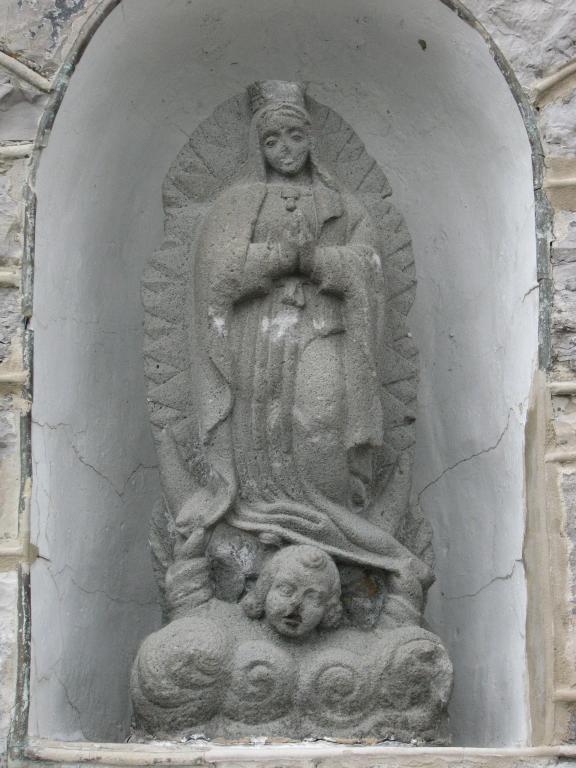
Look at this figure, and tell me what it is, and where it is. The first question is easy. The second is odd, to the point of being bizarre. It involves some real twists and turns, with curious international and diplomatic angles.
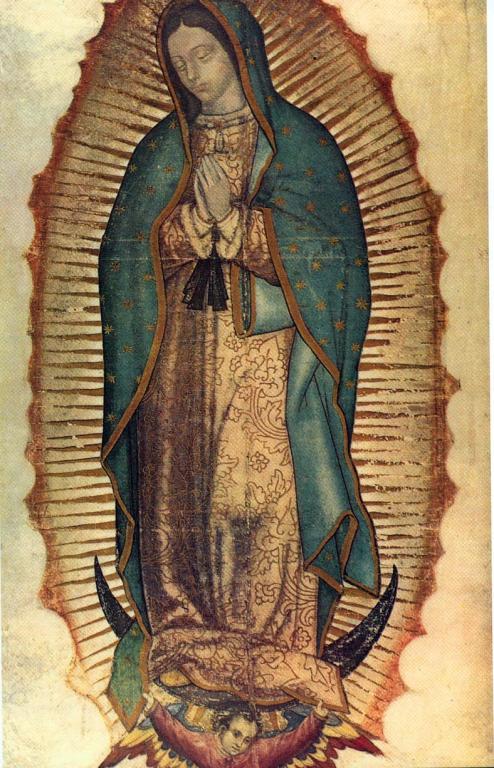
The statue is unquestionably the Virgin of Guadalupe, the form of the Virgin uniquely beloved in Mexico. It looks as if it came from a wayside shrine, or a church in Mexico itself, and I think it is a significant piece. As to date, seventeenth century is plausible, if not earlier, but I am wide open on this. As I’ll explain, establishing exact provenance is not really possible. By way of comparison, here is the famous original Guadalupe image:
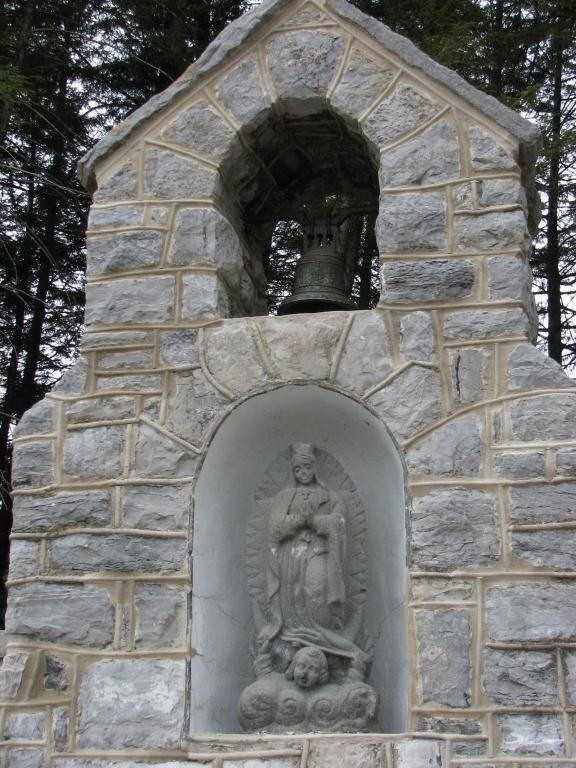
But where this particular statue can now be found is surprising indeed. It stands at the heart of a open air monument commemorating the fallen officers of the US 28th Division, at a First World War shrine attached to the Pennsylvania Military Museum in Boalsburg, PA, a few miles from State College. Historically, that is absolutely not an area with any particular Latino heritage. Nor until quite recent times was Catholicism strong in the area. In Boalsburg, as in most villages and smaller towns in the area, the obvious older churches are all Protestant, whether German (Lutheran or Reformed) or Scotch-Irish (Presbyterian or Methodist). So how did this ultra-Catholic statue get here?
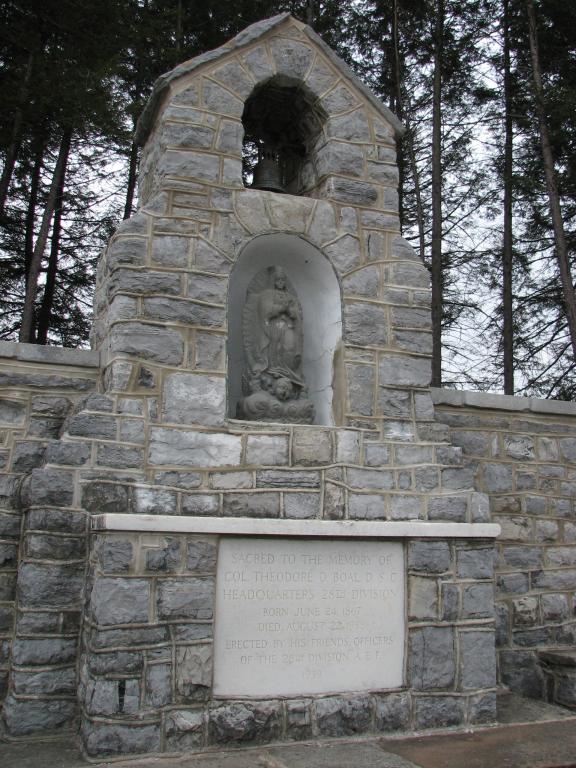
I have known this statue for many years, and occasionally wondered about it. But when I started asking questions, it soon emerged that virtually nobody could supply detailed answers, and even people who knew the site well had basically no idea that the Virgin was there, or what she was. As far as I can tell, that neglect also extends to the sizable Penn State/State College Catholic community, who have never (say) organized any kind of religious event there. Put it this way: after many years of residence, I have never met anyone in the area who has so much as heard of the statue.
So here are my investigations to date, and further assistance would be greatly appreciated.
The story begins with the Boal family, firm Protestants who left Ireland at the end of the eighteenth century and settled on the then-wild frontier, founding the village of Boalsburg. One later member of the house acquired considerable wealth. This was Theodore Davis Boal (1867-1938), a prosperous architect. Theodore – “Terry” – was strongly committed to France, where he married his wife. From the late 1890s, he adopted the lifestyle of a country squire in a great house, as he expanded and reconstructed that original house in Boalsburg. Through his wife, he even inherited the chapel that had once belonged to Christopher Columbus – and which now, amazingly, stands reconstructed in Boalsburg, PA.
Anyone familiar with Northern Ireland will know the Boal name from the very important far-Right Protestant politician Desmond Boal, sometimes described as the brains behind Ian Paisley. I assume he was distant kin, which makes the Catholic aspects of the family’s US history all the more ironic.
In the early twentieth century, Theodore Boal shared the alarm of his friend and namesake, Theodore Roosevelt, about growing menaces to US national security. Accordingly, he prepared his own militia troop ready for the day when war would come. In 1916, he founded the “Boal Troop,” a mobile machine gun unit, which was then incorporated into the Pennsylvania National Guard. I take the following from Philip Sauerlender, “Boalsburg’s Rough Riders: Terry Boal and the Boal Troop,” Mansion Notes, 38.1, Centre County Historical Society, Winter 2016:
They were sent in the Fall to guard the Mexican border in Texas while Pershing chased Pancho Villa.
I originally suspected that the Guadalupe figure might have been acquired during the Boal Troop’s 1916 service on or over the Mexican border. Visions of The Wild Bunch danced before my eyes … but this turns out to be flat wrong. Back to Sauerlender:
The next year war was declared and the Boal Troop was incorporated into the 28th Division U.S. Army as part of a machine gun battalion. Theodore Boal was detached and put on the staff of the 28th Division. Both Boal and the troop served in the war where they received honors.
Theodore became a Lieutenant Colonel.
Boal returned from France with a railroad carload of military relics for a planned 28th Division Officers’ Club and Museum on his estate. The troop was reformed and stables built on the property. As part of the Officers’ Club, Boal designed and started construction of a World War Memorial. Although the Officers’ Club and cavalry troop were disbanded, the memorial was expanded and evolved into the present 28th Division Memorial and Pennsylvania Military Museum in Boalsburg.
As the shrine grew in the 1920s, it incorporated an extensive wall containing plaques commemorating officers, and in the center was a blank space intended for Boal himself when he died. This was a shrine within a shrine, which is deliberately built to look like an altar. This is the space now occupied by the Mexican Virgin.
The responsibility for filling that vacant space on the wall fell to Theodore Boal’s son Pierre de Lagarde Boal (1895-1966). As his name suggests, Pierre was born in France, and he maintained that European connection throughout his life. He married a French wife, and converted to Catholicism for the occasion. A romantic figure straight from the pages of Scott Fitzgerald, he joined the French army cavalry, the Cuirassiers, and in 1914-15 he fought with the Lafayette Flying Corps, the Lafayette Escadrille. He received a Legion of Honor citation, the Purple Heart, the Croix de la Guerre with gilt star, and the Lafayette Flying Corps ribbon. He enjoyed a distinguished diplomatic career, with a focus on Latin America. That included time in Mexico, in 1919, and again from 1936 through 1940, as Counselor to the US Embassy. He served as Envoy Extraordinary to Nicaragua (1941-42) and US Ambassador Extraordinary to Bolivia (1942-44).
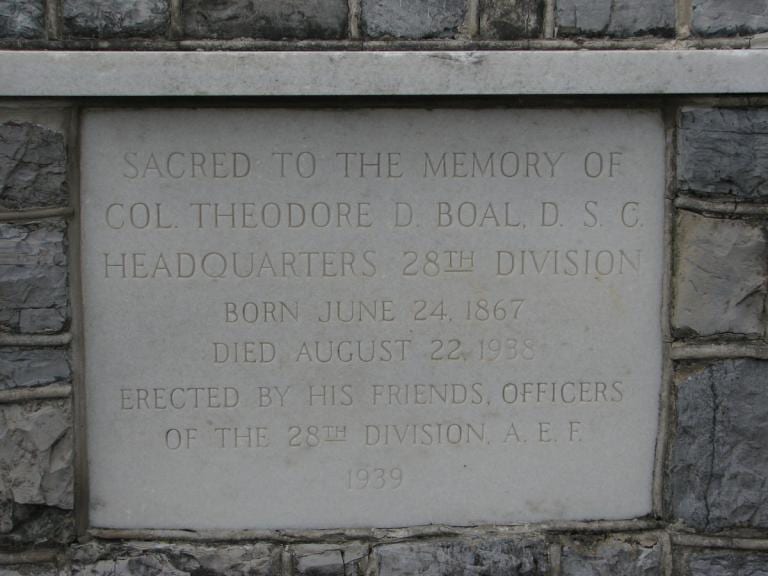
To pull the story together, Theodore Boal died in August 1938, and a monument was indeed erected. In September 1940, a newspaper article reports “that Pierre Boal (attached to the U.S. Embassy in Mexico City) brought back with him a Madonna and bell he obtained in Mexico for placement above the altar.” (I owe this reference to the kindness of Military Museum educator, Mr. Joe Horvath).
So what exactly is this statue? It is certainly Mexican, but the question remains of just where that statue had come from in the first place. “Obtained” how exactly? Surely some local church did not just decide to hand a cherished item over to the wealthy gringo passing through? This is not from a parish gift shop.
Some context might be in order. In the decades following the Mexican Revolution, the Catholic church suffered severely in that country. Brutal persecutions recurred during the Cristero War of 1926-29, a horrific conflict largely forgotten by Americans, in which over a hundred thousand perished – not to mention hundreds of thousands of refugees forced to flee to the US. Mexican left-wing radicals were very repressive toward clergy and believers through the 1930s, the era made famous by Graham Greene’s The Power and the Glory (1940).
Through those years, Mexico was in semi-permanent confrontations with the United States, and that made the Mexican struggles a recurrent issue in domestic US politics. The US Catholic church, and Catholic leaders, repeatedly demanded intervention against the radicals and persecutors, even to the point of advocating invasion. In 1927, the Mexican government was dreading a US invasion, and US Catholics were praying for one – although the Coolidge administration itself apparently never seriously planned for such a step. Had US forces actually decided to occupy Mexico, a detailed plan was sitting on their shelves, namely War Plan Green, which remained notionally in force until 1946.
Concern continued through the 1930. In 1932, Pope Pius XI issued the encyclical Acerba Animi (On the Persecution of the Church in Mexico). In the US, the demagogic Father Charles Coughlin made these Mexican horrors one of his special themes, and warned of sinister plots between Mexico and the Soviet Union. Father Michael Kenny published hair-raising books denouncing Mexican atrocities, under titles like No God Next Door – Red Rule in Mexico and Our Responsibility (1935): that book became an overnight best-seller. Cries for intervention became all the more strident in 1938 when Mexico nationalized US-owned oil resources in the country.
Weirdly, one of the main forces in the US strenuously opposing such aggressive interventionism through that whole period was that well-known body of upstanding anti-war, anti-imperialist, liberals … um, the Ku Klux Klan, who made it one of their big campaigning issues. After all, they really could not see much wrong with the thought of a secularist/Masonic government persecuting Catholics. The Klan donated money to the Mexican government to help them suppress Catholic Cristero rebels. The US Knights of Columbus tried to support those same rebels financially – while denying military aid – making it a kind of proxy war.
As a diplomat, Pierre Boal would have been in a very delicate position through these explosive years of the late 1930s. Was the statue a present to Boal from some devout Mexican Catholic family, perhaps grateful for his assistance? As I noted, his connections with the country went back decades. For what it is worth, the Cristero revolutionary slogan was “Long live Christ the King! Long live the Virgin of Guadalupe!” Note the Cristeros‘ Guadalupe banner here:
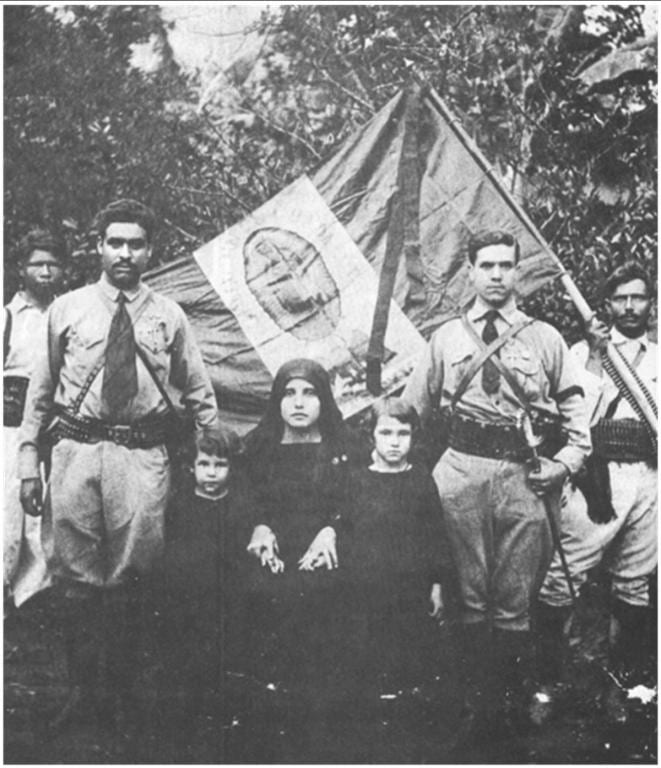

Or to offer a scenario that is at least as likely, it is very feasible that some local government official or warlord could simply have looted the statue from some church or shrine, and sold it to the highest bidder. A lot of church properties were plundered and desecrated in these bitter years, especially during the Cristero struggles, and many once-prized items were on the open market. It is rather like the antiquities market in the Middle East today following the wars in Iraq and Syria. As a faithful Catholic, Pierre Boal would have had nothing consciously to do with any such misappropriation, and he might have regarded buying the statue as a chance to save it from outright destruction. I am speculating.
Or assume that he simply purchased it through a dealer. So where did the dealer get it in the first place? It was assuredly not through any simple legal channels, and it had very likely been looted. Again, Pierre Boal was no wide-eyed tourist in Mexico, and he would certainly have known that.
Whatever the origins, erecting a statue like this in the particular circumstances of 1940 was a highly political statement about ongoing affairs in Mexico, although perhaps nobody watching the ceremony at Boalsburg realized this, except for Pierre Boal and his immediate family. But it also had a strong US resonance, at the exact time that Father Coughlin’s Christian Front paramilitaries were running riot in Philadelphia, Boston, and New York City (for instance), attacking Jews and leftists. Whether in Mexican politics – or US domestic affairs – the statue was even a pretty aggressive declaration, and there is no way around that. For a diplomat like Pierre Boal – well, it was pretty undiplomatic.
If anyone can suggest any further context about the statue’s date or region of manufacture, I would love to know. Does anyone know of some plausible parallels?
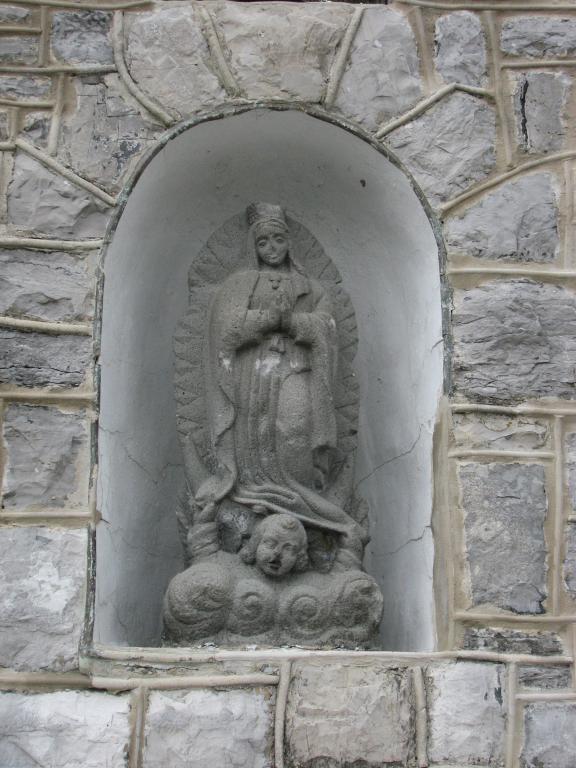
But here is my point. However it got there, we have a fine and rather moving statue of the Virgin of Guadalupe in the middle of rural Pennsylvania. Back in 1940, it was purely exotic, but in the modern US, with its sharply rising Latino population, it acquires a whole new relevance. If I had any say in the doings of the PA Military Museum, or of Boalsburg itself, I would draw attention to this, and try to attract visitors.
Who knows, it could yet become a regional pilgrimage shrine in the traditional sense of that word. See you there next December 12?
And I haven’t even started on the bell that Pierre brought back with him …
Next time, more about the Virgin, and some of the truly odd places that she chooses to descend.
Previous Post

February 13, 2020
Speaking with the Dead
Next Post
February 17, 2020 The Miraculous Flying House of Loreto
Browse Our Archives
Select a Category abolitionism Abortion Abraham Joshua Heschel Abraham Kuyper Abraham Lincoln Academia Activism Adam Renberg Advent Adventist africa African American Religion Agnes Howard Albert Camus American History American Religious History American Revolution American West Anabaptists Ancient History Andrea Turpin Andrei Tarkovsky Anglicanism Annales Ansley Lillian Quiros anti-Catholicism Antisemitism Anxious Bench apologetics Apparitions Arash Azizi Archaeology archives art Artificial Intelligence Asia Asian Americans Augustine Authors Bad Bunny Baptism Baptists Barack Obama Battle of Hastings Benjamin Franklin Bernard-Henri Levy Beth Allison Barr Beth Moore Bethany Mannon Bible Bill Cunningham Billy Graham Black Music Bob Dylan Body Boenhoffer Books Breastfeeding Bruce Springsteen C.S. Lewis Calvinism Cancel Culture Capitalism Carmelites Catholicism Cedric Robinson Cesar Chavez Charismaticism charity Charles Dickens Charles Lindbergh Che Guevara Chicago Children Chinese Christianity Chris Gehrz Christ Christian death Christian Higher Education Christian life Christian Nation Christian Nationalism Christianity Today Christmas Church life Church Practice cinema Civil Religion Civil Rights Movement Civil War civility Classics Climate Change Cold War Colonial Mexico colonialism Comer Communism community complementarianism Conference on Faith and History Congregationalism Conspiracies Conspiracy Conversion Narratives Coronavirus Costa Rica Council of Nicaea Covid-19 Creation Critical Race Theory Crusades Culture culture wars Daniel K. Williams David Barton David Swartz Death Ways death with dignity DEI democracy Democratic Party Devotion Digital Age Diplomacy discipleship diversity Donald Trump Drama Dua Lipa Early Church early modern Early modern Catholicism Easter Eastern Christianity economic exploitation Education elections Elie Wiesel Elizabeth II Elizabeth Taylor emotions Empire Engineering England enslavement Entertainment Episcopal Church Erica Ramirez eschatology Eurocentrism Evangelicalism Evangelicals Exegesis Family Feminism Film Flannery O'Connor folk music Food Foreign Policy founding fathers Franciscans Franciscus Junius fundamentalism Funerals G.K. Chesterton Gender Genocide genre geography George W. Bush George Washington George Whitefield Global Christianity Global church Grief Guadalupe Guest Post guest post gun control gun violence Gustavo Gutierrez Hamid Dabashi Harold John Ockenga Harvest Hate Hawaiian Christianity Healing health care Heather Cox Richardson Hell Heresy Hermeneutics Higher Education Hinduism Hippocratic oath Historical Fiction Historical Methodology Historical Profession Historical Profession Historical Theology Historical Thinking historiography Holidays Holocaust horror movies Human rights Humanitarian Work humanities Hummingbirds Hungary hymns Imago Dei Immigration Injustice Interviews Iran Islam Islamophobia Israel Ivan's Childhood Jacob Randolph James Bratt Janine Giordano Drake Japanese history Japanese Literature Jean Paul Sartre Jesse Miranda Jesus Jesus Christ Jimmy Carter Joan Baez Joan Didion Joanne Freeman João B. Chaves Joao Chaves Joey Cochran John Calvin John Fea John Tillotson John Turner Johnny Cash Jonathan Edwards Jonathan Tran Joseph Smith Josh Howerton Journalism Jr. Judaism Jürgen Moltmann Just War Justice Justin Brierley Karl Barth Katelyn Beaty koi ponds Kris Kristofferson Kristin Kobes Du Mez Latin American Religious History Latino Americans Lectio Divina Leisure Lent Leonard Cohen liberal arts liberalism Liberation Theology Linda Ronstadt Lisa Clark Diller Literature Lou Reed Lynchings Lynneth Miller Renberg Mainline Protestantism Malcolm Foley Marilyn Monroe Maritime history Mark Noll Marriage Martin Luther Martin Luther King Martyrdom Marxism Mary Masih Alinejad mass shootings material culture medieval Christianity Medieval Ethiopia Melissa Borja memory Mennonites Mental Health Mental Illness Methodism Mexican Americans Mexicans Mike Madrid Miles Mullin Min Jin Lee Miscarriage Missionaries Mister Rogers Mitt Romney modernity Monasticism Mormonism Motherhood Mothers of the Church Moving Music Musicals Nadya Williams Nahua Christianity Native Americans Natsume Sōseki New Contributor New England New Year New York Nico Non-Violent Protest Orthodoxy pacifism Paleo Evangelicals Palestinians Parenting Patti Smith Paul Kingsnorth Pedro Calderón de la Barca Pentecostalism Philip Jenkins Phillis Wheatley physician-assisted suicide pilgrimage Pilgrims pluralism Plutocracy Poetry Politics Pope Francis Pope Leo XIV post-modernism prayer preaching Presbyterians prosperity gospel Protest Public history Publishing Puritans purity culture Quakers race Race Massacres Racial Capitalism racial reconciliation racialization Racism Raha Bahloulipour Re-Enchantment reading Reformation Refugees religion and the university religion and war Religious Freedom Religious Nones Religious Pluralism Religious Symbols religious violence Republican Party Revival Rita Coolidge Ritual Roger Williams Roman Catholic church Royalty Russell Moore same-sex marriage Sarah Irving-Stonebraker Scandinavia Science Science and Technology Scopes trial Scriptural Interpretation secularism Selena Quintanilla seminary Seventh-Day Adventists sexual morality Sexuality Sikhs Silence slaveholders theology Slavery Slavoj Zizek social justice Social Media Southern Baptist Convention Southern Religion Spain Spiritual Autobiography Spiritual but not religious Spiritual Discipline Sports Stanley Hauerwas Suffering Summer Camps Sunday Night Odds and Ends Supernatural Supreme Court Syriac Christianity Tal Howard Taylor Swift Teaching Technology Television Thanksgiving The Beatles The Mission theater TheoBros Theology Thomas Dixon Thomas Jefferson Thomas Kidd Thomas Merton Tim Gloege Tim Walz Tom Holland Tourism tradition Tragedy Translation Transnationalism Travel Trump Ukraine Uncategorized Unitarians United Methodist Church US History Vanessa Chan Velvet Underground Verónica A. Gutiérrez Veronica Gutierrez Vikings Violence Virgin Mary Virtue Virtue ethics Visions Voting War WCTU Wendell Berry Westminster Assembly White Evangelicalism Wildfires Winnie the Pooh Witches women Women in Ministry Women's and Gender Studies Work Worship writing Yasunari Kawabata Zena Hitz
Select a Month October 2026 September 2026 August 2026 July 2026 June 2026 May 2026 April 2026 March 2026 February 2026 January 2026 December 2025 November 2025 October 2025 September 2025 August 2025 July 2025 June 2025 May 2025 April 2025 March 2025 February 2025 January 2025 December 2024 November 2024 October 2024 September 2024 August 2024 July 2024 June 2024 May 2024 April 2024 March 2024 February 2024 January 2024 December 2023 November 2023 October 2023 September 2023 August 2023 July 2023 June 2023 May 2023 April 2023 March 2023 February 2023 January 2023 December 2022 November 2022 October 2022 September 2022 August 2022 July 2022 June 2022 May 2022 April 2022 March 2022 February 2022 January 2022 December 2021 November 2021 October 2021 September 2021 August 2021 July 2021 June 2021 May 2021 April 2021 March 2021 February 2021 January 2021 December 2020 November 2020 October 2020 September 2020 August 2020 July 2020 June 2020 May 2020 April 2020 March 2020 February 2020 January 2020 December 2019 November 2019 October 2019 September 2019 August 2019 July 2019 June 2019 May 2019 April 2019 March 2019 February 2019 January 2019 December 2018 November 2018 October 2018 September 2018 August 2018 July 2018 June 2018 May 2018 April 2018 March 2018 February 2018 January 2018 December 2017 November 2017 October 2017 September 2017 August 2017 July 2017 June 2017 May 2017 April 2017 March 2017 February 2017 January 2017 December 2016 November 2016 October 2016 September 2016 August 2016 July 2016 June 2016 May 2016 April 2016 March 2016 February 2016 January 2016 December 2015 November 2015 October 2015 September 2015 August 2015 July 2015 June 2015 May 2015 April 2015 March 2015 February 2015 January 2015 December 2014 November 2014 October 2014 September 2014 August 2014 July 2014 June 2014 May 2014 April 2014 March 2014 February 2014 January 2014 December 2013 November 2013 October 2013 September 2013 August 2013 July 2013 June 2013 May 2013 April 2013 March 2013 February 2013 January 2013 December 2012 November 2012 October 2012 September 2012 August 2012 July 2012 June 2012 May 2012
Follow Us!
TAKE THE
Religious Wisdom Quiz
Who played instruments in Temple?
Select your answer to see how you score.
Levites Prophets Kings Priests
Related posts from Anxious Bench

Fairies, Witches, Folk Horror, and the Secret Commonwealth

Hogg’s Justified Sinner: A Gothic Classic for Halloween

James Hogg, Weird Wives, and Feminist Witches

How an Explosive Book Rewrote the Study of...
TRENDING AT PATHEOS Evangelical

The Dangers of Gradual Accommodation (Winking at Sin)
Recently, the “law of gradualness” resurfaced during the opening of a weeklong,...

The Iron Gates and the Lion of the...
Yesterday, I didn't finish my report about, well, yesterday. So I'll...

Dolly Parton’s Last Song Wins Dove Award with...
Bluegrass band The Grascals, speaking on the red carpet at the 57th...

The Image: On the Horror of Capitalism and...
The Image Then went the Pharisees, and took counsel how they might...

We are approaching the date of our new American national holiday: October...

Letters on Living the Faith by C.S. Lewis
Most of us met C.S. Lewis as a public intellectual. Mere Christianity....
view all Evangelical blogs
Ad-Free & Subscriber Log-In Subscription Support
- About Us
- 2026 Calendar
- Videos
- Podcasts
- Library of World Religions
- Faith In Media Tracker
- Advertise With Us
- Write for Us
- Privacy Policy
- Terms of Service
- Do Not Sell My Data
- Contact Us
- Radiant Digital
- Manage Newsletter Subscriptions
- Unsubscribe From Notifications
- Sitemap
Copyright 2008-2026, Patheos. All rights reserved.
Subscription Support Ad-Free & Subscriber Log-In
Follow Patheos