
BuddhistCatholicContemplativeEvangelicalGeneral ChristianHinduJewishLatter-day SaintMuslimNew VisionsProgressive Christian
Beliefs
- Buddhist
- Catholic
- Contemplative
- Evangelical
- General Christian
- Hindu
- Jewish
- Latter-day Saint
- More Voices
- Muslim
- New Visions
- Pagan
- Progressive Christian
Topics
- Religion News
- Food and Religion
- Sports and Religion
- Religious Art
- Religious Music and Entertainment
- Religious Events
- History and Religion
- Style and Religion
- Politics and Religion
- Women in Religion
- Recreation Outdoors and Religion
- Business Finance and Religion
- Careers Workplace and Religion
- Education and Religion
- Family Parenting and Religion
- Health Fitness and Religion
- Home and Religion
- Relationships and Religion
- Technology and Religion
- Travel and Religion
Columnists
- Buddhist Columnists
- Business Finance and Religion Columnists
- Careers Workplace and Religion Columnists
- Catholic Columnists
- Contemplative Columnists
- Education and Religion Columnists
- Evangelists Columnists
- Family Parenting and Religion Columnists
- General Christian Columnists
- Health Fitness and Religion Columnists
- Hindu Columnists
- History and Religion Columnists
- Home and Religion Columnists
- Jewish Columnists
- More Voices Columnists
- Latter Day Columnists
- Muslim Columnists
- New Visions Columnists
- Nonreligious Columnists
- Pagan Columnists
- Politics and Religion Columnists
- Progressive Columnists
- Recreation Outdoors and Religion Columnists
- Relationships and Religion Columnists
- Religion News Columnists
- Religious Art Columnists
- Religious Events Columnists
- Religious Music and Entertainment Columnists
- Sports and Religion Columnists
- Style and Religion Columnists
- Technology and Religion Columnists
- Travel and Religion Columnists
- Women in Religion Columnists
Resource Library
- 2026 Calendar
- Library of World Religions
- The 100 Most Holy Places on Earth
- Patheos Answers
- Podcasts
- Videos
- Faith Leaders Database
- Anglican Episcopalian
- Bahai
- Baptist
- Buddhism
- Christianity
- Confucianism
- Eastern Orthodoxy
- Hinduism
- Holiness and Pentecostal
- ISKCON
- Islam
- Judaism
- Lutheran
- Methodist
- The Church of Jesus Christ of Latter-day Saints
- New Age
- Paganism
- Presbytarian and Reformed
- Protestantism
- Religion Behind the Scenes
- Roman Catholic
- Scientology
- Shia Islam
- Sikhism
- Sufism
- Sunni Islam
- Taoism
- Zen
- See all religions
Research Tools
 Ad-Free & Subscriber Log-In Subscription Support
Ad-Free & Subscriber Log-In Subscription Support
Follow Patheos 

- Trending:
- Forgiveness
- |
- Marriage
- |
- Consciousness
- |
- Death Penalty
- |
- Election
- |
- Halloween

-
About the Authors
- Home
- Evangelical
- On Pilgrimage and Back Again
On Pilgrimage and Back Again
Last updated on: December 17, 2019 at 5:15 pm by Agnes Howard
On Pilgrimage and Back Again 2019-12-17T17:15:54-04:00 Agnes Howard
Patheos Explore the world's faith through different perspectives on religion and spirituality! Patheos has the views of the prevalent religions and spiritualities of the world.
It’s not your average out-of-office message: gone on pilgrimage, won’t be checking email.
Recently I wrote about Timothy Egan’s new book, A Pilgrimage to Eternity, before myself walking a piece of the Via Francigena with twenty-some twenty-somethings studying at Gordon-in-Orvieto. The students from Gordon College and other church-related institutions are mostly Protestant, making sense of the aesthetics and thoughtways of places heavily shaped by Roman Catholicism. The curriculum from time to time includes a pilgrimage, led by Swiss artist Marie-Dominique Miserez, who was teaching a course in tempera painting while I led a history class. 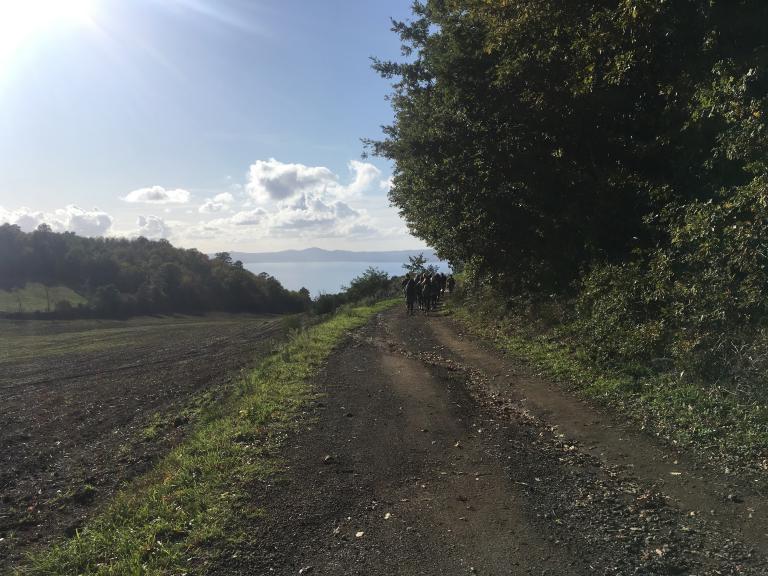
Most of the participants in this pilgrimage hail from a culture where pilgrimage is not much done. Announcing it sounds like an affectation, something requiring an excuse. We gave the students cover: they had to do it for their program. We went for three days, from Orvieto to Bolsena to Montefiascone to Viterbo, before returning by train. We all made it back basically safe and sound, though wet from the last day of rain. As Egan discovers, it can be hard to communicate to another person what the experience of pilgrimage has been, much less to speak for others on its significance for them. With due deference to that difficulty, I can try anyway to note four themes recurrent on our sacred journey through historically significant space:
1 We belong to the church, which means the Body of Christ, which is not only our local and disparate congregations: The walk itself strove to be ecumenical, seeking clearer understanding and goodwill among Christians of different kinds. We were inspired in part by Here I Walk, the account by Andrew Wilson and Sarah Hinlicky Wilson of walking Martin Luther’s pilgrimage to Rome on some of the same terrain and more. We hoped, like those writers and like Egan, to make sense of a landscape still shaped by sixteenth-century Reformations but also beyond that experience. One question we asked students to reflect on was how they understood the ideal church. They discussed this while walking a wooded path that sloped around Lake Bolsena and rose past pastures into some olive groves.
A few words recurred in these conversations: open, welcoming, inclusive, non-judgmental is what the church should be. Doctrine, demographics, even worship-music preferences did not enter discussion. It is good to be free of ancestral hatreds, but not knowing about them is not the same as not having them, as Egan recognizes too. Encountering the churches we visited, thinking about them in relation to personal religious experience, can bring to surface unconscious anti-Catholicism, unconscious acceptance or queasiness about their own traditions, or assumption that they don’t have a tradition but just are following Jesus according to the immediate inspiration of the Holy Spirit.
We met some theological gravity in the walk. In Bolsena in 1262, a Bohemian priest traveling from Rome and doubting the presence of Christ in the eucharist stopped at that cathedral to celebrate Mass. While he was handling the host, it bled onto the corporal cloth. This miracle, reported to Pope Urban IV, inspired the raising of the great duomo in nearby Orvieto and a composition by St. Thomas Aquinas of an office for Corpus Christi. In Viterbo, which calls itself the “City of Popes” in reference to the number who resided here in the middle ages, St. Thomas preached from an outdoor pulpit at the Dominican church of Santa Maria Nuova. In Viterbo also, in strained days of sixteenth-century Italy, “Renaissance woman” and poet Vittoria Colonna held conversations with Reginald Pole and others, seeking a way to harmonize doctrine and devotion among friends, to bring Reformation to life.
2 You can’t ignore the saints: Closely related to broadened understanding of “church” is awareness of the many other members of the Body of Christ, especially those distinguished by courage, holiness, or service. Protestants might avail these forerunners in the faith more avidly, noting that Catholics venerate and pray with the saints, not worship them. (Sarah Hinlicky Wilson is eloquent on this too.) By this point in the semester, art history and attentiveness have made students pretty familiar with saints, at least the idea of them. As it did for Egan, walking on pilgrimage made saints more immediate to us. The Via goes through Bolsena, whose Cathedral is dedicated to St. Cristina, martyred in the early 4th century, who was put through multiple tortures, fire, wheel, and snakes, being sunk in the lake with a millstone that miraculously wouldn’t sink her, then arrows before she finally was slain. In the crypt beneath the Montefiascone cathedral we saw the incorrupt body of seventeenth-century advocate of girls’ education, St. Lucy (Lucia Filippini), whom Egan records as having winked at him. Visitors not already accustomed to veneration might write off these displays. When present in front of them, though, they demand more reckoning. What is admirable about the life of this person? What would I do under similar trials? How would I hope others centuries later remember the way I lived out my faith? 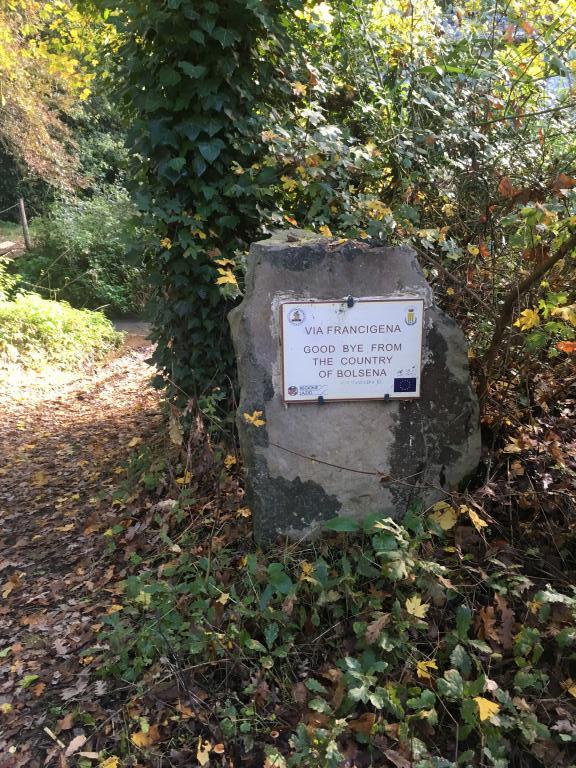
Sisters at the Benedictine monastery of San Pietro hosted us in Montefiascone, having housed pilgrims for centuries. They generously welcomed us to their prayers and table and to the life of the house. One sister, Paola, writes icons and narrated for us her biography and her process, receiving each pilgrim in our company as beloved by God.
Thinking about saints made us aware not only of the named ones along this route, but the thousands upon thousands of other people who walked this way, some conspicuously holy, some not so much. This may be the most accessible kind of communion with saints for first-time pilgrims. The flat fact of walking the same road that, you know, has been walked by many others carrying full hearts and intentions sets the way apart. It reminds walkers that the individual pilgrim accompanies more than twenty-something others.
3 Respect the physical world, including your body: It’s not a shabby bit of land, this stretch of countryside between Umbria and Lazio. It was pretty good on the clear days, the sky spread broad over the cypresses and umbrella pines, our walk wending around some new-plowed fields, past meadows grazed by pleasant sheep, through groves of hazelnut trees or olive trees. We walked longer sometimes than some in the group probably wished but also stopped for sketching and journaling here by a lake view, there in a medieval church square. It was not all idyll, though. Feet hurt, cold arrived, and it rained. Carrying your own food makes you hungry in a different way. It is healthy to be vulnerable this way.
Valparaiso university colleague David Weber, writing in the new issue of The Cresset, recounts his experience of a different pilgrimage, taken with students last year on the well-known Camino de Santiago. Weber considers how the physical realities of pilgrimage bear fruit:
Pilgrimage is an ascetic exercise for the purpose of experiencing and enjoying the blessedness of deprivation. Pilgrims are anti-materialists who embrace the distinction between needs and wants….Depriving one’s self of things is infinitely easier than dealing with the powerlessness one has over external circumstances. Each day’s destination is not determined by how well any one pilgrim slept, feels, or desires to walk. In fact, around the third or fourth day, no one wants to walk, and no one wants to quit walking. Pilgrimage is a paradoxical experience of conflicting desires, demanding the ascetic discipline to choose the long-term desire over short-term ones. With each painful step, the pilgrim exercises the free choice to slowly and painfully progress toward the fulfillment of the truly desired end. Sometime after the third or fourth day, this movement of tortured soles gains momentum, so that pilgrims begin to existentially feel the joy of progress toward the desired rest.

Photo: Marie-Dominique Miserez
4 Christians really are pilgrims on a journey: Striving to persuade some who may have been unsure about pilgrimage, we used others’ accounts to get at our purpose. As Heather Walton and colleagues argue in Christian Pilgrimage, Landscape, and Heritage , pilgrimage is not a metaphor but “the dominant metaphor” in Protestant piety. Sometimes that metaphor echoes the itinerant Christian from John Bunyan’s Pilgrim’s Progress, who ran out of his house ignoring his family by sticking fingers in his ears and proclaiming everlasting life to himself. Pilgrimage can pull us away from obligations and others. But it also can drive home the transience and contingency that is the condition of human life. It forces us to consider what we are carrying, where we are going, with whom we are walking. Our three days was a soft way to be reminded of this, when others have traumatic circumstances driving them away from settled life and to no sheltered safety.
Weber puts it this way:
Scripturally, Genesis understands the going-good life as a movement from nothingness to ever-increasing life—an ex nihilo movement. The Fall reversed this movement, so that life now naturally moves an nihilo, or toward annihilation. Theologically, the Creed sees Jesus’s resurrection as reversing that reversal, so that it is reasonable to once again see life as a buen camino (a good pilgrimage), a move from nothingness to ever-increasing life. Reasonable, perhaps, but still difficult—especially when one’s life is marked by loss.
For me, a most compelling reason to see my life as a pilgrimage is the absence of hopeful ways to make sense of life’s an nihilo movement.
The few days on the Via Francigena gave us this hopeful way.
Previous Post
December 15, 2019
How Nations Vanish, Continued
Next Post

December 17, 2019 The Religious History of the Premier League
Browse Our Archives
Select a Category abolitionism Abortion Abraham Joshua Heschel Abraham Kuyper Abraham Lincoln Academia Activism Adam Renberg Advent Adventist africa African American Religion Agnes Howard Albert Camus American History American Religious History American Revolution American West Anabaptists Ancient History Andrea Turpin Andrei Tarkovsky Anglicanism Annales Ansley Lillian Quiros anti-Catholicism Antisemitism Anxious Bench apologetics Apparitions Arash Azizi Archaeology archives art Artificial Intelligence Asia Asian Americans Augustine Authors Bad Bunny Baptism Baptists Barack Obama Battle of Hastings Benjamin Franklin Bernard-Henri Levy Beth Allison Barr Beth Moore Bethany Mannon Bible Bill Cunningham Billy Graham Black Music Bob Dylan Body Boenhoffer Books Breastfeeding Bruce Springsteen C.S. Lewis Calvinism Cancel Culture Capitalism Carmelites Catholicism Cedric Robinson Cesar Chavez Charismaticism charity Charles Dickens Charles Lindbergh Che Guevara Chicago Children Chinese Christianity Chris Gehrz Christ Christian death Christian Higher Education Christian life Christian Nation Christian Nationalism Christianity Today Christmas Church life Church Practice cinema Civil Religion Civil Rights Movement Civil War civility Classics Climate Change Cold War Colonial Mexico colonialism Comer Communism community complementarianism Conference on Faith and History Congregationalism Conspiracies Conspiracy Conversion Narratives Coronavirus Costa Rica Council of Nicaea Covid-19 Creation Critical Race Theory Crusades Culture culture wars Daniel K. Williams David Barton David Swartz Death Ways death with dignity DEI democracy Democratic Party Devotion Digital Age Diplomacy discipleship diversity Donald Trump Drama Dua Lipa Early Church early modern Early modern Catholicism Easter Eastern Christianity economic exploitation Education elections Elie Wiesel Elizabeth II Elizabeth Taylor emotions Empire Engineering England enslavement Entertainment Episcopal Church Erica Ramirez eschatology Eurocentrism Evangelicalism Evangelicals Exegesis Family Feminism Film Flannery O'Connor folk music Food Foreign Policy founding fathers Franciscans Franciscus Junius fundamentalism Funerals G.K. Chesterton Gender Genocide genre geography George W. Bush George Washington George Whitefield Global Christianity Global church Grief Guadalupe guest post Guest Post gun control gun violence Gustavo Gutierrez Hamid Dabashi Harold John Ockenga Harvest Hate Hawaiian Christianity Healing health care Heather Cox Richardson Hell Heresy Hermeneutics Higher Education Hinduism Hippocratic oath Historical Fiction Historical Methodology Historical Profession Historical Profession Historical Theology Historical Thinking historiography Holidays Holocaust horror movies Human rights Humanitarian Work humanities Hummingbirds Hungary hymns Imago Dei Immigration Injustice Interviews Iran Islam Islamophobia Israel Ivan's Childhood Jacob Randolph James Bratt Janine Giordano Drake Japanese history Japanese Literature Jean Paul Sartre Jesse Miranda Jesus Jesus Christ Jimmy Carter Joan Baez Joan Didion Joanne Freeman João B. Chaves Joao Chaves Joey Cochran John Calvin John Fea John Tillotson John Turner Johnny Cash Jonathan Edwards Jonathan Tran Joseph Smith Josh Howerton Journalism Jr. Judaism Jürgen Moltmann Just War Justice Justin Brierley Karl Barth Katelyn Beaty koi ponds Kris Kristofferson Kristin Kobes Du Mez Latin American Religious History Latino Americans Lectio Divina Leisure Lent Leonard Cohen liberal arts liberalism Liberation Theology Linda Ronstadt Lisa Clark Diller Literature Lou Reed Lynchings Lynneth Miller Renberg Mainline Protestantism Malcolm Foley Marilyn Monroe Maritime history Mark Noll Marriage Martin Luther Martin Luther King Martyrdom Marxism Mary Masih Alinejad mass shootings material culture medieval Christianity Medieval Ethiopia Melissa Borja memory Mennonites Mental Health Mental Illness Methodism Mexican Americans Mexicans Mike Madrid Miles Mullin Min Jin Lee Miscarriage Missionaries Mister Rogers Mitt Romney modernity Monasticism Mormonism Motherhood Mothers of the Church Moving Music Musicals Nadya Williams Nahua Christianity Native Americans Natsume Sōseki New Contributor New England New Year New York Nico Non-Violent Protest Orthodoxy pacifism Paleo Evangelicals Palestinians Parenting Patti Smith Paul Kingsnorth Pedro Calderón de la Barca Pentecostalism Philip Jenkins Phillis Wheatley physician-assisted suicide pilgrimage Pilgrims pluralism Plutocracy Poetry Politics Pope Francis Pope Leo XIV post-modernism prayer preaching Presbyterians prosperity gospel Protest Public history Publishing Puritans purity culture Quakers race Race Massacres Racial Capitalism racial reconciliation racialization Racism Raha Bahloulipour Re-Enchantment reading Reformation Refugees religion and the university religion and war Religious Freedom Religious Nones Religious Pluralism Religious Symbols religious violence Republican Party Revival Rita Coolidge Ritual Roger Williams Roman Catholic church Royalty Russell Moore same-sex marriage Sarah Irving-Stonebraker Scandinavia Science Science and Technology Scopes trial Scriptural Interpretation secularism Selena Quintanilla seminary Seventh-Day Adventists sexual morality Sexuality Sikhs Silence slaveholders theology Slavery Slavoj Zizek social justice Social Media Southern Baptist Convention Southern Religion Spain Spiritual Autobiography Spiritual but not religious Spiritual Discipline Sports Stanley Hauerwas Suffering Summer Camps Sunday Night Odds and Ends Supernatural Supreme Court Syriac Christianity Tal Howard Taylor Swift Teaching Technology Television Thanksgiving The Beatles The Mission theater TheoBros Theology Thomas Dixon Thomas Jefferson Thomas Kidd Thomas Merton Tim Gloege Tim Walz Tom Holland Tourism tradition Tragedy Translation Transnationalism Travel Trump Ukraine Uncategorized Unitarians United Methodist Church US History Vanessa Chan Velvet Underground Verónica A. Gutiérrez Veronica Gutierrez Vikings Violence Virgin Mary Virtue Virtue ethics Visions Voting War WCTU Wendell Berry Westminster Assembly White Evangelicalism Wildfires Winnie the Pooh Witches women Women in Ministry Women's and Gender Studies Work Worship writing Yasunari Kawabata Zena Hitz
Select a Month October 2026 September 2026 August 2026 July 2026 June 2026 May 2026 April 2026 March 2026 February 2026 January 2026 December 2025 November 2025 October 2025 September 2025 August 2025 July 2025 June 2025 May 2025 April 2025 March 2025 February 2025 January 2025 December 2024 November 2024 October 2024 September 2024 August 2024 July 2024 June 2024 May 2024 April 2024 March 2024 February 2024 January 2024 December 2023 November 2023 October 2023 September 2023 August 2023 July 2023 June 2023 May 2023 April 2023 March 2023 February 2023 January 2023 December 2022 November 2022 October 2022 September 2022 August 2022 July 2022 June 2022 May 2022 April 2022 March 2022 February 2022 January 2022 December 2021 November 2021 October 2021 September 2021 August 2021 July 2021 June 2021 May 2021 April 2021 March 2021 February 2021 January 2021 December 2020 November 2020 October 2020 September 2020 August 2020 July 2020 June 2020 May 2020 April 2020 March 2020 February 2020 January 2020 December 2019 November 2019 October 2019 September 2019 August 2019 July 2019 June 2019 May 2019 April 2019 March 2019 February 2019 January 2019 December 2018 November 2018 October 2018 September 2018 August 2018 July 2018 June 2018 May 2018 April 2018 March 2018 February 2018 January 2018 December 2017 November 2017 October 2017 September 2017 August 2017 July 2017 June 2017 May 2017 April 2017 March 2017 February 2017 January 2017 December 2016 November 2016 October 2016 September 2016 August 2016 July 2016 June 2016 May 2016 April 2016 March 2016 February 2016 January 2016 December 2015 November 2015 October 2015 September 2015 August 2015 July 2015 June 2015 May 2015 April 2015 March 2015 February 2015 January 2015 December 2014 November 2014 October 2014 September 2014 August 2014 July 2014 June 2014 May 2014 April 2014 March 2014 February 2014 January 2014 December 2013 November 2013 October 2013 September 2013 August 2013 July 2013 June 2013 May 2013 April 2013 March 2013 February 2013 January 2013 December 2012 November 2012 October 2012 September 2012 August 2012 July 2012 June 2012 May 2012
Follow Us!
TAKE THE
Religious Wisdom Quiz
What instrument did Miriam play?
Select your answer to see how you score.
Harp Trumpet Tambourine Lyre
Related posts from Anxious Bench

Fairies, Witches, Folk Horror, and the Secret Commonwealth
Should Christians Smash the Machine? Ask Mister Rogers
Christians Helped Invent Race. Some Now Call It...

Hogg’s Justified Sinner: A Gothic Classic for Halloween
TRENDING AT PATHEOS Evangelical

57th Dove Awards Honor Dolly Parton, Crown New...
On gospel music’s biggest night, the 57th annual GMA Dove Awards honored...

The First Eucharistic Controversy: Christ’s Real Presence
For Catholics, the Eucharist is the source and summit of the Christian...

What a Stop Sign Can Teach Us About...
How to Make a Decision When You Can't Hear God Main point:...

Archdiocese Hosts Military Marriage Retreat in Germany
RASTATT, Germany — The transient military lifestyle, with its frequent deployments and...

Nearly every morning, I make the drive to Detroit with my high-school-age...

The Real AI Story Is Adoption Without Trust
Artificial intelligence has crossed a political threshold. It is no longer a...
view all Evangelical blogs
Ad-Free & Subscriber Log-In Subscription Support
- About Us
- 2026 Calendar
- Videos
- Podcasts
- Library of World Religions
- Faith In Media Tracker
- Advertise With Us
- Write for Us
- Privacy Policy
- Terms of Service
- Do Not Sell My Data
- Contact Us
- Radiant Digital
- Manage Newsletter Subscriptions
- Unsubscribe From Notifications
- Sitemap
Copyright 2008-2026, Patheos. All rights reserved.
Subscription Support Ad-Free & Subscriber Log-In
Follow Patheos