
BuddhistCatholicContemplativeEvangelicalGeneral ChristianHinduJewishLatter-day SaintMuslimNew VisionsProgressive Christian
Beliefs
- Buddhist
- Catholic
- Contemplative
- Evangelical
- General Christian
- Hindu
- Jewish
- Latter-day Saint
- More Voices
- Muslim
- New Visions
- Pagan
- Progressive Christian
Topics
- Religion News
- Food and Religion
- Sports and Religion
- Religious Art
- Religious Music and Entertainment
- Religious Events
- History and Religion
- Style and Religion
- Politics and Religion
- Women in Religion
- Recreation Outdoors and Religion
- Business Finance and Religion
- Careers Workplace and Religion
- Education and Religion
- Family Parenting and Religion
- Health Fitness and Religion
- Home and Religion
- Relationships and Religion
- Technology and Religion
- Travel and Religion
Columnists
- Buddhist Columnists
- Business Finance and Religion Columnists
- Careers Workplace and Religion Columnists
- Catholic Columnists
- Contemplative Columnists
- Education and Religion Columnists
- Evangelists Columnists
- Family Parenting and Religion Columnists
- General Christian Columnists
- Health Fitness and Religion Columnists
- Hindu Columnists
- History and Religion Columnists
- Home and Religion Columnists
- Jewish Columnists
- More Voices Columnists
- Latter Day Columnists
- Muslim Columnists
- New Visions Columnists
- Nonreligious Columnists
- Pagan Columnists
- Politics and Religion Columnists
- Progressive Columnists
- Recreation Outdoors and Religion Columnists
- Relationships and Religion Columnists
- Religion News Columnists
- Religious Art Columnists
- Religious Events Columnists
- Religious Music and Entertainment Columnists
- Sports and Religion Columnists
- Style and Religion Columnists
- Technology and Religion Columnists
- Travel and Religion Columnists
- Women in Religion Columnists
Resource Library
- 2026 Calendar
- Library of World Religions
- The 100 Most Holy Places on Earth
- Patheos Answers
- Podcasts
- Videos
- Faith Leaders Database
- Anglican Episcopalian
- Bahai
- Baptist
- Buddhism
- Christianity
- Confucianism
- Eastern Orthodoxy
- Hinduism
- Holiness and Pentecostal
- ISKCON
- Islam
- Judaism
- Lutheran
- Methodist
- The Church of Jesus Christ of Latter-day Saints
- New Age
- Paganism
- Presbytarian and Reformed
- Protestantism
- Religion Behind the Scenes
- Roman Catholic
- Scientology
- Shia Islam
- Sikhism
- Sufism
- Sunni Islam
- Taoism
- Zen
- See all religions
Research Tools
 Ad-Free & Subscriber Log-In Subscription Support
Ad-Free & Subscriber Log-In Subscription Support
Follow Patheos 

- Trending:
- Forgiveness
- |
- Marriage
- |
- Consciousness
- |
- Death Penalty
- |
- Election
- |
- Halloween

-
About the Authors
- Home
- Evangelical
- Wonder Woman 1984 in 2020: Fear Amid Prosperity, Then and Now
Wonder Woman 1984 in 2020: Fear Amid Prosperity, Then and Now
Last updated on: December 12, 2019 at 3:30 pm by Andrea L. Turpin
Wonder Woman 1984 in 2020: Fear Amid Prosperity, Then and Now 2019-12-12T15:30:05-04:00 Andrea L. Turpin
Patheos Explore the world's faith through different perspectives on religion and spirituality! Patheos has the views of the prevalent religions and spiritualities of the world.
I belong to an all-female super-hero-movie-viewing group. Imagine my delight, then, when the trailer for Wonder Woman 1984 dropped this weekend. I was also thrilled for a second reason: I make a big deal out of 1984 in my American history survey course, and I use video clips to do it. I relish adding a new one! But it got me thinking: why set this movie in 1984?
Director Patty Jenkins has said she chose the mid-1980s because that decade “showed mankind at its best and worst. It was grand and wonderful, there was great music and there were elegant and beautiful things. But other things about the decade revealed the worst of us. To have Wonder Woman in that period of time that was us at our most extreme, is wonderful.”
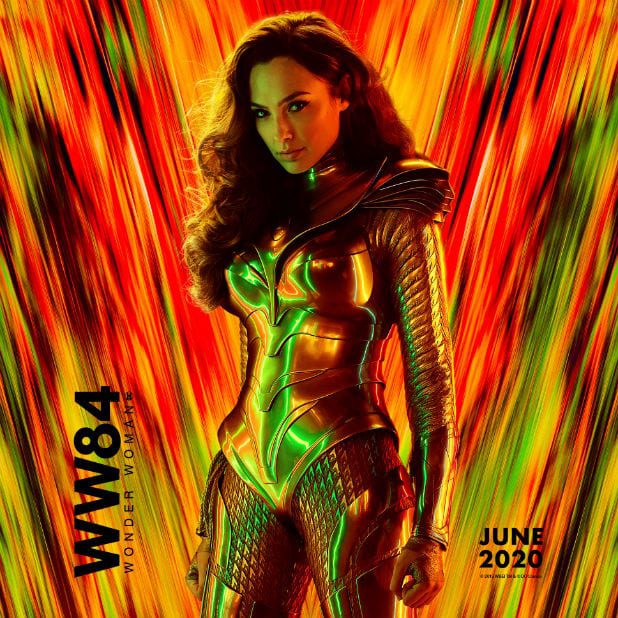
DC Films/Atlas Entertainment // Public Domain
Jenkins may be on to something about 1984 in particular as a year of extremes. I try to get my students into the feel of what it would have been like to live in the 80s by showing them a series of videos they would likely have viewed had they been alive in 1984: an ad, a movie intro, and two presidential campaign commercials. (I may also be trying to keep their attention at the tail end of a semester…) Between them, these videos reveal the 80s to have been a paradoxical moment of great prosperity coupled with great fear.
First, prosperity. I start off by showing the class the famous Apple Super Bowl ad that introduced one of the first affordable personal computers. The ad depicts a group of 1984-like totalitarian pawns with shaved heads and dull jumpsuits watching a supreme leader on a screen spew propaganda. A single blond woman wearing a white tank top and orange wind shorts (hey, it was the 80s) and chased by guards then hurls a hammer into the screen, reducing the talking head to a shower of light. The final line: “On January 24, Apple Computer will introduce Macintosh. And you’ll see why 1984 won’t be like “1984.”” So why not? Because the American economic system has made computer technology and its attendant opportunities for personal expression affordable for the masses.
If I have time, I show students a follow-up: the clever 2011 Motorola Super Bowl ad that recasts Apple as the Evil Empire, to borrow Reagan’s famous phrase for Soviet Russia from his 1983 speech to the National Association of Evangelicals. (Here the peons marching in a line all wear white earbuds!)
The second video clip to emphasize prosperity is President Reagan’s “Morning in America” reelection campaign ad. Quite possibly the cheeriest presidential campaign ad ever, its basic message was that, to quote The Lego Movie, “Everything is awesome!” So why would you switch parties now? In this context, “everything” likewise refers to the economy.
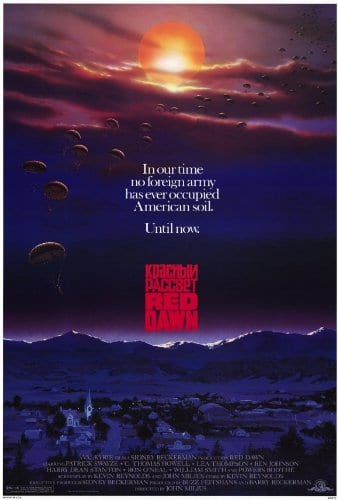
United Artists/Valkyrie Films // Public Domain
But everything was not awesome. 1984 is also the year of the movie Red Dawn, which depicted Soviets parachuting into a small Colorado town and gunning down its high schoolers. Our heroes escape to the woods to fight back. The heroes include Patrick Swayze, Jennifer Grey, and Charlie Sheen. No joke: it was Dirty Dancing with communists and Charlie Sheen. (Like I said, it was the 80s.) To make this plot seem feasible, the movie opens with a series of hypothetical world events that flash across the screen. Things like “Soviet Union suffers worst wheat harvest in 55 years” and “Greens Party gains control of West German Parliament. Demands withdrawal of nuclear weapons from European soil.” Like falling dominoes, they end with the proposition: “NATO dissolves. United States stands alone.” The movie was wildly successful (unlike when it was remade in 2012 with North Korea as the enemy). In 1984, the world seemed sufficiently unstable to make it just believable enough.
But Reagan knew this too, and addressed it in a second famous campaign ad called “The Bear.” In this year of extremes, this may have been either one of the most or the least subtle presidential campaign ads ever. The ad just shows a bear wandering around in the woods while a voiceover informs us that there may or may not be a bear in the woods and it may or may not be tame. But just to be safe, “Isn’t it smart to be as strong as the bear? If there is a bear?” The accompanying slogan was “Prepared for Peace,” a reference to Reagan’s arms escalation policy designed to break the economy of the Soviet bear. A secondary effect, though, was exacerbating Americans’ fears of nuclear chicken.
Reagan won reelection in what was, to continue with the extremes, one of the most extreme electoral college victories ever. I always hear an audible intake of breath when I show the map to my students. It was a time of great prosperity and great fear, and his campaign successfully spoke to both.
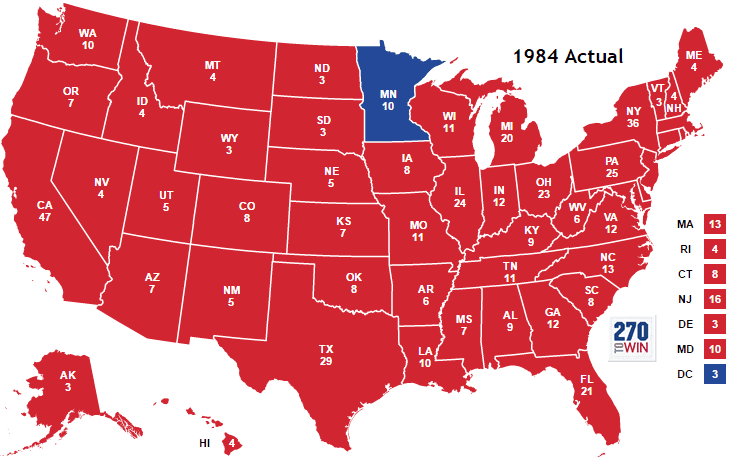
https://www.270towin.com/1984_Election/
And so I wonder if 1984 is in fact exactly the right year to set a blockbuster movie releasing in 2020. Once again we are in a time of great prosperity and great fear. Unemployment has been steadily falling since 2012 and stands currently at an impressively low 3.5%, the lowest since 1969. At the same time, President Trump has stoked racial fears of immigrants taking away jobs or bringing in violence.
Many of my students are politically conservative, so I have begun flagging the difference in the rhetoric of President Reagan and President Trump. Small-federal-government (except for military spending!) Reagan actually said this in his second inaugural address:
“And there is another area where the Federal Government can play a part. As an older American, I remember a time when people of different race, creed, or ethnic origin in our land found hatred and prejudice installed in social custom and, yes, in law. There is no story more heartening in our history than the progress that we have made toward the “brotherhood of man” that God intended for us. Let us resolve there will be no turning back or hesitation on the road to an America rich in dignity and abundant with opportunity for all our citizens. Let us resolve that we the people will build an American opportunity society in which all of us–white and black, rich and poor, young and old–will go forward together arm in arm. Again, let us remember that though our heritage is one of blood lines from every corner of the Earth, we are all Americans pledged to carry on this last, best hope of man on Earth.”
That’s right, Reagan said one of the few roles of the federal government should be racial reconciliation. The Soviet Union and its widely perceived antagonism to American economic, political, and religious traditions was the enemy, so Reagan could cast a vision that all Americans’ embrace of these traditions bound us together regardless of our differences.
Today we do not have the same type of external enemy we had in the 1980s, so we fight ourselves. Democrats stoke fear about conservatives taking away abortion freedoms while Republicans stoke fear about liberals taking away religious freedoms. In our polarized society, these fears are more reasonable than the ones Trump stokes about immigrants. I’m not saying we should go get a real external enemy. That’s how people die.
But I am saying that whether on the right or the left, we should guard against the politics of fear. We will need to find a better politics of the common good. Here is Wonder Woman director Patty Jenkins again in 2017: “Our fantasy of a hero is that he’s the good guy who is going to shut down the bad guy. That has got to change if we want to deal with the crisis that we’re in. There is no bad guy. We are all to blame. New kinds of heroics need to be celebrated, like love, thoughtfulness, forgiveness, diplomacy, or we’re not going to get there. No one is coming to save us.”
I’m intrigued to see what Wonder Woman 1984 has to say to 2020.
Previous Post

December 10, 2019
Can Evangelicals Support Religious Freedom and LGBT Rights?

Browse Our Archives
Select a Category abolitionism Abortion Abraham Joshua Heschel Abraham Kuyper Abraham Lincoln Academia Activism Adam Renberg Advent Adventist africa African American Religion Agnes Howard Albert Camus American History American Religious History American Revolution American West Anabaptists Ancient History Andrea Turpin Andrei Tarkovsky Anglicanism Annales Ansley Lillian Quiros anti-Catholicism Antisemitism Anxious Bench apologetics Apparitions Arash Azizi Archaeology archives art Artificial Intelligence Asia Asian Americans Augustine Authors Bad Bunny Baptism Baptists Barack Obama Battle of Hastings Benjamin Franklin Bernard-Henri Levy Beth Allison Barr Beth Moore Bethany Mannon Bible Bill Cunningham Billy Graham Black Music Bob Dylan Body Boenhoffer Books Breastfeeding Bruce Springsteen C.S. Lewis Calvinism Cancel Culture Capitalism Carmelites Catholicism Cedric Robinson Cesar Chavez Charismaticism charity Charles Dickens Charles Lindbergh Che Guevara Chicago Children Chinese Christianity Chris Gehrz Christ Christian death Christian Higher Education Christian life Christian Nation Christian Nationalism Christianity Today Christmas Church life Church Practice cinema Civil Religion Civil Rights Movement Civil War civility Classics Climate Change Cold War Colonial Mexico colonialism Comer Communism community complementarianism Conference on Faith and History Congregationalism Conspiracies Conspiracy Conversion Narratives Coronavirus Costa Rica Council of Nicaea Covid-19 Creation Critical Race Theory Crusades Culture culture wars Daniel K. Williams David Barton David Swartz Death Ways death with dignity DEI democracy Democratic Party Devotion Digital Age Diplomacy discipleship diversity Donald Trump Drama Dua Lipa Early Church early modern Early modern Catholicism Easter Eastern Christianity economic exploitation Education elections Elie Wiesel Elizabeth II Elizabeth Taylor emotions Empire Engineering England enslavement Entertainment Episcopal Church Erica Ramirez eschatology Eurocentrism Evangelicalism Evangelicals Exegesis Family Feminism Film Flannery O'Connor folk music Food Foreign Policy founding fathers Franciscans Franciscus Junius fundamentalism Funerals G.K. Chesterton Gender Genocide genre geography George W. Bush George Washington George Whitefield Global Christianity Global church Grief Guadalupe guest post Guest Post gun control gun violence Gustavo Gutierrez Hamid Dabashi Harold John Ockenga Harvest Hate Hawaiian Christianity Healing health care Heather Cox Richardson Hell Heresy Hermeneutics Higher Education Hinduism Hippocratic oath Historical Fiction Historical Methodology Historical Profession Historical Profession Historical Theology Historical Thinking historiography Holidays Holocaust horror movies Human rights Humanitarian Work humanities Hummingbirds Hungary hymns Imago Dei Immigration Injustice Interviews Iran Islam Islamophobia Israel Ivan's Childhood Jacob Randolph James Bratt Janine Giordano Drake Japanese history Japanese Literature Jean Paul Sartre Jesse Miranda Jesus Jesus Christ Jimmy Carter Joan Baez Joan Didion Joanne Freeman João B. Chaves Joao Chaves Joey Cochran John Calvin John Fea John Tillotson John Turner Johnny Cash Jonathan Edwards Jonathan Tran Joseph Smith Josh Howerton Journalism Jr. Judaism Jürgen Moltmann Just War Justice Justin Brierley Karl Barth Katelyn Beaty koi ponds Kris Kristofferson Kristin Kobes Du Mez Latin American Religious History Latino Americans Lectio Divina Leisure Lent Leonard Cohen liberal arts liberalism Liberation Theology Linda Ronstadt Lisa Clark Diller Literature Lou Reed Lynchings Lynneth Miller Renberg Mainline Protestantism Malcolm Foley Marilyn Monroe Maritime history Mark Noll Marriage Martin Luther Martin Luther King Martyrdom Marxism Mary Masih Alinejad mass shootings material culture medieval Christianity Medieval Ethiopia Melissa Borja memory Mennonites Mental Health Mental Illness Methodism Mexican Americans Mexicans Mike Madrid Miles Mullin Min Jin Lee Miscarriage Missionaries Mister Rogers Mitt Romney modernity Monasticism Mormonism Motherhood Mothers of the Church Moving Music Musicals Nadya Williams Nahua Christianity Native Americans Natsume Sōseki New Contributor New England New Year New York Nico Non-Violent Protest Orthodoxy pacifism Paleo Evangelicals Palestinians Parenting Patti Smith Paul Kingsnorth Pedro Calderón de la Barca Pentecostalism Philip Jenkins Phillis Wheatley physician-assisted suicide pilgrimage Pilgrims pluralism Plutocracy Poetry Politics Pope Francis Pope Leo XIV post-modernism prayer preaching Presbyterians prosperity gospel Protest Public history Publishing Puritans purity culture Quakers race Race Massacres Racial Capitalism racial reconciliation racialization Racism Raha Bahloulipour Re-Enchantment reading Reformation Refugees religion and the university religion and war Religious Freedom Religious Nones Religious Pluralism Religious Symbols religious violence Republican Party Revival Rita Coolidge Ritual Roger Williams Roman Catholic church Royalty Russell Moore same-sex marriage Sarah Irving-Stonebraker Scandinavia Science Science and Technology Scopes trial Scriptural Interpretation secularism Selena Quintanilla seminary Seventh-Day Adventists sexual morality Sexuality Sikhs Silence slaveholders theology Slavery Slavoj Zizek social justice Social Media Southern Baptist Convention Southern Religion Spain Spiritual Autobiography Spiritual but not religious Spiritual Discipline Sports Stanley Hauerwas Suffering Summer Camps Sunday Night Odds and Ends Supernatural Supreme Court Syriac Christianity Tal Howard Taylor Swift Teaching Technology Television Thanksgiving The Beatles The Mission theater TheoBros Theology Thomas Dixon Thomas Jefferson Thomas Kidd Thomas Merton Tim Gloege Tim Walz Tom Holland Tourism tradition Tragedy Translation Transnationalism Travel Trump Ukraine Uncategorized Unitarians United Methodist Church US History Vanessa Chan Velvet Underground Verónica A. Gutiérrez Veronica Gutierrez Vikings Violence Virgin Mary Virtue Virtue ethics Visions Voting War WCTU Wendell Berry Westminster Assembly White Evangelicalism Wildfires Winnie the Pooh Witches women Women in Ministry Women's and Gender Studies Work Worship writing Yasunari Kawabata Zena Hitz
Select a Month October 2026 September 2026 August 2026 July 2026 June 2026 May 2026 April 2026 March 2026 February 2026 January 2026 December 2025 November 2025 October 2025 September 2025 August 2025 July 2025 June 2025 May 2025 April 2025 March 2025 February 2025 January 2025 December 2024 November 2024 October 2024 September 2024 August 2024 July 2024 June 2024 May 2024 April 2024 March 2024 February 2024 January 2024 December 2023 November 2023 October 2023 September 2023 August 2023 July 2023 June 2023 May 2023 April 2023 March 2023 February 2023 January 2023 December 2022 November 2022 October 2022 September 2022 August 2022 July 2022 June 2022 May 2022 April 2022 March 2022 February 2022 January 2022 December 2021 November 2021 October 2021 September 2021 August 2021 July 2021 June 2021 May 2021 April 2021 March 2021 February 2021 January 2021 December 2020 November 2020 October 2020 September 2020 August 2020 July 2020 June 2020 May 2020 April 2020 March 2020 February 2020 January 2020 December 2019 November 2019 October 2019 September 2019 August 2019 July 2019 June 2019 May 2019 April 2019 March 2019 February 2019 January 2019 December 2018 November 2018 October 2018 September 2018 August 2018 July 2018 June 2018 May 2018 April 2018 March 2018 February 2018 January 2018 December 2017 November 2017 October 2017 September 2017 August 2017 July 2017 June 2017 May 2017 April 2017 March 2017 February 2017 January 2017 December 2016 November 2016 October 2016 September 2016 August 2016 July 2016 June 2016 May 2016 April 2016 March 2016 February 2016 January 2016 December 2015 November 2015 October 2015 September 2015 August 2015 July 2015 June 2015 May 2015 April 2015 March 2015 February 2015 January 2015 December 2014 November 2014 October 2014 September 2014 August 2014 July 2014 June 2014 May 2014 April 2014 March 2014 February 2014 January 2014 December 2013 November 2013 October 2013 September 2013 August 2013 July 2013 June 2013 May 2013 April 2013 March 2013 February 2013 January 2013 December 2012 November 2012 October 2012 September 2012 August 2012 July 2012 June 2012 May 2012
Follow Us!
TAKE THE
Religious Wisdom Quiz
True or False: King Josiah found the Book of the Law hidden in the temple during repairs.
Select your answer to see how you score.
FALSE TRUE
Related posts from Anxious Bench
Christians Helped Invent Race. Some Now Call It...
George Rogers and the Pentecostal Case Against Movies
John Calvin: Pastor. Theologian. Immigrant Nuisance?

How Modern Citizenship Debates Echo the Reformation
TRENDING AT PATHEOS Evangelical

The Sermon on the Mount, Part I: Matthew...
The Sermon on the Mount, Part I (Matthew 4:12-5:12) St. Matthew moves...

What's up from Crossway: Reviewing some of their latest A few weeks...

Janie Learns the Way of the Cross: A...
Teaching children about Jesus' Passion can be challenging. Many parents and educators...

Looking For Good Catholic Writing - October 2026
He alone extends the heavens, and he walks upon the waves of...

In "Irreplaceable," our book on vocation and technology, Trevor Sutton and I...

I was strolling through the top floor of the brand new Parthenon...
view all Evangelical blogs
Ad-Free & Subscriber Log-In Subscription Support
- About Us
- 2026 Calendar
- Videos
- Podcasts
- Library of World Religions
- Faith In Media Tracker
- Advertise With Us
- Write for Us
- Privacy Policy
- Terms of Service
- Do Not Sell My Data
- Contact Us
- Radiant Digital
- Manage Newsletter Subscriptions
- Unsubscribe From Notifications
- Sitemap
Copyright 2008-2026, Patheos. All rights reserved.
Subscription Support Ad-Free & Subscriber Log-In
Follow Patheos