
BuddhistCatholicContemplativeEvangelicalGeneral ChristianHinduJewishLatter-day SaintMuslimNew VisionsProgressive Christian
Beliefs
- Buddhist
- Catholic
- Contemplative
- Evangelical
- General Christian
- Hindu
- Jewish
- Latter-day Saint
- More Voices
- Muslim
- New Visions
- Pagan
- Progressive Christian
Topics
- Religion News
- Food and Religion
- Sports and Religion
- Religious Art
- Religious Music and Entertainment
- Religious Events
- History and Religion
- Style and Religion
- Politics and Religion
- Women in Religion
- Recreation Outdoors and Religion
- Business Finance and Religion
- Careers Workplace and Religion
- Education and Religion
- Family Parenting and Religion
- Health Fitness and Religion
- Home and Religion
- Relationships and Religion
- Technology and Religion
- Travel and Religion
Columnists
- Buddhist Columnists
- Business Finance and Religion Columnists
- Careers Workplace and Religion Columnists
- Catholic Columnists
- Contemplative Columnists
- Education and Religion Columnists
- Evangelists Columnists
- Family Parenting and Religion Columnists
- General Christian Columnists
- Health Fitness and Religion Columnists
- Hindu Columnists
- History and Religion Columnists
- Home and Religion Columnists
- Jewish Columnists
- More Voices Columnists
- Latter Day Columnists
- Muslim Columnists
- New Visions Columnists
- Nonreligious Columnists
- Pagan Columnists
- Politics and Religion Columnists
- Progressive Columnists
- Recreation Outdoors and Religion Columnists
- Relationships and Religion Columnists
- Religion News Columnists
- Religious Art Columnists
- Religious Events Columnists
- Religious Music and Entertainment Columnists
- Sports and Religion Columnists
- Style and Religion Columnists
- Technology and Religion Columnists
- Travel and Religion Columnists
- Women in Religion Columnists
Resource Library
- 2026 Calendar
- Library of World Religions
- The 100 Most Holy Places on Earth
- Patheos Answers
- Podcasts
- Videos
- Faith Leaders Database
- Anglican Episcopalian
- Bahai
- Baptist
- Buddhism
- Christianity
- Confucianism
- Eastern Orthodoxy
- Hinduism
- Holiness and Pentecostal
- ISKCON
- Islam
- Judaism
- Lutheran
- Methodist
- The Church of Jesus Christ of Latter-day Saints
- New Age
- Paganism
- Presbytarian and Reformed
- Protestantism
- Religion Behind the Scenes
- Roman Catholic
- Scientology
- Shia Islam
- Sikhism
- Sufism
- Sunni Islam
- Taoism
- Zen
- See all religions
Research Tools
 Ad-Free & Subscriber Log-In Subscription Support
Follow Patheos 

- Trending:
- Advent
- |
- Forgiveness
- |
- Thanksgiving
- |
- Election
- |
- Seasonal Holidays
- |
- Marriage

-
About the Authors
- Home
- Evangelical
- Beyond Red Kettles and Chick-fil-A: Some History of the Salvation Army
Beyond Red Kettles and Chick-fil-A: Some History of the Salvation Army
Last updated on: November 26, 2019 at 10:16 am by Chris Gehrz
Beyond Red Kettles and Chick-fil-A: Some History of the Salvation Army 2019-11-26T10:16:58-04:00 Chris Gehrz
Patheos Explore the world's faith through different perspectives on religion and spirituality! Patheos has the views of the prevalent religions and spiritualities of the world.
…the Salvation Army is both more and less than most people suppose it to be. The Army is more than blandly beneficial, more than a mere charity. It is a religious crusade, an evangelical Christian denomination; its sole purpose is to secure the redemption of lost sinners through faith in the Atonement of Christ. (Edward H. McKinley)
If you’re like me, you thought about the Salvation Army for two reasons last week.
First, you went to the grocery store or a mall and saw someone ringing a bell in front of a red kettle, inviting donations from passers-by. It’s the most iconic image of the Army: the ubiquitous symbol of its universally admired commitment to serve people around the world suffering from poverty, homelessness, disease, etc. This year Salvationists aim to raise $150 million through those kettles and bells.
But they will not receive money from one corporate sponsor. As you may also have seen last week, the Salvation Army featured in this CNN story about a fast food chain’s decision to change its philanthropic giving.
Chick-fil-A has announced that beginning next year it will no longer donate to Salvation Army and the Fellowship of Christian Athletes (FCA). Both organizations have taken controversial stands on homosexuality and same-sex marriage. https://t.co/X1HJ4Bd2FF
— CNN (@CNN) November 18, 2019
At least for now, Chick-fil-A Foundation won’t direct money to two Christian nonprofits: Fellowship of Christian Athletes and the Salvation Army, which last year received $115,000 in support of a program that gives holiday gifts to children. Commentators instantly made a connection with criticism that Chick-fil-A had received from gay rights activists. It had started with the company’s founders’ support of anti-same-sex marriage groups in 2011-2012, but turned more recently to philanthropic support of conservative religious organizations.
That news got me looking through the Anxious Bench archive, searching for a post that I could share with readers who might be confused to see that “anti-LGBTQ” headline in the season of red kettles and bell ringers. But remarkably, it seems that we’ve never written a post primarily devoted to the history of the Army.
I’m not sure I’m the best one to rectify that oversight. But one of the joys of blogging is that you have a built-in excuse to learn just enough about something to feel comfortable sharing your semi-ignorance with others!
Now, it’s not that I knew nothing of the Salvationist story before this month.

Catherine and William Booth – Wikimedia
I knew it started with an English Methodist preacher named William Booth, who will feature prominently in a lecture I give next Friday on Christian responses to the Industrial Revolution. “My only hope for the permanent deliverance of mankind from misery,” he wrote in 1890, “is the regeneration or remaking of the individual by the power of the Holy Ghost through Jesus Christ. But in providing for the relief of temporal misery I reckon that I am only making it easy where it is now difficult, and possible where it is now all but impossible, for men and women to find their way to the Cross of our Lord Jesus Christ.” Booth argued that if people could not live even as well as a London cab horse — with “a shelter for the night, food for its stomach, and work allotted to it by which it can earn its corn” — they could never truly hear and respond to the Gospel. So he and his wife Catherine founded a relief mission in London in 1865, which took on the name of Salvation Army in 1878.
I knew that their Wesleyan roots have historically led Salvationists to emphasize both social and personal holiness. They warn about the dangers of alcohol and pornography, as well as racism and human trafficking. So I wasn’t too surprised to learn that today’s Salvation Army takes the position that “Scripture forbids sexual intimacy between members of the same sex.” While Salvation Army U.S.A. and its regional territories take pains nowadays to emphasize how they minister to and hire LGBTQ individuals, they have not retreated from their traditional stance on sexuality.
Finally, I knew enough about the history of the Salvation Army to nod vigorously when my wife first suggested we call our daughter Evangeline. Not only is it from the Greek for “good news,” but that was the name William and Catherine Booth gave to their fourth daughter, who followed her parents into leadership of the Army. Evangeline Booth was the first of three Salvationist women (so far) to hold the rank of General and one of the denomination’s founders in North America.
I knew all this. But I didn’t know much about the Salvation Army in the last 100 years. So I started by paging through some Salvationist perspectives on the denomination’s history: E. H. McKinley’s Marching to Glory: The History of The Salvation Army in the United States, 1880-1992 (2nd ed., Eerdmans, 1995); Henry Gariepy’s even more hagiographic Christianity in Action: The International History of the Salvation Army (Eerdmans, 2009); and Harold Hill’s more critical Saved to Save and Saved to Serve: Perspectives on Salvation Army History (Wipf & Stock, 2017).
But bearing in mind Kristin’s observations about the strengths and weaknesses of “insider history,” I spent most of my time reading Red-Hot and Righteous: The Urban Religion of the Salvation Army (Harvard University Press, 1999) by Diane Winston, a journalist and scholar who now holds a chair in media and religion at the Annenberg School.
I’m glad I did! While Winston doesn’t directly address Salvationist views on homosexuality (she did in this 2009 interview with NPR), her account helps me better understand a couple of tensions in the history of the Salvation Army that may be relevant to what happened last week.
In Winston’s book, “issues of gender and sexuality came to the fore” not in later debates over same-sex marriage — her story ends in 1950 — but in the Salvation Army’s response to World War I, when an organization headed by a woman decided to send women (“lassies”) among the 250 Salvationists deployed to France. Known as “Sallies,” their service among American soldiers made them as iconic an Army symbol at the time as the red kettles are now.
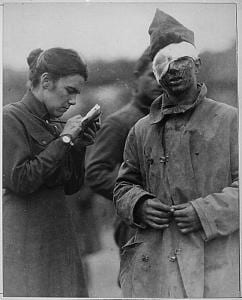
A “Sally” writing a letter home for a wounded soldier – CC BY-SA 2.0 (Marion Doss)
But a complicated symbol, at once signifying “wholesome womanhood” and “the sexual ambiguity that lay between the spiritual and the secular.”
For Winston, the case of the Sallies illustrates how the Salvation Army’s commitment to “religionize secular things” has also meant that its soldiers often “blurred boundaries… Not content to transgress geographic borders, Salvationists defied symbolic boundaries, too.” For example, the sight of “uniformed women” in late 19th century Salvation Army parades “struck many New Yorkers as a violation of Christian norms.” In that 2009 NPR interview, Winston mentioned how one New York Times reporter warned readers “that if your daughter joins the army, she should kiss her respectability good bye.”
The “first Christian group in modern times to treat women as men’s equals” would not stop with women’s participation in parades. As it deepened its engagement with urban culture, a fundamentally conservative Christian organization would employ what for the time were transgressive methods. For while the Salvation Army continued to affirm the importance of personal (and social) holiness as it entered the Roaring Twenties, the uniform of the Sallies came to signal “a more provocative notion—the ability to put on or cast off an identity as easily as a new suit of clothes” — just in time for the arrival of an “age of flappers and sexual freedom.”
Yet even as Army leaders “allowed socialites to pose as models and showgirls to raise funds in uniform,” they insisted that “lassies themselves… hew to a proper image.” Salvationist women who tried to use “sexual charisma” to further their mission risked censure.
Women like Captain Rheba Crawford. “Feisty, attractive, and articulate,” writes Winston, Crawford “lived in Greenwich Village, liked pretty clothes, and plainly spoke her mind.” Not just “The Prettiest Girl in The Salvation Army” but a practitioner of William Booth’s preference for “red-hot” preaching, she drew a thousand a week to her open-air sermons on the steps of a Broadway theater owned by George M. Cohan. But after a policeman arrested her in 1922, Crawford was asked to resign her commission. While she accepted the “Army’s standing policy to avoid dispute and to frown on personal publicity,” she regretted having “to lay down the only weapons God gave me.”
The case of women like Crawford is just one example of a larger theme in Winston’s account: how an evangelical, Holiness denomination has often lived in tension with the fast-changing values of urban culture. For Salvationists, the challenge has long been how they can be “In the city but not of the city.”
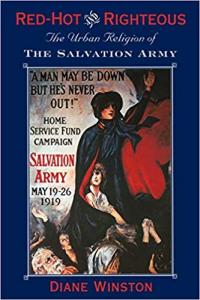 With an account that starts in New York in 1880, Winston emphasizes how the Salvation Army “staked a claim to city life as no religious group had done before… Even in smaller cities and towns, the Army existed only insofar as it had a public presence.” Shaped by its roots in Holiness theology, the Salvation Army has always sought to “transform the secular world into the Kingdom of God” — by placing itself in the centers of culture… and so, not surprisingly, it finds itself in the midst of cultural debates.
And you could substitute the words economy and economic for culture and cultural. In Winston’s interpretation of its experience in the United States, the Salvation Army has been “both a symptom of and a catalyst for a new, evolving urban culture driven by commerce and fueled by consumption.” But you don’t get to be “one of the nation’s most successful charitable fundraisers” without having to wrestle with your relationship to an economy in which corporations play an outsized role in philanthropy. And you can’t keep “a strong symbolic claim not only on America’s purse strings but also on its psyche” without having to deal with consumers who might, as Tara Isabella Burton put it last week, envision “the spending of money as inextricable from affirmations of one’s values.”
Previous Post

November 25, 2019
Scrolls, Lost Gospels, And Why Nobody Came Back To Get Them

Browse Our Archives
Select a Category abolitionism Abortion Abraham Joshua Heschel Abraham Kuyper Abraham Lincoln Academia Activism Adam Renberg Advent Adventist africa African American Religion Agnes Howard Albert Camus American History American Religious History American Revolution American West Anabaptists Ancient History Andrea Turpin Andrei Tarkovsky Anglicanism Annales Ansley Lillian Quiros anti-Catholicism Antisemitism Anxious Bench apologetics Apparitions Arash Azizi Archaeology archives art Artificial Intelligence Asia Asian Americans Augustine Authors Bad Bunny Baptism Baptists Barack Obama Battle of Hastings Benjamin Franklin Bernard-Henri Levy Beth Allison Barr Beth Moore Bethany Mannon Bible Bill Cunningham Billy Graham Black Music Bob Dylan Body Boenhoffer Books Breastfeeding Bruce Springsteen C.S. Lewis Calvinism Cancel Culture Capitalism Carmelites Catholicism Cedric Robinson Cesar Chavez Charismaticism charity Charles Dickens Charles Lindbergh Che Guevara Chicago Children Chinese Christianity Chris Gehrz Christ Christian death Christian Higher Education Christian life Christian Nation Christian Nationalism Christianity Today Christmas Church life Church Practice cinema Civil Religion Civil Rights Movement Civil War civility Classics Climate Change Cold War Colonial Mexico colonialism Comer Communism community complementarianism Conference on Faith and History Congregationalism Conspiracies Conspiracy Conversion Narratives Coronavirus Costa Rica Council of Nicaea Covid-19 Creation Critical Race Theory Crusades Culture culture wars Daniel K. Williams David Barton David Swartz Death Ways death with dignity DEI democracy Democratic Party Devotion Digital Age Diplomacy discipleship diversity Donald Trump Drama Dua Lipa Early Church early modern Early modern Catholicism Easter Eastern Christianity economic exploitation Education elections Elie Wiesel Elizabeth II Elizabeth Taylor emotions Empire Engineering England enslavement Entertainment Episcopal Church Erica Ramirez eschatology Eurocentrism Evangelicalism Evangelicals Exegesis Family Feminism Film Flannery O'Connor folk music Food Foreign Policy founding fathers Franciscans Franciscus Junius fundamentalism Funerals G.K. Chesterton Gender Genocide genre geography George W. Bush George Washington George Whitefield Global Christianity Global church Grief Guadalupe Guest Post guest post gun control gun violence Gustavo Gutierrez Hamid Dabashi Harold John Ockenga Harvest Hate Hawaiian Christianity Healing health care Heather Cox Richardson Hell Heresy Hermeneutics Higher Education Hinduism Hippocratic oath Historical Fiction Historical Methodology Historical Profession Historical Profession Historical Theology Historical Thinking historiography Holidays Holocaust horror movies Human rights Humanitarian Work humanities Hummingbirds Hungary hymns Imago Dei Immigration Injustice Interviews Iran Islam Islamophobia Israel Ivan's Childhood Jacob Randolph James Bratt Janine Giordano Drake Japanese history Japanese Literature Jean Paul Sartre Jesse Miranda Jesus Jesus Christ Jimmy Carter Joan Baez Joan Didion Joanne Freeman João B. Chaves Joao Chaves Joey Cochran John Calvin John Fea John Tillotson John Turner Johnny Cash Jonathan Edwards Jonathan Tran Joseph Smith Josh Howerton Journalism Jr. Judaism Jürgen Moltmann Just War Justice Justin Brierley Karl Barth Katelyn Beaty koi ponds Kris Kristofferson Kristin Kobes Du Mez Latin American Religious History Latino Americans Lectio Divina Leisure Lent Leonard Cohen liberal arts liberalism Liberation Theology Linda Ronstadt Lisa Clark Diller Literature Lou Reed Lynchings Lynneth Miller Renberg Mainline Protestantism Malcolm Foley Marilyn Monroe Maritime history Mark Noll Marriage Martin Luther Martin Luther King Martyrdom Marxism Mary Masih Alinejad mass shootings material culture medieval Christianity Medieval Ethiopia Melissa Borja memory Mennonites Mental Health Mental Illness Methodism Mexican Americans Mexicans Mike Madrid Miles Mullin Min Jin Lee Miscarriage Missionaries Mister Rogers Mitt Romney modernity Monasticism Mormonism Motherhood Mothers of the Church Moving Music Musicals Nadya Williams Nahua Christianity Native Americans Natsume Sōseki New Contributor New England New Year New York Nico Non-Violent Protest Orthodoxy pacifism Paleo Evangelicals Palestinians Parenting Patti Smith Paul Kingsnorth Pedro Calderón de la Barca Pentecostalism Philip Jenkins Phillis Wheatley physician-assisted suicide pilgrimage Pilgrims Piracy pluralism Plutocracy Poetry Politics Pope Francis Pope Leo XIV post-modernism prayer preaching Presbyterians prosperity gospel Protest Public Executions Public history Publishing Puritans purity culture Quakers race Race Massacres Racial Capitalism racial reconciliation racialization Racism Raha Bahloulipour Re-Enchantment reading Reformation Refugees religion and the university religion and war Religious Freedom Religious Nones Religious Pluralism Religious Symbols religious violence Republican Party Revival Rita Coolidge Ritual Roger Williams Roman Catholic church Royalty Russell Moore same-sex marriage Sarah Irving-Stonebraker Scandinavia Science Science and Technology Scopes trial Scriptural Interpretation secularism Selena Quintanilla seminary Seventh-Day Adventists sexual morality Sexuality Sikhs Silence slaveholders theology Slavery Slavoj Zizek social justice Social Media Southern Baptist Convention Southern Religion Spain Spiritual Autobiography Spiritual but not religious Spiritual Discipline Sports Stanley Hauerwas Suffering Summer Camps Sunday Night Odds and Ends Supernatural Supreme Court Syriac Christianity Tal Howard Taylor Swift Teaching Technology Television Thanksgiving The Beatles The Mission theater TheoBros Theology Thomas Dixon Thomas Jefferson Thomas Kidd Thomas Merton Tim Gloege Tim Walz Tom Holland Tourism tradition Tragedy Translation Transnationalism Travel Trump Ukraine Uncategorized Unitarians United Methodist Church US History Vanessa Chan Velvet Underground Verónica A. Gutiérrez Veronica Gutierrez Vikings Violence Virgin Mary Virtue Virtue ethics Visions Voting War WCTU Wendell Berry Westminster Assembly White Evangelicalism Wildfires Winnie the Pooh Witches women Women in Ministry Women's and Gender Studies Work Worship writing Yasunari Kawabata Zena Hitz
Select a Month November 2026 October 2026 September 2026 August 2026 July 2026 June 2026 May 2026 April 2026 March 2026 February 2026 January 2026 December 2025 November 2025 October 2025 September 2025 August 2025 July 2025 June 2025 May 2025 April 2025 March 2025 February 2025 January 2025 December 2024 November 2024 October 2024 September 2024 August 2024 July 2024 June 2024 May 2024 April 2024 March 2024 February 2024 January 2024 December 2023 November 2023 October 2023 September 2023 August 2023 July 2023 June 2023 May 2023 April 2023 March 2023 February 2023 January 2023 December 2022 November 2022 October 2022 September 2022 August 2022 July 2022 June 2022 May 2022 April 2022 March 2022 February 2022 January 2022 December 2021 November 2021 October 2021 September 2021 August 2021 July 2021 June 2021 May 2021 April 2021 March 2021 February 2021 January 2021 December 2020 November 2020 October 2020 September 2020 August 2020 July 2020 June 2020 May 2020 April 2020 March 2020 February 2020 January 2020 December 2019 November 2019 October 2019 September 2019 August 2019 July 2019 June 2019 May 2019 April 2019 March 2019 February 2019 January 2019 December 2018 November 2018 October 2018 September 2018 August 2018 July 2018 June 2018 May 2018 April 2018 March 2018 February 2018 January 2018 December 2017 November 2017 October 2017 September 2017 August 2017 July 2017 June 2017 May 2017 April 2017 March 2017 February 2017 January 2017 December 2016 November 2016 October 2016 September 2016 August 2016 July 2016 June 2016 May 2016 April 2016 March 2016 February 2016 January 2016 December 2015 November 2015 October 2015 September 2015 August 2015 July 2015 June 2015 May 2015 April 2015 March 2015 February 2015 January 2015 December 2014 November 2014 October 2014 September 2014 August 2014 July 2014 June 2014 May 2014 April 2014 March 2014 February 2014 January 2014 December 2013 November 2013 October 2013 September 2013 August 2013 July 2013 June 2013 May 2013 April 2013 March 2013 February 2013 January 2013 December 2012 November 2012 October 2012 September 2012 August 2012 July 2012 June 2012 May 2012
Follow Us!
TAKE THE
Religious Wisdom Quiz
Your eyes are compared to these gentle birds, and your temples behind your veil are like the halves of a fruit. What is the fruit?
Select your answer to see how you score.
A fig A pomegranate A grape An apple
Related posts from Anxious Bench
Paris & CT Burn 50 Years After Newsweek's...

What Coffee Reveals About America's Evangelical Varieties

A Casserole is Not a Counterpoint

Angelina Grimké's Forgotten Turn to Apocalyptic Faith
TRENDING AT PATHEOS Evangelical

Jesus is Coming with Glory and Power
https://www.youtube.com/watch?v=_lt60EDHOQ4&list=RD_lt60EDHOQ4&start_radio=1

The Late Francis Frangipane & the Failure Too...
I learned today that another one of my heroes has gone to...

Thomas Paine, the Smiths, the apostles in England,...
I'm pleased to announce that the Becoming Brigham Black Friday Sale,...

CatholicTV Series: Six Black Catholics on Path to...
WATERTOWN, Mass., November 9, 2026 – In recognition of Black Catholic History...

New Advent Journal Invites Catholics to Be Pilgrims
Florissant, MO, November 16, 2026— What if Advent were more than a...

INNER CIRCLE: John's Quantum Gospel
INTRODUCTION In this next Inner Circle series, which I anticipate will...
view all Evangelical blogs
Ad-Free & Subscriber Log-In Subscription Support
- About Us
- 2026 Calendar
- Videos
- Podcasts
- Library of World Religions
- Faith In Media Tracker
- Advertise With Us
- Write for Us
- Privacy Policy
- Terms of Service
- Do Not Sell My Data
- Contact Us
- Radiant Digital
- Manage Newsletter Subscriptions
- Unsubscribe From Notifications
- Sitemap
Copyright 2008-2026, Patheos, part of the Radiant Digital network of media brands. All rights reserved.
Subscription Support Ad-Free & Subscriber Log-In
Follow Patheos