
BuddhistCatholicContemplativeEvangelicalGeneral ChristianHinduJewishLatter-day SaintMuslimNew VisionsProgressive Christian
Beliefs
- Buddhist
- Catholic
- Contemplative
- Evangelical
- General Christian
- Hindu
- Jewish
- Latter-day Saint
- More Voices
- Muslim
- New Visions
- Pagan
- Progressive Christian
Topics
- Religion News
- Food and Religion
- Sports and Religion
- Religious Art
- Religious Music and Entertainment
- Religious Events
- History and Religion
- Style and Religion
- Politics and Religion
- Women in Religion
- Recreation Outdoors and Religion
- Business Finance and Religion
- Careers Workplace and Religion
- Education and Religion
- Family Parenting and Religion
- Health Fitness and Religion
- Home and Religion
- Relationships and Religion
- Technology and Religion
- Travel and Religion
Columnists
- Buddhist Columnists
- Business Finance and Religion Columnists
- Careers Workplace and Religion Columnists
- Catholic Columnists
- Contemplative Columnists
- Education and Religion Columnists
- Evangelists Columnists
- Family Parenting and Religion Columnists
- General Christian Columnists
- Health Fitness and Religion Columnists
- Hindu Columnists
- History and Religion Columnists
- Home and Religion Columnists
- Jewish Columnists
- More Voices Columnists
- Latter Day Columnists
- Muslim Columnists
- New Visions Columnists
- Nonreligious Columnists
- Pagan Columnists
- Politics and Religion Columnists
- Progressive Columnists
- Recreation Outdoors and Religion Columnists
- Relationships and Religion Columnists
- Religion News Columnists
- Religious Art Columnists
- Religious Events Columnists
- Religious Music and Entertainment Columnists
- Sports and Religion Columnists
- Style and Religion Columnists
- Technology and Religion Columnists
- Travel and Religion Columnists
- Women in Religion Columnists
Resource Library
- 2026 Calendar
- Library of World Religions
- The 100 Most Holy Places on Earth
- Patheos Answers
- Podcasts
- Videos
- Faith Leaders Database
- Anglican Episcopalian
- Bahai
- Baptist
- Buddhism
- Christianity
- Confucianism
- Eastern Orthodoxy
- Hinduism
- Holiness and Pentecostal
- ISKCON
- Islam
- Judaism
- Lutheran
- Methodist
- The Church of Jesus Christ of Latter-day Saints
- New Age
- Paganism
- Presbytarian and Reformed
- Protestantism
- Religion Behind the Scenes
- Roman Catholic
- Scientology
- Shia Islam
- Sikhism
- Sufism
- Sunni Islam
- Taoism
- Zen
- See all religions
Research Tools
 Ad-Free & Subscriber Log-In Subscription Support
Ad-Free & Subscriber Log-In Subscription Support
Follow Patheos 

- Trending:
- Forgiveness
- |
- Marriage
- |
- Consciousness
- |
- Death Penalty
- |
- Election
- |
- Halloween

-
About the Authors
- Home
- Evangelical
- Yoder School: An Interview with Phyllis Miller Swartz
Yoder School: An Interview with Phyllis Miller Swartz
Last updated on: August 14, 2019 at 12:01 am by David Swartz
Yoder School: An Interview with Phyllis Miller Swartz 2019-08-12T22:32:07-04:00 David Swartz
Patheos Explore the world's faith through different perspectives on religion and spirituality! Patheos has the views of the prevalent religions and spiritualities of the world.
I’m pleased to welcome my mother, Phyllis Miller Swartz, to the Anxious Bench. She has extensive teaching experience at middle schools and prisons in Ohio. She is also the author of Yoder School, just released by Cascadia House. It’s a memoir that traces the educational journey of a young conservative Mennonite schoolgirl from the Appalachian Mountains to gritty Flint, Michigan, to Amish country in Lancaster County, Pennsylvania, to the hippie hothouse of Antioch College. I know I’m biased, but this is a really compelling book.
—David
***
What was Yoder School?
Nicknamed “Dutch College,” Yoder was a public school, eight grades in three rooms. It was set upon a slope rising up from the Casselman River in one of the ranges of the Appalachian Mountains in western Maryland. But only the children of the plain people went there—Amish, Beachy, and Mennonite kids. I belonged to the Mennonites.
My classmates reminded me of the quilt on my bed at home. I liked the mixed-together patterns: the dark aproned dresses of the Amish girls beside the brighter dresses of the Mennonites, short hair of the Mennonite boys mixed with the longer Amish cuts like the hair of Noah Yoder, who sat across the aisle from me. His straw-colored hair looked as if his mom put a serving bowl on top of his head and then cut all the hair that hung beneath the bowl. I liked how his hair bounced when he ran to recess.
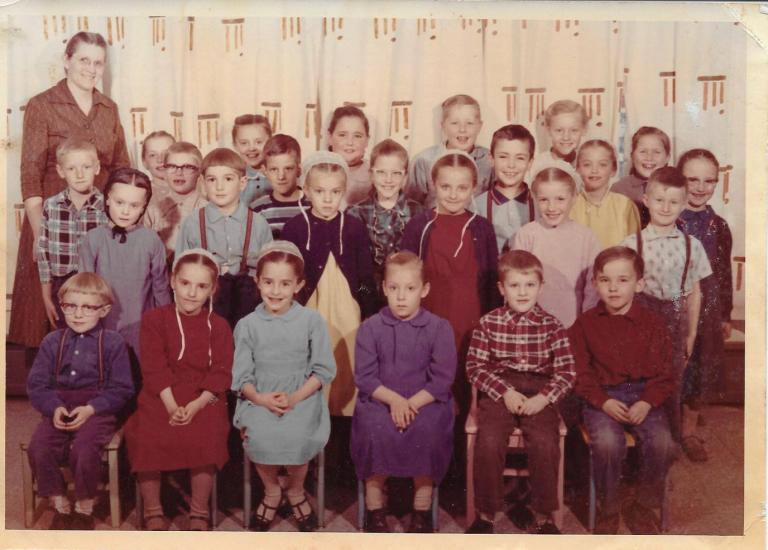
Phyllis (front row, third from the left) with her Yoder School classmates (minus most of the Amish kids who chose not to be in the picture)
Your reflections begin with a three-room Amish schoolhouse, but they end with the hippie Antioch College. On one level, they couldn’t be more different. But you suggest that they had many similarities. How so?
At Yoder School time flowed and subjects merged into each other. My classmates and I couldn’t quite tell if we were working or playing or learning. We tramped across meadows and through woods to fill jars with flowers. And back at school, we pored over flower books to identify the hundred and fifty specimens we had found. We watched a monarch butterfly emerge from its cocoon and used math block towers to solve the puzzles of math. We counted out change in our classroom “store” and wrote our own books. No matter our ages, we read with the first grade or second or fifth, whichever level fit us best. At Yoder School, I could see that learning was full of wonder, so I decided to become a teacher.
And then we moved away—to Flint, Michigan. How, I often asked myself during those years, could I become a good teacher when I didn’t have one? Through junior high and high school and in classes at a community college, I kept searching for the enchantment I had found at Yoder School. And mostly not finding it. Not until I enrolled at Antioch College in Yellow Springs, Ohio.
When I walked into my first class, I didn’t see cape dresses and suspenders and head coverings. But I did see distinctive dress. I saw tattoos and body piercings in eyebrows and noses and lips and tongues. I saw purple hair and bare feet. And I saw headbands and flowers in hair so unkempt my grandma would have called it strubblig.
But in those classrooms in Yellow Springs, I found wonder once again. At Antioch students learned, not only in classes, but also outside classroom walls, spending 25 percent of their time in internships. We didn’t use No. 2 pencils to fill in little rectangles on bubble answer sheets. Instead, we researched and wrote papers and debated. Our professors didn’t give us grades, but they wrote narrative evaluations of our involvement in class. With this freedom, I became invested and set higher standards for my work than a professor would have set. Once again, I was curious. I wanted to know things.
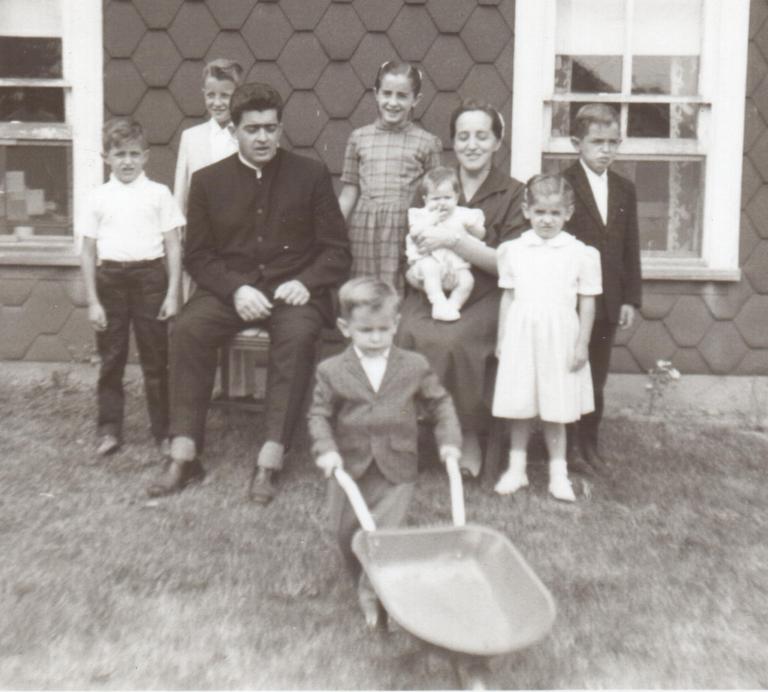
Phyllis (back center) with her family when she was living in Flint, Michigan
What can your experiences as a child say about American Mennonite trajectories more broadly in the 1960s and 1970s?
I left the cloistered three-room Yoder School in the mountains of Western Maryland because my parents moved to Flint, Michigan. There I encountered fights, peace-loving hippies, race riots, and tried to keep from getting bullied for wearing a head covering to school. I didn’t have the perspective then that I was among others who were also the “quiet in the land” moving beyond the shelters of their own communities to follow a new missionary impulse. I only knew that I understood more about being a stranger in the land than I wanted to know—how it felt, for example, to wear a head covering to a school where no one had ever heard of a Mennonite. And I wondered about social issues I had never pondered before—what the church could do, for example, about racial tension and poverty. And I was puzzled by the two flavors of peace I saw—the turn-your-cheek kind I had been taught in Sunday school and the calls for peace from the flower children and the protestors of the Vietnam War.
I had a greater understanding, though, of how I fit into the historical trajectory of higher education. Sitting on the long bench at my grandma’s kitchen table during family meals, I had listened to stories about our family’s chain of learning. I’d heard how my great-grandpa taught himself English so well that people said they needed a dictionary to understand him when he preached, how my great-great grandpa had founded the subscription school that later became Yoder School, and how my grandpa four greats back had started a school in his home, saying, “The children must learn.”
Squished between my cousins on the bench and swirling gravy through my mashed potatoes, I’d think about how I, too, liked to learn. And I’d feel sorry for my mom and dad and grandparents, who had quit school for the church, even though they would have liked more schooling.
Now in the 1960s, the church let people go to school past seventh grade, all the way through high school and even to college. This is why my dad had gone to college, even though he had never gone to high school and even though he had three children and almost four and even though he milked 20 Jerseys every day to pay the rent and sold eggs door-to-door in the city to buy groceries. Like me, my dad liked to work with his mind more than with his hands.
And I recognized that it was both a privilege and a responsibility to be the first one in this chain of people to have known on my first day at Yoder School, that I could go straight through all the grades of school and through all the years of college to get a diploma. This might be hard, I often thought, but I need do this.
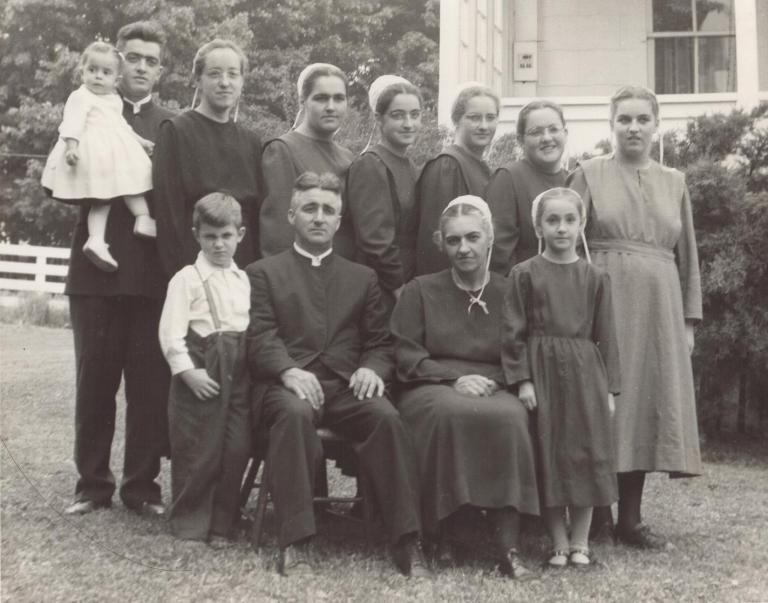
Phyllis (held by her father), the first grandchild in the large Miller family
Can you share a brief excerpt from the book?
That summer, my father baptized me. This made public my association with God. With my baptism, I acknowledged that I would follow Jesus’s teachings in daily life, that I would bend my will to God’s will, to suffer so that later I would be in glory with God. And now was the time to start wearing a covering on my head, in accordance with the Apostle Paul’s words in I Corinthians 11. I won’t think about wearing this to school until fall, I promised myself each morning when I pinned my covering over my hair.
My first day to wear a covering to T.N. Lamb Junior High, I woke with a dread like I was going to one of the executions in the Martyrs’ Mirror. My brother James and I read the Martyrs’ Mirror with a fascinated horror. This heavy book, four inches thick, told the stories of over four thousand people who died because they refused to give up their beliefs about God. We read about two girls who were led to their executions with straw wreaths on their heads.
One girl whispered to the other, “Since the Lord Jesus wore a crown of thorns for us, why should we not wear these crowns of straw in honor of him?”
We read about bodies torn on the rack and gouged out eyes, and beheadings, and stories of people singing while they burned. These stories were proof to us that living for God brings people to suffering. And this could be true for us, too. Wearing a covering to T.N. Lamb Junior High wasn’t anything like being burned on a stake, but it sure felt like it.
I started off later than usual, on purpose. I wanted to arrive just as the school bell rang. I was conscious of each step I took toward school, feeling fortunate that I wasn’t meeting anyone I knew. Then I came to the smoking tree, just a block before school.
Usually when I came by that tree, twenty to thirty kids lounged under it taking their last drags before school. But it was late, so only about five kids still lingered, the smoky, blue haze much thinner than it would have been ten minutes before. As soon as Harold MacDonald saw me, he said, “What the heck?” But just then the warning bell rang. Harold and his buddies stomped out their cigarettes and hightailed it for school. And I hurried behind them, moving faster than I had all morning.
The day was everlasting, just like the day I kept Amos Beachy from getting a paddling so long ago at Yoder School. My friends raised their eyebrows when they saw me or simply asked, “What’s that?” I shaved my answer down to three words: for my church. I could see my teachers watching me. And the kids who didn’t know me so well just pointed and snickered. I kept my head high and raised my hand to answer questions in class. I looked everyone—my friends and everyone else—straight in the eye. . . .
You just retired after thirty years of teaching. How did this childhood incident shape your teaching methods?
School hurts. It’s a place where students get wounded. Rushed teachers make throw-away comments. And bullies pass their pain to others. Students are maligned for not having the right accent, the right shoes, the right hair. Or, they are ostracized for living on the wrong side of town or because the work is too hard for them . . . or too easy. And students are marginalized for their ethnicities.
My wounding came from being different—a country girl moved to the city with braids instead of a beehive hairdo, with skirts mid-calf instead of mid-thigh mini length. I knew how to sing shaped notes but had never heard of the Rolling Stones. And I could trace my ancestors back to the old country but had never seen the Addams Family.
It took me a while to see the hidden gift of these wounds, to realize that the looks, the laughs, the assumptions that I wouldn’t fit at a party could be turned to a benefit. I didn’t see that being different was developing resilience in me and courage and creativity. And not until I became a teacher did I understand that I could turn what had hurt me into a haven for my students.
One day on hall duty at the middle school where I taught, for example, I watched the stream of students flow by. There in the hall, I could see a girl wearing a hijab, a boy with a prosthetic leg, a special education student newly included in my classroom, a girl with a missing arm, a student who towered over her classmates and one stretching to appear as tall as he could. I could see a student whose father had murdered his classmate’s dad.
These students, I realized, had my heart. All through my decades of teaching, I had reached for the students on the edges. The wounds of my differentness had caused me pain, but they had also deepened my understanding and compassion and were now helping me teach.
What memoirs did you read as you wrote your own?
I read memoirs the whole time I was writing, too many to remember. And I read them in a new way, not only for the story, but also to see how the stories were written. Some memoirs I re-read to find their overall structures. I focused on compelling scenes—why exactly did these scenes pull me in? How did authors show conflict and personality and growth?
I read memoirs from authors whose stories were quite different from mine, memoirs like Westover’s Educated, Kalanithi’s When Breath Becomes Air, Obama’s Becoming, and The Glass Castle by Jeannette Walls. And I read memoirs that, while still different, came closer to my story—Why I Left the Amish by Saloma Miller Furlong, I Am Hutterite by Mary-Ann Kirkby, and Blush by Shirley Hershey Showalter.
As I read I found people, who struggled as I had, to know how to be different and how to blend in. And I found people who encountered obstacles as they reached toward goals—sometimes successfully and sometimes not. Though our stories are distinct, in many ways we are all very much the same.
What was it like writing about people who are still living?
Sometimes complicated. In order to be truthful, I needed to tell some stories of pain, but I didn’t want to cause more pain. So in those sections, I changed names, modified chronology, merged characters, and altered details to protect identities. But when I wanted to recognize or honor someone who contributed to my education, I used an actual name.
My editor gave me a helpful construct. As you write, he told me, think in terms of your position. Are you looking at a character from below or from above or from the side? Any story that might be read as implying a from-above view of persons as broken is particularly tricky, he said, while views from the side and below provide more latitude. I often felt the two tugs of truth and kindness and tried to keep a balance.
What’s next for you?
When I finished writing Yoder School, I found I wasn’t finished with Flint. So I’ve been writing a middle-grade historical fiction book set in Flint, Michigan. It’s not biographical, but like the main character, I left my grandma in the mountains when I moved to Flint. And like the main character, I was a kid in the 1960s when the Civil Rights Movement was growing and the cities were burning and the Beatles were singing and the Vietnam War seemed endless. And both my protagonist and I know what it’s like to be different—to have accents and clothes and hairstyles that show everyone, especially bullies, that we have come from a different place.
Previous Post
August 13, 2019
The Impossible, Necessary History of the Hymnal
Next Post

August 14, 2019 Pelicans Revisited
Browse Our Archives
Select a Category abolitionism Abortion Abraham Joshua Heschel Abraham Kuyper Abraham Lincoln Academia Activism Adam Renberg Advent Adventist africa African American Religion Agnes Howard Albert Camus American History American Religious History American Revolution American West Anabaptists Ancient History Andrea Turpin Andrei Tarkovsky Anglicanism Annales Ansley Lillian Quiros anti-Catholicism Antisemitism Anxious Bench apologetics Apparitions Arash Azizi Archaeology archives art Artificial Intelligence Asia Asian Americans Augustine Authors Bad Bunny Baptism Baptists Barack Obama Battle of Hastings Benjamin Franklin Bernard-Henri Levy Beth Allison Barr Beth Moore Bethany Mannon Bible Bill Cunningham Billy Graham Black Music Bob Dylan Body Boenhoffer Books Breastfeeding Bruce Springsteen C.S. Lewis Calvinism Cancel Culture Capitalism Carmelites Catholicism Cedric Robinson Cesar Chavez Charismaticism charity Charles Dickens Charles Lindbergh Che Guevara Chicago Children Chinese Christianity Chris Gehrz Christ Christian death Christian Higher Education Christian life Christian Nation Christian Nationalism Christianity Today Christmas Church life Church Practice cinema Civil Religion Civil Rights Movement Civil War civility Classics Climate Change Cold War Colonial Mexico colonialism Comer Communism community complementarianism Conference on Faith and History Congregationalism Conspiracies Conspiracy Conversion Narratives Coronavirus Costa Rica Council of Nicaea Covid-19 Creation Critical Race Theory Crusades Culture culture wars Daniel K. Williams David Barton David Swartz Death Ways death with dignity DEI democracy Democratic Party Devotion Digital Age Diplomacy discipleship diversity Donald Trump Drama Dua Lipa Early Church early modern Early modern Catholicism Easter Eastern Christianity economic exploitation Education elections Elie Wiesel Elizabeth II Elizabeth Taylor emotions Empire Engineering England enslavement Entertainment Episcopal Church Erica Ramirez eschatology Eurocentrism Evangelicalism Evangelicals Exegesis Family Feminism Film Flannery O'Connor folk music Food Foreign Policy founding fathers Franciscans Franciscus Junius fundamentalism Funerals G.K. Chesterton Gender Genocide genre geography George W. Bush George Washington George Whitefield Global Christianity Global church Grief Guadalupe Guest Post guest post gun control gun violence Gustavo Gutierrez Hamid Dabashi Harold John Ockenga Harvest Hate Hawaiian Christianity Healing health care Heather Cox Richardson Hell Heresy Hermeneutics Higher Education Hinduism Hippocratic oath Historical Fiction Historical Methodology Historical Profession Historical Profession Historical Theology Historical Thinking historiography Holidays Holocaust horror movies Human rights Humanitarian Work humanities Hummingbirds Hungary hymns Imago Dei Immigration Injustice Interviews Iran Islam Islamophobia Israel Ivan's Childhood Jacob Randolph James Bratt Janine Giordano Drake Japanese history Japanese Literature Jean Paul Sartre Jesse Miranda Jesus Jesus Christ Jimmy Carter Joan Baez Joan Didion Joanne Freeman João B. Chaves Joao Chaves Joey Cochran John Calvin John Fea John Tillotson John Turner Johnny Cash Jonathan Edwards Jonathan Tran Joseph Smith Josh Howerton Journalism Jr. Judaism Jürgen Moltmann Just War Justice Justin Brierley Karl Barth Katelyn Beaty koi ponds Kris Kristofferson Kristin Kobes Du Mez Latin American Religious History Latino Americans Lectio Divina Leisure Lent Leonard Cohen liberal arts liberalism Liberation Theology Linda Ronstadt Lisa Clark Diller Literature Lou Reed Lynchings Lynneth Miller Renberg Mainline Protestantism Malcolm Foley Marilyn Monroe Maritime history Mark Noll Marriage Martin Luther Martin Luther King Martyrdom Marxism Mary Masih Alinejad mass shootings material culture medieval Christianity Medieval Ethiopia Melissa Borja memory Mennonites Mental Health Mental Illness Methodism Mexican Americans Mexicans Mike Madrid Miles Mullin Min Jin Lee Miscarriage Missionaries Mister Rogers Mitt Romney modernity Monasticism Mormonism Motherhood Mothers of the Church Moving Music Musicals Nadya Williams Nahua Christianity Native Americans Natsume Sōseki New Contributor New England New Year New York Nico Non-Violent Protest Orthodoxy pacifism Paleo Evangelicals Palestinians Parenting Patti Smith Paul Kingsnorth Pedro Calderón de la Barca Pentecostalism Philip Jenkins Phillis Wheatley physician-assisted suicide pilgrimage Pilgrims pluralism Plutocracy Poetry Politics Pope Francis Pope Leo XIV post-modernism prayer preaching Presbyterians prosperity gospel Protest Public history Publishing Puritans purity culture Quakers race Race Massacres Racial Capitalism racial reconciliation racialization Racism Raha Bahloulipour Re-Enchantment reading Reformation Refugees religion and the university religion and war Religious Freedom Religious Nones Religious Pluralism Religious Symbols religious violence Republican Party Revival Rita Coolidge Ritual Roger Williams Roman Catholic church Royalty Russell Moore same-sex marriage Sarah Irving-Stonebraker Scandinavia Science Science and Technology Scopes trial Scriptural Interpretation secularism Selena Quintanilla seminary Seventh-Day Adventists sexual morality Sexuality Sikhs Silence slaveholders theology Slavery Slavoj Zizek social justice Social Media Southern Baptist Convention Southern Religion Spain Spiritual Autobiography Spiritual but not religious Spiritual Discipline Sports Stanley Hauerwas Suffering Summer Camps Sunday Night Odds and Ends Supernatural Supreme Court Syriac Christianity Tal Howard Taylor Swift Teaching Technology Television Thanksgiving The Beatles The Mission theater TheoBros Theology Thomas Dixon Thomas Jefferson Thomas Kidd Thomas Merton Tim Gloege Tim Walz Tom Holland Tourism tradition Tragedy Translation Transnationalism Travel Trump Ukraine Uncategorized Unitarians United Methodist Church US History Vanessa Chan Velvet Underground Verónica A. Gutiérrez Veronica Gutierrez Vikings Violence Virgin Mary Virtue Virtue ethics Visions Voting War WCTU Wendell Berry Westminster Assembly White Evangelicalism Wildfires Winnie the Pooh Witches women Women in Ministry Women's and Gender Studies Work Worship writing Yasunari Kawabata Zena Hitz
Select a Month October 2026 September 2026 August 2026 July 2026 June 2026 May 2026 April 2026 March 2026 February 2026 January 2026 December 2025 November 2025 October 2025 September 2025 August 2025 July 2025 June 2025 May 2025 April 2025 March 2025 February 2025 January 2025 December 2024 November 2024 October 2024 September 2024 August 2024 July 2024 June 2024 May 2024 April 2024 March 2024 February 2024 January 2024 December 2023 November 2023 October 2023 September 2023 August 2023 July 2023 June 2023 May 2023 April 2023 March 2023 February 2023 January 2023 December 2022 November 2022 October 2022 September 2022 August 2022 July 2022 June 2022 May 2022 April 2022 March 2022 February 2022 January 2022 December 2021 November 2021 October 2021 September 2021 August 2021 July 2021 June 2021 May 2021 April 2021 March 2021 February 2021 January 2021 December 2020 November 2020 October 2020 September 2020 August 2020 July 2020 June 2020 May 2020 April 2020 March 2020 February 2020 January 2020 December 2019 November 2019 October 2019 September 2019 August 2019 July 2019 June 2019 May 2019 April 2019 March 2019 February 2019 January 2019 December 2018 November 2018 October 2018 September 2018 August 2018 July 2018 June 2018 May 2018 April 2018 March 2018 February 2018 January 2018 December 2017 November 2017 October 2017 September 2017 August 2017 July 2017 June 2017 May 2017 April 2017 March 2017 February 2017 January 2017 December 2016 November 2016 October 2016 September 2016 August 2016 July 2016 June 2016 May 2016 April 2016 March 2016 February 2016 January 2016 December 2015 November 2015 October 2015 September 2015 August 2015 July 2015 June 2015 May 2015 April 2015 March 2015 February 2015 January 2015 December 2014 November 2014 October 2014 September 2014 August 2014 July 2014 June 2014 May 2014 April 2014 March 2014 February 2014 January 2014 December 2013 November 2013 October 2013 September 2013 August 2013 July 2013 June 2013 May 2013 April 2013 March 2013 February 2013 January 2013 December 2012 November 2012 October 2012 September 2012 August 2012 July 2012 June 2012 May 2012
Follow Us!
TAKE THE
Religious Wisdom Quiz
I am an offering without defect, completely burned on the altar as a pleasing aroma to the Lord. What am I?
Select your answer to see how you score.
A burnt offering A grain offering A peace offering A sin offering
Related posts from Anxious Bench

Angelina Grimké's Forgotten Turn to Apocalyptic Faith
Angelina Grimké and the Turmoils of Perfection
On Different Educations and the Global Church

White Whales and Early Republic Indian Rights Petitions
TRENDING AT PATHEOS Evangelical

Swimfan: Forgotten Aughts Pleasures
This is a recovery effort. In 2002, My Big Fat Greek Wedding...

Top Three Anti-Catholic Lies About Catholicism
This is my initial transcript for the video, "THE 3 WORST...

Pope Leo Celebrates Mass for Nurses & Docs...
I don't have any idea how he did it, but Pope Leo...

The Sermon on the Mount, Part I: Matthew...
The Sermon on the Mount, Part I (Matthew 4:12-5:12) St. Matthew moves...

What's up from Crossway: Reviewing some of their latest A few weeks...

Janie Learns the Way of the Cross: A...
Teaching children about Jesus' Passion can be challenging. Many parents and educators...
view all Evangelical blogs
Ad-Free & Subscriber Log-In Subscription Support
- About Us
- 2026 Calendar
- Videos
- Podcasts
- Library of World Religions
- Faith In Media Tracker
- Advertise With Us
- Write for Us
- Privacy Policy
- Terms of Service
- Do Not Sell My Data
- Contact Us
- Radiant Digital
- Manage Newsletter Subscriptions
- Unsubscribe From Notifications
- Sitemap
Copyright 2008-2026, Patheos. All rights reserved.
Subscription Support Ad-Free & Subscriber Log-In
Follow Patheos