
BuddhistCatholicContemplativeEvangelicalGeneral ChristianHinduJewishLatter-day SaintMuslimNew VisionsProgressive Christian
Beliefs
- Buddhist
- Catholic
- Contemplative
- Evangelical
- General Christian
- Hindu
- Jewish
- Latter-day Saint
- More Voices
- Muslim
- New Visions
- Pagan
- Progressive Christian
Topics
- Religion News
- Food and Religion
- Sports and Religion
- Religious Art
- Religious Music and Entertainment
- Religious Events
- History and Religion
- Style and Religion
- Politics and Religion
- Women in Religion
- Recreation Outdoors and Religion
- Business Finance and Religion
- Careers Workplace and Religion
- Education and Religion
- Family Parenting and Religion
- Health Fitness and Religion
- Home and Religion
- Relationships and Religion
- Technology and Religion
- Travel and Religion
Columnists
- Buddhist Columnists
- Business Finance and Religion Columnists
- Careers Workplace and Religion Columnists
- Catholic Columnists
- Contemplative Columnists
- Education and Religion Columnists
- Evangelists Columnists
- Family Parenting and Religion Columnists
- General Christian Columnists
- Health Fitness and Religion Columnists
- Hindu Columnists
- History and Religion Columnists
- Home and Religion Columnists
- Jewish Columnists
- More Voices Columnists
- Latter Day Columnists
- Muslim Columnists
- New Visions Columnists
- Nonreligious Columnists
- Pagan Columnists
- Politics and Religion Columnists
- Progressive Columnists
- Recreation Outdoors and Religion Columnists
- Relationships and Religion Columnists
- Religion News Columnists
- Religious Art Columnists
- Religious Events Columnists
- Religious Music and Entertainment Columnists
- Sports and Religion Columnists
- Style and Religion Columnists
- Technology and Religion Columnists
- Travel and Religion Columnists
- Women in Religion Columnists
Resource Library
- 2026 Calendar
- Library of World Religions
- The 100 Most Holy Places on Earth
- Patheos Answers
- Podcasts
- Videos
- Faith Leaders Database
- Anglican Episcopalian
- Bahai
- Baptist
- Buddhism
- Christianity
- Confucianism
- Eastern Orthodoxy
- Hinduism
- Holiness and Pentecostal
- ISKCON
- Islam
- Judaism
- Lutheran
- Methodist
- The Church of Jesus Christ of Latter-day Saints
- New Age
- Paganism
- Presbytarian and Reformed
- Protestantism
- Religion Behind the Scenes
- Roman Catholic
- Scientology
- Shia Islam
- Sikhism
- Sufism
- Sunni Islam
- Taoism
- Zen
- See all religions
Research Tools
 Ad-Free & Subscriber Log-In Subscription Support
Follow Patheos 

- Trending:
- Advent
- |
- Forgiveness
- |
- Thanksgiving
- |
- Election
- |
- Seasonal Holidays
- |
- Marriage

-
About the Authors
- Home
- Evangelical
- The Sexuality Debate Dividing an Evangelical Denomination
The Sexuality Debate Dividing an Evangelical Denomination
Last updated on: June 30, 2019 at 11:26 pm by Chris Gehrz
The Sexuality Debate Dividing an Evangelical Denomination 2019-06-30T23:26:29-04:00 Chris Gehrz
Patheos Explore the world's faith through different perspectives on religion and spirituality! Patheos has the views of the prevalent religions and spiritualities of the world.
To this point it’s primarily been mainline denominations like the United Methodist Church and Anabaptist groups like the Mennonite Church USA that have faced schism over sexuality and same-sex marriage, what religion journalist Richard Ostling calls “Protestants’ most divisive issues since slavery.” But evangelicals’ turn is fast approaching. Last week the 2019 synod of the Christian Reformed Church in North America debated the interim report of a committee tasked “to explore biblical conceptions of sexuality and gender,” with a final vote looming in 2021. And this week my home denomination will vote on expelling one of its oldest, now LGBT-affirming congregations.
The Evangelical Covenant Church (ECC) was founded by pietistic Swedish immigrants in 1885, eleven years after First Covenant Church Minneapolis (FCCM) was organized. At the 2019 Annual Meeting in Omaha, delegates will consider a recommendation that FCCM be “involuntarily dismissed” for being “out of harmony” with the ECC’s position on human sexuality. It would be the first such excommunication in Covenant history, but likely not the last over an issue that increasingly divides a denomination renowned for seeking unity in essentials and granting liberty in all other matters.
Though one of the fastest-growing religious groups in the United States, the Covenant Church is still relatively small. So what follows is my attempt to interpret the ECC’s version of the sexuality debate for a wider evangelical audience, in light of a Pietist heritage that is one of the oldest sources of historic evangelicalism and yet also makes the Covenant somewhat unusual in contemporary evangelicalism.
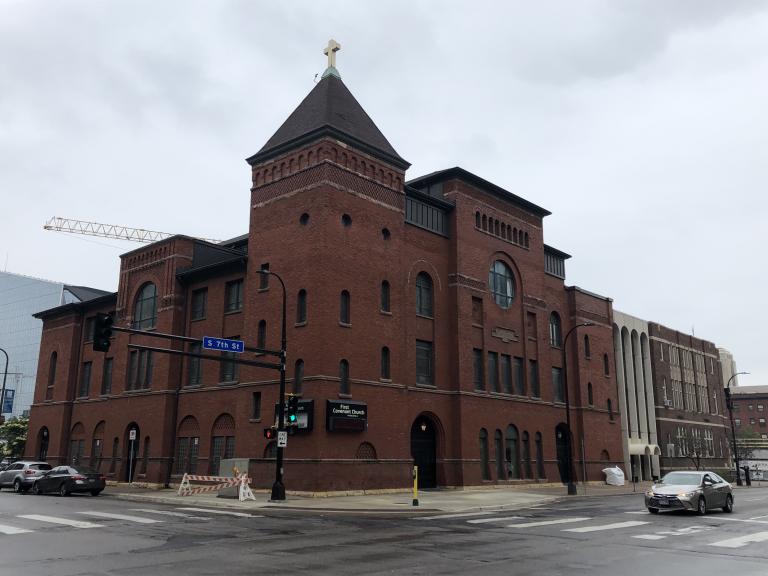
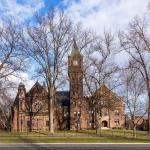
First Covenant Church in Minneapolis, MN – CC BY-SA 4.0 (Chris Gehrz)
In 1996, the year the U.S. Congress passed the Defense of Marriage Act with bipartisan support, ECC Annual Meeting delegates adopted a resolution affirming that “publicly declared, legally binding marriage between one woman and one man is the one appropriate place for sexual intercourse. Heterosexual marriage, faithfulness within marriage, abstinence outside of marriage—these constitute the Christian standard.” Since then this formula has been reiterated often, but such resolutions typically have no binding force. For example, the ECC statement on the environment is four years older than the one on sexuality, yet I’ve never heard of any Covenanter being sanctioned because he or she failed to “examine his or her personal environmental stewardship” nor any congregation being ruled “out of harmony” for not heeding the Annual Meeting’s exhortation to “to teach environmental awareness from a Christian perspective.”
But for whatever reason, sexuality has been treated differently by Covenant leadership. In February 2015, the ECC terminated its partnership with Christ Church, a new congregation in Portland, Oregon, over its pastor’s affirmation of same-sex marriage and the full participation of LGBT Christians in the life of that faith community. Later that year, the Covenant released a set of guidelines requiring clergy to uphold the denominational stance on sexuality (whatever their personal belief) and not to officiate same-sex weddings. When Covenant pastor Judy Peterson violated the latter provision, she was removed from her position as campus pastor at North Park University, the denomination’s school in Chicago.
Peterson preached this past Sunday at First Covenant Minneapolis, which last year affirmed its desire to “Welcome all persons and families, including LGBTQ+, to participate at all levels of community” (including congregational leadership roles) and to offer pastoral care (including weddings) to “all in our congregation without regard for ability, race, sex, gender identity or sexual orientation.” As a result, lead pastor Dan Collison had his credentials suspended, and the congregation was notified that it was “out of harmony” with the denomination’s position.
The fact that this is the first Covenant congregation to face involuntary dismissal is particularly notable. FCCM is one of the oldest churches in the denomination, and perhaps the most prominent, with its historic brick building standing across from the Vikings stadium in downtown Minneapolis. Its most famous pastor was E.A. Skogsbergh, the “Swedish Moody,” and one of his successors, Paul Rees, was a leader of the National Association of Evangelicals and World Vision — and one of the signers of the 1973 Chicago Declaration of Evangelical Social Concern. Its scholar-in-residence is Jay Phelan, the retired president of North Park Theological Seminary, and its membership includes Phil Anderson, the Oxford-educated dean of Covenant historians. After a period of decline, FCCM has rebounded under Collison, and would normally be celebrated by the Covenant as a model of church revitalization and socially conscious urban ministry.
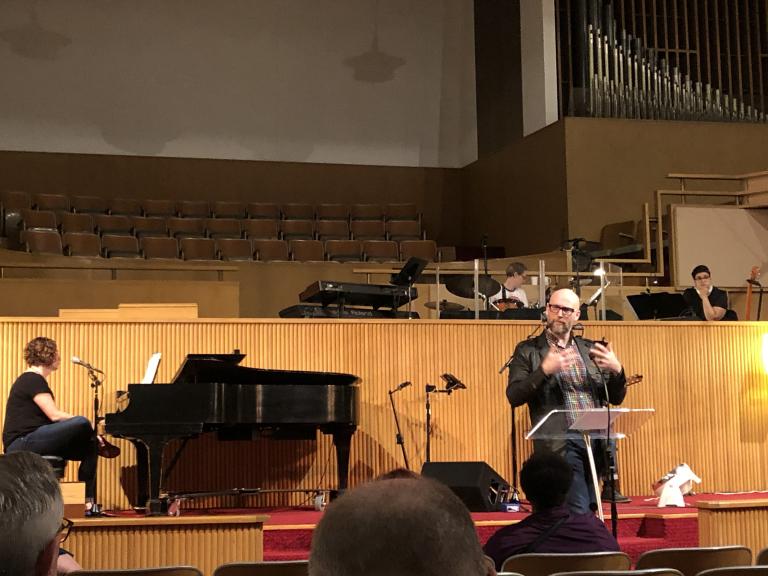
Pastor Dan Collison addresses members of First Covenant Minneapolis on Sunday, June 23, 2019 – CC BY-SA 4.0 (Chris Gehrz)
Now, First Covenant hasn’t been dismissed yet. In the denomination’s polity, the Annual Meeting is the governing body, not the executive board. In an extraordinary public post, former ECC president Glenn Palmberg reminded delegates that “it is not inappropriate or disloyal or unCovenant to vote in opposition to a recommendation from the Covenant Executive Board.” (He even reported that one-third of that committee itself voted against dismissing First Covenant.) Palmberg warned that involuntary dismissal “would mean the people who constitute the FCCM congregation are removed from the ECC by vote of their fellow Covenanters. This dismissal would include people who have found new life in Christ during the revitalization of this historic church.”
So above all, I pray that God would grant wisdom to this year’s delegates, who are under enormous pressure. For Covenanters on both sides of the debate, what’s at stake is the very identity of an increasingly diverse denomination that describes itself as “Evangelical, but not exclusive; Biblical, but not doctrinaire; Traditional, but not rigid; and Congregational, but not independent.” In a May 31 email to Covenanters, ECC president John Wenrich warned that “the future of our denomination rests on the discernment of this Annual Meeting,” with the decision bearing “implications not merely upon our theology or ministry, but upon our identity.”
I think he’s right, but not for the reasons he states. Covenanters can agree with the “discerned position” on human sexuality and yet still desire unity with those “mission friends” (the original name for Covenanters) who disagree. For those of us, FCCM’s dissent on a non-essential matter is a non-threat for a non-confessional church. (That’s a key distinction between the ECC and denominations like the Christian Reformed Church, where the debate is not whether to grant certain beliefs “confessional status,” but if the traditional position on sexuality warrants that standing.) As Anderson explained in his response to the “out of harmony” recommendation, the Covenant Church was “born of ‘dissent’… the Covenant story, therefore, is one of ecclesial liberation that could empower cohesive diversity because it was rooted solely in the personal experience of new life in Christ.”
Seen from that vantage point, the real threat to Covenant identity would be to abandon the very heritage that makes the ECC both historically evangelical and distinct from other contemporary evangelical bodies: Pietism.
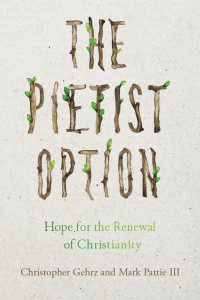 I’m sure it’s no secret that the Covenant’s internal debate about sexuality was never far from my mind as I co-wrote The Pietist Option two years ago. That was especially true of ch. 6, in which I argued that part of “the Pietist option is to insist that unity—while impossible to achieve perfectly—is essential to Christian community, mission, and witness.” (“Grant us grace,” Collison prayed for all Covenanters on Sunday morning, “that a watching world might see Jesus in the midst of disagreement.”) Indeed, it was because I recognized Pietism’s “irenic spirit” in the life and ministry of the Covenant that I rejoined the denomination of my upbringing when I moved back to Minnesota in 2003.
Having lived through splits in Baptist churches in Virginia and Connecticut, I “gained new appreciation that the Covenant Church holds only five broad doctrinal affirmations” — none of which addresses sexual ethics — “plus a sixth that grants ‘freedom in Christ’” on all other matters on which fellow believers tend to disagree. For example, the Covenant affirms both infant and believer’s baptism — and even requires pastors to be willing to perform either. (Not that congregations that fail to advertise this fact and baptize in only one mode have ever been declared “out of harmony.”)
Or consider Christian participation in warfare… In a recent article on the Covenant understanding of freedom in Christ, North Park professor Michelle Clifton-Soderstrom pointed out that the ECC has also affirmed contradictory positions on this ancient debate. “Just war Christians and pacifist Christians remain at irreconcilable odds when it comes to the permissibility of killing,” but Covenanters of both convictions have granted freedom to each other. “That it has also shown hospitality to just war adherents and pacifists,” concluded Clifton-Soderstrom, “deeming both disciples of Jesus Christ in equal measure, demonstrates humility in the face of deep and complex moral questions.” If that’s possible with baptism and warfare, her readers might wonder, why not sexuality?
That pietistic ethos of mutual hospitality and humble conviction has often led Covenanters to talk about unity using that word harmony, which Anderson defined in terms of another classic emphasis of Pietism:
Harmony always referred to living faith as the sole criterion of belonging: mission, mutual support of the denomination’s ministries, but never doctrine beyond the ancient creeds of the Church (especially the Apostles’ Creed) or positions where Christians may have serious differences.
For those of us who cherish this aspect of the Pietist/Covenant heritage, it is creating new criteria for belonging that puts us out of harmony with each other, not the lived faith of FCCM’s pastors and members.
Of course, Wenrich would strongly disagree with me. “To make this conversation about pietism,” he wrote in late May, “is a distraction away from the true issues at hand. And if we allow this distraction to become the centerpiece of conversation, we give validity and credence to the subversive actions of FCCM; actions that have never represented the ways in which we have behaved together as a Covenant, even in disagreement and dissent.” In a subsequent video, he apologized for failing to “communicate the depth of my sorrow” and insisted that “I am so proud of our Pietist heritage as Mission Friends.” But Wenrich continued to argue for FCCM’s dismissal, insisting that “False unity does not last, as other denominations have discovered.”
“The Covenant is about freedom,” Wenrich wrote in the May 31 email, “but I believe the authority of Scripture is even more core to Covenant identity.” Indeed, the first Covenant Affirmation is “the centrality of the word of God,” and all prospective members of Covenant congregations are asked whether they “accept the Holy Scriptures, the Old and New Testaments, as the word of God and the only perfect rule for faith, doctrine, and conduct.” (The only other membership question is, “Do you confess Jesus Christ as your Savior and promise to follow him as Lord?”)
Not incidentally, Collison, Phelan, and Peterson are among the founders of Covenant Collective, a new “Pietist renewal movement” that “exists to promote this same Pietist vision for the local church. We will not be motivated by fear or by the need to create firm boundaries; but by commitment to the Word, the love of neighbor, and the desire to walk humbly with all who put their faith in Jesus”
But to set biblical authority over and against Christian freedom betrays a misunderstanding of how Pietism has shaped these evangelicals’ understanding of the Bible. The ECC’s official explanation of its first affirmation starts with Pietist forebear Philipp Jakob Spener, who had recovered
the living nature of the word of God. The word is the “powerful means” to the creation of new life through the Holy Spirit. For many in Spener’s day the word of God was simply information, or law, or rules; for Spener the word was power—power to effect change in the life of the hearer through the Holy Spirit.
Rejecting fundamentalist readings of Scripture in a 1963 report on “Biblical Authority and Christian Freedom,” a denominational committee that included FCCM pastor Paul Fryhling credited our Pietist forebears with a “rediscovery of the living view of the Bible which characterized the early Reformation,” a view forgotten by established churches that were “rigidly orthodox” but “often did little to meet the needs of the heart and made difficult a warm-hearted and vital relation to the message of Scripture.” A proper reading of the Bible, Fryhling et al. concluded, would “find it an altar where one meets the living God and receives personally the reality of redemption.”
Moreover, they acknowledged that “the meaning of the Bible or the nature of its relevance is not so clear as to remove all diversities of interpretation.” No doubt thinking of the Covenant’s own origins as a renewal movement within a Lutheran state church, the committee even admitted that “Christian vitality has not always been maintained by the majority. It has, in fact, often been found only in small minorities.”
(This view itself is deeply rooted in Pietism. In his pioneering work of church history, the Pietist scholar Gottfried Arnold found the Anabaptists and other persecuted dissenters more Christ-like than the magisterial churches that had condemned them as heretics. Arnold refused “to demean the virtues of those who would normally be described as enemies. I have always wished from the heart that love would set a sweet harmony and peace to my disposition during this work, so that all emotions would be kept in the best possible balance and all the requisites of a just, true history may be provided.” I can only hope that I’ve accomplished something similar with this review.)
None of that means that FCCM’s reading of what the Bible says on love and marriage is necessarily right. But it strongly suggests that those of us in the majority should hesitate to label ours the “biblical” position and imply that the minority have rejected the authority of Scripture. We must be willing to grant that legitimate dissent can result from encountering the living God in his written word.
Indeed, it’s an old Covenant maxim that it’s the Old and New Testaments themselves that form the “only perfect rule” — not any particular interpretation of them, however popular or traditional. At the conclusion of his post urging a No vote on FCCM’s dismissal, Glenn Palmberg quoted from the ECC’s 2010 resource paper on reading the Bible:
Regardless of the reason, the record of misreadings in Christian history is cause for humility in our own reading of the Bible. It should cause us to pause before we make authoritative statements about a particular interpretation of a passage—especially if it is an interpretation on which Christians authentically disagree. Simply put: we sometimes get it wrong. When reading faithfully, we will often find the Bible challenging the way we live rather than affirming it. The Bible pierces to the depths of our souls and “judges the thoughts and attitudes of the heart” (Hebrews 4:12).
I don’t expect that most evangelical readers will affirm FCCM’s position on same-sex marriage and LGBT participation in church leadership. But I do hope they see that the issues here are complicated — and that seeking answers in Scripture should leave us feeling challenged at least as often as we feel affirmed. Moreover, what’s happening this week in the Covenant Church should remind all evangelicals that debate over Christian unity in light of honest differences over sexuality and marriage cannot be avoided by any evangelical body — at least, not unless it’s willing simply to write off a generation of younger evangelicals who increasingly take a different view of these matters than their parents and grandparents.
Update: on Friday about 75% of delegates to the ECC Annual Meeting voted to expel FCCM; later that afternoon, they voted to strip Collison of his credentials. (Steve Armfield, a retired Covenant pastor who had officiated his son’s wedding to another man, was also removed from the roster.)
Previous Post

June 24, 2019
Losing the Faith: Of Apostates, Renegades, and Traitors
Next Post
June 26, 2019 When Gender Theology Doesn’t Fit in Our Boxes: Then and Now
Browse Our Archives
Select a Category abolitionism Abortion Abraham Joshua Heschel Abraham Kuyper Abraham Lincoln Academia Activism Adam Renberg Advent Adventist africa African American Religion Agnes Howard Albert Camus American History American Religious History American Revolution American West Anabaptists Ancient History Andrea Turpin Andrei Tarkovsky Anglicanism Annales Ansley Lillian Quiros anti-Catholicism Antisemitism Anxious Bench apologetics Apparitions Arash Azizi Archaeology archives art Artificial Intelligence Asia Asian Americans Augustine Authors Bad Bunny Baptism Baptists Barack Obama Battle of Hastings Benjamin Franklin Bernard-Henri Levy Beth Allison Barr Beth Moore Bethany Mannon Bible Bill Cunningham Billy Graham Black Music Bob Dylan Body Boenhoffer Books Breastfeeding Bruce Springsteen C.S. Lewis Calvinism Cancel Culture Capitalism Carmelites Catholicism Cedric Robinson Cesar Chavez Charismaticism charity Charles Dickens Charles Lindbergh Che Guevara Chicago Children Chinese Christianity Chris Gehrz Christ Christian death Christian Higher Education Christian life Christian Nation Christian Nationalism Christianity Today Christmas Church life Church Practice cinema Civil Religion Civil Rights Movement Civil War civility Classics Climate Change Cold War Colonial Mexico colonialism Comer Communism community complementarianism Conference on Faith and History Congregationalism Conspiracies Conspiracy Conversion Narratives Coronavirus Costa Rica Council of Nicaea Covid-19 Creation Critical Race Theory Crusades Culture culture wars Daniel K. Williams David Barton David Swartz Death Ways death with dignity DEI democracy Democratic Party Devotion Digital Age Diplomacy discipleship diversity Donald Trump Drama Dua Lipa Early Church early modern Early modern Catholicism Easter Eastern Christianity economic exploitation Education elections Elie Wiesel Elizabeth II Elizabeth Taylor emotions Empire Engineering England enslavement Entertainment Episcopal Church Erica Ramirez eschatology Eurocentrism Evangelicalism Evangelicals Exegesis Family Feminism Film Flannery O'Connor folk music Food Foreign Policy founding fathers Franciscans Franciscus Junius fundamentalism Funerals G.K. Chesterton Gender Genocide genre geography George W. Bush George Washington George Whitefield Global Christianity Global church Grief Guadalupe guest post Guest Post gun control gun violence Gustavo Gutierrez Hamid Dabashi Harold John Ockenga Harvest Hate Hawaiian Christianity Healing health care Heather Cox Richardson Hell Heresy Hermeneutics Higher Education Hinduism Hippocratic oath Historical Fiction Historical Methodology Historical Profession Historical Profession Historical Theology Historical Thinking historiography Holidays Holocaust horror movies Human rights Humanitarian Work humanities Hummingbirds Hungary hymns Imago Dei Immigration Injustice Interviews Iran Islam Islamophobia Israel Ivan's Childhood Jacob Randolph James Bratt Janine Giordano Drake Japanese history Japanese Literature Jean Paul Sartre Jesse Miranda Jesus Jesus Christ Jimmy Carter Joan Baez Joan Didion Joanne Freeman João B. Chaves Joao Chaves Joey Cochran John Calvin John Fea John Tillotson John Turner Johnny Cash Jonathan Edwards Jonathan Tran Joseph Smith Josh Howerton Journalism Jr. Judaism Jürgen Moltmann Just War Justice Justin Brierley Karl Barth Katelyn Beaty koi ponds Kris Kristofferson Kristin Kobes Du Mez Latin American Religious History Latino Americans Lectio Divina Leisure Lent Leonard Cohen liberal arts liberalism Liberation Theology Linda Ronstadt Lisa Clark Diller Literature Lou Reed Lynchings Lynneth Miller Renberg Mainline Protestantism Malcolm Foley Marilyn Monroe Maritime history Mark Noll Marriage Martin Luther Martin Luther King Martyrdom Marxism Mary Masih Alinejad mass shootings material culture medieval Christianity Medieval Ethiopia Melissa Borja memory Mennonites Mental Health Mental Illness Methodism Mexican Americans Mexicans Mike Madrid Miles Mullin Min Jin Lee Miscarriage Missionaries Mister Rogers Mitt Romney modernity Monasticism Mormonism Motherhood Mothers of the Church Moving Music Musicals Nadya Williams Nahua Christianity Native Americans Natsume Sōseki New Contributor New England New Year New York Nico Non-Violent Protest Orthodoxy pacifism Paleo Evangelicals Palestinians Parenting Patti Smith Paul Kingsnorth Pedro Calderón de la Barca Pentecostalism Philip Jenkins Phillis Wheatley physician-assisted suicide pilgrimage Pilgrims Piracy pluralism Plutocracy Poetry Politics Pope Francis Pope Leo XIV post-modernism prayer preaching Presbyterians prosperity gospel Protest Public Executions Public history Publishing Puritans purity culture Quakers race Race Massacres Racial Capitalism racial reconciliation racialization Racism Raha Bahloulipour Re-Enchantment reading Reformation Refugees religion and the university religion and war Religious Freedom Religious Nones Religious Pluralism Religious Symbols religious violence Republican Party Revival Rita Coolidge Ritual Roger Williams Roman Catholic church Royalty Russell Moore same-sex marriage Sarah Irving-Stonebraker Scandinavia Science Science and Technology Scopes trial Scriptural Interpretation secularism Selena Quintanilla seminary Seventh-Day Adventists sexual morality Sexuality Sikhs Silence slaveholders theology Slavery Slavoj Zizek social justice Social Media Southern Baptist Convention Southern Religion Spain Spiritual Autobiography Spiritual but not religious Spiritual Discipline Sports Stanley Hauerwas Suffering Summer Camps Sunday Night Odds and Ends Supernatural Supreme Court Syriac Christianity Tal Howard Taylor Swift Teaching Technology Television Thanksgiving The Beatles The Mission theater TheoBros Theology Thomas Dixon Thomas Jefferson Thomas Kidd Thomas Merton Tim Gloege Tim Walz Tom Holland Tourism tradition Tragedy Translation Transnationalism Travel Trump Ukraine Uncategorized Unitarians United Methodist Church US History Vanessa Chan Velvet Underground Verónica A. Gutiérrez Veronica Gutierrez Vikings Violence Virgin Mary Virtue Virtue ethics Visions Voting War WCTU Wendell Berry Westminster Assembly White Evangelicalism Wildfires Winnie the Pooh Witches women Women in Ministry Women's and Gender Studies Work Worship writing Yasunari Kawabata Zena Hitz
Select a Month November 2026 October 2026 September 2026 August 2026 July 2026 June 2026 May 2026 April 2026 March 2026 February 2026 January 2026 December 2025 November 2025 October 2025 September 2025 August 2025 July 2025 June 2025 May 2025 April 2025 March 2025 February 2025 January 2025 December 2024 November 2024 October 2024 September 2024 August 2024 July 2024 June 2024 May 2024 April 2024 March 2024 February 2024 January 2024 December 2023 November 2023 October 2023 September 2023 August 2023 July 2023 June 2023 May 2023 April 2023 March 2023 February 2023 January 2023 December 2022 November 2022 October 2022 September 2022 August 2022 July 2022 June 2022 May 2022 April 2022 March 2022 February 2022 January 2022 December 2021 November 2021 October 2021 September 2021 August 2021 July 2021 June 2021 May 2021 April 2021 March 2021 February 2021 January 2021 December 2020 November 2020 October 2020 September 2020 August 2020 July 2020 June 2020 May 2020 April 2020 March 2020 February 2020 January 2020 December 2019 November 2019 October 2019 September 2019 August 2019 July 2019 June 2019 May 2019 April 2019 March 2019 February 2019 January 2019 December 2018 November 2018 October 2018 September 2018 August 2018 July 2018 June 2018 May 2018 April 2018 March 2018 February 2018 January 2018 December 2017 November 2017 October 2017 September 2017 August 2017 July 2017 June 2017 May 2017 April 2017 March 2017 February 2017 January 2017 December 2016 November 2016 October 2016 September 2016 August 2016 July 2016 June 2016 May 2016 April 2016 March 2016 February 2016 January 2016 December 2015 November 2015 October 2015 September 2015 August 2015 July 2015 June 2015 May 2015 April 2015 March 2015 February 2015 January 2015 December 2014 November 2014 October 2014 September 2014 August 2014 July 2014 June 2014 May 2014 April 2014 March 2014 February 2014 January 2014 December 2013 November 2013 October 2013 September 2013 August 2013 July 2013 June 2013 May 2013 April 2013 March 2013 February 2013 January 2013 December 2012 November 2012 October 2012 September 2012 August 2012 July 2012 June 2012 May 2012
Follow Us!
TAKE THE
Religious Wisdom Quiz
I am the first to fall asleep in death for following Jesus. I saw heaven opened as stones struck me. Who am I?
Select your answer to see how you score.
John James Stephen Peter
Related posts from Anxious Bench
Paris & CT Burn 50 Years After Newsweek's...

What Coffee Reveals About America's Evangelical Varieties

A Casserole is Not a Counterpoint
Origen, Eustathius, and the Witch of Endor
TRENDING AT PATHEOS Evangelical

Blue Christmas: Making Room for Grief at Church
A Blue Christmas service makes room for grief, remembrance, and hope. Explore...

We Can Trust That God Will Use Our...
A Jesus-loving young friend who is going through deep suffering sent me...

Everything is worship for Quakers. The Quakers emphasize contemplation, equality, pacifism and...

Happy Thanksgiving! I published this Thanksgiving column back in 2017 in...

More Than a Meal: A Messianic Thanksgiving
A Messianic Thanksgiving What if Thanksgiving became more than a meal to...

The Darkening of the Sun, Moon, and Stars
The darkening of the sun and moon and the falling of stars...
view all Evangelical blogs
Ad-Free & Subscriber Log-In Subscription Support
- About Us
- 2026 Calendar
- Videos
- Podcasts
- Library of World Religions
- Faith In Media Tracker
- Advertise With Us
- Write for Us
- Privacy Policy
- Terms of Service
- Do Not Sell My Data
- Contact Us
- Radiant Digital
- Manage Newsletter Subscriptions
- Unsubscribe From Notifications
- Sitemap
Copyright 2008-2026, Patheos, part of the Radiant Digital network of media brands. All rights reserved.
Subscription Support Ad-Free & Subscriber Log-In
Follow Patheos