
BuddhistCatholicContemplativeEvangelicalGeneral ChristianHinduJewishLatter-day SaintMuslimNew VisionsProgressive Christian
Beliefs
- Buddhist
- Catholic
- Contemplative
- Evangelical
- General Christian
- Hindu
- Jewish
- Latter-day Saint
- More Voices
- Muslim
- New Visions
- Pagan
- Progressive Christian
Topics
- Religion News
- Food and Religion
- Sports and Religion
- Religious Art
- Religious Music and Entertainment
- Religious Events
- History and Religion
- Style and Religion
- Politics and Religion
- Women in Religion
- Recreation Outdoors and Religion
- Business Finance and Religion
- Careers Workplace and Religion
- Education and Religion
- Family Parenting and Religion
- Health Fitness and Religion
- Home and Religion
- Relationships and Religion
- Technology and Religion
- Travel and Religion
Columnists
- Buddhist Columnists
- Business Finance and Religion Columnists
- Careers Workplace and Religion Columnists
- Catholic Columnists
- Contemplative Columnists
- Education and Religion Columnists
- Evangelists Columnists
- Family Parenting and Religion Columnists
- General Christian Columnists
- Health Fitness and Religion Columnists
- Hindu Columnists
- History and Religion Columnists
- Home and Religion Columnists
- Jewish Columnists
- More Voices Columnists
- Latter Day Columnists
- Muslim Columnists
- New Visions Columnists
- Nonreligious Columnists
- Pagan Columnists
- Politics and Religion Columnists
- Progressive Columnists
- Recreation Outdoors and Religion Columnists
- Relationships and Religion Columnists
- Religion News Columnists
- Religious Art Columnists
- Religious Events Columnists
- Religious Music and Entertainment Columnists
- Sports and Religion Columnists
- Style and Religion Columnists
- Technology and Religion Columnists
- Travel and Religion Columnists
- Women in Religion Columnists
Resource Library
- 2026 Calendar
- Library of World Religions
- The 100 Most Holy Places on Earth
- Patheos Answers
- Podcasts
- Videos
- Faith Leaders Database
- Anglican Episcopalian
- Bahai
- Baptist
- Buddhism
- Christianity
- Confucianism
- Eastern Orthodoxy
- Hinduism
- Holiness and Pentecostal
- ISKCON
- Islam
- Judaism
- Lutheran
- Methodist
- The Church of Jesus Christ of Latter-day Saints
- New Age
- Paganism
- Presbytarian and Reformed
- Protestantism
- Religion Behind the Scenes
- Roman Catholic
- Scientology
- Shia Islam
- Sikhism
- Sufism
- Sunni Islam
- Taoism
- Zen
- See all religions
Research Tools
 Ad-Free & Subscriber Log-In Subscription Support
Ad-Free & Subscriber Log-In Subscription Support
Follow Patheos 

- Trending:
- Forgiveness
- |
- Marriage
- |
- Consciousness
- |
- Death Penalty
- |
- Election
- |
- Halloween

-
About the Authors
- Home
- Evangelical
- 100 Years After The Great War: “The Sheep That Were Not Fed”
100 Years After The Great War: “The Sheep That Were Not Fed”
Last updated on: November 11, 2018 at 11:00 am by Chris Gehrz
100 Years After The Great War: “The Sheep That Were Not Fed” 2018-11-10T12:08:58-04:00 Chris Gehrz
Patheos Explore the world's faith through different perspectives on religion and spirituality! Patheos has the views of the prevalent religions and spiritualities of the world.
Philip is our resident expert on World War I, and I’m excited to see him start a new series on its conclusion. But I do teach a travel course in Europe on that topic (plus a summer version of that tour that has a few spots open!) and write and speak often about how it has been remembered. So let me be so bold as to mark today’s 100th anniversary of the end of the war in western Europe by reflecting on how certain Christians participated in the war: army chaplains.

British army chaplain preaching on the Western Front in 1918 – National Library of Scotland/Wikimedia
Five years ago, I was invited to give a talk about WWI to the chaplains’ corps of the Minnesota Army National Guard. They were curious how their predecessors had experienced a war that initially fused piety and patriotism. As Philip mentions in The Great and Holy War, one British chaplain “noted wryly that the initial declaration of war sparked ‘a run on the bank of God.'” But that same chaplain soon became a prime example of how the war caused religious questioning and a turn to pacifism.
His full name was Geoffrey Anketell Studdert Kennedy, but British soldiers called him “Woodbine Willie,” after the brand of cigarette he brought to the wounded. In the last year of the war Studdert Kennedy published his first collection of poetry, Rough Rhymes of a Padre, in which he considered how “the lovin’ God he looks down on it all, / On the blood, and the mud, and the smell, / Oh God if it’s true how I pity you / For you must be livin’ in hell.” Then in 1919 he came to wider attention for Lies!, which revealed him to be an increasingly confident spokesman for Christian pacifism (and Christian socialism — see ch. 3, “The Lie in the Industrial Revolution”). Here he wrestles with God’s relationship to war:
Does God will War? Is it part of His mysterious plan? Are the Militarist historians right? I answer: “If God wills War, then I am morally mad, and I don’t know good from evil.” War is the most obviously wicked thing I know. If God wills War then I am not an atheist, I am an anti-theist. I am against God. I hate Him. Does God hate War? Does He will its abolition? Does He will Peace on earth? Does God will that the Bible’s broken dreams come true? That to me is an obvious Truth—the first one. Why doesn’t He make them come True then? Because He can’t without our willing co-operation—that is to me another obvious Truth, the second one. Whatever God does for us must be done through us.

G.A. Studdert Kennedy in 1918 – Wikimedia/public domain
In an Easter sermon published in the 1923 collection The Wicket Gate, Studdert Kennedy reflected on Jesus’ words from the cross asking God to forgive his persecutors:
The Christ is faced with His enemies; and you realise the startling truth, that Goodness has no enemies; that it for ever separates the sinner from the sin; that it never deals with evil persons, but only with evil thoughts and evil dreams. You realise that for God, under any provocation whatsoever, hatred is impossible. He simply cannot hate. Nothing justifies it, not even this Crucifixion. This is the Goodness that would bring us back to realities. Nine-tenths of our wars and battles are fought in the land of dreams, with unreal people and unreal nations, which our hatred and our fear create. Germany hates and fears a monster called Britain, which does not exist; and Britain retaliates by hating and fearing an equally unreal Germany.
Studdert Kennedy was far from alone among Protestant clergy in exchanging nationalism for pacifism after 1914-18. But as the Canadian veteran and novelist Will Bird suggested, such a turn might have come too late. In his 1930 memoir, And We Go On (later as Ghosts Have Warm Hands), Bird remembers a soldier named Tommy, sharing his disillusionment with the church in an exchange with a comrade who is looking for the chaplain:
“Don’t start that argument. I was a member of the Methodist Church when I enlisted. Now I don’t know or care about anything connected with it…. Preachers and padres are not any better than brass hats. They’re out of touch with the men, and they’ve lost their hold.”
“Don’t you believe in God?”
“I do. If I didn’t I’d quit everything. But I’m going to have my own belief in my own way.”
Later in that memoir, the disillusioned Tommy runs into a chaplain determined to prove that he’s not just an apologist for the “brass hats.” It’s easy to imagine Studdert Kennedy being the model for this particular chaplain. But Tommy doesn’t respond as you might expect:
“No,” said Tommy. “I don’t want to hear any more twaddle. I’ve had to go on church parades but this isn’t compulsory, and once I’m out of this rig no man will ever make me listen to your stuff.”
The padre tried to argue. “We’re going to teach a real gospel now,” he said. “The war’s over and we’re going to, first of all, prove to the people what a horrible crime it is.”
“Don’t do that,” cried Tommy. “You’ll lose the few you’ve still got if you turn hypocrite. The war hasn’t changed. If it’s wrong now it was wrong in ‘14, and what did you shout then?”
The padre’s eyes flooded full. He could not talk.
It’s a commonplace that World War I accelerated the secularization of the West, and Bird’s memoir suggests how churches’ vocal support for the war ultimately alienated people in the pews. But it’s possible to imagine a different result. Consider a different war memoir, written by a liberal journalist in 1922.
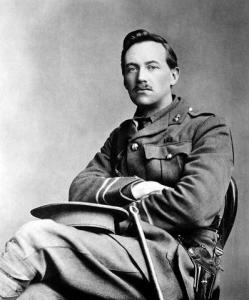
C. E. Montague (1867-1928)
Charles Edward Montague was well into his forties when the war started and had to die his white hair black in order to volunteer. He rapidly rose through the ranks and ultimately spent part of the war escorting VIPs like H.G. Wells on visits to the Western Front. Along the way, he became familiar with a diverse array of chaplains, ranging from courageous heroes like Theodore Hardy (one of three British chaplains to win the Victoria Cross in WWI — posthumously, as he was also one of the 179 who died) to those like the one “drunk at dinner in Gobert’s restaurant at Amiens on the evening of one of the bloodiest days of the first battle of the Somme.” But most commonly, Montague found “the large, healthy, pleasant young curate not severely importuned by a vocation, the ex-athlete, the prop and stay of village cricket-clubs, the good fellow whom the desires of parents, the gaiety of his youth at the university, and the whole drift of things about him had shepherded unresistingly into the open door of the Church.”
While this type of chaplain had his good points (“He gladly frequented the least healthy parts of the line, and would frankly mourn the pedantry which denied him a service revolver”), Montague concluded that such padres were regarded warily by the soldiers with whom they tried to ingratiate themselves:
The vigour with which he threw off the parson and put on the man and the brother did not always strike the original men and brothers as it was intended. Your virilist chaplain was apt to overdo, to their mind, his jolly implied disclaimers of any compromising connection with kingdoms not of this world. For one thing, he was, for the taste of people versed in carnage, a shade too fussily bloodthirsty. Nobody made such a point of aping your little trench affectations of callousness; nobody else was so anxious to keep you assured that the blood of the enemy smelt as good to his nose as it could to any of yours…. surprising to say, [the men] secretly wanted a change from themselves; had the parsons really nothing to say of their own about this noisome mess in which the good old world seemed to be foundering?
His own father had left the Catholic clergy, but Montague didn’t celebrate the religious version of the larger disenchantment that gave his 1922 memoir its title. Nor did he treat secularization as an inevitability. Instead, Montague concluded that the churches had missed a massive opportunity for evangelism and discipleship. In a chapter entitled “The Sheep That Were Not Fed,” he borrowed a second metaphor from the Gospels:
When you want to catch the Thames gudgeon you first comb the river’s bed hard with a long rake…. For our professional fishers of men in the army the war did the raking gratis. The men came under their hands at the time of the most drastic experience in most of the men’s lives, immersed in a new and strange life of sensations at once simple and intense, shaken roughly out of the world of mechanical habit… living always among swiftly dying friends and knowing their own death at any time to be as probable as anyone’s…. Imagine the religious revival that there might have been if some man of apostolic genius had had the fishing in the troubled waters, the ploughing and sowing of broken soil…
Nothing perceptible came of it all.
Here’s a more complete version of the 2013 chaplains talk from which this post is derived.
Previous Post

November 9, 2018
1918: Did the War End Too Soon?
Next Post
November 12, 2018 1918: The Other Centennial
Browse Our Archives
Select a Category abolitionism Abortion Abraham Joshua Heschel Abraham Kuyper Abraham Lincoln Academia Activism Adam Renberg Advent Adventist africa African American Religion Agnes Howard Albert Camus American History American Religious History American Revolution American West Anabaptists Ancient History Andrea Turpin Andrei Tarkovsky Anglicanism Annales Ansley Lillian Quiros anti-Catholicism Antisemitism Anxious Bench apologetics Apparitions Arash Azizi Archaeology archives art Artificial Intelligence Asia Asian Americans Augustine Authors Bad Bunny Baptism Baptists Barack Obama Battle of Hastings Benjamin Franklin Bernard-Henri Levy Beth Allison Barr Beth Moore Bethany Mannon Bible Bill Cunningham Billy Graham Black Music Bob Dylan Body Boenhoffer Books Breastfeeding Bruce Springsteen C.S. Lewis Calvinism Cancel Culture Capitalism Carmelites Catholicism Cedric Robinson Cesar Chavez Charismaticism charity Charles Dickens Charles Lindbergh Che Guevara Chicago Children Chinese Christianity Chris Gehrz Christ Christian death Christian Higher Education Christian life Christian Nation Christian Nationalism Christianity Today Christmas Church life Church Practice cinema Civil Religion Civil Rights Movement Civil War civility Classics Climate Change Cold War Colonial Mexico colonialism Comer Communism community complementarianism Conference on Faith and History Congregationalism Conspiracies Conspiracy Conversion Narratives Coronavirus Costa Rica Council of Nicaea Covid-19 Creation Critical Race Theory Crusades Culture culture wars Daniel K. Williams David Barton David Swartz Death Ways death with dignity DEI democracy Democratic Party Devotion Digital Age Diplomacy discipleship diversity Donald Trump Drama Dua Lipa Early Church early modern Early modern Catholicism Easter Eastern Christianity economic exploitation Education elections Elie Wiesel Elizabeth II Elizabeth Taylor emotions Empire Engineering England enslavement Entertainment Episcopal Church Erica Ramirez eschatology Eurocentrism Evangelicalism Evangelicals Exegesis Family Feminism Film Flannery O'Connor folk music Food Foreign Policy founding fathers Franciscans Franciscus Junius fundamentalism Funerals G.K. Chesterton Gender Genocide genre geography George W. Bush George Washington George Whitefield Global Christianity Global church Grief Guadalupe Guest Post guest post gun control gun violence Gustavo Gutierrez Hamid Dabashi Harold John Ockenga Harvest Hate Hawaiian Christianity Healing health care Heather Cox Richardson Hell Heresy Hermeneutics Higher Education Hinduism Hippocratic oath Historical Fiction Historical Methodology Historical Profession Historical Profession Historical Theology Historical Thinking historiography Holidays Holocaust horror movies Human rights Humanitarian Work humanities Hummingbirds Hungary hymns Imago Dei Immigration Injustice Interviews Iran Islam Islamophobia Israel Ivan's Childhood Jacob Randolph James Bratt Janine Giordano Drake Japanese history Japanese Literature Jean Paul Sartre Jesse Miranda Jesus Jesus Christ Jimmy Carter Joan Baez Joan Didion Joanne Freeman João B. Chaves Joao Chaves Joey Cochran John Calvin John Fea John Tillotson John Turner Johnny Cash Jonathan Edwards Jonathan Tran Joseph Smith Josh Howerton Journalism Jr. Judaism Jürgen Moltmann Just War Justice Justin Brierley Karl Barth Katelyn Beaty koi ponds Kris Kristofferson Kristin Kobes Du Mez Latin American Religious History Latino Americans Lectio Divina Leisure Lent Leonard Cohen liberal arts liberalism Liberation Theology Linda Ronstadt Lisa Clark Diller Literature Lou Reed Lynchings Lynneth Miller Renberg Mainline Protestantism Malcolm Foley Marilyn Monroe Maritime history Mark Noll Marriage Martin Luther Martin Luther King Martyrdom Marxism Mary Masih Alinejad mass shootings material culture medieval Christianity Medieval Ethiopia Melissa Borja memory Mennonites Mental Health Mental Illness Methodism Mexican Americans Mexicans Mike Madrid Miles Mullin Min Jin Lee Miscarriage Missionaries Mister Rogers Mitt Romney modernity Monasticism Mormonism Motherhood Mothers of the Church Moving Music Musicals Nadya Williams Nahua Christianity Native Americans Natsume Sōseki New Contributor New England New Year New York Nico Non-Violent Protest Orthodoxy pacifism Paleo Evangelicals Palestinians Parenting Patti Smith Paul Kingsnorth Pedro Calderón de la Barca Pentecostalism Philip Jenkins Phillis Wheatley physician-assisted suicide pilgrimage Pilgrims pluralism Plutocracy Poetry Politics Pope Francis Pope Leo XIV post-modernism prayer preaching Presbyterians prosperity gospel Protest Public history Publishing Puritans purity culture Quakers race Race Massacres Racial Capitalism racial reconciliation racialization Racism Raha Bahloulipour Re-Enchantment reading Reformation Refugees religion and the university religion and war Religious Freedom Religious Nones Religious Pluralism Religious Symbols religious violence Republican Party Revival Rita Coolidge Ritual Roger Williams Roman Catholic church Royalty Russell Moore same-sex marriage Sarah Irving-Stonebraker Scandinavia Science Science and Technology Scopes trial Scriptural Interpretation secularism Selena Quintanilla seminary Seventh-Day Adventists sexual morality Sexuality Sikhs Silence slaveholders theology Slavery Slavoj Zizek social justice Social Media Southern Baptist Convention Southern Religion Spain Spiritual Autobiography Spiritual but not religious Spiritual Discipline Sports Stanley Hauerwas Suffering Summer Camps Sunday Night Odds and Ends Supernatural Supreme Court Syriac Christianity Tal Howard Taylor Swift Teaching Technology Television Thanksgiving The Beatles The Mission theater TheoBros Theology Thomas Dixon Thomas Jefferson Thomas Kidd Thomas Merton Tim Gloege Tim Walz Tom Holland Tourism tradition Tragedy Translation Transnationalism Travel Trump Ukraine Uncategorized Unitarians United Methodist Church US History Vanessa Chan Velvet Underground Verónica A. Gutiérrez Veronica Gutierrez Vikings Violence Virgin Mary Virtue Virtue ethics Visions Voting War WCTU Wendell Berry Westminster Assembly White Evangelicalism Wildfires Winnie the Pooh Witches women Women in Ministry Women's and Gender Studies Work Worship writing Yasunari Kawabata Zena Hitz
Select a Month October 2026 September 2026 August 2026 July 2026 June 2026 May 2026 April 2026 March 2026 February 2026 January 2026 December 2025 November 2025 October 2025 September 2025 August 2025 July 2025 June 2025 May 2025 April 2025 March 2025 February 2025 January 2025 December 2024 November 2024 October 2024 September 2024 August 2024 July 2024 June 2024 May 2024 April 2024 March 2024 February 2024 January 2024 December 2023 November 2023 October 2023 September 2023 August 2023 July 2023 June 2023 May 2023 April 2023 March 2023 February 2023 January 2023 December 2022 November 2022 October 2022 September 2022 August 2022 July 2022 June 2022 May 2022 April 2022 March 2022 February 2022 January 2022 December 2021 November 2021 October 2021 September 2021 August 2021 July 2021 June 2021 May 2021 April 2021 March 2021 February 2021 January 2021 December 2020 November 2020 October 2020 September 2020 August 2020 July 2020 June 2020 May 2020 April 2020 March 2020 February 2020 January 2020 December 2019 November 2019 October 2019 September 2019 August 2019 July 2019 June 2019 May 2019 April 2019 March 2019 February 2019 January 2019 December 2018 November 2018 October 2018 September 2018 August 2018 July 2018 June 2018 May 2018 April 2018 March 2018 February 2018 January 2018 December 2017 November 2017 October 2017 September 2017 August 2017 July 2017 June 2017 May 2017 April 2017 March 2017 February 2017 January 2017 December 2016 November 2016 October 2016 September 2016 August 2016 July 2016 June 2016 May 2016 April 2016 March 2016 February 2016 January 2016 December 2015 November 2015 October 2015 September 2015 August 2015 July 2015 June 2015 May 2015 April 2015 March 2015 February 2015 January 2015 December 2014 November 2014 October 2014 September 2014 August 2014 July 2014 June 2014 May 2014 April 2014 March 2014 February 2014 January 2014 December 2013 November 2013 October 2013 September 2013 August 2013 July 2013 June 2013 May 2013 April 2013 March 2013 February 2013 January 2013 December 2012 November 2012 October 2012 September 2012 August 2012 July 2012 June 2012 May 2012
Follow Us!
TAKE THE
Religious Wisdom Quiz
What was the name of the Roman governor who sentenced Jesus to death?
Select your answer to see how you score.
Pontius Pilate Tiberius Caesar Augustus Herod Antipas
Related posts from Anxious Bench

Epic Fury in the End-Times: Exploring Pentecostal War...

Gentlemen Clergymen in the Mud and Blood of...
Walking in Henry’s England: The English Church Revisited
Surprised by History: Telling the Story
TRENDING AT PATHEOS Evangelical

Janie Learns the Way of the Cross: A...
Teaching children about Jesus' Passion can be challenging. Many parents and educators...

Looking For Good Catholic Writing - October 2026
He alone extends the heavens, and he walks upon the waves of...

In "Irreplaceable," our book on vocation and technology, Trevor Sutton and I...

I was strolling through the top floor of the brand new Parthenon...

What Does Gêvâh Mean For Kimberley Guifoyle &...
This week, a lot of the news is focused on Kimberly Guilfoyle....

INNER CIRCLE: Profound Mystery (Of Christ In All...
Ephesians 5:31-32 “For this reason, a man will leave his father and...
view all Evangelical blogs
Ad-Free & Subscriber Log-In Subscription Support
- About Us
- 2026 Calendar
- Videos
- Podcasts
- Library of World Religions
- Faith In Media Tracker
- Advertise With Us
- Write for Us
- Privacy Policy
- Terms of Service
- Do Not Sell My Data
- Contact Us
- Radiant Digital
- Manage Newsletter Subscriptions
- Unsubscribe From Notifications
- Sitemap
Copyright 2008-2026, Patheos. All rights reserved.
Subscription Support Ad-Free & Subscriber Log-In
Follow Patheos