
BuddhistCatholicContemplativeEvangelicalGeneral ChristianHinduJewishLatter-day SaintMuslimNew VisionsProgressive Christian
Beliefs
- Buddhist
- Catholic
- Contemplative
- Evangelical
- General Christian
- Hindu
- Jewish
- Latter-day Saint
- More Voices
- Muslim
- New Visions
- Pagan
- Progressive Christian
Topics
- Religion News
- Food and Religion
- Sports and Religion
- Religious Art
- Religious Music and Entertainment
- Religious Events
- History and Religion
- Style and Religion
- Politics and Religion
- Women in Religion
- Recreation Outdoors and Religion
- Business Finance and Religion
- Careers Workplace and Religion
- Education and Religion
- Family Parenting and Religion
- Health Fitness and Religion
- Home and Religion
- Relationships and Religion
- Technology and Religion
- Travel and Religion
Columnists
- Buddhist Columnists
- Business Finance and Religion Columnists
- Careers Workplace and Religion Columnists
- Catholic Columnists
- Contemplative Columnists
- Education and Religion Columnists
- Evangelists Columnists
- Family Parenting and Religion Columnists
- General Christian Columnists
- Health Fitness and Religion Columnists
- Hindu Columnists
- History and Religion Columnists
- Home and Religion Columnists
- Jewish Columnists
- More Voices Columnists
- Latter Day Columnists
- Muslim Columnists
- New Visions Columnists
- Nonreligious Columnists
- Pagan Columnists
- Politics and Religion Columnists
- Progressive Columnists
- Recreation Outdoors and Religion Columnists
- Relationships and Religion Columnists
- Religion News Columnists
- Religious Art Columnists
- Religious Events Columnists
- Religious Music and Entertainment Columnists
- Sports and Religion Columnists
- Style and Religion Columnists
- Technology and Religion Columnists
- Travel and Religion Columnists
- Women in Religion Columnists
Resource Library
- 2026 Calendar
- Library of World Religions
- The 100 Most Holy Places on Earth
- Patheos Answers
- Podcasts
- Videos
- Faith Leaders Database
- Anglican Episcopalian
- Bahai
- Baptist
- Buddhism
- Christianity
- Confucianism
- Eastern Orthodoxy
- Hinduism
- Holiness and Pentecostal
- ISKCON
- Islam
- Judaism
- Lutheran
- Methodist
- The Church of Jesus Christ of Latter-day Saints
- New Age
- Paganism
- Presbytarian and Reformed
- Protestantism
- Religion Behind the Scenes
- Roman Catholic
- Scientology
- Shia Islam
- Sikhism
- Sufism
- Sunni Islam
- Taoism
- Zen
- See all religions
Research Tools
 Ad-Free & Subscriber Log-In Subscription Support
Ad-Free & Subscriber Log-In Subscription Support
Follow Patheos 

- Trending:
- Forgiveness
- |
- Marriage
- |
- Consciousness
- |
- Death Penalty
- |
- Election
- |
- Halloween

-
About the Authors
- Home
- Evangelical
- Refugee Politics and a Tale of Two Thanksgivings
Refugee Politics and a Tale of Two Thanksgivings
Last updated on: November 15, 2018 at 11:36 am by Melissa Borja
Refugee Politics and a Tale of Two Thanksgivings 2018-11-15T11:36:21-04:00 Melissa Borja
Patheos Explore the world's faith through different perspectives on religion and spirituality! Patheos has the views of the prevalent religions and spiritualities of the world.
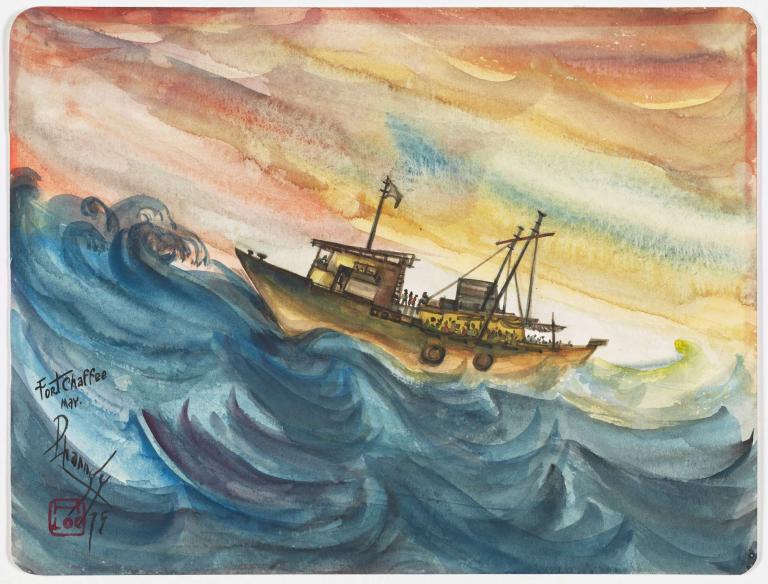
“Fleeing for Liberty,” 1975. Museum Object 1981.118; “Fleeing for Liberty”; 1975; Artifacts Relating to the Life and Presidency of Gerald R. Ford, 1977 – 2016; Collection GRF-MCOLL: Gerald R. Ford Museum Collection, 1977 – 2016; Gerald R. Ford Museum, Grand Rapids, MI.
Nearly forty years ago, a minister, a rabbi, and two priests went to the White House, and together with the President and other religious leaders, they planned a special series of Thanksgiving observances. Their Thanksgiving events, however, did not feature turkey feasts and English Pilgrims. Rather, the Thanksgiving they planned called for fasting and church fundraisers to collect money to aid Southeast Asian refugees.
The year was 1979, and a humanitarian crisis was unfolding in Asia. “Boat people” were escaping Vietnam in droves, while Hmong and Lao refugees were fleeing the Pathet Lao. In neighboring Cambodia, Pol Pot had fallen from power that year, after killing a fifth of the Cambodian population, and those who had managed to survive were starving and seeking refuge in Thailand.
After a day of meetings, the religious leaders held a press conference with President Jimmy Carter. After announcing his plans to increase government spending on refugee relief and resettlement, President Carter urged religious communities across America to “match the government effort” and give generously to refugee aid groups. “I ask specifically that every Saturday and Sunday in the month of November, up until Thanksgiving, be set aside as days for Americans in their synagogues and churches, and otherwise, to give generously to help alleviate this suffering,” he said.
Religious leaders reiterated his call. Rabbi Bernard Mandelbaum proposed a Thanksgiving dinner where Protestant, Catholic, and Jewish people would gather to eat “what a typical Cambodian eats on a day when he’s starving.” His suggestion for an interfaith Thanksgiving feast where people would eat close to nothing was perhaps made in jest. Nonetheless, Rabbi Mandelbaum was deeply serious about the shared conviction of the government and religious leaders who had gathered that day at the White House. “I think it’s good for America that all of us stand together in this prime response of religion which is ‘Love your neighbor as yourself,’” he said.
Refugee politics in 1979
The Thanksgiving events proposed by President Carter and the minister, the rabbi, and the priests may today seem quaint, but the pro-refugee advocacy of these religious and government leaders was in fact quite bold and rather unpopular in 1979. Then and throughout the twentieth century, Americans widely opposed admitting refugees for resettlement. One national Gallup poll conducted in May 1975, just one month after the fall of Saigon, found that only 36 per cent of Americans surveyed favored the resettlement of Southeast Asian refugees; 54 per cent of Americans surveyed opposed it. Attitudes toward Southeast Asian refugees warmed somewhat over time, but American reluctance to admit Southeast Asian refugees remained consistent throughout the 1970s and 1980s. Even a full decade after the end of the Vietnam War, a plurality of Americans believed that the United States had accepted too many refugees.
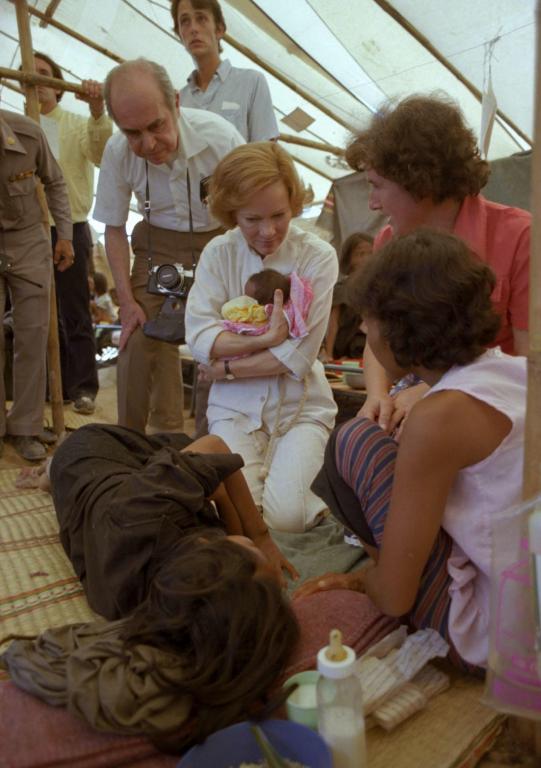
First Lady Rosalynn Carter Visits a Refugee Camp in Sa Kas, Thailand, 1979. First Lady Rosalynn Carter Visits a Refugee Camp in Sa Kas, Thailand; 11/9/1979; Collection JC-WHSP: Carter White House Photographs Collection.
Despite the opposition, nearly a million Southeast Asian refugees were resettled in the United States, and their arrival sometimes provoked hostile and even violent reactions. A New York Times profile of Niceville, Florida, reveal the scope and intensity of anti-refugee sentiment. A community located near Eglin Air Force Base, one of the four military-run camps that housed newly arrived Vietnamese refugees, Niceville was not, despite its name, particularly nice to the Vietnamese newcomers. When the local radio station polled area residents about the 1,500 Vietnamese being airlifted from Saigon, 80 per cent of the people said that they did not want the military to bring refugees to their town. At one point, residents circulated a petition demanding that refugees be sent to a different place, and school children reportedly made jokes about shooting refugees.
The reasons for opposing refugee resettlement varied and included concerns about the potential impact on local employment, the strain on government resources, the threat to national security, and the possibility of Communist infiltration. The belief that Southeast Asian refugees were dirty and unable to assimilate also motivated anti-refugee sentiment. “There’s no telling what kind of diseases they’ll be bringing with them,” said Vincent Davis of Niceville. (When asked by the reporter to identify which diseases the Vietnamese refugees carried, Davis replied, “I don’t know,” but then added that “there’s bound to be some of those tropical germs floating around.”) Sometimes the opposition was due simply to anti-Asian racism. At Fort Walton Beach High School, near Niceville, students even discussed plans to establish a “gook klux klan.”
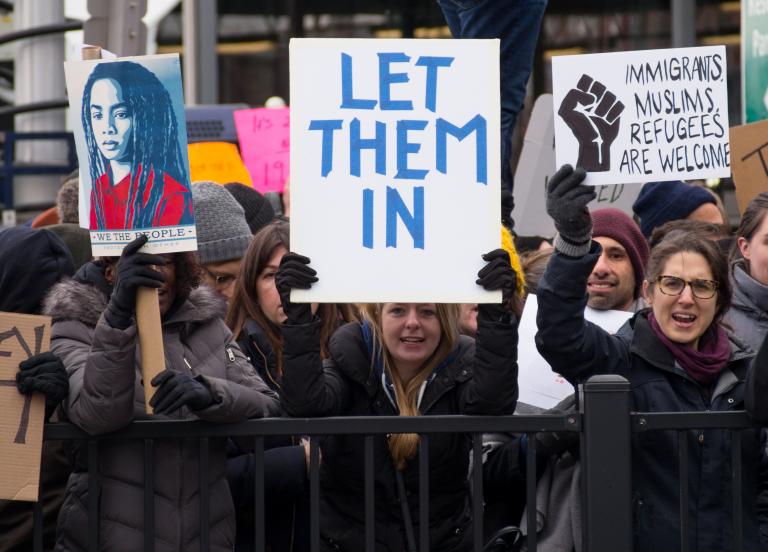
Protest at John F. Kennedy International Airport (JFK), Terminal 4, in New York City, against Donald Trump’s executive order signed in January 2017 banning citizens of seven countries from traveling to the United States (the executive order is also known as “Protecting the Nation from Foreign Terrorist Entry into the United States”).
Refugee politics in 2018
As this recent history shows, the nativism of 2018, while ugly, has a long and deep-rooted history. Today as in 1979, Americans remain skeptical of refugees and asylum-seekers. The Pew Research Center found this spring that, overall, about half of Americans (51%) believe that the United States has a responsibility to accept refugees. However, opinions divided on partisan lines; only 26% of Republicans believe that the United States should be responsible for resettling refugees. Public opinion about the people in the “migrant caravan,” many of whom are fleeing violence in Central America and hope to seek asylum in the United States, are also negative. One recent poll found that 42% of polled voters believe that Mexico should return the people in the migrant caravan back to their home countries.
Of course, the situation today is also quite different from that of 1979. Most obviously, President Trump is no President Carter, and the Trump administration has actively chosen not to lead the world in showing a generous response to refugees. In September, for example, President Trump slashed refugee admissions to 30,000 a year, the lowest number since the creation of the modern refugee resettlement system in 1980. In addition, just last week, he announced plans to make it more difficult for people to claim asylum; according to Sabrina Ardalan of the Harvard Immigration and Refugee Clinical Program, these policy changes will make claiming asylum nearly impossible. To be sure, as Michael Barnett argues, the Trump administration’s stance on refugees, while more restrictive than previous administrations, is not exceptional compared to other nations, which, as a general rule, treat refugees quite badly. However, what sets President Trump apart is his harsh rhetoric. While previous American presidents have at least gestured toward the lofty ideal of the United States as a refuge for the persecuted, the downtrodden, and the freedom-loving, President Trump has repeatedly demonized refugees, asylum-seekers, and immigrants as dangerous criminals and terrorists who pose a dangerous threat to America.
The opposition to refugees and asylum-seekers has not been limited to President Trump. Other politicians have mobilized voters through the crass exploitation of nativist fear and hate. Anti-immigrant, neo-Nazi, and anti-Muslim hate groups have been on the rise, and this week, the FBI released a report that found that in 2017, hate crimes—of which almost 60% were motivated by race, ethnicity, or ancestry—increased by 17%. Last month, the belief that refugees are “invaders that kill our people” even compelled Robert Bowers to gun down 11 worshipers at Pittsburgh’s Tree of Life synagogue, which he targeted in part because he linked it to the Hebrew Immigrant Aid Society (HIAS), a voluntary agency that resettles refugees. (As Jaclyn Granick and Britt Tevis point out, “Anti-Semitism, nativism and anti-immigrant sentiments have long been inextricably intertwined.”)
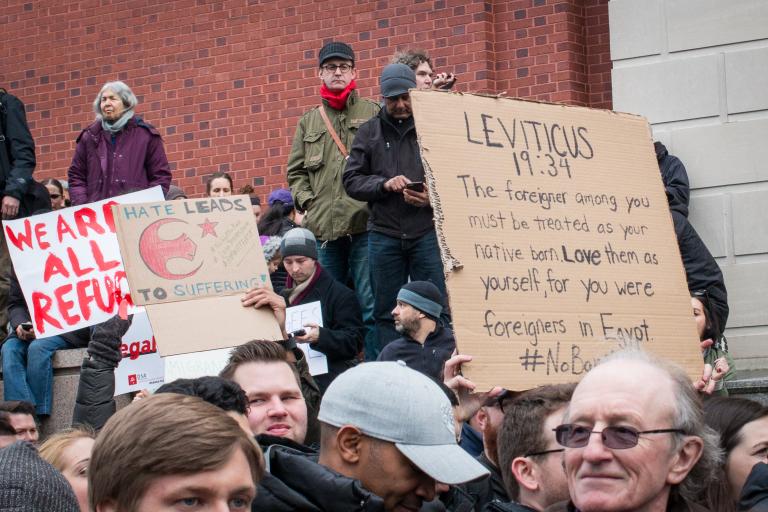
Muslim Ban protests, Washington, D.C., January 29, 2017.
“We are called by our faith traditions to welcome the stranger”
If government leaders are pulling back their commitment to refugees and asylum-seekers, how are people of faith responding? In the run-up to the midterm election, some news coverage suggested that white evangelical women, horrified by the separation of families at the border and the ban on Muslim refugees, were abandoning the Republican party and backing Democratic candidates such as Beto O’Rourke. However, a look at the voting patterns in the midterm elections last week indicates that most white evangelical Christians remain solidly supportive of the Republican party and, by implication, its harsh restrictionist stance on refugees and immigrants.
Still, many religious groups insist that the United States should continue to welcome refugees, asylum-seekers, and immigrants and have expressed this commitment through advocacy and daring acts of protest. Leaders of faith-based voluntary agencies such as World Relief, Church World Service, and the United States Conferences on Catholic Bishops Migration and Refugee Services have repeatedly condemned the reduction of refugee admissions and the treatment of asylum-seekers. Religious leaders have also been organizing their own caravans, willingly putting their bodies in danger in order to protest government policies and show compassion to migrants. For example, rabbis from across the country are undertaking a “pilgrimage” to the southern border. This “sacred journey,” Rabbi Miriam Terlinchamp explains, arises from Jewish commitments to “decency, justice, and compassion” and aims “to stop the unacceptable practice of imprisoning immigrant minors, and ensure protection for those seeking refuge within our borders.” Similarly, the New Sanctuary Coalition is forming a “sanctuary caravan” led by two dozen faith leaders who hope “to prevent vigilante justice” and aid migrant families. “Exodus is not new,” says Pr. Eduardo Fabian Arias. “We are called by our faith traditions to welcome the stranger. We will answer that call.” One humanitarian activist, Scott Warren, who was recently arrested and charged with federal criminal counts of harboring illegal migrants in the Arizona desert, has even argued that because his religious convictions require him to aid immigrants, his actions are protected by the Religious Freedom Restoration Act.
Religious groups doing refugee resettlement work have also benefited from generous giving. Donors on Facebook contributed over a quarter million dollars to HIAS within the first three days after the Tree of Life massacre, and religious congregations are donating money, time, and talent to resettlement efforts, even when there are no refugees to help—yet. In Tarrant County, one of the counties that resettles the most number of refugees in Texas, the Trump administration’s policies have caused the number of refugee arrivals to decline 71.7%. Churches in Tarrant County that were busily preparing homes, meals, medical care, employment, and English classes for newly arrived refugees found that the families they eagerly hoped to assist never arrived. Nevertheless, the churches have continued to give, prepare, and hope. Shalaina Abioye of Catholic Charities Fort Worth observes that, though “the numbers are lower,” Tarrant County has not lost its “spirit of welcoming refugees.”
“Thanks, God, for the saving of life”
Like the minister, rabbi, and priests who visited the White House to plan Thanksgiving in 1979, people of faith today are leading the effort to press for government policies that are generous and compassionate to refugees, asylum-seekers, and immigrants. These religious activists face formidable opposition. As was the case four decades ago, they must contend with a general population that is wary of refugees and other migrants. Now, however, they must also deal with a government that is no longer a willing partner, but a hostile adversary. In an era when the U.S. government is choosing to turn its back on the world’s most vulnerable people, it is clear that the moral leadership of people of faith matters more than ever. And why precisely does their matter? Because the lives of refugees fleeing violence and persecution are severely at risk.
Another Thanksgiving story offers a powerful reminder of why the work of refugee advocacy is so important. In 1991, the Hmong Christian Church of God in Minneapolis gathered for the fifteenth annual “Thanksgiving service.” The event was not actually in November, but in May, and the intent was not to commemorate the migration of English Pilgrims who sailed to Massachusetts on the Mayflower, but the migration of Hmong refugees who flew to the United States on an airplane. The program cover for the “great memorial celebration” in fact featured a drawing of an oversized jetliner, superimposed on the outline of the globe. The airplane appeared to be leaving Southeast Asia, represented by a Hmong man holding a Laotian flag, and careening toward the continental United States, where another Hmong man bearing an American flag offered the greeting, “welcome to the U.S.” Projecting from the top of the globe was a large crucifix, under which read the joyful declaration, “Thanks God for the saving of life.”
On the inside of the program, the church’s pastor, Rev. Young Tao, lists the reasons for which the congregation had gathered to “celebrate this thanksgiving”: among them, “to Honors the Government of the United States, the Governor of Minnesota and all those in authority under him, and the kind citizens of Minnesota who throug their gracious generosity have assisted us to a happily resettle here in this wonderful State” and “to Show our gratitude and honor to the agencies, Churches, sponsors, and friends who have shared willingly with us and have provided us with the necessities of the life such as food, clothing, furnitures, and housing.” Later, the pastor emphasizes that the Hmong people should thank God above all. “But God pours out His love, and the United States government has fill with all of loves,” the pastor writes. “And by the Churches, agencies, and friends, They accept the Hmong into their home land. This is our thanksgiving and gratitude to continually.”
As this Thanksgiving service reveals, the members of the Hmong Christian Church of God were profoundly grateful to find a new home in the United States. The misery they had endured throughout their refugee journey from Laos, and the resilience and thanksgiving they displayed in the years after, offer a compelling lesson for all Americans—that living, breathing, celebrating, long-suffering human beings are at the center of the refugee policies that politicians so cruelly deploy as a political weapon. It is these human beings who are the very reason why people of faith are rejecting the actions of the current government and pressing for refugee policies that show “gracious generosity” and make possible “the saving of life.”
Previous Post
November 14, 2018
Disrupting Evangelical Biblical Womanhood
Next Post

November 16, 2018 1918: The Good Soldier
Browse Our Archives
Select a Category abolitionism Abortion Abraham Joshua Heschel Abraham Kuyper Abraham Lincoln Academia Activism Adam Renberg Advent Adventist africa African American Religion Agnes Howard Albert Camus American History American Religious History American Revolution American West Anabaptists Ancient History Andrea Turpin Andrei Tarkovsky Anglicanism Annales Ansley Lillian Quiros anti-Catholicism Antisemitism Anxious Bench apologetics Apparitions Arash Azizi Archaeology archives art Artificial Intelligence Asia Asian Americans Augustine Authors Bad Bunny Baptism Baptists Barack Obama Battle of Hastings Benjamin Franklin Bernard-Henri Levy Beth Allison Barr Beth Moore Bethany Mannon Bible Bill Cunningham Billy Graham Black Music Bob Dylan Body Boenhoffer Books Breastfeeding Bruce Springsteen C.S. Lewis Calvinism Cancel Culture Capitalism Carmelites Catholicism Cedric Robinson Cesar Chavez Charismaticism charity Charles Dickens Charles Lindbergh Che Guevara Chicago Children Chinese Christianity Chris Gehrz Christ Christian death Christian Higher Education Christian life Christian Nation Christian Nationalism Christianity Today Christmas Church life Church Practice cinema Civil Religion Civil Rights Movement Civil War civility Classics Climate Change Cold War Colonial Mexico colonialism Comer Communism community complementarianism Conference on Faith and History Congregationalism Conspiracies Conspiracy Conversion Narratives Coronavirus Costa Rica Council of Nicaea Covid-19 Creation Critical Race Theory Crusades Culture culture wars Daniel K. Williams David Barton David Swartz Death Ways death with dignity DEI democracy Democratic Party Devotion Digital Age Diplomacy discipleship diversity Donald Trump Drama Dua Lipa Early Church early modern Early modern Catholicism Easter Eastern Christianity economic exploitation Education elections Elie Wiesel Elizabeth II Elizabeth Taylor emotions Empire Engineering England enslavement Entertainment Episcopal Church Erica Ramirez eschatology Eurocentrism Evangelicalism Evangelicals Exegesis Family Feminism Film Flannery O'Connor folk music Food Foreign Policy founding fathers Franciscans Franciscus Junius fundamentalism Funerals G.K. Chesterton Gender Genocide genre geography George W. Bush George Washington George Whitefield Global Christianity Global church Grief Guadalupe Guest Post guest post gun control gun violence Gustavo Gutierrez Hamid Dabashi Harold John Ockenga Harvest Hate Hawaiian Christianity Healing health care Heather Cox Richardson Hell Heresy Hermeneutics Higher Education Hinduism Hippocratic oath Historical Fiction Historical Methodology Historical Profession Historical Profession Historical Theology Historical Thinking historiography Holidays Holocaust horror movies Human rights Humanitarian Work humanities Hummingbirds Hungary hymns Imago Dei Immigration Injustice Interviews Iran Islam Islamophobia Israel Ivan's Childhood Jacob Randolph James Bratt Janine Giordano Drake Japanese history Japanese Literature Jean Paul Sartre Jesse Miranda Jesus Jesus Christ Jimmy Carter Joan Baez Joan Didion Joanne Freeman João B. Chaves Joao Chaves Joey Cochran John Calvin John Fea John Tillotson John Turner Johnny Cash Jonathan Edwards Jonathan Tran Joseph Smith Josh Howerton Journalism Jr. Judaism Jürgen Moltmann Just War Justice Justin Brierley Karl Barth Katelyn Beaty koi ponds Kris Kristofferson Kristin Kobes Du Mez Latin American Religious History Latino Americans Lectio Divina Leisure Lent Leonard Cohen liberal arts liberalism Liberation Theology Linda Ronstadt Lisa Clark Diller Literature Lou Reed Lynchings Lynneth Miller Renberg Mainline Protestantism Malcolm Foley Marilyn Monroe Maritime history Mark Noll Marriage Martin Luther Martin Luther King Martyrdom Marxism Mary Masih Alinejad mass shootings material culture medieval Christianity Medieval Ethiopia Melissa Borja memory Mennonites Mental Health Mental Illness Methodism Mexican Americans Mexicans Mike Madrid Miles Mullin Min Jin Lee Miscarriage Missionaries Mister Rogers Mitt Romney modernity Monasticism Mormonism Motherhood Mothers of the Church Moving Music Musicals Nadya Williams Nahua Christianity Native Americans Natsume Sōseki New Contributor New England New Year New York Nico Non-Violent Protest Orthodoxy pacifism Paleo Evangelicals Palestinians Parenting Patti Smith Paul Kingsnorth Pedro Calderón de la Barca Pentecostalism Philip Jenkins Phillis Wheatley physician-assisted suicide pilgrimage Pilgrims pluralism Plutocracy Poetry Politics Pope Francis Pope Leo XIV post-modernism prayer preaching Presbyterians prosperity gospel Protest Public history Publishing Puritans purity culture Quakers race Race Massacres Racial Capitalism racial reconciliation racialization Racism Raha Bahloulipour Re-Enchantment reading Reformation Refugees religion and the university religion and war Religious Freedom Religious Nones Religious Pluralism Religious Symbols religious violence Republican Party Revival Rita Coolidge Ritual Roger Williams Roman Catholic church Royalty Russell Moore same-sex marriage Sarah Irving-Stonebraker Scandinavia Science Science and Technology Scopes trial Scriptural Interpretation secularism Selena Quintanilla seminary Seventh-Day Adventists sexual morality Sexuality Sikhs Silence slaveholders theology Slavery Slavoj Zizek social justice Social Media Southern Baptist Convention Southern Religion Spain Spiritual Autobiography Spiritual but not religious Spiritual Discipline Sports Stanley Hauerwas Suffering Summer Camps Sunday Night Odds and Ends Supernatural Supreme Court Syriac Christianity Tal Howard Taylor Swift Teaching Technology Television Thanksgiving The Beatles The Mission theater TheoBros Theology Thomas Dixon Thomas Jefferson Thomas Kidd Thomas Merton Tim Gloege Tim Walz Tom Holland Tourism tradition Tragedy Translation Transnationalism Travel Trump Ukraine Uncategorized Unitarians United Methodist Church US History Vanessa Chan Velvet Underground Verónica A. Gutiérrez Veronica Gutierrez Vikings Violence Virgin Mary Virtue Virtue ethics Visions Voting War WCTU Wendell Berry Westminster Assembly White Evangelicalism Wildfires Winnie the Pooh Witches women Women in Ministry Women's and Gender Studies Work Worship writing Yasunari Kawabata Zena Hitz
Select a Month October 2026 September 2026 August 2026 July 2026 June 2026 May 2026 April 2026 March 2026 February 2026 January 2026 December 2025 November 2025 October 2025 September 2025 August 2025 July 2025 June 2025 May 2025 April 2025 March 2025 February 2025 January 2025 December 2024 November 2024 October 2024 September 2024 August 2024 July 2024 June 2024 May 2024 April 2024 March 2024 February 2024 January 2024 December 2023 November 2023 October 2023 September 2023 August 2023 July 2023 June 2023 May 2023 April 2023 March 2023 February 2023 January 2023 December 2022 November 2022 October 2022 September 2022 August 2022 July 2022 June 2022 May 2022 April 2022 March 2022 February 2022 January 2022 December 2021 November 2021 October 2021 September 2021 August 2021 July 2021 June 2021 May 2021 April 2021 March 2021 February 2021 January 2021 December 2020 November 2020 October 2020 September 2020 August 2020 July 2020 June 2020 May 2020 April 2020 March 2020 February 2020 January 2020 December 2019 November 2019 October 2019 September 2019 August 2019 July 2019 June 2019 May 2019 April 2019 March 2019 February 2019 January 2019 December 2018 November 2018 October 2018 September 2018 August 2018 July 2018 June 2018 May 2018 April 2018 March 2018 February 2018 January 2018 December 2017 November 2017 October 2017 September 2017 August 2017 July 2017 June 2017 May 2017 April 2017 March 2017 February 2017 January 2017 December 2016 November 2016 October 2016 September 2016 August 2016 July 2016 June 2016 May 2016 April 2016 March 2016 February 2016 January 2016 December 2015 November 2015 October 2015 September 2015 August 2015 July 2015 June 2015 May 2015 April 2015 March 2015 February 2015 January 2015 December 2014 November 2014 October 2014 September 2014 August 2014 July 2014 June 2014 May 2014 April 2014 March 2014 February 2014 January 2014 December 2013 November 2013 October 2013 September 2013 August 2013 July 2013 June 2013 May 2013 April 2013 March 2013 February 2013 January 2013 December 2012 November 2012 October 2012 September 2012 August 2012 July 2012 June 2012 May 2012
Follow Us!
TAKE THE
Religious Wisdom Quiz
True or False: King Josiah found the Book of the Law hidden in the temple during repairs.
Select your answer to see how you score.
FALSE TRUE
Related posts from Anxious Bench
John Calvin: Pastor. Theologian. Immigrant Nuisance?
How Modern Citizenship Debates Echo the Reformation

The Sunday School Democrats: Carter and Talarico
Bad Sermons, Political Violence, and Evil May Day...
TRENDING AT PATHEOS Evangelical

The Sermon on the Mount, Part I: Matthew...
The Sermon on the Mount, Part I (Matthew 4:12-5:12) St. Matthew moves...

What's up from Crossway: Reviewing some of their latest A few weeks...

Janie Learns the Way of the Cross: A...
Teaching children about Jesus' Passion can be challenging. Many parents and educators...

Looking For Good Catholic Writing - October 2026
He alone extends the heavens, and he walks upon the waves of...

In "Irreplaceable," our book on vocation and technology, Trevor Sutton and I...

I was strolling through the top floor of the brand new Parthenon...
view all Evangelical blogs
Ad-Free & Subscriber Log-In Subscription Support
- About Us
- 2026 Calendar
- Videos
- Podcasts
- Library of World Religions
- Faith In Media Tracker
- Advertise With Us
- Write for Us
- Privacy Policy
- Terms of Service
- Do Not Sell My Data
- Contact Us
- Radiant Digital
- Manage Newsletter Subscriptions
- Unsubscribe From Notifications
- Sitemap
Copyright 2008-2026, Patheos. All rights reserved.
Subscription Support Ad-Free & Subscriber Log-In
Follow Patheos