
BuddhistCatholicContemplativeEvangelicalGeneral ChristianHinduJewishLatter-day SaintMuslimNew VisionsProgressive Christian
Beliefs
- Buddhist
- Catholic
- Contemplative
- Evangelical
- General Christian
- Hindu
- Jewish
- Latter-day Saint
- More Voices
- Muslim
- New Visions
- Pagan
- Progressive Christian
Topics
- Religion News
- Food and Religion
- Sports and Religion
- Religious Art
- Religious Music and Entertainment
- Religious Events
- History and Religion
- Style and Religion
- Politics and Religion
- Women in Religion
- Recreation Outdoors and Religion
- Business Finance and Religion
- Careers Workplace and Religion
- Education and Religion
- Family Parenting and Religion
- Health Fitness and Religion
- Home and Religion
- Relationships and Religion
- Technology and Religion
- Travel and Religion
Columnists
- Buddhist Columnists
- Business Finance and Religion Columnists
- Careers Workplace and Religion Columnists
- Catholic Columnists
- Contemplative Columnists
- Education and Religion Columnists
- Evangelists Columnists
- Family Parenting and Religion Columnists
- General Christian Columnists
- Health Fitness and Religion Columnists
- Hindu Columnists
- History and Religion Columnists
- Home and Religion Columnists
- Jewish Columnists
- More Voices Columnists
- Latter Day Columnists
- Muslim Columnists
- New Visions Columnists
- Nonreligious Columnists
- Pagan Columnists
- Politics and Religion Columnists
- Progressive Columnists
- Recreation Outdoors and Religion Columnists
- Relationships and Religion Columnists
- Religion News Columnists
- Religious Art Columnists
- Religious Events Columnists
- Religious Music and Entertainment Columnists
- Sports and Religion Columnists
- Style and Religion Columnists
- Technology and Religion Columnists
- Travel and Religion Columnists
- Women in Religion Columnists
Resource Library
- 2026 Calendar
- Library of World Religions
- The 100 Most Holy Places on Earth
- Patheos Answers
- Podcasts
- Videos
- Faith Leaders Database
- Anglican Episcopalian
- Bahai
- Baptist
- Buddhism
- Christianity
- Confucianism
- Eastern Orthodoxy
- Hinduism
- Holiness and Pentecostal
- ISKCON
- Islam
- Judaism
- Lutheran
- Methodist
- The Church of Jesus Christ of Latter-day Saints
- New Age
- Paganism
- Presbytarian and Reformed
- Protestantism
- Religion Behind the Scenes
- Roman Catholic
- Scientology
- Shia Islam
- Sikhism
- Sufism
- Sunni Islam
- Taoism
- Zen
- See all religions
Research Tools
 Ad-Free & Subscriber Log-In Subscription Support
Ad-Free & Subscriber Log-In Subscription Support
Follow Patheos 

- Trending:
- Forgiveness
- |
- Marriage
- |
- Consciousness
- |
- Death Penalty
- |
- Election
- |
- Halloween

-
About the Authors
- Home
- Evangelical
- The Ritual of Saying Goodbye to the Family Dog
The Ritual of Saying Goodbye to the Family Dog
Last updated on: September 20, 2018 at 3:28 pm by Melissa Borja
The Ritual of Saying Goodbye to the Family Dog 2018-09-20T15:28:00-04:00 Melissa Borja
Patheos Explore the world's faith through different perspectives on religion and spirituality! Patheos has the views of the prevalent religions and spiritualities of the world.
I live in New York City, which is the greatest city in the world, but the reality is that few things are easy here. Whether it’s enrolling a child in kindergarten, riding public transit to work, or paying the rent to keep a roof overhead, completing basic tasks can be surprisingly complicated for New Yorkers. This fact of life was made especially clear to me one sunny September afternoon in 2015, when I discovered that Rufus, my beloved thirteen-year-old Italian Greyhound, had died underneath my dining room table.

Rufus and Macey, our two Italian Greyhounds
I’d dealt with the death of pets before. My fifteen-year-old collie, Rover, died when I was teenager, and my twelve-year-old German shepherd, Joshua, was put to sleep on the day that I passed my graduate school oral exams. Those were sad experiences, of course, but they weren’t particularly complicated ones, at least when it came to the physical aspects of pet death. Since Joshua was euthanized, the veterinarian handled the disposal of his remains, and since Rover passed away while I was living in Michigan, where we owned a home, my family was able to simply bury his body in our backyard.
Rufus’s death, however, presented an unexpected problem: how to handle a dead pet in Manhattan. Like most New Yorkers, my husband and I rent an apartment and have no backyard, so burying our dog on private property wasn’t a possibility. I went online and discovered that there were a few other options available to us, though, and I presented these to our six-year-old daughter after school. My husband and I had decided to let our child, the most sensitive member of our family, make the decision about what to do with Rufus’s body, and I chose to have this difficult conversation with her over lemonade and snacks at our favorite corner diner.
“The first option,” I began, “is to bury Rufus. We could lay him to rest in a pet cemetery, and we could have a little funeral for him. The one thing you should know, though, is that this option is very expensive and could cost us about a thousand dollars.” I tried to be matter-of-fact, but secretly hoped that she wouldn’t choose this option, as we didn’t have the funds for an expensive dog funeral.
My daughter listened carefully and nodded. “What’s the second option?” she asked.
“The second option,” I continued, “is to cremate his body. We could then take his ashes and maybe sprinkle them in a place we love, like Central Park or overboard the Staten Island Ferry. This option would cost us a couple hundred dollars if we visit the vet nearby, or we could cremate his body for less if we head uptown to the city’s Animal Care Center.” Again, I laid out the process as plainly as I could, but I knew that this option was also difficult, as it would likely require us to bring our dead dog for a one-hour ride on the city bus in the middle of rush hour traffic. Truth be told, I didn’t relish the prospect of carrying a dead dog on a hot and crowded city bus.
“And what’s the third option?” she asked.
The final option, which was free, was also the least comfortable to discuss, even though the New York City government website describes this option in the bluntest terms. “You can also put a dead animal out for pickup by the Department of Sanitation on your garbage day,” the city government advises. “The remains must be placed in a heavy-duty black plastic bag or double plastic bag and a note should be taped to the bag stating its contents (for example, ‘dead dog’ or ‘dead cat’).”
For my conversation with my daughter, though, I searched for gentler, more euphemistic words. “The third option is the fee-free option,” I said. “This would involve putting Rufus’s body in the place where we put other things that we no longer keep in our home.”
She considered these words as she peered at me shrewdly over the top of her lemonade glass. “You mean the dump,” she said.
I sighed. Six-year-olds aren’t easily fooled. “Yeah,” I said. “The dump.”
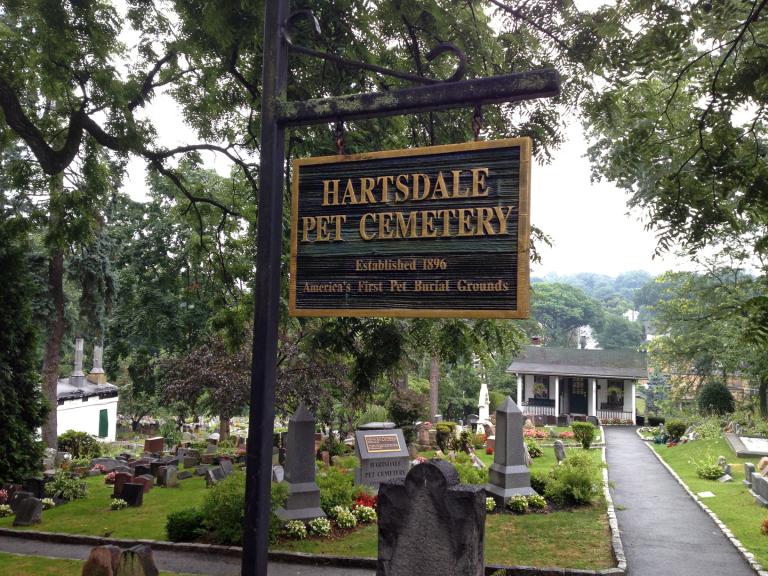
The entrance to New York’s Hartsdale Pet Cemetery, established in 1896 and the oldest commercial pet cemetery in the United States (Wikimedia Commons)
Animal afterlives and vernacular religion
My family made light of the “fee-free” option. In his friskier days, Rufus had enjoyed picking through our garbage and eating our dinner scraps, and we quipped that being laid to rest among chicken bones and rotten banana peels would offer splendid fulfillment of his greatest dreams. The idea of setting his body out on the curb to be picked up by the New York City Department of Sanitation also reminded us of a joke that we had heard on the radio a few years back. “Why do Unitarians like to die on Tuesday?” the joke went. “Because Wednesday is recycling day!”

Rufus, our Italian Greyhound
We reached for humor, though, largely to quell our unease. In truth, it seemed rather callous to us to dispose of Rufus’s body in the dumpster. He was, after all, dearly loved, and we considered him a member of our family. Putting his remains out with the trash thus seemed distasteful and unceremonious. Didn’t he deserve a dignified ending, like what we offered our human relatives? For that reason, and perhaps also because of my religious commitments and my love of comforting ritual, I preferred to say goodbye to him in a way that more formally expressed my genuine love and grief. At the same time, I also wondered if I was being unnecessarily sentimental, and if my desire to conduct a ceremony to honor my dead dog was an unnecessary extravagance. Because wasn’t Rufus just a dog? And yet wasn’t he also more than that?
The scholarship on this matter suggests that my inclination to view Rufus not simply as a dog, but as a beloved companion, is not an unusual position. Sabina Magliocco, Professor of Anthropology at the University of British Columbia, recently published an article in the Journal of Folklore Research about her research on how modern Westerners have understood their pets as spiritual beings with an interiority and an afterlife that resembles that of humans. Magliocco argues that, across religious traditions, people commonly extend personhood to animals. The belief in the spiritual significance of animals might even reach back to the first humans. For example, archaeologists point to remains of cat, dog, and fox burials as evidence that our Paleolithic predecessors viewed these animals as having a spiritual status equivalent to that of human beings. In addition, historian Laura Hobgood Oster characterizes the relationship between early humans and dogs as “religious” and argues that burial remains demonstrate that people believed that dogs joined their human companions in the afterlife.

Cast of a cat burial dating to 7500-7000 B.C., unearthed at the site Parekklisia-Sillourokampos, Cyprus, and held at the Limassol Archeological Museum (Wikimedia Commons)
Magliocco explains that, over the centuries, the belief that animals are spiritual beings declined, for several reasons: humans domesticated animals and saw them primarily as a food source, and later, “the combined forces of religion and science exiled the idea of animal spirituality from mainstream thought.” However, she argues that in the West, two cultural developments in the nineteenth and twentieth centuries produced an important shift in popular attitudes toward animals. First, the animal welfare and animal rights movement advanced “an animistic ontology of nonhuman animals.” Second, the human-like representation of animals in films like Ratatouille and books like Black Beauty “created in the popular imagination an idea of animals as furry, feathered, or finned humans—an idea that influences folk constructions of animals as part of the human social world, as beings with interior lives and souls.” As a result of these forces, humans increasingly extend personhood to animals and view them as having spiritual characteristics, souls, and afterlives. Magliocco, for example, found that 75 per cent of the participants in her study see their companion animals as kin and refer to their pets as “family,” “children,” and “fur babies.” This fact is important because, as she explains, “animistic ontologies emerge from relational epistemologies: animals are accorded personhood when they behave as if in a close relationship with narrators.” Indeed, 81 per cent of the people she surveyed believe that “animals have souls.”
The view of animals as family members and spiritual beings shapes how modern Westerners imagine what happens to their pets after death. Magliocco argues that the personhood that humans grant their companion animals also “extends into the spiritual realm,” and in her research, she found that people of diverse religious backgrounds believe that animals have an afterlife. Ideas about animal afterlives vary widely and include, but are not limited to, the belief that pets experience reincarnation, return to earth as “ghosts and messengers from the otherworld,” and live blissfully in Paradise with their human family.
One of the most prevalent stories that people tell about animal afterlives centers on the idea of “crossing the Rainbow Bridge,” which is how many of the participants in Magliocco’s study describe the death of their pets. The narrative of the Rainbow Bridge, which has uncertain origins, centers on the promise of a joyful reunion of humans and their beloved animals at the gates of Heaven:
According to this legend, the Rainbow Bridge is a meadow located “this side of Heaven,” in other words, before the entrance to Paradise, and connected to it by means of a rainbow. When a pet dies, it goes to this mythical place, where it is restored in body and health to its youthful form. There, it plays and enjoys all earthly pleasures, including peace, sunshine, and plentiful food and water. On the day its beloved human owner dies, the pet senses this fact, much as it might have realized in life that its human had come home, and races, leaps, or bounds to the Rainbow Bridge, where a reunion of human and beloved pet takes place. In some versions, the owner proceeds to Heaven, but is able to cross the Rainbow Bridge to play with the departed pet at any time, for all eternity. In others, the pet and the owner cross the Rainbow Bridge to Paradise together, never again to be separated.
The Rainbow Bridge legend is particularly useful for Christians who seek to square their beliefs about animal souls with official church teachings. As Magliocco explains, the narrative usefully resolves “a Christian theology barring animals from Heaven and pet owners’ desires to be reunited with their pets after death.” It’s even more common, though, for people to believe that Heaven is equally open to humans and animals—an indication that while some Christians turn to the Rainbow Bridge narrative to mediate between sanctioned Christian theology and their own beliefs, many others readily embrace ideas about animal afterlives that openly diverge from official Christian teachings.
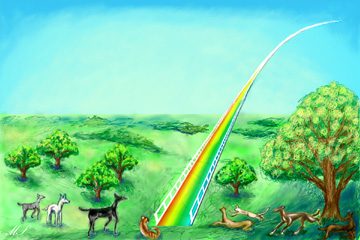
An image of the Rainbow Bridge, created by Maris Stella (Wikimedia Commons)
The Rainbow Bridge story illustrates some important patterns in how humans in the modern West think about animal afterlives. First, people are eclectic and creative in their beliefs, and they draw on scientific and religious ideas as well as empirical experiences to make sense of what happens to their animals after death. This flexibility and inventiveness is on display in the Rainbow Bridge legend, which is not rooted in any passage in the Bible, but appears to have derived from a poem written by Paul Dahm, a grief counselor, in 1981. The willingness of people to borrow and blend beliefs from different sources is similarly illustrated by their ideas about animal reincarnation. Magliocco notes that the Western people in her study see reincarnation as “a way for souls to return to the material world and spend additional time with their companions from previous lives, perfecting their relationships and enjoying being together.” This understanding of reincarnation contrasts sharply with traditional Hindu and Buddhist beliefs, which hold that the purpose of living a good life is to achieve a state of purity and, ultimately, to be removed from the process of reincarnation entirely. The respondents in Magliocco’s study adopt ideas from Eastern religions, reinterpret them, and fuse them with Christian and New Age concepts. Their eclectic, nontraditional beliefs reveal both the religious pluralism of contemporary society and the willingness of people in the West to assemble religious concepts and amend them to their liking.
Both the Rainbow Bridge legend and the unconventional reincarnation beliefs held by modern Western people reveal that ideas about animal afterlives often parallel ideas about human afterlives, at the same time that they run counter to mainstream religious and scientific thought. As Magliocco explains, “People who love animals and include them in their lives are inclined to disregard the formal teachings of established religions and form their own vernacular ontologies about animal lives.” Importantly, animal-loving humans are not only willing to ignore sanctioned theology—they are also willing to revise it. “What is striking in these responses is how individuals who have loved animals depart from official theological teachings to create a place for them in their spiritual cosmology,” writes Magliocco. “They imagine a God who loves dogs and cats as much as they do, makes room for them in Paradise, or even recreates them in Heaven for the faithful who have loved them as companions.”
The practices associated with the death of pets are as eclectic and improvisational as the beliefs. The participants in Magliocco’s study perform familiar rituals, but do so in unorthodox and inventive ways. Magliocco describes how one Christian woman administered a sacrament in order to ensure that her beloved pet would join her in Heaven:
One focus group member recounted how, as a child, she had heard that in an emergency, a lay person could baptize individuals in order to save their souls. When she learned that dogs could not go to Heaven, she decided to baptize her dog so she could be sure to be reunited with him in the hereafter.
This woman, finding herself in what she considered an urgent situation, aimed to solve her problem by drawing on the ritual knowledge and religious resources available to her–even if it meant administering a sacrament in a nonstandard way, for nonstandard purposes.
“It’s so hard to say goodbye” (but it’s easier with Boyz II Men)
When Rufus died, I suppose I found myself in a similar situation as the woman who baptized her dog. I, too, sought comfort in familiar rituals. And, like her, I had limited options and drew on the religious resources at my disposal in a way that was, I admit, rather heterodox.
I actually have professional experience with funerals and end-of-life rituals. In my teenage years, I had earned money for college by working as a parish funeral cantor. Because of that experience, I gained a deep knowledge of Catholic funeral hymns. (Twenty years later, I can still sing all the verses to “On Eagle’s Wings.”) More importantly, by witnessing so many people experience the tender moment of saying their last goodbye to their friends and family, I developed a deep appreciation of the importance of ritual—and hymn-singing especially—in helping people to grieve and to express sorrow and love.
It made sense to me, then, to honor Rufus through the sacred act of singing. We weren’t able to spend a thousand dollars on a pet funeral, but I figured that we could at least raise up our voices and bid Rufus farewell through a good song or two. Because I didn’t have a hymnal on hand, we improvised, as is the case with most beliefs and practices associated with the death of pets. A dear friend who was visiting happened to know the piano chords to “Seasons of Love” from Rent, and so we all sang that. We didn’t have the sheet music for any other appropriate song, so we then chose to sing Boyz II Men’s “It’s So Hard to Say Goodbye”, which can be performed a cappella. And finally, after the last climactic chorus, my husband carried Rufus’ body, nestled neatly in a shoebox, solemnly out the door.
Previous Post

September 19, 2018
Surviving the Academic Job Market Part 2: Interviewing Well
Next Post

September 21, 2018 Sages Standing In God’s Holy Fire
Browse Our Archives
Select a Category abolitionism Abortion Abraham Joshua Heschel Abraham Kuyper Abraham Lincoln Academia Activism Adam Renberg Advent Adventist africa African American Religion Agnes Howard Albert Camus American History American Religious History American Revolution American West Anabaptists Ancient History Andrea Turpin Andrei Tarkovsky Anglicanism Annales Ansley Lillian Quiros anti-Catholicism Antisemitism Anxious Bench apologetics Apparitions Arash Azizi Archaeology archives art Artificial Intelligence Asia Asian Americans Augustine Authors Bad Bunny Baptism Baptists Barack Obama Battle of Hastings Benjamin Franklin Bernard-Henri Levy Beth Allison Barr Beth Moore Bethany Mannon Bible Bill Cunningham Billy Graham Black Music Bob Dylan Body Boenhoffer Books Breastfeeding Bruce Springsteen C.S. Lewis Calvinism Cancel Culture Capitalism Carmelites Catholicism Cedric Robinson Cesar Chavez Charismaticism charity Charles Dickens Charles Lindbergh Che Guevara Chicago Children Chinese Christianity Chris Gehrz Christ Christian death Christian Higher Education Christian life Christian Nation Christian Nationalism Christianity Today Christmas Church life Church Practice cinema Civil Religion Civil Rights Movement Civil War civility Classics Climate Change Cold War Colonial Mexico colonialism Comer Communism community complementarianism Conference on Faith and History Congregationalism Conspiracies Conspiracy Conversion Narratives Coronavirus Costa Rica Council of Nicaea Covid-19 Creation Critical Race Theory Crusades Culture culture wars Daniel K. Williams David Barton David Swartz Death Ways death with dignity DEI democracy Democratic Party Devotion Digital Age Diplomacy discipleship diversity Donald Trump Drama Dua Lipa Early Church early modern Early modern Catholicism Easter Eastern Christianity economic exploitation Education elections Elie Wiesel Elizabeth II Elizabeth Taylor emotions Empire Engineering England enslavement Entertainment Episcopal Church Erica Ramirez eschatology Eurocentrism Evangelicalism Evangelicals Exegesis Family Feminism Film Flannery O'Connor folk music Food Foreign Policy founding fathers Franciscans Franciscus Junius fundamentalism Funerals G.K. Chesterton Gender Genocide genre geography George W. Bush George Washington George Whitefield Global Christianity Global church Grief Guadalupe guest post Guest Post gun control gun violence Gustavo Gutierrez Hamid Dabashi Harold John Ockenga Harvest Hate Hawaiian Christianity Healing health care Heather Cox Richardson Hell Heresy Hermeneutics Higher Education Hinduism Hippocratic oath Historical Fiction Historical Methodology Historical Profession Historical Profession Historical Theology Historical Thinking historiography Holidays Holocaust horror movies Human rights Humanitarian Work humanities Hummingbirds Hungary hymns Imago Dei Immigration Injustice Interviews Iran Islam Islamophobia Israel Ivan's Childhood Jacob Randolph James Bratt Janine Giordano Drake Japanese history Japanese Literature Jean Paul Sartre Jesse Miranda Jesus Jesus Christ Jimmy Carter Joan Baez Joan Didion Joanne Freeman João B. Chaves Joao Chaves Joey Cochran John Calvin John Fea John Tillotson John Turner Johnny Cash Jonathan Edwards Jonathan Tran Joseph Smith Josh Howerton Journalism Jr. Judaism Jürgen Moltmann Just War Justice Justin Brierley Karl Barth Katelyn Beaty koi ponds Kris Kristofferson Kristin Kobes Du Mez Latin American Religious History Latino Americans Lectio Divina Leisure Lent Leonard Cohen liberal arts liberalism Liberation Theology Linda Ronstadt Lisa Clark Diller Literature Lou Reed Lynchings Lynneth Miller Renberg Mainline Protestantism Malcolm Foley Marilyn Monroe Maritime history Mark Noll Marriage Martin Luther Martin Luther King Martyrdom Marxism Mary Masih Alinejad mass shootings material culture medieval Christianity Medieval Ethiopia Melissa Borja memory Mennonites Mental Health Mental Illness Methodism Mexican Americans Mexicans Mike Madrid Miles Mullin Min Jin Lee Miscarriage Missionaries Mister Rogers Mitt Romney modernity Monasticism Mormonism Motherhood Mothers of the Church Moving Music Musicals Nadya Williams Nahua Christianity Native Americans Natsume Sōseki New Contributor New England New Year New York Nico Non-Violent Protest Orthodoxy pacifism Paleo Evangelicals Palestinians Parenting Patti Smith Paul Kingsnorth Pedro Calderón de la Barca Pentecostalism Philip Jenkins Phillis Wheatley physician-assisted suicide pilgrimage Pilgrims pluralism Plutocracy Poetry Politics Pope Francis Pope Leo XIV post-modernism prayer preaching Presbyterians prosperity gospel Protest Public history Publishing Puritans purity culture Quakers race Race Massacres Racial Capitalism racial reconciliation racialization Racism Raha Bahloulipour Re-Enchantment reading Reformation Refugees religion and the university religion and war Religious Freedom Religious Nones Religious Pluralism Religious Symbols religious violence Republican Party Revival Rita Coolidge Ritual Roger Williams Roman Catholic church Royalty Russell Moore same-sex marriage Sarah Irving-Stonebraker Scandinavia Science Science and Technology Scopes trial Scriptural Interpretation secularism Selena Quintanilla seminary Seventh-Day Adventists sexual morality Sexuality Sikhs Silence slaveholders theology Slavery Slavoj Zizek social justice Social Media Southern Baptist Convention Southern Religion Spain Spiritual Autobiography Spiritual but not religious Spiritual Discipline Sports Stanley Hauerwas Suffering Summer Camps Sunday Night Odds and Ends Supernatural Supreme Court Syriac Christianity Tal Howard Taylor Swift Teaching Technology Television Thanksgiving The Beatles The Mission theater TheoBros Theology Thomas Dixon Thomas Jefferson Thomas Kidd Thomas Merton Tim Gloege Tim Walz Tom Holland Tourism tradition Tragedy Translation Transnationalism Travel Trump Ukraine Uncategorized Unitarians United Methodist Church US History Vanessa Chan Velvet Underground Verónica A. Gutiérrez Veronica Gutierrez Vikings Violence Virgin Mary Virtue Virtue ethics Visions Voting War WCTU Wendell Berry Westminster Assembly White Evangelicalism Wildfires Winnie the Pooh Witches women Women in Ministry Women's and Gender Studies Work Worship writing Yasunari Kawabata Zena Hitz
Select a Month October 2026 September 2026 August 2026 July 2026 June 2026 May 2026 April 2026 March 2026 February 2026 January 2026 December 2025 November 2025 October 2025 September 2025 August 2025 July 2025 June 2025 May 2025 April 2025 March 2025 February 2025 January 2025 December 2024 November 2024 October 2024 September 2024 August 2024 July 2024 June 2024 May 2024 April 2024 March 2024 February 2024 January 2024 December 2023 November 2023 October 2023 September 2023 August 2023 July 2023 June 2023 May 2023 April 2023 March 2023 February 2023 January 2023 December 2022 November 2022 October 2022 September 2022 August 2022 July 2022 June 2022 May 2022 April 2022 March 2022 February 2022 January 2022 December 2021 November 2021 October 2021 September 2021 August 2021 July 2021 June 2021 May 2021 April 2021 March 2021 February 2021 January 2021 December 2020 November 2020 October 2020 September 2020 August 2020 July 2020 June 2020 May 2020 April 2020 March 2020 February 2020 January 2020 December 2019 November 2019 October 2019 September 2019 August 2019 July 2019 June 2019 May 2019 April 2019 March 2019 February 2019 January 2019 December 2018 November 2018 October 2018 September 2018 August 2018 July 2018 June 2018 May 2018 April 2018 March 2018 February 2018 January 2018 December 2017 November 2017 October 2017 September 2017 August 2017 July 2017 June 2017 May 2017 April 2017 March 2017 February 2017 January 2017 December 2016 November 2016 October 2016 September 2016 August 2016 July 2016 June 2016 May 2016 April 2016 March 2016 February 2016 January 2016 December 2015 November 2015 October 2015 September 2015 August 2015 July 2015 June 2015 May 2015 April 2015 March 2015 February 2015 January 2015 December 2014 November 2014 October 2014 September 2014 August 2014 July 2014 June 2014 May 2014 April 2014 March 2014 February 2014 January 2014 December 2013 November 2013 October 2013 September 2013 August 2013 July 2013 June 2013 May 2013 April 2013 March 2013 February 2013 January 2013 December 2012 November 2012 October 2012 September 2012 August 2012 July 2012 June 2012 May 2012
Follow Us!
TAKE THE
Religious Wisdom Quiz
Where was Jesus' first miracle performed?
Select your answer to see how you score.
Jerusalem Capernaum Nazareth Cana
Related posts from Anxious Bench
Sing a Song of Love: Sons, The Beatles,...

But for Fortune: Joan Baez and Latin America
Does Being Modern Impoverish Worship?

Worship Wars: The Early Modern Versions
TRENDING AT PATHEOS Evangelical

The Sermon on the Mount, Part I: Matthew...
The Sermon on the Mount, Part I (Matthew 4:12-5:12) St. Matthew moves...

What's up from Crossway: Reviewing some of their latest A few weeks...

Janie Learns the Way of the Cross: A...
Teaching children about Jesus' Passion can be challenging. Many parents and educators...

Looking For Good Catholic Writing - October 2026
He alone extends the heavens, and he walks upon the waves of...

In "Irreplaceable," our book on vocation and technology, Trevor Sutton and I...

I was strolling through the top floor of the brand new Parthenon...
view all Evangelical blogs
Ad-Free & Subscriber Log-In Subscription Support
- About Us
- 2026 Calendar
- Videos
- Podcasts
- Library of World Religions
- Faith In Media Tracker
- Advertise With Us
- Write for Us
- Privacy Policy
- Terms of Service
- Do Not Sell My Data
- Contact Us
- Radiant Digital
- Manage Newsletter Subscriptions
- Unsubscribe From Notifications
- Sitemap
Copyright 2008-2026, Patheos. All rights reserved.
Subscription Support Ad-Free & Subscriber Log-In
Follow Patheos